
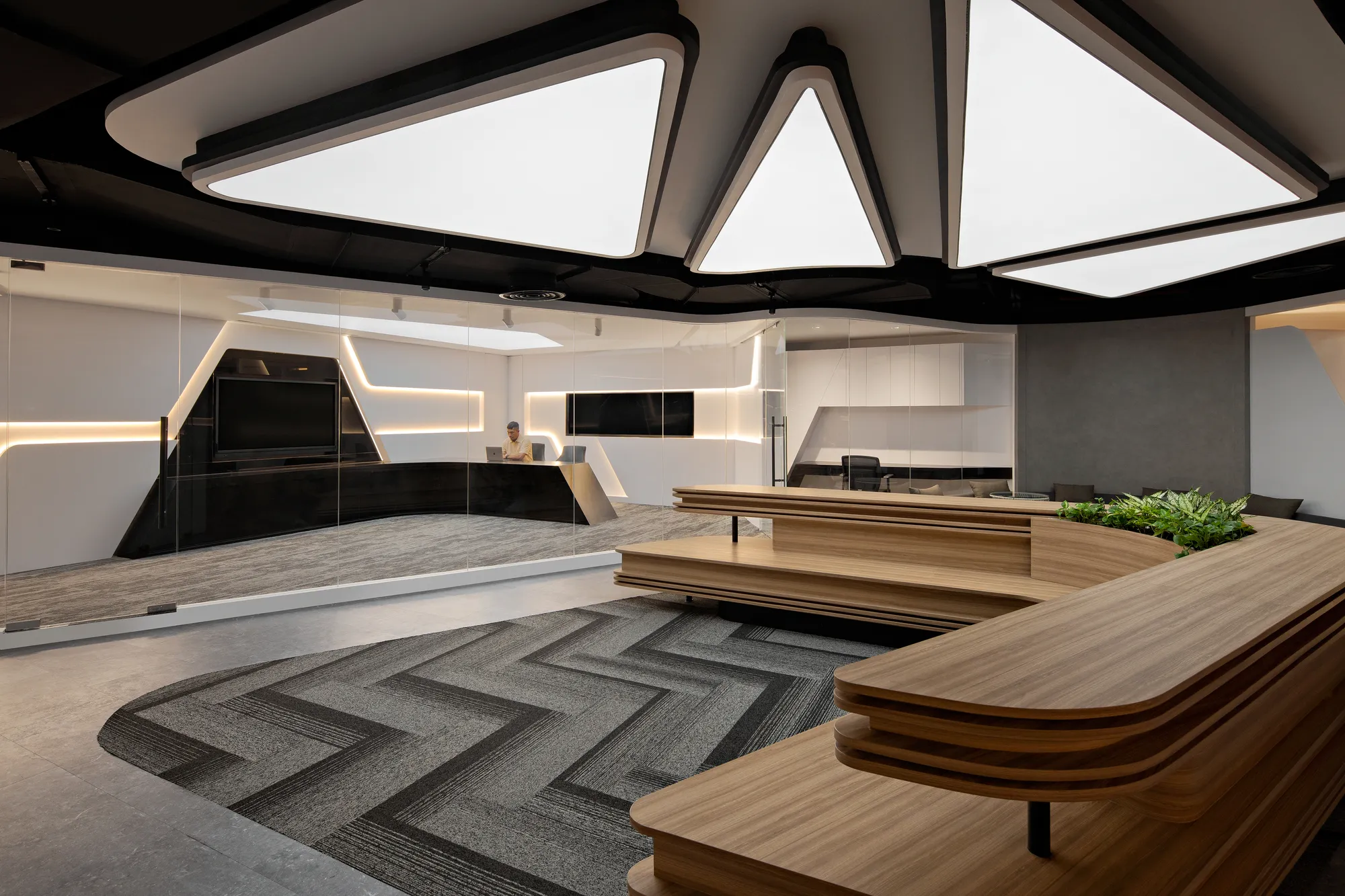
Angkasa Architects Designs a Jakarta Co-Working Office Around Circadian Rhythms and Stock Curves
A 720-square-meter office for a stock market platform in Jakarta channels market graphics into curving forms and light that shifts with the day.


Most co-working spaces treat productivity as a furniture problem: pick a desk height, add a bean bag, call it flexible. Angkasa Architects took a different route for the Saham Rakyat Office in Jakarta. Working for a stock market platform, the firm treated the 720-square-meter floor plate as a landscape of biological and spatial rhythms, designing a lighting system that tracks the body's circadian clock and a plan whose curves borrow directly from the oscillating lines of stock market graphics.
The result is an office that feels less like a tech startup and more like a sculpted interior garden. Planter boxes double as spatial dividers, an eight-meter communal table anchors the working floor, and a luminous Barrisol stretch membrane ceiling shifts color temperature from cool daylight to warm white as the hours pass. It is a project that takes the mundane brief of "open plan office" and gives it genuine physiological logic.
A Plan Built from Functional Fragments
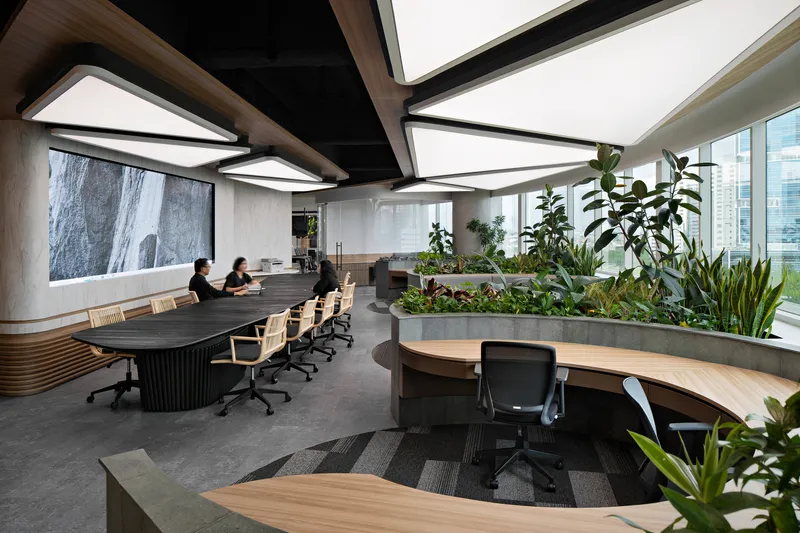
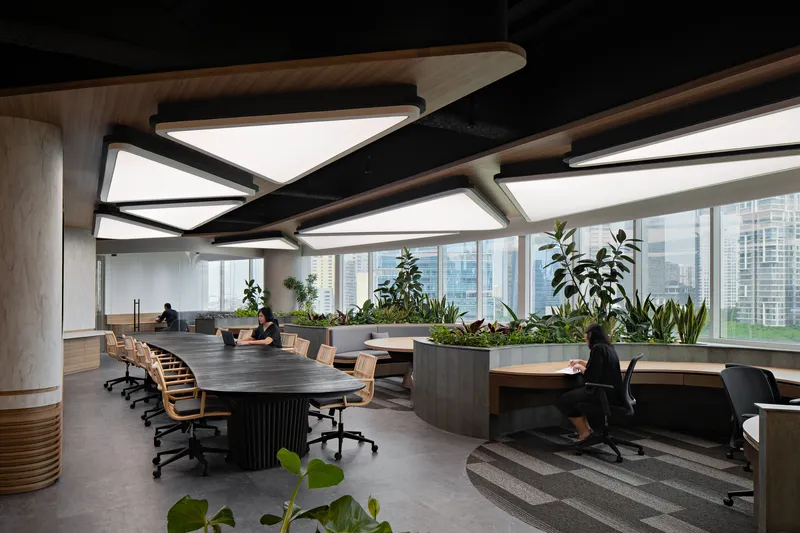
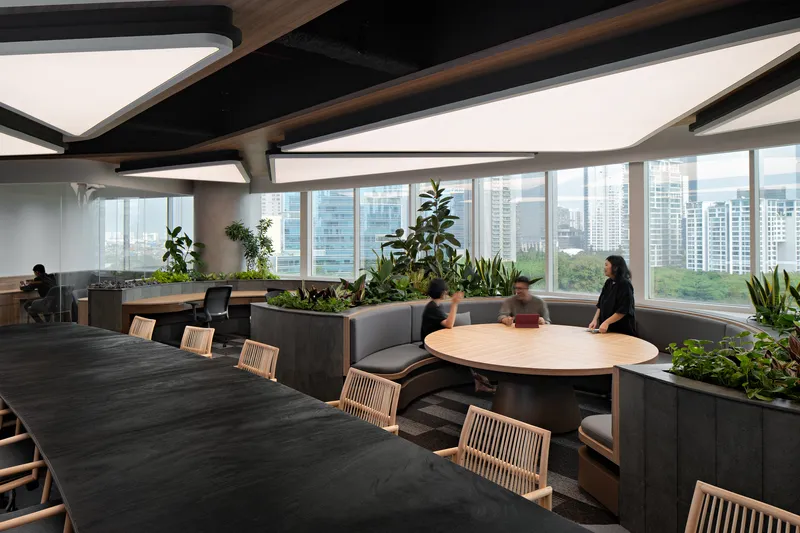
Angkasa's first move was to reject the open loft. Instead of one continuous floor, they subdivided the space into discrete zones, each seeded with a specific program: reception, communal work area, coffee working area, staff zones, and meeting rooms. The divisions are not hard walls but planted concrete boxes and tiered carpet platforms that gently separate one territory from the next. The effect is a kind of interior topography, where stepping up onto a carpeted mound signals a shift in activity without closing off sightlines.
Floor-to-ceiling glazing along the perimeter floods every fragment with natural light and frames panoramic views of the Jakarta skyline. The curved banquette seating that wraps the edges keeps the eye moving, reinforcing the sense that this is a landscape to navigate rather than a grid to occupy.
Curves That Reference the Trading Floor
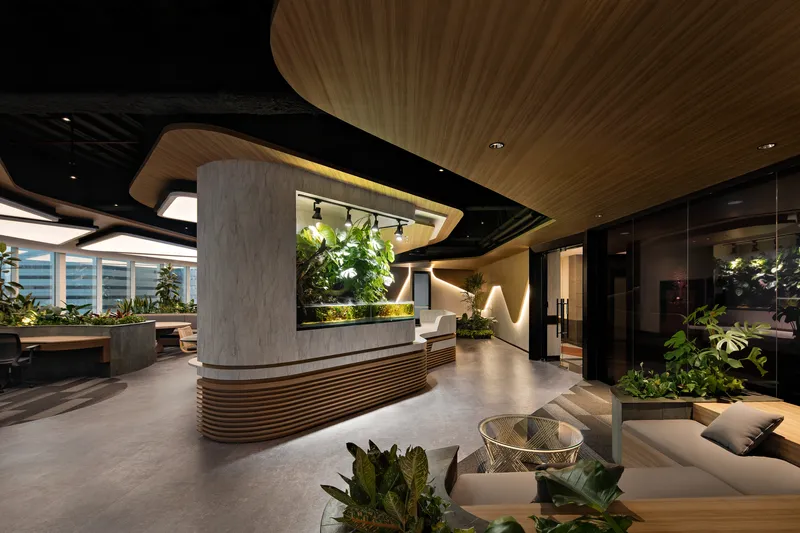
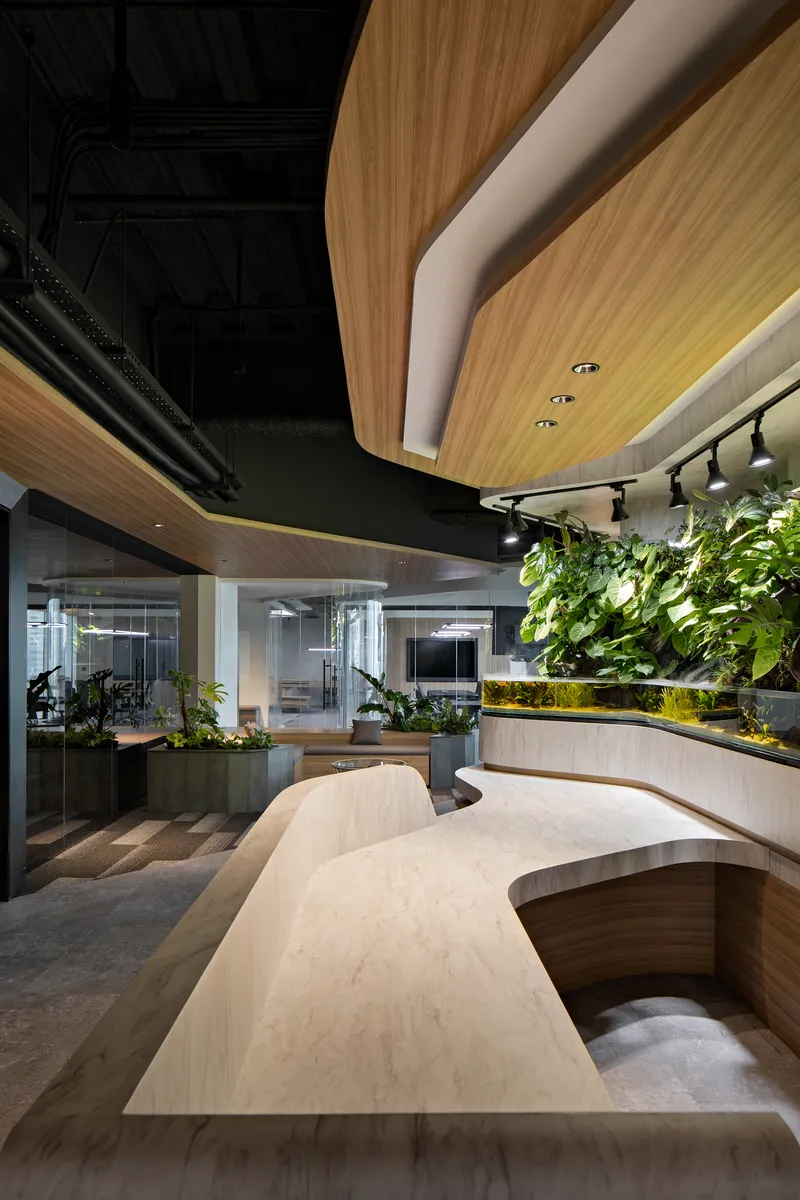
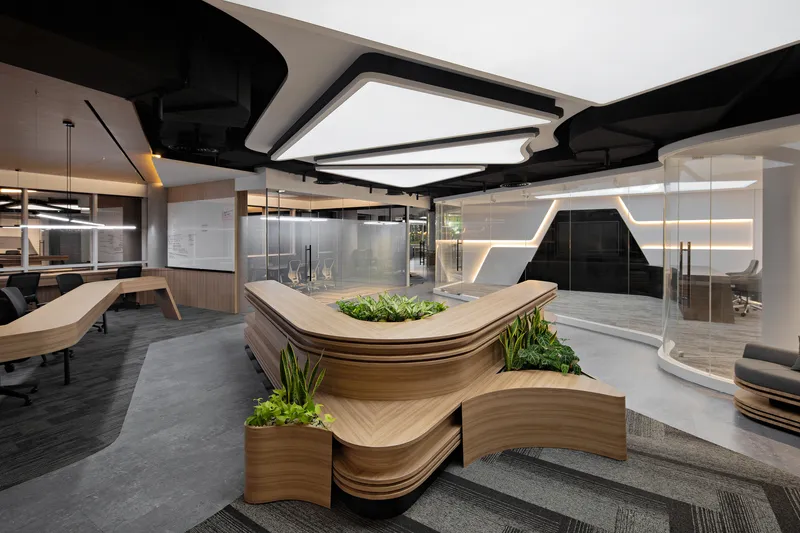
The client's core business is stock trading, and Angkasa translated that identity into geometry rather than branding. Curving lines dominate the reception counter, the ceiling soffits, and the desk forms, echoing the unpredictable peaks and troughs of a stock chart. It is a subtle conceptual hook: the curves are legible as a design language without requiring a wall-mounted mission statement to explain them.
The reception desk itself wraps through the space with a concrete and wood slat base, its stone countertop sweeping in a continuous arc beneath suspended timber ceiling elements. Marble surfaces ground the entry sequence in a material weight that the rest of the office deliberately avoids. The palette stays overwhelmingly white, letting the curvilinear forms read as sculptural events against a neutral backdrop.
Light That Follows the Body's Clock
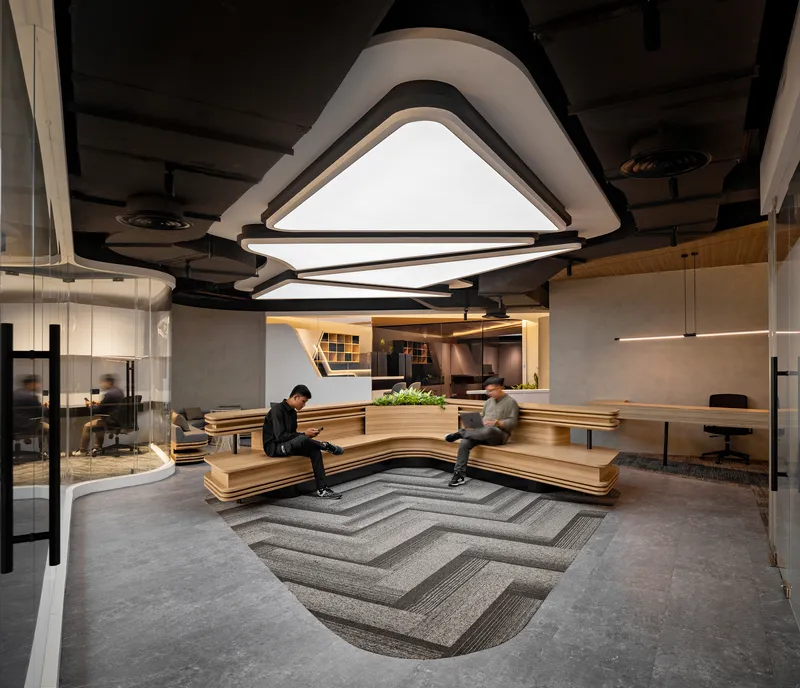
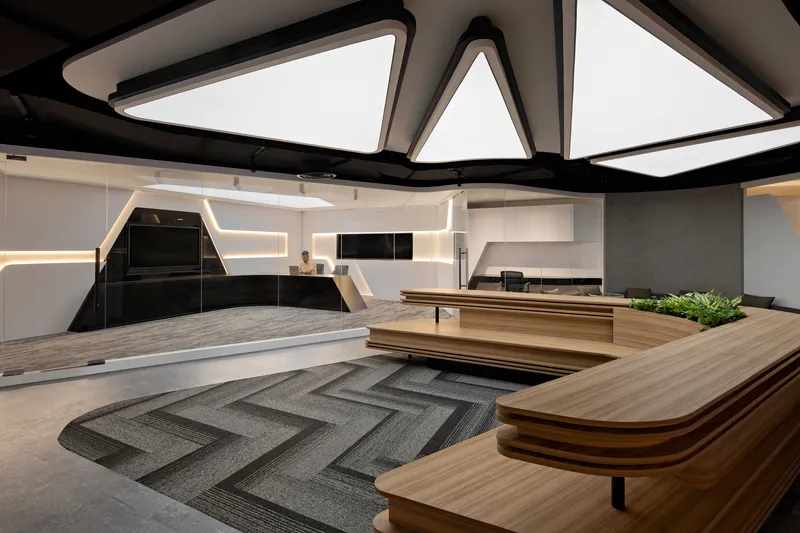
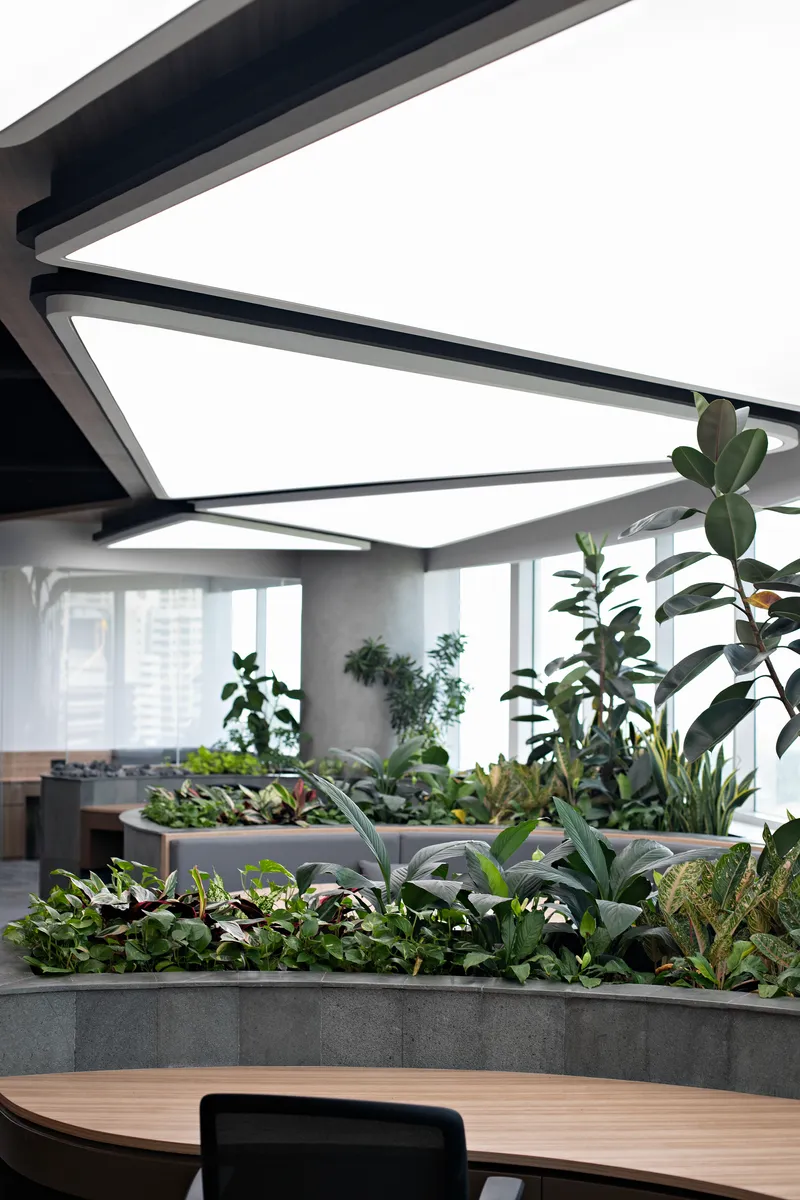
The triangular ceiling luminaires are not just decorative. They house a circadian lighting system that adjusts both color temperature and brightness across the workday. During morning hours, the Barrisol membrane panels emit cool, daylight-spectrum light to promote alertness. As the afternoon progresses, the system warms toward amber tones, easing the transition toward evening. Brightness is calibrated against the natural light entering from the perimeter glazing, dimming when the sun is strongest and compensating as clouds roll in.
This approach treats artificial light as a physiological tool rather than an aesthetic accessory. In a city like Jakarta, where many office workers spend the entire day indoors, aligning interior light with the solar cycle is a practical health intervention. It is the kind of decision that rarely appears in project photographs but fundamentally shapes how a space feels at three o'clock on a Tuesday.
Greenery as Infrastructure
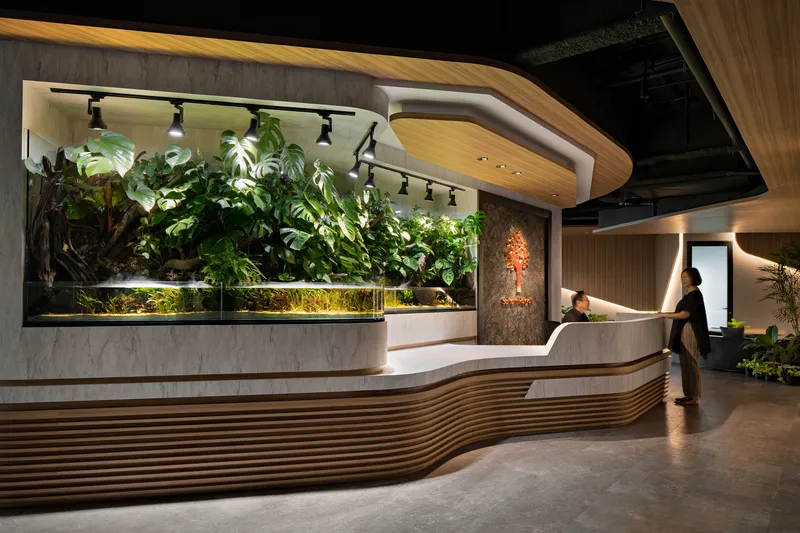
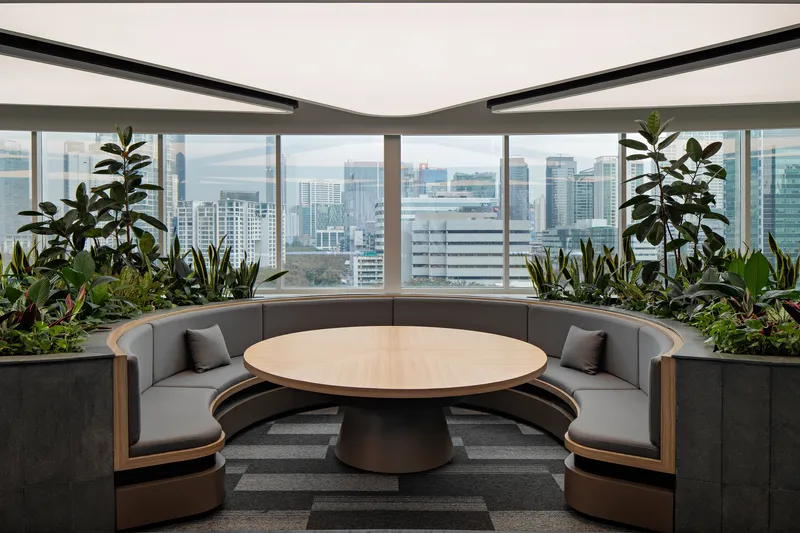
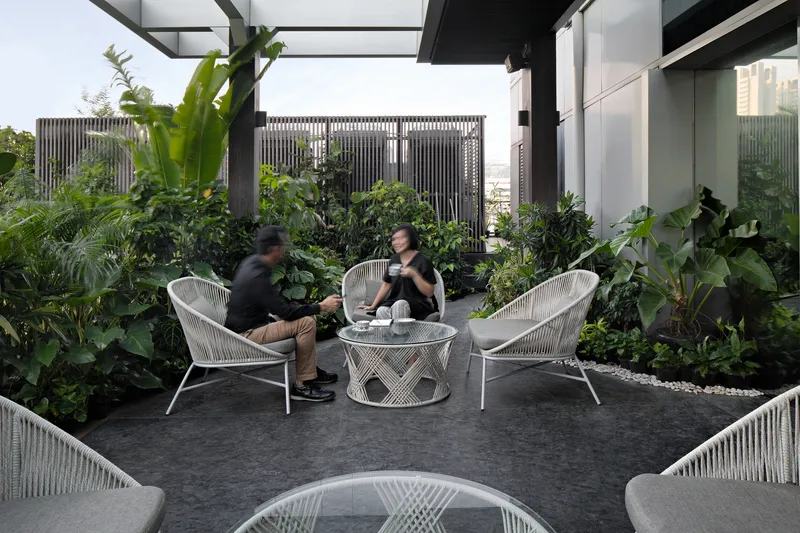
Plants are everywhere in this office, and they are doing real spatial work. Concrete planter boxes act as barriers between desk clusters. A living green wall backs the secondary reception counter, adding texture and humidity to the air. On the outdoor terrace, dense tropical planting and slatted timber screens create a sheltered pocket of shade that feels worlds away from the air-conditioned interior. Wire frame furniture reinforces the casual register: this is the place for a phone call, not a Zoom meeting.
One of the more unexpected inclusions is a paludarium, a combined aquatic and terrestrial vivarium, positioned as a focal point within the office. It is an eccentric touch that underscores how seriously Angkasa took the idea of bringing biological systems inside.
Communal Zones and Enclosed Meeting Rooms
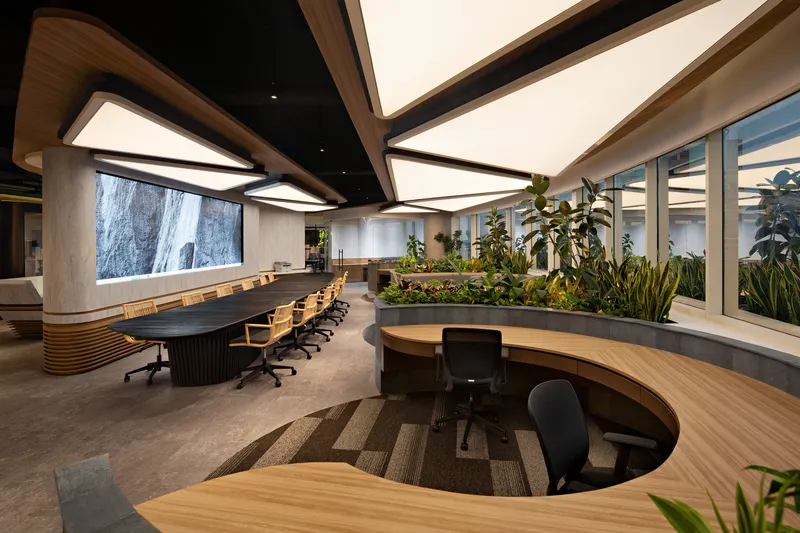
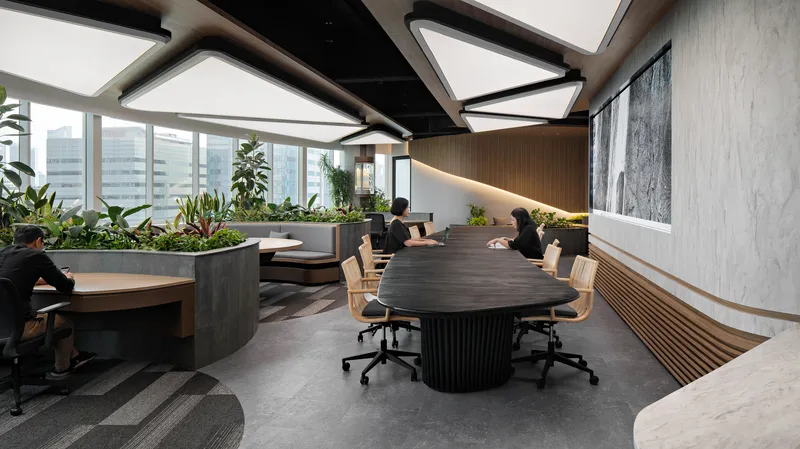
The eight-meter communal table is the social spine of the office. Positioned within a terraced carpet zone and flanked by integrated planters, it accommodates anything from a solo lunch to a team brainstorm. Circular workstations cluster nearby, offering a different posture and a different scale of interaction. The variety matters: in a co-working context, giving people genuine choice about where and how they sit is not a luxury but a functional requirement.
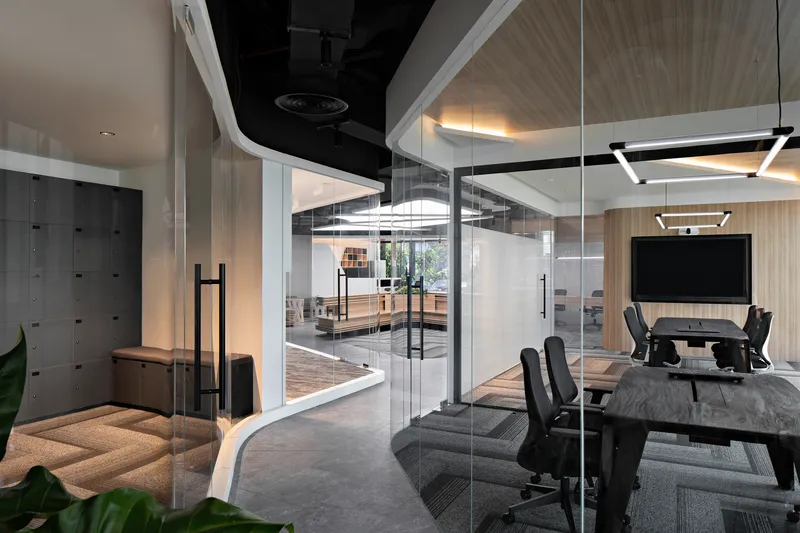
Glass-enclosed meeting rooms line the interior edge, their transparent partitions preserving visual continuity while containing sound. Exposed ceilings inside the meeting rooms contrast with the sculptural Barrisol membrane outside, signaling a shift from the flowing communal landscape into a more utilitarian register. A locker wall visible through the glass adds a layer of everyday practicality.
Threshold and Transition Spaces
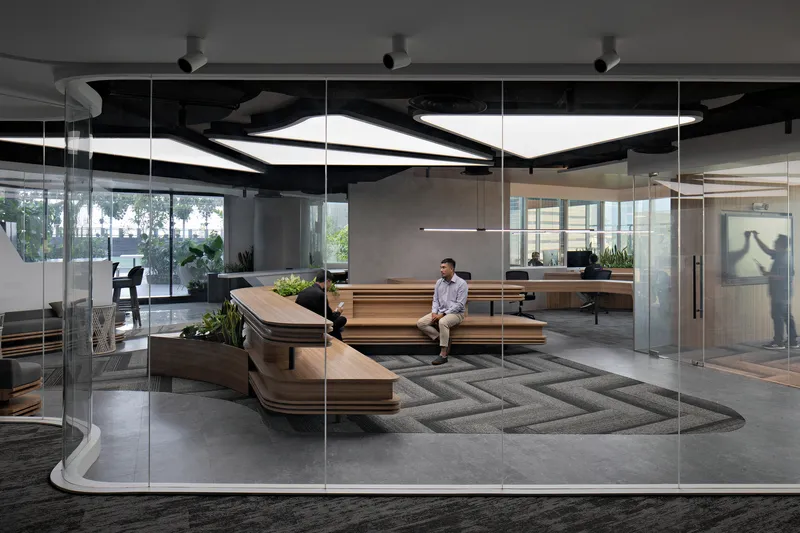
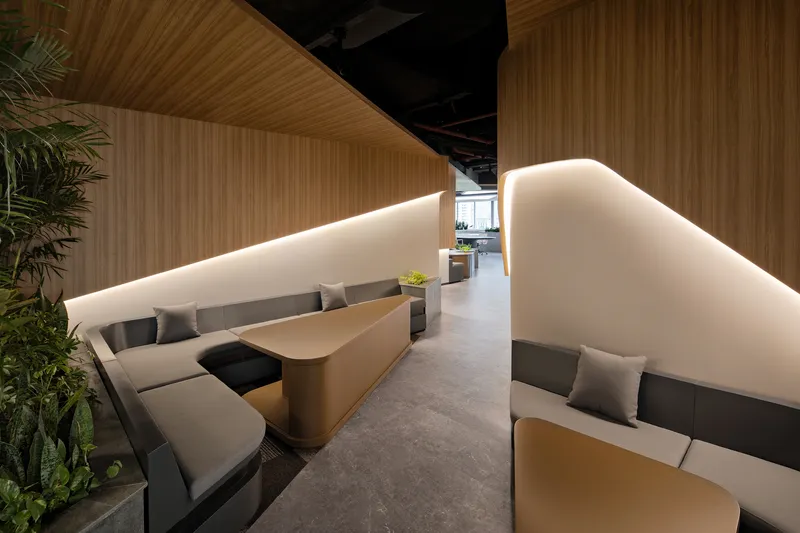
Angkasa paid careful attention to the moments between zones. The reception lounge, visible through a full-height glass wall, features tiered timber benches that double as informal seating and a visual buffer between the entry and the working floor. A seating alcove with upholstered benches tucks behind curved, backlit white partitions under a timber slatted ceiling, creating a semi-private retreat without requiring a door.
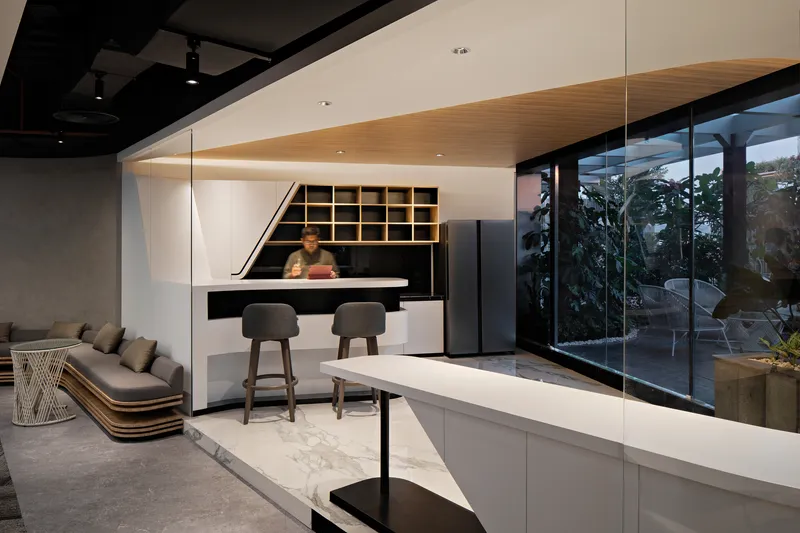
The secondary reception counter, framed by timber shelving and glass walls opening to tropical greenery, reinforces the layered quality of the plan. Every transition has been designed, not just the destinations.
Materiality and Detail
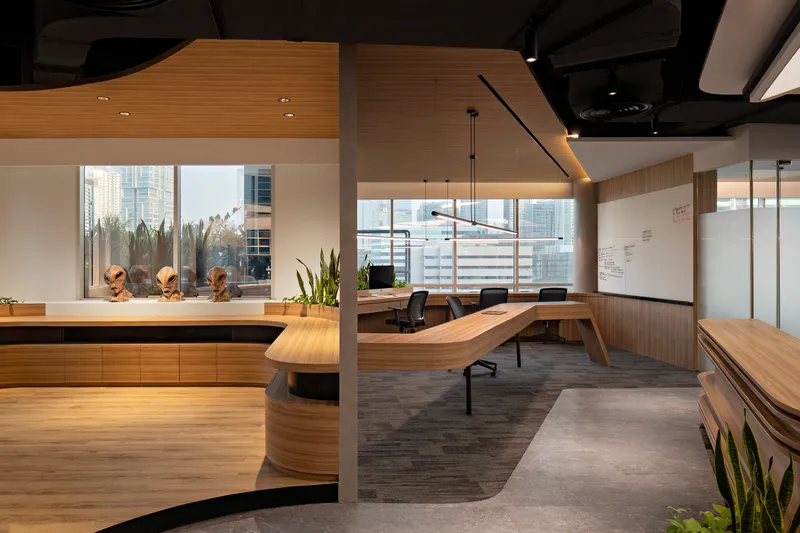
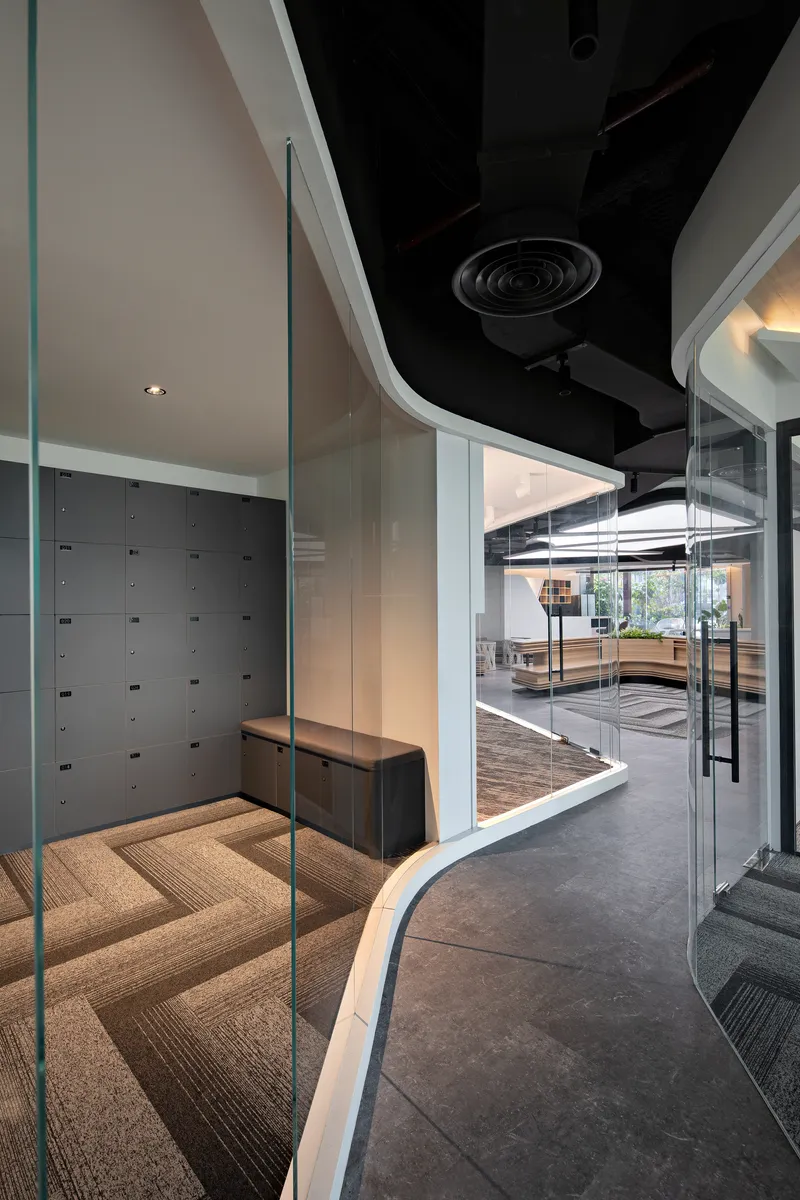
The material palette is deliberately restrained. White surfaces dominate, accented by warm timber slats, chevron-patterned carpet inlays, and exposed black ceiling ducts in the service zones. The contrast between the refined marble at reception and the raw black ductwork near the locker rooms establishes a clear hierarchy of finish that corresponds to the hierarchy of program. Where clients see polish, staff see honesty.
Horizontal louvered screens at the perimeter filter Jakarta's intense sunlight while framing views of the city. They are one of the few elements that register from the exterior, hinting at the layered interior world behind them.
Plans and Drawings
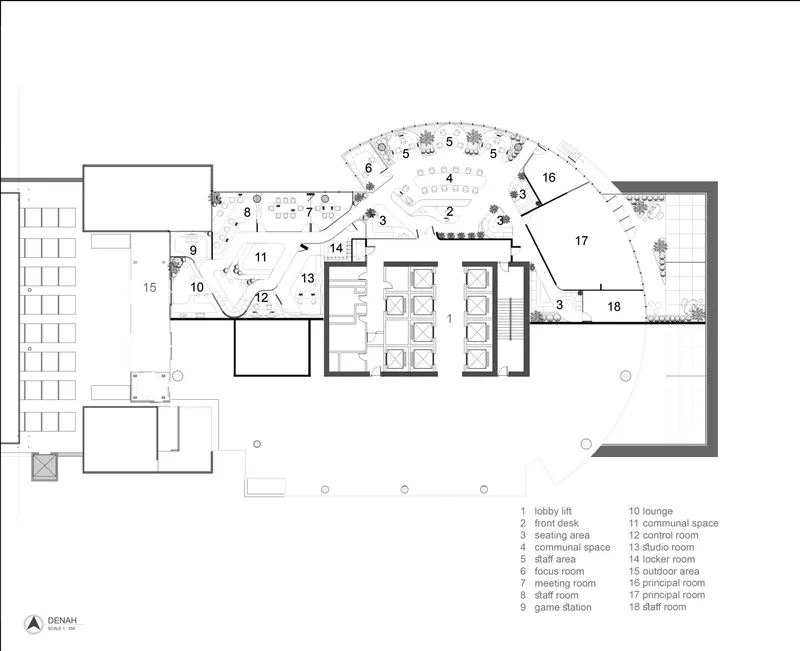
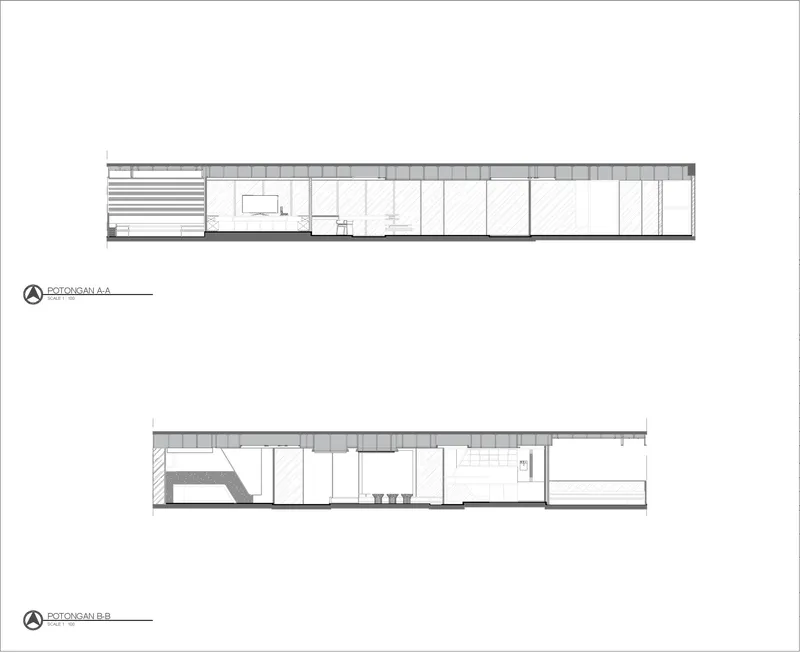
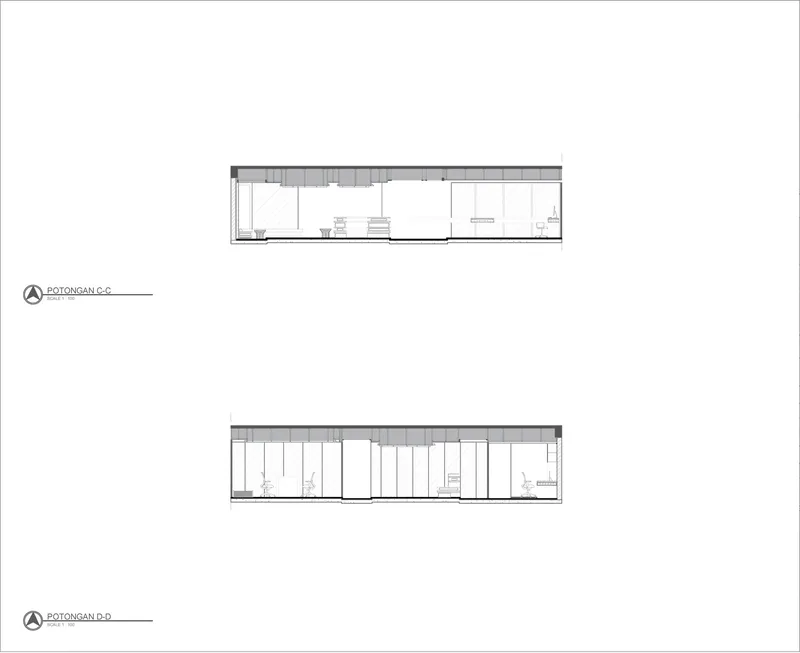
The floor plan reveals just how deliberately the curving geometry structures the layout. The reception zone, conference room, and landscaped terrace read as interlocking lobes rather than orthogonal rooms, with planting beds mediating between each program. The section drawings expose the ceiling strategy: the Barrisol membrane panels sit at varying heights, creating pockets of compression and release that correspond to the activity zones below. Two perpendicular section cuts show how the roof structure accommodates both the luminous membrane and the exposed ductwork in a compact vertical envelope.
Why This Project Matters
The Saham Rakyat Office matters because it takes two ideas that are usually treated as marketing copy, circadian lighting and biophilic design, and embeds them as genuine organizational strategies. The light system is not a single mood setting; it is a dynamic infrastructure that responds to the time of day and the conditions outside. The planting is not decorative wallpaper; it partitions space, filters air, and anchors a paludarium that gives the office a point of collective fascination. These are decisions that require coordination between architects, engineers, and lighting consultants, and they show.
For a 720-square-meter co-working fit-out, the ambition is notable. Angkasa Architects could have delivered a competent open plan with some greenery and called it done. Instead, they built a landscape of tiered platforms, curving counters, and shifting light that treats the human body as the primary design brief. In a city where office interiors too often default to international minimalism or tech-bro cliché, that commitment to physiological specificity is worth paying attention to.
Saham Rakyat Office by Angkasa Architects. Jakarta, Indonesia. 720 m². Completed 2022. Photography by Mario Wibowo.
About the Studio
Share Your Own Work on uni.xyz
If projects like this are the kind of work you want to make, uni.xyz is a place to publish your own, find collaborators, and enter design competitions.




Popular Articles
Popular articles from the community


Co-Life: Senior Housing Design That Reconnects Older Adults With the City
Co-Life reimagines senior housing design through healing gardens, shared streets, workshops, and a sustainable community across generations.

The Earth Pod: 3D Printed Homes for Resilient Refugee Communities
The Earth Pod reimagines refugee housing through 3D printed homes made from clay, combining resilience, self-sufficiency, and rapid shelter.

Hill & Cross Opera: Sculptural Opera House Architecture Shaped by Tallinn’s Landscape and Identity
Hill & Cross Opera reimagines opera house architecture in Tallinn through its sculptural hill, civic plaza, glass wave and a luminous cross.

The Ocean Hive: Sustainable Architecture for a Self-Sufficient Civilization at Sea
The Ocean Hive imagines sustainable architecture at sea, where modular habitats, algae, wave power and ocean waste sustain a growing colony.

Similar Reads
You might also enjoy these articles

Bao Huynh Watercolor Atelier: A Serene Art Retreat in Hội An
Bao Huynh Watercolor Atelier in Hội An blends multifunctional art spaces, sustainable design, local materials, and family-friendly living in a serene environment.

Atelier Macri Concept Store Interior Design by CASE-REAL
Atelier Macri store features a "ko" counter, walnut wood details, cork displays, blending retail, gallery, and seamless customer experiences.

Manuel Vargas Izquierdo Stadium and High-Performance Sports Center: Architectural Excellence in Jalpa de Méndez
The Manuel Vargas Izquierdo Stadium blends sustainable design, inclusive sports facilities, and cultural-inspired architecture, revitalizing Jalpa de Méndez’s public spaces.

KAKR Buluh Awar Hall: Revitalizing Community and Ecology Through Bamboo Architecture
Community built bamboo hall revitalizes Buluh Awar village, empowering youth, restoring ecology, celebrating vernacular craftsmanship through sustainable architecture and culture.

Explore Office Building Competitions
Discover active competitions in this discipline



Challenge to reimagine the Iron Throne


Photograph architecture without architects


Illustrate the lost glory of Angkor Wat - Render Challenge


Design challenge to reuse E-waste
Comments (0)
Please login or sign up to add comments
No comments yet. Be the first to comment!