
Anonym Turns a Family Lawn in Bangkok into a Courtyard House for Two Generations
On a 376-square-meter plot in Bangkok, a former green lawn becomes a shared courtyard linking a new house to an existing family home.


A son gets married, starts a family, and needs a house. In many cities, that means moving away. In Bangkok, where multigenerational proximity still holds cultural weight, it can mean something more precise: building a new dwelling next to the original home and negotiating the seam between them. That seam, for Anonym, became the entire premise of Bhoon+ House. Led by Phongphat Ueasangkhomset, the studio took a 376-square-meter plot that had been little more than a decorative lawn and converted it into a courtyard dwelling that gives the younger family genuine autonomy while keeping the two households close enough to share a single planted ground.
What makes the project genuinely interesting is the refusal to treat the courtyard as a passive void. Here, the courtyard is the building's operative core: the roof pitches toward it, the glass walls open onto it, the circulation routes orbit it. The lawn that once sat unused now does structural social work, mediating between generations, between interior and exterior, between enclosure and sky. It is architecture that takes a family condition and translates it into a spatial one, without sentimentality and with considerable material discipline.
Street Face and Threshold


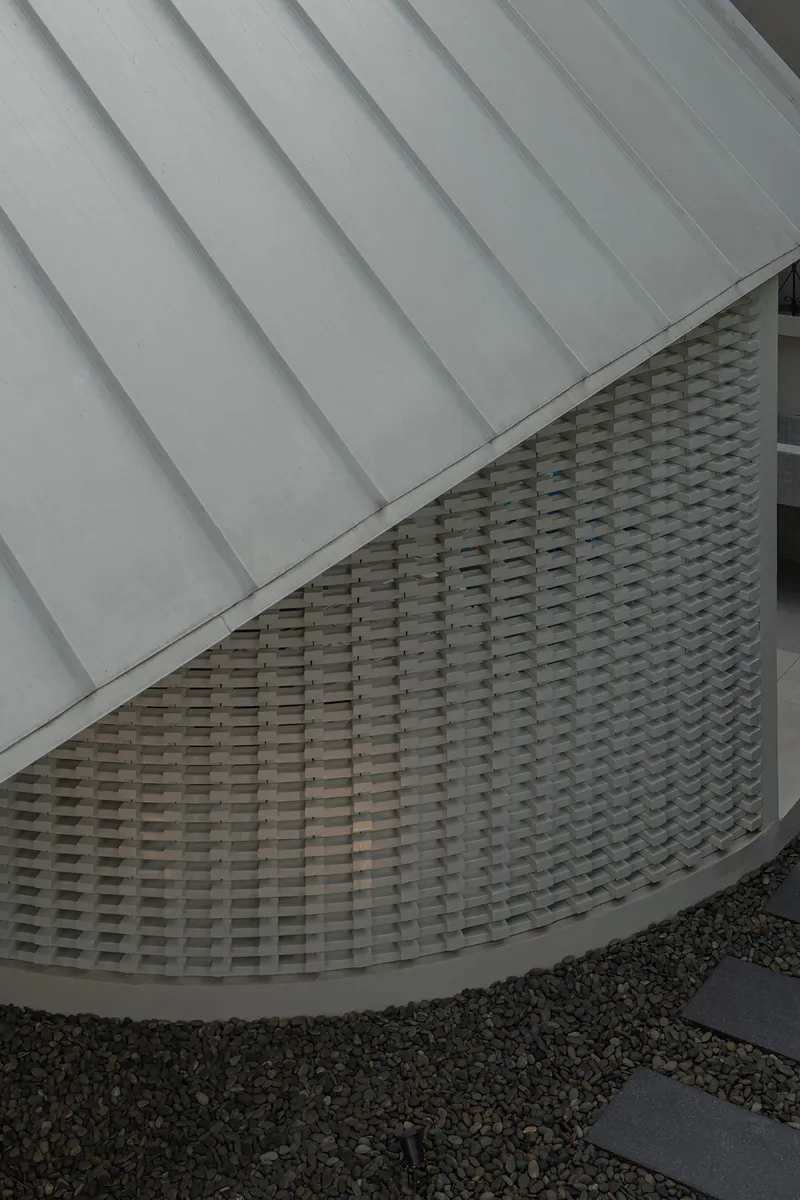
From the street, Bhoon+ House is restrained to the point of reticence. A white plastered facade with a gabled profile and a covered carport gives away almost nothing about the layered interior behind it. The volume reads as solid, domestic, and modest. But at its edges, the material palette shifts: a woven brick wall emerges beneath the white standing-seam metal roof, introducing texture and craft without ornamentation.
The staggered grey brickwork, visible in detail, forms a relief pattern that catches light differently across the day. It is a screen and a surface at once, hinting at the permeability that defines the rest of the house. The street facade is a controlled threshold: opaque enough to offer privacy, specific enough to signal that something considered is happening behind it.
The Courtyard as Organizing Principle
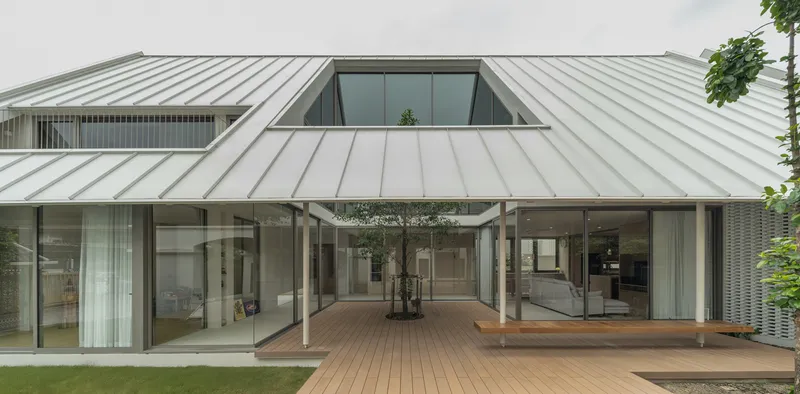

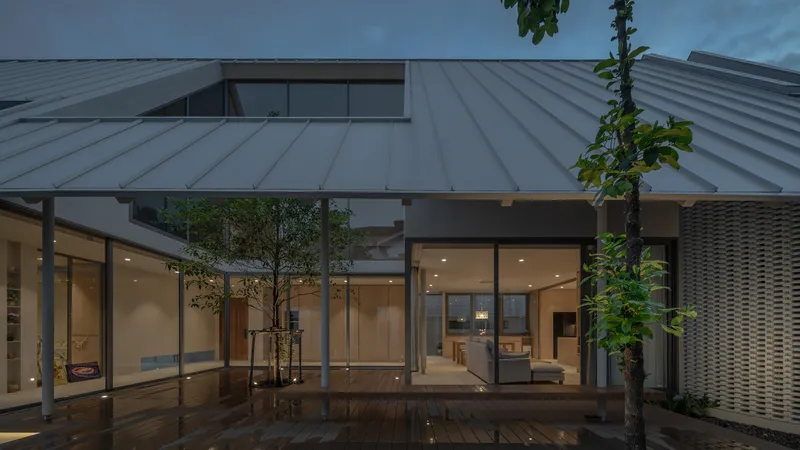
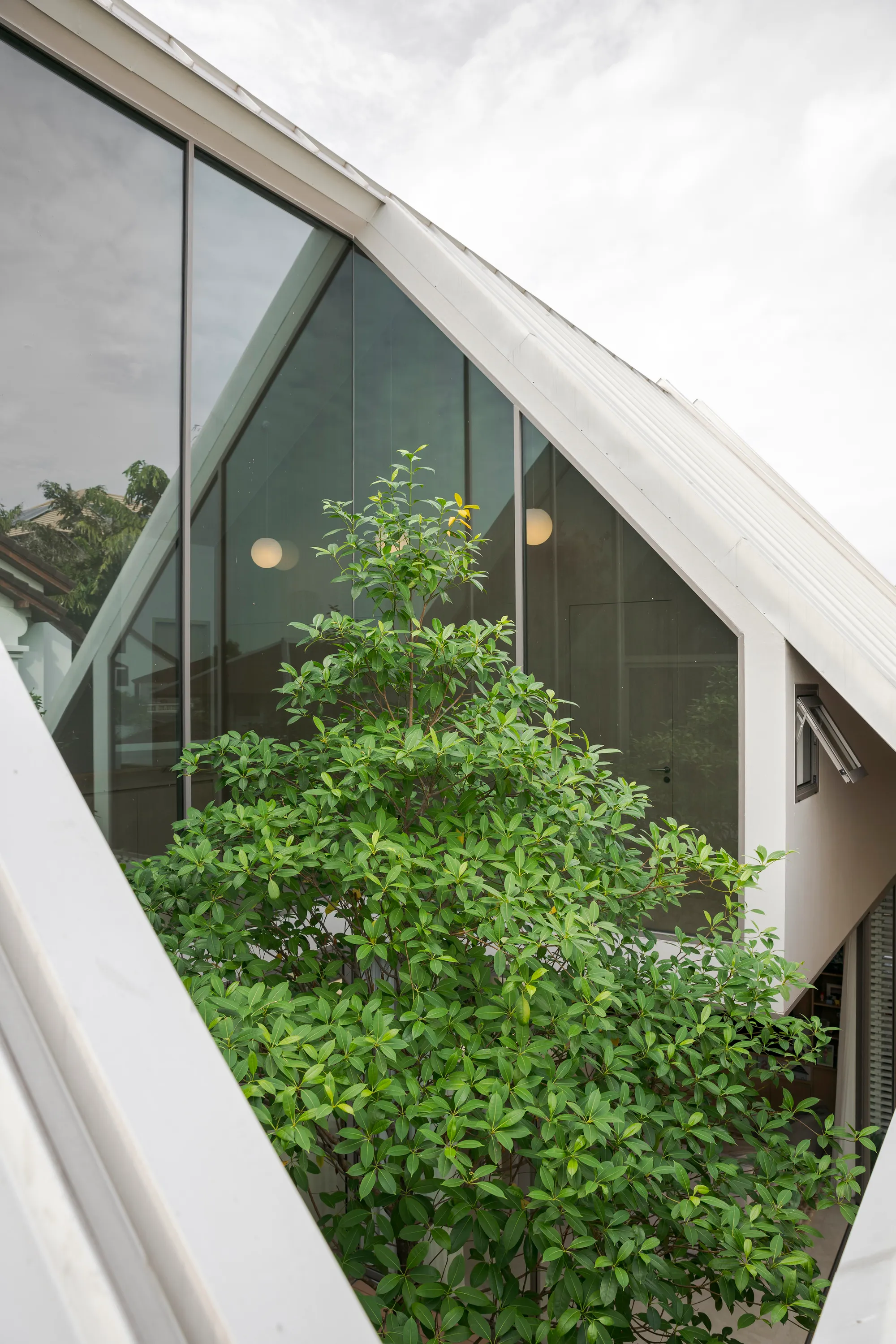
Step past the threshold and the house opens suddenly into a timber-decked courtyard enclosed by glass-walled volumes on three sides and capped by a sloping metal roof with skylights. A young tree grows at the center, and the triangular courtyard opening frames it against the sky. The geometry here is deliberate: the angled roof planes and the tapering plan create forced perspective effects that make the 350-square-meter house feel considerably larger than its footprint.
The courtyard is not residual space carved out of the floor plan. It is the generative diagram. Every room addresses it. The living areas open directly onto the timber deck; the bedrooms overlook it from the upper level; the circulation routes wrap around it. In a Bangkok climate where cross-ventilation and shade are not luxuries but necessities, the courtyard also performs thermally, channeling air through the glass-walled volumes and pulling light deep into the plan without direct solar exposure.
Living at Grade
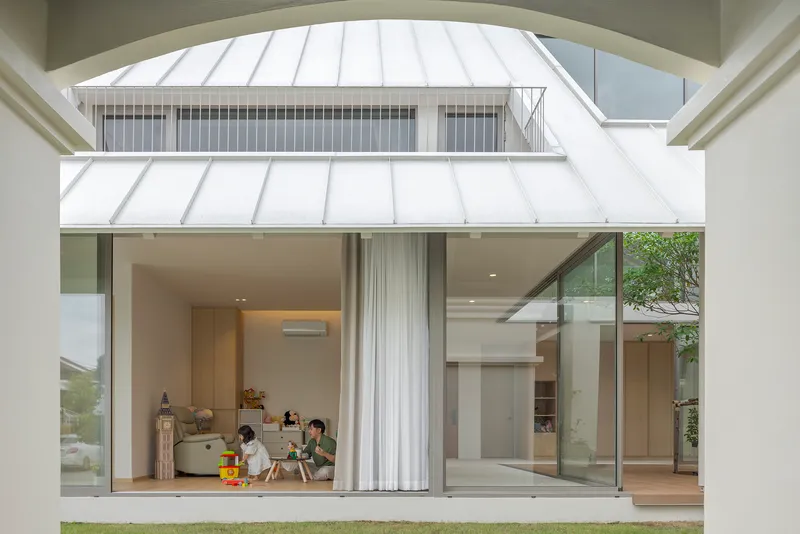

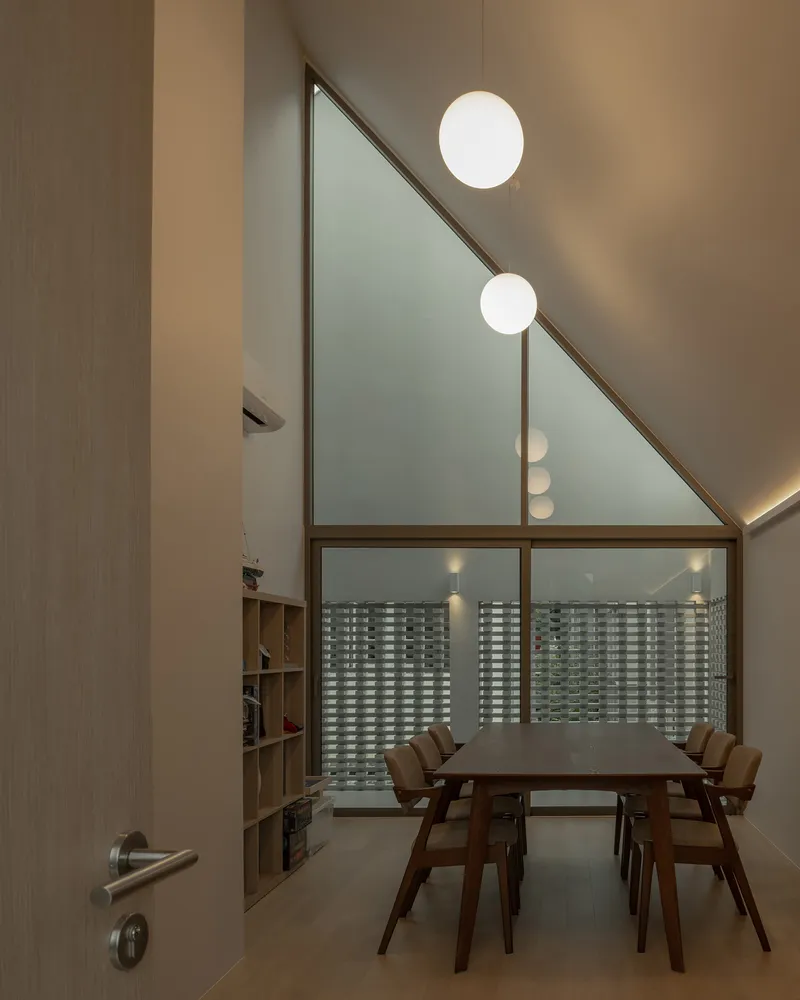
The ground floor collapses the distinction between indoor and outdoor living. Children play on the lawn just beyond the glazed wall of the living area; sheer curtains soften the boundary without closing it. Planted beds line the courtyard edges, and the dining room sits beneath an angled ceiling that culminates in a frosted glass gable window, pulling diffused light down onto the table. Spherical pendant lights mark the center of the space with a quiet domesticity.
The material language at grade is warm and precise: pale wood cabinetry, timber decking, light plaster walls. Nothing competes for attention. The restraint allows the courtyard itself, its tree, its changing sky, its connection to the original family home, to remain the dominant presence in every room.
Moving Through Light
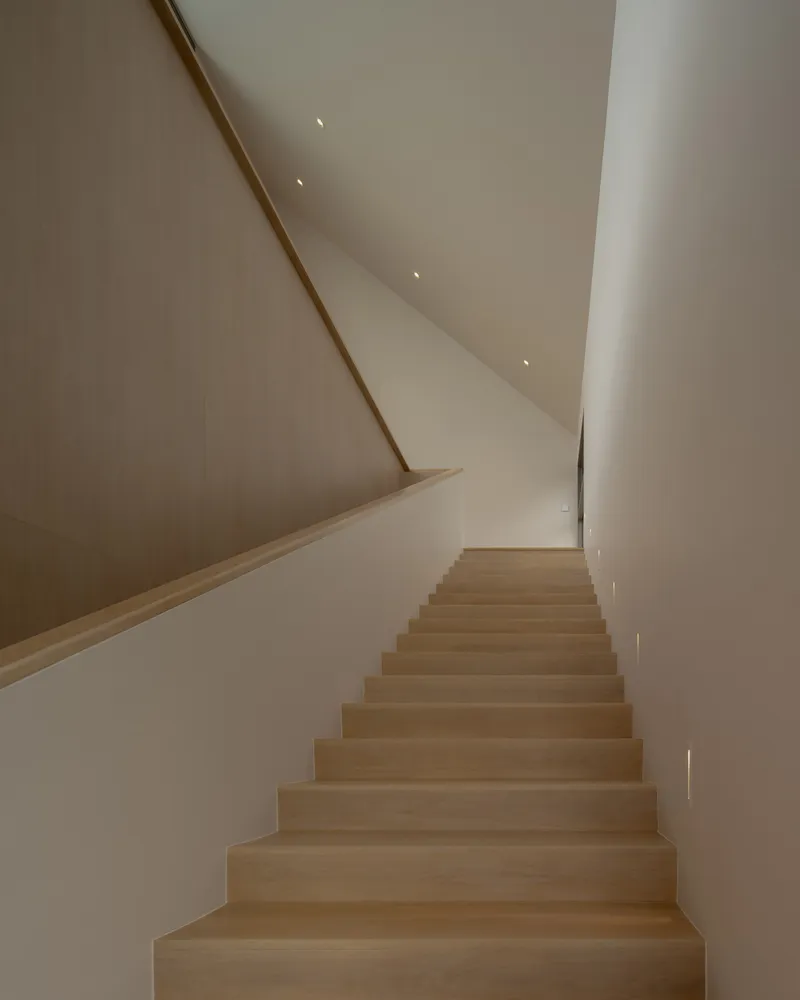
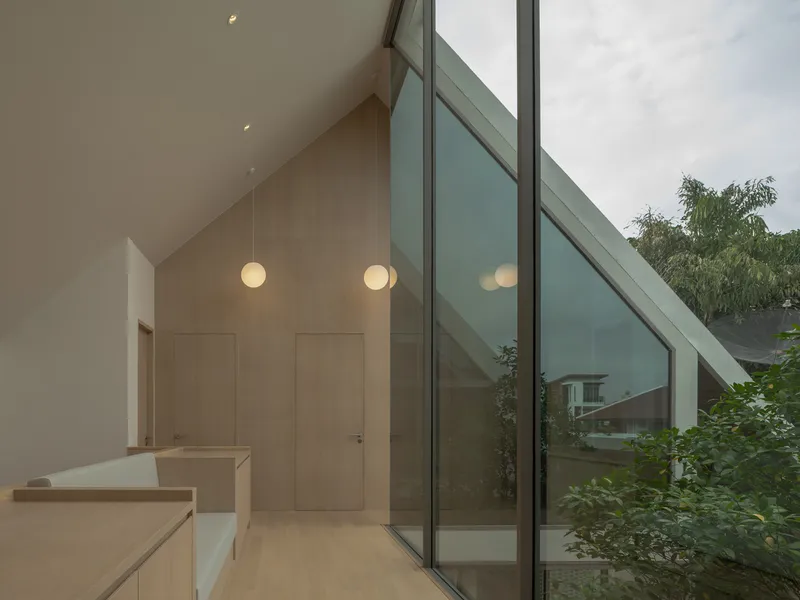
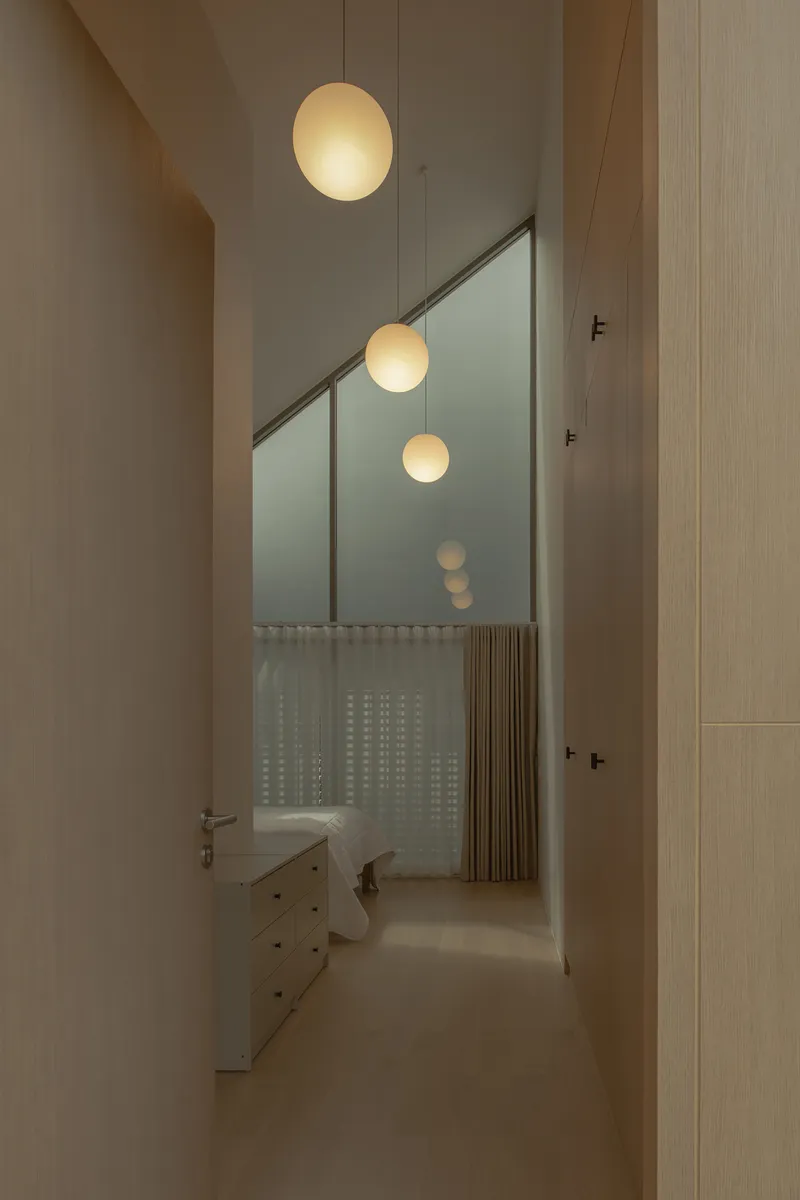
Circulation in Bhoon+ House is never neutral. The staircase ascends beneath a sloped white ceiling with recessed spotlights, compressing the space vertically before releasing it into the upper-level corridor. That corridor, lined with sloped glazing, becomes a lantern at dusk, the pendant lights reflected in the glass alongside the courtyard tree below. Angled glass partitions and translucent curtains layer the views, so you never see the whole house at once. There is always another frame, another glimpse.
The design team, including Parnduangjai Roojnawate and Pornpansa Kheedkhin, has treated every corridor and landing as an opportunity to control how light enters and how the eye moves. The effect is processional without being theatrical. You are always aware of where the courtyard is, even when you cannot see it directly.
Private Rooms, Open Frames

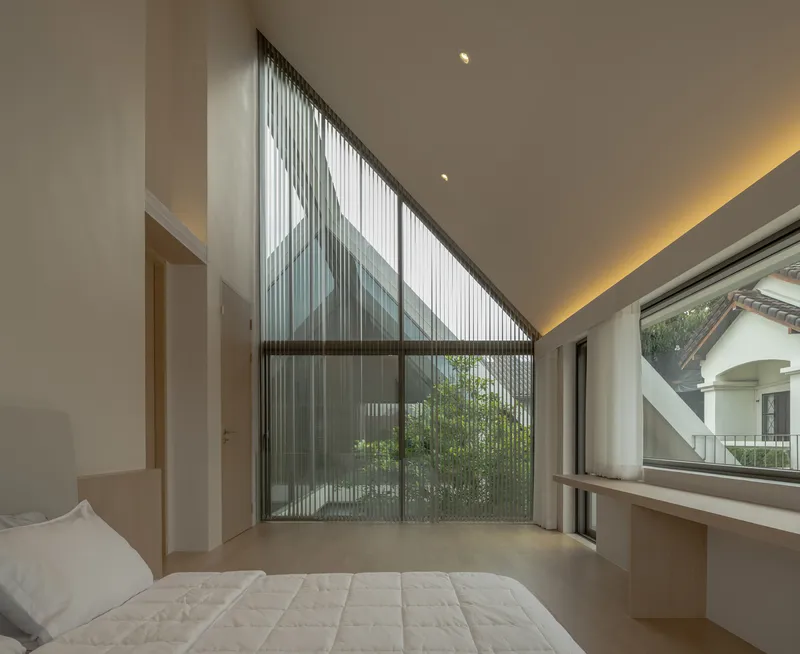

The bedrooms occupy the upper level and use the gabled roof geometry to create intimate, shaped volumes. One bedroom places a sloped skylight above the bed, framing a wedge of sky through sheer curtains. Another opens through a full gabled glass wall onto a bamboo grove filtered by a slatted screen. Privacy is achieved through orientation and screening rather than through opacity: the rooms are enclosed but never sealed.
A narrow study alcove, lined with built-in desk and shelving flanked by tall plywood storage cabinets, offers the kind of focused retreat that a young family genuinely needs. It is a small space, but its proportions and material warmth make it feel purposeful rather than cramped. These private rooms do not abandon the courtyard logic; they simply modulate it, turning the openness of the ground floor into something quieter and more contained.
Upper Galleries and Dusk

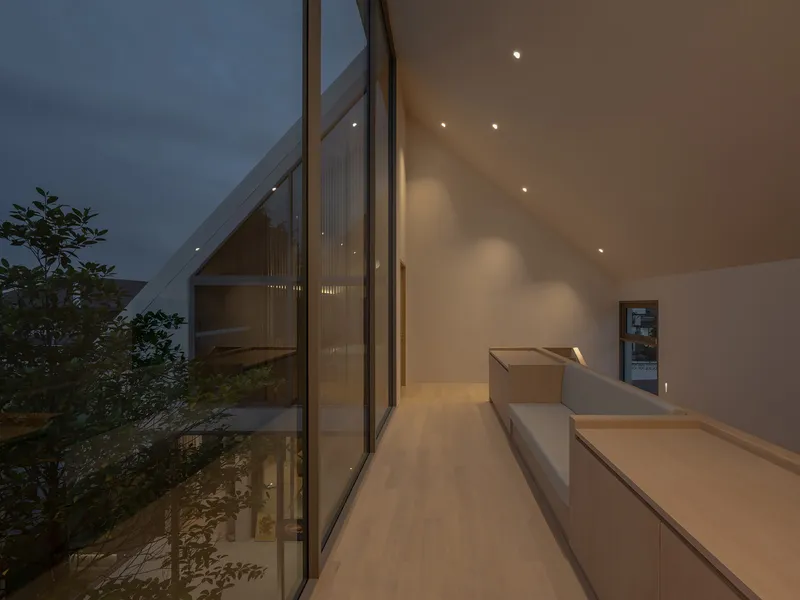
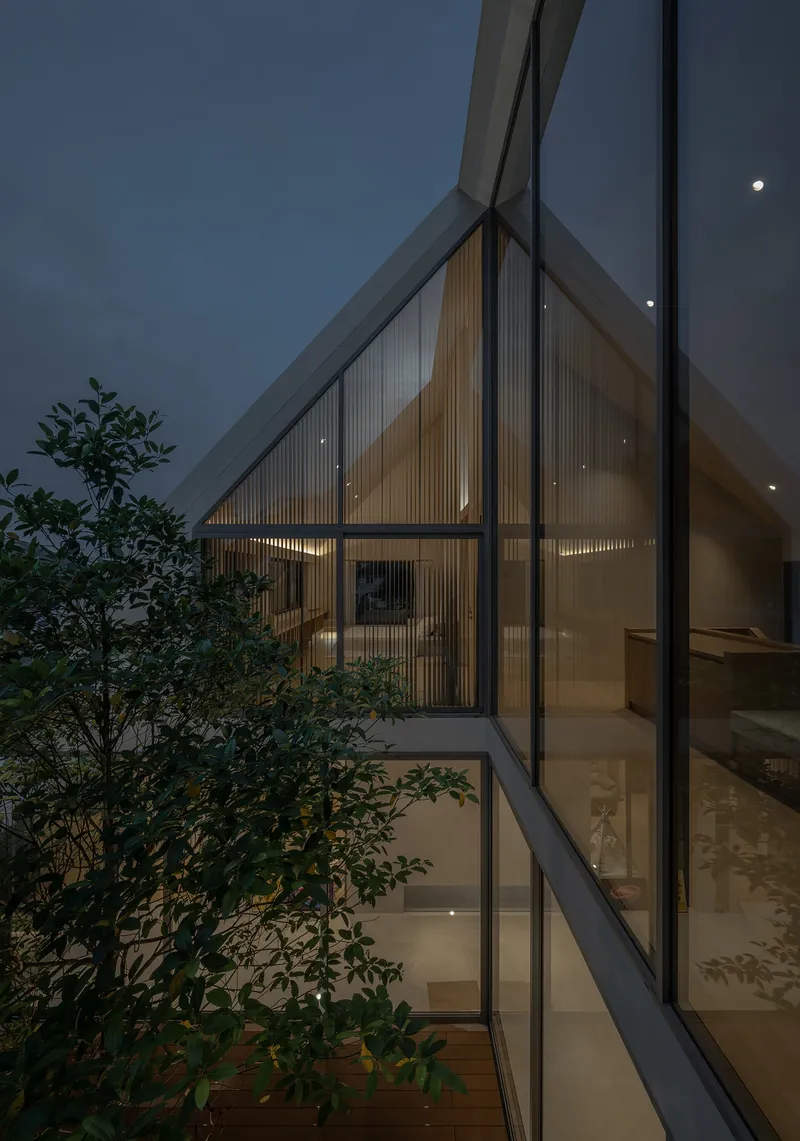
From the upper level, the double-height stairwell with its sloped glazing and pale wood railings offers a commanding view back into the courtyard below. Occupants appear in the frame as figures in a landscape, moving across the timber deck beneath the canopy of the courtyard tree. At twilight, the house performs its most compelling trick: the glass walls become luminous planes, the interior volumes glow against the darkening sky, and the courtyard tree is silhouetted against the warm interior light.
The nighttime exterior, shot with a rising moon behind the angled glass facade and timber screening, reveals the house as a composition of overlapping transparencies. The planted trees, lit from within, become part of the architecture rather than its backdrop. It is a house that changes register across the day, from the bright white volumes of noon to the layered luminosity of evening.
Roof and Material Craft
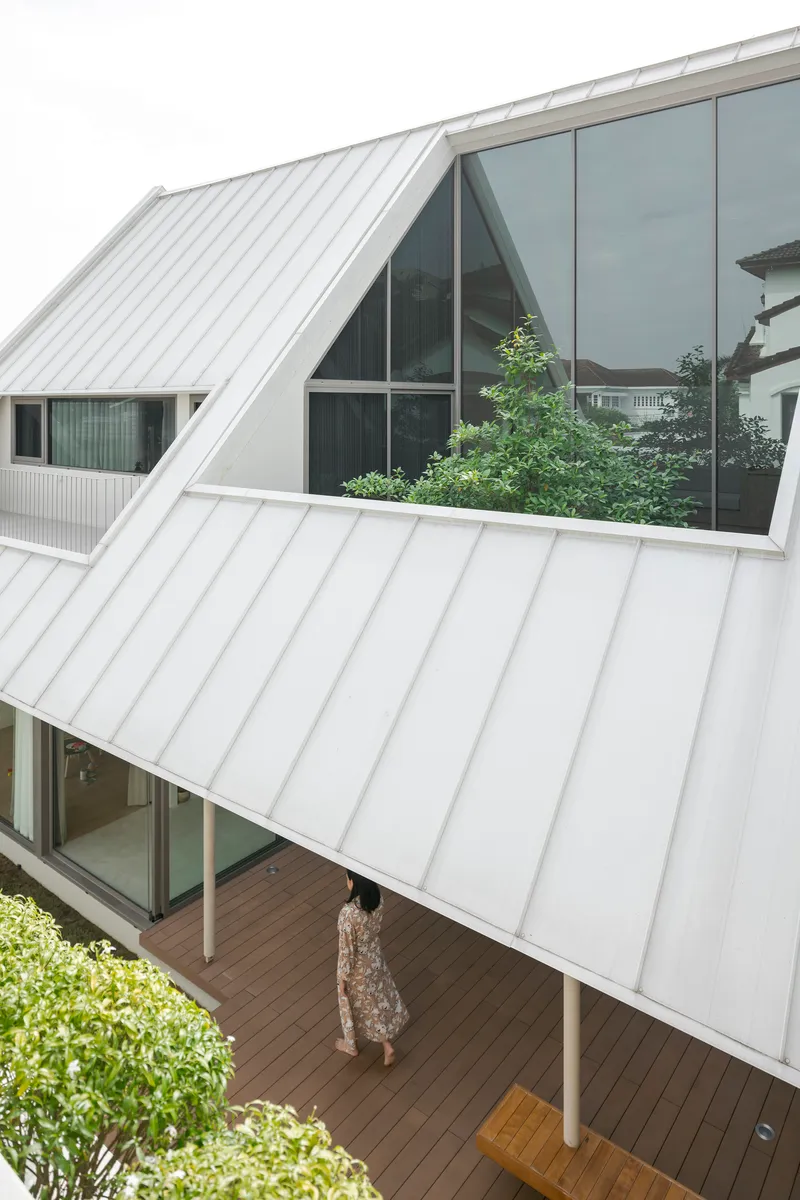


The white metal canopy, with its standing-seam profile, is the house's unifying element. It slopes, folds, and lifts to create covered walkways, shaded terraces, and sky-lit interiors. From above, the elevated timber deck walkway reads as a bridge between volumes, with the canopy floating overhead like a single continuous gesture. The perforated metal screens that appear alongside the glass walls add another layer of climate mediation, filtering light and allowing air movement without sacrificing the visual connection to the courtyard.
The material palette, white metal, timber, woven brick, pale plywood, translucent glass, works because every element has a climatic as well as an aesthetic rationale. The roof reflects heat. The timber deck stays cool underfoot. The brick screen breathes. In a city as hot and humid as Bangkok, this is not decoration; it is survival, executed with care.
Plans and Drawings
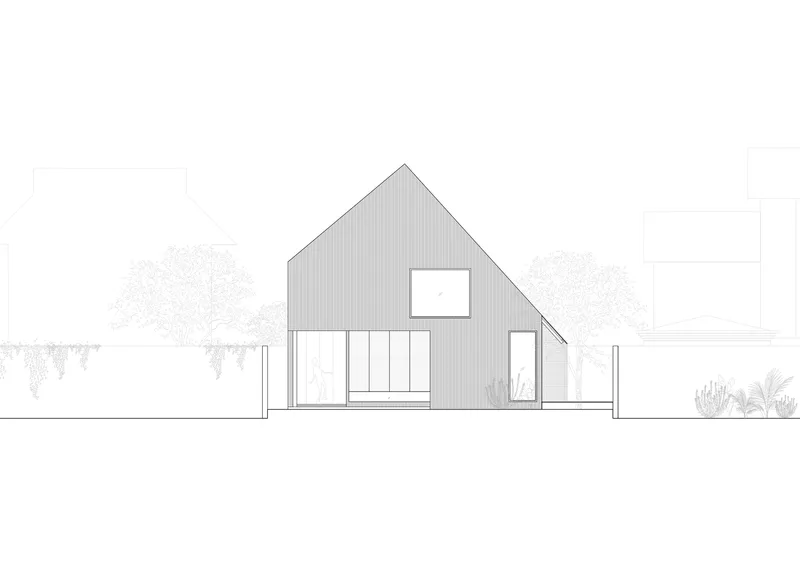

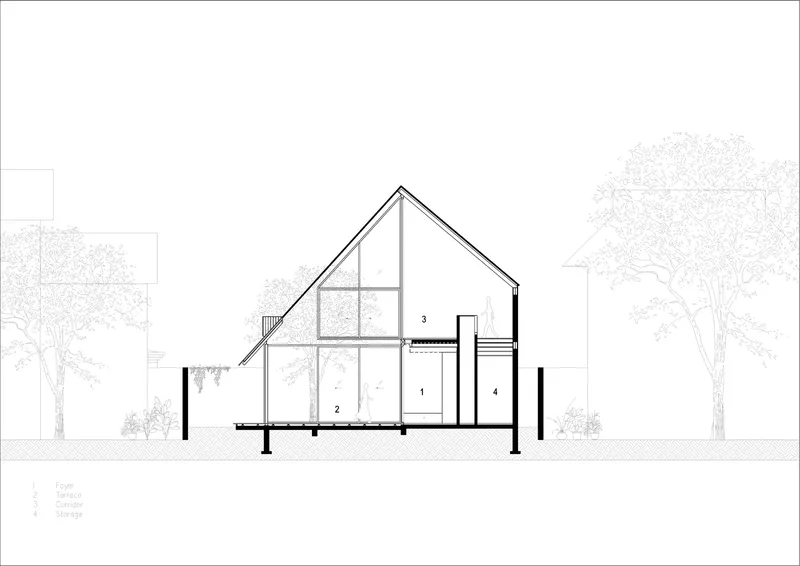
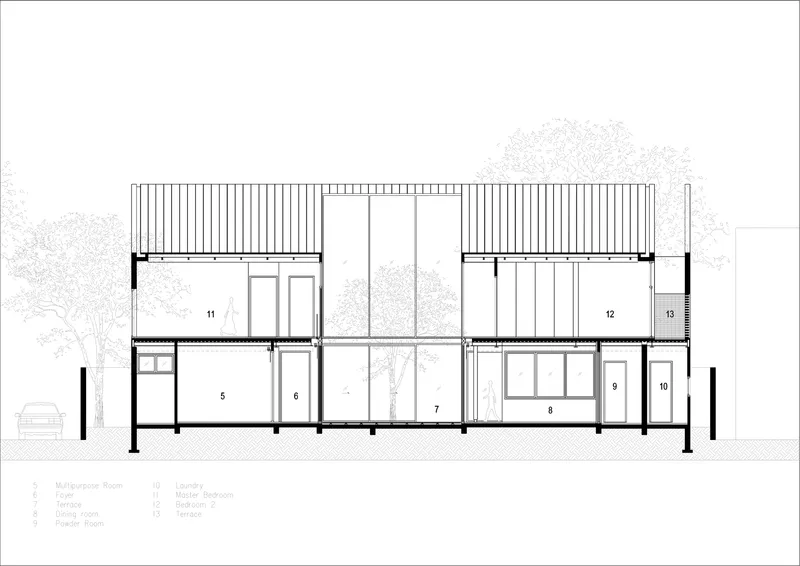
The elevations confirm what the photographs suggest: a house of two registers. The street-facing elevation is tight, vertical, and largely closed, with ribbon windows and vertical cladding creating a composed urban face. The courtyard elevations are the opposite: fully glazed, open, and engaged with the planted ground. The sections are the most revealing drawings, showing how the gabled roof volumes create double-height spaces that channel light down into the plan while the central courtyard, with its tree canopy, anchors the entire composition.
The long section through the house demonstrates the deliberate level changes and the way interior volumes of different heights are organized around the courtyard. Columns are minimal; the structure relies on the roof planes and the glass walls to define enclosure. The drawings also clarify the relationship between the new house and its context: the adjacent trees and landscape elements are not afterthoughts but integral parts of the spatial strategy.
Why This Project Matters
Bhoon+ House addresses a condition that is both culturally specific and universally relevant: how to build for the next generation without severing the connection to the first. The courtyard, transformed from an unused lawn into the shared heart of two households, is a spatial answer to a social question. It resists the false binary between independence and proximity, offering both through careful orientation, transparency, and the strategic placement of a single tree.
Anonym's achievement here is not formal novelty but organizational clarity. Every decision, from the opaque street facade to the luminous courtyard walls, from the sloped roof planes to the woven brick screen, serves the project's core proposition: that closeness and autonomy can coexist when the architecture is precise enough to hold both. In a city where density is increasing and family structures are evolving, this 350-square-meter house offers a model that is replicable in principle, even if it is singular in execution.
Bhoon+ House by Anonym, led by Phongphat Ueasangkhomset. Bangkok, Thailand. 350 m². Completed 2025. Photography by DOF SKYGROUND and Soopakorn Srisakul.
About the Studio
Share Your Own Work on uni.xyz
If projects like this are the kind of work you want to make, uni.xyz is a place to publish your own, find collaborators, and enter design competitions.




Popular Articles
Popular articles from the community


The Ocean Hive: Sustainable Architecture for a Self-Sufficient Civilization at Sea
The Ocean Hive imagines sustainable architecture at sea, where modular habitats, algae, wave power and ocean waste sustain a growing colony.

AL-JANNAH: Sustainable Architecture and Permaculture for Afghan Widows
AL-JANNAH uses sustainable architecture and permaculture to create resilient oasis of housing, learning, work and renewal for Afghan widows.
EW PARK: Sustainable Architecture Reimagines the Future of Urban Parking
EW PARK reimagines city parking as a modular wooden tower combining automation, solar energy, electric mobility, and adaptable urban design.

The Earth Pod: 3D Printed Homes for Resilient Refugee Communities
The Earth Pod reimagines refugee housing through 3D printed homes made from clay, combining resilience, self-sufficiency, and rapid shelter.


Similar Reads
You might also enjoy these articles

Bao Huynh Watercolor Atelier: A Serene Art Retreat in Hội An
Bao Huynh Watercolor Atelier in Hội An blends multifunctional art spaces, sustainable design, local materials, and family-friendly living in a serene environment.

Atelier Macri Concept Store Interior Design by CASE-REAL
Atelier Macri store features a "ko" counter, walnut wood details, cork displays, blending retail, gallery, and seamless customer experiences.

Manuel Vargas Izquierdo Stadium and High-Performance Sports Center: Architectural Excellence in Jalpa de Méndez
The Manuel Vargas Izquierdo Stadium blends sustainable design, inclusive sports facilities, and cultural-inspired architecture, revitalizing Jalpa de Méndez’s public spaces.

KAKR Buluh Awar Hall: Revitalizing Community and Ecology Through Bamboo Architecture
Community built bamboo hall revitalizes Buluh Awar village, empowering youth, restoring ecology, celebrating vernacular craftsmanship through sustainable architecture and culture.




Comments (0)
Please login or sign up to add comments
No comments yet. Be the first to comment!