

APS Concept Wraps a Dalat Forest Villa in Pine Wood and Stone to Blur the Line Between Shelter and Canopy
A hospitality retreat in Vietnam's pine highlands uses modified timber and local stone to dissolve indoors and outdoors across a sloped site.


Dalat sits in Vietnam's Central Highlands at roughly 1,500 meters above sea level, wrapped in a perpetual coolness that draws visitors out of the lowland heat. The pine forests that blanket its slopes are the city's defining asset, but they also pose a design challenge: how do you build a hospitality retreat that earns its place among the trees rather than displacing them? APS Concept answers with Villa of the Star, a 335 m² renovation completed in 2022 as part of the Mo Stay project. Rather than clearing the site to announce the building, the studio buries its lower half in tangled stone and lifts two pointed timber volumes into the canopy, letting the architecture read as an extension of the hillside.
What makes the project worth studying is its material discipline. The entire interior skin, ceiling, walls, and floors in the private rooms, is clad in modified pine wood chosen for its resistance to moisture, mildew, termites, and heat. The shared living spaces switch to ground concrete, drawing a tactile line between communal and intimate zones. Every decision filters through the studio's stated triad of Connectivity, Locality, and Sustainability, and for once those words actually correspond to legible moves in the built work.
Two Gables in the Trees
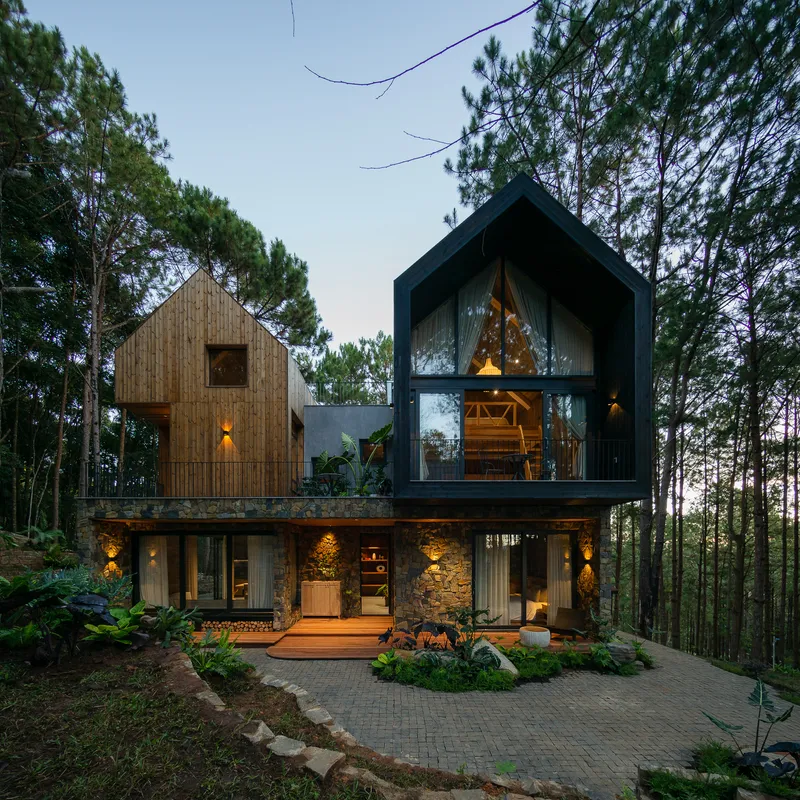
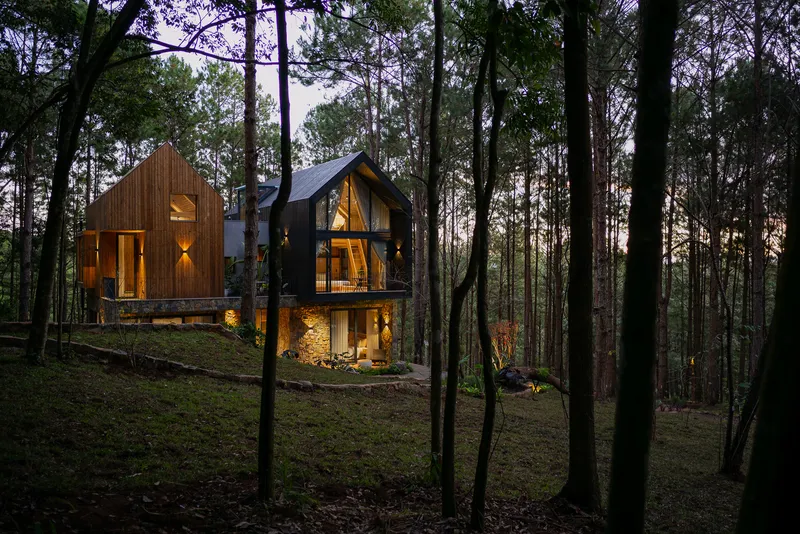

The villa reads as two pointed-roof blocks connected by a lower linking element. The stone base anchors the composition to the slope while the gabled timber volumes rise among the trunks, their dark metal cladding and warm wood tones oscillating between blending in and standing out depending on the hour. At twilight the interiors glow through the glazing and the building resembles a pair of lanterns hung in the canopy.
A timber walkway threads uphill through the pines to the entrance, forcing an approach sequence that is deliberately slow. You climb through the forest before you arrive at the house. That procession matters because it frames the villa as a destination inside the landscape, not apart from it.
Stone Steps as Infrastructure


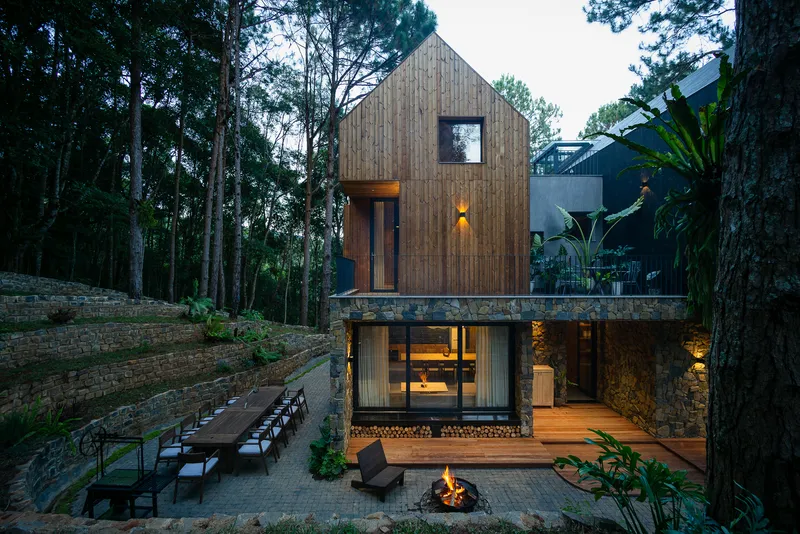
The low taluy bank surrounding the site is managed with terraced stone steps that do triple duty: retaining wall, erosion control, and outdoor amphitheater. During heavy rains these steps prevent rocks and soil from sweeping into the building, a real concern on Dalat's sloped terrain. In dry weather the same stone terraces become a gathering space, wrapping a sunken fire pit at the rear courtyard. The move is pragmatic and social at the same time, which is the best kind of landscape strategy.
Shared Spaces on Ground Concrete


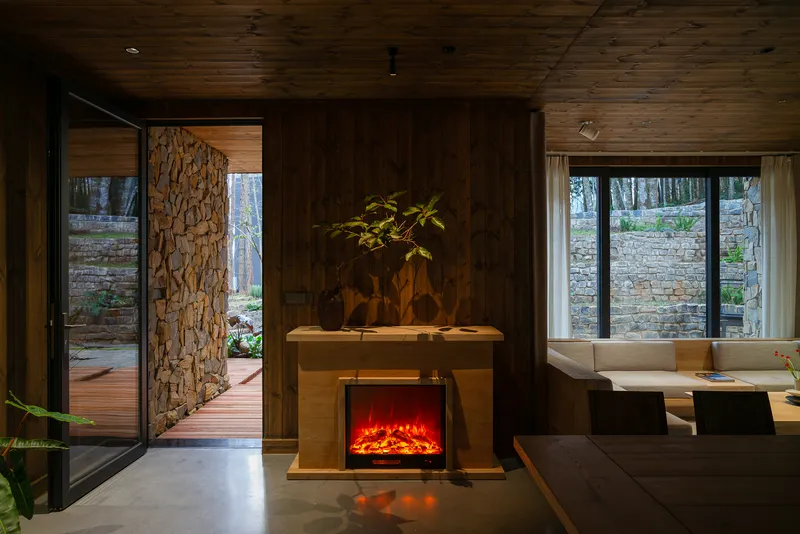
The living room and kitchen occupy the linking volume between the two gable blocks, floored in ground concrete that feels cooler underfoot and visually distinct from the timber-wrapped bedrooms above. The effect is immediate: you sense the shift from public to private without a door in the way. A built-in seating nook flanks an electric fireplace, while the dining room pushes up into a vaulted timber ceiling with open shelving and a glazed courtyard that pulls greenery into the meal.
Large glass doors at the kitchen dissolve the boundary between cooking and the outdoor deck, turning the entire ground floor into a continuous surface for group gatherings. The villa is designed for families and friend groups, and the floor plan's generosity on the ground level reflects that hospitality brief without oversizing the private rooms.
Timber Bedrooms, Calibrated Light


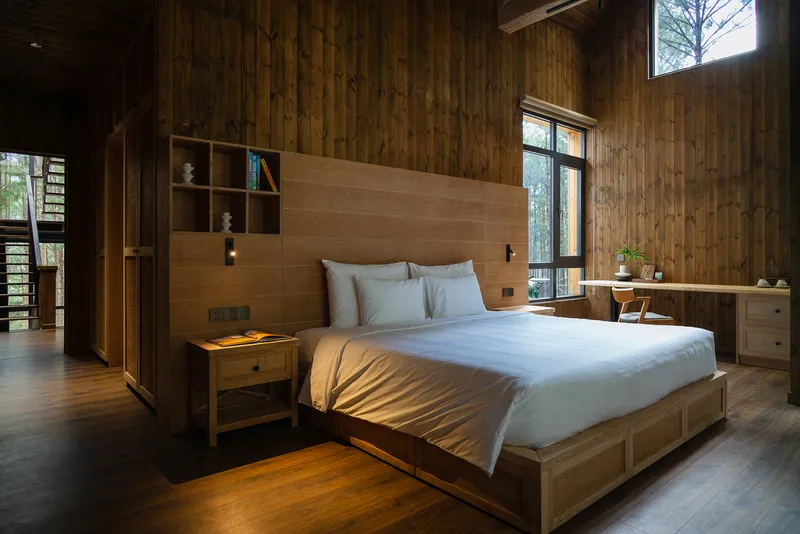
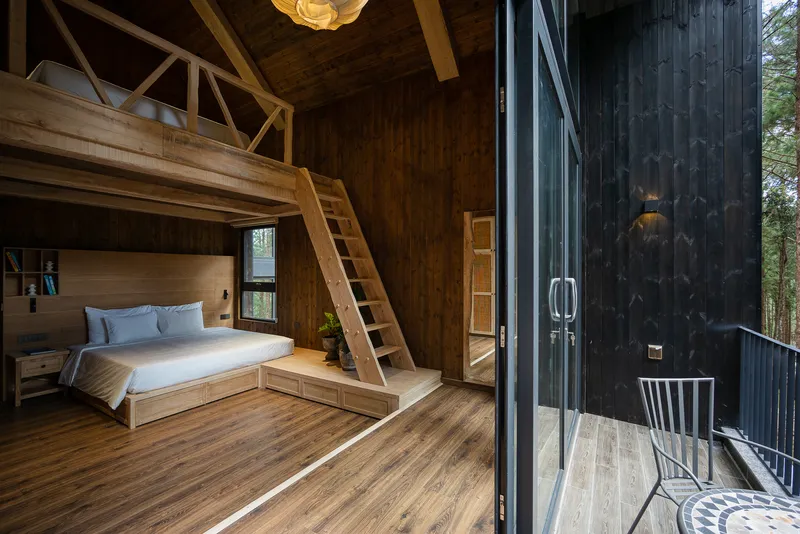
The bedrooms are wrapped almost entirely in modified pine, ceiling to floor, with wood tones shifting from light to dark depending on position. That tonal variation is deliberate: it adds depth and avoids the monotony that all-wood interiors so often fall into. Some rooms include loft platforms accessed by simple ladders, stacking sleeping area above seating area and compressing the section without shrinking the floor.


Glass placement is selective rather than generous for its own sake. Corner windows frame specific pine trunks. Full-height glazing opens only where a courtyard or forest view warrants it. The intent is that from inside the house, you still feel the change of scenery outside. At dusk, corner window seats become small observatories looking into the surrounding canopy.
Water and Forest

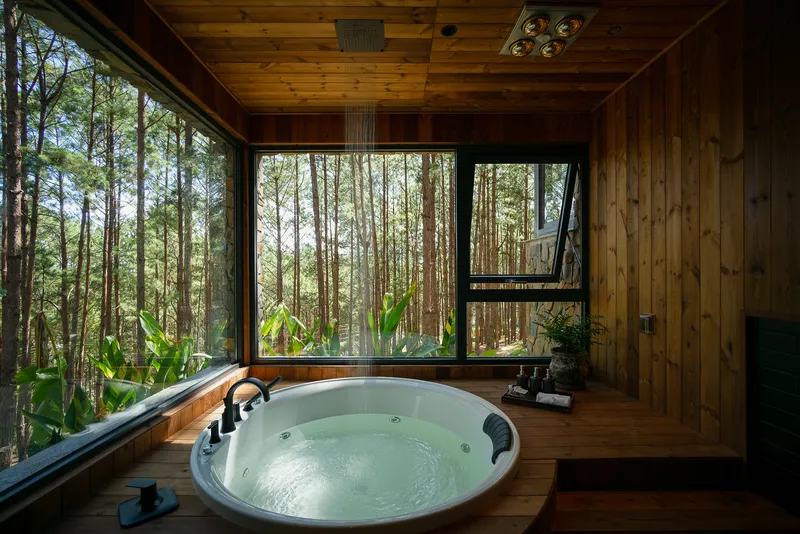
Two bathing experiences anchor opposite ends of the private program. A sunken bathtub surrounded by timber steps looks out through a fully glazed wall into a misty forest, turning a morning bath into something close to a viewing platform. Elsewhere, a circular jacuzzi is set into a timber deck framed by corner windows that face dense vegetation. Both spaces treat water as a lens for the landscape rather than a sealed amenity, reinforcing the villa's insistence on visual permeability.
Vertical Circulation and Filtered Light


The main staircase is open timber with vertical wood slats along the wall that filter daylight into striped patterns on the treads. It is a simple detail, but it gives the circulation spine its own character rather than treating it as leftover space. The slat pattern reappears at the balcony cladding, where corrugated metal meets vertical timber to modulate views out and airflow in.
Bedrooms on the upper levels open through glass doors to exterior balconies and courtyards, each scaled just large enough for a chair and a cup of coffee. The restraint is important. The outdoor spaces are prompts to engage with the forest, not stages for furniture catalogs.
Plans and Drawings

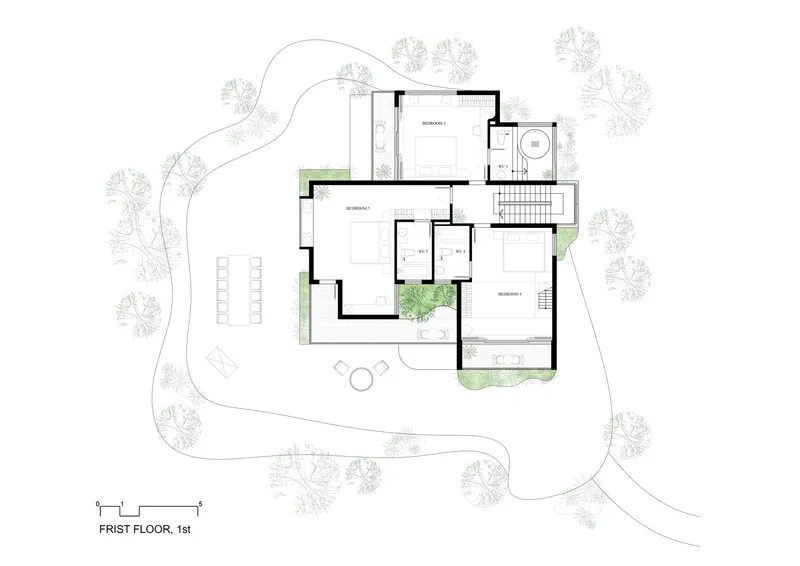
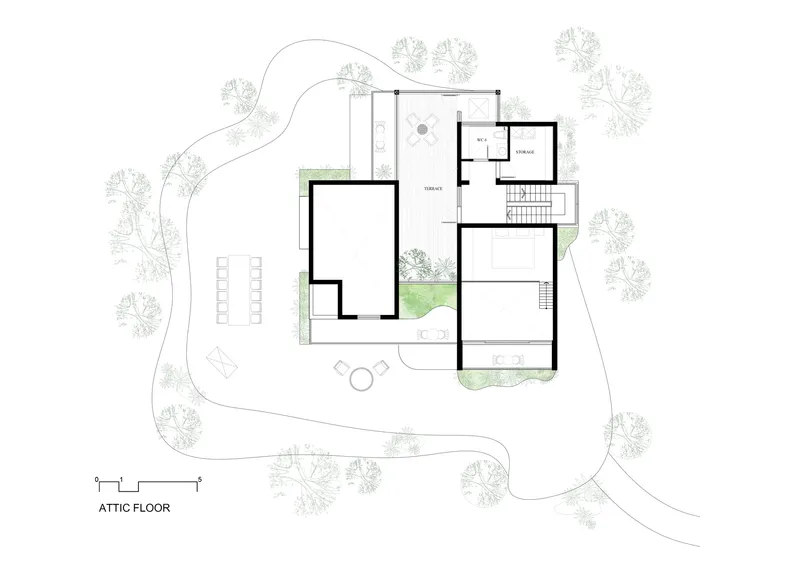


The ground floor plan reveals how the open living and dining spaces occupy the linking volume between the two gable blocks, with a broad terrace wrapping the landscaped perimeter. The first floor stacks bedrooms along a compact circulation core, while the attic level tucks a final suite under the pitched roof. The section drawing is the most revealing: it shows the diagonal staircase navigating the slope, the pitched roofs lifting clear of the canopy, and the way each level steps with the terrain rather than flattening it. The roof plan confirms the courtyard at the heart of the composition, a void that pulls light and air into the center of the plan.
Why This Project Matters
Villa of the Star succeeds because it takes three overused words, Connectivity, Locality, and Sustainability, and converts them into physical choices you can touch. Connectivity is the ground concrete floor that flows without threshold from kitchen to deck. Locality is the modified pine and tangled stone sourced from the region's own material palette. Sustainability is the passive strategy of selective glazing and natural ventilation rather than sealed, conditioned rooms. None of these moves are revolutionary on their own, but stacked together they produce a hospitality space that feels genuinely embedded in its site.
Dalat's tourism economy is growing fast, and with it the pressure to build generic resort architecture that could sit anywhere from Bali to the Swiss Alps. APS Concept's contribution here is a reminder that the most compelling hospitality design starts with the specific: specific trees, specific slopes, specific rain patterns, specific wood. The villa does not borrow an aesthetic from abroad. It builds one from the ground it stands on, and that is harder than it looks.
Villa of the Star by APS Concept, Dalat, Vietnam. 335 m², completed 2022. Photography by Quang Tran.
About the Studio
Share Your Own Work on uni.xyz
If projects like this are the kind of work you want to make, uni.xyz is a place to publish your own, find collaborators, and enter design competitions.


Popular Articles
Popular articles from the community

Tsunami Convergenics: Turning Catastrophic Ocean Forces into Underwater Housing Infrastructure
A speculative underwater settlement off the coast of Onagawa, Japan, treats tsunamis and typhoons as energy sources rather than threats.

Faces of the Soviet Avant-Garde: Turning Moscow's Street Names into an Open-Air Museum
A network of sculptural installations across a Moscow residential district transforms forgotten architect names into spatial encounters with cultural memor

The Amber Palace Opera: A Geological Fiction Surfaces on Tallinn's Baltic Waterfront
Pierre Brillard reimagines a Baltic legend as a public landscape, opera house, and waterfront promenade rooted in Tallinn's coastal identity.

Temporary Home for Dogs: A Reversed Zoo Rethinks Animal Shelter Architecture
In Bucharest, a sinuous corridor and freed landscape flip the logic of containment, designing a shelter that works to make itself unnecessary.

Similar Reads
You might also enjoy these articles

Pixel Gardens: One Repeated Module Stacked Into a Terraced Social Housing Tower for Famagusta
Salem Bader's shortlisted housing tower builds a vertical neighbourhood from one repeated module, offsetting units to carve terraces, light and air.

Bao Huynh Watercolor Atelier: A Serene Art Retreat in Hội An
Bao Huynh Watercolor Atelier in Hội An blends multifunctional art spaces, sustainable design, local materials, and family-friendly living in a serene environment.

Atelier Macri Concept Store Interior Design by CASE-REAL
Atelier Macri store features a "ko" counter, walnut wood details, cork displays, blending retail, gallery, and seamless customer experiences.

Manuel Vargas Izquierdo Stadium and High-Performance Sports Center: Architectural Excellence in Jalpa de Méndez
The Manuel Vargas Izquierdo Stadium blends sustainable design, inclusive sports facilities, and cultural-inspired architecture, revitalizing Jalpa de Méndez’s public spaces.

Explore Villa Competitions
Discover active competitions in this discipline

Challenge to design mud housing for contemporary communities

Challenge to reimagine the Iron Throne

Photograph architecture without architects

Illustrate the lost glory of Angkor Wat - Render Challenge
Comments (0)
Please login or sign up to add comments
No comments yet. Be the first to comment!