

Arca
Mountain resort
1)What was the concept behind the project?
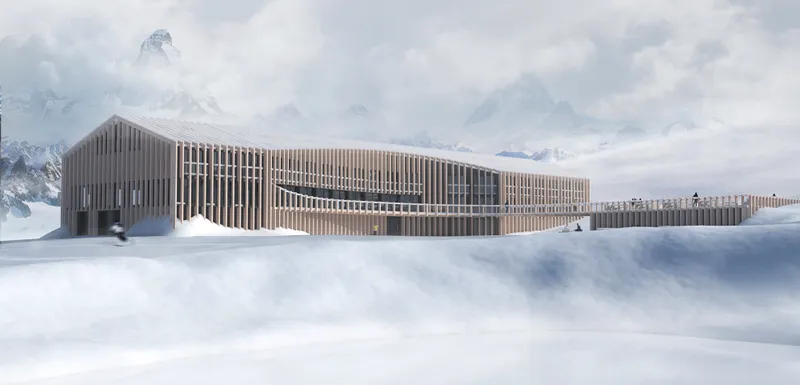
Designing a building, in a natural landscape, without an urban context that will not compete with the views around us and that fits well into the topography of the area, is not an easy task. We tried to answer the above-mentioned problems with a simple form that refers to the traditional geometry of Alpine construction but finished in a more modern way. By using an oblong simplified body, we want to complement the natural landscape with an object where people can find shelter, which is why the title "Arca". In addition, the longitudinal shape of the building arranged parallel to the slope looks like a ship digging into a wave.
Planks perpendicular to the façade add a second layer to our building. Through such a procedure, two interesting points of viewing the designed resort appear to us. One is the person who stands by the building. From a short distance, the "boards" open and allow you to observe what is happening inside, through appropriate cutouts we additionally emphasize public spaces such as a restaurant or the main hall. A similar situation is when a person views the landscape from the inside of the building. The second point of view is from the perspective of a skier descending from the slope. Now when we view the building from a greater distance, the "boards" merge with each other and form a whole, which increases the privacy of guests.
To respond to the assumption of designing an ecological building, we have set ourselves the goal of designing a self-sufficient building. In our project, we offer a water filtration system - the treatment plant from the laboratory is in the basement of the service building. The course of water through the building is circular. Grey wastewater unsuitable for filtration is transported to the biogas plant. In addition, we take into account the replenishment of water reservoirs, by rainfall or naturally occurring sources. Another element that allows the building to function as self-sufficient is the biogas plant. Biodegradable waste in an appropriate process is processed into biogas, from which we produce thermal energy and electricity. The production of electricity is complemented by photovoltaic panels mounted on facade "boards".
2)How do we fit into the terrain? – plot analysis
The shape of the designed plot was the starting point for the initial block, which we then tried to subordinate to the existing terrain and functional conditions. One of the advantages of the selected plot is that it is located next to the ski slope. Trying to take advantage of this, we proposed to locate the main body parallel to the slope and introduce a traverse that crosses the initial body and leads to the courtyard, which is a new intimate space integrating all the functions of the building.
The unique character of the building was achieved by connecting two blocks using a pier and another indentation in the main body to which we were provoked by the line of the water reservoir adjacent to the plot. In this way, we broke the monotony of the solid, adding softness and lightness to it.
The orientation of the longitudinal building perpendicular to the slope required its partial burial into the terrain, such a location of the solid allowed us to imagine the designed building as a ship attacking the incoming waves.
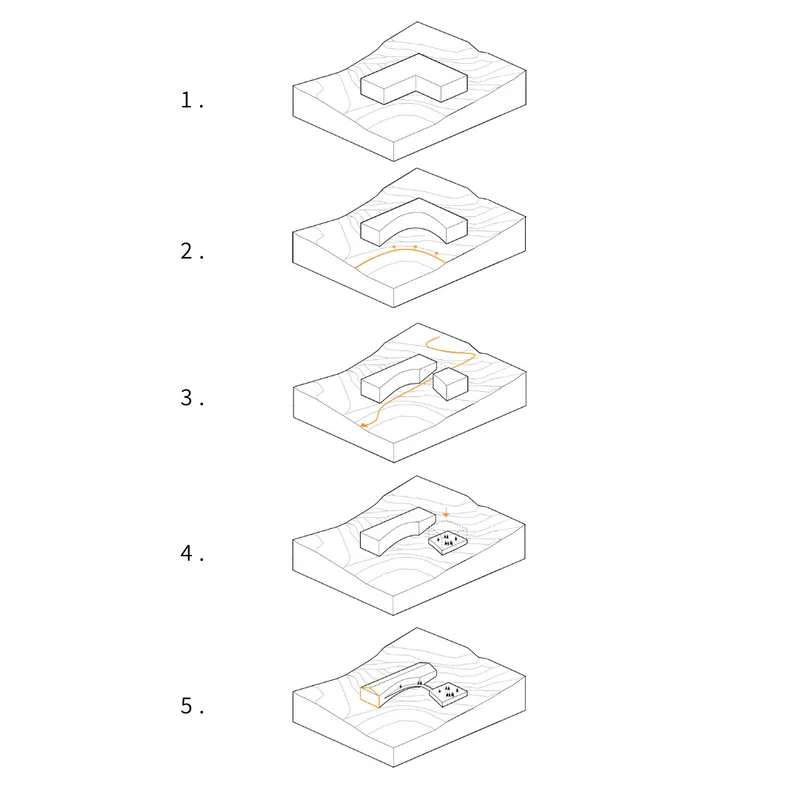
3)The process of designing the form of our building can be divided into 5 stages:
1)The first stage was to choose the shape that most optimally fits into the geometry of the plot.
2)In the next stage, we wanted to refer to the landscape near the plot, hence the lake-shaped notch.
3)The next step was to create an opening that would allow skiers to descend to the main door of our building. In addition, the gap allows us to design a separate service space easily accessible to skiers and snowboarders. In addition, the connection of two buildings through a bridge emphasizes the edge of the lake.
4)By lowering the service building, we get a terrace space with a beautiful view of the surrounding mountains. The terrace can be accessed directly from the slope.
5)The form of the main building was inspired by geometry of the traditional Alpine house
4)What materials were chosen? And why?
One of the pre-design assumptions was to make the building as ecological as possible, which is why we decided to make it from materials with the lowest possible carbon footprint. As a result of these findings, one of the basic building materials that we used is wood, which in addition remains a traditional material and provides an original and healthy microclimate.
The construction of the building was made in the technology of the CLT solid wood system - large-format massive panels made of cross-layered wood, used as load bearing and partition walls, as well as ceilings. The glulam structure is characterized by high strength and load-bearing capacity, short-time of construction, air tightness and high fire resistance.
The facade of the building was also finished with wood, made of boards fired using the Shou Sugi Ban method. Where, from a purely visual aspect, it is an original and interesting material that gives uniqueness to the building's body. This method ensures fast implementation and increased fire protection.
5)How we met the competition programme?
During the design process, we decided that the hotel function should be separated from the service function. In the main body of the building there is a resort part. On the ground floor from the south-west side, we located the delivery zone and garage spaces. Next to the garage door, we have designed an entrance for employees, which at the same time serves as an emergency exit. Behind the delivery zone there is a corridor to which further functions are connected. The closest to the southern wall are the guest toilets (16) from the restaurant which is located on the floor above. Then, above the toilets, we designed the laundry and drying rooms (13) and the bedding warehouse (15), between which there are stairs leading to the restaurant (14). To the left of the laundry rooms, there are kitchen warehouses (6), and a place for garbage cans (7). Going further down the corridor on the left, we pass the evacuation staircase and then we come to the cloakroom of cooks (5) and the cloakroom for hotel employees (12). We designed the chefs' locker room with separate toilets. The kitchen (4) connected to the cloakroom (5) and warehouses (6) is located on the central part of the building. It was connected by stairs and freight elevators with the kitchen part on the upper floor. In the central part of the building there is the main hall (1), in which we designed the reception and lobby, two entrances lead to the lobby from two sides of the building. Above the representative part in the eastern part of the building, we designed SPA & Wellness (2). The spa can be accessed from the main hall or directly from the staircase that leads to the rooms. In the spa we have designed three swimming pools and two saunas.
In the second block, there is a service part of the building. On the left side there is a bar (17), behind the bar there is a kitchen (19), above the kitchen we have designed toilets for guests (18). On the right side of the building, from the top there are: lockers for skiers (25), ski workshops (24), equipment rental (23). In the central part of the building there are common rooms with toilets for employees (20). Under the toilets, we have designed a space for snow patrol (21) and for paramedics (22).
On the first floor, we designed a restaurant with a self-service buffet. The restaurant is set in a south-western direction, overlooking the slope and mountains. In the central part of the building, there is a continuation of the main lobby of the building to create a buffer zone between the restaurant and hotel rooms. Above the lobby there are rooms for 1, 2 and 3 people. The next rooms are correspondingly larger, in each there are beds, wardrobes and bathrooms with showers.
The second floor is intended for hotel rooms. Next to the staircases we located utility rooms and storages for bedding. In the central part there is a space where guests can sit and relax.
The third floor is also intended for rooms. At this level, a new type appears - an apartment. It is a room designed for four people with two bathrooms, two bedrooms with a kitchen and a living room.
6)Summary
When designing a simple body, we wanted to fit well into the natural landscape. To make the building not too simple, we added a "second layer of facade", which changes the perception of the building depending on the point of observation. In addition, the assumptions of self-sufficiency allow us to design this building in an isolated place, and the complex functional program makes everyone find something for themselves. From admiring the views, through relaxing baths in the pools, to skiing on the alpine slopes.

Popular Articles
Popular articles from the community

Tsunami Convergenics: Turning Catastrophic Ocean Forces into Underwater Housing Infrastructure
A speculative underwater settlement off the coast of Onagawa, Japan, treats tsunamis and typhoons as energy sources rather than threats.

Extended Shell: Retrofitting Kolkata's Balconies as Living Urban Thresholds
A modular retrofit system recovers the social and environmental intelligence of Kolkata's historic verandas for contemporary Park Street residents.

Faces of the Soviet Avant-Garde: Turning Moscow's Street Names into an Open-Air Museum
A network of sculptural installations across a Moscow residential district transforms forgotten architect names into spatial encounters with cultural memor

The Amber Palace Opera: A Geological Fiction Surfaces on Tallinn's Baltic Waterfront
Pierre Brillard reimagines a Baltic legend as a public landscape, opera house, and waterfront promenade rooted in Tallinn's coastal identity.

Similar Reads
You might also enjoy these articles

The Rhythm of Seasons
A Farmers' Market Connecting Nature and the City

More Than a Building-Designing a Living System
More Than a Building-Designing a Living System
Base Beyond
DESERT COMPOUND ARID: TOURISM OF ABSENCE AND ABUNDANCE

Explore Cross Laminated Timber Competitions
Discover active competitions in this discipline


Challenge to reimagine the Iron Throne

Photograph architecture without architects

Illustrate the lost glory of Angkor Wat - Render Challenge

Design challenge to reuse E-waste
Comments (0)
Please login or sign up to add comments
No comments yet. Be the first to comment!