
SO WHAT?...IF SO!: Stripping Architecture Back to a Nude Canvas in Tokyo
A modular 'Nude Building' concept uses AR, VR, and holographic overlays to challenge generic urbanism and invite cultural evolution.


What if a building arrived with no skin, no style, no cultural allegiance? Just a bare structural framework waiting to be dressed by anyone willing to project an ideology onto it. That is the provocation at the heart of SO WHAT?...IF SO!, a proposal that reframes architecture not as a finished product but as a live, modular canvas. The concept, called the "Nude Building," strips structure down to open, semi-open, and closed spatial modules, then invites architects, artists, and citizens to layer digital visual effects, ornamental overlays, and hybrid expressions onto the base form. The result is a building that can wear Gothic tracery in the morning and minimalist futurism by evening, challenging the homogenization that defines so many contemporary cities.
Designed by Manivannan J and Arun, this shortlisted entry in the Di - Generic Cities: Tokyo competition takes aim at the brief's central question: how do we break the "generic" in global urbanism? Their answer roots itself in Tokyo's spiritual diversity and intercultural fabric, weaving religious, communal, and performative programmes into a masterplan that treats the city as a complex, interdependent evolutionary product rather than a static artifact.
The City as an Evolving Organism
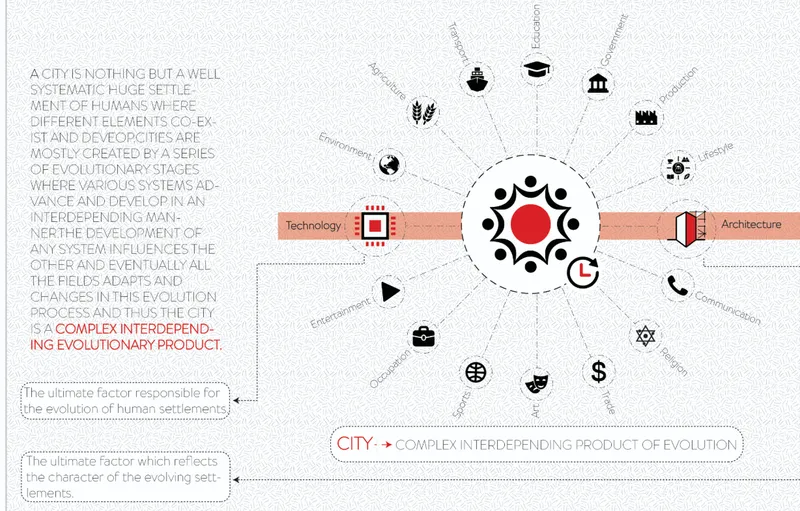
The opening diagram lays out the project's theoretical engine. Technology, environment, religion, economy, and governance appear as interconnected nodes, each feeding into and reshaping one another across evolutionary stages. Architecture sits at the intersection of all these forces, not as a passive container but as both narrative and medium of change. The designers argue that a city is never static; it is an organism whose built form reflects shifting values, needs, and aspirations. By mapping these interdependencies visually, the project establishes its core claim: architecture does not merely exist within the city, it embodies its very process of growth.
From Neolithic Stone to 21st-Century Code
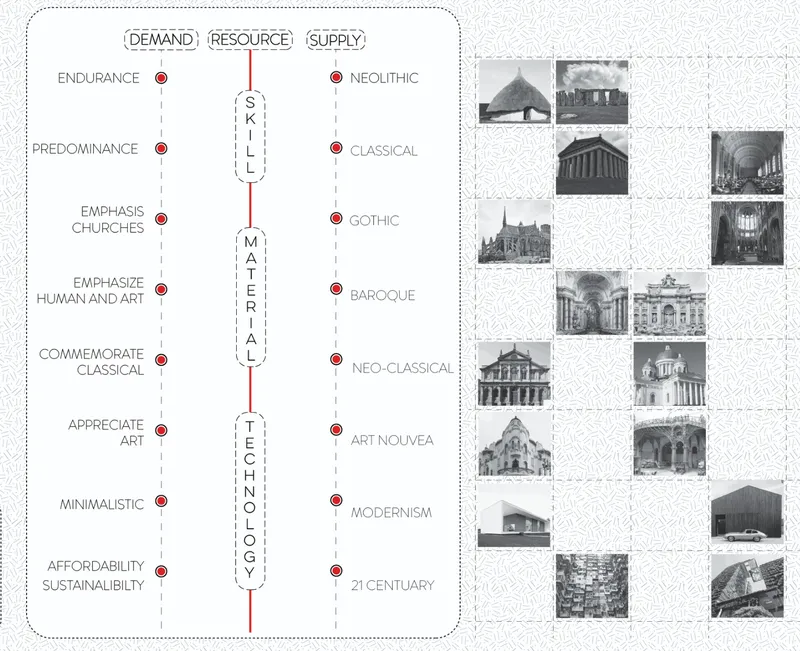
A sweeping timeline traces architectural style from Neolithic forms through Gothic, Baroque, Art Nouveau, and Modernism, aligning each period with the material technologies and cultural values that produced it. The diagram makes a persuasive case that these styles are not aesthetic choices alone but responses to deeper societal stimuli: the triad of demand, resource, and supply. As materials evolved from stone to steel to digital composites, architecture adapted in kind. The implication is clear: the next evolutionary leap will be driven by AR, VR, and holographic tools, technologies the designers deploy to generate contrasting scenarios that challenge conventional perceptions of space and form.
What makes this timeline more than a history lesson is its forward-facing argument. If every major architectural shift has been catalyzed by new technologies intersecting with cultural need, then the tools of immersive digital experience represent not a gimmick but a legitimate evolutionary force. The designers position their Nude Building as the architectural typology native to this emerging era.
A Masterplan of Sacred Courtyards and Communal Microzones
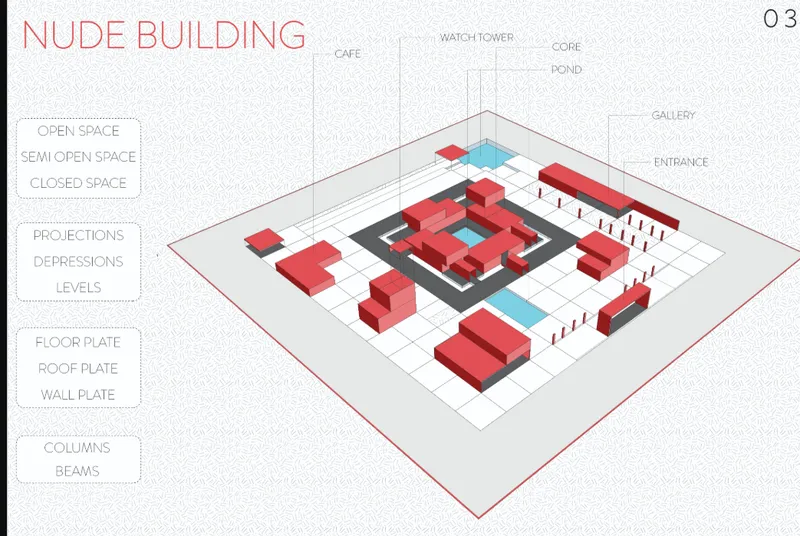
The axonometric drawing reveals the project's spatial organization: red building volumes and blue water features arranged around a central courtyard, with labelled zones for prayer, meditation, performance, dining, and marketplaces. Circulation paths are strategically designed to create microzones and transitional areas that foster dialogue between users, cultures, and traditions. The layout reflects Japan's spiritual diversity, weaving religious and communal functions into a single cohesive plan while allowing specific sacred spaces to maintain their sanctity.
The courtyard acts as the social hinge of the scheme. Inclusivity is zoned rather than forced: a visitor moving from marketplace to meditation garden passes through transitional thresholds that modulate noise, light, and visual density. These spatial gradients are the architectural equivalent of a cultural handshake, bridging programmes that might otherwise feel incompatible. It is here that the Nude Building concept moves from theory to felt experience, as the modular base structures around the courtyard can adopt different digital skins depending on the activity or community they serve.
Torii Gates, Pagodas, and Layered Identities in Elevation
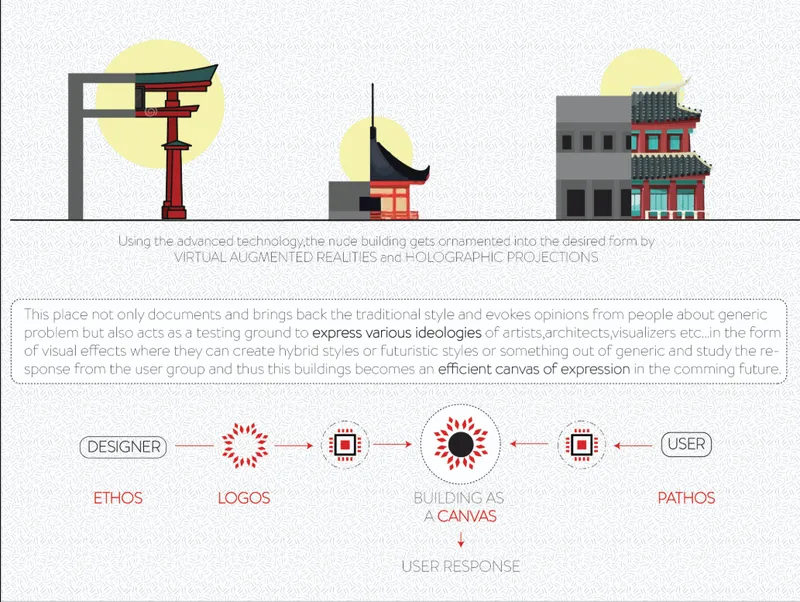
The elevation drawing is the project's most evocative image: three stylized structures, a torii gate, a pagoda, and a multi-story building, stand side by side against golden suns. Together they compress centuries of Japanese architectural identity into a single composition, illustrating how the Nude Building might absorb and project diverse cultural narratives simultaneously. The drawing is deliberately graphic, almost iconographic, signaling that the building's identity is never fixed. It can reference tradition and futurity in the same frame, depending on the overlay applied.
By placing these forms in direct adjacency, the designers make a spatial argument about coexistence. The torii gate's open threshold, the pagoda's vertical layering, and the contemporary building's modular grid are not competing typologies. They are episodes in the same evolutionary story, each available as a visual and programmatic language that users can select, combine, or reject. Architecture becomes an experiential canvas inviting reinterpretation, adaptation, and cultural layering.
Why This Project Matters
The generic city is a well-documented problem, but most critiques stop at diagnosis. Manivannan J and Arun push further by proposing a mechanism: generate new architectural demand through diverse user experiences, then provide a structural framework flexible enough to absorb those demands. The Nude Building is less a building type and more a protocol for continuous cultural negotiation, a physical infrastructure designed to never finish becoming itself.
In the context of Tokyo, a city that already oscillates between hyper-tradition and radical futurism, the proposal feels particularly resonant. Rather than choosing one identity, the project insists that architecture's role is to hold space for many identities at once. If AR and VR tools continue to mature, the notion of a base structure that can wear infinite digital skins may move from speculative to practical faster than we expect. This entry plants a flag at that intersection, arguing convincingly that architecture is not a problem to solve but a stage in human evolution.
View the Full Project
About the Designers
Designers: Manivannan J, Arun
Enter a Design Competition on uni.xyz
uni.xyz runs architecture and design competitions year-round that reward proposals with spatial conviction and real site intelligence.
Project credits: SO WHAT?...IF SO!... by Manivannan J, Arun Di - Generic Cities: Tokyo (uni.xyz).



Popular Articles
Popular articles from the community


Lunar Spiral: Space Architecture Shaped by the Mathematics of the Universe
Lunar Spiral reimagines space architecture through Fibonacci geometry, lunar regolith, levitating habitats, and self-sustaining Moon living.

Play: Fragments of Their World
Familiar architecture becomes modular playground design, creating safe spaces where displaced children can learn, connect, imagine and play.

Riyadh For All: Intergenerational Urban Design for Active Aging in Rabat
Riyadh For All reimagines urban design in Rabat with intergenerational co-living, adaptive courtyards, and Moroccan cultural exchange today.

Hill & Cross Opera: Sculptural Opera House Architecture Shaped by Tallinn’s Landscape and Identity
Hill & Cross Opera reimagines opera house architecture in Tallinn through its sculptural hill, civic plaza, glass wave and a luminous cross.

Similar Reads
You might also enjoy these articles

Day and Night Park: A Time-Based Urban Newsstand in Beijing
A temporary urban newsstand in Beijing blending travel, light, and reading through poetic colors, compact form, and community-focused design.

Modernist Patio Renovation in El Masnou, Barcelona by Oliver Segura Arquitectura + Cebrià Arquitectura
Modernist patio renovation blending tradition and innovation with a movable pool, leveled floors, and Catalan materials in El Masnou.

Alto Residencial Coop: Cooperative Housing Development in Santiago de Compostela by Carbajo Barrios Arquitectos
A linear cooperative housing complex blending white volumes and perforated metal façades, enhancing community living, natural light, privacy, and urban integration.

Vil Genis School by BPA ARCHITECTURE – Massy, France
Vil Genis School in Massy, France, features sustainable design, south-facing classrooms, community integration, accessible spaces, and modern educational architecture.

Comments (0)
Please login or sign up to add comments
No comments yet. Be the first to comment!