

Architecture Classics: Casa en el Aire – A Sculptural Masterpiece by Agustín Hernández
Cantilevered sculptural house in Mexico City by Agustín Hernández, blending geometric forms, pre-Columbian influences, and innovative engineering into a modern landmark.


Architect: Agustín Hernández
Rising dramatically above the sloping landscape of eastern Mexico City, Casa en el Aire (House in the Air) by Agustín Hernández is a daring architectural statement — part family home, part monumental sculpture. Designed in the late 20th century by the Mexican master of Sculptural Architecture, this residence defies conventional forms, blending geometric precision, cultural symbolism, and cutting-edge engineering into a single elevated structure.
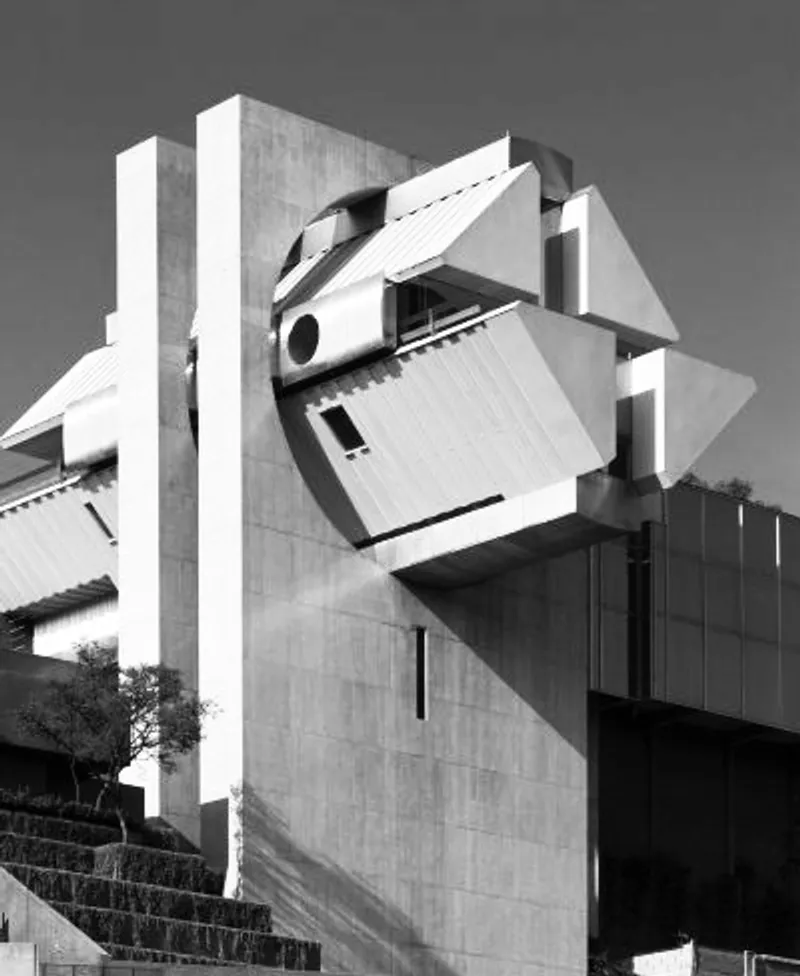
A Vision Suspended in the Sky
From a distance, the house appears as though it hovers effortlessly above the terrain — a cantilevered architectural icon supported by two monumental concrete pylons pierced by circular openings. Through this void passes the elongated, prismatic body of the home, its bold geometry striking a perfect balance between structural logic and artistic expression.
Hernández’s design is rooted in three guiding principles:
- Originality of form and expressive value – pushing architecture beyond mere function into the realm of sculpture.
- Innovative interior solutions – creating fluid, interconnected spaces without traditional walls.
- A reinterpretation of pre-Columbian architecture – drawing from ancient Mexican geometry, particularly the symbolic interplay between the circle and square.

Design in Harmony with the Terrain
The site’s steep slope at the end of a wide avenue determined the structural strategy. By elevating the main volume, Hernández preserved open ground space and eliminated the need for heavy retaining walls. The design also maximizes panoramic views of the surrounding cityscape while maintaining privacy.
The rhomboidal volume articulates the façade’s horizontal lines:
- The widest section houses the reception and social spaces.
- The intermediate floors contain private bedrooms.
- The narrowest section is dedicated to service areas.
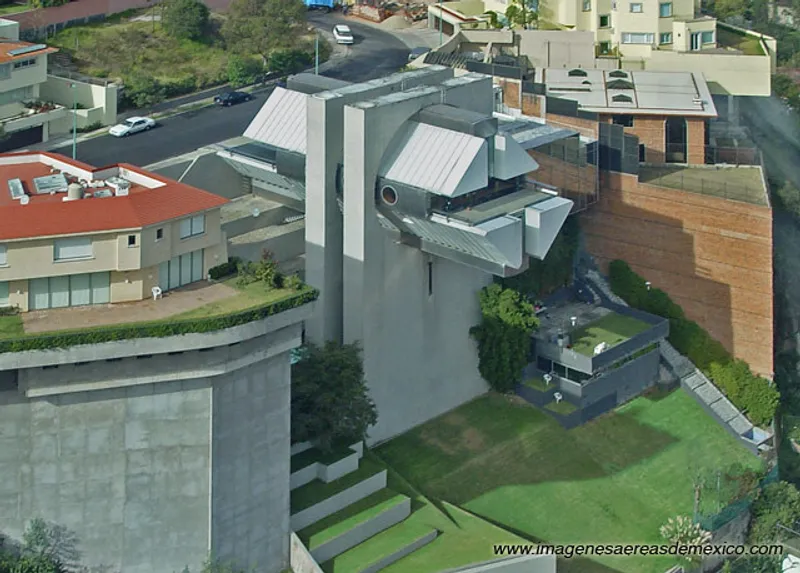
A Dramatic Arrival Experience
Entry to Casa en el Aire is through a 30-meter-long glass corridor, fully covered with domes. This transitional space plays with light and shadow, creating a dynamic refraction effect where deep purple tones dominate, heightening the sense of theatrical arrival.
An Open Interior Landscape
Rejecting conventional partitions, Hernández designed the interior as a series of interconnected zones defined by furniture, art pieces, and subtle architectural elements. Predominant materials — wood, concrete, steel, and glass — are combined in a sober, elegant palette that enhances the sculptural quality of the spaces.
Lifestyle and Amenities
- Outdoor parking integrated seamlessly into the elevated structure.
- A wine cellar embedded within the load-bearing walls.
- A pool in a stepped garden with a cascading waterfall flowing from the upper level, merging nature and architecture.
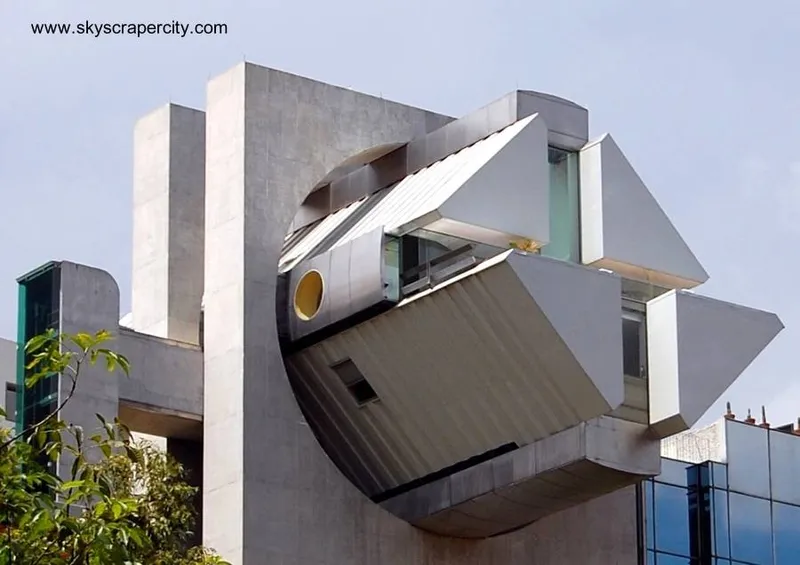
Structural Ingenuity
The house’s framework is based on a 1.15-meter module. Two massive reinforced concrete supports work in compression, while the cantilevered portion is constructed from a prefabricated metal frame bolted to four master beams. This structural system enables the building to have six visible façades, each transparently expressing the interior volumes through carefully placed windows, skylights, and openings.
A House from the Future, Rooted in the Present
Often described as something out of a science fiction film, Casa en el Aire stands as a timeless testament to optimism in modern architecture. As Hernández himself explains:
“For me, a house is an abstract concept of interrelated spaces where the comfort and well-being of the human being prevail — a habitable microcosm.”


Popular Articles
Popular articles from the community


Architekt Andreas Gruber Scatters 23 Dark Timber Chalets Across a South Tyrolean Forest Edge
In Molini di Tures, Amonti Chalets breaks a resort into a hamlet of gabled timber houses, with parking, storage and services pushed into the slope.

longwave studio Reorganizes a 112 m² Tainan Apartment Around the Daily Routines of a Family and Two Cats
In Tainan, Taiwan, birch plywood, rust-red furniture and a freestanding plaster wall link arrival, storage, work and family life in one apartment.

U.GA Architects Wraps an Oval Rooftop Pool in Curved Board-Formed Concrete on Busan's Jeollidan-gil
In Busan's Jeonpo-dong, a 454 m² mixed-use block stacks a neighborhood facility, guest rooms and an oval rooftop pool inside spiraling concrete walls.

LT2A and OPEN Architectes Thread a Brick and Glass High School Through a Wooded Belgian Campus
In Braine-l'Alleud, a 3,000 m² wing for Collège Cardinal Mercier pairs pale brick with a glazed colonnade, deferring to a small chapel and a dense wood.

Similar Reads
You might also enjoy these articles


Hodi-Mandai Geram
Project Function: Preservation and revitalization of the Intangible heritage and socio-spatial identity of the Hodi by Housing, Cultural Memory Center, Sacred Grove, landscape, local tourism economy


Olio Towers: A Mid-Rise for Performers That Fuses Housing, Rehearsal, and Stage
Located blocks from Houston's Theater District, this modular tower stacks living units around a central performance atrium.

Oasis: Modular Green Housing Carved into Dhaka's Urban Fabric
A shortlisted Plugin Housing entry reclaims unauthorized settlements in Dhaka with stepped concrete volumes, green roofs, and ventilation-driven design.

Black Hole: A Floating Megastructure for the Post-Physical Era
Emiliano Mazzarotto envisions a spherical, self-scaling arena where e-sports, digital hotels, and holographic stadiums replace traditional public space.

Explore Architecture Competitions
Discover active competitions in this discipline

Challenge to reimagine the Iron Throne

Photograph architecture without architects

Illustrate the lost glory of Angkor Wat - Render Challenge

Design challenge to reuse E-waste
Comments (0)
Please login or sign up to add comments
No comments yet. Be the first to comment!