

Architecture Growth: Modular Containers That Evolve Like Living Organisms
Anastasiia Mina's container architecture borrows its logic from cellular biology, growing from single modules into dynamic urban structures.


What if a building could grow the way a plant does? Not through blueprints revised and redrawn, but through a logic of accumulation: cell joins cell, module joins module, and a structure emerges that is never truly finished. That is the provocation at the heart of Architecture Growth, a project that treats shipping containers not as cheap construction shortcuts but as architectural DNA, the smallest repeatable unit from which complex urban organisms can develop.
Designed by Anastasiia Mina, the project maps the transformation of a single container through four evolutionary stages, arriving at a multi-storey, mixed-use structure that integrates greenery, public pathways, and community farming. The formal language draws explicitly from organic growth patterns, referencing the ear of rye and the movement of petals, while the modular system promises something conventional construction rarely delivers: genuine adaptability over time.
From Cell to City Block: Four Stages of Growth
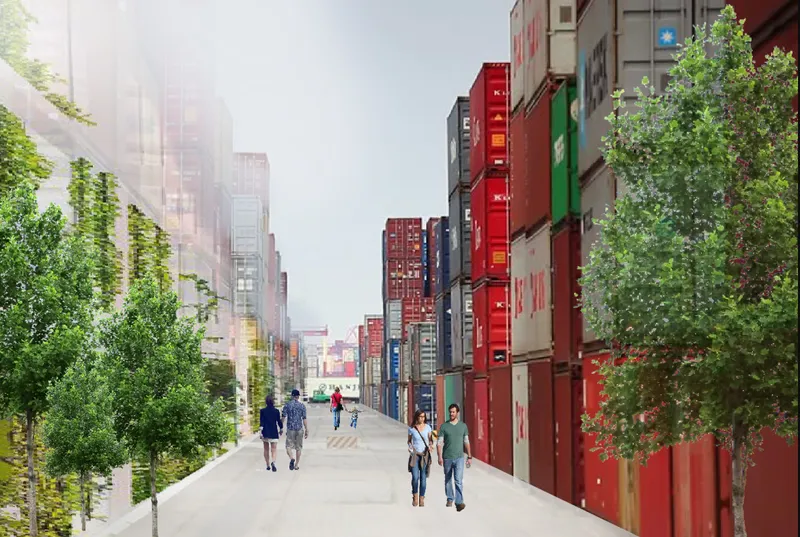
Mina organizes the design around a clear evolutionary sequence. It begins with the Organism, Cell, Module stage, where each container functions as an independent unit, a self-contained building block analogous to a biological cell. These units then merge into a Unified Organism, an interconnected framework where containers share walls, circulation, and structural loads. The third stage pushes the system vertical into a Multi-Storey Structure, optimizing limited urban land by stacking and interlocking modules upward. The final stage, Dynamic Architecture, produces a form that blends structure, sculpture, and sustainable living into a single cohesive entity. The street-level rendering captures this culmination: stacked container volumes rise above a tree-lined pedestrian pathway, their arrangement loose enough to feel organic yet deliberate enough to hold habitable space.
What matters here is the distinction between modularity and repetition. Plenty of container architecture simply stacks identical boxes. Mina's framework insists on transformation at each stage. The containers fold, expand, and reconfigure according to community needs, which means the architecture is never locked into a single programme. Living space today could become a farming terrace or a cultural venue tomorrow.
Proving the Logic in Cardboard and Wire
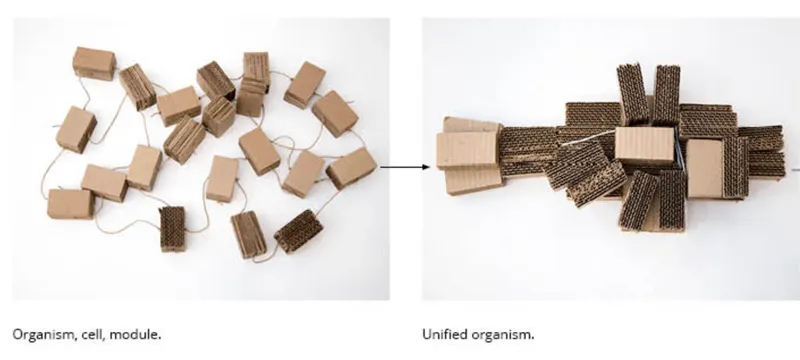
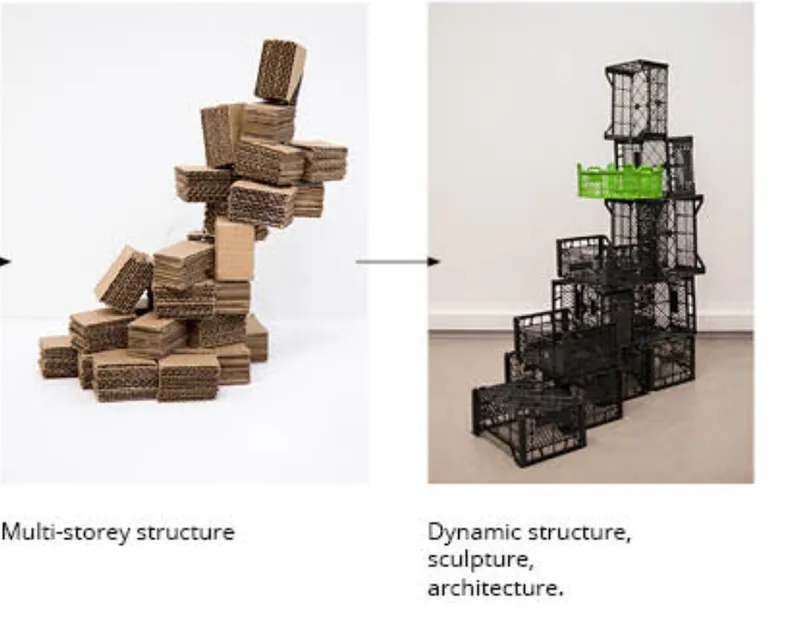
Two physical models make the growth narrative tangible. The first shows cardboard modules scattered as individual units, then progressively assembled into a dense, clustered form. You can read the transition from isolation to community in a single glance. The second model advances the material language: stacked cardboard volumes give way to black wire-frame crates, with a single green crate introduced as a signal of ecological programme, urban farming, greenery, or public garden space entering the structural matrix.
These models do more than illustrate the concept; they test it. The shift from solid cardboard to open wireframe demonstrates how the system can vary in enclosure and transparency, producing closed habitable rooms alongside open, ventilated agricultural zones. The green crate is a small but effective move, anchoring the project's sustainability claims in a physical object rather than leaving them as abstract rhetoric.
Urban Farming as Architectural Programme
Sustainability in this project is not limited to material reuse. Mina positions urban farming as a core programme, not an afterthought bolted onto a rooftop. The architectural language itself reflects this commitment: forms that recall rye ears and petal movements are not arbitrary stylistic choices but indices of a deeper alignment between building and cultivation. The design integrates greenery and public pathways to encourage community interaction, and it proposes mixed-use spaces that combine living, farming, and cultural activities within the same modular framework.
By targeting neglected or underutilized urban spaces, the project positions container architecture as a tool for regeneration rather than gentrification. The containers arrive, adapt, and grow with the community, a process that mirrors the agricultural cycles the design celebrates. Architecture here becomes, as Mina describes it, a living, breathing system that sustains the urban communities it serves.
Why This Project Matters
Container architecture has been explored exhaustively, and much of that exploration has settled into a comfortable formula: stack, paint, photograph. What Mina brings to the conversation is a developmental framework, a way of thinking about container buildings not as finished objects but as systems in motion. The four-stage growth model gives designers, communities, and policymakers a shared vocabulary for incremental urban development, one that does not require a master plan to be complete before the first unit is inhabited.
Equally important is the insistence on biological metaphor as a structural, not merely aesthetic, principle. When Mina compares modules to cells and buildings to organisms, the claim is operational: the architecture should be capable of adaptation, regeneration, and expansion at every scale. That is a high bar, and the physical models suggest the idea has real spatial legs. For cities facing rapid growth, shrinking budgets, and climate pressure, a modular system that can fold, expand, farm, and house on the same chassis is not a fantasy. It is a necessity that this project begins to articulate with clarity.
View the Full Project
About the Designers
Designer: Anastasiia Mina
Enter a Design Competition on uni.xyz
uni.xyz runs architecture and design competitions year-round that reward proposals with spatial conviction and real site intelligence.
Project credits: Architecture Growth by Anastasiia Mina.


Popular Articles
Popular articles from the community


Opera by the Sea Estonia: Three Shells Dissolving Architecture into Tallinn's Coastline
A winning opera house proposal replaces monumental form with interconnected shells that blur the boundary between building, park and Baltic Sea.

Opera on the Sea: Driftwood Logic Shapes a Timber Opera House on Estonia's Coast
Trevor Orgill's opera house translates the entangled drift of floating timber into a civic building where wood, water, and music converge.

Faces of the Soviet Avant-Garde: Turning Moscow's Street Names into an Open-Air Museum
A network of sculptural installations across a Moscow residential district transforms forgotten architect names into spatial encounters with cultural memor

Manzana Morphosis: Stretching Barcelona's Grid into a Living Landscape for 2050
A radical reworking of the Eixample manzana turns density into a tool for generous public space, vertical ecology, and environmental performance.

Similar Reads
You might also enjoy these articles

Bao Huynh Watercolor Atelier: A Serene Art Retreat in Hội An
Bao Huynh Watercolor Atelier in Hội An blends multifunctional art spaces, sustainable design, local materials, and family-friendly living in a serene environment.

Atelier Macri Concept Store Interior Design by CASE-REAL
Atelier Macri store features a "ko" counter, walnut wood details, cork displays, blending retail, gallery, and seamless customer experiences.

Manuel Vargas Izquierdo Stadium and High-Performance Sports Center: Architectural Excellence in Jalpa de Méndez
The Manuel Vargas Izquierdo Stadium blends sustainable design, inclusive sports facilities, and cultural-inspired architecture, revitalizing Jalpa de Méndez’s public spaces.

KAKR Buluh Awar Hall: Revitalizing Community and Ecology Through Bamboo Architecture
Community built bamboo hall revitalizes Buluh Awar village, empowering youth, restoring ecology, celebrating vernacular craftsmanship through sustainable architecture and culture.

Explore Architecture of Tomorrow Competitions
Discover active competitions in this discipline

Challenge to reimagine the Iron Throne

Photograph architecture without architects

Illustrate the lost glory of Angkor Wat - Render Challenge

Design challenge to reuse E-waste
Comments (0)
Please login or sign up to add comments
No comments yet. Be the first to comment!