
suatudio Splits a Multigenerational Home into Interlocking Concrete Volumes in West Java
Rumah Tahu House in Sumedang, Indonesia adapts to sloping terrain with split levels, timber decks, and deep overhangs for two generations.


An architect designing their own home is always an exercise in self-interrogation. Rumah Tahu House, completed in 2025 by suatudio lead architects Gagas Firas Silmi, Arif Rachman Hidayat, and Adhietya Orlandho Putra Sunarmo, sits on sloping ground in Sumedang, West Java, and serves two generations of one family. At 131 square meters, it is modest in area but ambitious in section, using the grade change to stack and stagger a sequence of concrete volumes that read less like a single dwelling and more like a small compound negotiating the landscape.
What makes the project genuinely interesting is how it treats the split level not as a pragmatic concession to topography but as the organizing principle of domestic life. Every threshold, from the gravel courtyard to the cantilevered mezzanine, establishes a new datum. Rooms don't simply sit beside each other; they overlap, peer down, and breathe outward through glazed walls and timber decks. The result is a house that feels spatially generous despite its compact footprint, a quality that owes everything to section and nothing to excess square footage.
Concrete Volumes and the Street


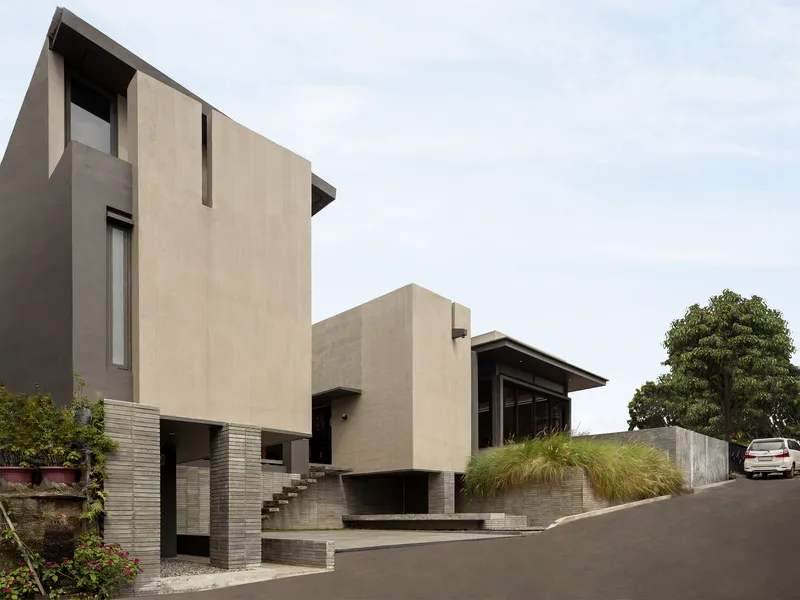
From the street, Rumah Tahu presents itself as a cluster of raw concrete masses separated by a gravel courtyard and connected by external stairs. The material palette is deliberately restrained: board-formed concrete, tile-clad retaining walls, and ornamental grasses that soften the base. There is no monolithic facade. Instead, the house reveals its internal logic immediately. You can read the split levels, the stair routes, and the separation between programmatic zones before you step inside.
At dusk, the upper glazed living volume glows against the muted concrete tower, turning the house into a lantern visible from the road. The cantilevered flat roofs extend beyond the walls with enough depth to provide serious rain protection, a non-negotiable in tropical West Java, without closing down the facade. The external stair, running alongside a louvered screen, doubles as a vertical garden boundary, anchoring the architecture to the terrain rather than hovering above it.
The Terrain as Architecture

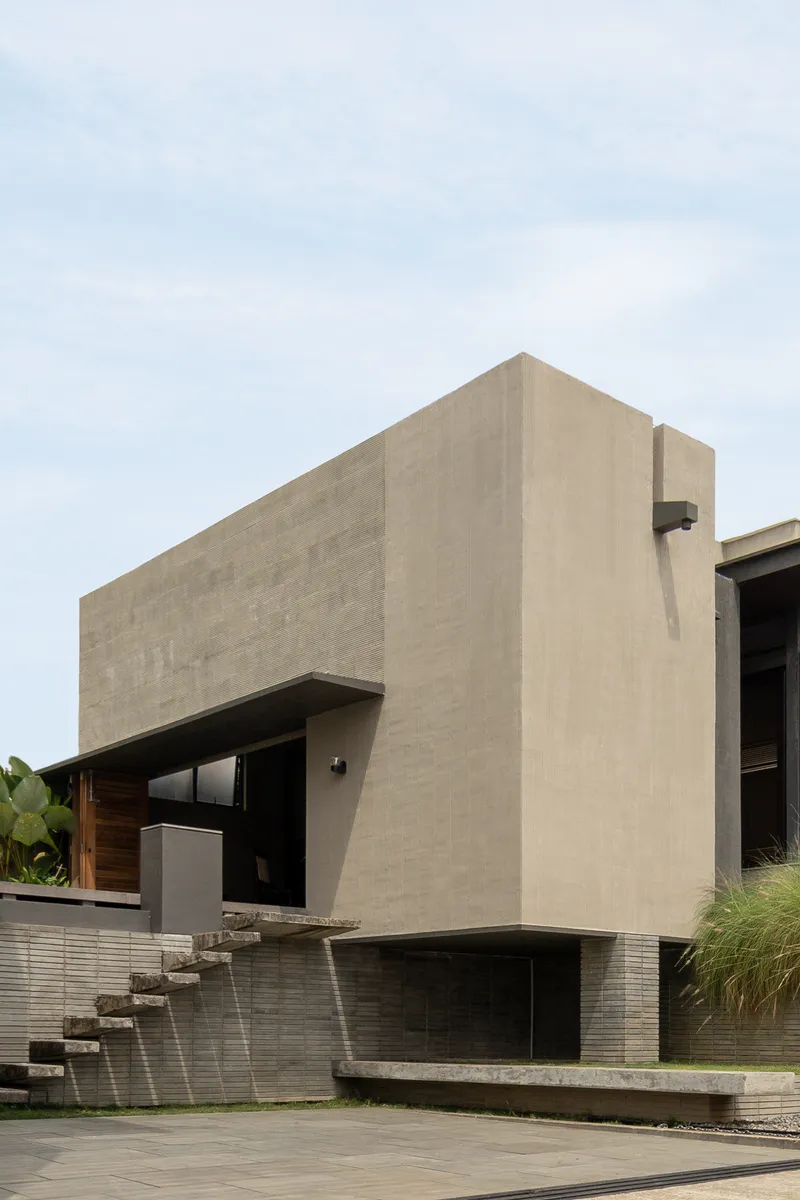
The sloping site could have been flattened and forgotten. suatudio chose instead to let the grade shape the section. The rear elevation reveals the full ambition: glazed volumes sit elevated on striped masonry plinths, and the lawn slopes away beneath them, creating a dialogue between the inhabited spaces and the ground they barely touch. A cantilevered concrete mass hovers above a water feature, its weight visually suspended over stone steps, a move that is theatrical but never gratuitous.
Ornamental grasses and a single tree occupy the spaces between volumes, not as decoration but as spatial connectors. They blur the line between courtyard and garden, between the public face of the house and its private rear. The external stairs climbing the concrete wall beside horizontal louvered screens underscore a key idea: circulation in this house is not hidden. It is celebrated as the primary spatial experience.
Double Height Living and the Floating Stair
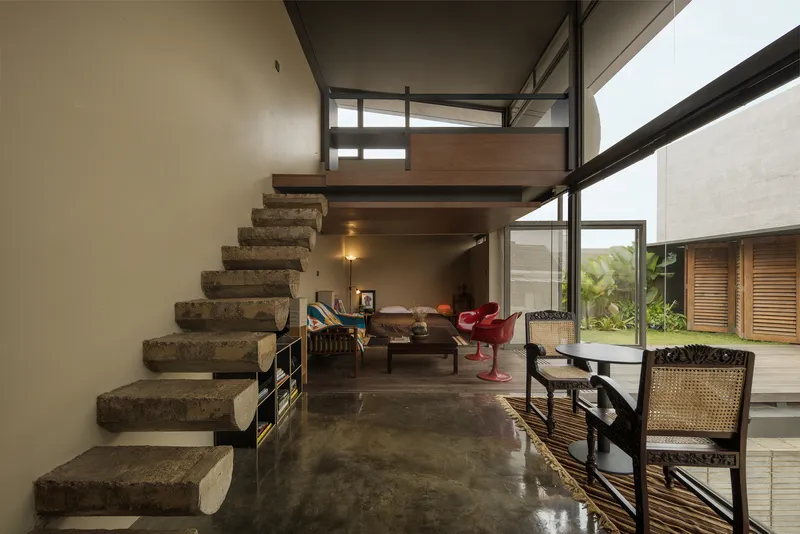


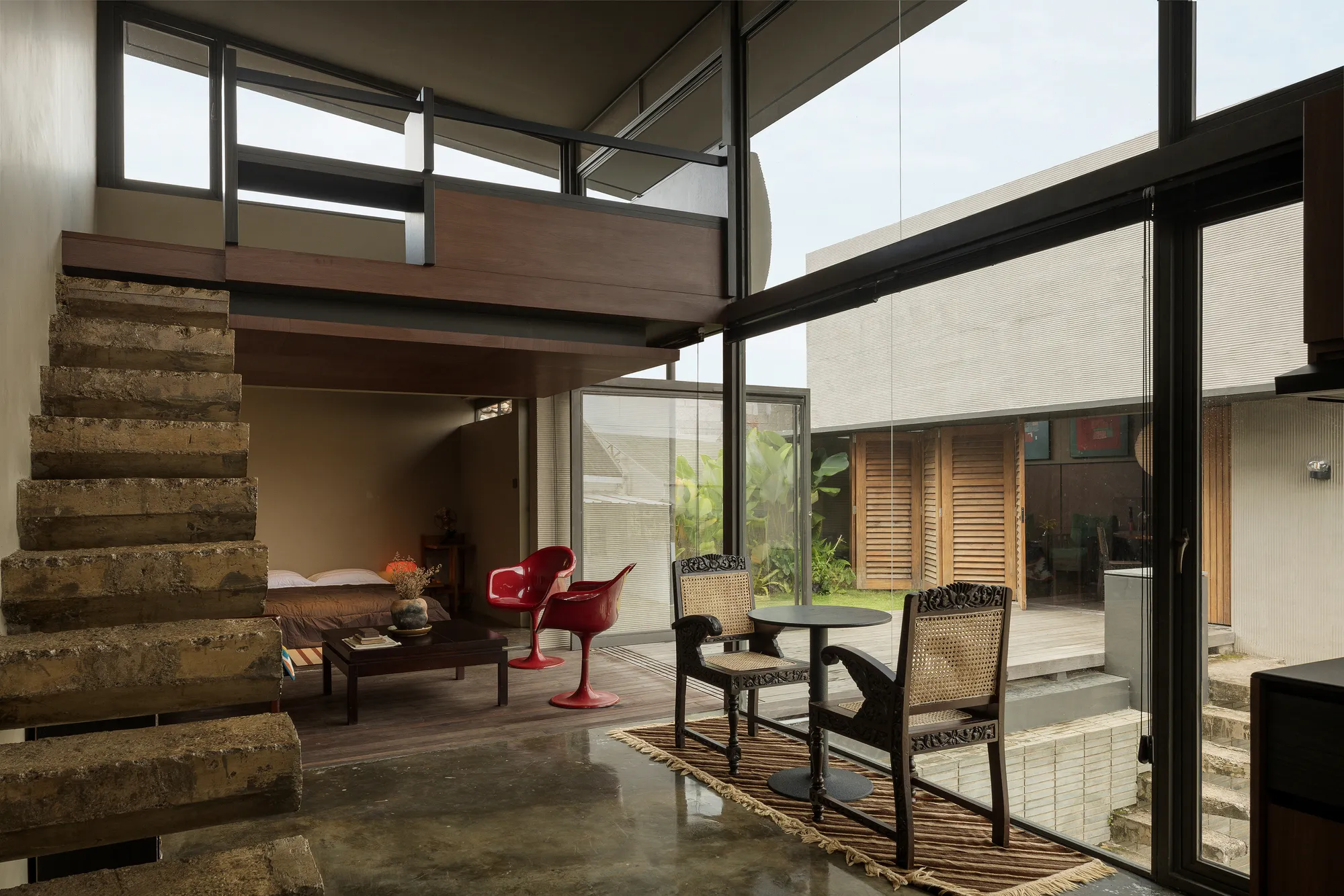
The interior heart of Rumah Tahu is its double-height living space. A cantilevered mezzanine and an exposed concrete staircase dominate the volume, establishing a vertical section that connects the lower gathering areas to the upper bedroom level. The stair floats free of the wall on one side, casting sharp shadows that shift through the day. Full-height glazing on the courtyard side washes the concrete in natural light, preventing the raw material from feeling oppressive.
The planted courtyard visible through the glass is not incidental. It is the visual anchor that orients every room on the ground floor. Sit in the living area and you look through glass to greenery to sky. Stand on the mezzanine and you look down into the same courtyard from above. The architects have used a single outdoor space to unify multiple interior levels, a smart economy of means.
Timber, Light, and the Intimate Rooms

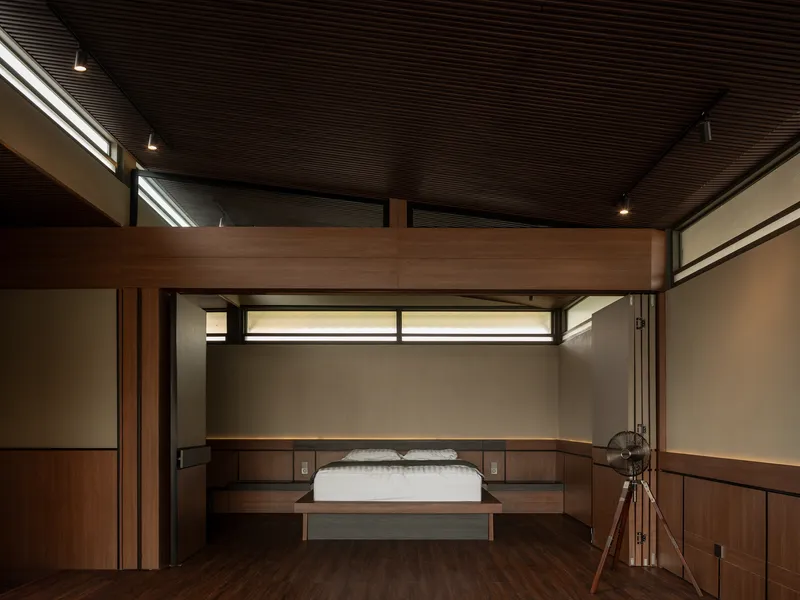
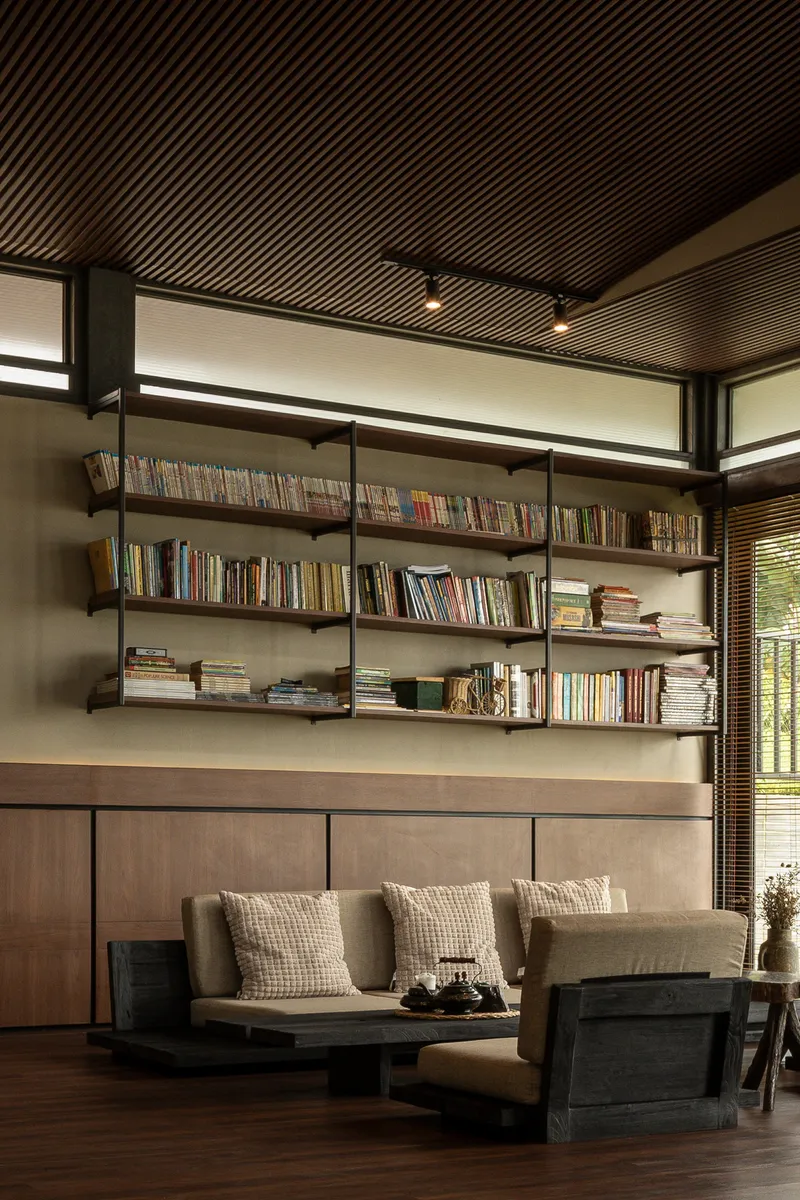
Where the public spaces are concrete and glass, the bedrooms shift to timber. Slatted ceilings diffuse light that enters through clerestory windows, creating a warm, low-ceilinged atmosphere that contrasts sharply with the double-height living volume. The bedroom platforms, built in timber over dark wood flooring, feel grounded and protective. Horizontal clerestory strips run just below the ceiling plane, pulling in controlled daylight without sacrificing privacy.
A built-in bookshelf beneath one of these clerestory windows captures afternoon sun in a way that feels designed to the hour. The timber slat ceiling continues from bedroom to bookshelf nook, making the transition seamless. These are the moments where Rumah Tahu reveals its attention to daily ritual: the reading light at four o'clock, the warm glow on a bed platform at morning. For a multigenerational house, this care in the private rooms matters as much as the grandeur of the shared spaces.
Dining at the Edge
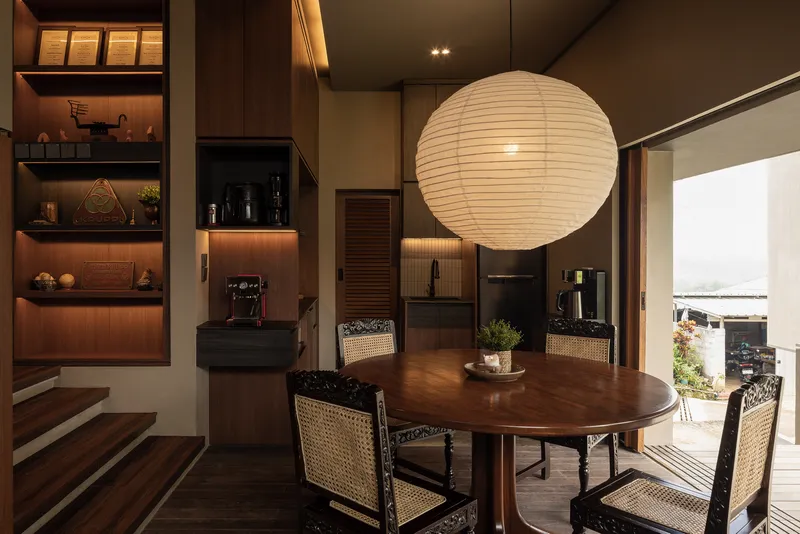

The dining area occupies a threshold condition, half inside, half terrace. A spherical paper lantern marks the center of the table, glowing at dusk like a second moon. Open shelving lines one wall, while the opposite side opens onto a timber deck that overlooks distant village rooftops dissolving into mist. The choice to place the dining room at this precise juncture, where interior warmth meets the vastness of the Sumedang landscape, is the most emotionally resonant move in the house.
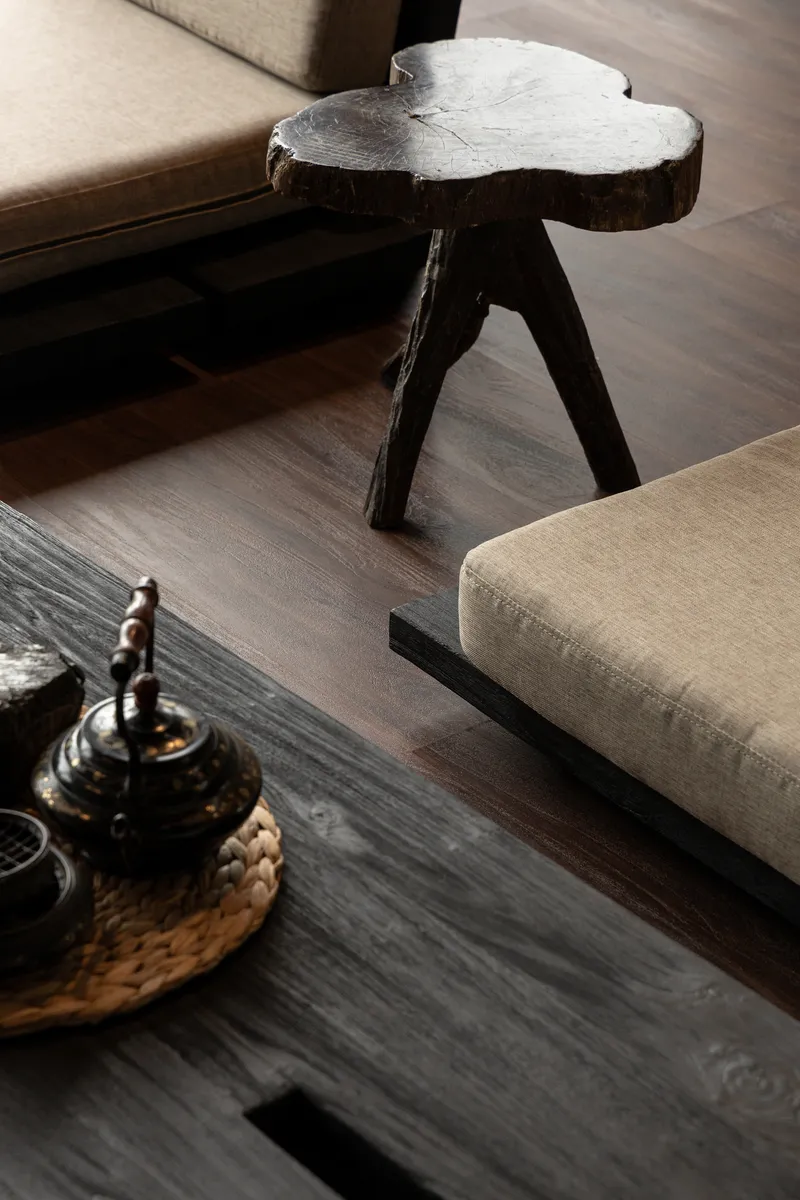
Details here are spare but precise. A live-edge timber side table sits on dark wood flooring beside upholstered seating and a metal teapot, objects that suggest a life actually lived rather than staged. The architects have resisted the urge to over-design the furnishings, letting the architecture do the work and the inhabitants bring the texture.
The Deck as Connective Tissue


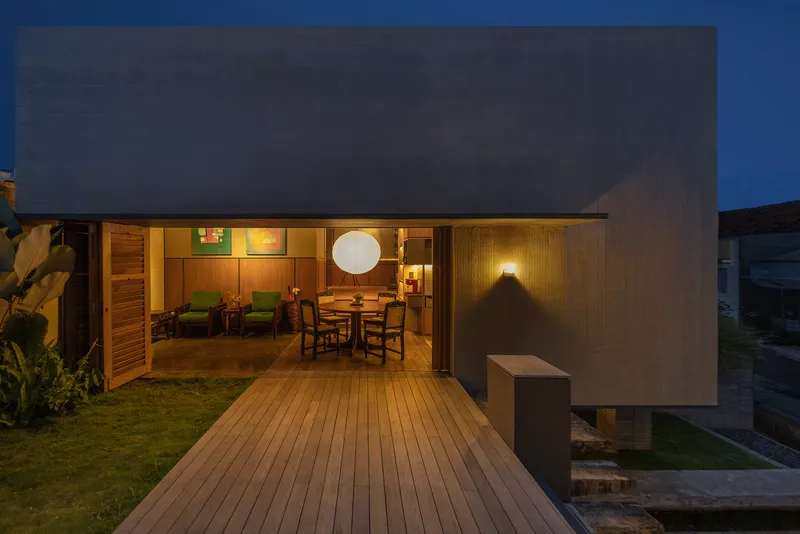
Timber decks wrap through the house like tendons, linking the concrete volumes to the garden, the living room to the dining terrace, the interior to the sky. The garden facade shows this most clearly: a broad deck leads to the glass-walled living room beneath a flat roof overhang, framed by vertical wood slats and tropical plants. At night, the deck becomes a stage, lit from within and bordered by darkness.
These decks are not just circulation. They are rooms without walls, places where the two generations sharing this house can overlap or retreat. In tropical Indonesia, outdoor living is not a luxury; it is the default. suatudio acknowledges this by making the decks as architecturally considered as the enclosed spaces, with the same material discipline and the same care for proportion.
Twilight and the Illuminated Section


The dusk photographs reveal what the daylight views only imply. The two-story facade becomes a sectional diagram drawn in light: the lower podium anchored in planted courtyard, the upper living space glowing behind glass, the cantilevered roof hovering as a dark band above. The house is legible at every scale, from the street to the garden to the distant hillside. The timber deck extending over the garden at dusk acts as a horizontal datum, connecting the illuminated interior to the darkening landscape beyond.
Plans and Drawings


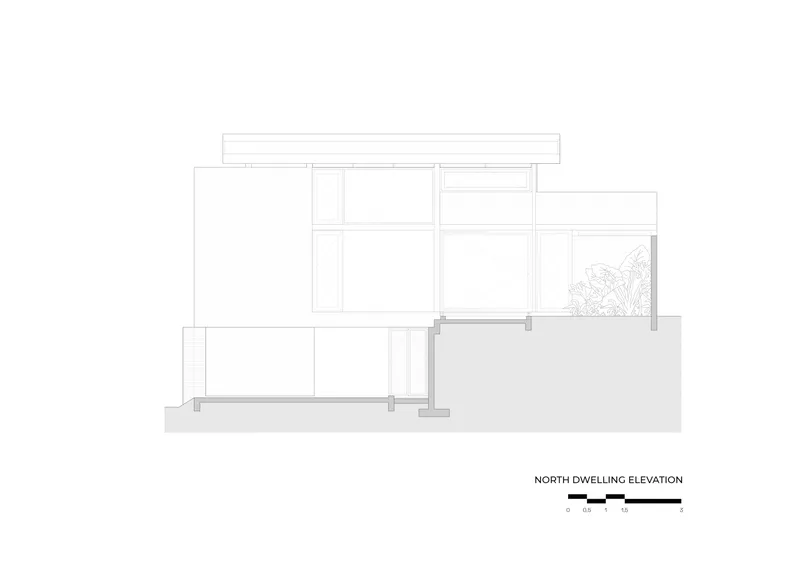


The floor plan confirms what the photographs suggest: an open living and dining core with an integrated terrace, flanked by a bedroom wing that steps down with the terrain. The elevations and sections are where Rumah Tahu truly communicates its ideas. The split-level section shows how every room occupies a different datum, with a sunken lower level carved into the slope and sloped roof planes that follow the hillside's natural inclination. The elevations reveal the louvered screens and stepped terrain as inseparable parts of a single architectural composition. These are honest drawings; nothing in the built work contradicts them.
Why This Project Matters
Rumah Tahu House matters because it demonstrates that a compact multigenerational home need not compromise on spatial richness. At 131 square meters, suatudio has delivered a house that operates in section as skillfully as many projects three times its size. The split levels, cantilevered volumes, and timber decks are not formal indulgences; they are direct responses to a sloping site and the social dynamics of two generations sharing one address. Every decision, from the placement of the dining terrace to the orientation of the clerestory windows, serves both the landscape and the life inside.
In a region where rapid development often flattens terrain and erases context, this house insists on working with what is already there. The Sumedang hillside enters every room, whether as a misty panorama from the dining deck or as a sloping lawn visible through the rear glazing. suatudio has built a house that belongs precisely where it stands, and nowhere else. That specificity, more than any material choice or formal gesture, is what makes Rumah Tahu worth studying.
Rumah Tahu House by suatudio (lead architects Gagas Firas Silmi, Arif Rachman Hidayat, Adhietya Orlandho Putra Sunarmo). Sumedang, Jawa Barat, Indonesia. Completed 2025. 131 m². Photography by Tristan Salim.
About the Studio
Share Your Own Work on uni.xyz
If projects like this are the kind of work you want to make, uni.xyz is a place to publish your own, find collaborators, and enter design competitions.



Popular Articles
Popular articles from the community


Conexión: Biophilic Design Reimagines High-Rise Living in Hong Kong
Conexión reimagines high-rise living in Hong Kong through biophilic design, green facades, shared spaces, daylight, water and nature within.

AL-JANNAH: Sustainable Architecture and Permaculture for Afghan Widows
AL-JANNAH uses sustainable architecture and permaculture to create resilient oasis of housing, learning, work and renewal for Afghan widows.

Riyadh For All: Intergenerational Urban Design for Active Aging in Rabat
Riyadh For All reimagines urban design in Rabat with intergenerational co-living, adaptive courtyards, and Moroccan cultural exchange today.
EW PARK: Sustainable Architecture Reimagines the Future of Urban Parking
EW PARK reimagines city parking as a modular wooden tower combining automation, solar energy, electric mobility, and adaptable urban design.


Similar Reads
You might also enjoy these articles

Bao Huynh Watercolor Atelier: A Serene Art Retreat in Hội An
Bao Huynh Watercolor Atelier in Hội An blends multifunctional art spaces, sustainable design, local materials, and family-friendly living in a serene environment.

Atelier Macri Concept Store Interior Design by CASE-REAL
Atelier Macri store features a "ko" counter, walnut wood details, cork displays, blending retail, gallery, and seamless customer experiences.

Manuel Vargas Izquierdo Stadium and High-Performance Sports Center: Architectural Excellence in Jalpa de Méndez
The Manuel Vargas Izquierdo Stadium blends sustainable design, inclusive sports facilities, and cultural-inspired architecture, revitalizing Jalpa de Méndez’s public spaces.

KAKR Buluh Awar Hall: Revitalizing Community and Ecology Through Bamboo Architecture
Community built bamboo hall revitalizes Buluh Awar village, empowering youth, restoring ecology, celebrating vernacular craftsmanship through sustainable architecture and culture.




Comments (0)
Please login or sign up to add comments
No comments yet. Be the first to comment!