
Architecture Saville Isaacs Cascades a Five-Level Concrete Retreat Down the Avoca Beach Hillside
Rockpool House stacks twelve-guest capacity across terraced volumes that negotiate bush, slope, and beachfront in coastal NSW.


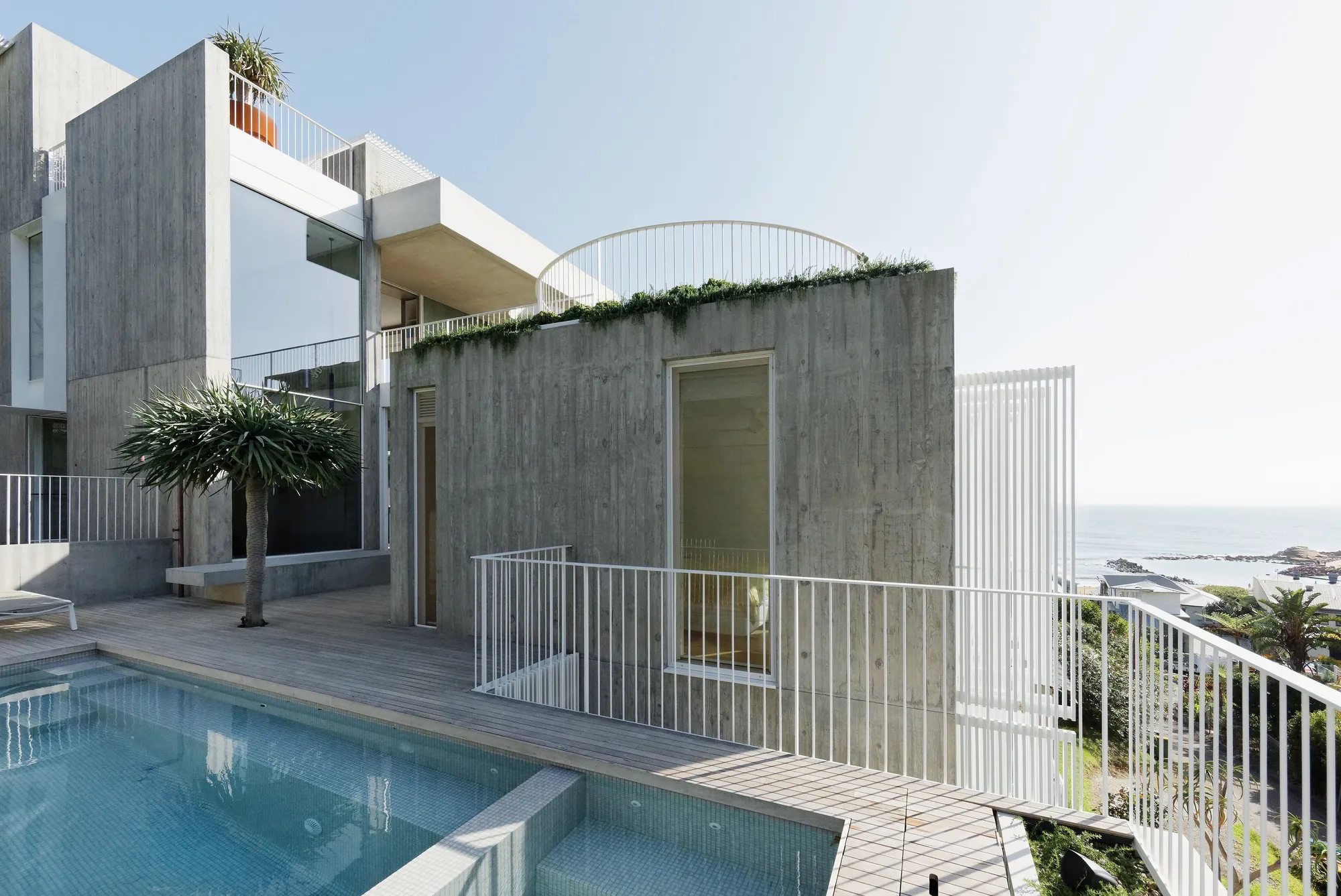
Building on a steep coastal site usually means choosing between the view and the land. Architecture Saville Isaacs refused the choice. Rockpool House, completed in 2026 on the Central Coast of New South Wales, drops five levels down a hillside that separates native bushland from wide beachfront, treating the slope not as a constraint but as the organizing logic for every room, terrace, and threshold in the house. The result is a 478 m² concrete cascade that reads from the street as a disciplined stack of white louvred volumes, and from the beach as a series of timber decks, planted ledges, and exposed concrete cores stepping toward the sand.
What makes the project worth studying is how seriously it takes the problem of multi-generational occupation. Sleeping twelve guests across a master suite and four king bedrooms, each with a private ensuite, Rockpool House must deliver both communal generosity and individual retreat. The sectional strategy solves this cleanly: shared living, cooking, and dining occupy the central level, while bedrooms peel away above and below, each opening onto its own terrace orientation. It is a house that moves with the day, catching morning sun on one side and sheltering from afternoon wind on the other.
Street Face: Louvres, Concrete, and Controlled Opacity


From the street, the house is almost reticent. White vertical louvres wrap the upper floors, screening the interior from the public road while admitting light and breeze in controlled strips. Below, a recessed garage entry for eight cars tucks into an exposed concrete plinth. The ribbed white facade steps back at each level, revealing board-formed concrete cores and planter boxes that soften the transition between architecture and the coastal vegetation climbing the hillside.
The louvre system does double duty. It flattens the visual mass of a five-storey house into something that reads as a series of thin horizontal bands, and it gives privacy to bedrooms that would otherwise be fully exposed to the slope above. The decision to leave the concrete structure visible at the base anchors the house in geological terms: the building looks as if it has been carved from the hill, not placed on it.
The Oculus and Outdoor Rooms


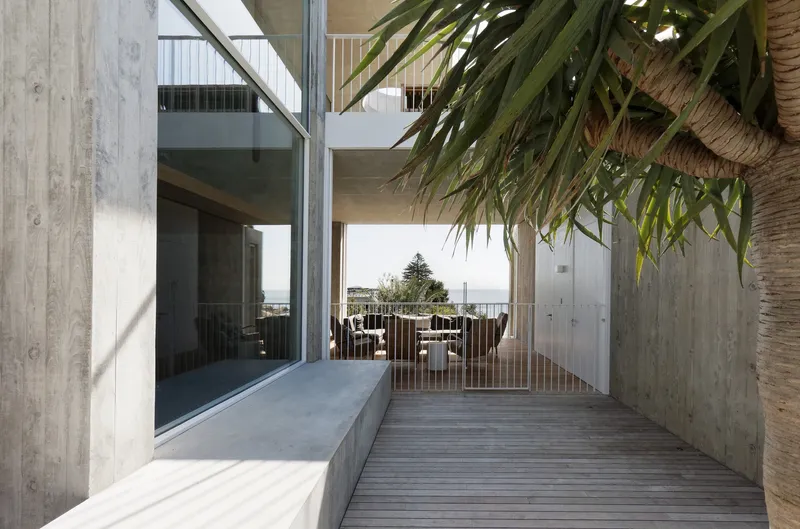
A circular opening cut through a concrete soffit, referred to as "The Oculus," is the spatial signature of Rockpool House. It frames nothing but sky, casting a disc of moving light across the timber-decked terrace below and marking the passage of hours more legibly than any clock. The gesture is simple but effective: it turns a covered outdoor room into a kind of sundial, connecting an otherwise sheltered space to the atmosphere overhead.
Terraces proliferate across all five levels, each tuned to a different moment. A slatted canopy terrace faces the ocean for long afternoon shade. A timber passage beneath a heavy concrete slab channels a view past palm fronds to the sea. A roof deck with low seating opens panoramically to the bay. Rather than offering one grand balcony, the architects distribute outdoor living across the section, so that someone in the house can always find the right exposure.
Material Palette: Board-Formed Concrete and Coastal Stone


The material language is deliberately restrained. Board-formed concrete walls carry the texture of their timber formwork, lending warmth and grain to what might otherwise feel industrial. A timber staircase with open treads rises between these walls and a glass balustrade, creating a vertical spine that stitches the levels together without enclosing them. Ground-back floors embedded with white pebbles give underfoot surfaces a tactile, almost geological character.
Elsewhere, Euromarble with visible veining lines bathroom surfaces, and Patricia Urquiola tiles add a handcrafted layer to wet areas. The palette sits at the intersection of rawness and refinement, what the architects describe as "barefoot luxury." Nothing is polished to a mirror finish, but nothing is rough enough to feel unresolved. It is a house designed to be touched, to register sand on bare feet without suffering for it.
Living and Kitchen: The Communal Heart


The open-plan kitchen, living, and dining level is where the house gathers its twelve occupants. Full-height glazing on the ocean side dissolves the wall plane entirely, making the polished concrete floor read as a continuous surface that simply happens to be indoors. A fireplace anchors the living zone, pulling the family inward on colder evenings when the wind picks up off the water.
The kitchen is the most visually striking interior moment. A long island clad in green-veined stone, likely the Euromarble noted in the project's material schedule, runs beneath white cabinetry that stretches toward a glazed corner. A ribbed white partition wall separates the cooking zone from the dining area without severing the visual connection between them. The ribbing echoes the louvre language of the exterior facade, maintaining material consistency across inside and out.
Private Retreat: Bathing and the Master Suite
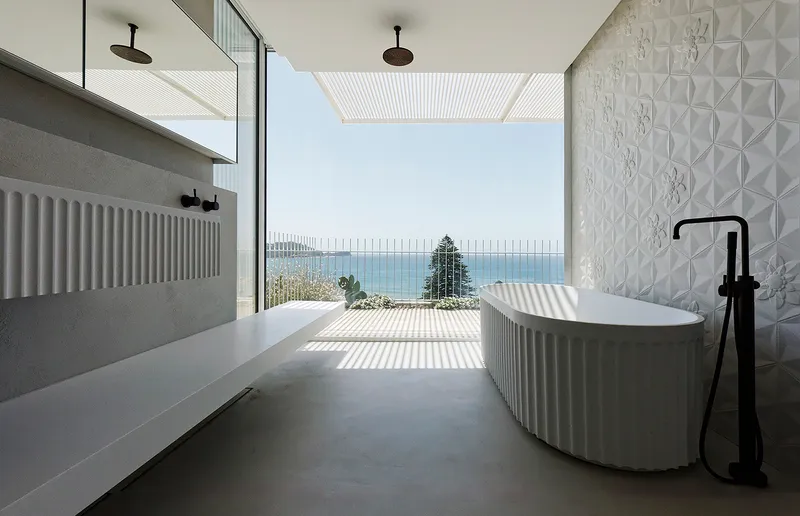

The master suite occupies the top floor, the most private and panoramic level. Its spa ensuite, fitted with a freestanding soaking tub and double shower, opens through a corrugated screen to a direct ocean view. The screen filters light into soft vertical bands, turning the act of bathing into a slow, meditative experience rather than a performative one. Privacy and exposure coexist here without contradiction.
On the adjacent terrace, a white fabric canopy billows in the afternoon breeze, softening the hard geometry of the timber deck. The canopy introduces the only genuinely ephemeral element in the entire project: fabric responding to wind, a material that changes character minute by minute. It is a small detail, but it reveals an attention to sensory experience that runs through every level of the house.
The Rooftop and Pool Deck

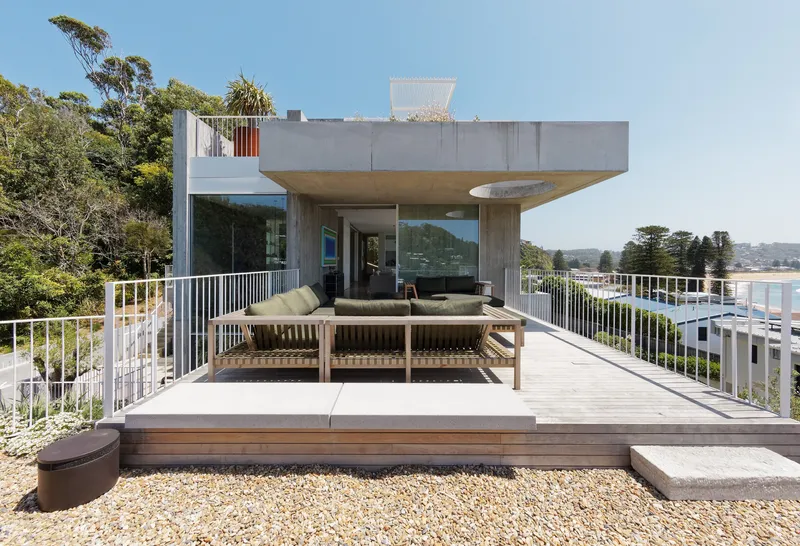

The roof terrace caps the composition with timber decking, a single palm tree, and a curved planted parapet that softens the building's top edge into something almost sculptural. Landscaping by Spirit Level continues the integration strategy here, using native coastal species to blur the line between architecture and terrain. From this vantage point, the bay unfolds in a wide panorama, and the house below disappears entirely into the slope.
At pool level, a heated pool and curved concrete pavilion sit behind white metal railings with the coastline stretched out beyond. The pavilion roof curls slightly, a subtle formal move that distinguishes it from the orthogonal volumes above. Combined with a sauna, cold plunge, and wine cellar distributed across the lower levels, the pool deck completes a wellness program that treats the house less as a residence and more as a retreat compound calibrated for extended family stays.
Why This Project Matters
Multi-generational houses are often resolved in plan: a main wing here, a granny flat there, connected by a corridor or courtyard. Rockpool House resolves the problem in section, using the hillside to separate and reconnect its occupants vertically. Each level claims its own relationship to sun, wind, and view, which means that privacy is achieved through topography rather than doors. It is a strategy that only works because the architects committed fully to the cascading form, letting the slope dictate the building rather than fighting it with retaining walls and flat pads.
The broader lesson here is about restraint in material terms and generosity in spatial ones. Board-formed concrete, timber, stone, and glass do not constitute an exotic palette, but they are deployed with enough precision and enough variation, the Oculus cut, the ribbed partitions, the veined stone island, to sustain interest across five levels and nearly 500 square metres. Architecture Saville Isaacs have produced a house that feels inevitable on its site, which is the hardest thing to achieve and the surest sign that the design decisions were correct.
Rockpool House by Architecture Saville Isaacs. Avoca Beach, New South Wales, Australia. 478 m². Completed 2026. Landscape design by Spirit Level. Photography by Kata Bayer.
About the Studio
Share Your Own Work on uni.xyz
If projects like this are the kind of work you want to make, uni.xyz is a place to publish your own, find collaborators, and enter design competitions.




Popular Articles
Popular articles from the community


Hill & Cross Opera: Sculptural Opera House Architecture Shaped by Tallinn’s Landscape and Identity
Hill & Cross Opera reimagines opera house architecture in Tallinn through its sculptural hill, civic plaza, glass wave and a luminous cross.

Riyadh For All: Intergenerational Urban Design for Active Aging in Rabat
Riyadh For All reimagines urban design in Rabat with intergenerational co-living, adaptive courtyards, and Moroccan cultural exchange today.

Co-life: Sustainable Architecture for Age-Friendly Community Living
Co-life reimagines sustainable architecture for seniors through courtyards, rammed earth, shared gardens, and spaces designed for belonging.
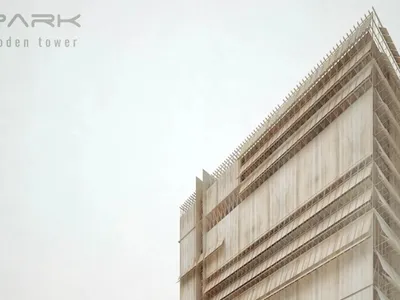
EW PARK: Sustainable Architecture Reimagines the Future of Urban Parking
EW PARK reimagines city parking as a modular wooden tower combining automation, solar energy, electric mobility, and adaptable urban design.


Similar Reads
You might also enjoy these articles

Bao Huynh Watercolor Atelier: A Serene Art Retreat in Hội An
Bao Huynh Watercolor Atelier in Hội An blends multifunctional art spaces, sustainable design, local materials, and family-friendly living in a serene environment.

Atelier Macri Concept Store Interior Design by CASE-REAL
Atelier Macri store features a "ko" counter, walnut wood details, cork displays, blending retail, gallery, and seamless customer experiences.

Manuel Vargas Izquierdo Stadium and High-Performance Sports Center: Architectural Excellence in Jalpa de Méndez
The Manuel Vargas Izquierdo Stadium blends sustainable design, inclusive sports facilities, and cultural-inspired architecture, revitalizing Jalpa de Méndez’s public spaces.

KAKR Buluh Awar Hall: Revitalizing Community and Ecology Through Bamboo Architecture
Community built bamboo hall revitalizes Buluh Awar village, empowering youth, restoring ecology, celebrating vernacular craftsmanship through sustainable architecture and culture.

Explore Seaside Architecture Competitions
Discover active competitions in this discipline


Challenge to design mud housing for contemporary communities


Challenge to reimagine the Iron Throne


Photograph architecture without architects


Illustrate the lost glory of Angkor Wat - Render Challenge
Comments (0)
Please login or sign up to add comments
No comments yet. Be the first to comment!