
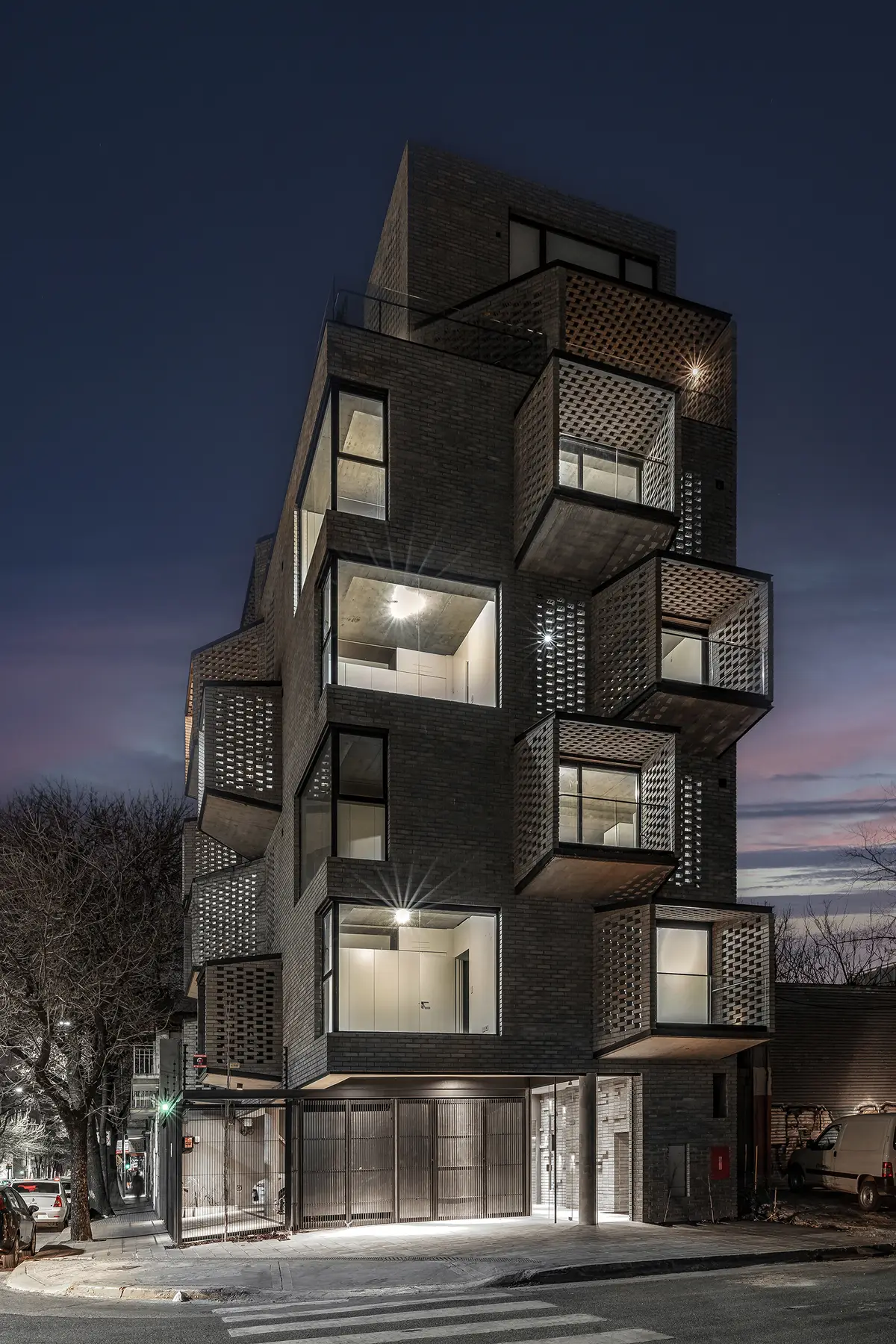
Arqtipo Stacks Trapezoidal Brick Balconies into a Buenos Aires Housing Tower
Ten apartments on a narrow corner lot in Villa Urquiza use perforated brickwork as climate screen, privacy filter, and urban identity.


On a corner plot barely nine meters wide and thirteen deep, wedged between Monroe Street and the Mitre railroad tracks in Villa Urquiza, Arqtipo has packed ten apartments into a seven-story brick tower that somehow reads as both monolithic and deeply porous. M 5605 Housing, completed in 2022, won the Brick Award 2024 in the Living Together category, and the recognition is deserved: the project treats a single humble material, Corblock's Bricko brick, as the basis for an entire architectural vocabulary of screens, parapets, soffits, and cantilevers.
What makes the building genuinely interesting is not just the brick obsession but the strategic geometry of its balconies. Each one is designed as a trapezoidal oriel: closed on the sides, top, and bottom, tapering toward the street, with a glass parapet at the narrow end. The result is a series of bellows-like expansions that negotiate noise from the adjacent rail corridor, modulate privacy between neighbors, and control daylight without a single operable shutter. It is a housing block where the envelope does all the heavy lifting.
A Corner Lot with a Railroad Problem
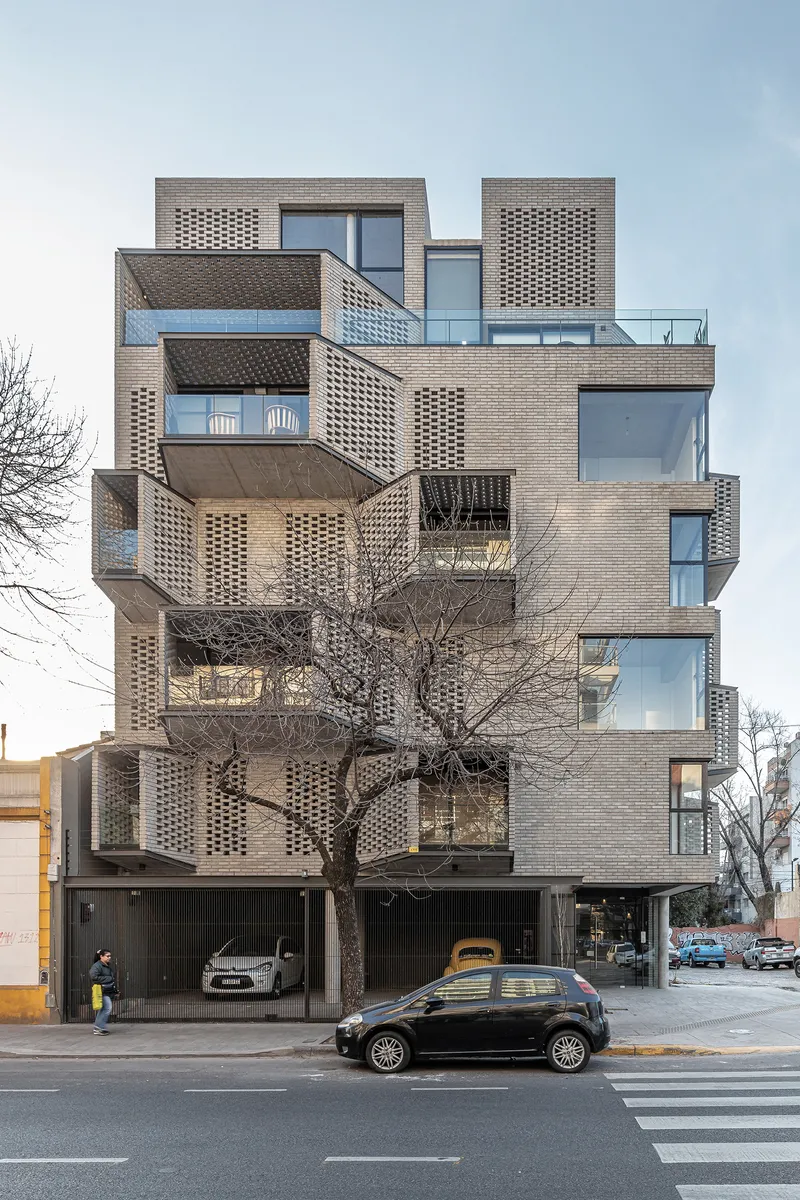
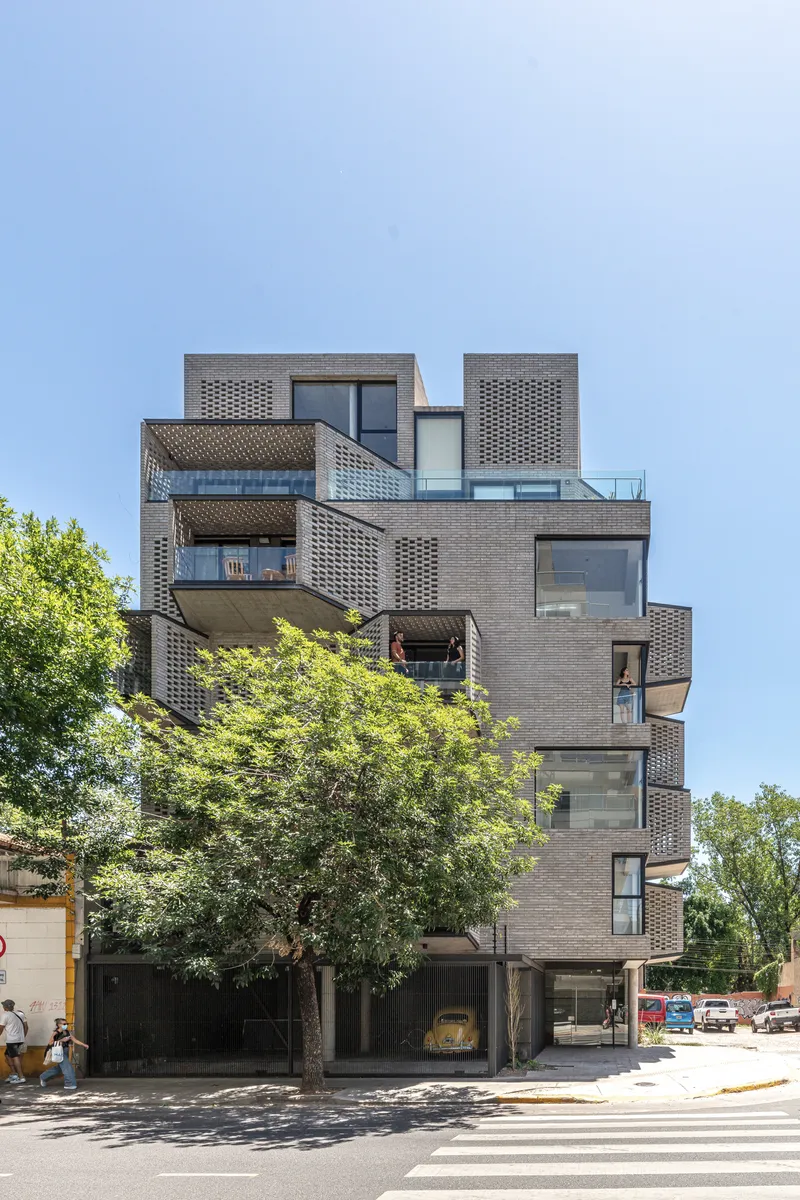
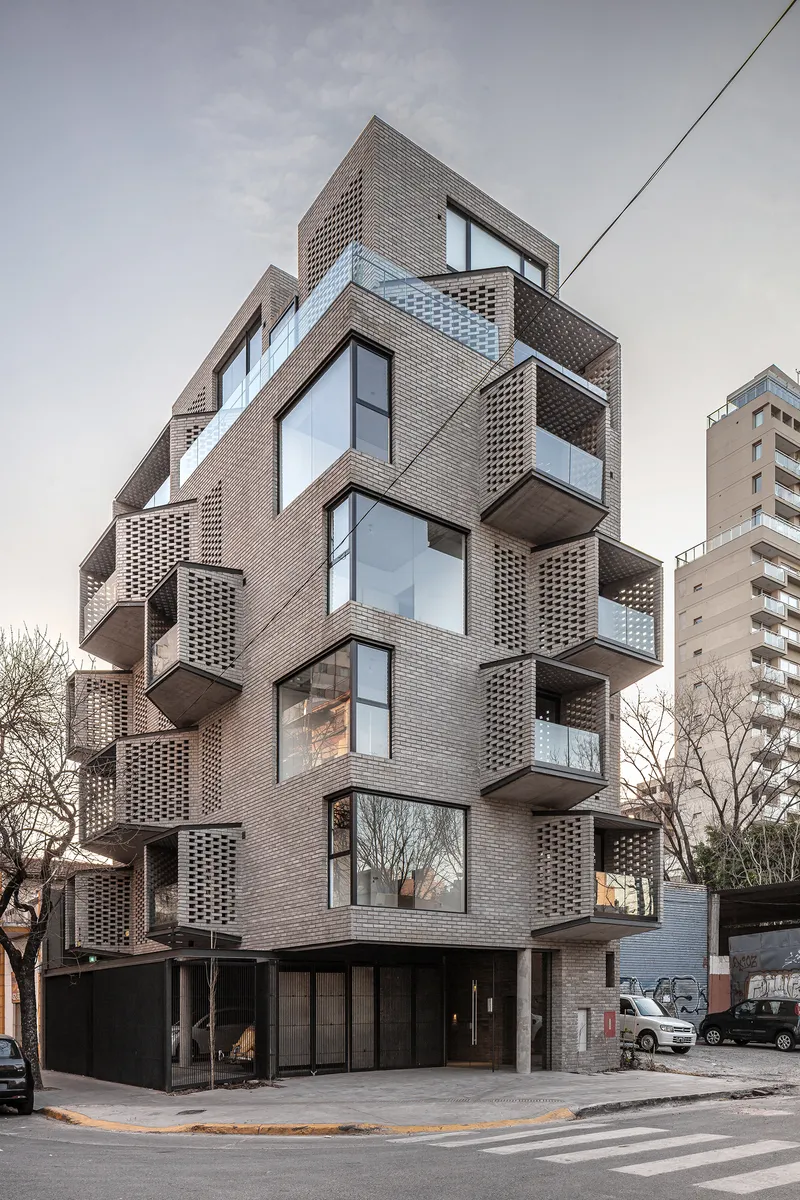
The 8.80 by 12.72 meter site sits in a medium-density residential fabric, but the proximity to the Mitre railroad makes it anything but typical. Arqtipo's response was to treat the entire ground floor as public space, pulling parking and circulation inward while opening the corners to the street. The upper floors step back in accordance with Buenos Aires setback regulations, but the architects absorbed those mandatory retreats into the envelope itself, turning code compliance into a compositional tool rather than a residual scar.
From the street, the building reads as a stack of offset volumes. Bare winter branches frame the brick mass in most views, reinforcing the sense of a geological formation erupting from a residential block. The corner windows, large and rounded, incise the facade at strategic points to give corner apartments panoramic views of the low-rise neighborhood stretching in every direction.
Perforated Brick as Environmental Mediator
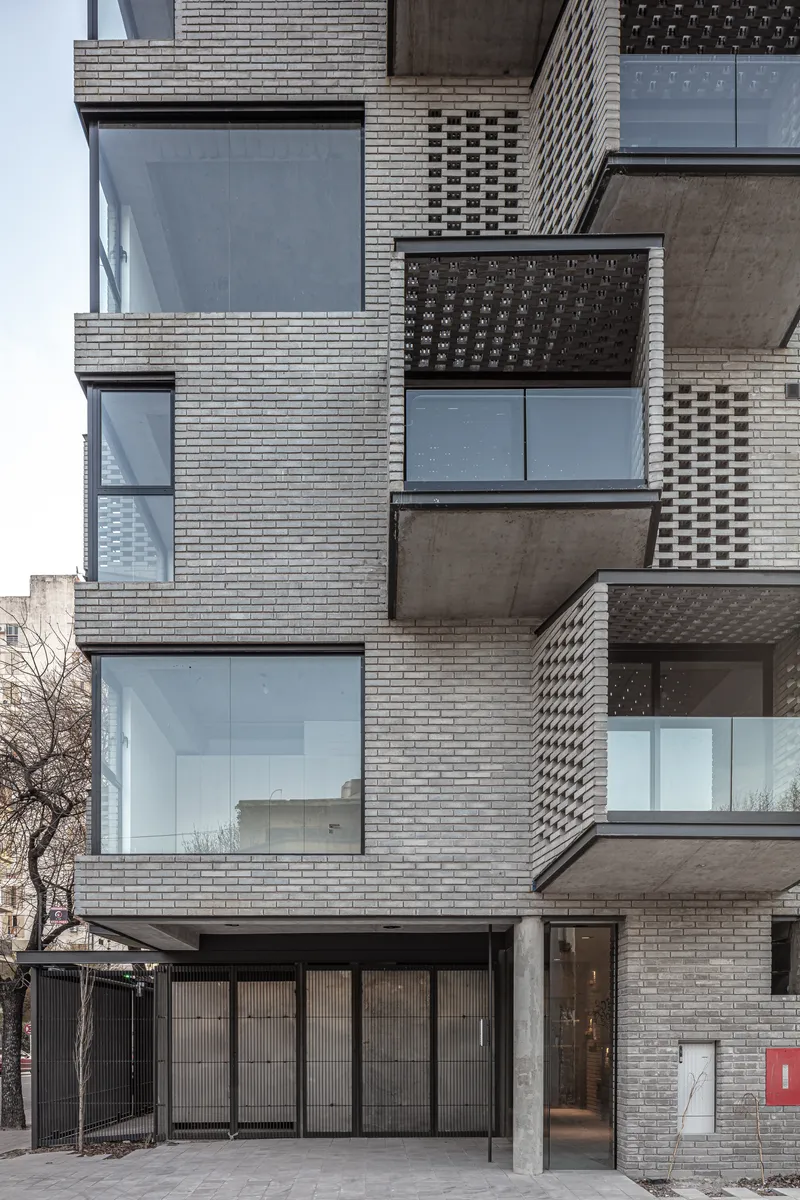
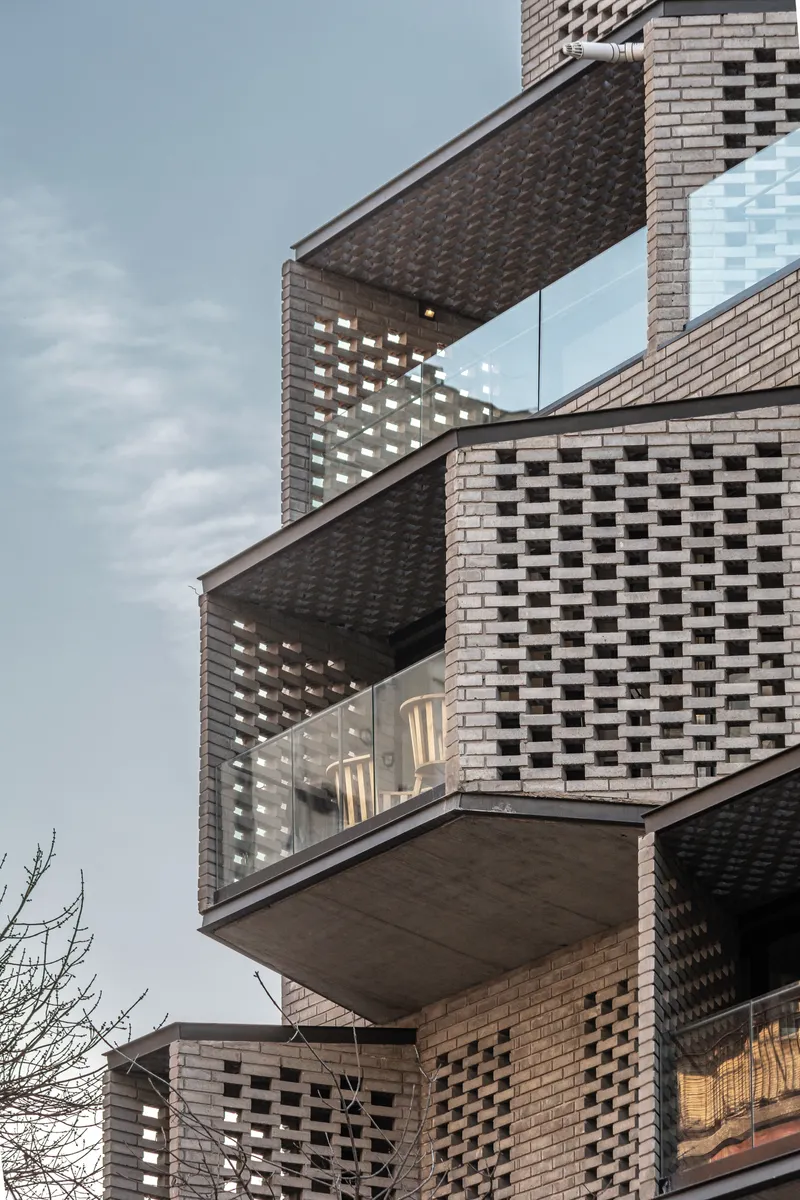
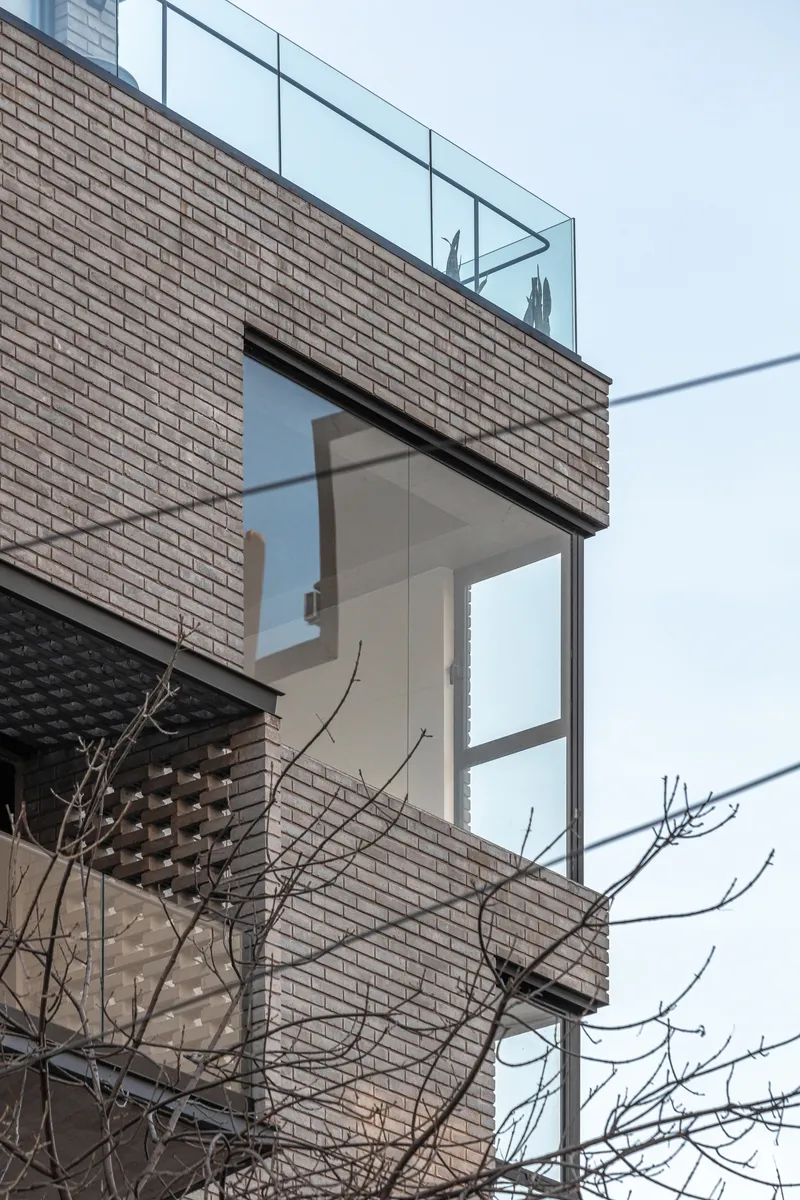
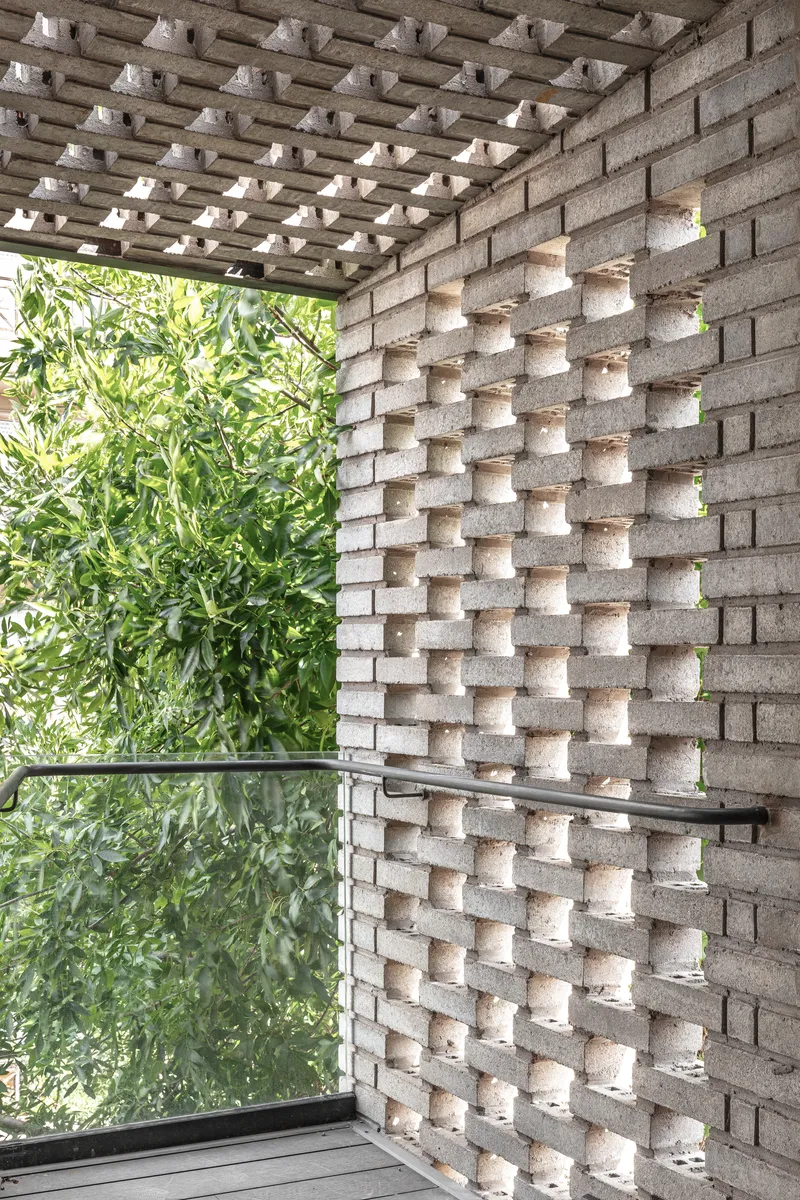
The perforated brick screens are not decoration. They are the building's primary strategy for managing the competing demands of a noisy rail-adjacent site: residents want light and air, but they do not want train noise and the gaze of passing commuters. Arqtipo's solution is a mono-material envelope where the same brick alternates between solid and open-bond configurations. Where privacy matters most, the bond tightens. Where light is needed, it loosens.
The morphological operations Arqtipo describes, repetition, section, and linking, are visible in the way each balcony module rhymes with but never exactly copies the one above or below. The perforated panels create a moiré effect in elevation that changes with the viewer's angle, giving the facade a kinetic quality that belies its weight.
The Balcony as Room
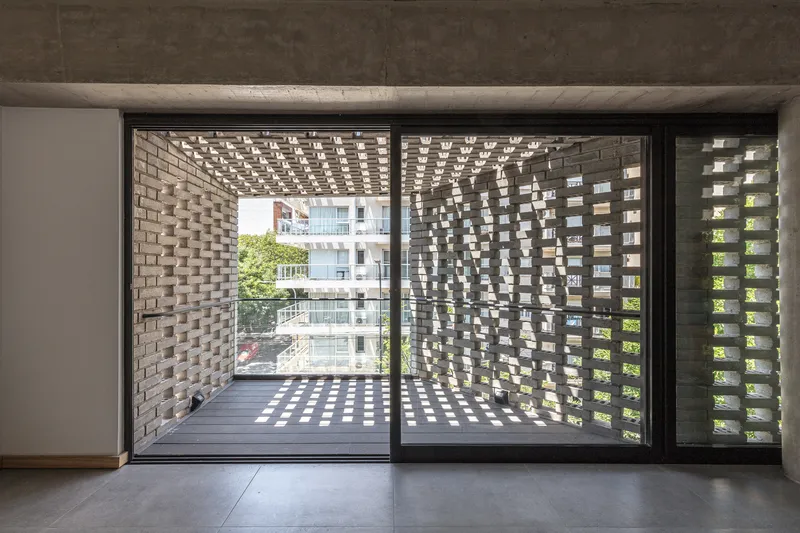
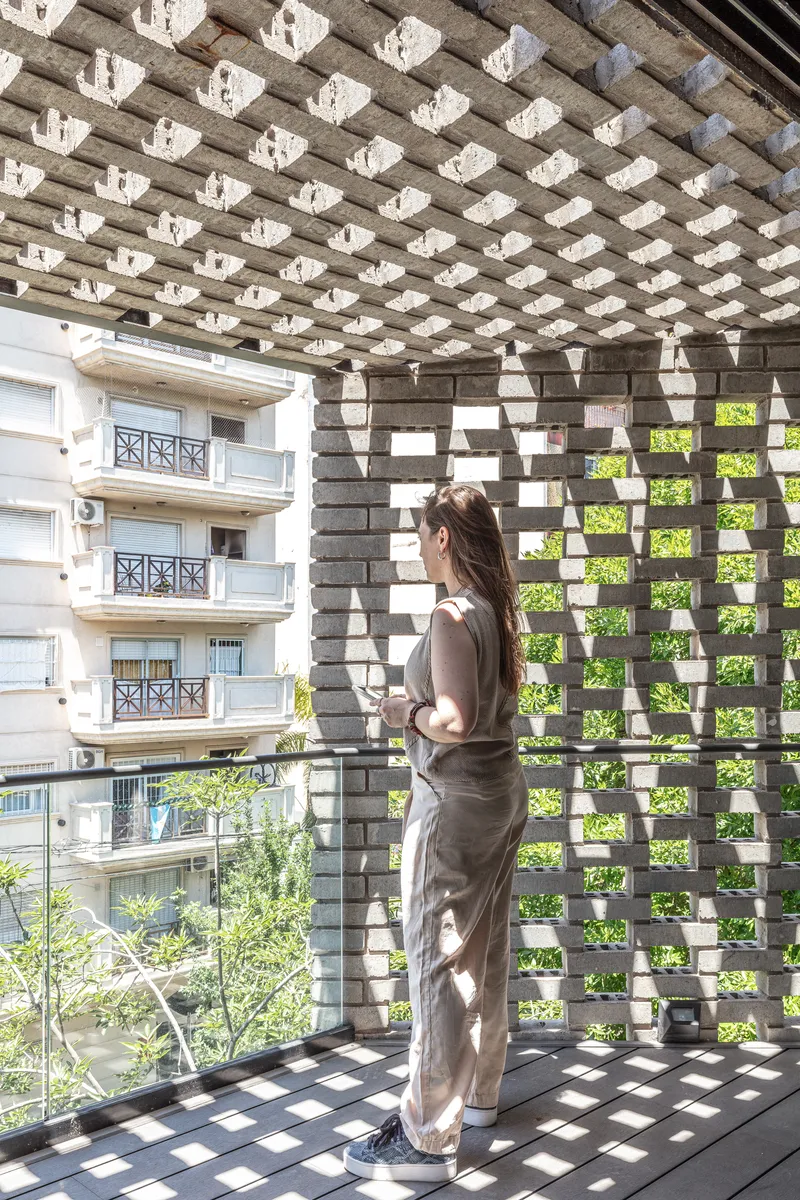
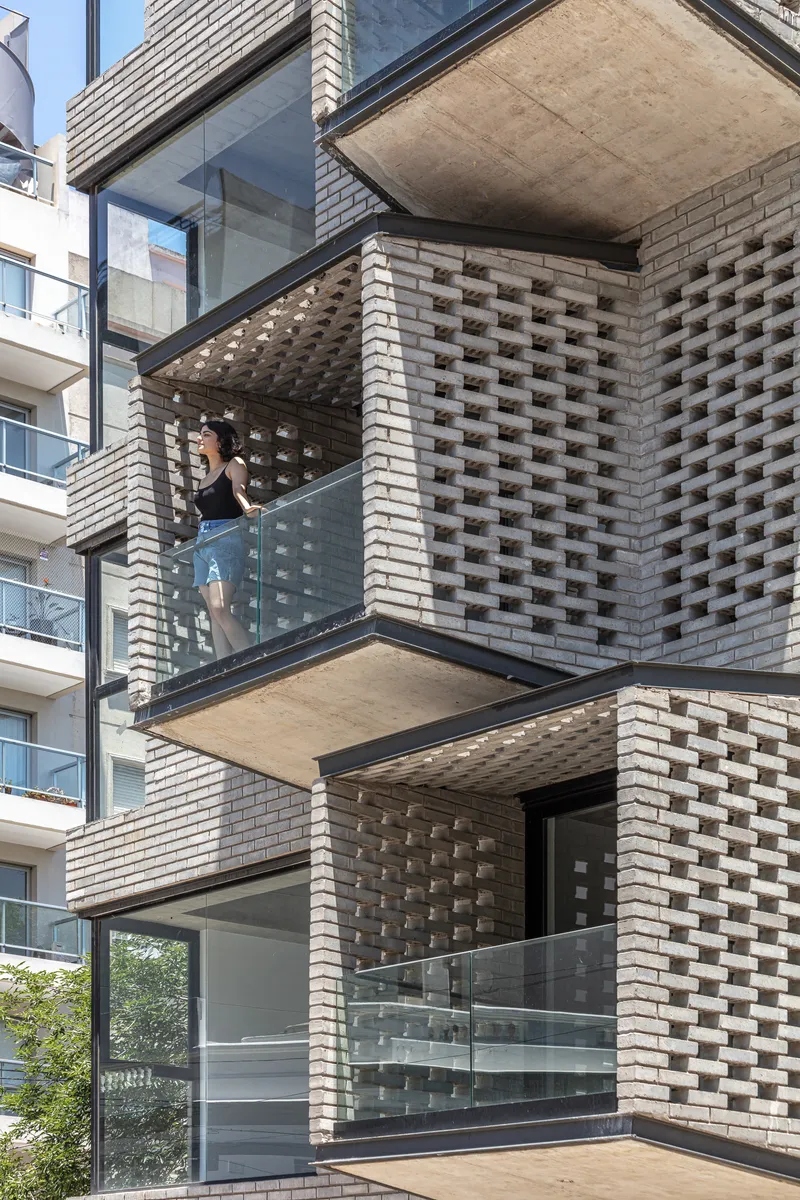
Step onto one of these balconies and you are not standing on a ledge. You are inside a room with a perforated ceiling, solid side walls, and a glass parapet that narrows toward the street like the prow of a ship. Dappled light filters through the brick overhead, casting a pattern on the floor that shifts with the sun. The trapezoidal taper means the balcony is widest at the building face, where the sliding glass doors open, and narrowest at the city edge, creating a gradient of enclosure that feels almost instinctive.
This is not a new idea; bay windows and oriels have worked this way for centuries. But applying the principle in brick at this scale, on every floor of a speculative housing project, is a commitment few developers would tolerate. The fact that Arqtipo pulled it off on a 665 square meter budget suggests a builder who trusted the architects.
Interior Logic
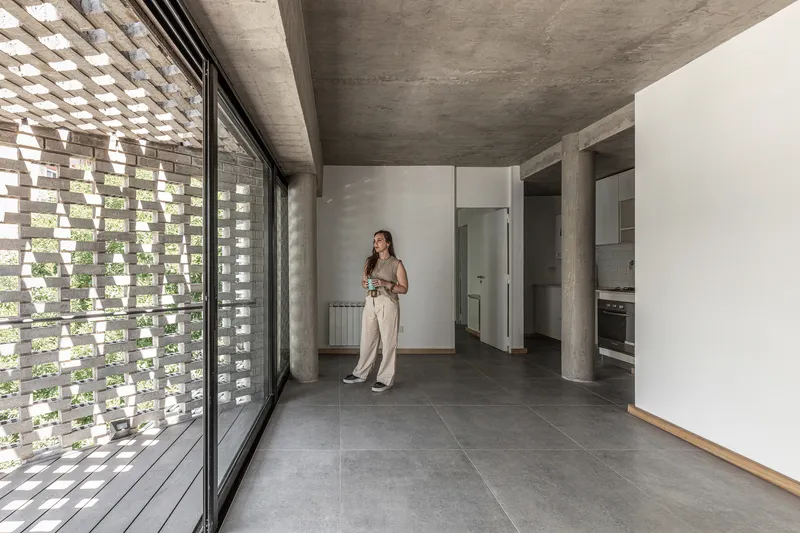
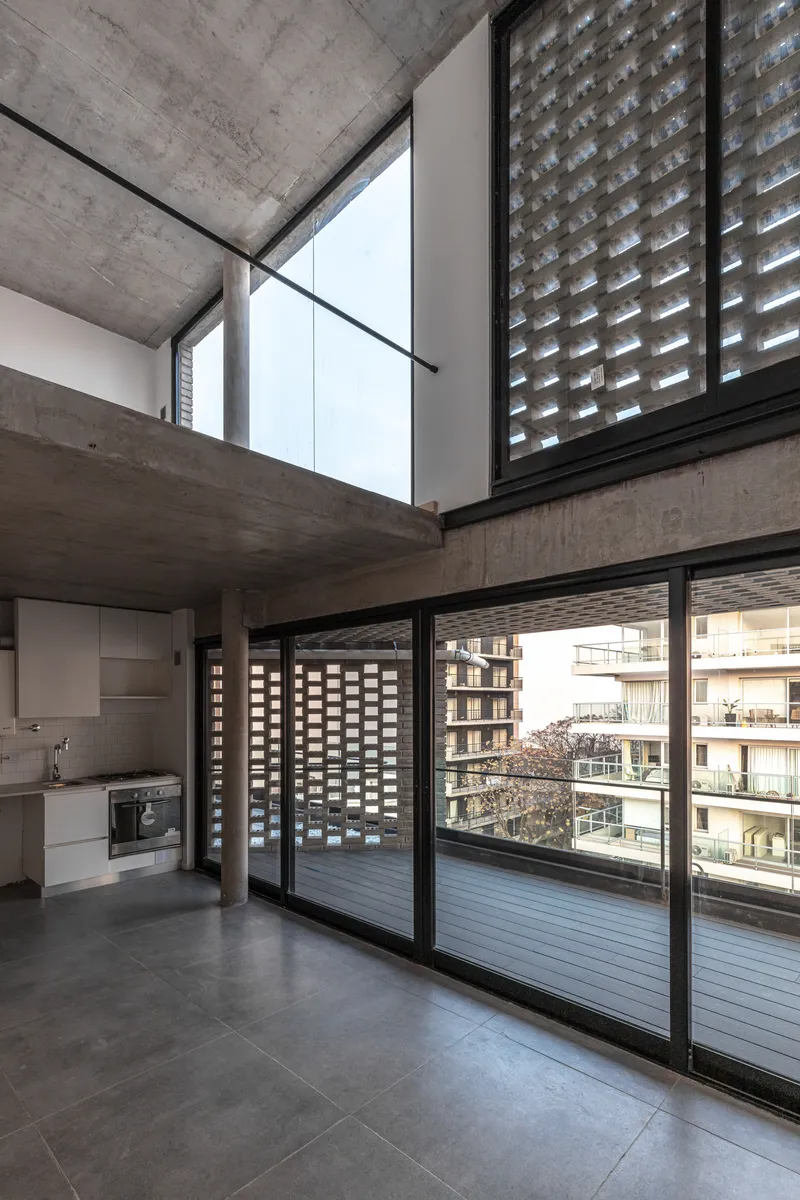
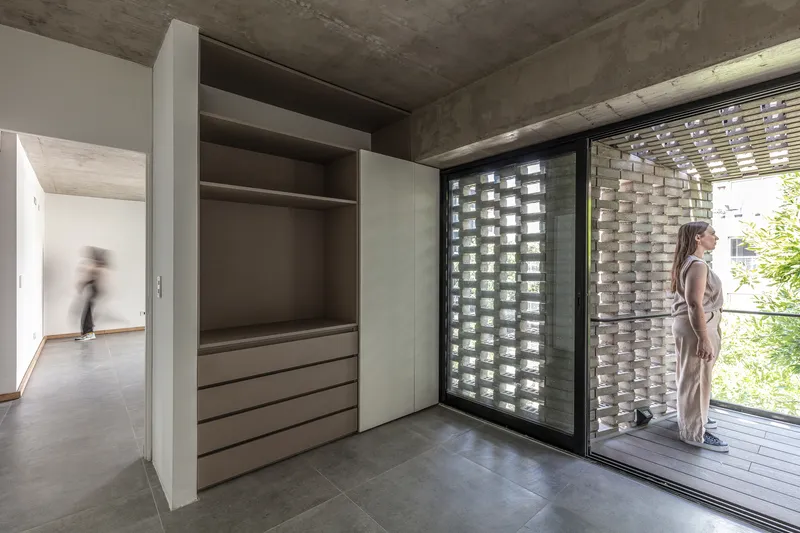
Inside, the apartments are compact but spatially generous. Several units feature double-height living areas with mezzanine levels, a move that compensates for the narrow floor plate by trading horizontal area for vertical volume. Concrete ceilings are left exposed, grey tile floors run continuously from living spaces to bedrooms, and the brick screens are always visible through sliding glass doors, anchoring every room to the facade's rhythm.
The material palette is restrained to the point of severity: concrete, brick, glass, steel, and timber in small doses. There is no plasterboard softening the edges. The discipline works because the perforated screens provide all the texture and visual warmth the interiors need. When the afternoon sun hits the west-facing screens, the living rooms fill with a lattice of light and shadow that no pendant fixture could replicate.
Threshold and Ground
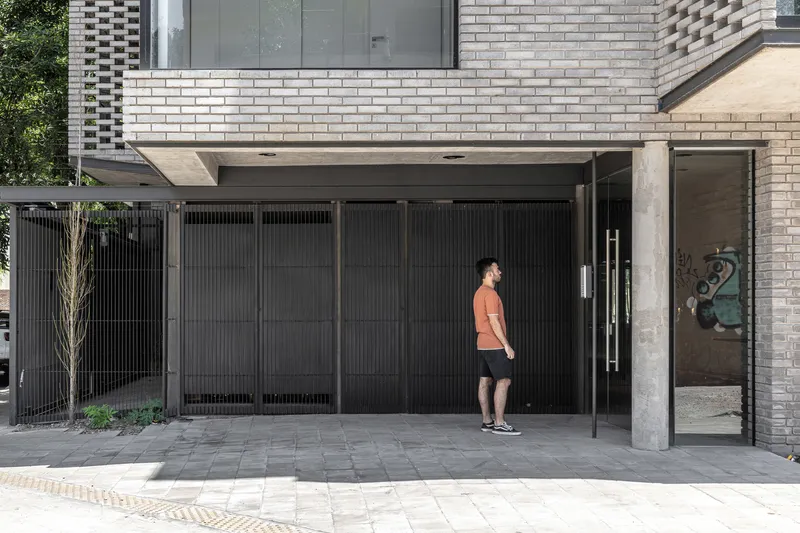
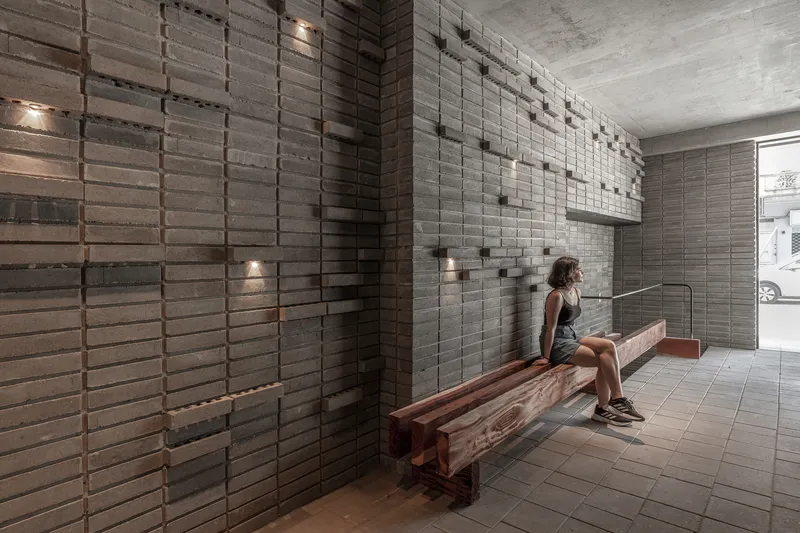
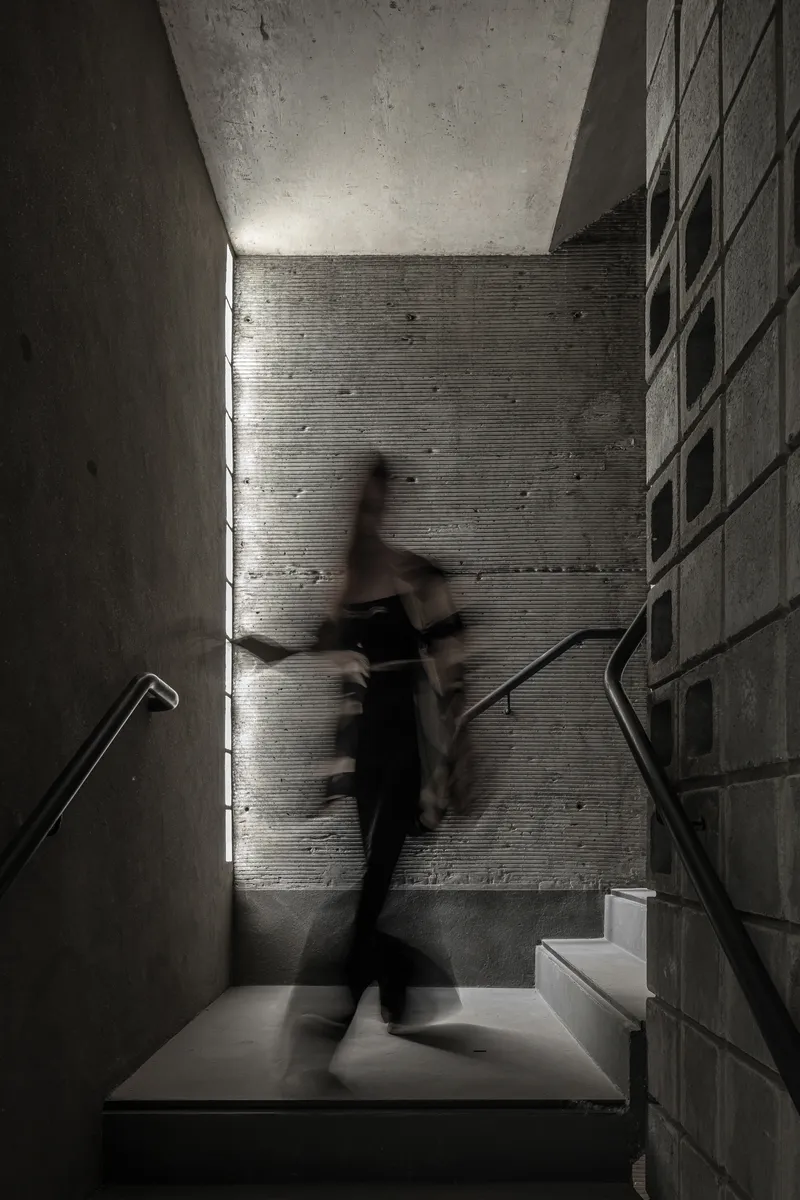
The ground floor is treated as a threshold between the public sidewalk and the private tower above. A black metal gate marks the entrance without sealing it off, and the entry vestibule uses stacked brick screen walls to filter views inward. A timber bench invites residents to pause, turning circulation into a moment of rest rather than a corridor to rush through. The concrete staircase beyond is lit by vertical slot windows that catch figures in motion, giving the common areas the same attention to light that the apartments receive.
Dusk and Detail
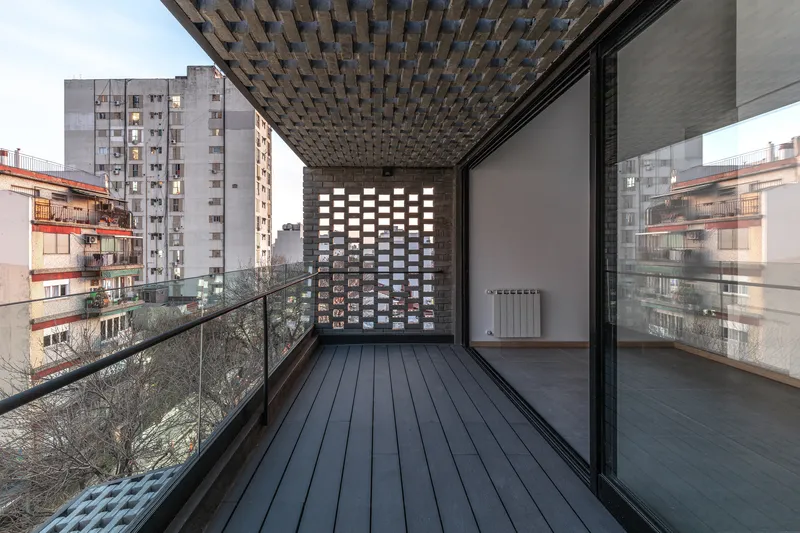
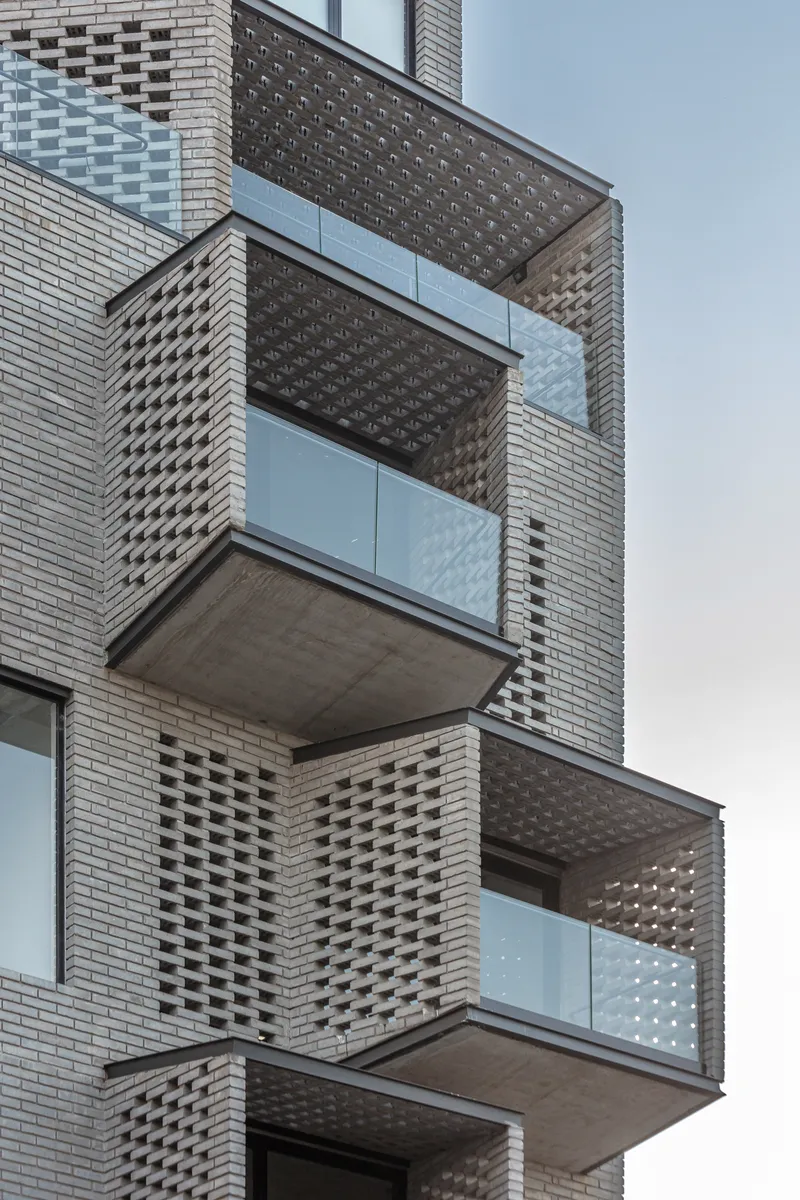
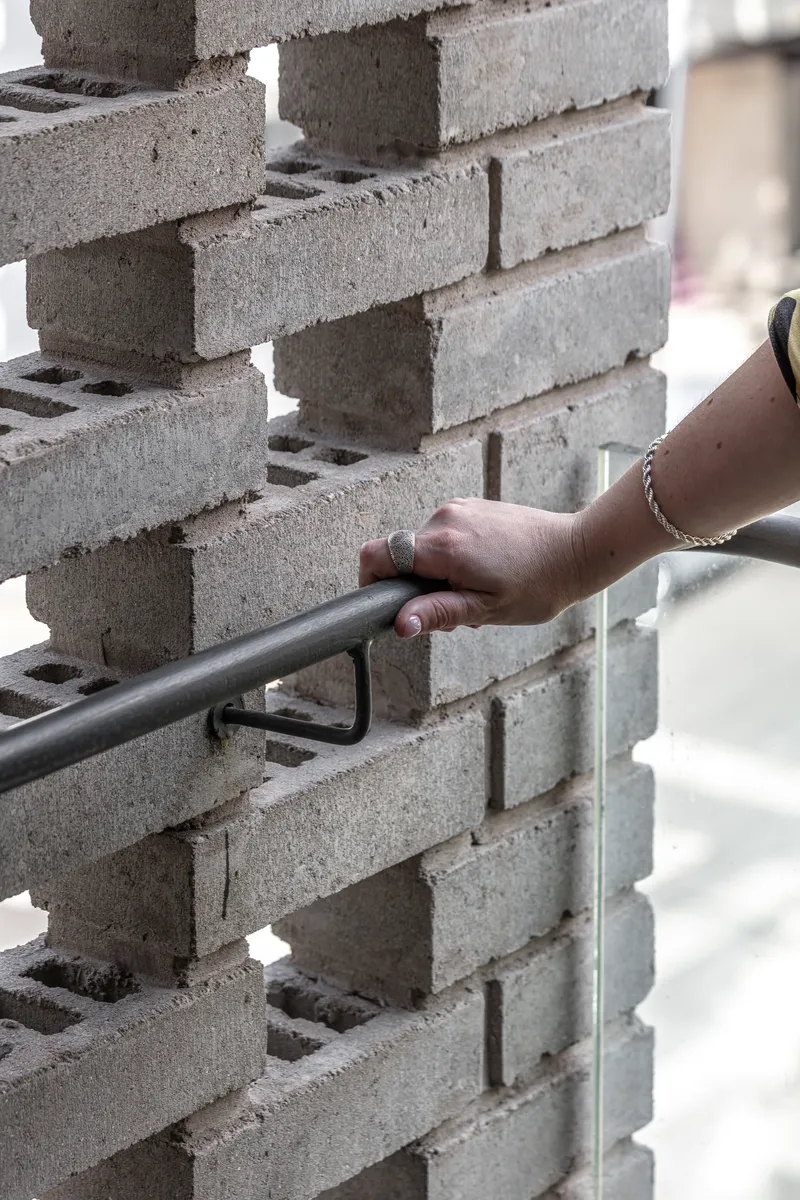
At dusk the building reveals its second life. The patterned brick soffits over the terraces glow with reflected interior light, and the dark wood decking of the upper terraces reads as a warm ground plane floating above the street. Glass railings disappear, leaving the brick screens as the only boundary between domestic life and the city sky. Up close, the craftsmanship holds up: handrails are cleanly bolted to the perforated walls, and the bond patterns are executed with a precision that rewards a second look.
Night Presence
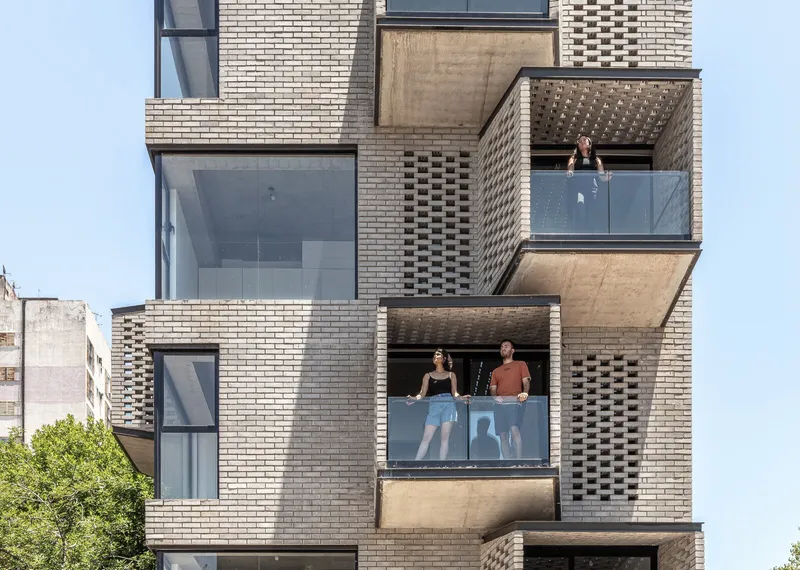
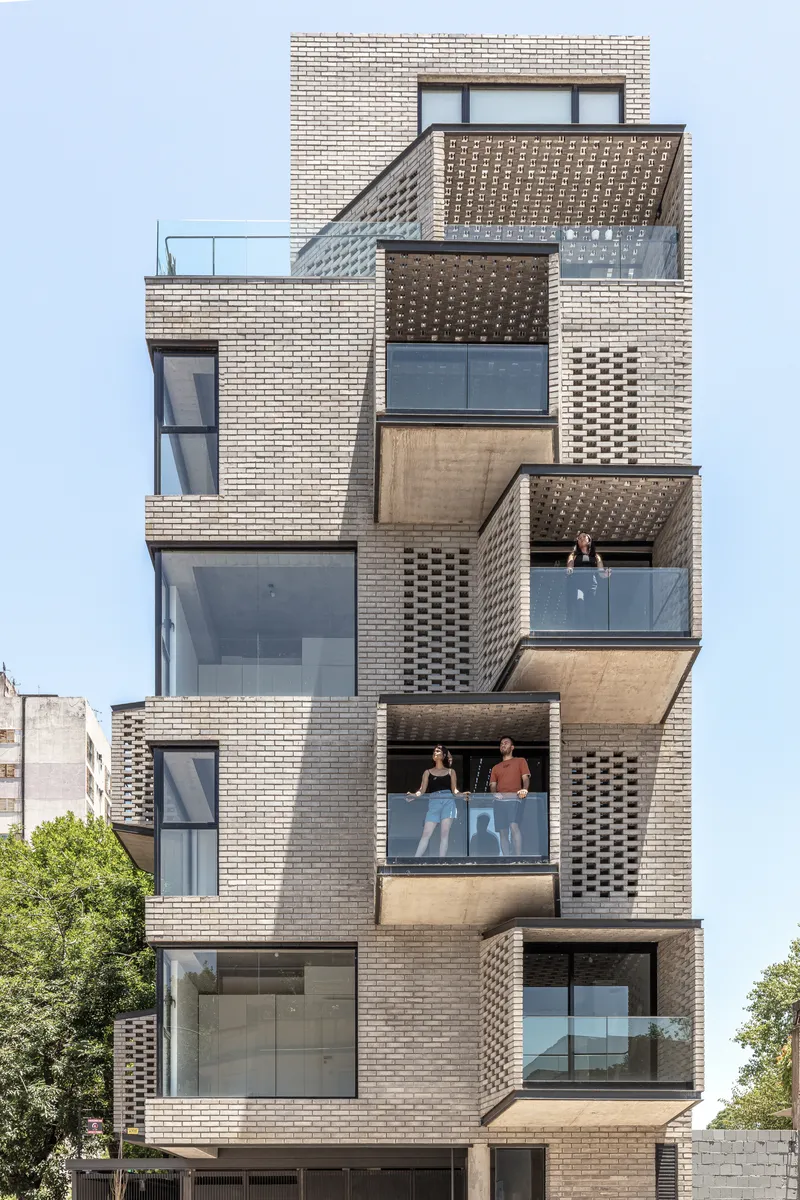
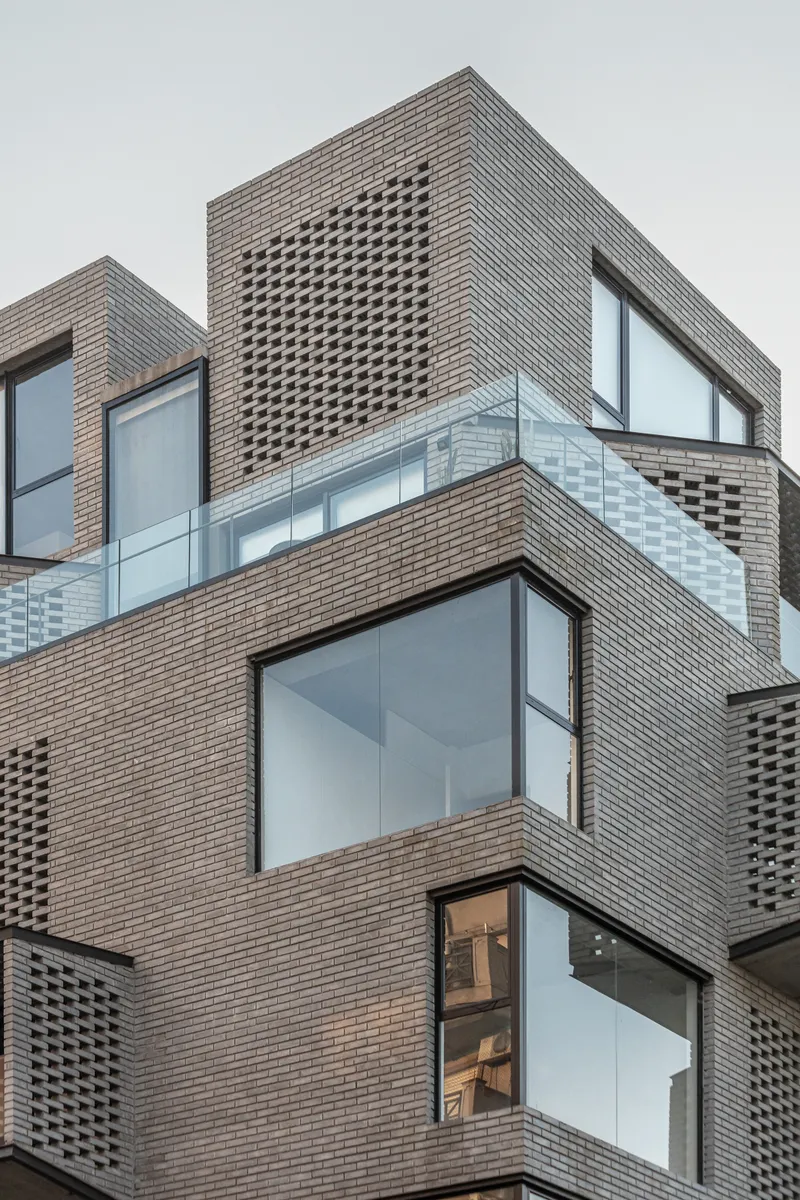
Seen from the street at night, M 5605 becomes a lantern. Warm light leaks through the perforated screens at varying intensities depending on which rooms are occupied, turning the facade into a register of domestic activity. Residents appear on upper terraces, silhouetted against the glow. The building's mass, so assertive during the day, softens into a lattice of light. It is a simple effect, entirely a consequence of the envelope's porosity rather than any theatrical lighting design, and it gives the building a civic presence disproportionate to its modest footprint.
Plans and Drawings
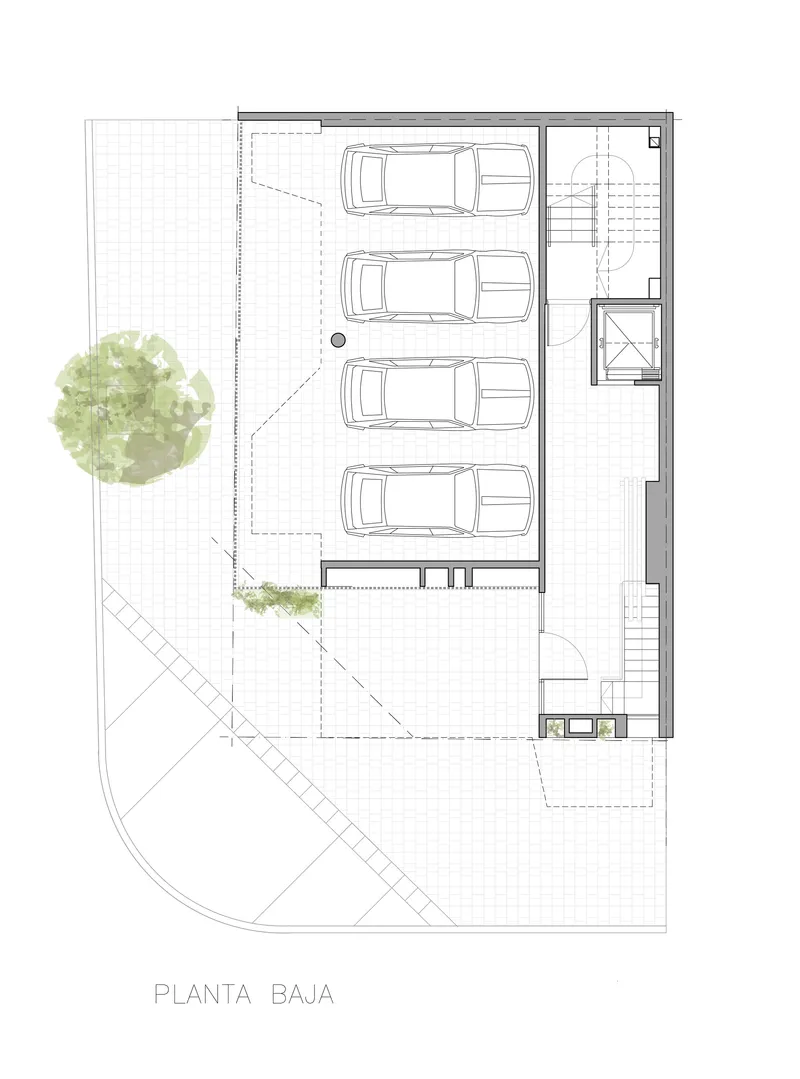
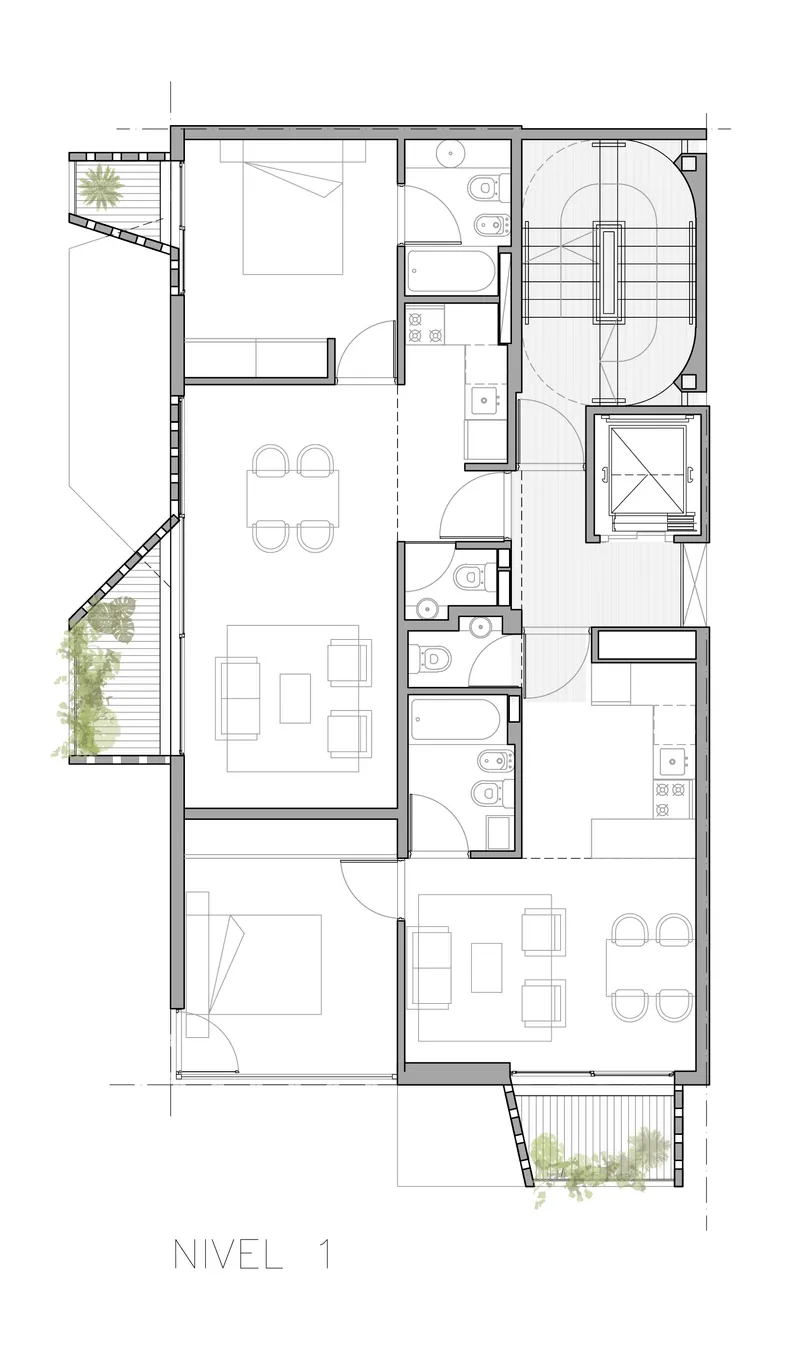
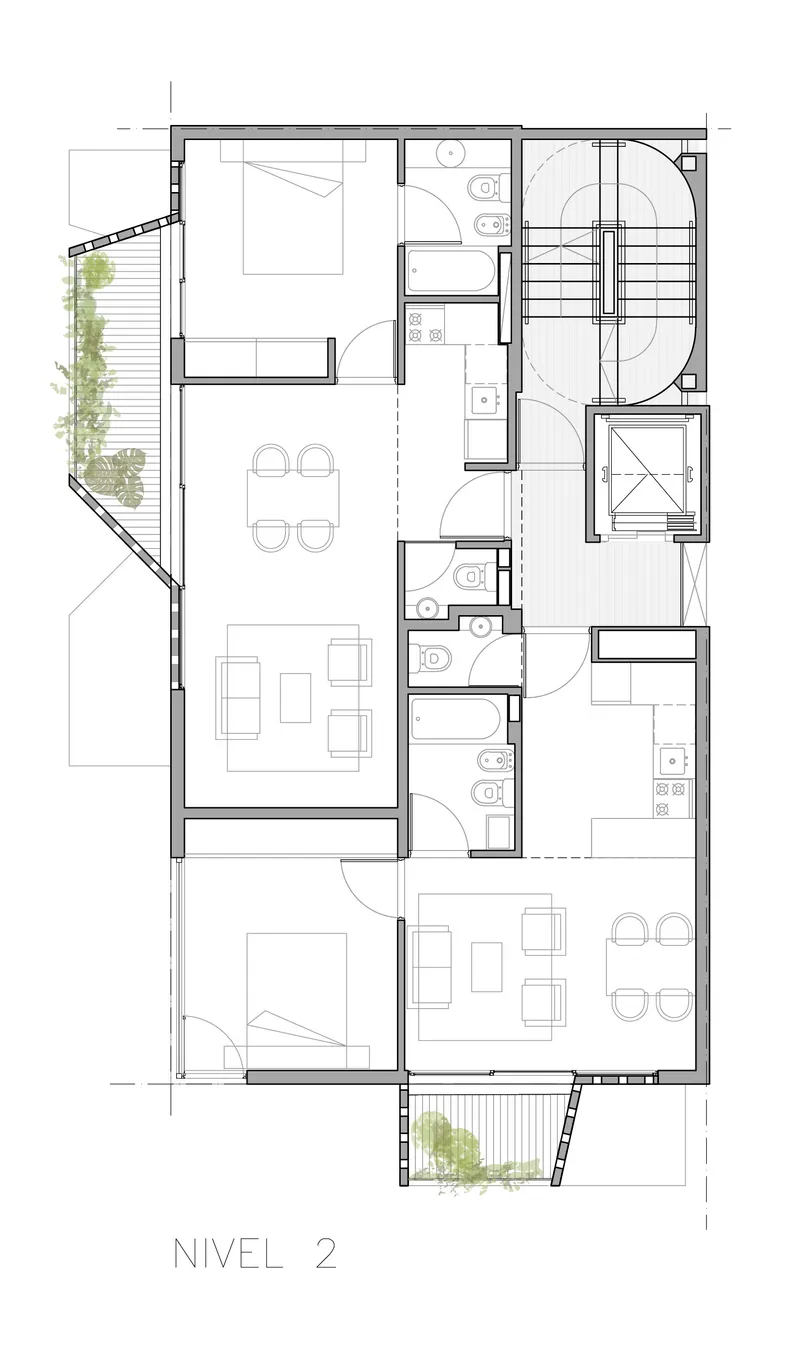
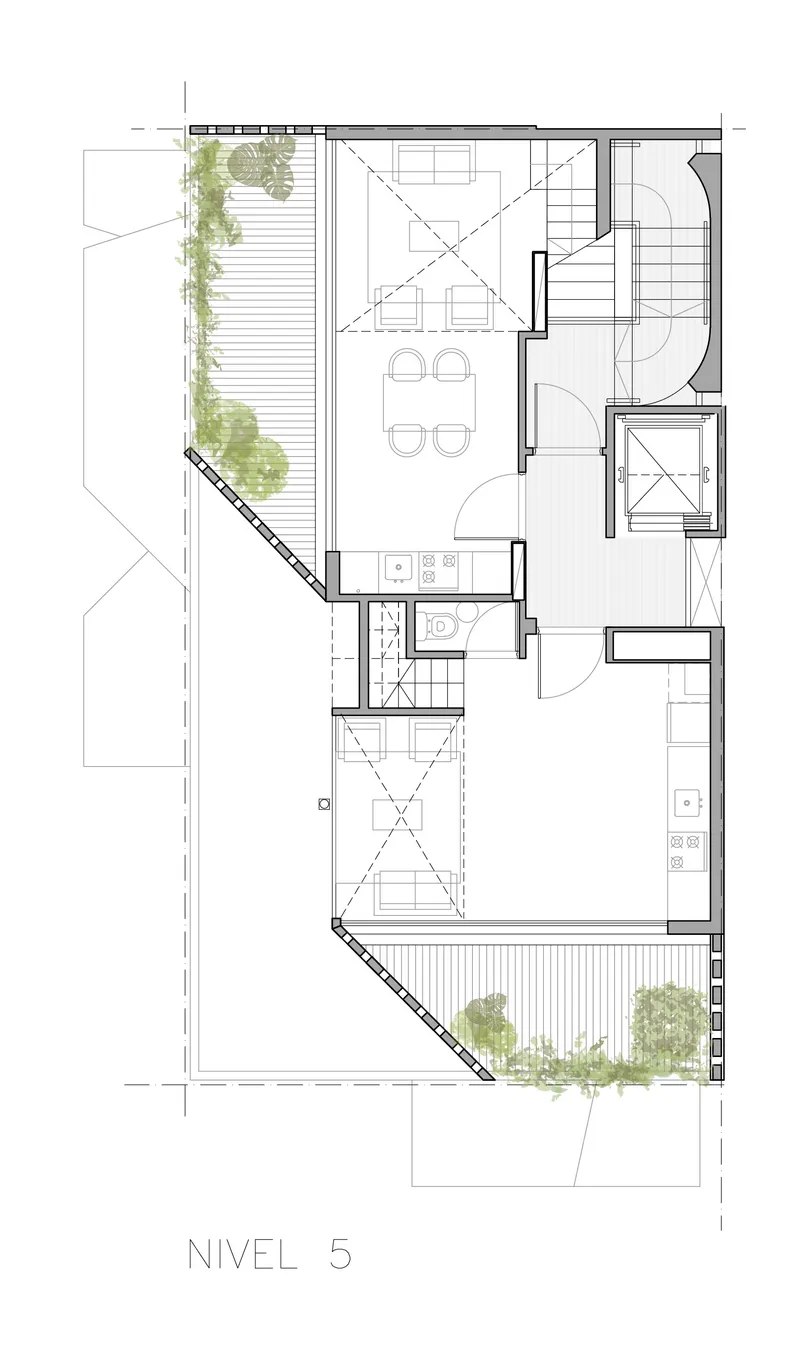
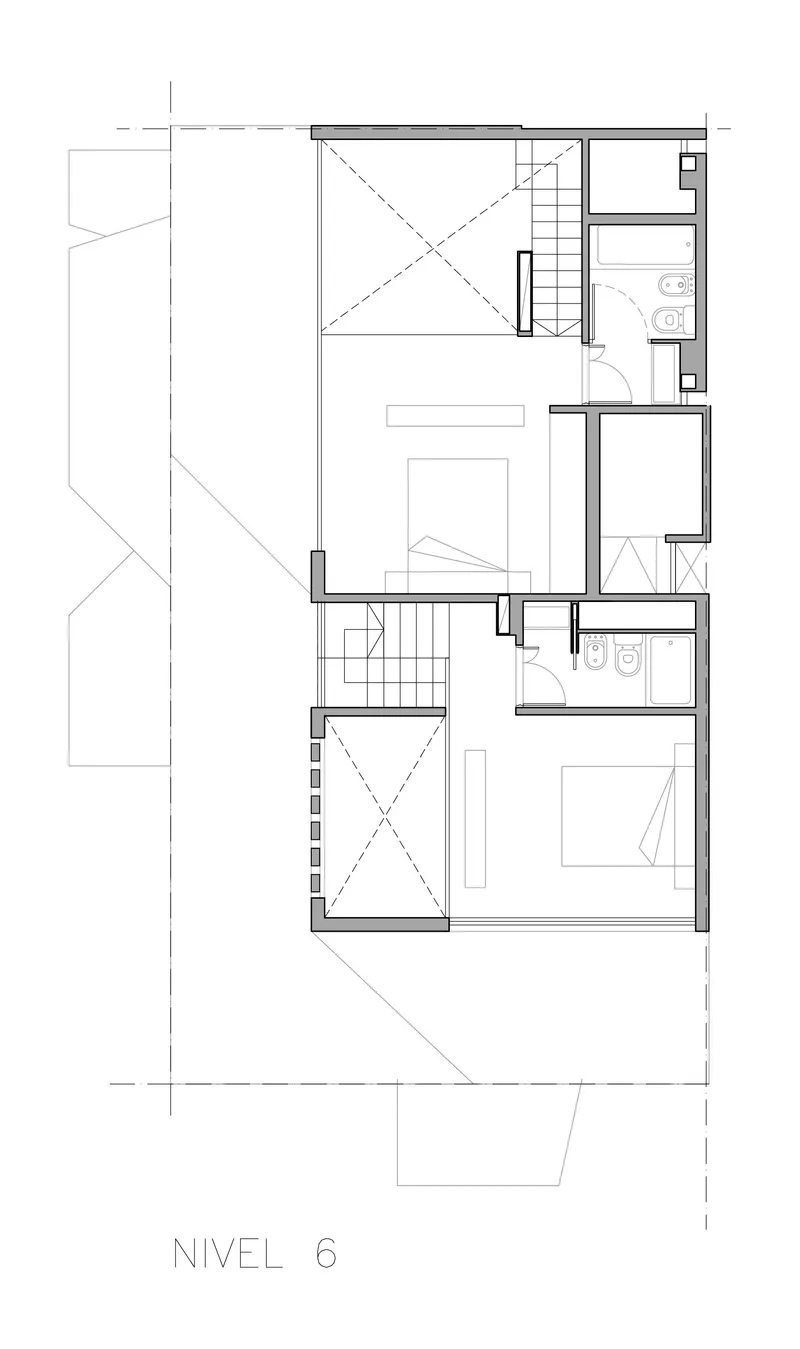
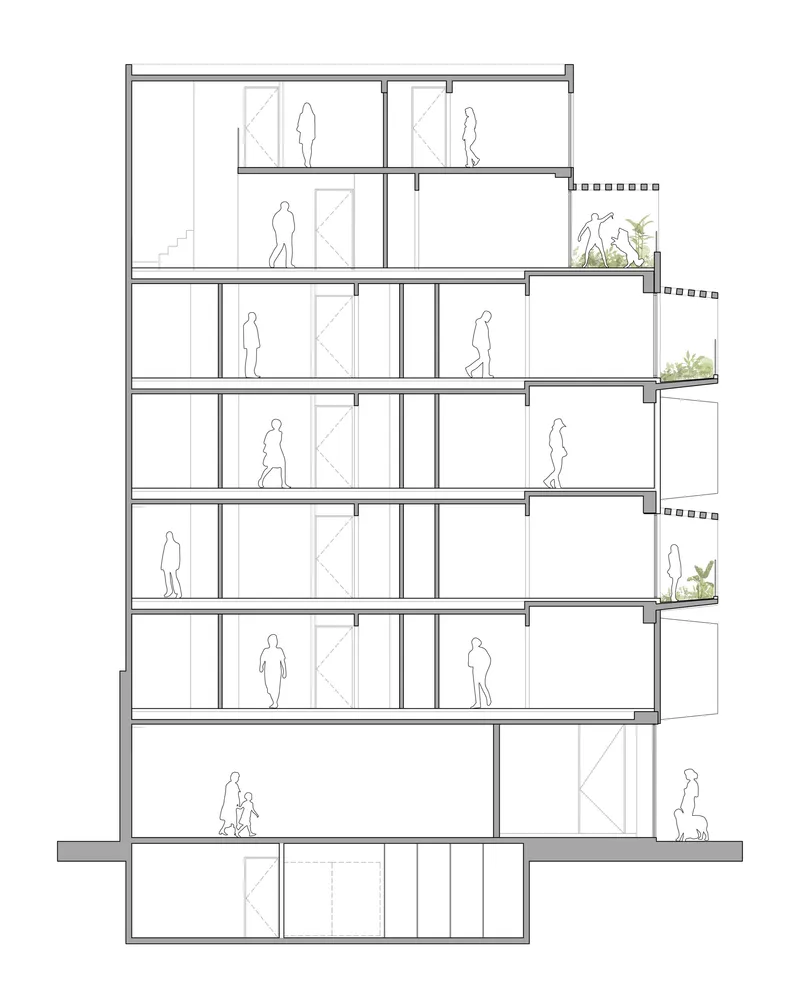
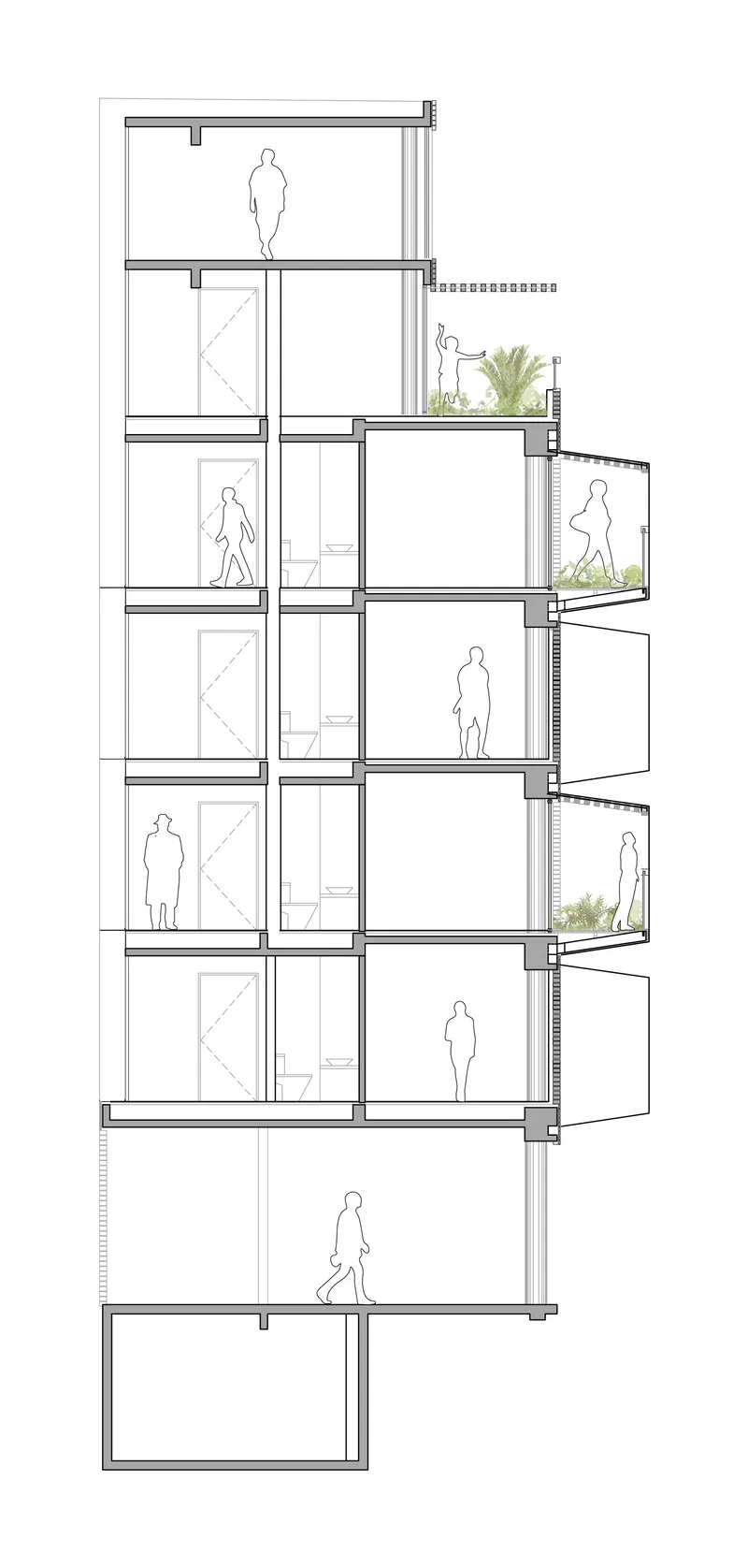
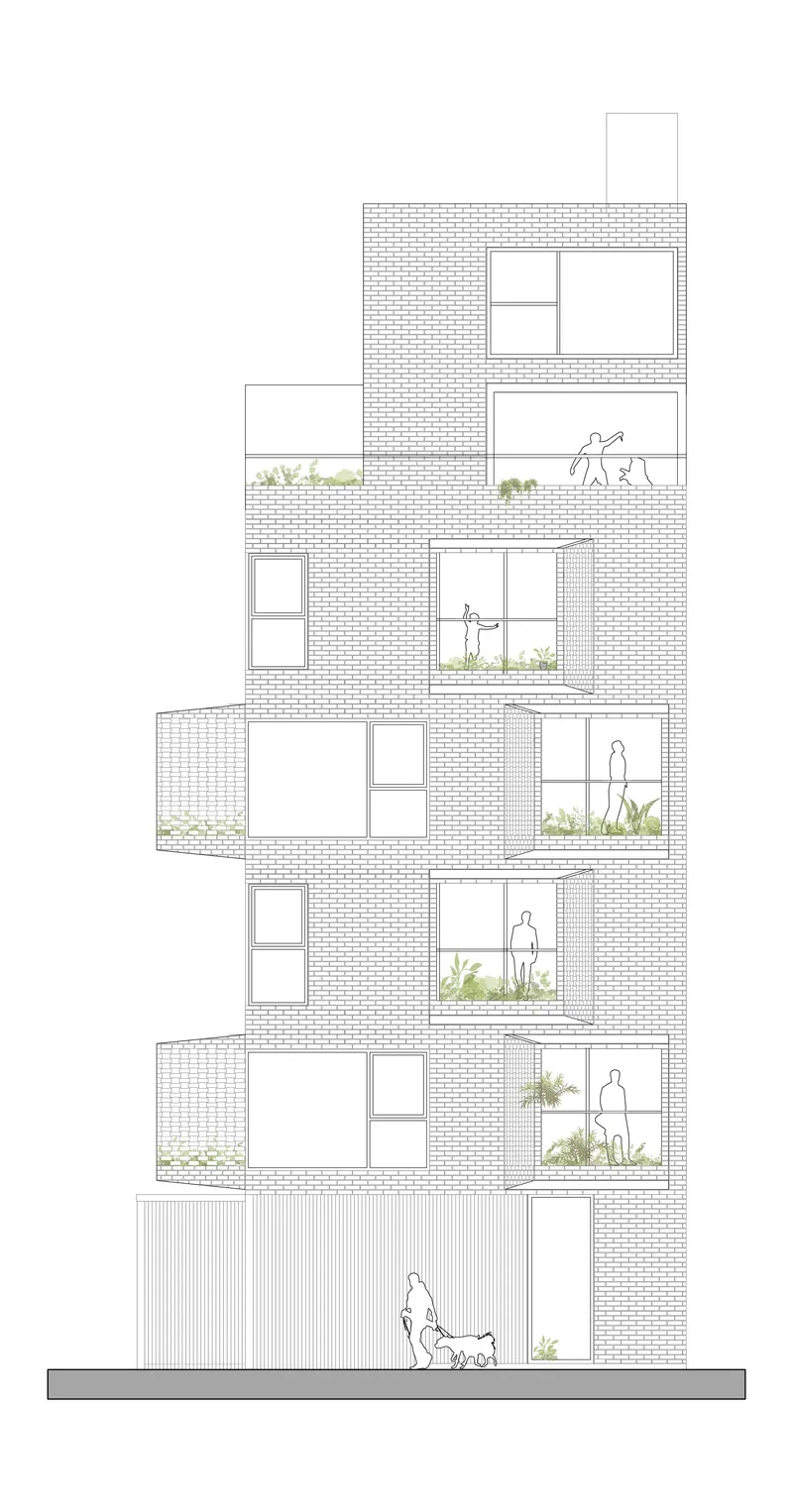
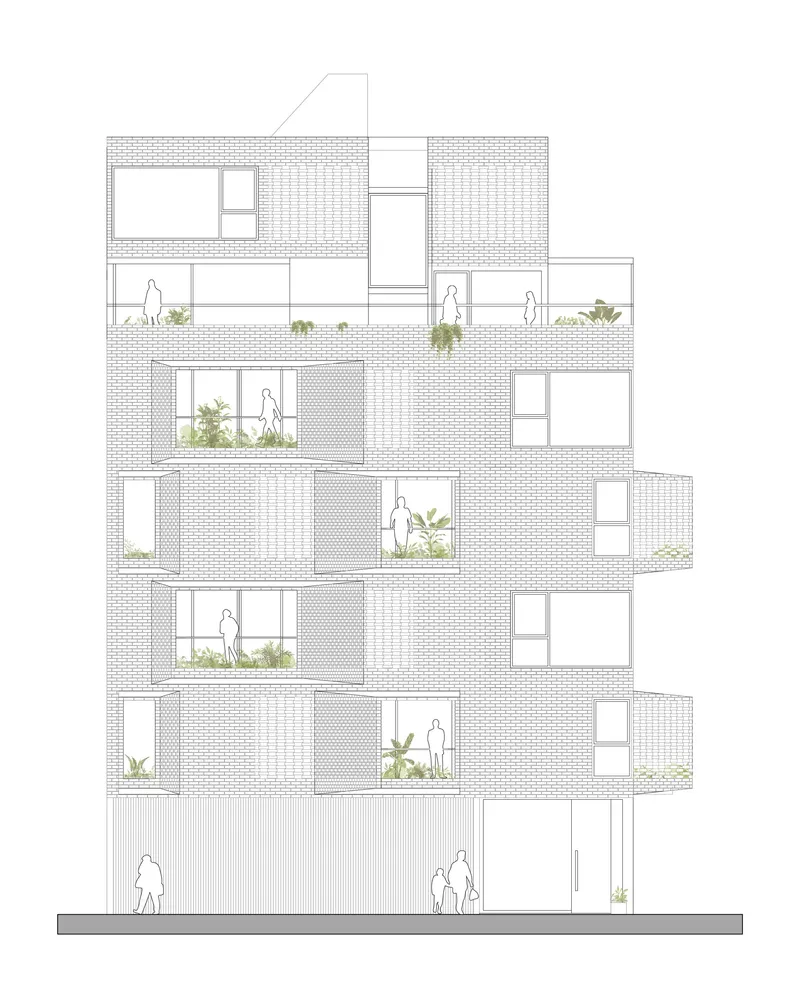
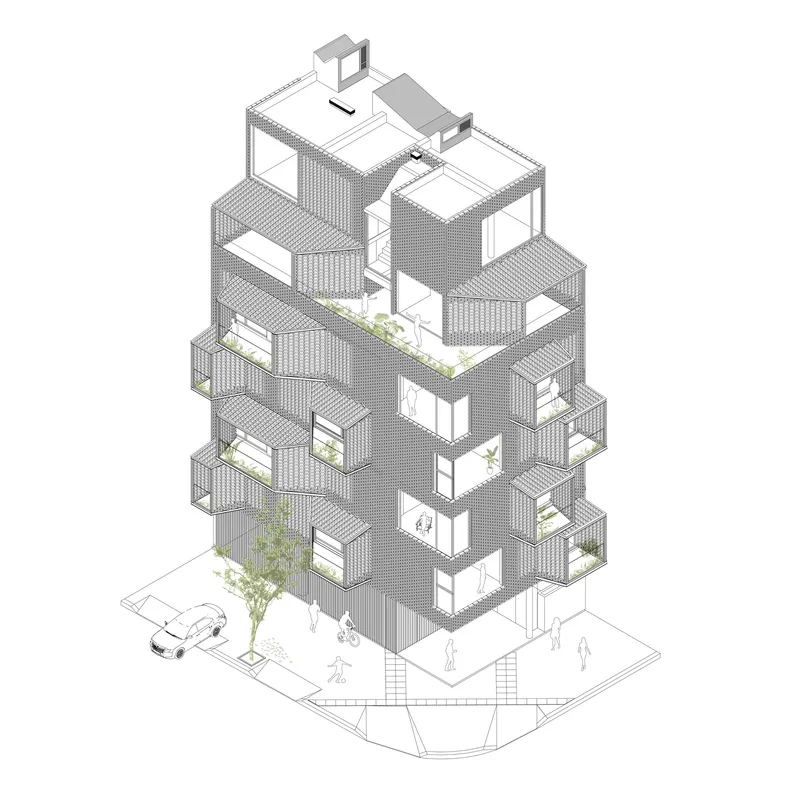
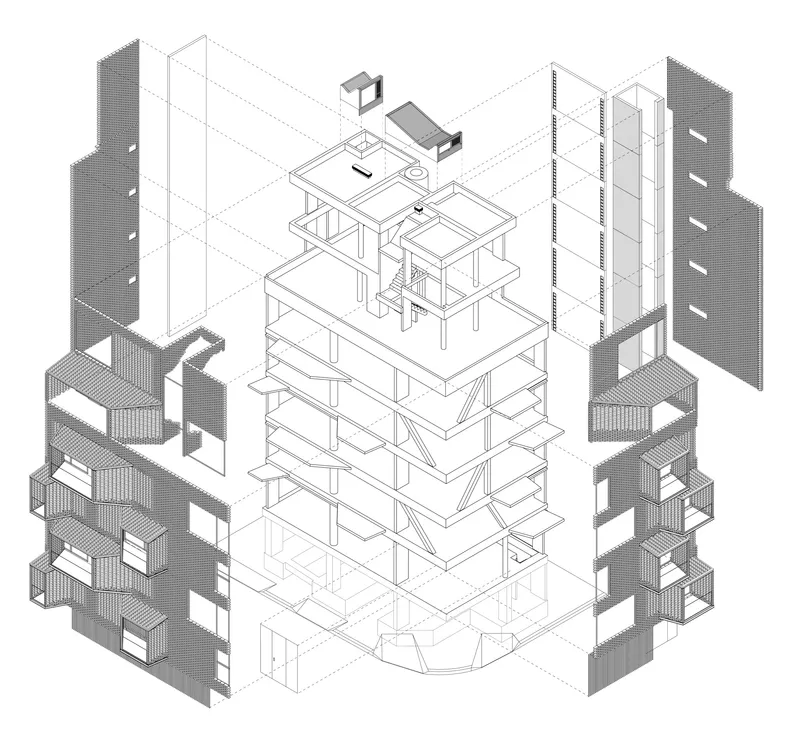
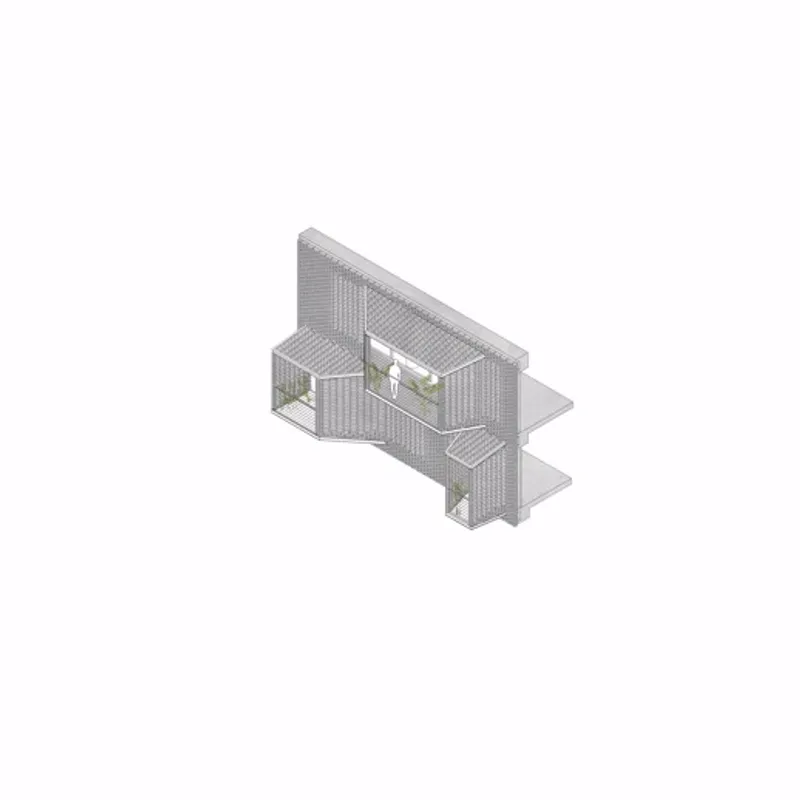
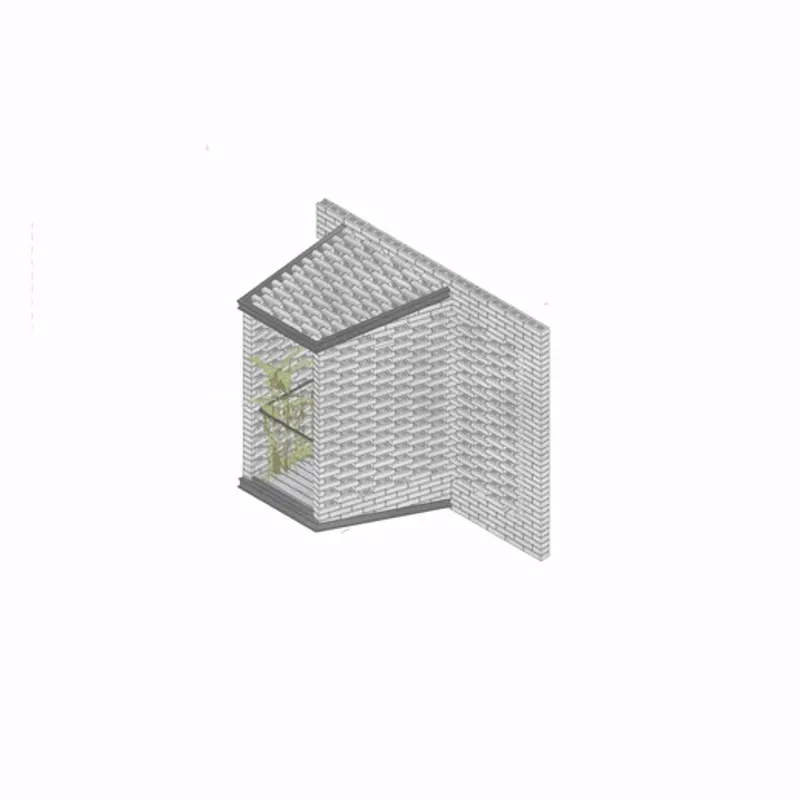
The floor plans confirm what the photographs suggest: apartments are organized around the stairwell core, with each unit claiming a different slice of the corner condition. The ground floor plan reveals a four-car parking bay tucked beneath the tower, while upper levels alternate between single-floor units with planted balconies and duplex configurations with double-height volumes. The section drawings are perhaps the most revealing, showing how the trapezoidal balconies cantilever at different depths on alternating floors, creating the staggered rhythm visible in elevation.
The exploded axonometric is particularly instructive: it separates the structural steel and concrete frame from the floor plates, the brick envelope components, and the rooftop elements, making clear that the facade is a self-supporting screen system rather than a veneer applied to a conventional frame. The isometric unit studies at the bottom of the drawing set show how each apartment's patterned masonry walls and interior courtyard conditions were designed as discrete objects before being assembled into the tower.
Why This Project Matters
M 5605 Housing is a quiet argument against two lazy defaults in contemporary multifamily design: the glass curtain wall that ignores climate, and the rendered masonry box that ignores craft. Arqtipo chose a single material and explored it with the rigor of a research project, producing a building where every environmental problem, noise, privacy, solar gain, ventilation, is solved by the same brick envelope. The Brick Award jury recognized this, but the real test is whether the building works for the ten families who live behind those screens. The photographs of residents leaning on balcony rails and sitting in dappled light suggest it does.
For a profession that often treats social housing and developer housing as aesthetically incompatible categories, M 5605 is a useful corrective. It proves that a speculative apartment building on a constrained urban lot can be architecturally ambitious without being expensive or indulgent. The trick is to pick one material, understand it deeply, and let it do the work. Not every project needs a signature gesture. Sometimes a well-laid brick is enough.
M 5605 Housing by Arqtipo. Located in Villa Urquiza, Buenos Aires, Argentina. 665 m². Completed in 2022. Photography by Federico Kulekdjian.
About the Studio
Share Your Own Work on uni.xyz
If projects like this are the kind of work you want to make, uni.xyz is a place to publish your own, find collaborators, and enter design competitions.


Popular Articles
Popular articles from the community


Temporary Home for Dogs: A Reversed Zoo Rethinks Animal Shelter Architecture
In Bucharest, a sinuous corridor and freed landscape flip the logic of containment, designing a shelter that works to make itself unnecessary.
Faces of the Soviet Avant-Garde: Turning Moscow's Street Names into an Open-Air Museum
A network of sculptural installations across a Moscow residential district transforms forgotten architect names into spatial encounters with cultural memor

Manzana Morphosis: Stretching Barcelona's Grid into a Living Landscape for 2050
A radical reworking of the Eixample manzana turns density into a tool for generous public space, vertical ecology, and environmental performance.
Tsunami Convergenics: Turning Catastrophic Ocean Forces into Underwater Housing Infrastructure
A speculative underwater settlement off the coast of Onagawa, Japan, treats tsunamis and typhoons as energy sources rather than threats.

Similar Reads
You might also enjoy these articles

Bao Huynh Watercolor Atelier: A Serene Art Retreat in Hội An
Bao Huynh Watercolor Atelier in Hội An blends multifunctional art spaces, sustainable design, local materials, and family-friendly living in a serene environment.

Atelier Macri Concept Store Interior Design by CASE-REAL
Atelier Macri store features a "ko" counter, walnut wood details, cork displays, blending retail, gallery, and seamless customer experiences.

Manuel Vargas Izquierdo Stadium and High-Performance Sports Center: Architectural Excellence in Jalpa de Méndez
The Manuel Vargas Izquierdo Stadium blends sustainable design, inclusive sports facilities, and cultural-inspired architecture, revitalizing Jalpa de Méndez’s public spaces.

KAKR Buluh Awar Hall: Revitalizing Community and Ecology Through Bamboo Architecture
Community built bamboo hall revitalizes Buluh Awar village, empowering youth, restoring ecology, celebrating vernacular craftsmanship through sustainable architecture and culture.

Explore Housing Units Competitions
Discover active competitions in this discipline

Challenge to reimagine the Iron Throne

Photograph architecture without architects

Illustrate the lost glory of Angkor Wat - Render Challenge

Design challenge to reuse E-waste
Comments (0)
Please login or sign up to add comments
No comments yet. Be the first to comment!