
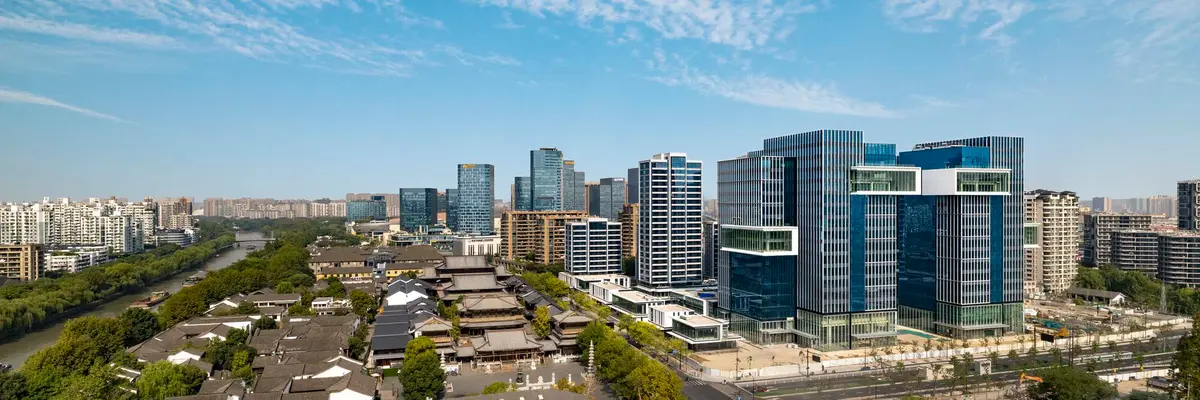
Arquitectonica and Farrells Weave a 230,000 m² Mixed-Use District Around a Thousand-Year-Old Temple in Hangzhou
Winland Center channels Hangzhou's silk heritage and traditional courtyard planning into a canal-side development beside the ancient Xiangji Temple.


Building next to a UNESCO World Heritage Site and a thousand-year-old Buddhist temple is a brief that would make most architects cautious. Arquitectonica and Farrells took the opposite approach: rather than retreating into deference, they produced a 230,000 m² mixed-use complex that openly confronts its historic neighbors, stacking cantilevered glass volumes into the Hangzhou skyline while organizing its plan around a spatial logic borrowed directly from traditional Chinese compound architecture.
The result is Winland Center, completed in 2021 on the bank of the Grand Canal. Two office towers, seven retail villas, six residential towers, and a network of elevated link bridges and sunken courtyards come together in a scheme that reads as an entire urban quarter rather than a single building. What makes it genuinely interesting is how the design team derived their massing not from a singular formal gesture but from an analysis of pedestrian movement, view corridors, and the spatial DNA of the three-entry courtyard compound, a typology that runs from Beijing's Forbidden City to the adjacent Xiangji Temple itself.
A Compound Logic for the 21st Century
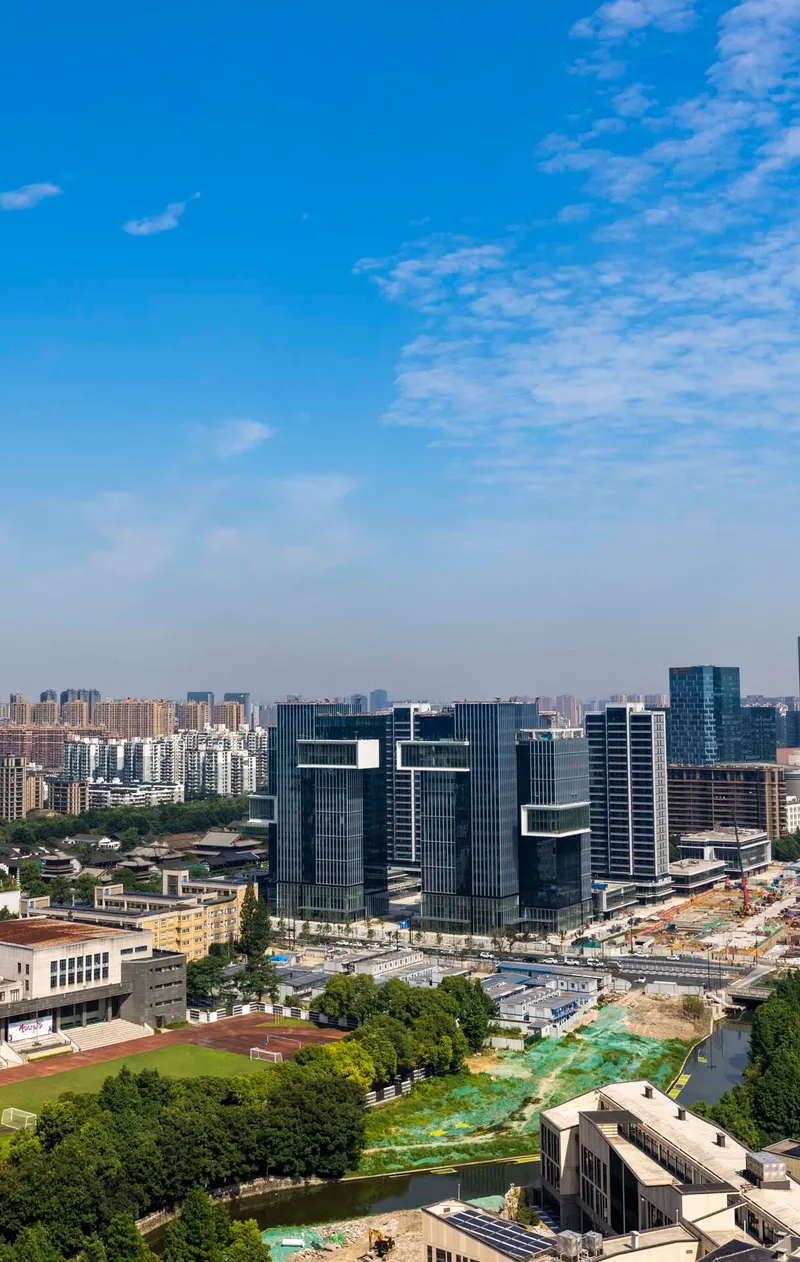
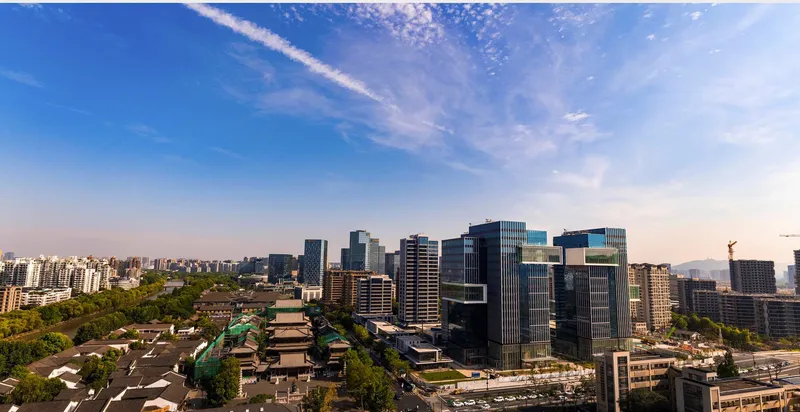
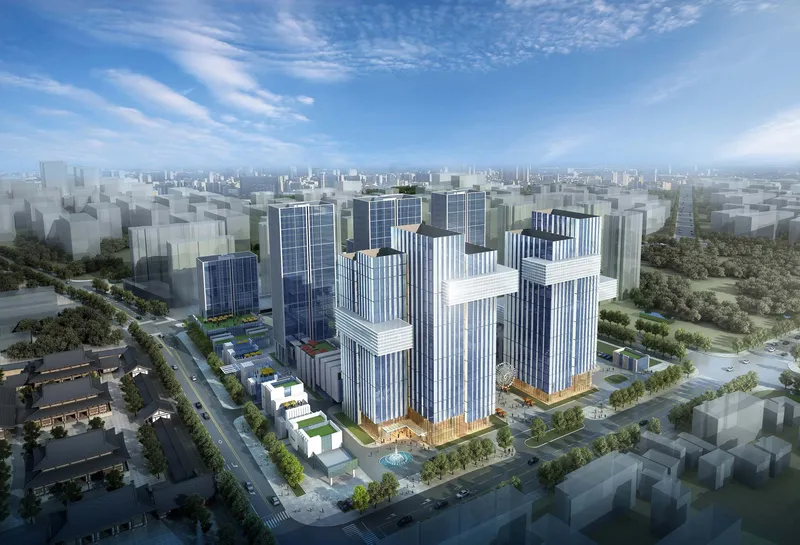
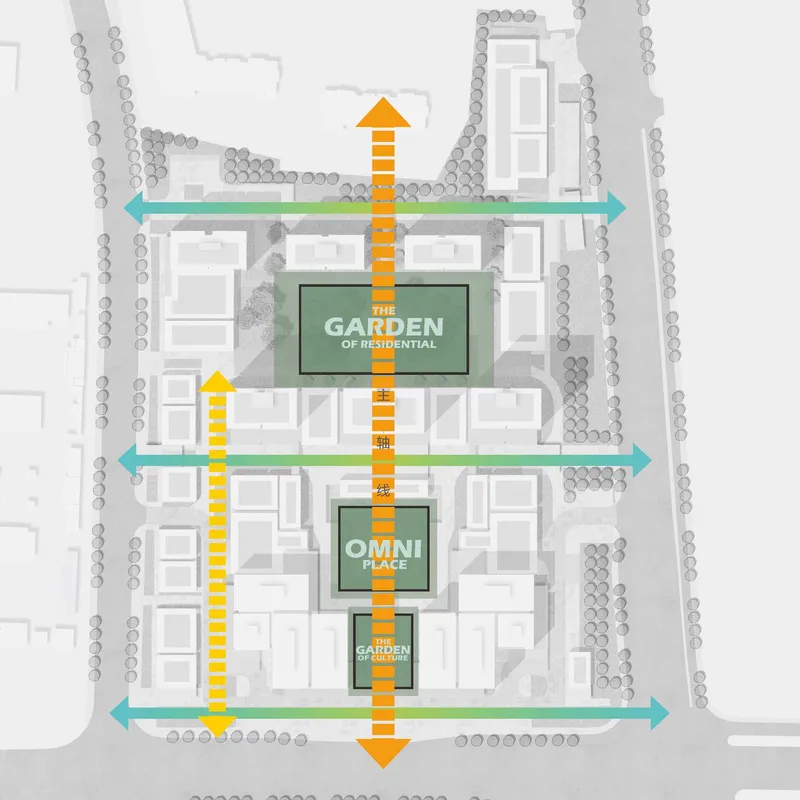
The plan is organized along five axes, described by the architects as "two vertical and three horizontal," establishing the primary circulation lines through the site. This grid does not mimic the adjacent temple literally; instead, it transposes the sequential threshold experience of a traditional Chinese three-entry compound into a contemporary pedestrian network. Visitors move through layered courtyards and plazas, each offering a different relationship to the towers above and the temple grounds beyond.
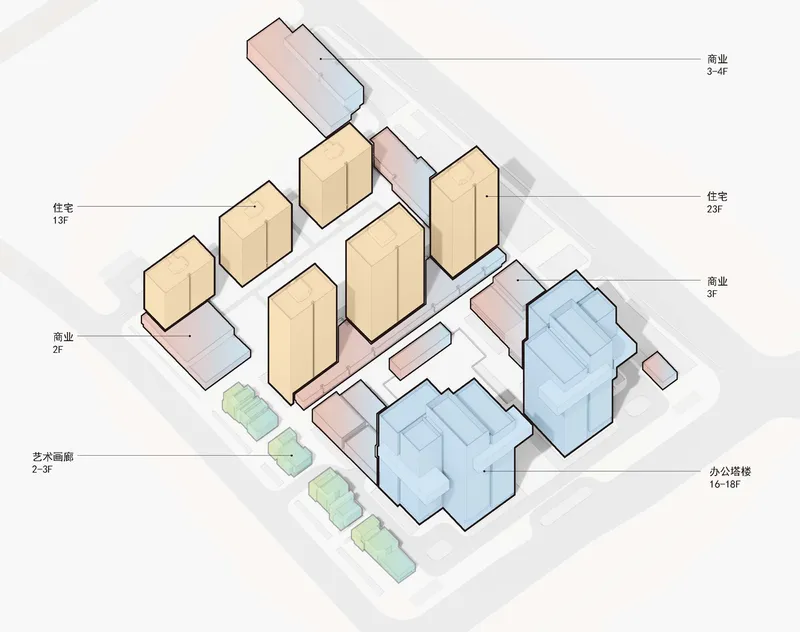
From the air, the development's logic becomes clear. The office towers anchor the composition at one end, the residential blocks step down in cascading heights at the other, and the retail villas and courtyards mediate between them. A 30-meter setback from Xiangji Temple gives the historic complex breathing room, but the visual dialogue is constant: glass facades frame temple rooftops, and the canal corridor threads through both old and new.
Interlocking Oblongs and the Mondrian Principle
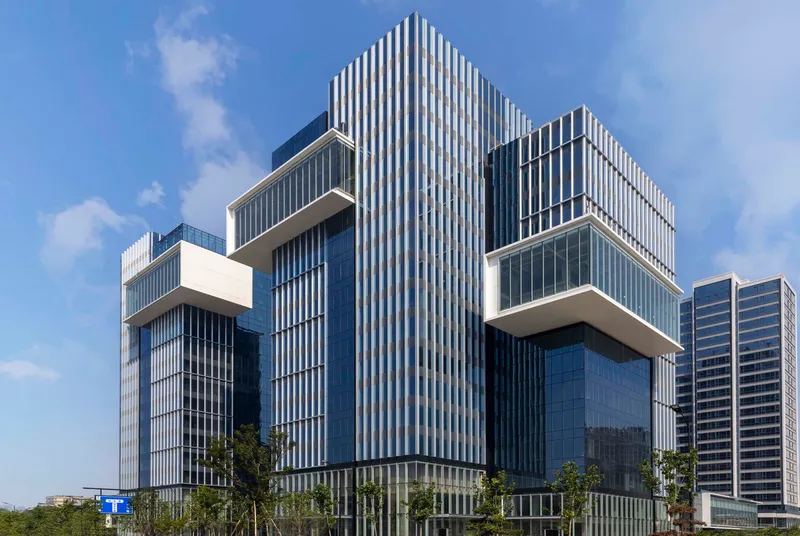
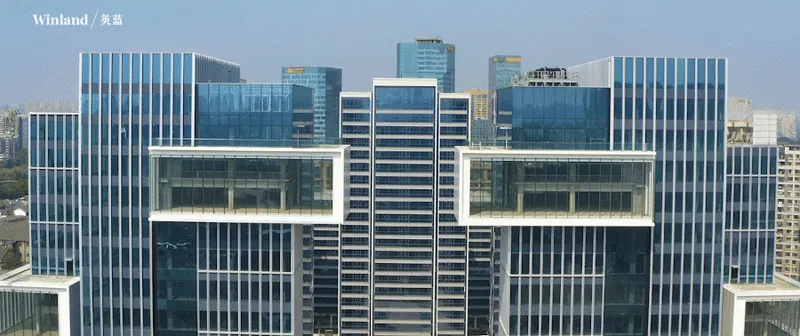
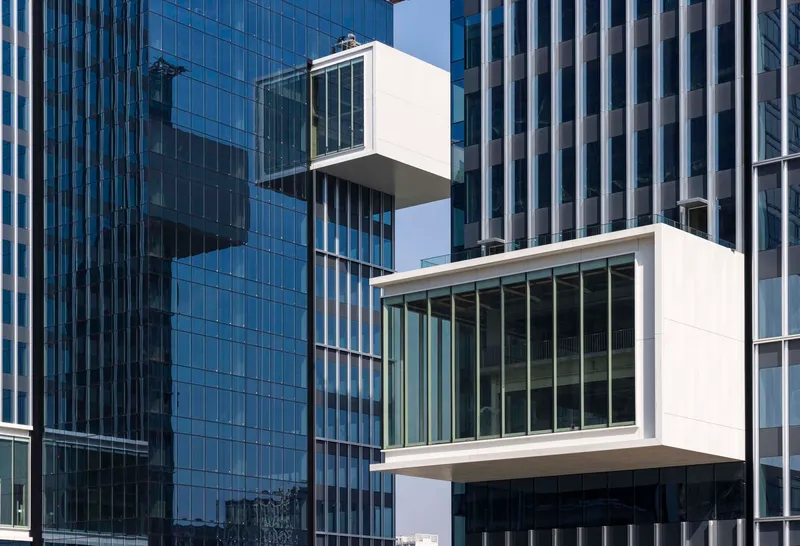
The office towers are the most visually assertive elements in the composition. Their facades are assembled from interlocking oblong volumes, transparent glass boxes that cantilever playfully from vertical-ribbed cores. The architects cite Piet Mondrian's paintings as a conceptual reference, and the comparison holds: individual volumes retain their identity while locking into a larger compositional field. Each cantilevered box reads as both a discrete room and a fragment of a larger pattern.
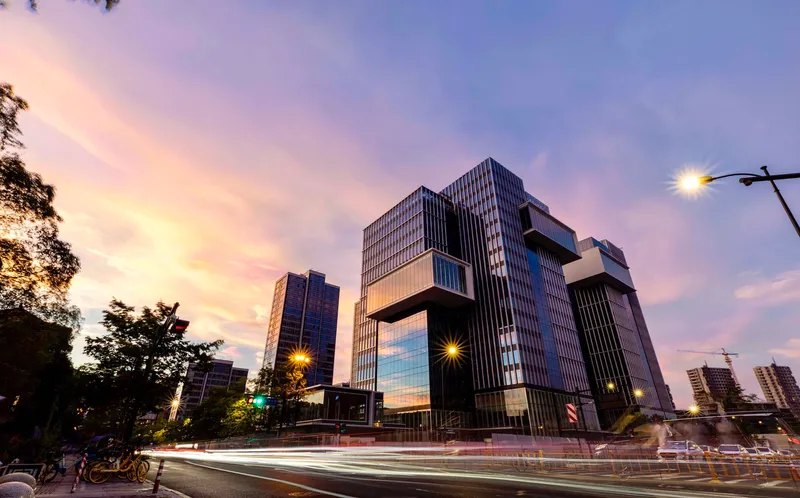
The structural bravery here is worth noting. These are not decorative appliqués; the cantilevered volumes are habitable spaces, their full-height glazing making them lanterns at dusk and framing panoramic views toward the canal during the day. The vertical metal fins that wrap the towers add rhythm and solar control, but they also give the facades a textile quality that links back to the project's deeper narrative about Hangzhou's silk industry.
Silk in Concrete
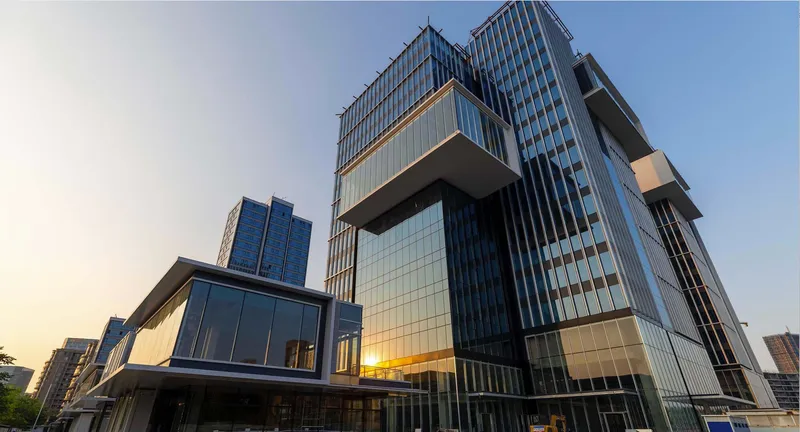
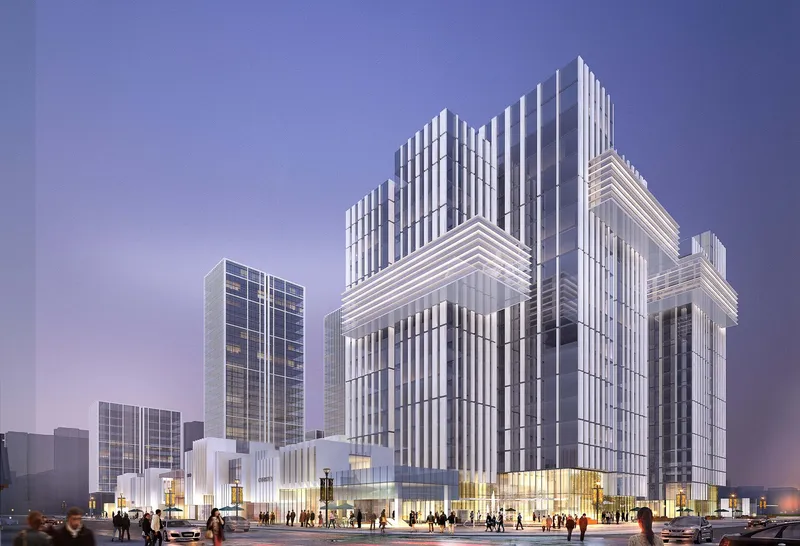
Hangzhou was historically one of China's great silk-producing cities, and the project makes this reference material rather than metaphorical. Along Lishui Road, curved UHPC (Ultra High Performance Concrete) panels in an off-white finish are shaped to resemble draped fabric. The effect is subtle from a distance but unmistakable up close: the panels billow and fold in a way that concrete should not, lending the ground-level retail frontage a softness that counterbalances the towers' hard geometry above.
The choice of UHPC is pragmatic as much as poetic. The material's density and low porosity make it ideal for Hangzhou's humid subtropical climate, where conventional concrete would degrade faster. Combined with hidden-frame curtain walls and reinforced concrete structure throughout, the material palette is restrained but technically considered. There is a listed silk warehouse across the street; the curved UHPC panels nod to it without resorting to pastiche.
Living with a Temple
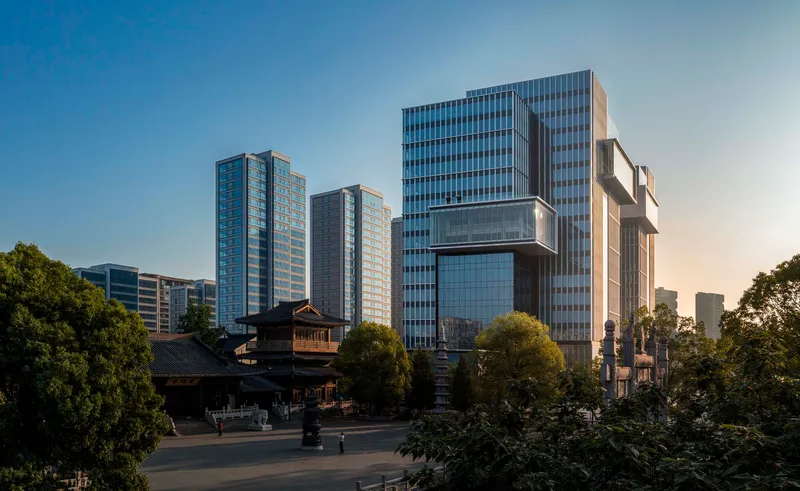
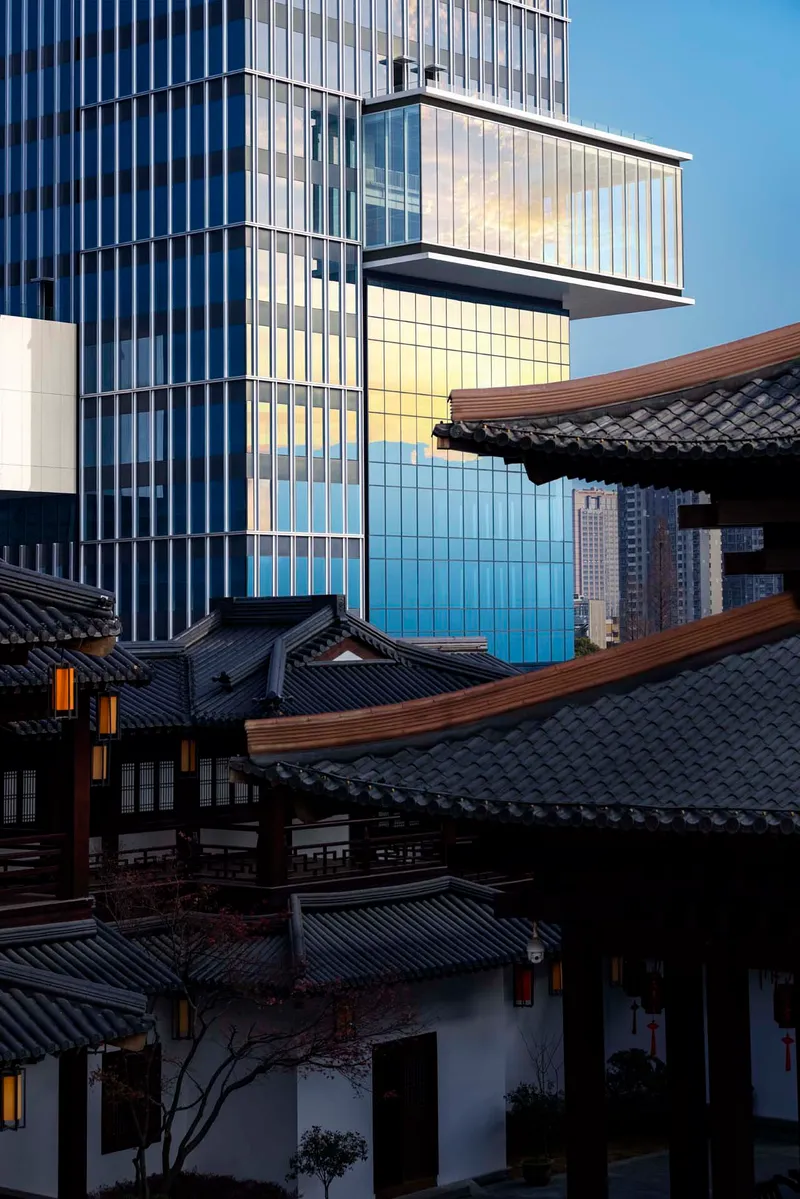
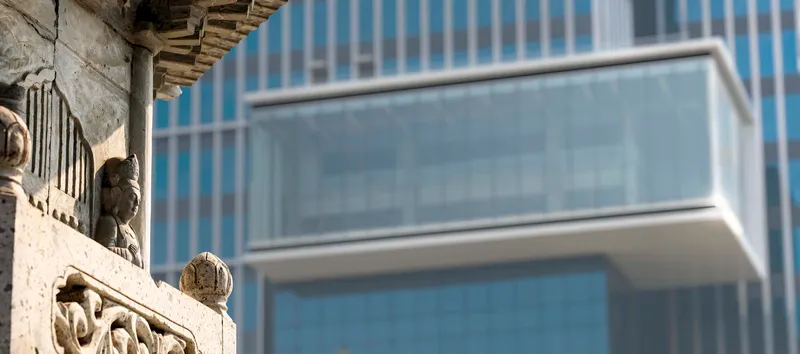
The juxtaposition between Winland Center and Xiangji Temple is the project's defining tension. Several vantage points in the complex frame the temple's timber pavilions and tiled roofs against the glass and UHPC towers behind them. The architects managed this relationship through careful massing: residential towers are arranged in cascading heights to keep the temple's sight lines open, and the retail villas closest to the heritage boundary adopt a lower scale and more restrained expression.
Whether this dialogue succeeds depends on your tolerance for contrast. The stone balustrades and carved lions of the temple precinct now share a visual field with floating glass boxes and vertical metal fins. For some, this will read as a respectful acknowledgment that cities evolve; for others, it will feel like too much proximity. What cannot be denied is that the design team engaged the problem directly rather than hiding behind a wall of trees.
Ground Plane and Public Life
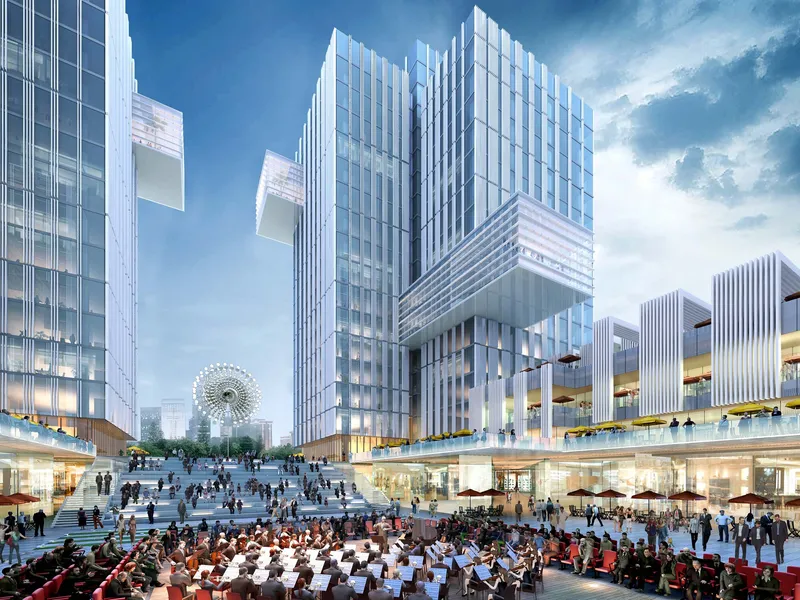
The success of any mixed-use complex this large hinges on what happens at ground level. Winland Center distributes its public program across walkable retail streetscapes, sunken courtyards, and elevated plazas connected by sheltered walkways. The retail villas are scaled to the pedestrian and clustered to create an intimate streetscape that contrasts with the tower volumes above. Terraced seating and gathering spaces beneath the cantilevered office blocks create sheltered outdoor rooms for cultural events.
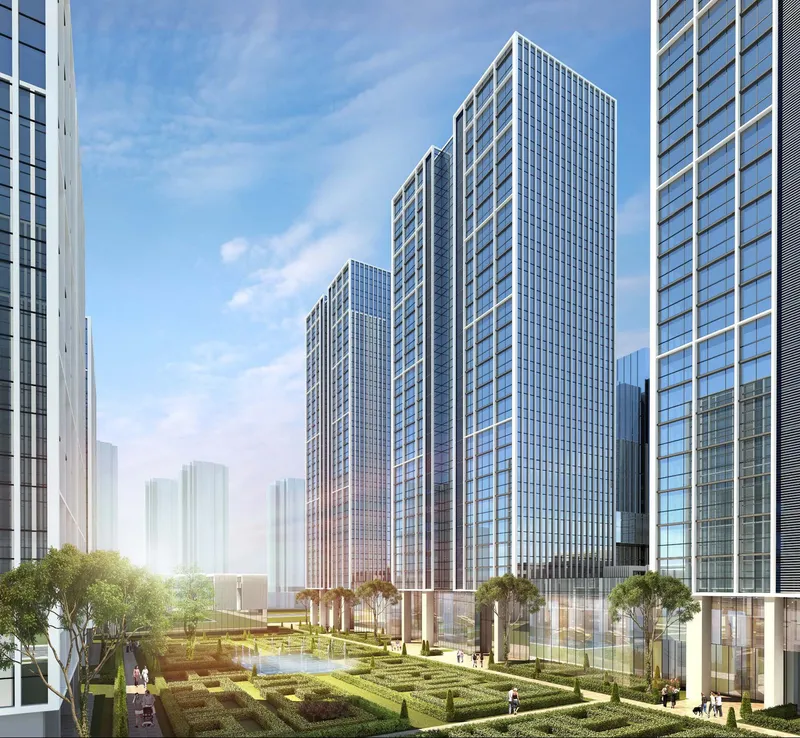
The landscaped courtyards within the residential precincts follow a different logic: geometric hedge gardens and perimeter tree planting establish quiet, semi-private green spaces that buffer the apartments from the commercial activity beyond. The transition between public plaza, semi-public retail street, and private residential courtyard is handled through level changes and planting rather than gates, a decision that keeps the development permeable even as it differentiates zones of intensity.
The Residential Cascade
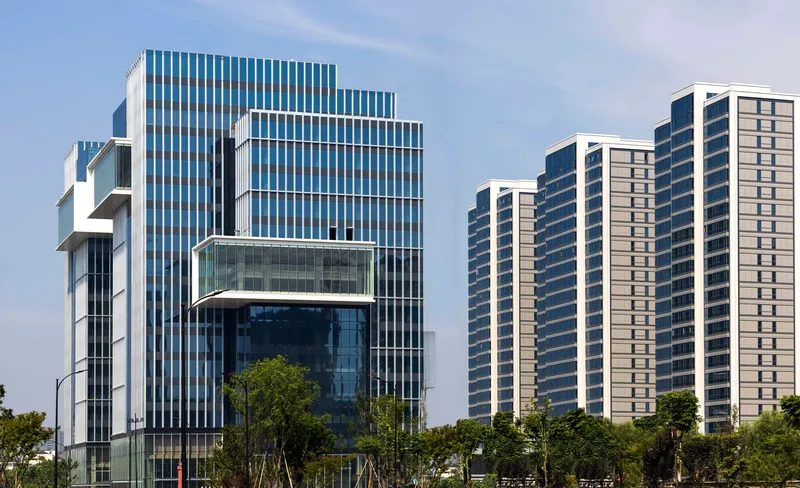
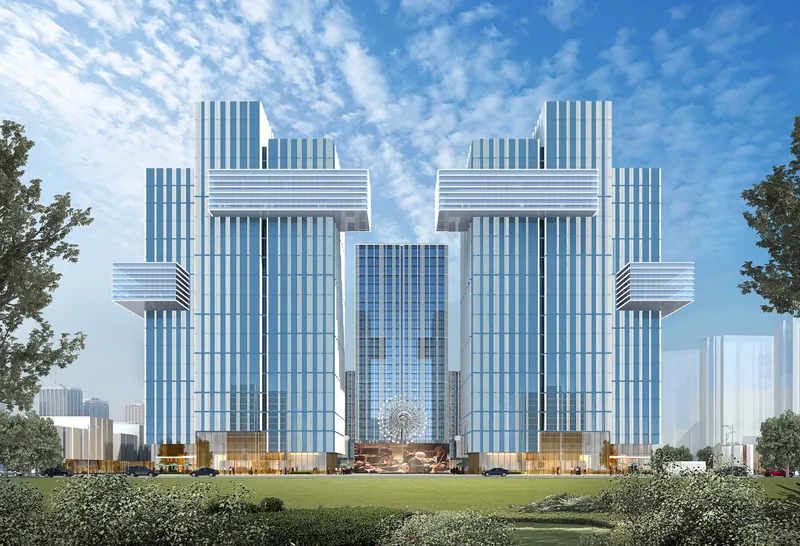
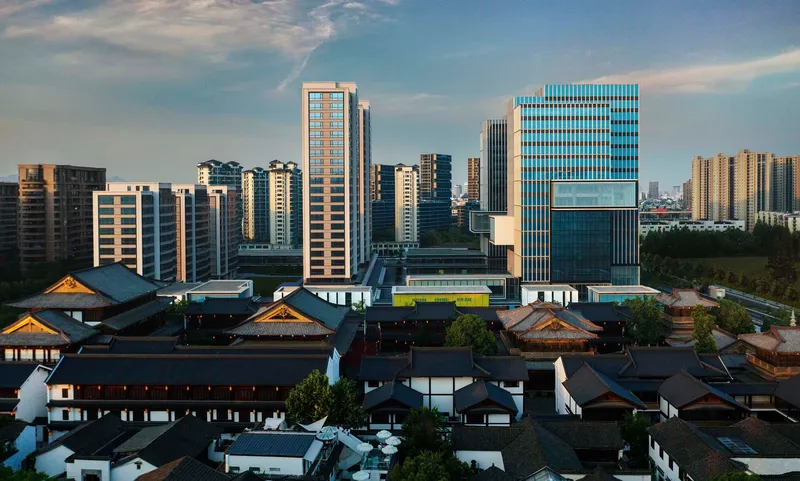
Six residential towers step down in height as they move away from the office cores, a massing strategy that maximizes daylight penetration and views toward the Grand Canal. The towers are slender enough to avoid the wall-of-building effect that plagues many Chinese superblock developments, and their vertical louvered facades provide a degree of privacy and solar shading without closing off the interiors entirely.
The interconnected residential podiums tie the towers together at their bases, housing shared amenities and providing sheltered pedestrian routes. It is a pragmatic response to Hangzhou's hot, rainy summers: residents can move between buildings, retail, and transit without exposure. The cascading height profile also creates a skyline silhouette that is more varied than a uniform cluster, giving each tower a distinct address within the ensemble.
Plans and Drawings
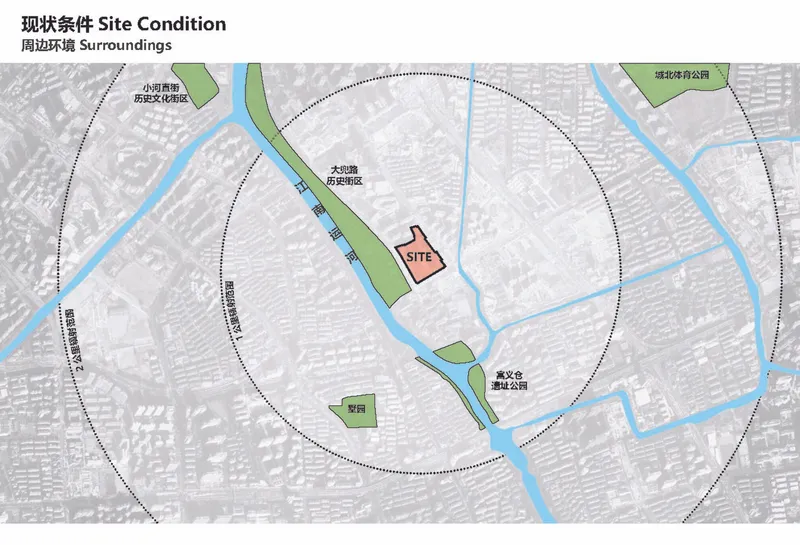
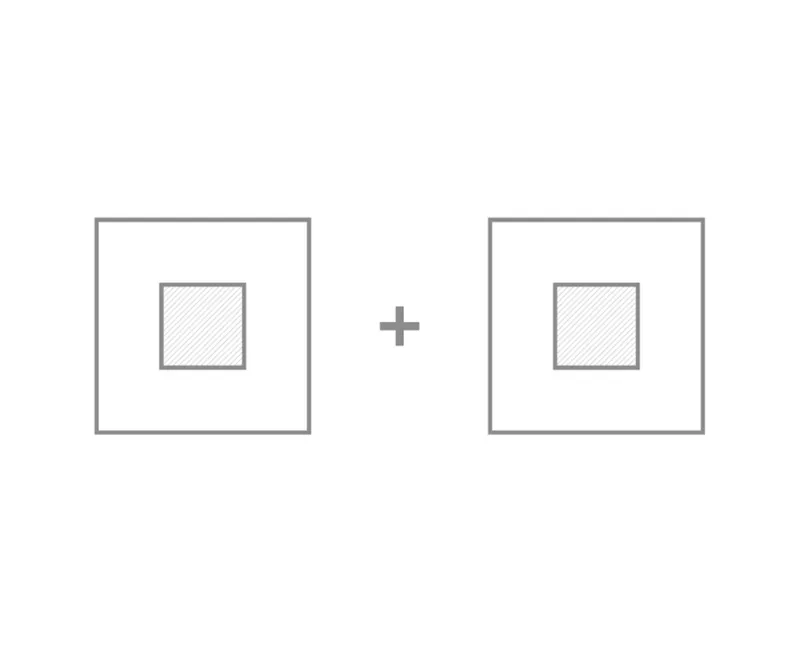
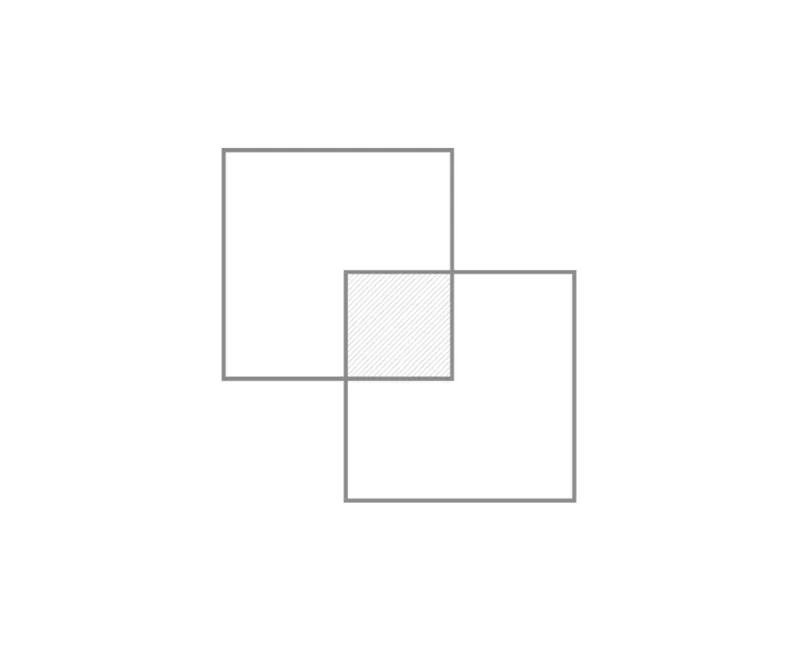
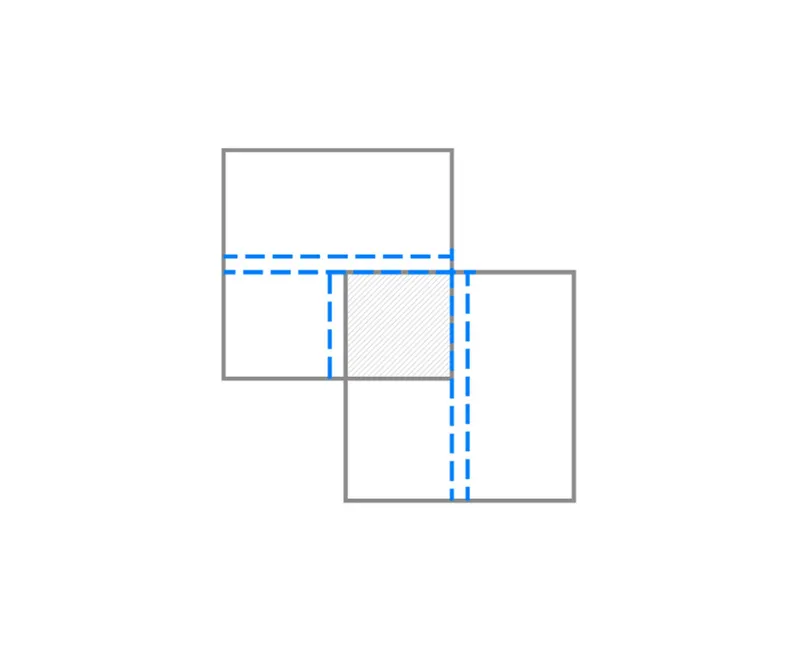
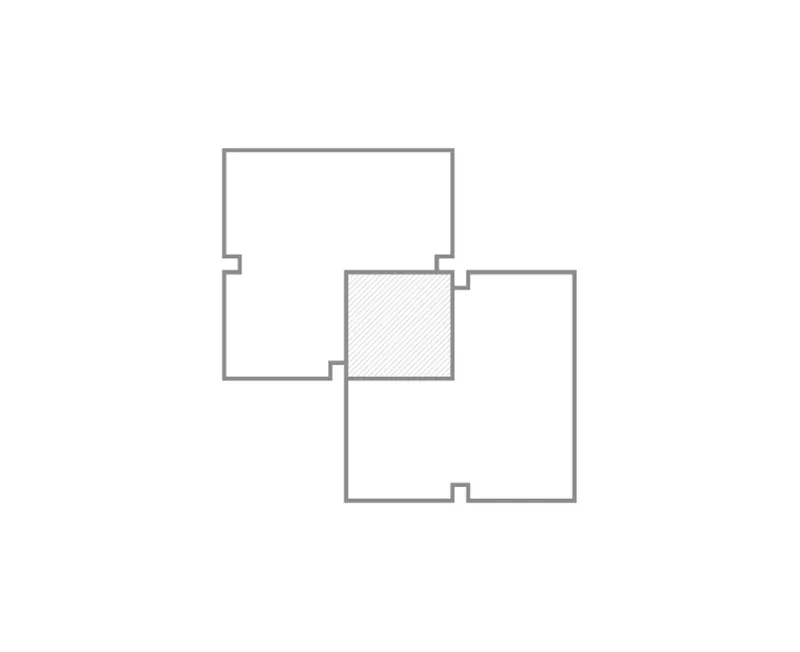
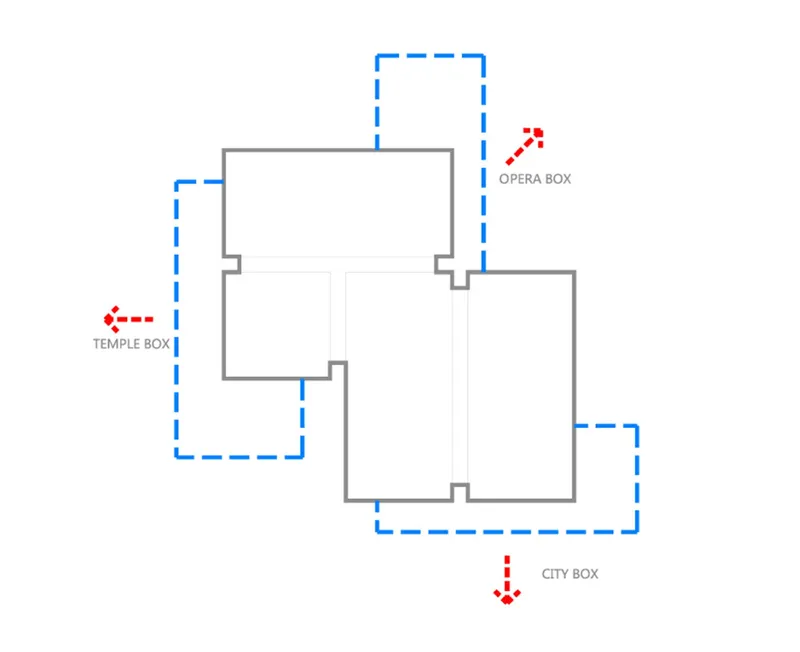
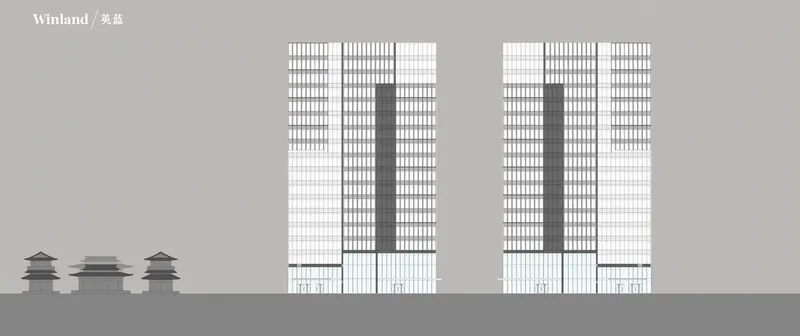
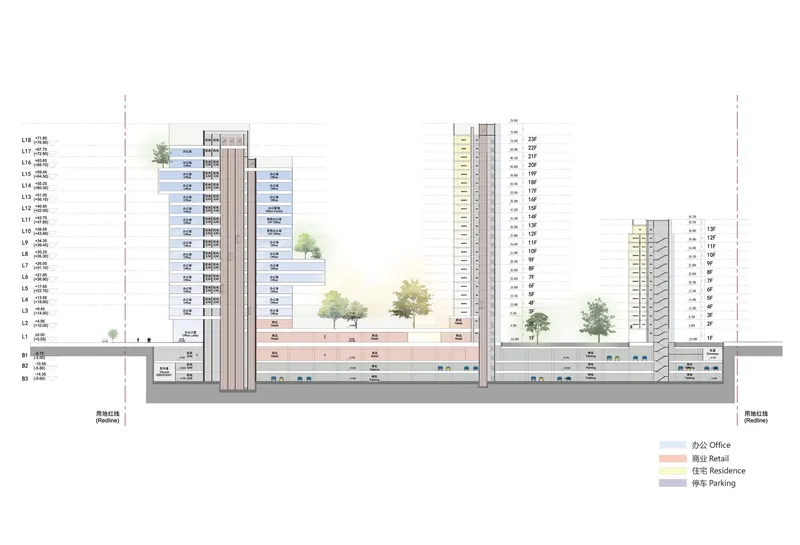
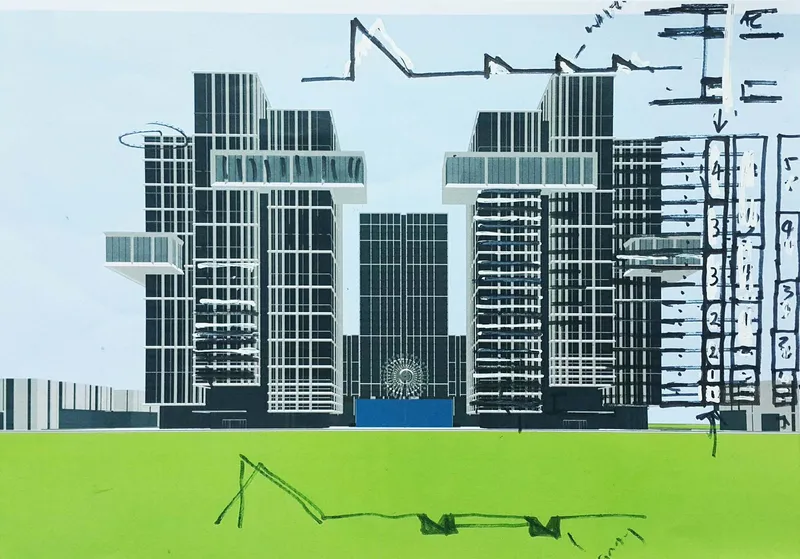
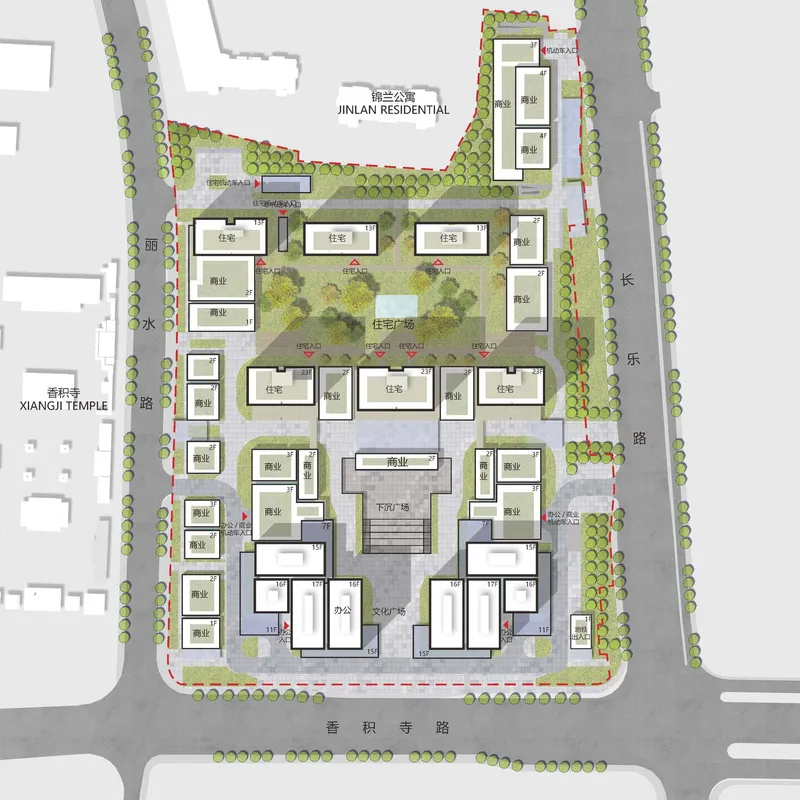
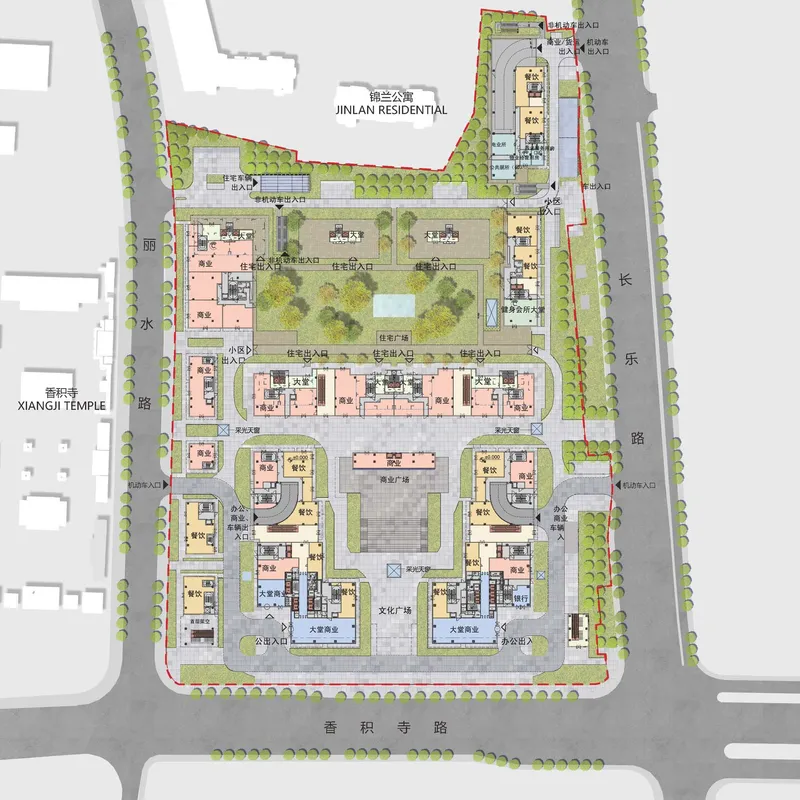
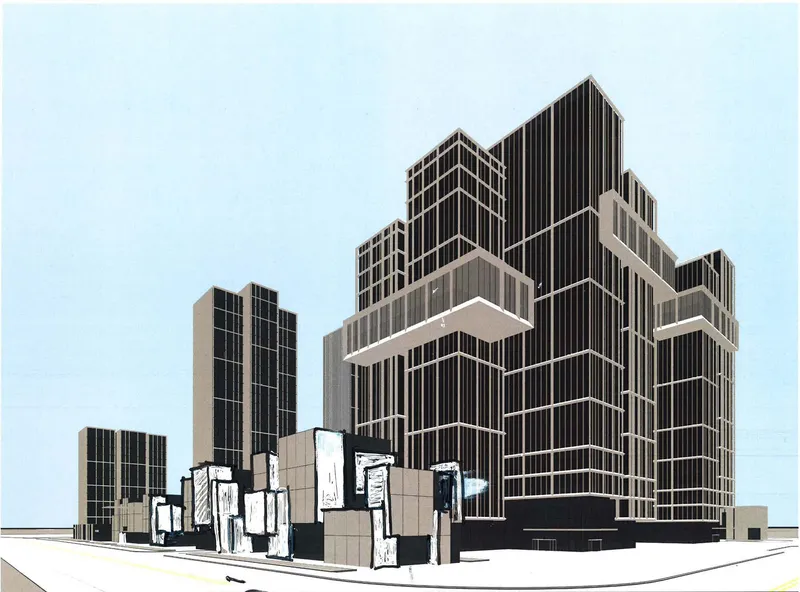
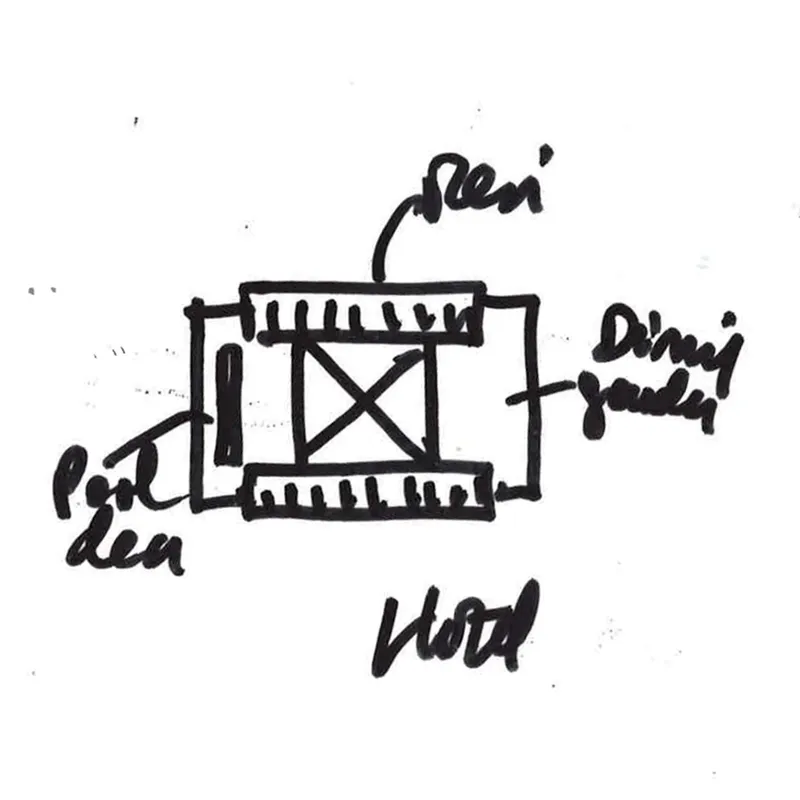
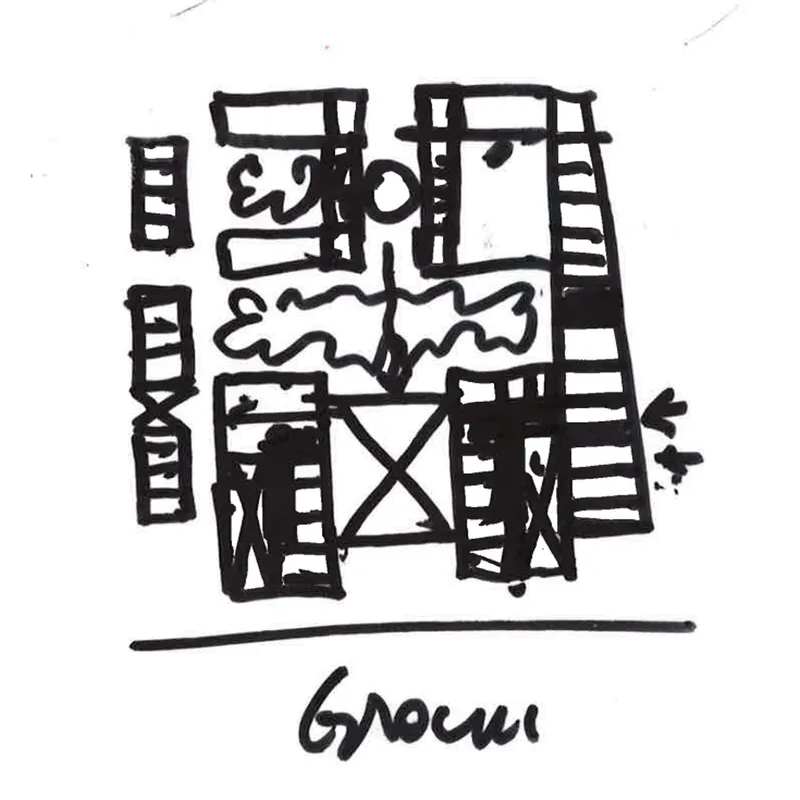
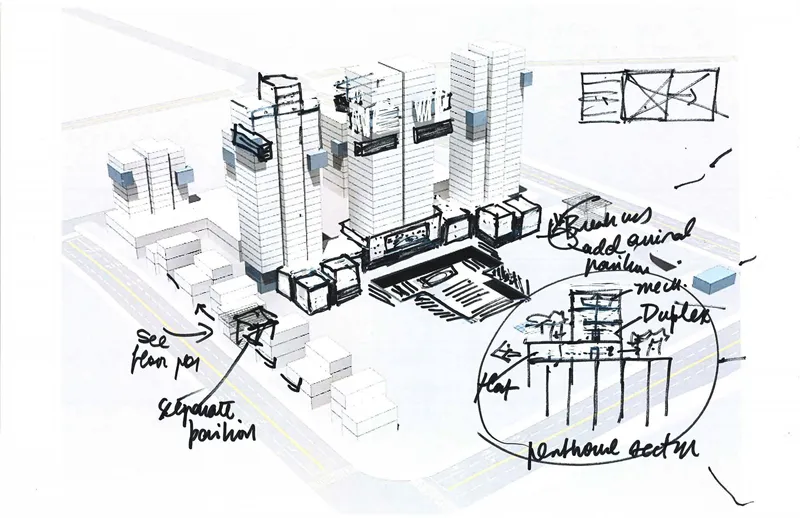
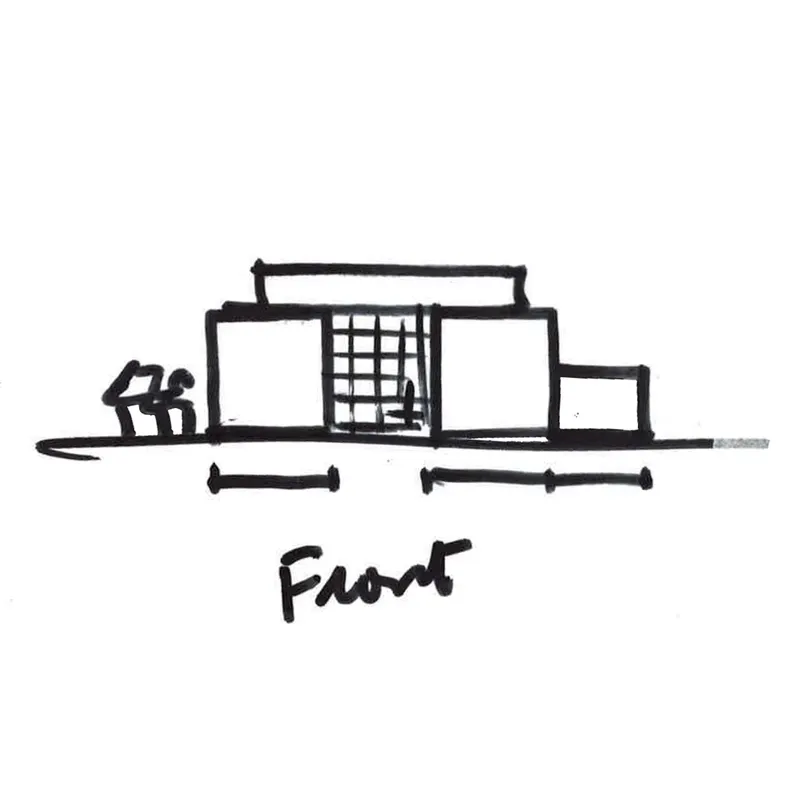
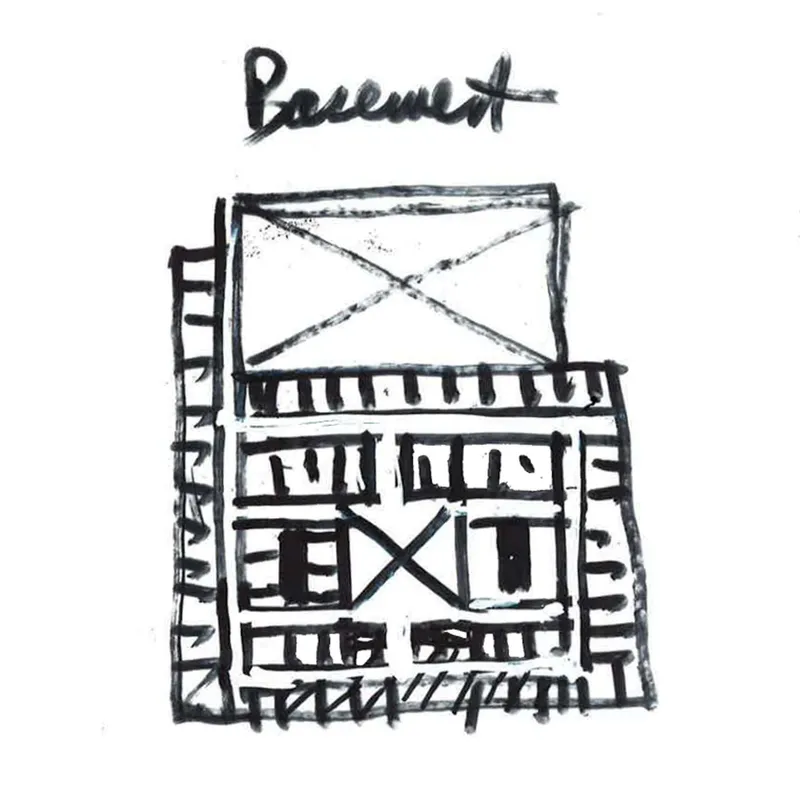
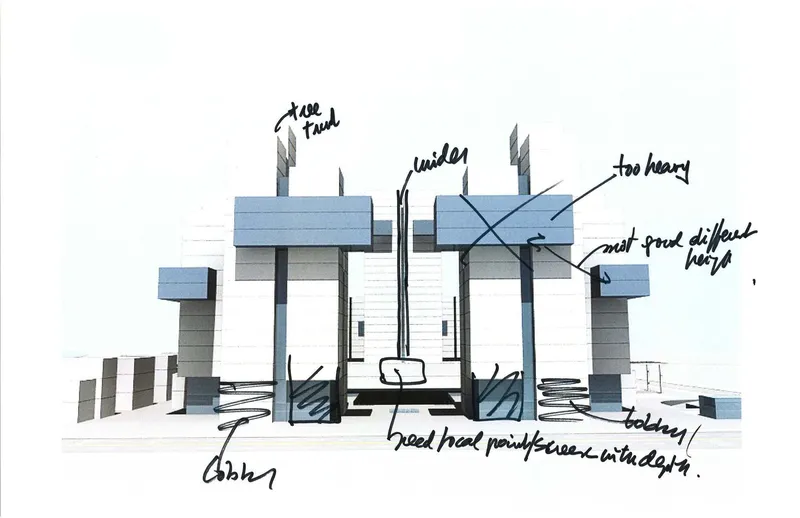
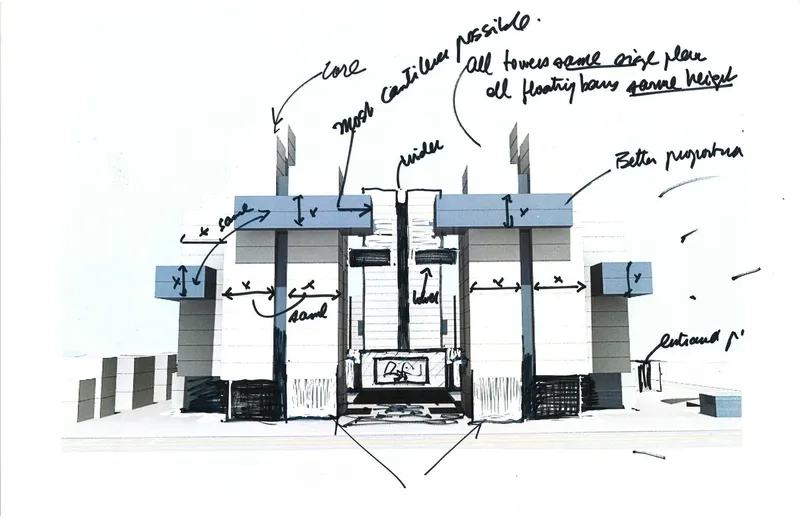
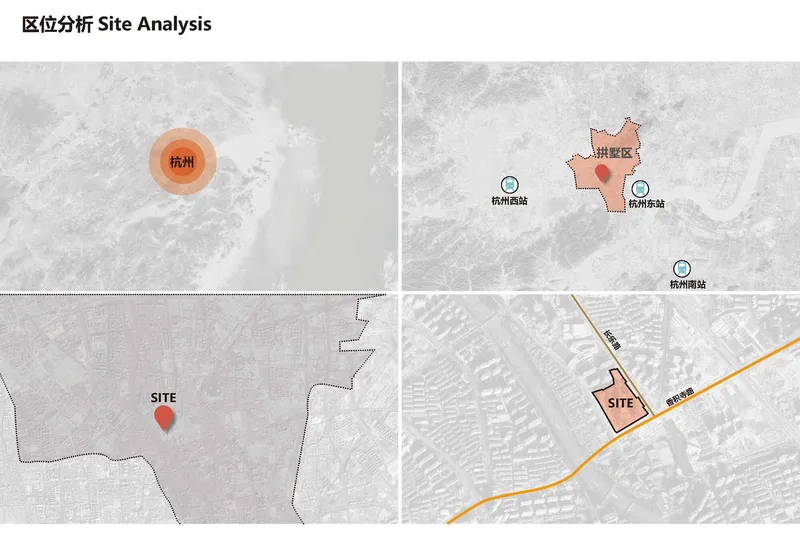
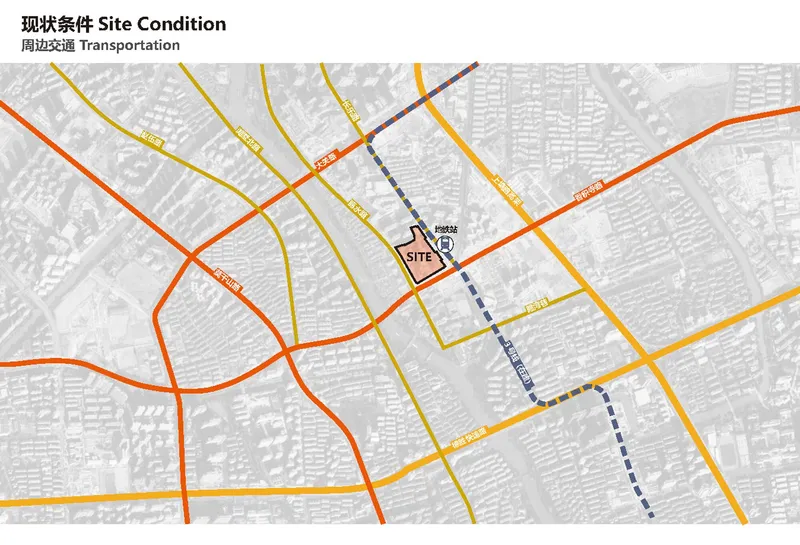
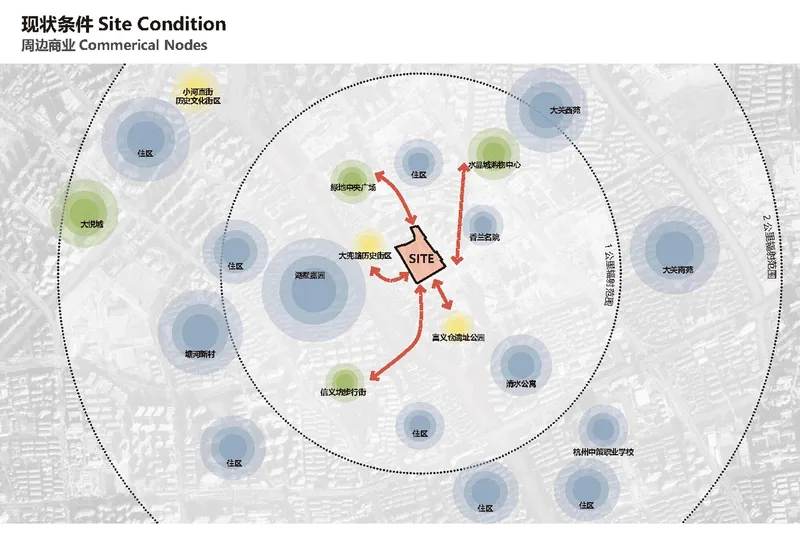
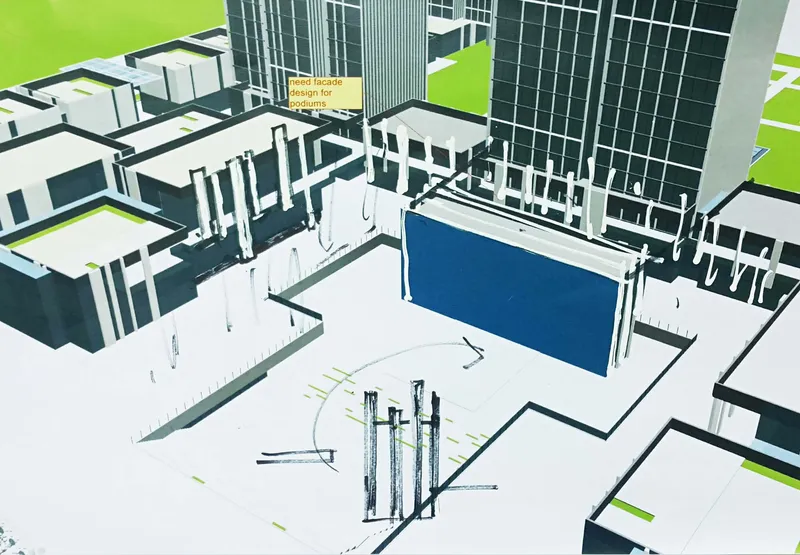
The drawings reveal the scheme's intellectual rigor. The courtyard-overlap diagrams show how two square volumes with central voids are rotated and merged to produce a shared courtyard at their intersection, a clear geometric procedure that generates the plan's spatial variety. The section through the podium illustrates how retail, office, and parking levels stack beneath the towers, with the sunken courtyard pulling daylight and activity down to the lower levels. The hand sketches by the design team are unusually expressive, showing the elevation strategies for vertical fins, entrance canopies, and the relationship between tower cores and cantilevered volumes still being worked out by hand.
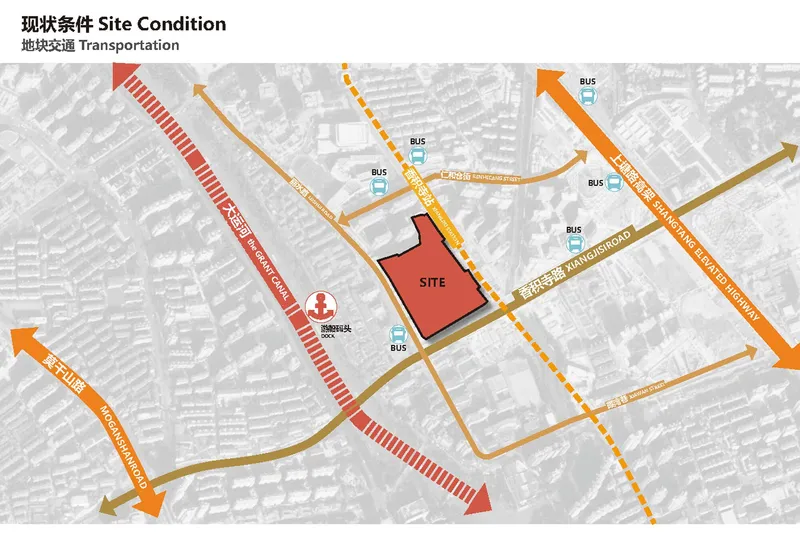
The site analysis diagrams deserve attention. They map bus routes, commercial catchment radii, pedestrian desire lines, and green corridor connections with an analytical density that explains many of the plan's decisions. The five-axis layout is not an arbitrary grid; it responds to the movement patterns that the site generates by virtue of its position between the canal, the temple, and the surrounding road network.
Why This Project Matters
Winland Center matters because it takes on a problem that most large-scale Chinese mixed-use developments avoid: how to build a quarter-million square meters of contemporary program beside a heritage site without either overwhelming it or pretending it doesn't exist. The design team's answer, rooting the spatial logic in the same courtyard typology that organizes the adjacent temple, is intellectually honest. It argues that continuity in urban culture can be carried by spatial sequence and plan logic rather than stylistic mimicry.
The collaboration between Arquitectonica and Farrells brings together Miami's appetite for bold figuration and Hong Kong's pragmatic urbanism, and you can feel both sensibilities at work. The cantilevered glass boxes are unmistakably Arquitectonica; the pedestrian network and transit integration carry Farrells' fingerprints. The project is not flawless. Some of the tower-temple juxtapositions push the limits of contextual respect, and the retail villas' relationship to the heritage buffer could be tighter. But as a demonstration of how to organize a complex, multi-tower development around a coherent spatial idea rather than a marketing diagram, Winland Center sets a standard worth studying.
Winland Center by Arquitectonica and Farrells. Hangzhou, China. 224,199 m². Completed 2021. Photography by Winland Group.
About the Studio
Share Your Own Work on uni.xyz
If projects like this are the kind of work you want to make, uni.xyz is a place to publish your own, find collaborators, and enter design competitions.


Popular Articles
Popular articles from the community


Manzana Morphosis: Stretching Barcelona's Grid into a Living Landscape for 2050
A radical reworking of the Eixample manzana turns density into a tool for generous public space, vertical ecology, and environmental performance.


ETEH Reworks the Shared Spaces of São Domingos School in Brazil Around Timber, Color and Hanging Plants
At São Domingos School in Brazil, 436 m² of hall, refectory and library are recast with timber joinery, a yellow and blue code and trailing greenery.

David Ortega Stacks a Two-Story Mexico City Penthouse Around a Steel Stair and a Pergola-Shaded Roof Terrace
In Colonia Roma, a 300 m² penthouse uses oak joinery, a planted steel stair and a slatted roof pergola to make a new-build apartment feel like a house.

graciastudio Turns a Viewless Tijuana Lot Inward Around a Courtyard of Concrete, Timber and Trees
In Tijuana, Jorge Gracia's GA2 House stacks a timber-clad private floor over exposed concrete and replaces a missing view with a planted interior patio.

Similar Reads
You might also enjoy these articles

LAVA Architecten Gives Vocational Education a Sawtooth-Roofed Face on a Mechelen School Campus
In Mechelen, Belgium, a 2,053 m² STEM school on a 6×6 m grid turns workshops and classrooms into rooms that can be rearranged as teaching changes.

KEMA Studio Turns a Derelict Marvila Attic into a 60 m² Lighthouse Apartment Above Lisbon
In Lisbon's Marvila district, a rebuilt roof, four skylights and two plywood volumes turn an unlivable attic into a bright home facing the Tagus.

Pixel Gardens: One Repeated Module Stacked Into a Terraced Social Housing Tower for Famagusta
Salem Bader's shortlisted housing tower builds a vertical neighbourhood from one repeated module, offsetting units to carve terraces, light and air.

Bao Huynh Watercolor Atelier: A Serene Art Retreat in Hội An
Bao Huynh Watercolor Atelier in Hội An blends multifunctional art spaces, sustainable design, local materials, and family-friendly living in a serene environment.


Comments (0)
Please login or sign up to add comments
No comments yet. Be the first to comment!