
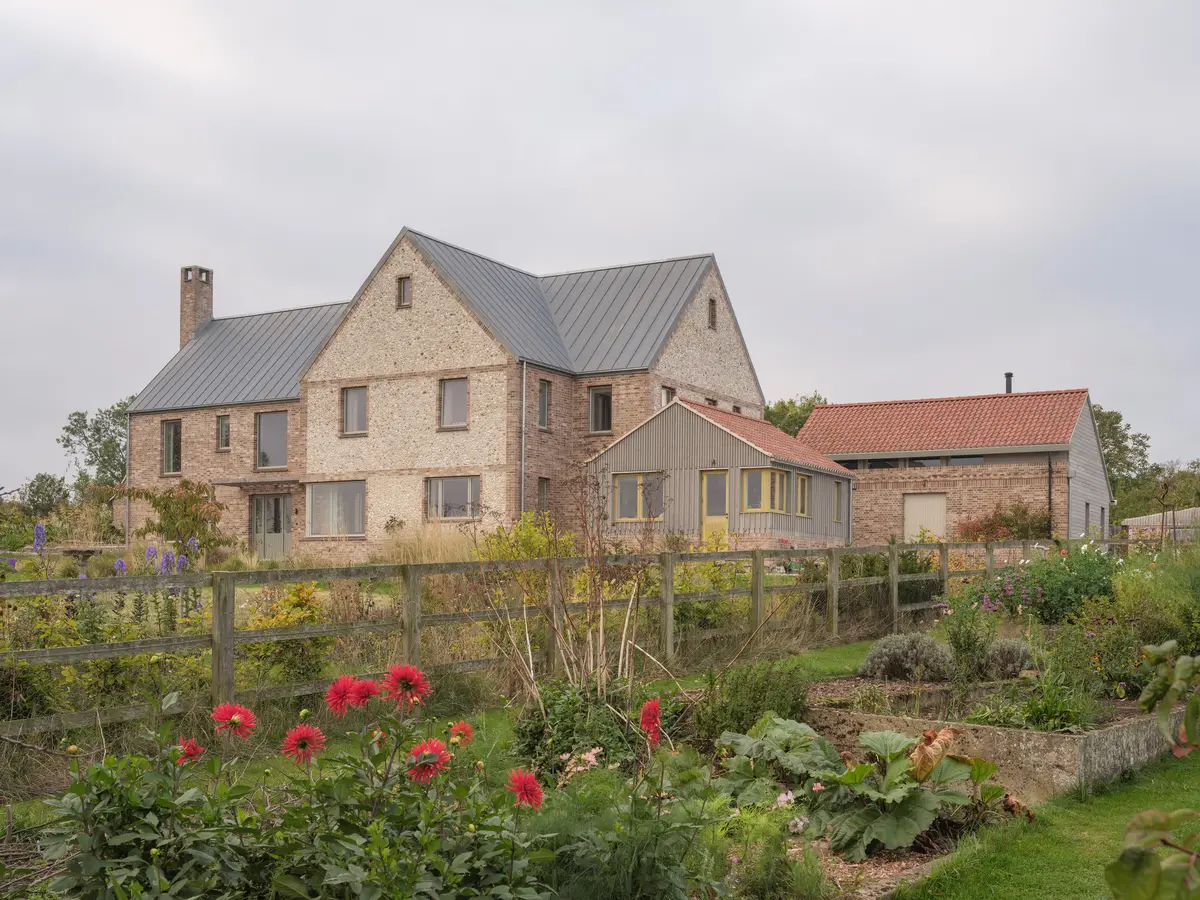
Ashworth Parkes Architects Build a Contemporary Farmhouse That Feels Like It Has Always Been There
A cluster of gabled volumes in brick, flint, and timber replaces a derelict 1940s dwelling on a former market garden in North Hertfordshire.


Replacing a poorly constructed 1940s dwelling that had deteriorated beyond rescue, the Contemporary Farmhouse by Ashworth Parkes Architects sits on a former market garden in North Hertfordshire. The project reads less as a single house and more as a small agricultural hamlet: a family of gabled volumes connected by courtyards, covered walkways, and brick thresholds. The ambition was not to mimic historical buildings but to root a new dwelling so convincingly in the local material palette that it registers as an accumulation over time rather than a single act of construction.
What makes the project genuinely compelling is the discipline of its additive logic. Each volume carries its own roof, its own cladding material, and its own relationship to the landscape, yet together they compose a coherent whole. Brick, knapped flint, vertical timber boarding, and standing seam metal roofing are all drawn from the North Hertfordshire vernacular. The result is a 606 square metre house that manages to be large without ever feeling monolithic, and contemporary without straining for novelty.
A Hamlet, Not a House
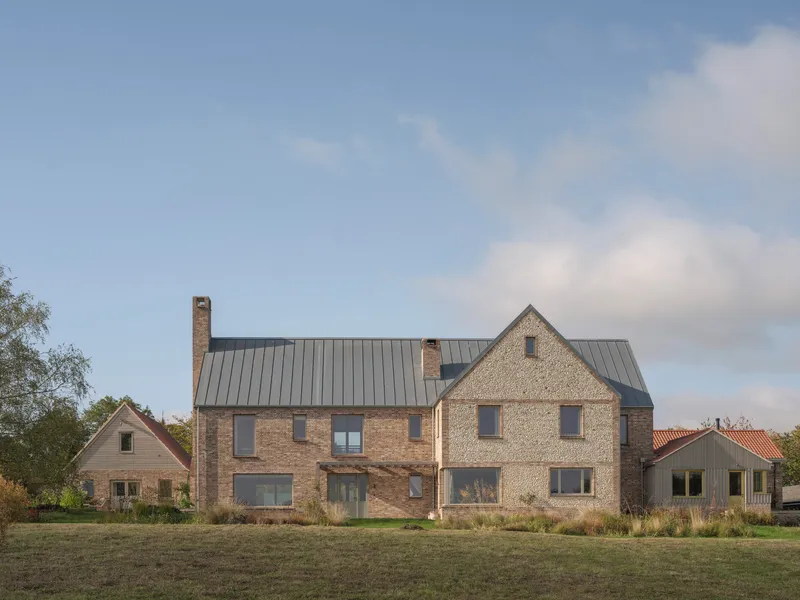


From any angle, the farmhouse presents itself as a cluster of structures rather than a unified mass. The aerial view reveals how the separate volumes are arranged around a gravel courtyard, each one slightly rotated or offset from the next. Standing seam metal roofs cap the gabled forms, their zinc-grey tone shifting with the weather and lending the composition a quiet industrial undertone that prevents it from tipping into pastiche.
The strategy is both spatial and social. By breaking the program into distinct volumes, the architects create thresholds, compression points, and moments of arrival between rooms that would otherwise be a single open corridor. You move through the house the way you would move through a farmyard: from building to building, outdoors and back in again, always aware of the sky.
Material Conversation: Brick, Flint, and Timber


The material palette deserves close reading. Knapped flint walls appear on gable ends, their rough texture playing against the precision of the brickwork that frames windows and corners. These are not decorative choices but direct references to the construction traditions of Hertfordshire, where flint and brick have been paired for centuries. The flint is laid with care, each face split to expose the dark glassy interior, a technique that requires real craft.
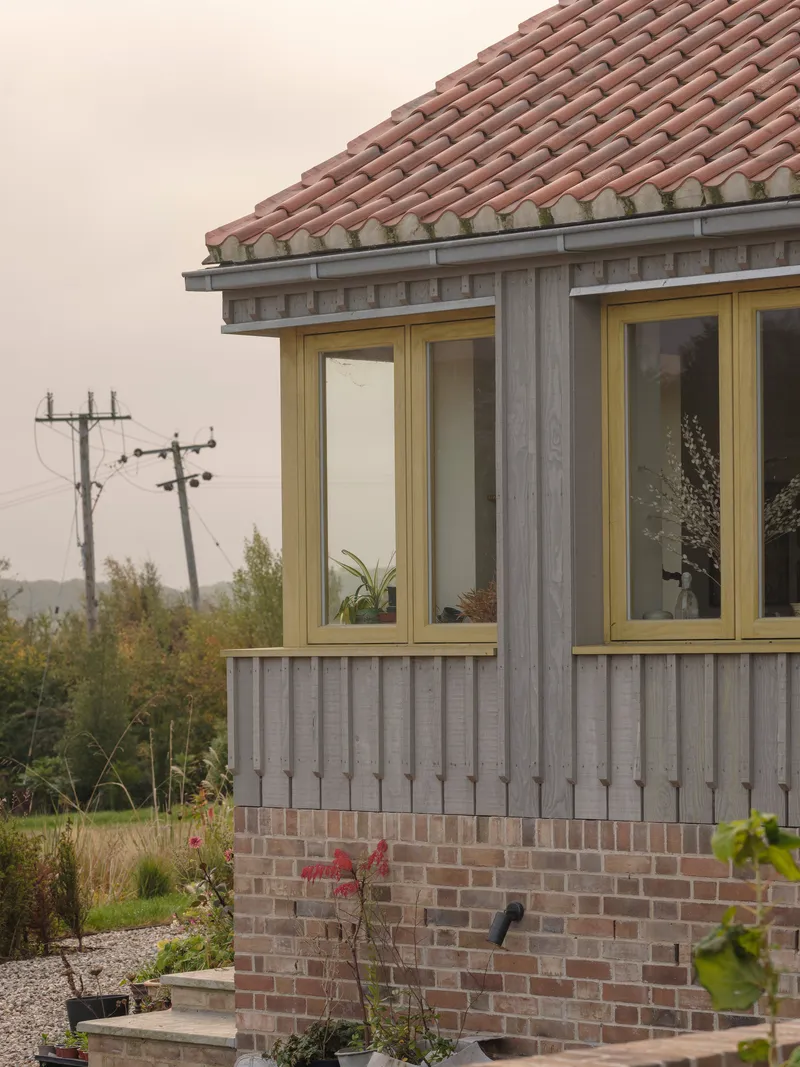

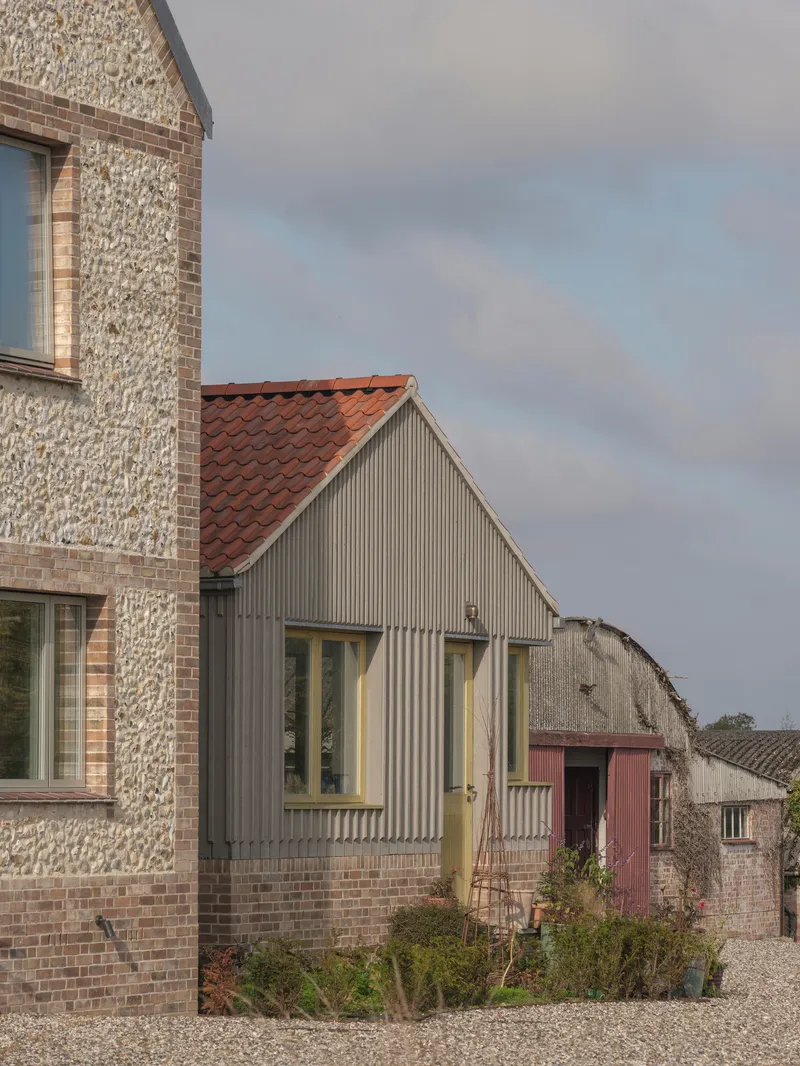
Vertical timber cladding wraps other volumes, sitting above brick plinths that anchor the lighter material to the ground. The timber will silver with age, gradually converging with the colour of the standing seam roofing. Terracotta roof tiles appear on subsidiary forms, adding another layer to the material hierarchy. Every surface tells you where it sits in the pecking order of the composition: flint is the oldest voice, brick the structural backbone, timber the lighter counterpoint.
Courtyards and Covered Ground


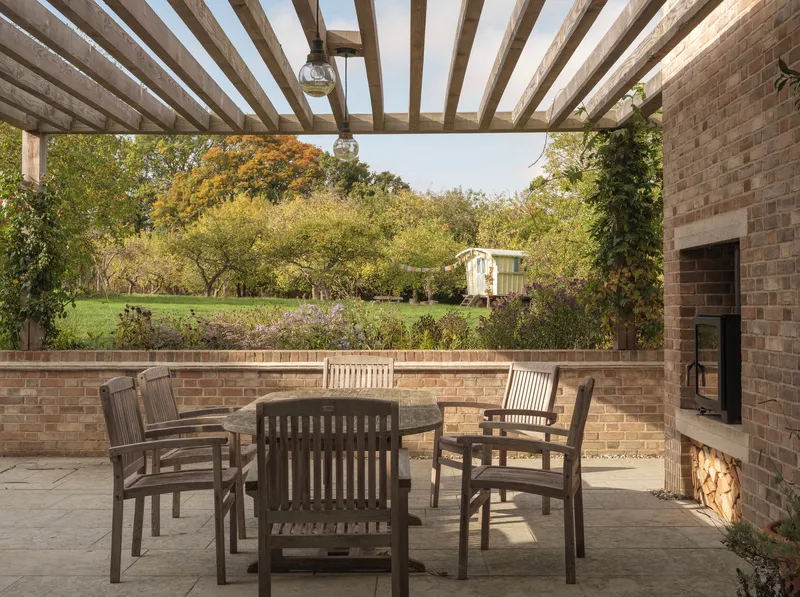
The courtyard is the social heart of the plan. Brick paving, a planted bed, and a timber pergola define an outdoor room that mediates between the private interior and the open Hertfordshire landscape. The pergola in particular is a smart move: it throws stripes of shadow across the courtyard, marking the passage of the day and framing views of the garden through its repetitive timber beams.
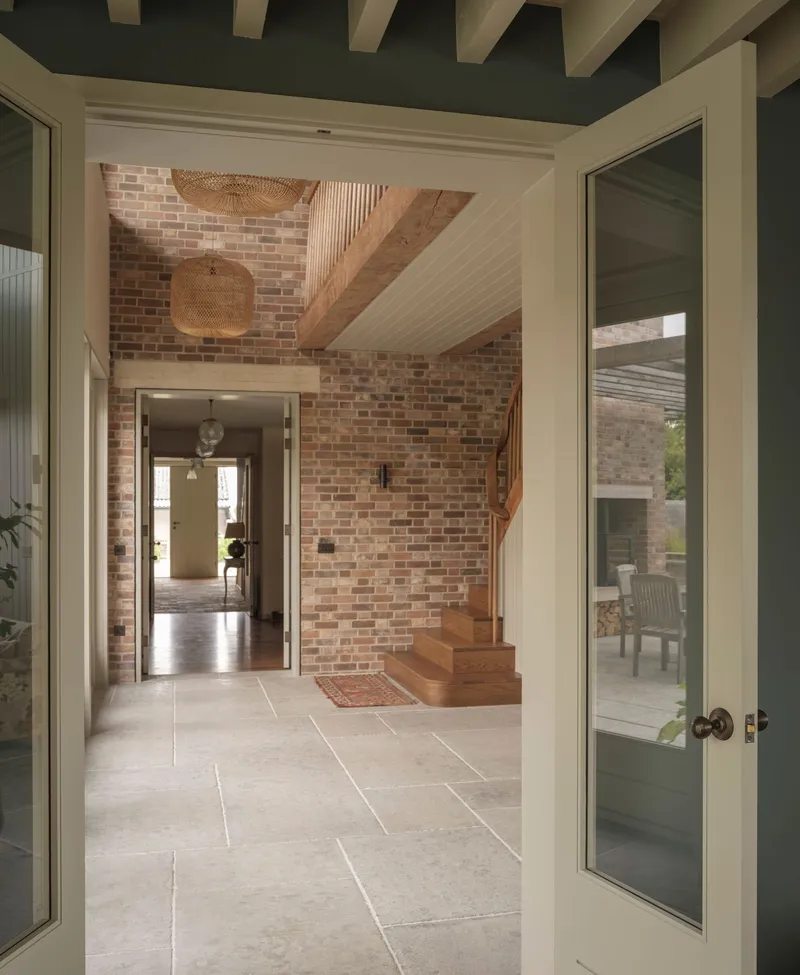
Glazed doorways open from the courtyard into living spaces, collapsing the threshold between inside and out. The brick walls continue through these openings, refusing to distinguish between exterior and interior surfaces. It is a subtle detail, but it reinforces the idea that the courtyard is not leftover space between buildings but a room in its own right.
Interior Warmth: Timber, Light, and View
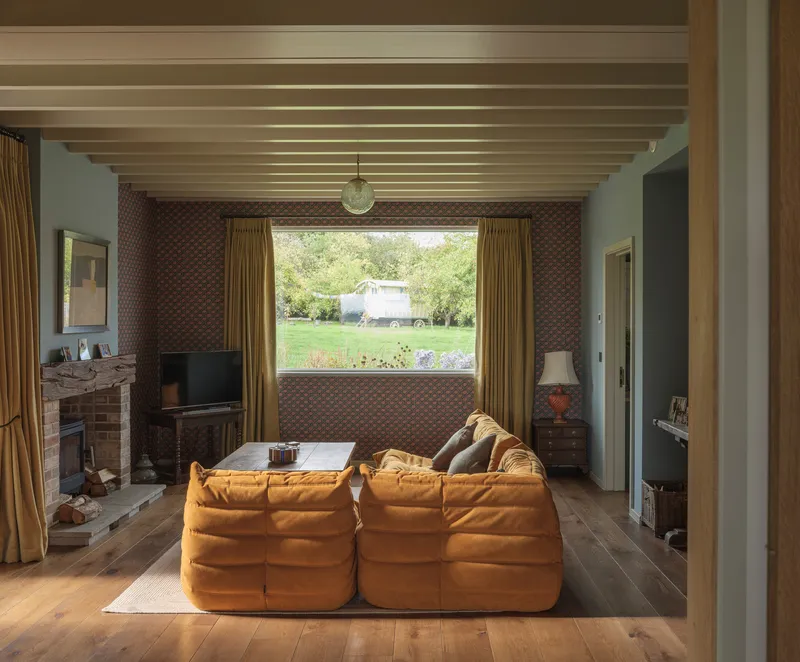

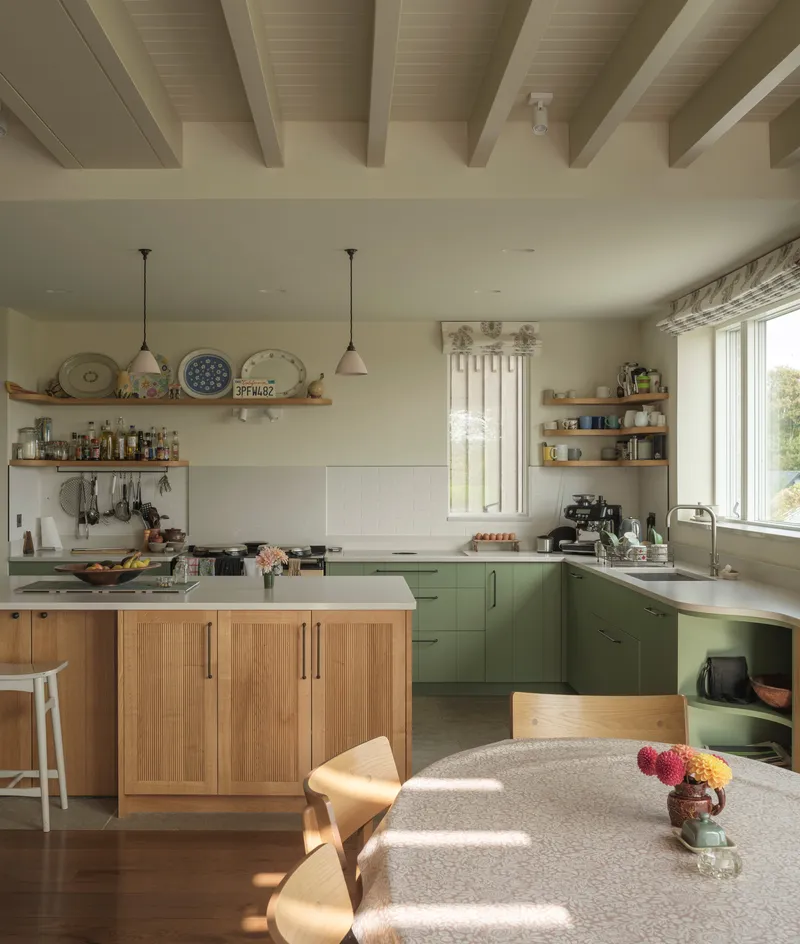
Inside, exposed timber ceiling joists and beams define the character of every room. The kitchen, with its green cabinetry and timber island, sits beneath a vaulted ceiling that follows the roofline, making the most of the gabled volume. Large landscape windows in the living areas are positioned precisely to frame the surrounding fields, pulling the countryside into the domestic interior without resorting to floor-to-ceiling glazing.
The built-in bookshelves flanking the living room window are a particularly confident detail. They frame the view as though it were a painting while also providing a deep window seat, a place where the boundary between looking at the landscape and inhabiting the room dissolves entirely.

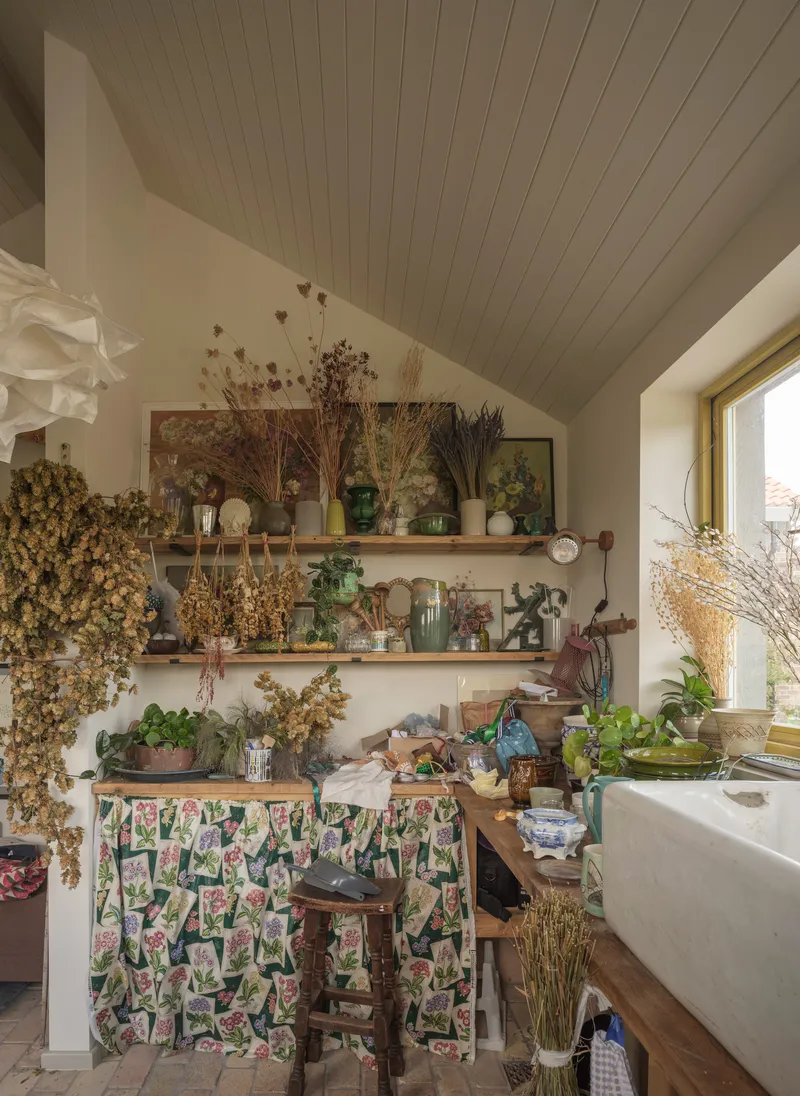
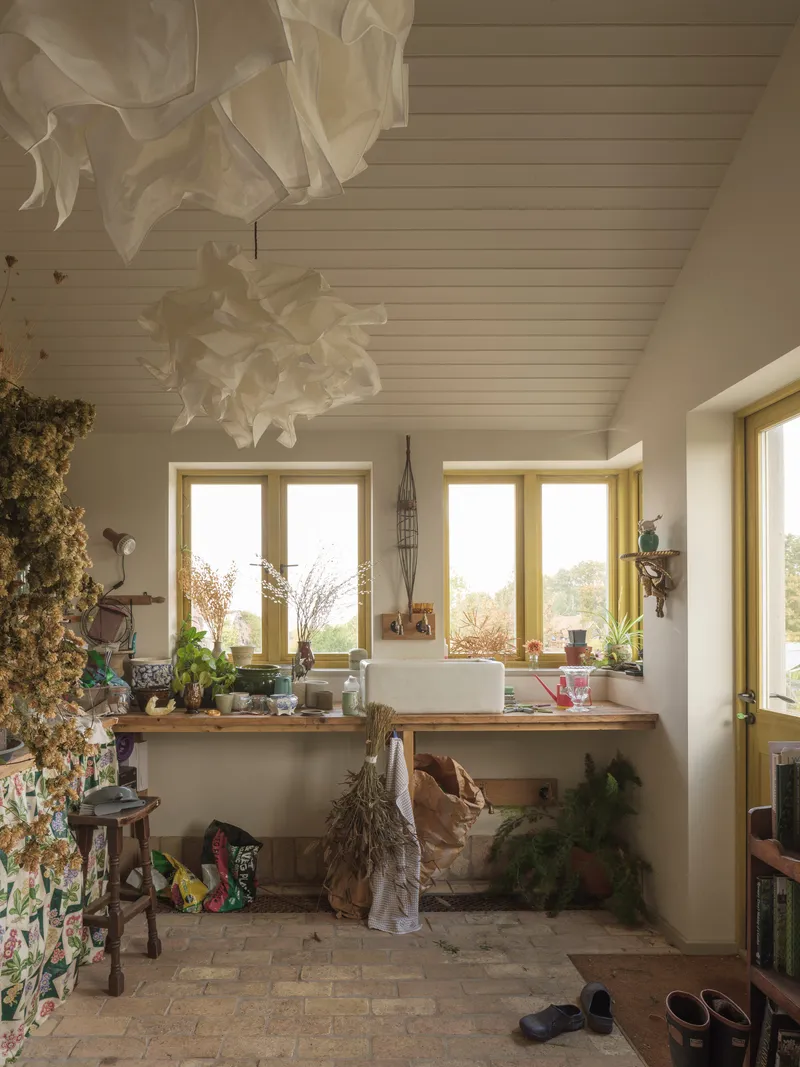
Secondary spaces are handled with the same level of attention. Painted tongue-and-groove ceilings, open shelving, and carefully placed pendant lights give bathrooms and kitchen corners a warm materiality that avoids the clinical finish common in new builds of this scale. The house feels lived in from the start, a quality that cannot be faked with styling alone. It comes from proportions, from the grain of the wood, and from a colour palette that feels settled rather than selected.
The Staircase as Craft Object

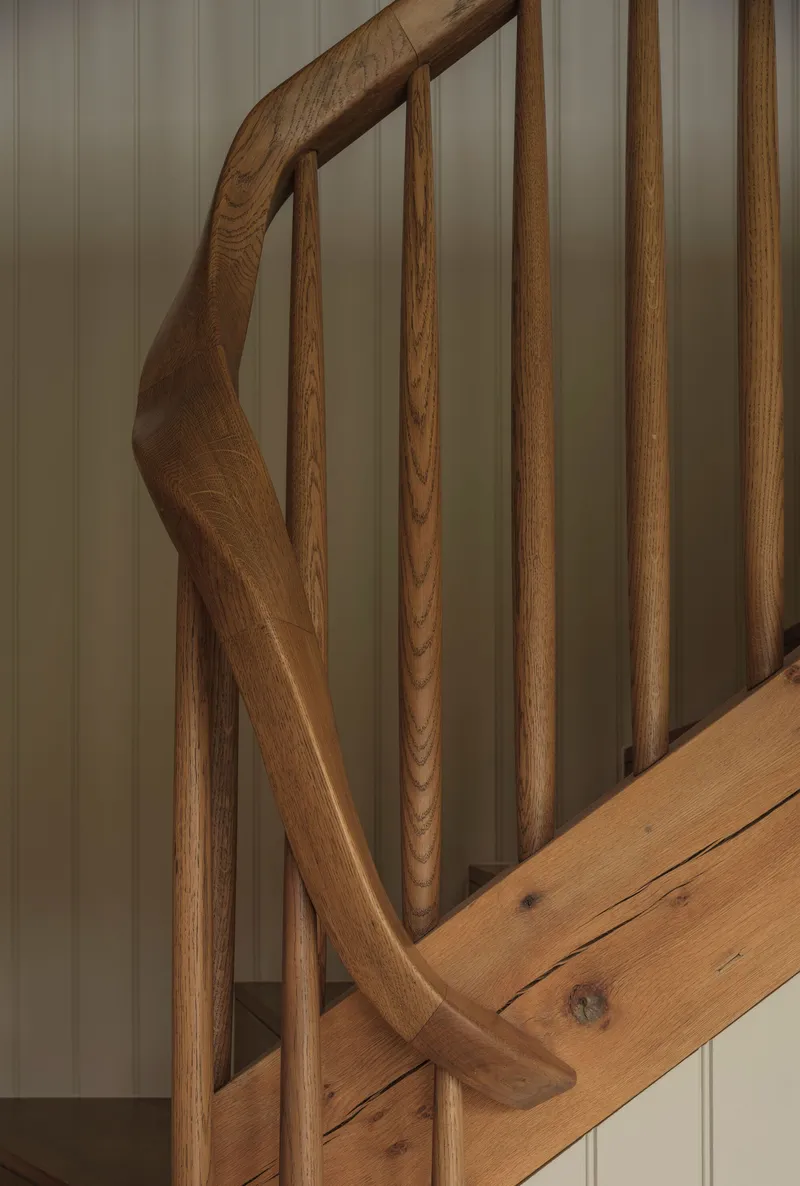
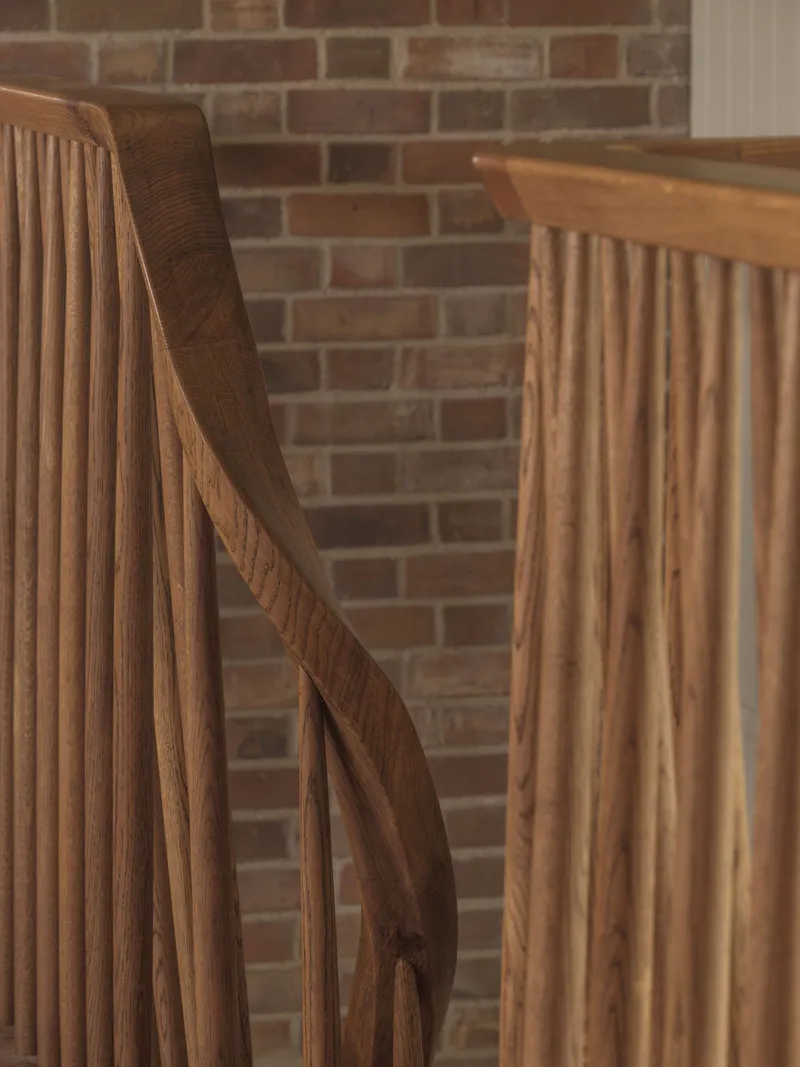
The oak staircase is the most overtly crafted element in the house. Its curved handrail sweeps upward between an exposed brick wall and painted vertical paneling, the two opposing textures heightening the tactile quality of the timber. Vertical balusters are closely spaced, giving the staircase a rhythmic transparency that allows light to filter through from the landing above.
Upstairs, the landing opens into a vaulted timber ceiling with a brick gable wall at its centre, a moment where the structure of the house is completely legible. Wooden balustrades enclose the void, and the space reads as a small gallery rather than mere circulation. It is a generous gesture in a project that consistently treats connective spaces as opportunities rather than obligations.

Grounded in the Garden
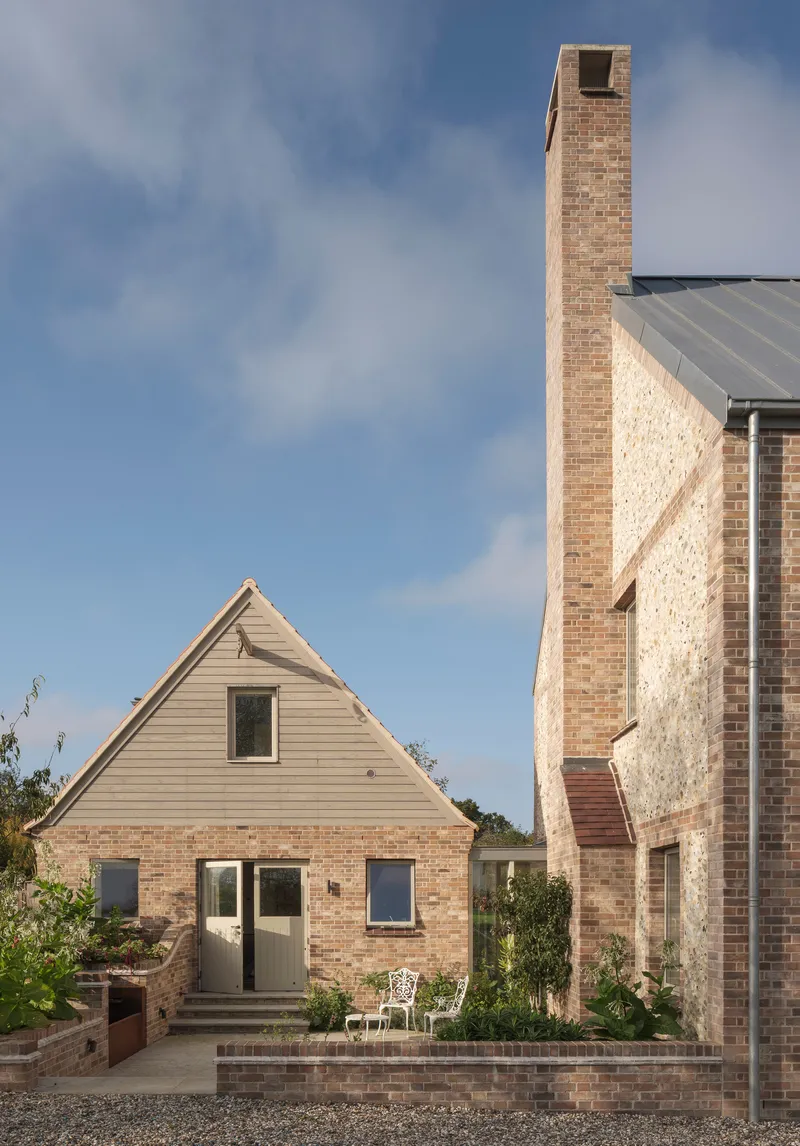


The relationship between house and garden honours the site's history as a market garden. Vegetable beds and dahlias appear in the foreground of nearly every exterior view, and planted beds line the base of the building where cladding meets ground. The brick-paved terrace between a pale timber-clad gable and a tall stone chimney is a moment of real composure: the chimney anchors the composition vertically while the planting softens its edges.
The front entrance, with its multicoloured brick facade and generous brick steps, is deliberately modest in scale. You arrive at the house the way you would arrive at any farmstead, through a sequence of thresholds rather than a grand frontage. It sets the tone for the entire experience: nothing is forced, and everything earns its place.
Dusk and Distance

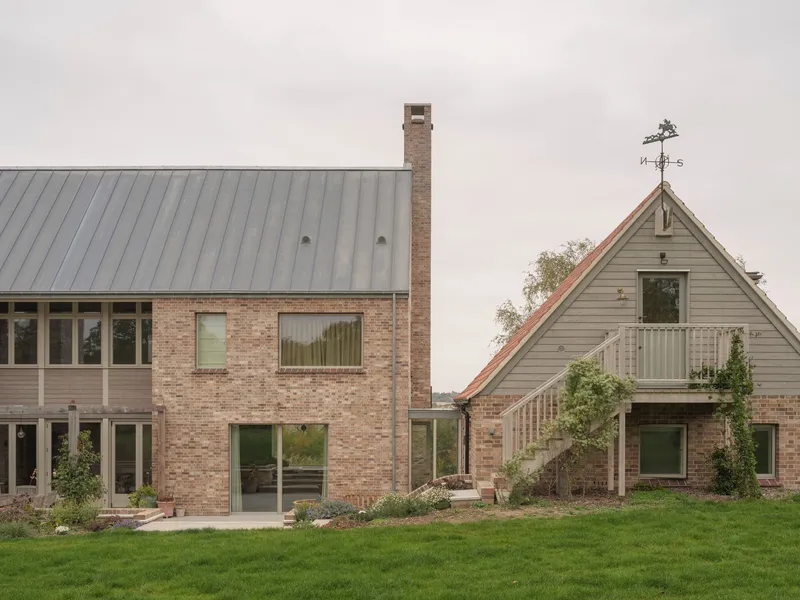
At dusk, the standing seam roof and brick chimney stack become silhouettes against the fading sky, and the house reveals its strongest architectural gesture: the chimney tower. Rising above the roofline, it acts as a vertical marker in the flat Hertfordshire landscape, a signal that this is a hearth, a centre of domestic life. The weather vane atop the timber-clad gable adds a detail that is almost too perfect in its farmyard associations, but it works because everything else in the project has earned that register of honesty.
Plans and Drawings

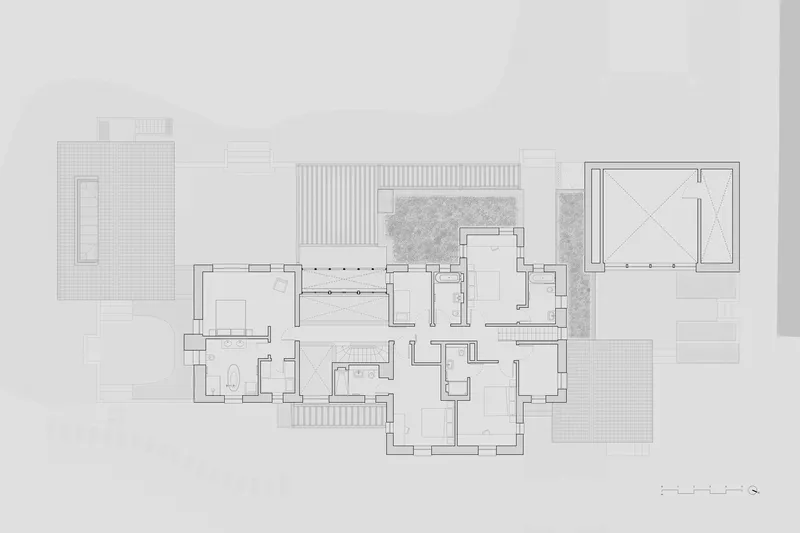
The floor plans confirm what the photographs suggest: interconnected rectangular volumes arranged around a central courtyard, with each wing given its own identity. The plan is not compact. It sprawls deliberately, prioritizing the experience of moving between pavilions over the efficiency of a single footprint. Patterned stone areas on the ground plan indicate the transitions between inside and out, courtyard and garden.

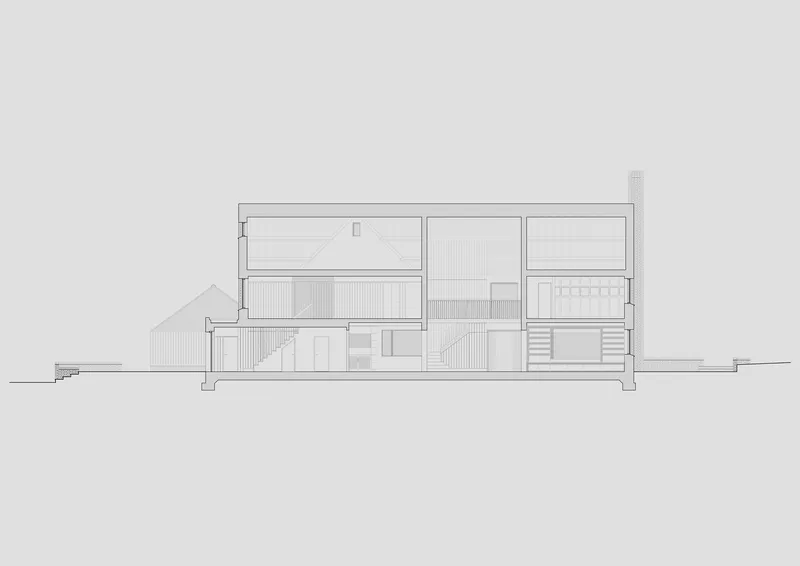
The sections reveal the variety of ceiling heights that the gabled forms allow. A central volume rises highest, flanked by lower additions clad in brick and vertical boarding. Clerestory windows appear at the junctions, washing the interiors with indirect light and ventilating the deeper rooms. The stair section shows how the landing opens into the roof space, borrowing volume from the structure to create the gallery-like quality visible in the photographs.
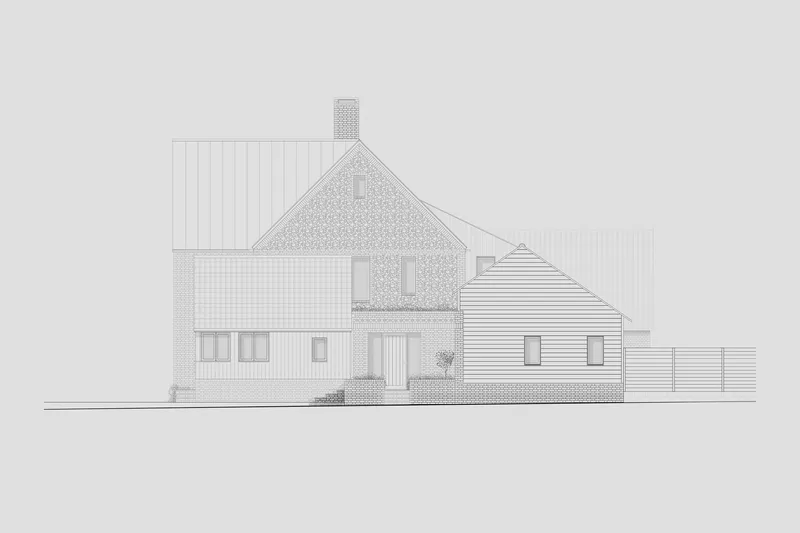
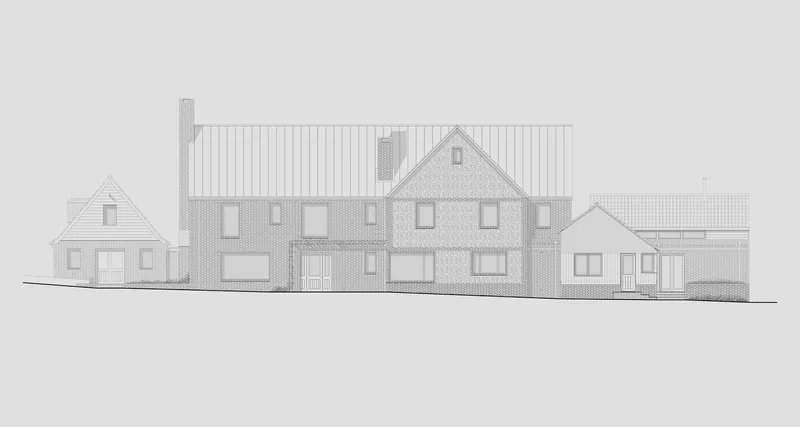

The elevations are the clearest illustration of the material strategy. Each facade reads as a composition of distinct cladding types: horizontal siding, vertical boarding, brick, and flint, all held together by the consistent geometry of the gable. Punched windows are placed with restraint, sized to the room they serve rather than to a gridded logic. The elevations also show how ancillary structures, smaller and simpler, complete the farmyard ensemble without competing with the main house.
Why This Project Matters
The Contemporary Farmhouse succeeds because it takes the idea of vernacular seriously without treating it as a costume. Every material, every roof pitch, and every courtyard proportion is drawn from a real construction tradition, but the composition, the detailing, and the spatial ambition are entirely of this moment. It offers a model for rural housing that respects context without retreating into nostalgia, a position that is far harder to hold than it looks.
At a time when many new rural houses in England oscillate between aggressive modernism and Heritage pastiche, Ashworth Parkes Architects have found a third way. The farmhouse proves that you can build at considerable scale in the countryside and still produce something that feels rooted, generous, and genuinely at home. It replaces a dwelling that had given up with one that intends to last.
Contemporary Farmhouse by Ashworth Parkes Architects. Located in North Hertfordshire, United Kingdom. 606 m². Completed in 2024. Photography by Matthew Smith.
About the Studio
Share Your Own Work on uni.xyz
If projects like this are the kind of work you want to make, uni.xyz is a place to publish your own, find collaborators, and enter design competitions.


Popular Articles
Popular articles from the community


Play: Fragments of Their World
Familiar architecture becomes modular playground design, creating safe spaces where displaced children can learn, connect, imagine and play.

Hill & Cross Opera: Sculptural Opera House Architecture Shaped by Tallinn’s Landscape and Identity
Hill & Cross Opera reimagines opera house architecture in Tallinn through its sculptural hill, civic plaza, glass wave and a luminous cross.

Little Red Riding Hood: Architectural Design as a Journey Through Fear, Light, and Storytelling
Little Red Riding Hood reimagines the fairy tale through architectural design shaped by fear, light, scale, memory, uncertainty, and choice.

Co-life: Sustainable Architecture for Age-Friendly Community Living
Co-life reimagines sustainable architecture for seniors through courtyards, rammed earth, shared gardens, and spaces designed for belonging.

Similar Reads
You might also enjoy these articles

Bao Huynh Watercolor Atelier: A Serene Art Retreat in Hội An
Bao Huynh Watercolor Atelier in Hội An blends multifunctional art spaces, sustainable design, local materials, and family-friendly living in a serene environment.

Atelier Macri Concept Store Interior Design by CASE-REAL
Atelier Macri store features a "ko" counter, walnut wood details, cork displays, blending retail, gallery, and seamless customer experiences.

Manuel Vargas Izquierdo Stadium and High-Performance Sports Center: Architectural Excellence in Jalpa de Méndez
The Manuel Vargas Izquierdo Stadium blends sustainable design, inclusive sports facilities, and cultural-inspired architecture, revitalizing Jalpa de Méndez’s public spaces.

KAKR Buluh Awar Hall: Revitalizing Community and Ecology Through Bamboo Architecture
Community built bamboo hall revitalizes Buluh Awar village, empowering youth, restoring ecology, celebrating vernacular craftsmanship through sustainable architecture and culture.

Explore Modular Farm Competitions
Discover active competitions in this discipline

Challenge to reimagine the Iron Throne

Photograph architecture without architects

Illustrate the lost glory of Angkor Wat - Render Challenge

Design challenge to reuse E-waste
Comments (0)
Please login or sign up to add comments
No comments yet. Be the first to comment!