
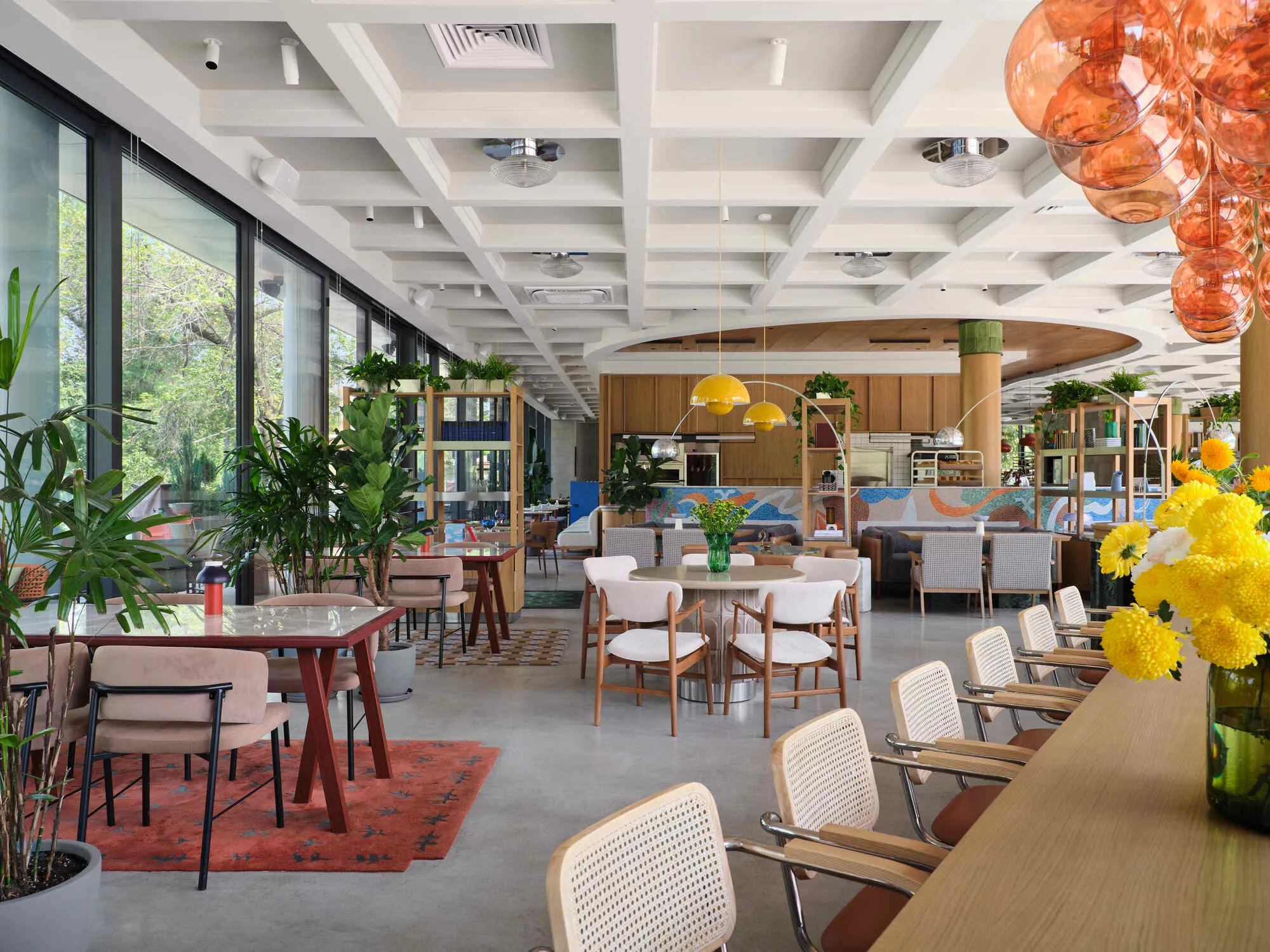
AT Interiors Revives a 1960s Almaty Landmark as the Swan-Themed Aqqu Central Café
A 1,150-square-meter café in Almaty, Kazakhstan resurrects a Soviet-era pavilion with mosaic murals, coffered ceilings, and layered timber craft.


Some buildings carry the weight of a city's memory. In Almaty, the café once known as Aqqu, meaning "white swan" in Kazakh, was one of those places: a modernist pavilion from the 1960s that anchored a stretch of the city's cultural life before falling into disrepair. Now, AT Interiors, led by Alyona Krasatulina, has brought it back as Aqqu Central Café, a 1,150-square-meter space that treats restoration not as a nostalgic exercise but as an opportunity to layer new material ambition onto an inherited civic form.
What makes this project worth studying is its refusal to choose between preservation and reinvention. The coffered ceilings remain, the floor-to-ceiling glazing is restored to its full civic transparency, and the curved facade with its white colonnade reads as it always did from the street. But inside, a dense collage of custom mosaic murals, carved timber panels, green glazed tile, and marble surfaces pushes the interior far beyond period-correct revival. The result is a café that feels simultaneously historical and genuinely contemporary, a rarity in regeneration work anywhere, and particularly notable in Central Asia.
Civic Bones: The Facade and Structure
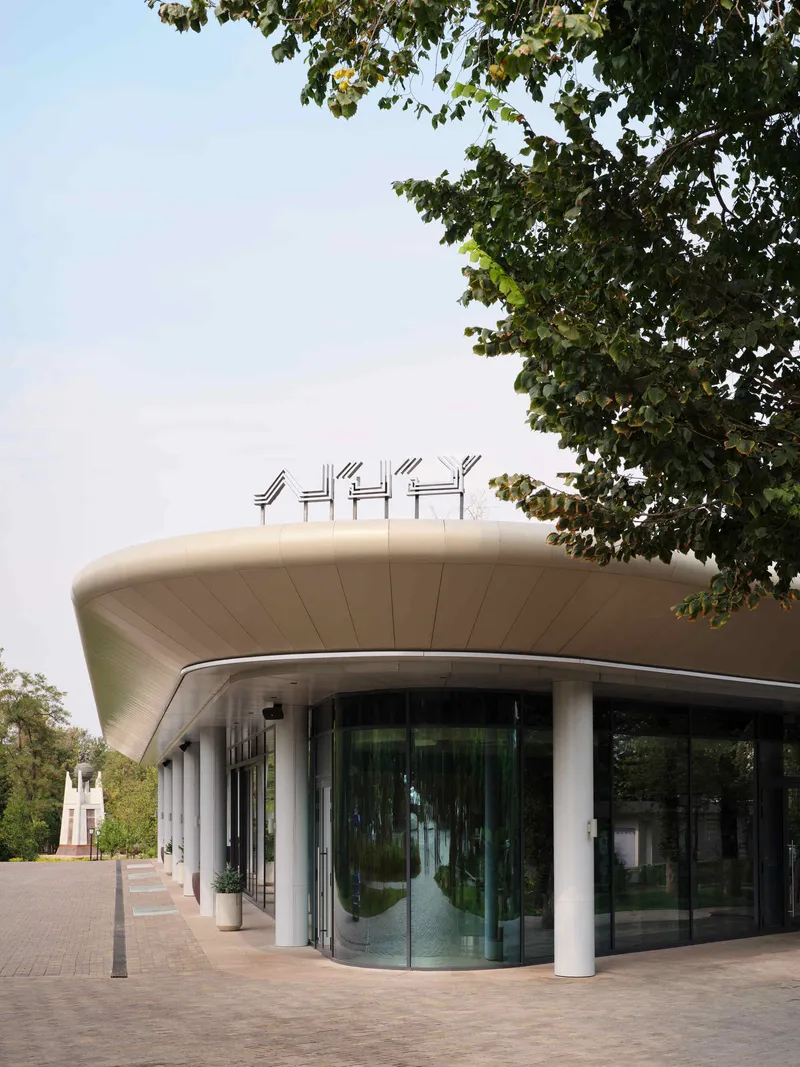
The curved facade, with its rhythm of white columns and generous glazing beneath an overhanging roof, is unmistakably Soviet modernist in its DNA. It sits under a mature tree canopy that has grown up around it over six decades, giving the building an almost accidental integration with its landscape. AT Interiors appears to have left this relationship intact, wisely allowing the architecture to remain a pavilion in a park rather than asserting itself over its surroundings.
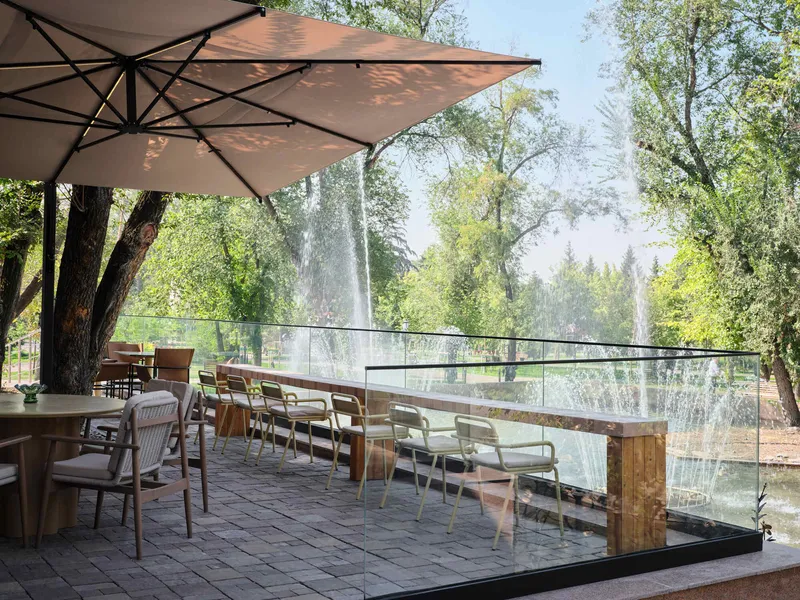
The outdoor terrace, with its glass balustrade overlooking fountain jets, completes the picture. The building was always designed as a gathering place where the boundary between inside and outside dissolved. Restoring that permeability, rather than walling off the interior for climate control or exclusivity, is a smart choice that preserves the building's original civic generosity.
The Coffered Ceiling as Organizing Principle
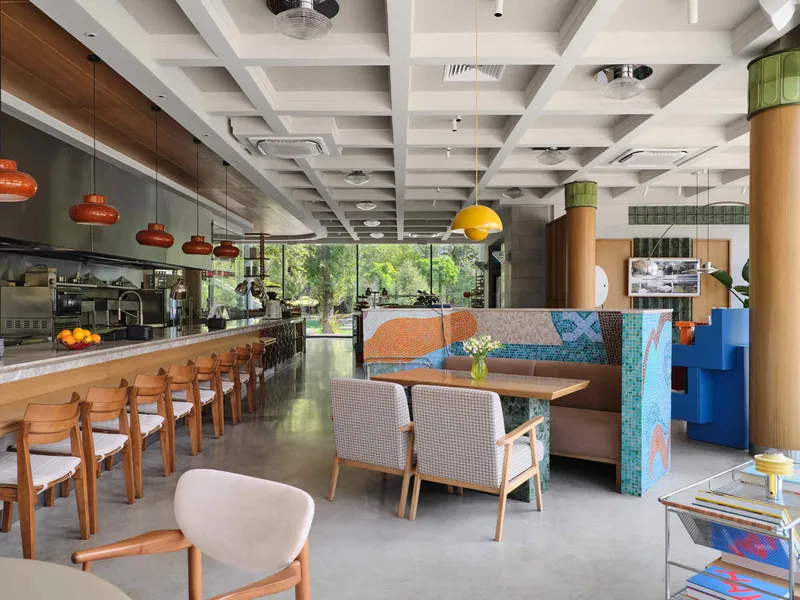

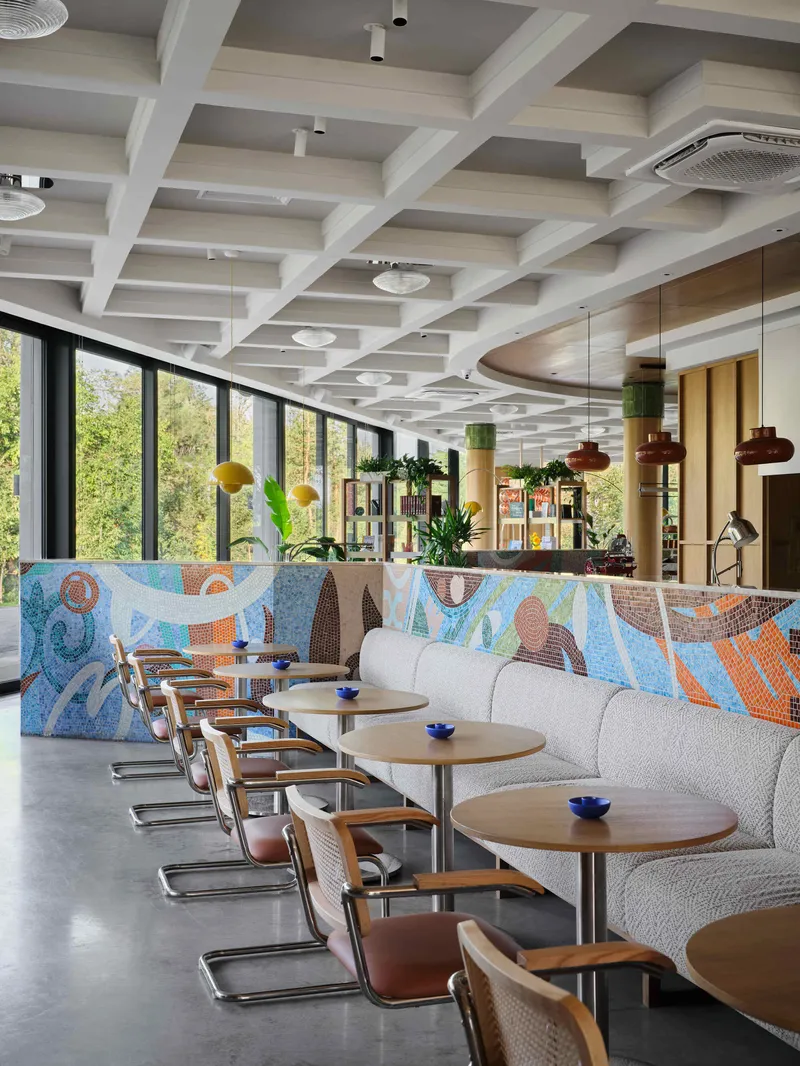
Walk into Aqqu and you immediately look up. The coffered white ceiling is the building's strongest inherited element, and AT Interiors has let it do heavy lifting. It creates a regular, rhythmic overhead plane that unifies wildly different zones below: open dining halls, intimate banquettes, bakery counters, and lounge nooks all sit under the same geometric grid. Clerestory windows along the edges flood the coffers with daylight, giving the ceiling a soft luminosity rather than the heaviness that a concrete grid might otherwise produce.
The decision to keep the ceiling white while introducing so much color and texture at eye level is a disciplined one. It prevents the space from tipping into visual overload, providing a calm datum line against which the mosaic walls, timber columns, and pendant lights can compete for attention without chaos.
Timber, Tile, and the Language of Ornament


The material palette is where the project declares its independence from strict restoration. Cylindrical timber columns are wrapped in carved panels with a tactile, almost folk-craft quality. One column sports a green glazed tile capital, a detail that could feel gratuitous but instead reads as a deliberate callback to the decorative ambitions of Central Asian architecture. Bakery counters are clad in deeply carved timber with curvilinear patterns that catch light across their relief surfaces.
These are not safe, minimal choices. They announce an interior that values craft density and visual richness, placing the café closer to the tradition of the European grand café or the decorated Soviet public canteen than to the stripped-back specialty coffee shops that dominate most cities today. It is a position worth defending, and AT Interiors defends it through quality of execution rather than mere quantity of surface.
Swan Murals and Mosaic Storytelling
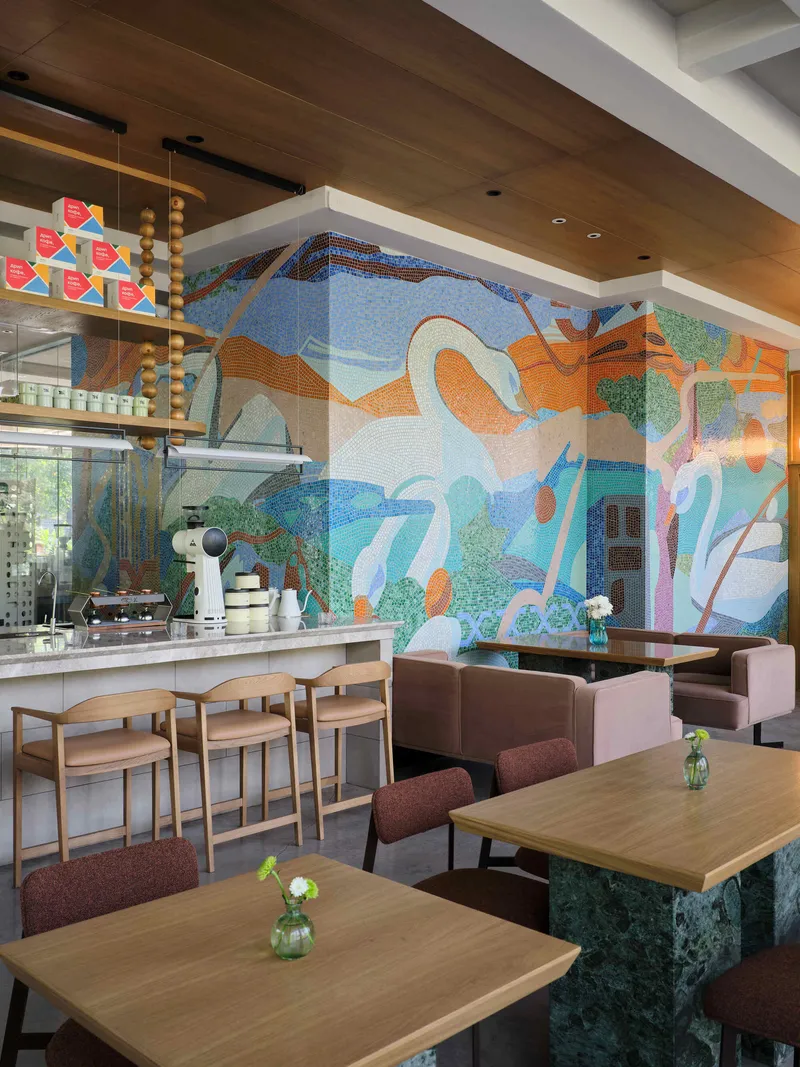
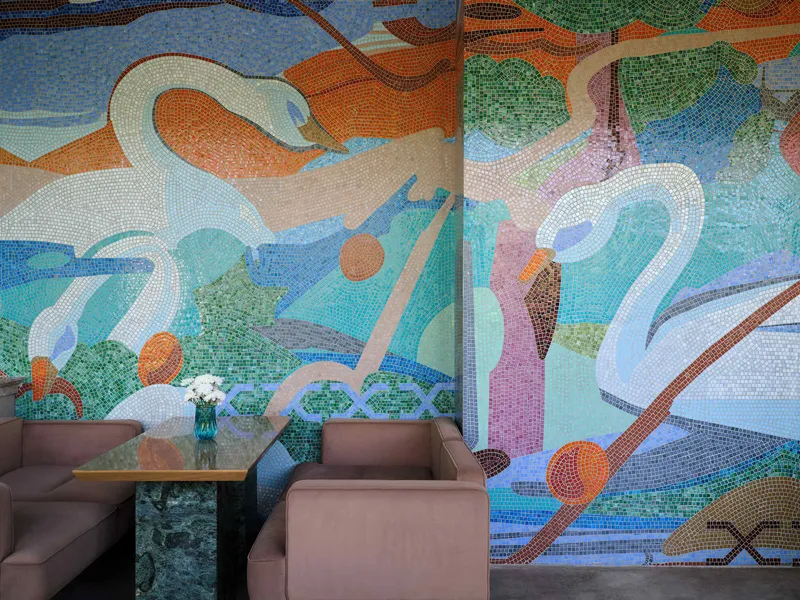

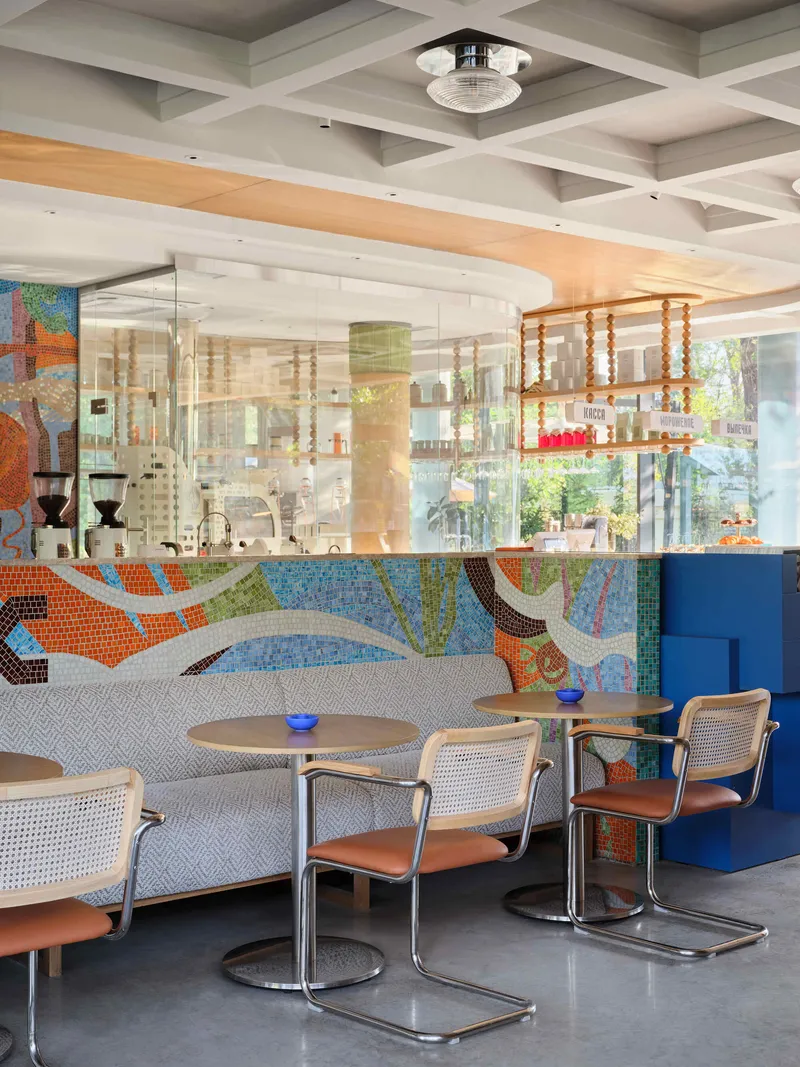
The name Aqqu means "white swan," and the bird appears throughout the café in custom mosaic murals that are among the project's most distinctive features. Behind one counter, a large-scale mosaic depicts swans gliding through an abstracted landscape in warm ochres, blues, and greens. Elsewhere, a wall features cypress trees in brown and blue against a multicolored tile field, giving corner seating areas a sense of enclosure and narrative that fixed artwork rarely achieves.
These murals do more than decorate. They root the project in a specific cultural identity without relying on the clichés of national branding. The swan motif connects to the café's history and name, while the mosaic technique itself nods to a long tradition of tile work across the region. The color choices feel confident and idiosyncratic rather than derived from a mood board.
Intimate Zones: Banquettes, Booths, and Lounges

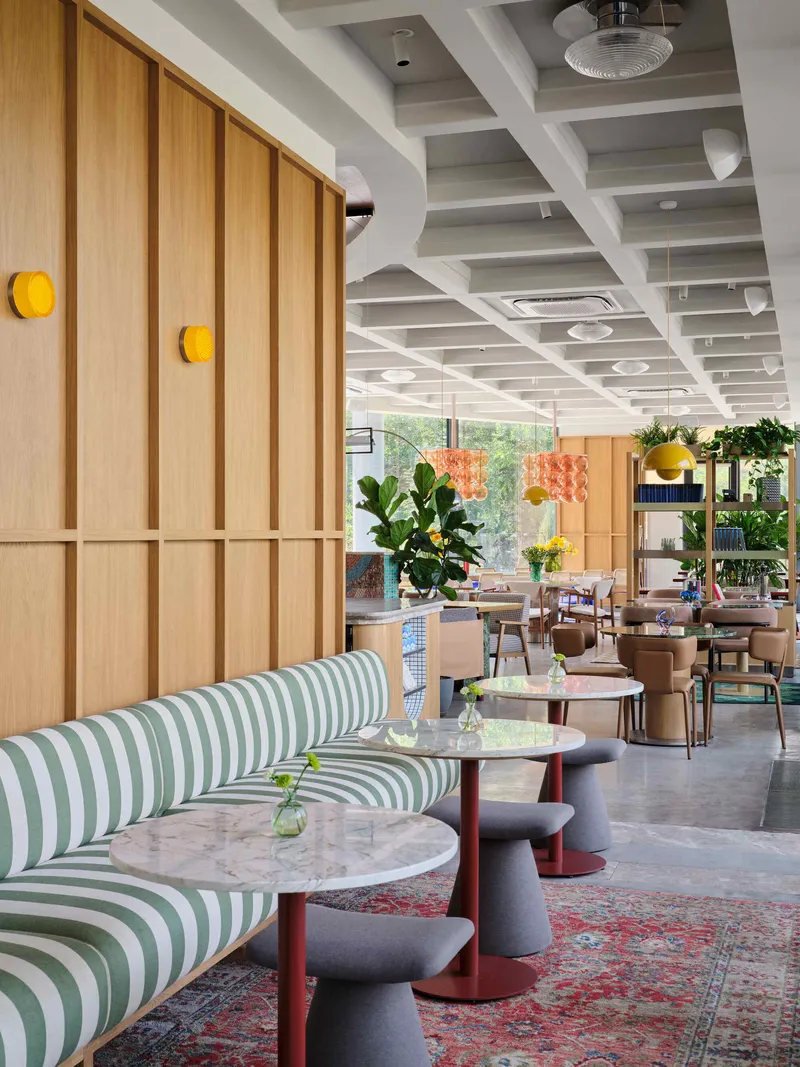
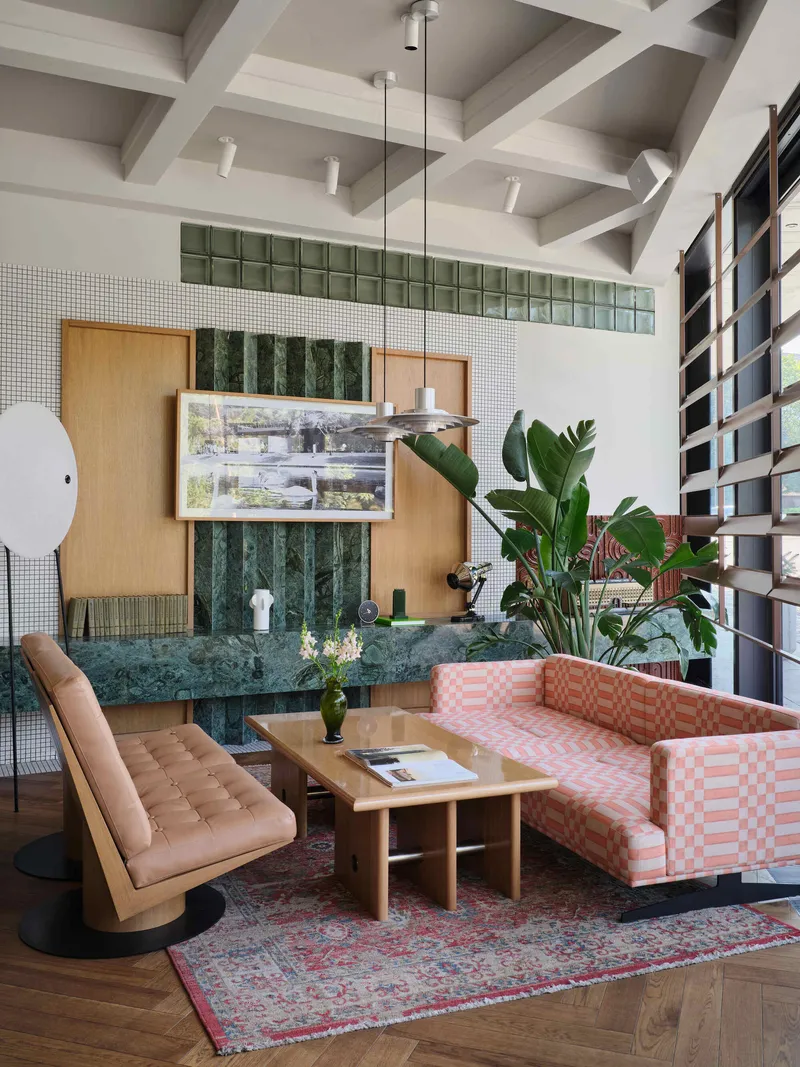
For a 1,150-square-meter café, the range of seating conditions is impressive. Green and white striped banquettes sit below timber wall panels punctuated with yellow circular knobs, creating zones that feel almost domestic in scale. Marble-topped tables, green marble coffee tables, and timber cabinetry shift the register from one area to the next, so that a couple sharing pastries occupies a fundamentally different atmosphere than a group gathered around a lounge fireplace.
The green marble fireplace surround in the lounge area deserves particular mention. It introduces a material weight and formality that anchors the surrounding mosaic walls and timber storage, turning what could be a leftover corner into the most considered room in the building.
Counter Culture: Coffee and Bakery Bars
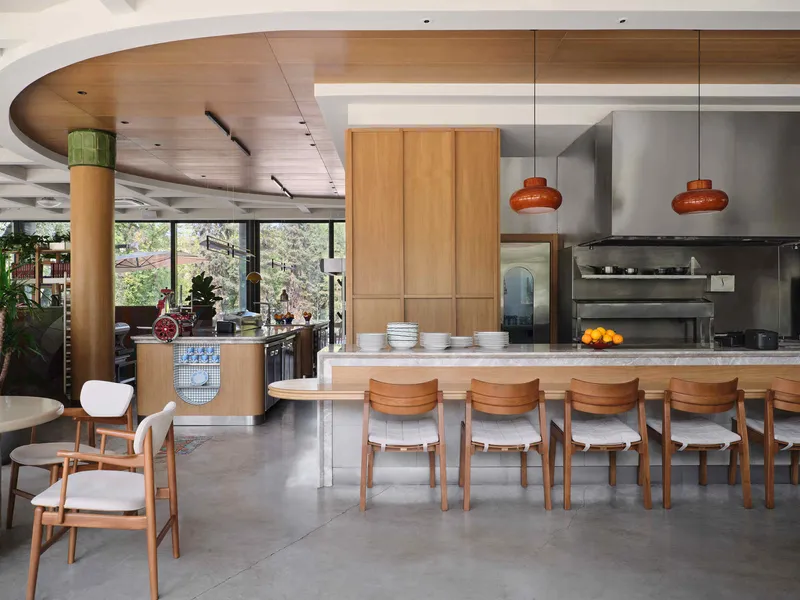

AT Interiors treats the service counters as architecture in miniature. The kitchen bar features a marble counter with timber stools beneath a circular wood ceiling soffit, an overhead gesture that defines the bar's territory without walls. Elsewhere, a blue laminate coffee counter with pendant lights reads as slightly more casual, creating a hierarchy between the sit-down experience and the grab-and-go moment.
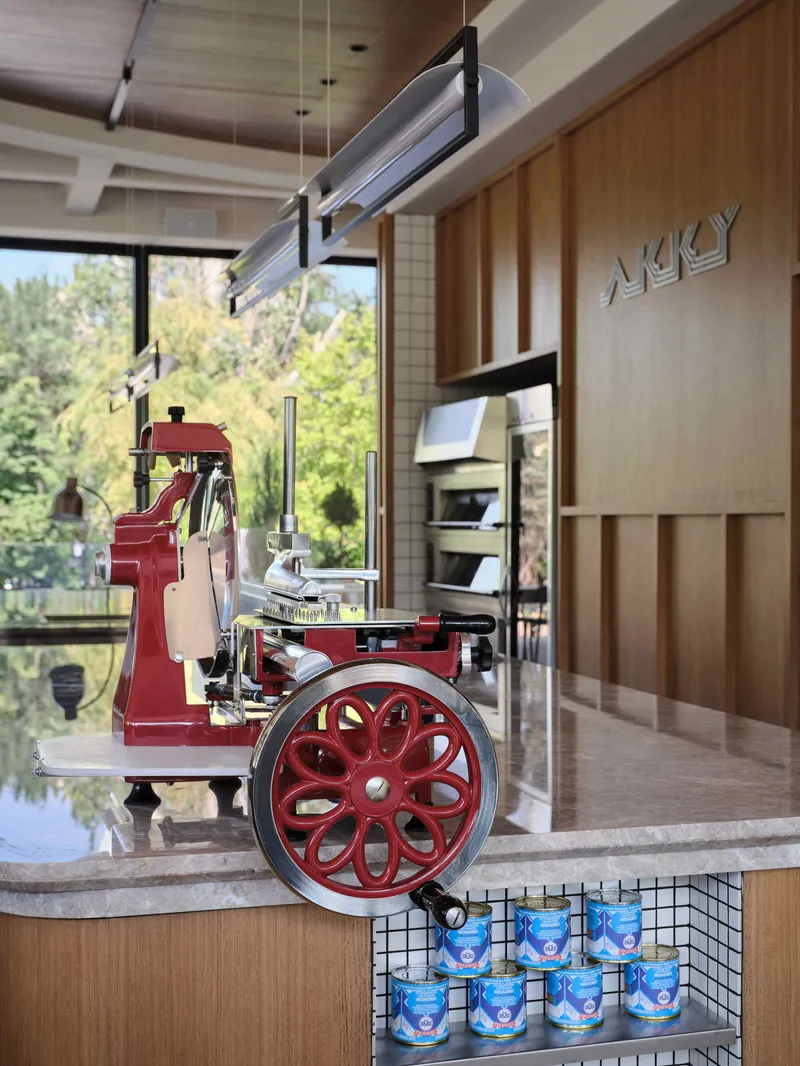
A red vintage espresso machine with a spoked wheel sits on a marble counter near the windows, looking like a found object from the original café. Whether it is genuinely vintage or strategically placed, it works. It anchors the coffee program in a sense of continuity and craftsmanship that reinforces the project's broader argument: that this space has always been here, even if most of what you see is new.
Details at the Margins

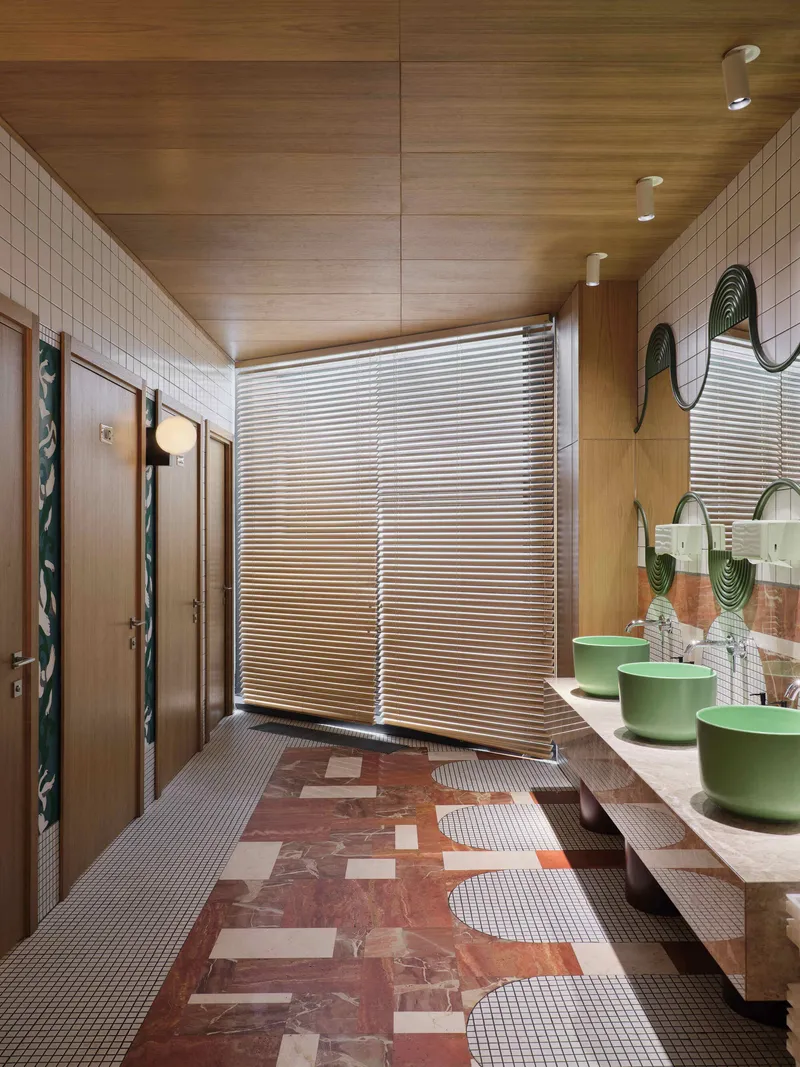

The quality of a hospitality interior is best judged in its secondary spaces. Here, AT Interiors does not let up. Restroom doors in oak flank a vertical tile panel featuring a koi fish mosaic in blue and green, an unexpected moment of delight in a transitional zone that most projects ignore. Inside, green vessel sinks sit on a floating counter against corrugated metal partitions under timber ceiling panels. It is a material combination that should not work but does, held together by the same color and craft logic that governs the main dining rooms.
A green glazed tile pedestal in the entrance area, topped with a sculptural pendant fixture, announces the interior's material ambitions before you even sit down. These threshold moments are where the project reveals its discipline: every zone, no matter how brief the visitor's encounter with it, receives full design attention.
Plans and Drawings

The floor plan reveals a triangular layout with dining areas radiating from a central service core, a geometry inherited from the original building. This plan shape explains the variety of spatial conditions: acute corners become intimate booths, the long glazed edges host open dining, and the core concentrates kitchen, bakery, and bar functions where they can serve multiple zones simultaneously. It is an efficient arrangement that the triangular footprint actually enhances rather than complicates.
Why This Project Matters
Aqqu Central Café matters because it demonstrates that architectural regeneration in Central Asia can be ambitious without being derivative. Too many restoration projects in the region either erase the Soviet era entirely in favor of a pre-colonial aesthetic or preserve it as lifeless heritage. AT Interiors has done neither. They have taken a building with strong modernist bones and filled it with a material language that draws from Kazakh identity, regional craft traditions, and contemporary hospitality design in equal measure.
The project also makes a case for ornamental density as a legitimate design strategy in an era that still defaults to minimalism for credibility. Every mosaic mural, carved timber panel, and glazed tile detail in this café earns its place through careful placement and material coherence. The result is a public interior that feels generous, specific, and rooted in its city. Almaty got its swan back.
Aqqu Central Café by AT Interiors, lead architect Alyona Krasatulina. Located in Almaty, Kazakhstan. 1,150 m². Completed in 2025.
About the Studio
AT interiors
Official website of AT interiors, one of the studios behind this project.
atinteriors.orgShare Your Own Work on uni.xyz
If projects like this are the kind of work you want to make, uni.xyz is a place to publish your own, find collaborators, and enter design competitions.




Popular Articles
Popular articles from the community


The Earth Pod: 3D Printed Homes for Resilient Refugee Communities
The Earth Pod reimagines refugee housing through 3D printed homes made from clay, combining resilience, self-sufficiency, and rapid shelter.

Co-Life: Senior Housing Design That Reconnects Older Adults With the City
Co-Life reimagines senior housing design through healing gardens, shared streets, workshops, and a sustainable community across generations.

Riyadh For All: Intergenerational Urban Design for Active Aging in Rabat
Riyadh For All reimagines urban design in Rabat with intergenerational co-living, adaptive courtyards, and Moroccan cultural exchange today.

The Musturak Paradise: Senior Living Architecture for a Connected Future in Temara, Morocco
The Musturak Paradise reimagines senior living architecture in Temara via private homes, social spaces, culture, community, and shared care.

Similar Reads
You might also enjoy these articles

Bao Huynh Watercolor Atelier: A Serene Art Retreat in Hội An
Bao Huynh Watercolor Atelier in Hội An blends multifunctional art spaces, sustainable design, local materials, and family-friendly living in a serene environment.

Atelier Macri Concept Store Interior Design by CASE-REAL
Atelier Macri store features a "ko" counter, walnut wood details, cork displays, blending retail, gallery, and seamless customer experiences.

Manuel Vargas Izquierdo Stadium and High-Performance Sports Center: Architectural Excellence in Jalpa de Méndez
The Manuel Vargas Izquierdo Stadium blends sustainable design, inclusive sports facilities, and cultural-inspired architecture, revitalizing Jalpa de Méndez’s public spaces.

KAKR Buluh Awar Hall: Revitalizing Community and Ecology Through Bamboo Architecture
Community built bamboo hall revitalizes Buluh Awar village, empowering youth, restoring ecology, celebrating vernacular craftsmanship through sustainable architecture and culture.

Explore Cafe Competitions
Discover active competitions in this discipline



Challenge to design a portable theatre


Challenge to design a portable music platform

Challenge to design an open learning module for the elderly
Comments (0)
Please login or sign up to add comments
No comments yet. Be the first to comment!