
Ateliê GR Packs a Seven-Person Family Home into a 243 m² Vertical Stack in São Paulo
Caetés House uses cobogós, a green roof, and color-coded infrastructure to turn a compact urban lot into a micro-city for a family of seven.


Designing a house for two adults and five children on a tight urban lot in São Paulo demands ruthless spatial economy. Ateliê GR, led by Gabriel Rodrigues Grinspum, responds with Caetés House: a three-story volume that distributes domestic, professional, and recreational life across vertically stacked floors connected by a central stair. The semi-buried ground level holds the living, dining, and kitchen areas opening onto a landscaped yard. The street-level floor houses a garage and two independent offices. The upper floor gathers bedrooms along a hallway lit through a wall of concrete cobogós. At 243 square meters, every cubic centimeter has a job.
What makes the project genuinely interesting is its refusal to treat budget-conscious construction as an aesthetic compromise. Exposed concrete blocks, prefabricated slabs, drywall partitions, and color-coded installations are not concealed but choreographed. The concept, which the architects describe as "the city is a house and the house is a city," manifests in the way public and private uses coexist without friction. Offices on the intermediate floor double as play zones. The green roof retains rainwater, eliminates asphalt membranes, and stages future solar panels. It is a house designed like infrastructure, and it works.
A Cobogó Screen That Does Three Things at Once
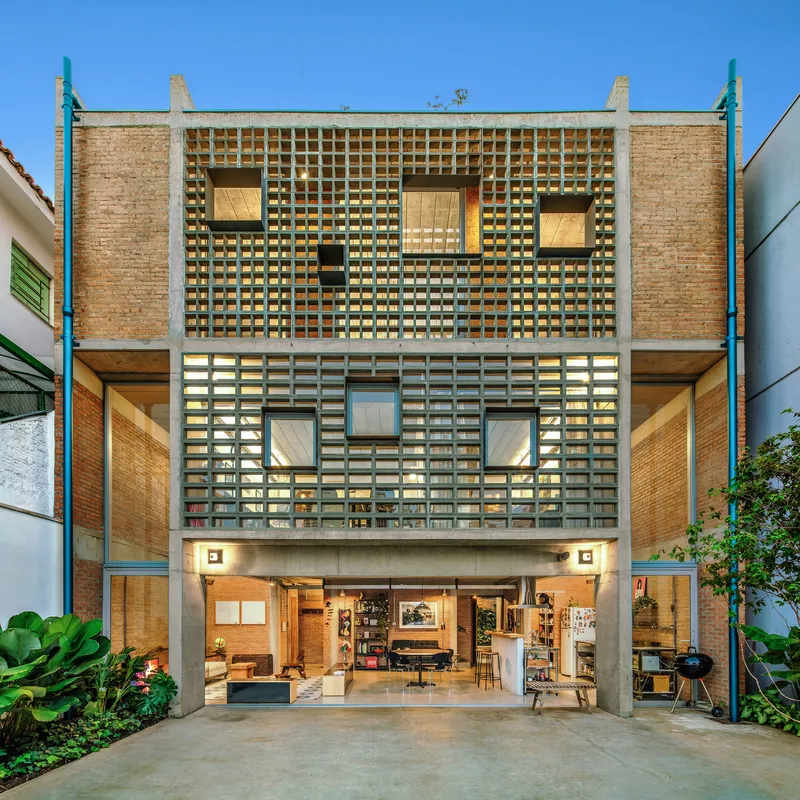
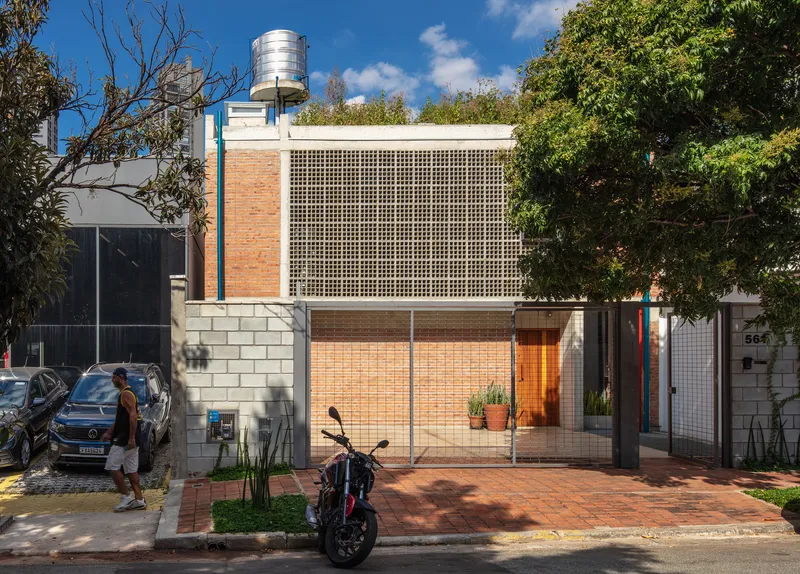
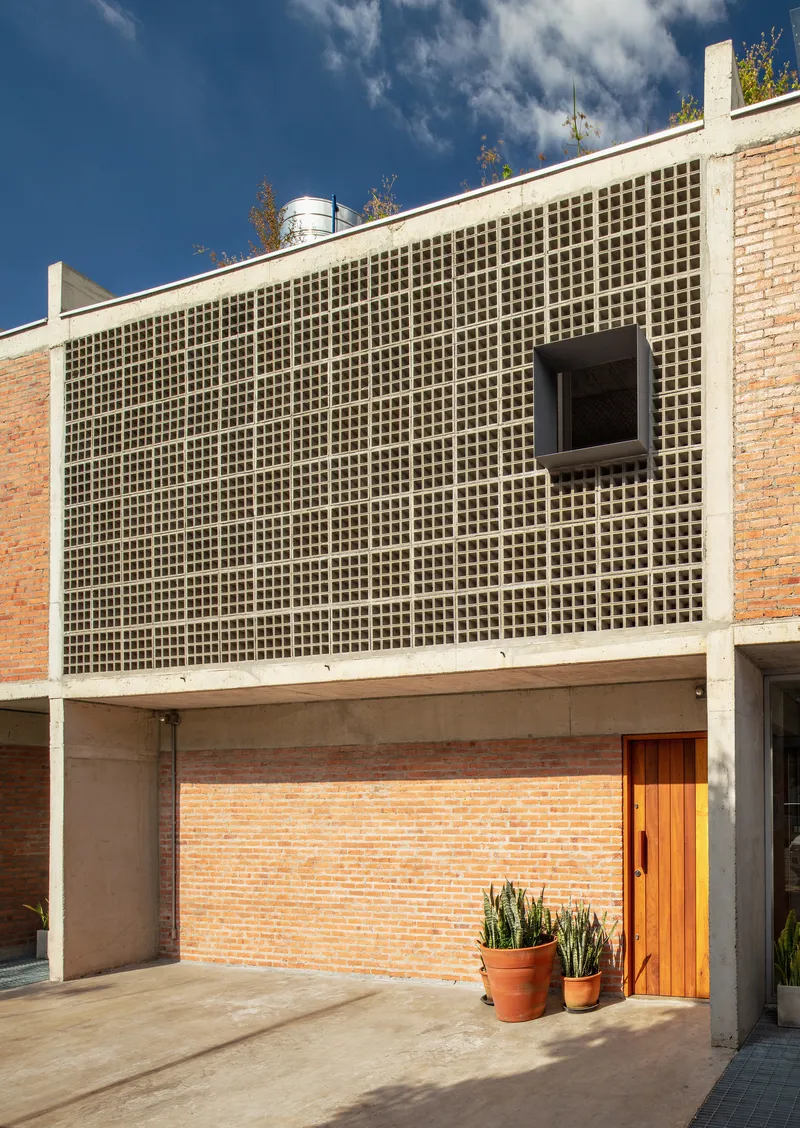
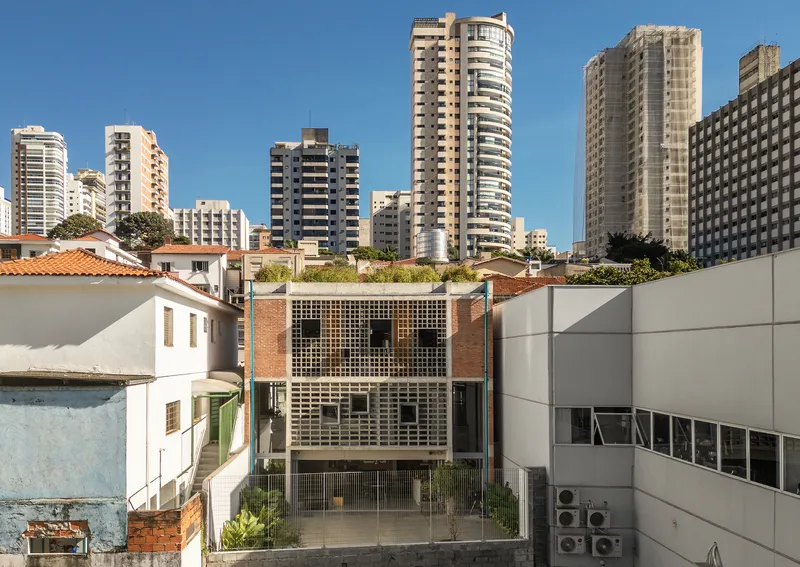
The street facade is defined by a large field of perforated concrete blocks, the cobogó screen that covers much of the upper volume. From the sidewalk, the screen reads as a monolithic lattice, giving the house presence without bulk. Up close, it is clearly a working element: it filters daylight into the upper hallway, drives cross ventilation through the bedrooms, and provides privacy from a street that mixes residential and commercial uses. Flanking it, exposed brick walls and blue-painted steel columns signal that the house belongs to the neighborhood rather than retreating behind a blank wall.
The entry courtyard, visible through a timber door below the screen, establishes the transition from city to house. Potted plants and a narrow threshold compress the arrival sequence before the interior opens up. It is a simple move, but one that underscores the architects' commitment to treating threshold conditions as architecture, not afterthought.
Industrial Vocabulary, Domestic Warmth
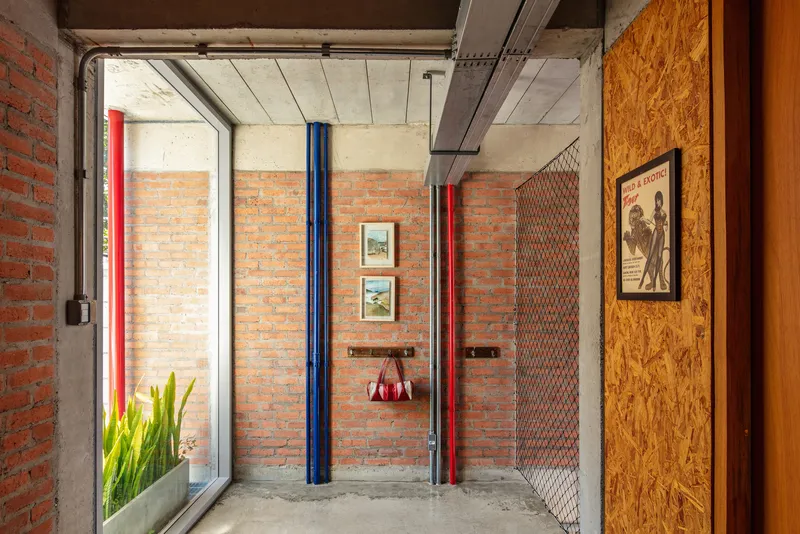
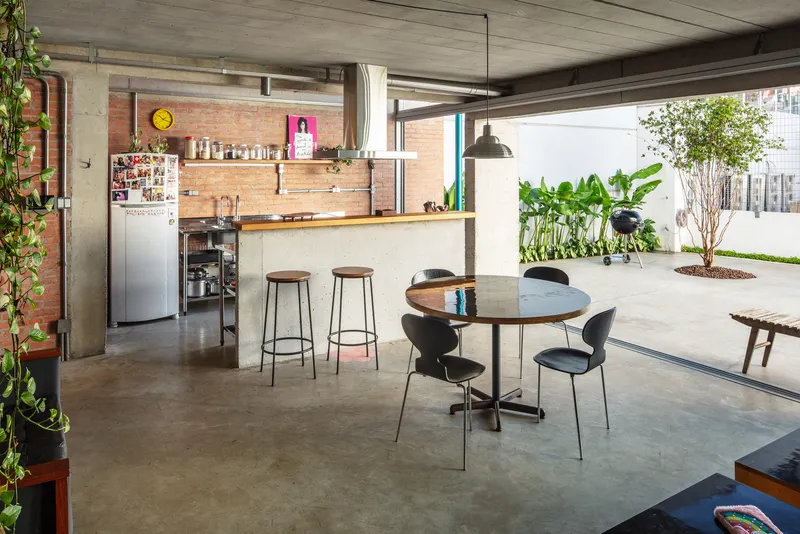
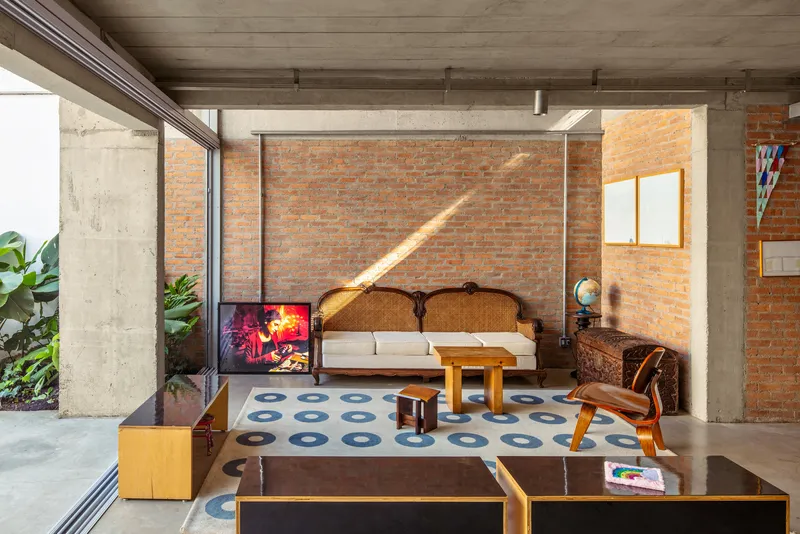
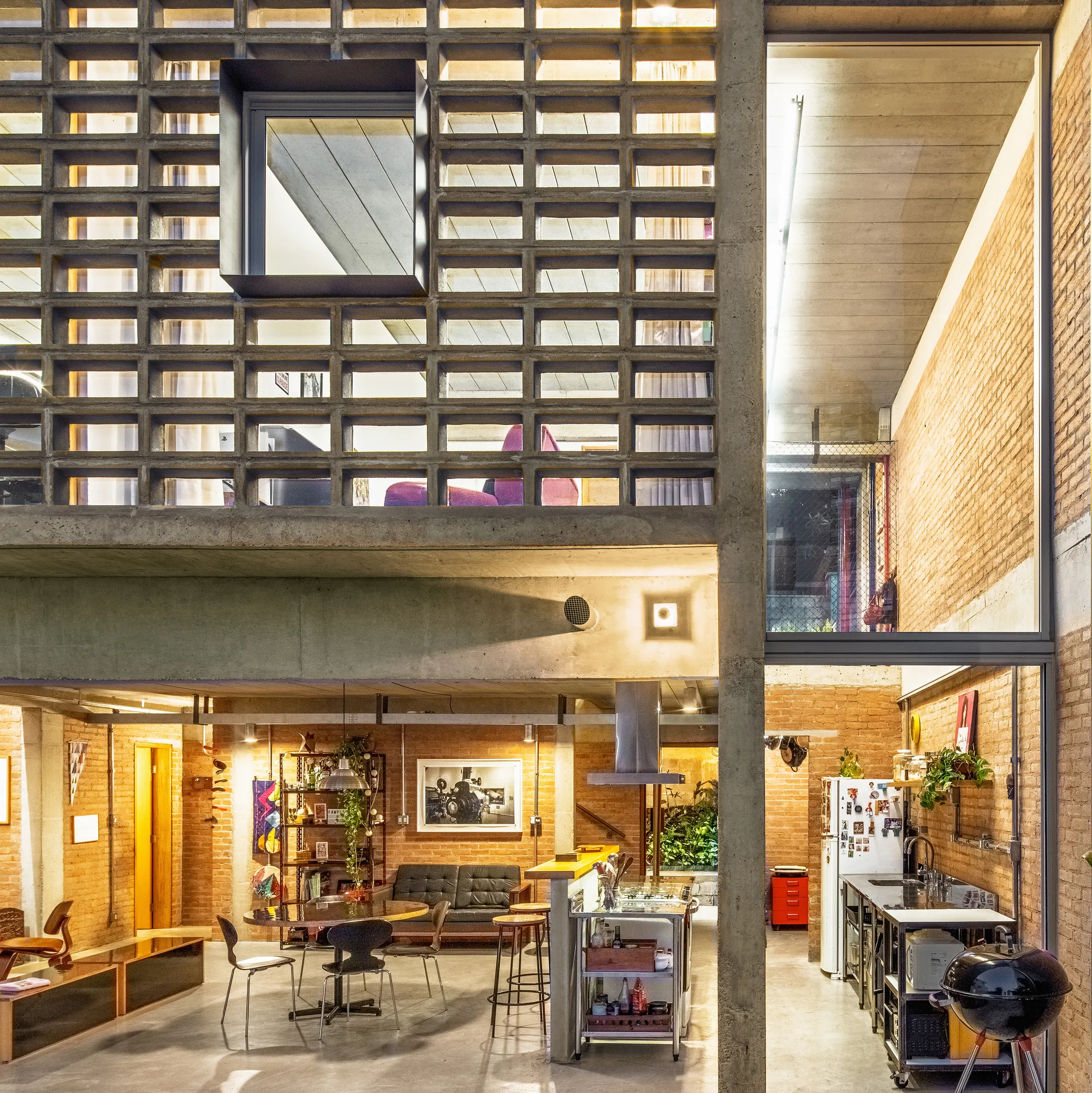
Inside, the lower floor registers as a loft more than a conventional living room. Exposed brick walls rise to a concrete ceiling, with blue and red steel columns standing in the open plan like punctuation marks. The color-coding is not decorative whimsy. It identifies structural versus mechanical systems, turning what would normally be hidden behind plasterboard into legible information. Artwork hangs casually on the brick, and afternoon sunlight from the courtyard washes across the dining table. The atmosphere is relaxed and slightly rough, which suits a household of seven.
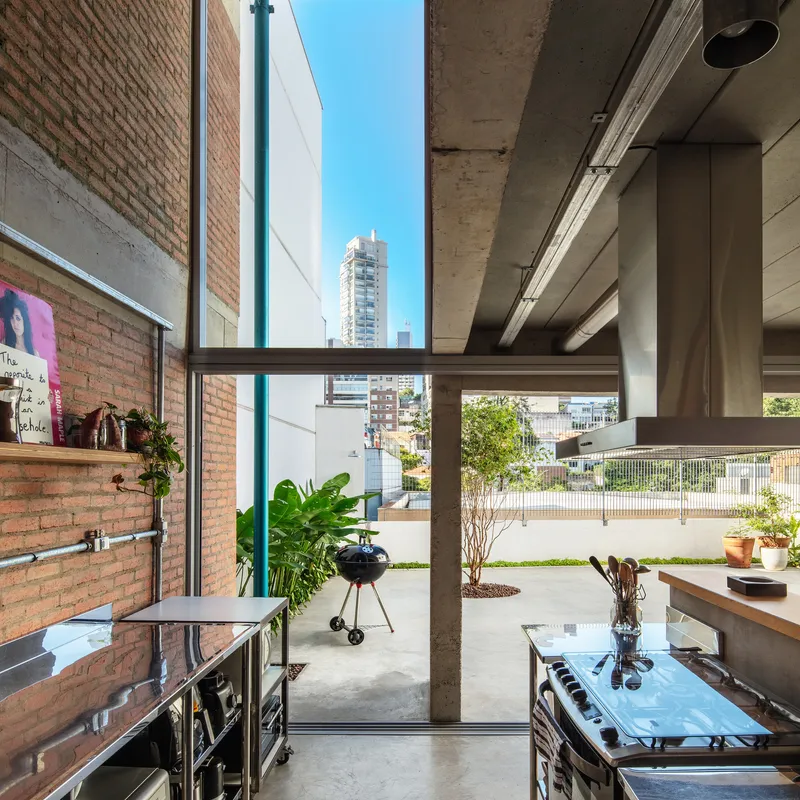
The kitchen counter, dining table, and courtyard beyond are arranged on a single visual axis, so the space reads as much larger than its footprint. Glazed doors fold back to merge indoor and outdoor areas, a standard move in tropical houses but well calibrated here to the specific orientation and prevailing breeze.
Light as Building Material
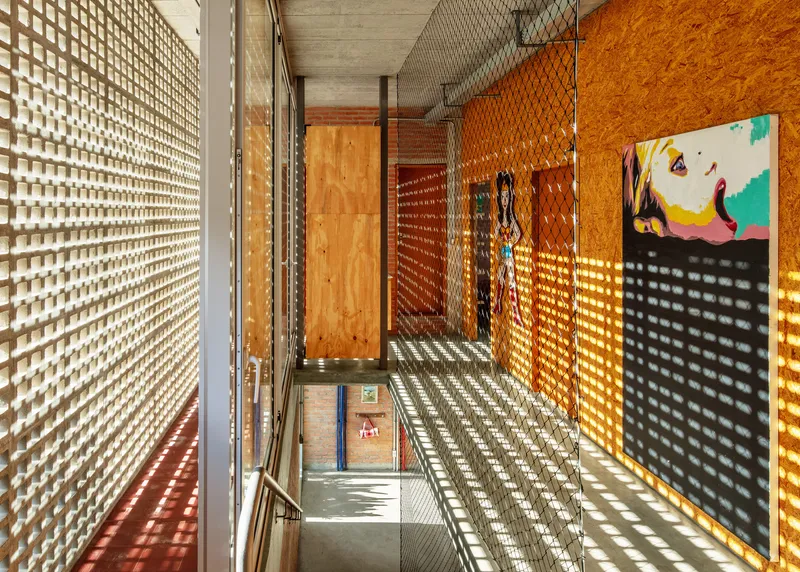
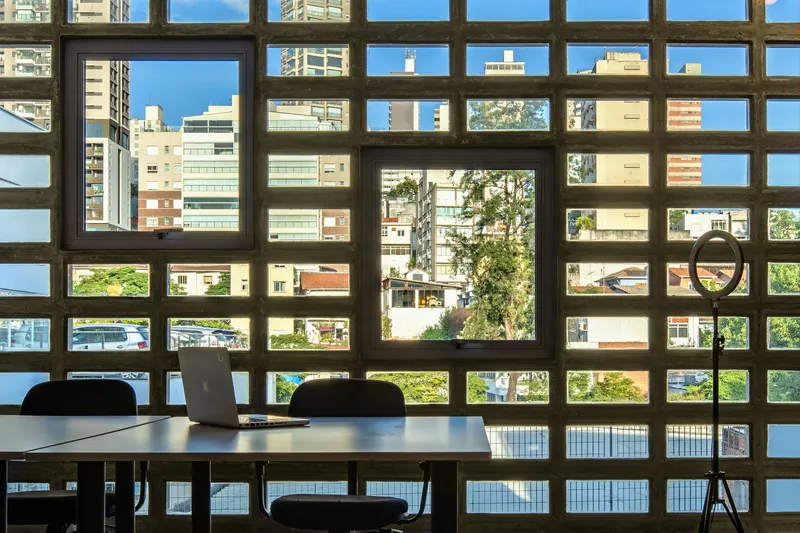
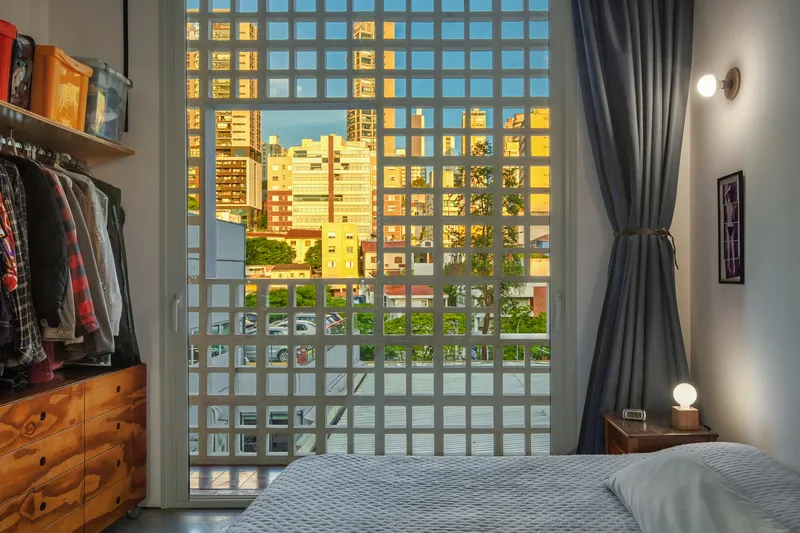
The cobogó screen's greatest payoff is felt indoors. In the stairwell, latticed shadows scroll across plywood panels and concrete floors as the sun moves, creating a shifting graphic layer that requires no additional finish. On the upper floor, a bedroom receives warm evening light through the same screen, silhouetting the São Paulo skyline in a golden grid. From a desk behind the screen, the city is visible but abstracted, framed into small squares that flatten the chaos of neighboring buildings and trees into something almost contemplative.
Glass block partitions repeat the trick at smaller scale. In the bathroom corridor and a bedroom, glass blocks filter daylight onto plywood cabinetry and concrete floors, creating a secondary luminous texture that is distinctly different from the cobogó's larger geometry. The house rarely needs artificial light during the day, which in a tropical latitude is both a comfort strategy and an energy strategy.
The Staircase as Connective Spine
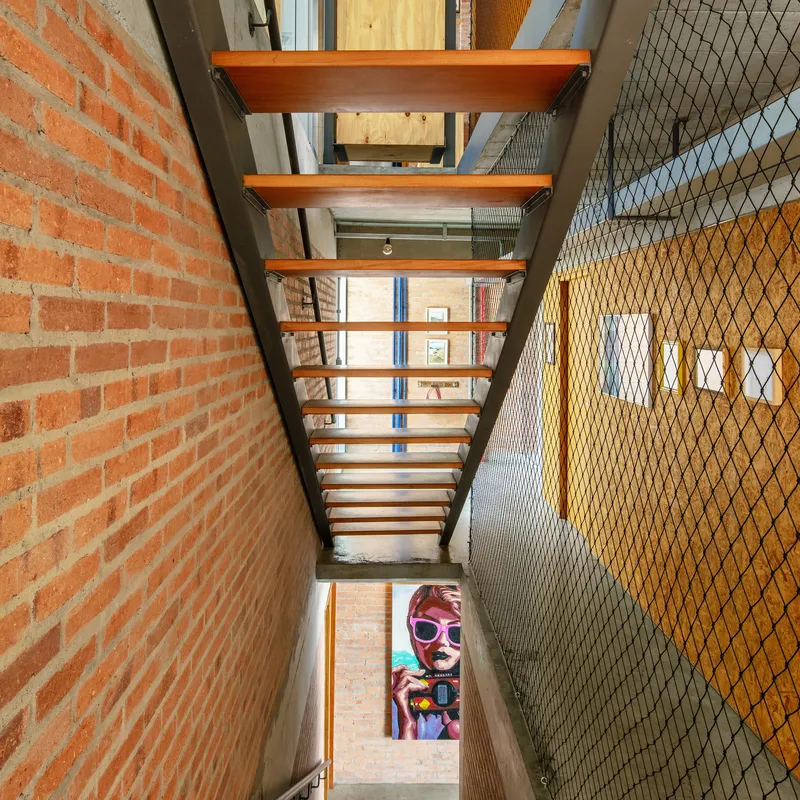
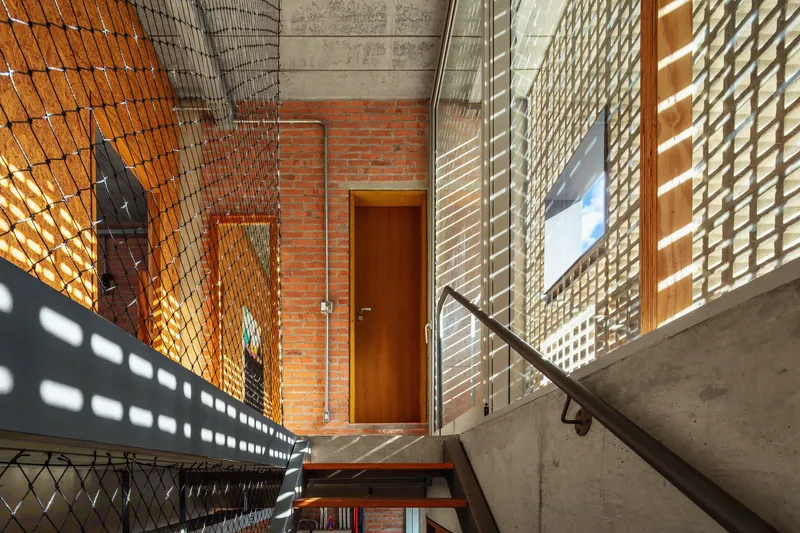
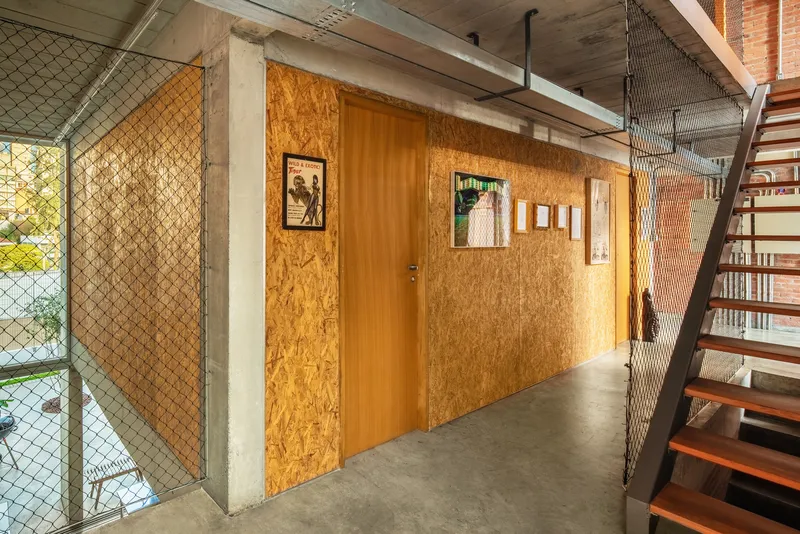
A central staircase links all three floors and functions as the house's social engine. Open timber treads on a steel frame allow light and sound to travel vertically, keeping the family connected across levels. Chain-link mesh and wire safety barriers replace solid balustrades, maintaining visual porosity while being robust enough for five children. The choice is pragmatic and honest: chain link is cheap, transparent, and nearly indestructible, qualities that align perfectly with the project's ethos.
On the upper hallway, oriented strand board lines the walls alongside the mesh railing, its rough texture complementing the concrete and brick below. The material palette throughout the house stays within a narrow range of exposed, affordable products, but the variety of textures, from smooth concrete to rough brick to fibrous OSB, keeps the interiors from feeling monotonous.
Courtyard, Green Roof, and the Water Equation
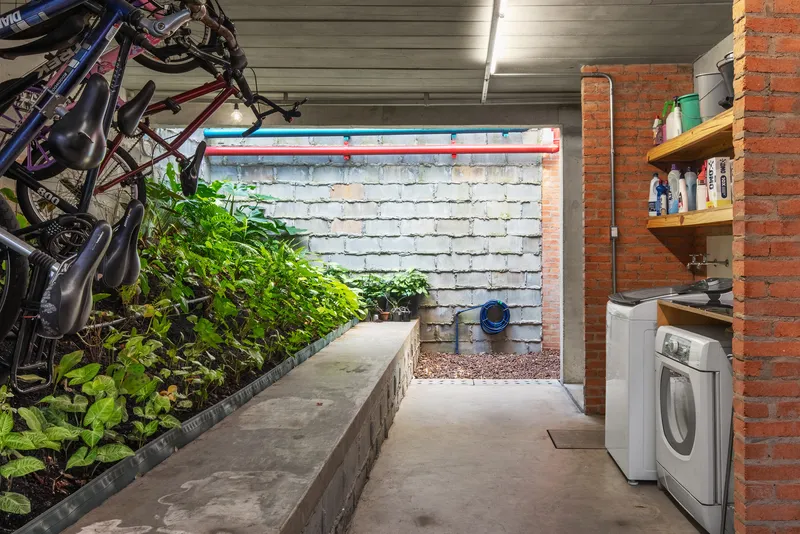
The interior courtyard at ground level serves as both utility space and breathing room. Planted beds line a white brick wall, bicycles hang from a corrugated metal ceiling, and daylight pours in from above. It is unpretentious and functional, the kind of space that will look better with use rather than worse.
From the rear, the house's three-story volume is visible with a planted roof terrace at the top. The green roof is more than ornamental. It acts as what the architects call a "green sponge," retaining rainwater during storms and releasing it for irrigation during dry periods. A permanent water layer provides waterproofing without asphalt membranes and delivers high thermal performance to the bedrooms directly below. The technical area is pre-wired for future solar panels, completing a passive strategy that treats the roof as the building's most productive surface.
Dusk Reveals the Double Life
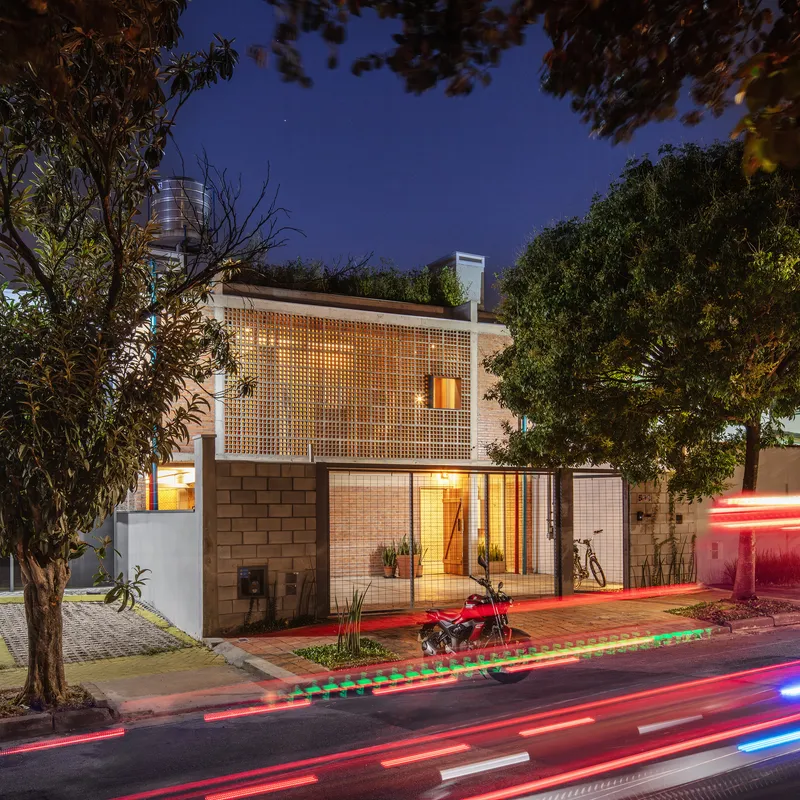
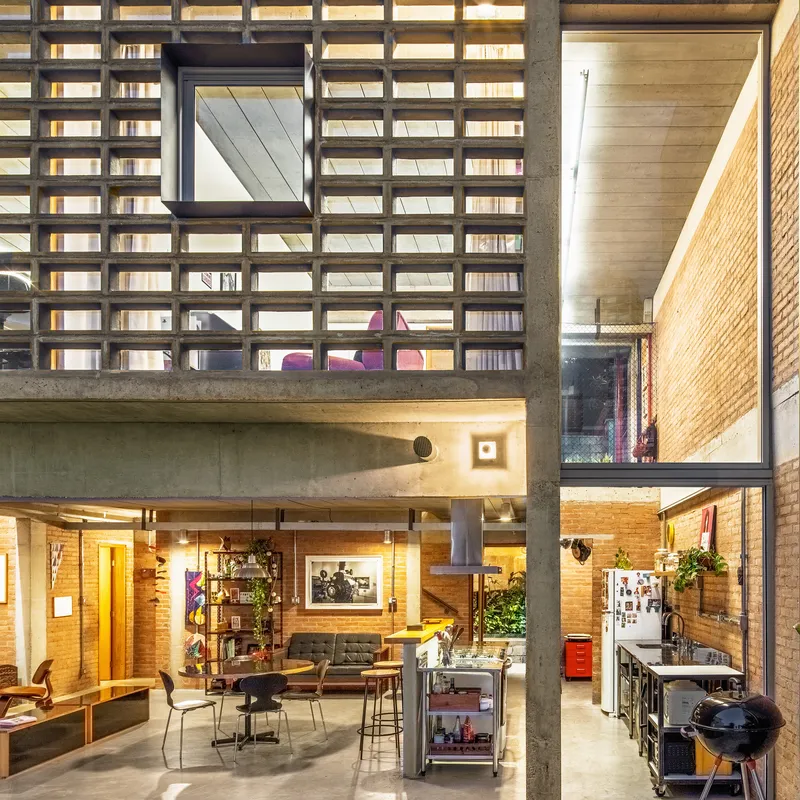
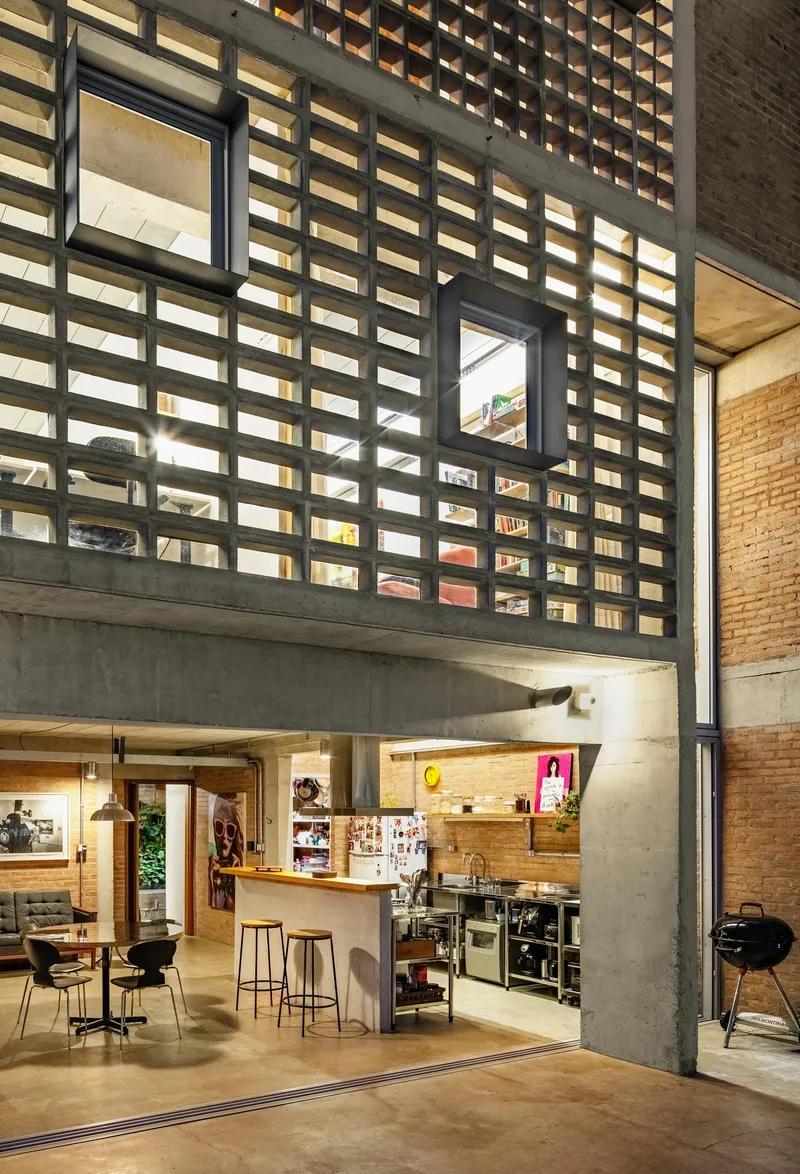
At twilight, the cobogó screen transforms from a privacy device into a lantern. Warm light spills through every perforation, and the house broadcasts its interior life to the street without sacrificing intimacy. The ground-floor glass facade glows beneath the lattice, and traffic light trails streak across the foreground, anchoring the house in its urban context. Inside, the double-height living space, lit artificially, reveals its full section: concrete columns, brick walls, and the grid screen stacked above.
The kitchen area beneath the screen at night is perhaps the most atmospheric image the house produces. Framed openings in the brick walls create deep reveals, and the warm artificial light turns the raw materials into something almost theatrical. It is a reminder that honest construction, when composed with care, does not need expensive finishes to generate atmosphere.
Material Close-Ups and Secondary Spaces
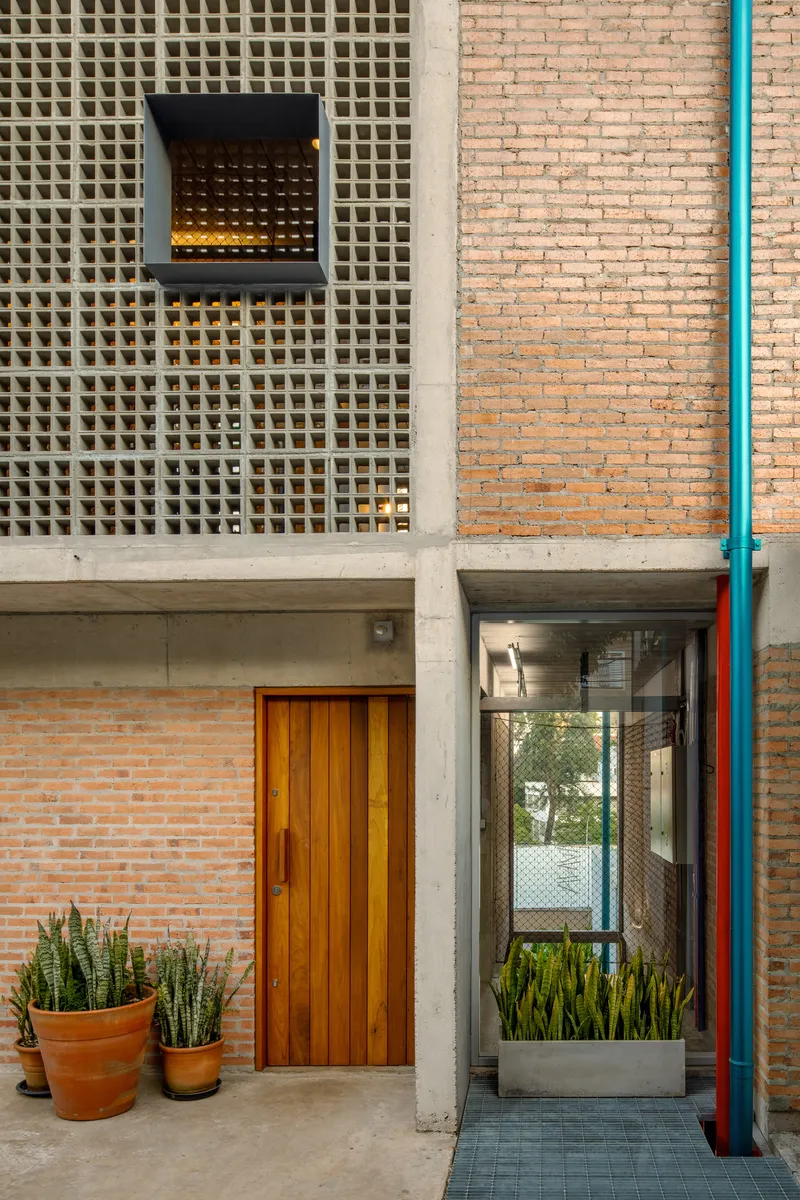
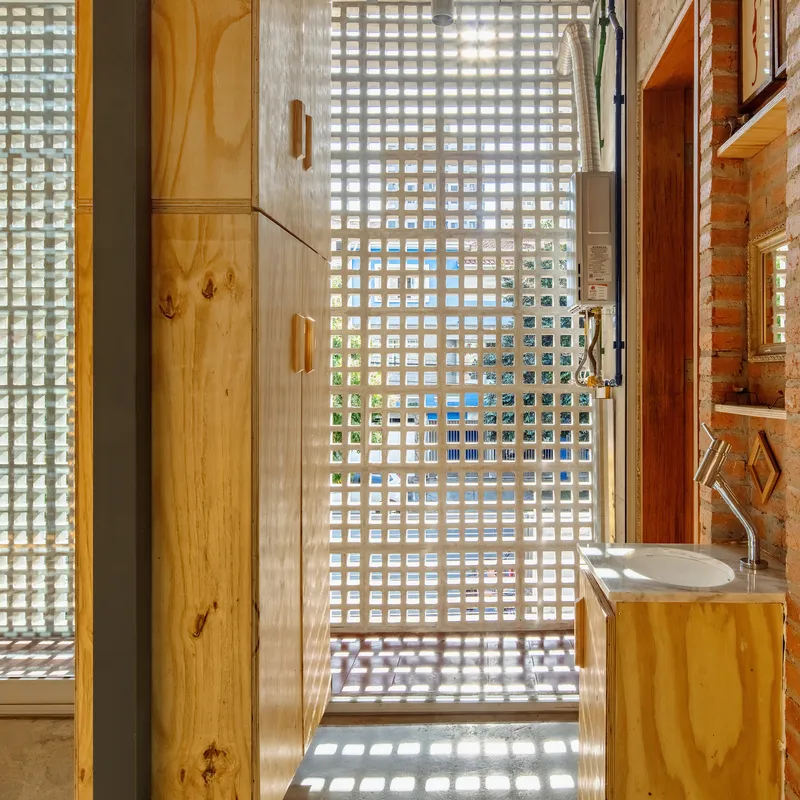
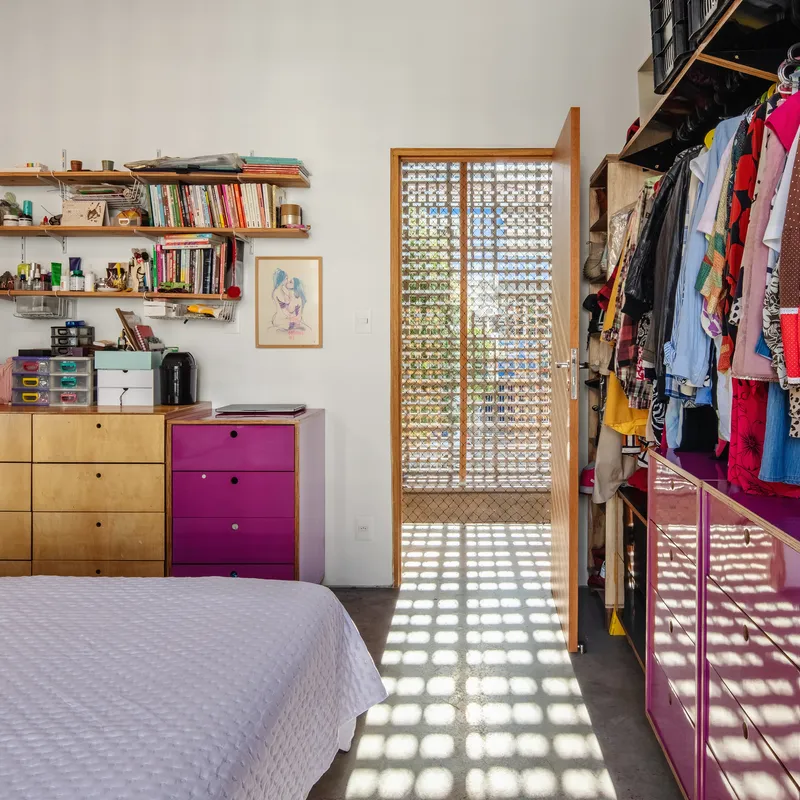
Detail shots confirm the discipline of the material strategy. A black window frame sits flush against the cobogó wall beside exposed brick, the junction clean and deliberate. In the bathroom corridor, glass block walls wash daylight across plywood cabinetry, a modest assembly that achieves genuine spatial quality. The bedroom deploys a glass block door that casts a precise grid of shadows across the concrete floor, turning a partition into an illumination device.
These secondary spaces, hallways, bathrooms, thresholds, receive the same design attention as the main rooms. In a compact house for seven people, corridors cannot afford to be leftover space. Here, they participate in the environmental and visual strategy on equal terms.
Facade and Ground Floor Condition
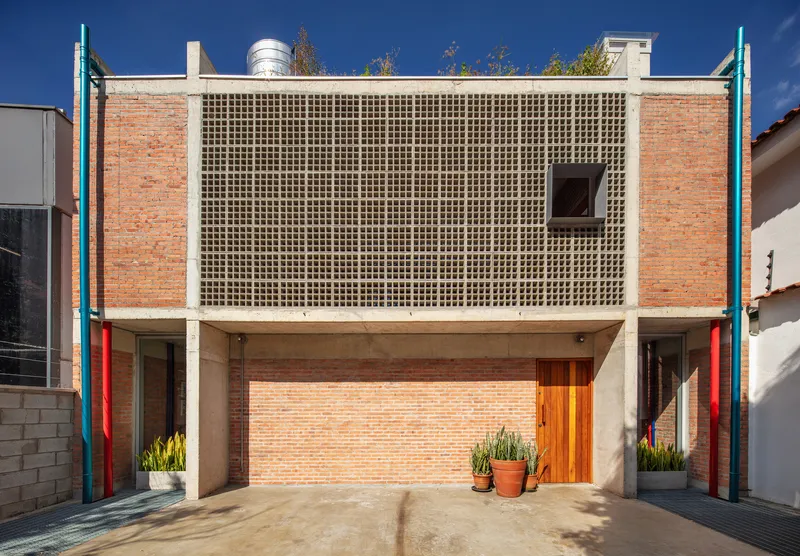
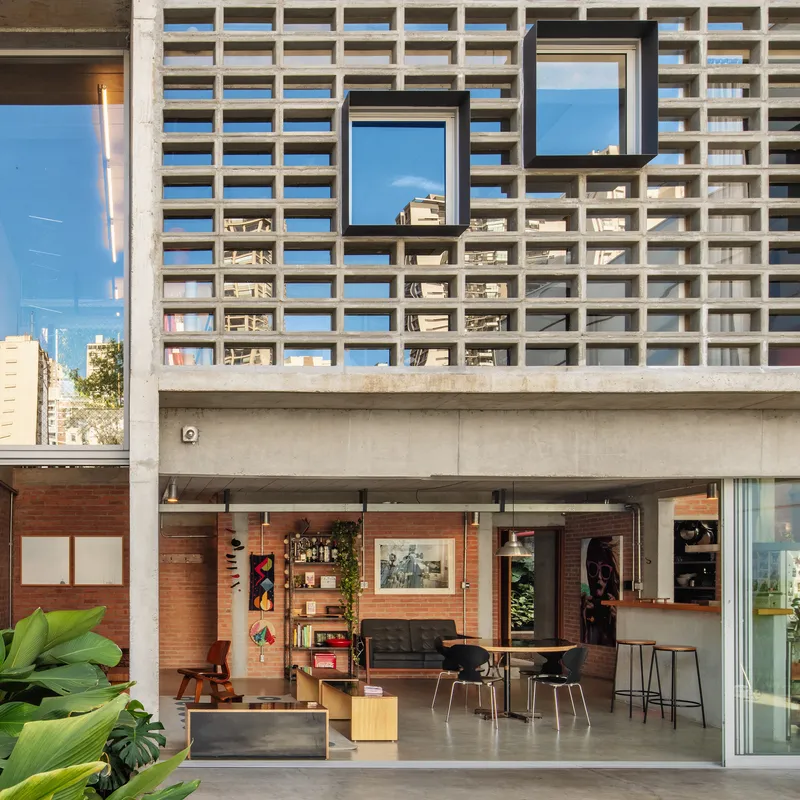
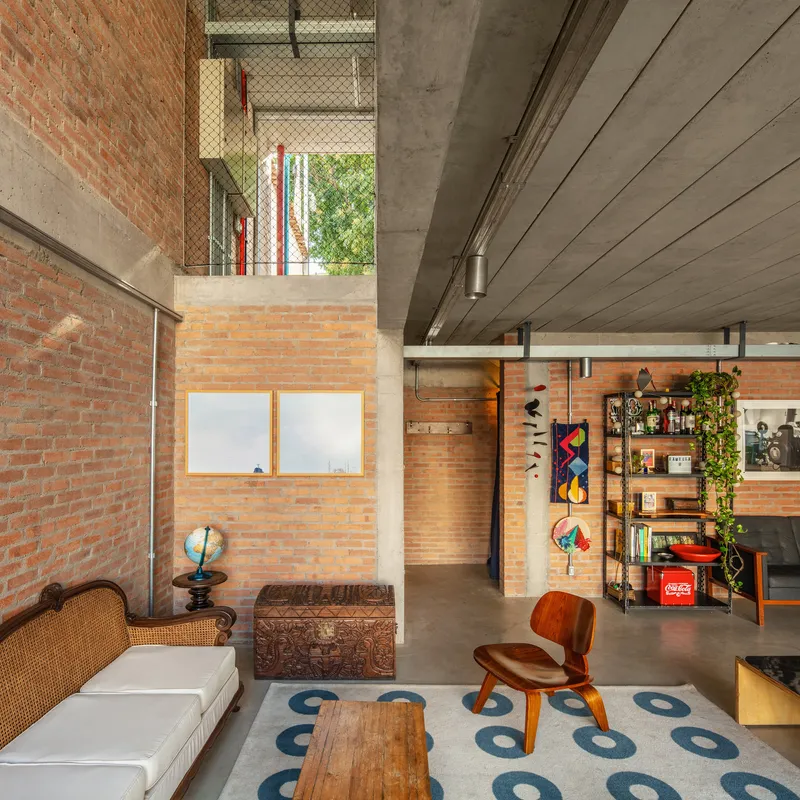
The front elevation reads as a layered sandwich. The latticed upper facade sits between exposed brick party walls, supported on blue steel columns that lift the cobogó volume above an open ground floor. The ground floor itself, with its breeze block screen and exposed brick, is porous enough to ventilate the garage and office spaces without mechanical systems. From inside, the double-height living space looks up toward a terrace through the concrete ceiling, reinforcing the vertical stacking logic that organizes the entire house.
Plans and Drawings
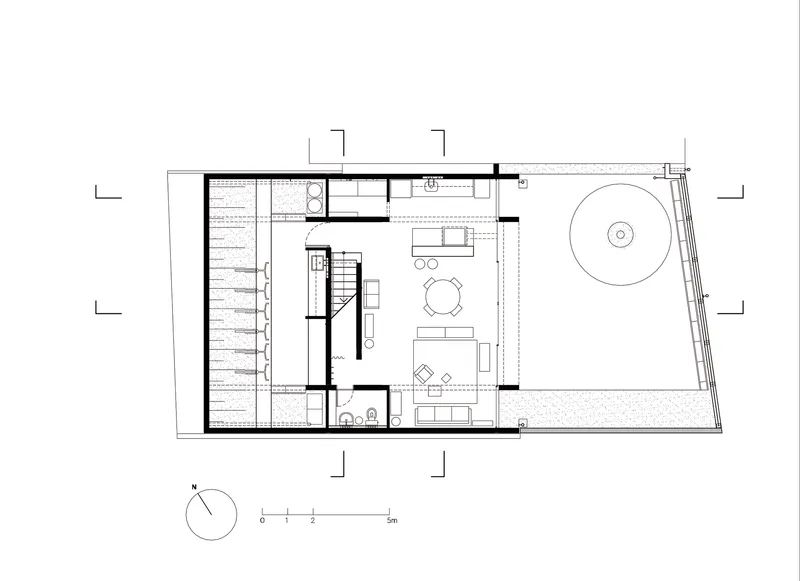
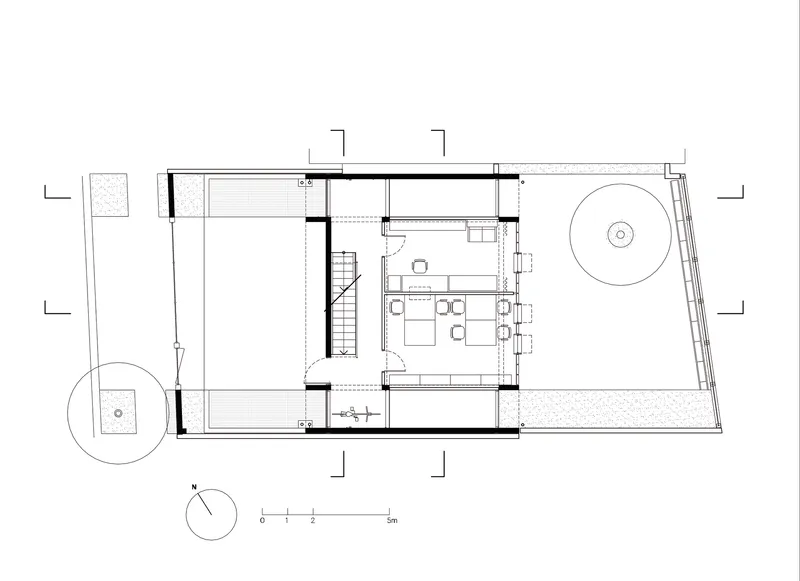
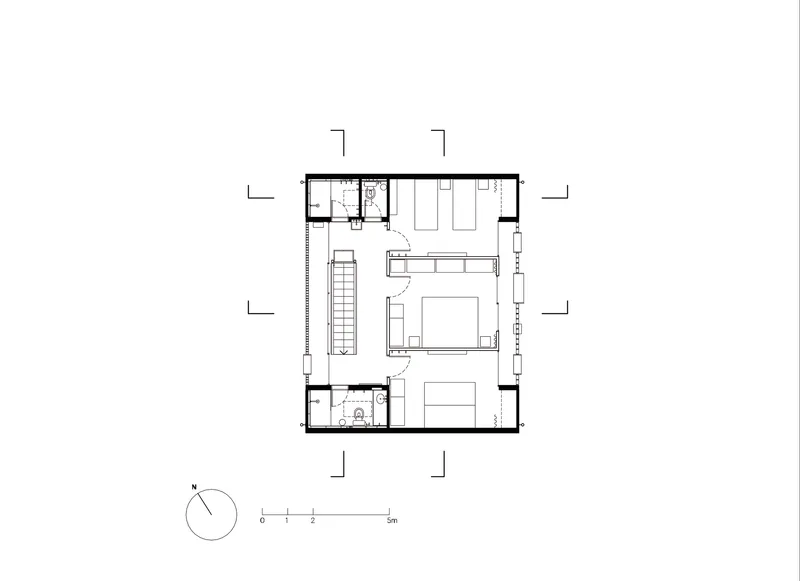
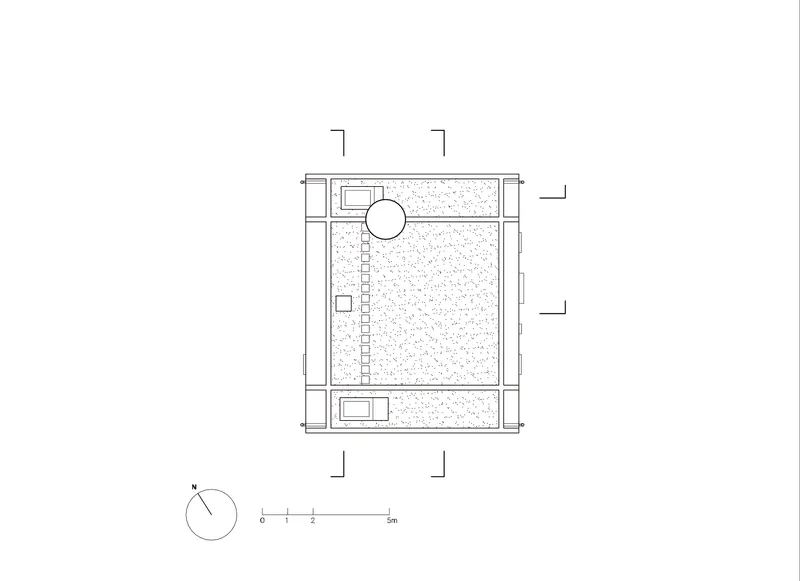
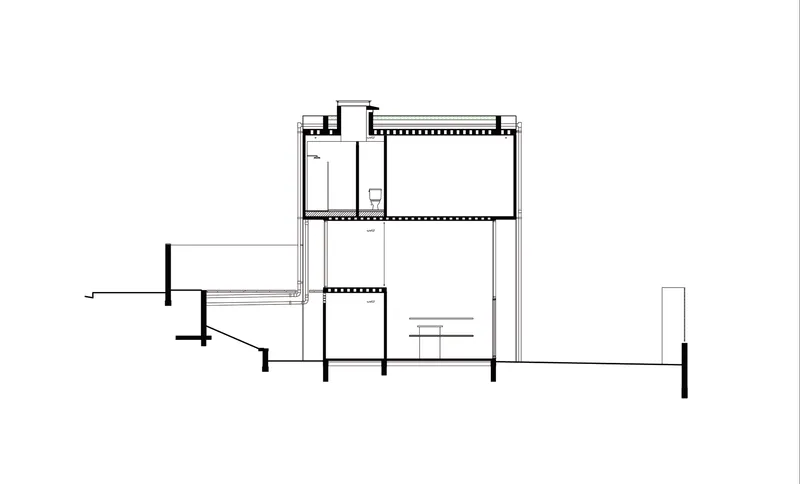
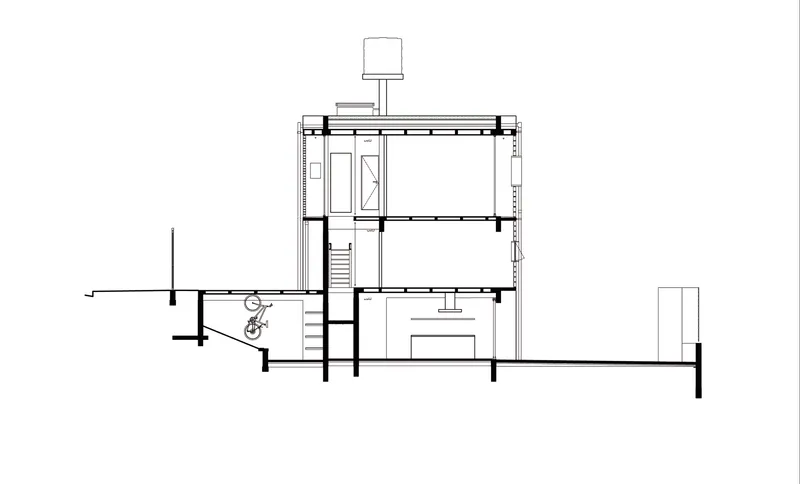
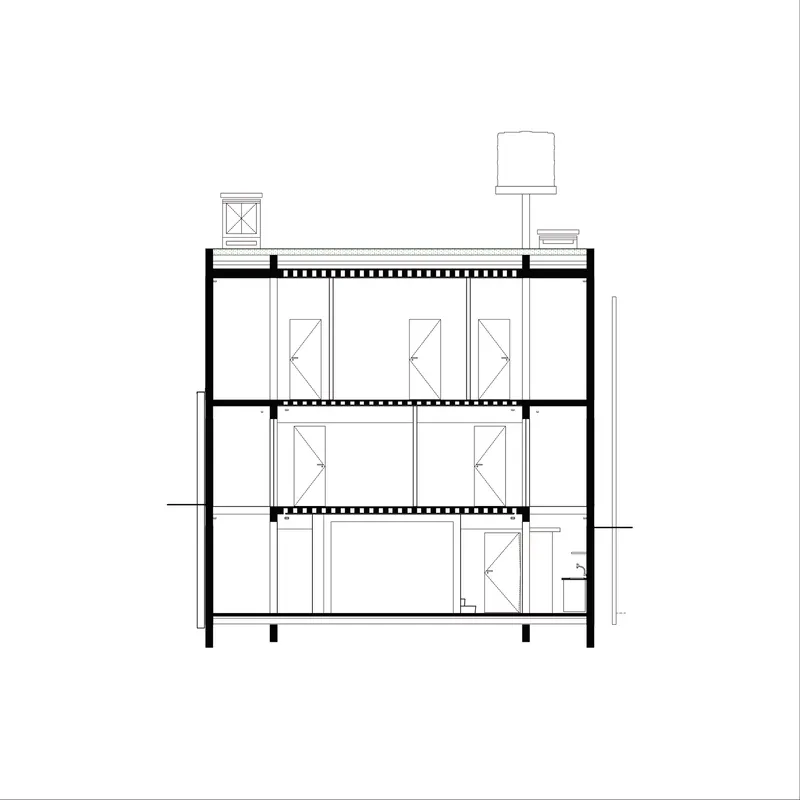
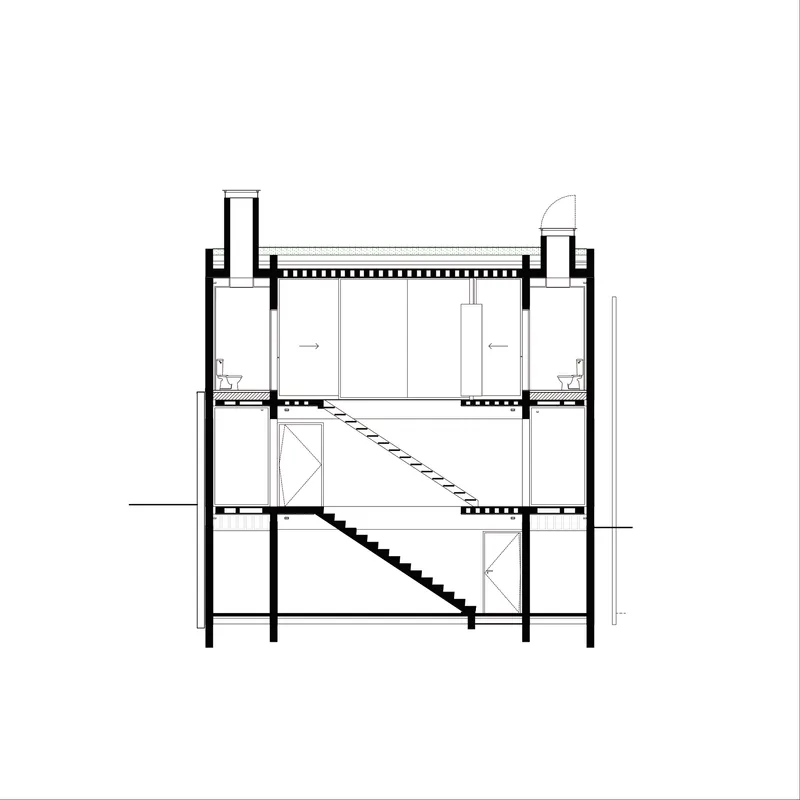
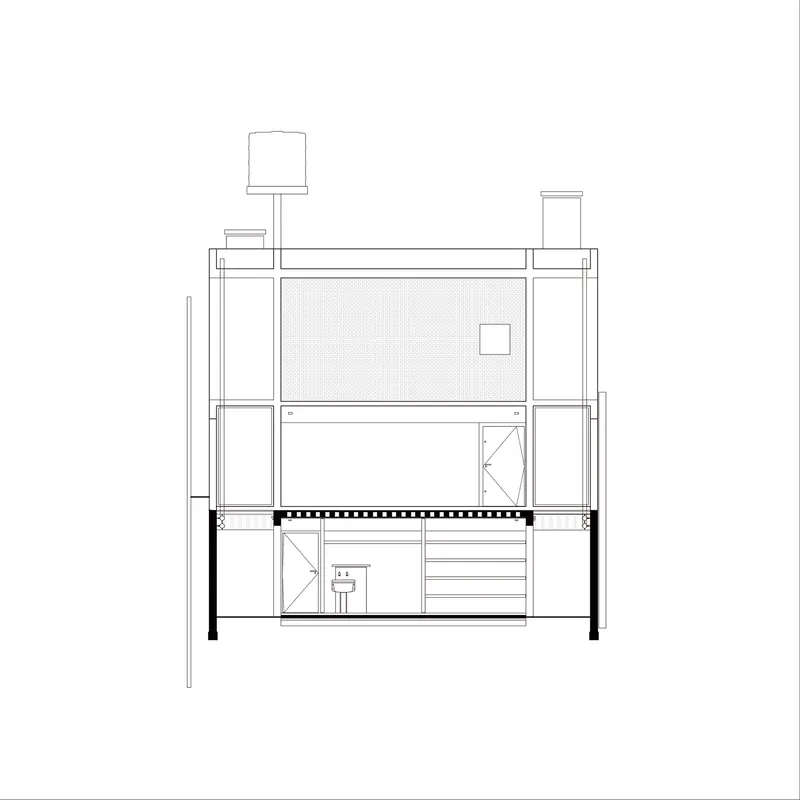
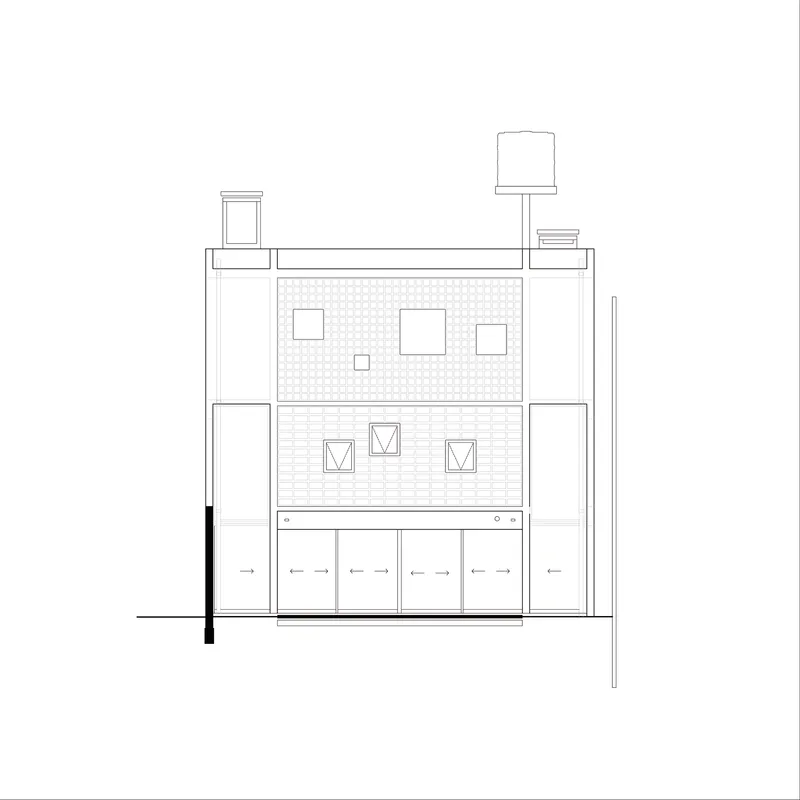
The floor plans confirm the compact efficiency of the layout. The ground floor plan shows the living area with its central stair and an exterior terrace anchored by a circular pool. The first floor opens up with living and dining flowing outward. The second floor consolidates the sleeping quarters, with a bedroom suite flanking a central stair and paired bathrooms. Sections cut through the house reveal the half-level stagger that the semi-buried lower floor creates, allowing higher ceilings where they matter most while keeping the overall building height in check.
The elevation drawing of the facade is particularly instructive, showing how the textured upper levels compose against the utilitarian ground floor garage doors. The roof plan documents the green roof's surface treatment and central courtyard, confirming that the productive landscape strategy is integral to the architectural proposition rather than a superficial addition.
Why This Project Matters
Caetés House matters because it demonstrates that a large family can live well in a compact urban footprint without resorting to either luxury materials or spatial austerity. The combination of cobogós, green roof hydrology, color-coded structure, and flexible drywall partitions constitutes a coherent design system, not a collection of one-off gestures. Each element does multiple jobs: the screen provides light, air, privacy, and identity; the roof retains water, insulates, and stages future energy production; the staircase connects, illuminates, and socializes.
In a city where vertical density often means anonymous apartment towers, Ateliê GR's insistence on the urban house as a viable typology is worth paying attention to. The architects' framing, that the city is a house and the house is a city, is not just rhetoric. It describes a building that opens to its street, accommodates work and play under one roof, and treats infrastructure as architecture. For practices working on constrained urban sites with real budgets, this is a useful precedent.
Caetés House by Ateliê GR, led by Gabriel Rodrigues Grinspum. Located in São Paulo, Brazil. 243 m², completed 2024. Photography by Nelson Kon.
About the Studio
Share Your Own Work on uni.xyz
If projects like this are the kind of work you want to make, uni.xyz is a place to publish your own, find collaborators, and enter design competitions.



Popular Articles
Popular articles from the community


Co-life: Sustainable Architecture for Age-Friendly Community Living
Co-life reimagines sustainable architecture for seniors through courtyards, rammed earth, shared gardens, and spaces designed for belonging.

Lunar Spiral: Space Architecture Shaped by the Mathematics of the Universe
Lunar Spiral reimagines space architecture through Fibonacci geometry, lunar regolith, levitating habitats, and self-sustaining Moon living.

The Ocean Hive: Sustainable Architecture for a Self-Sufficient Civilization at Sea
The Ocean Hive imagines sustainable architecture at sea, where modular habitats, algae, wave power and ocean waste sustain a growing colony.

The Musturak Paradise: Senior Living Architecture for a Connected Future in Temara, Morocco
The Musturak Paradise reimagines senior living architecture in Temara via private homes, social spaces, culture, community, and shared care.

Similar Reads
You might also enjoy these articles

Bao Huynh Watercolor Atelier: A Serene Art Retreat in Hội An
Bao Huynh Watercolor Atelier in Hội An blends multifunctional art spaces, sustainable design, local materials, and family-friendly living in a serene environment.

Atelier Macri Concept Store Interior Design by CASE-REAL
Atelier Macri store features a "ko" counter, walnut wood details, cork displays, blending retail, gallery, and seamless customer experiences.

Manuel Vargas Izquierdo Stadium and High-Performance Sports Center: Architectural Excellence in Jalpa de Méndez
The Manuel Vargas Izquierdo Stadium blends sustainable design, inclusive sports facilities, and cultural-inspired architecture, revitalizing Jalpa de Méndez’s public spaces.

KAKR Buluh Awar Hall: Revitalizing Community and Ecology Through Bamboo Architecture
Community built bamboo hall revitalizes Buluh Awar village, empowering youth, restoring ecology, celebrating vernacular craftsmanship through sustainable architecture and culture.




Comments (0)
Please login or sign up to add comments
No comments yet. Be the first to comment!