
Atelier ALL Carves Courtyards and Circular Portals into a Concrete Dwelling in Chaozhou
A board-formed concrete house on a streamside plot reinterprets the Chaoshan 'Cuò' dwelling through voids, water, and filtered light.


On the outskirts of Chaozhou, where the landscape shifts from dense village fabric to agricultural plots bisected by branching streams, Atelier ALL has built a house that takes its name from regional vernacular. In the Chaoshan dialect, "Cuò" denotes a residential dwelling, but the word carries more weight than a floor plan: it implies social fabric, neighborhood, the life that orbits a home. Xikoucuò Dwelling, completed in 2022 on a uniformly planned rural construction site, negotiates between that cultural freight and the realities of building new on a sloped plot roughly four meters above a stream. The result is 686 square meters of board-formed concrete organized around a sequence of courtyards, water features, and circular apertures that make the house feel less like a single volume and more like a small compound.
What makes the project worth studying is its refusal to settle for one tactic. The house is simultaneously massive and porous. Its gabled profile reads as a simple, almost archetypal house silhouette from the road, but once you move through the entry sequence, the architecture dissolves into layered screens, planted voids, reflecting pools, and light wells. Lead architects Liu Congxiao and Liu Xiao seem interested in how a dwelling can be monolithic from the outside and almost kaleidoscopic within, and the tension between those two conditions gives Xikoucuò its character.
Landscape and Silhouette
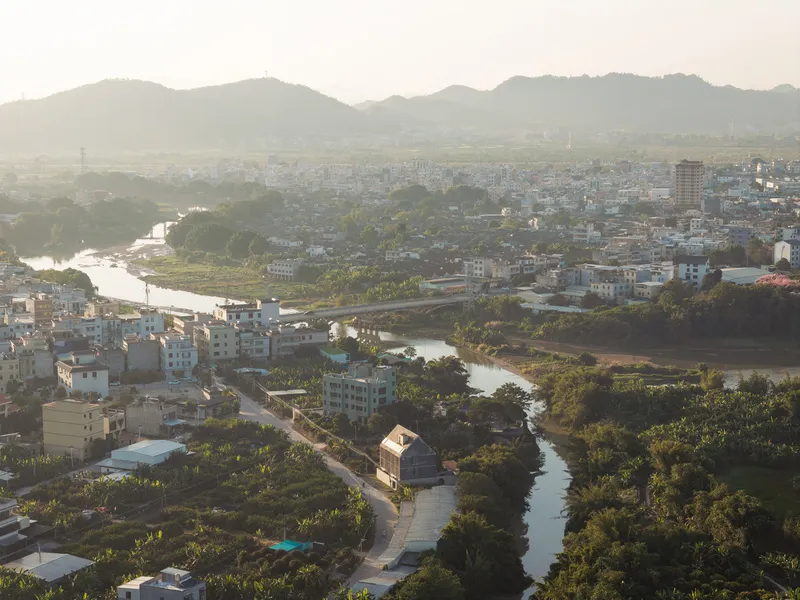

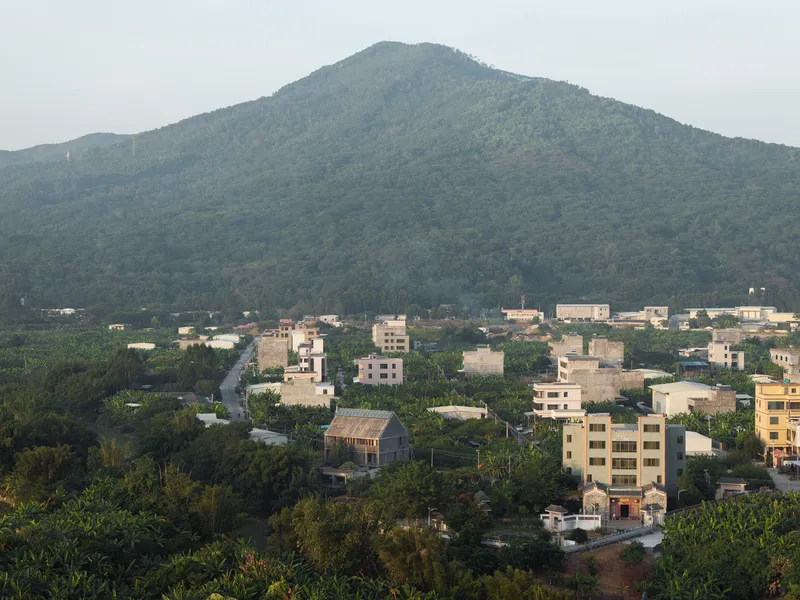
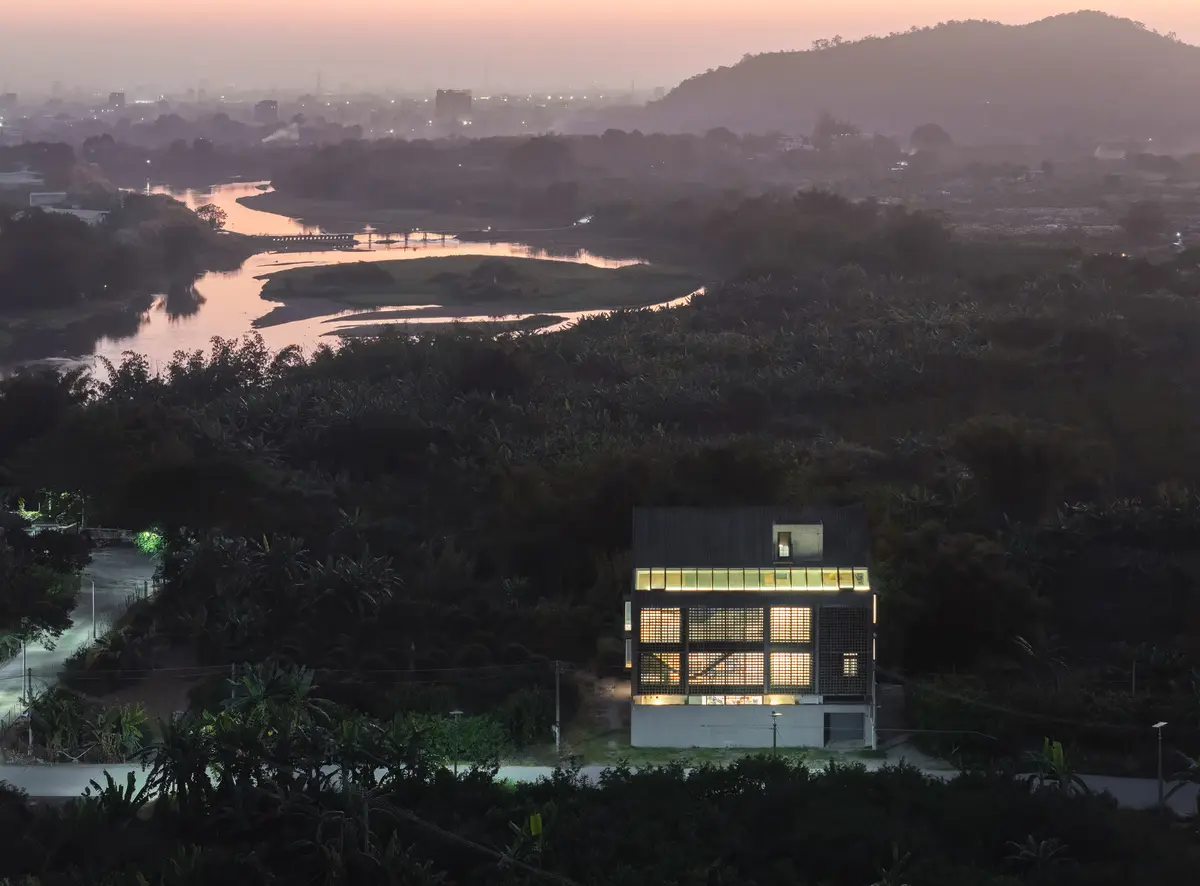
Seen from above, the house sits at the edge of a winding river valley, its steep gable roof echoing the pitch of surrounding mountains rather than the flat roofs of neighboring construction. The aerial views are revealing: the plot is relatively tight, surrounded by banana trees and low-rise housing, yet the building reads as distinct without being alien. Its concrete mass picks up the gray-green tones of the overcast Chaozhou sky, and the gabled form, while assertive, belongs to a long lineage of pitched-roof rural houses in the region.
The four-meter grade change on the stream side is handled with a concrete plinth and retaining wall that anchor the house to its terrain. Rather than fighting the slope, the architects exploit it, creating a layered section where ground-level spaces on the north side become elevated terraces overlooking foliage on the south. The house addresses two very different conditions: a planned road to the north, and a semi-wild streamside landscape to the south.
The Perforated Threshold


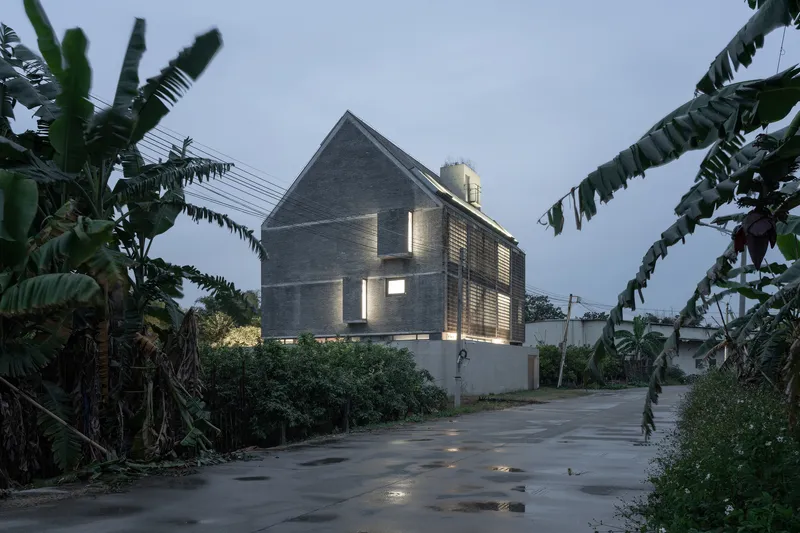
From the street, the house presents a controlled face. Perforated brick screens wrap portions of the facade, filtering views inward while maintaining privacy. The entry courtyard, framed by concrete walls and a timber door, functions as a compression chamber: you move from the open road into a narrow, sheltered space before the house opens up. It is a classic threshold device, common in courtyard typologies across southern China, but executed here with a material confidence that feels contemporary.
The perforated brick is not just decorative. It mediates between the subtropical climate's demand for ventilation and the family's need for enclosure. At dusk, when the house is illuminated from within, the screens glow with a gridded warmth that transforms the street elevation into something almost lantern-like. The dark brick volume with its vertical window slots, visible at night against the concrete retaining wall, reinforces a reading of the house as a solid object selectively punctured.
Courtyards and Water


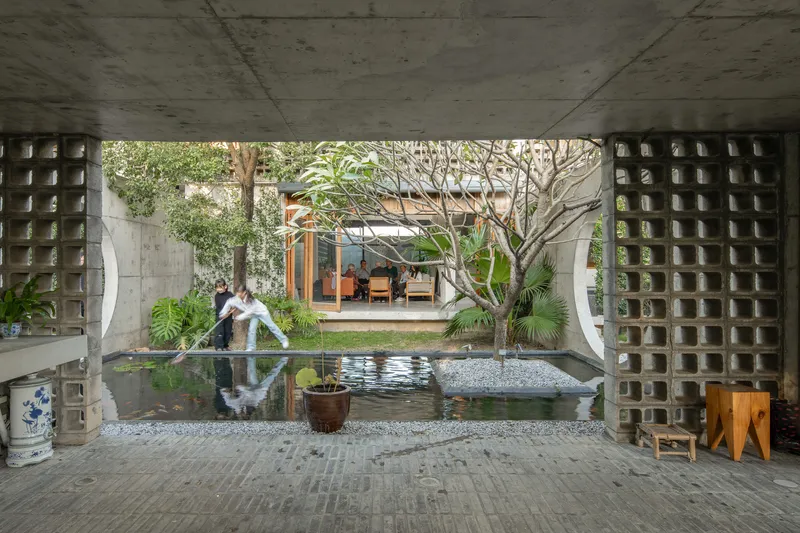
The interior courtyards are where the house comes alive. Two planted voids punctuate the plan, bringing light and air deep into the section while creating visual connections between floors. Reflecting pools and a koi pond sit beneath concrete arches and breeze block walls, establishing a microclimate of coolness and humidity that tempers the Chaozhou heat. The water is not incidental; it is a spatial device, reflecting the circular concrete openings above and extending the sense of depth in what could otherwise be a compressed plan.
Circular portals are the project's signature motif. Board-formed concrete walls are cut with full circles that frame views of trees, planted beds, and sky. These openings do more than provide visual pleasure: they control the sequence of discovery as you move through the house, offering glimpses before revealing rooms. The effect is cinematic, each circular frame composing a scene that changes with the time of day and the angle of approach.
Concrete and Timber Interiors
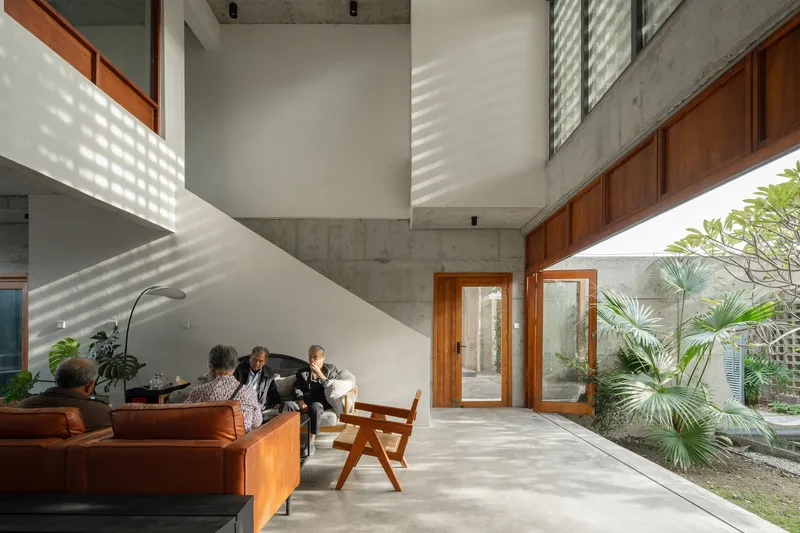


Inside, the material palette is restrained. Board-formed concrete dominates the ceilings and structural elements, its grain visible in every surface, while timber doors and joinery introduce warmth at the points of human contact. The double-height living room is the spatial anchor: patterned light from perforated screens falls across white walls, creating a constantly shifting interior atmosphere. A black spiral staircase rises through the section, its slender profile contrasting with the heavy concrete beams above.
The vaulted concrete ceiling in the upper level, with its rhythmic beams and skylights, is perhaps the most accomplished interior moment. Suspended globe pendants hang from the exposed structure, and a lofted timber floor sits beneath the pitched roof, creating a room that feels both sheltered and expansive. The architects clearly understand that concrete's brutality can become a virtue when paired with controlled natural light. Skylights cast sharp beams that move across the floor throughout the day, turning the house into a kind of sundial.
Filtered Light and the Inhabited Edge

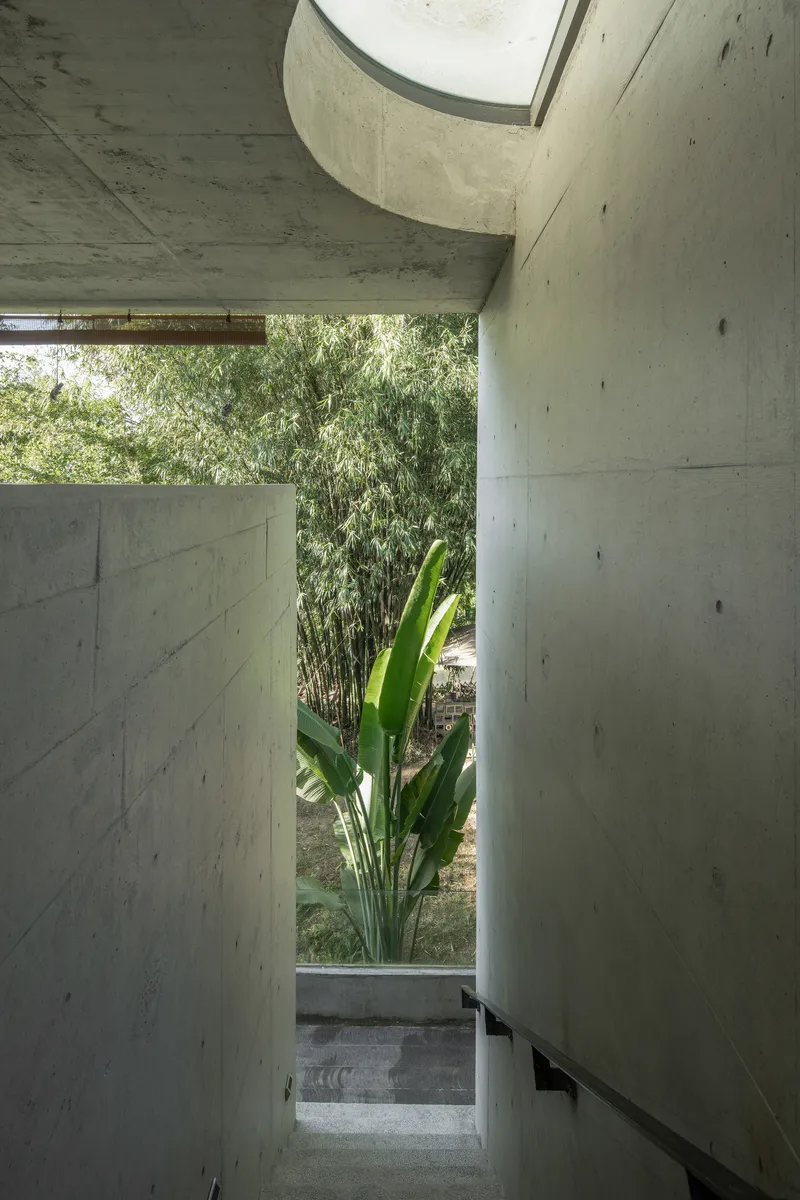

A curved concrete skylight in one room casts dappled afternoon light across a brick floor, and this image alone justifies the project's investment in heavy construction. Elsewhere, passageways open to planted courtyards where bamboo and bird of paradise grow beneath circular apertures. The upper level includes a seating nook with a blue sofa overlooking a stairwell, where concrete breeze blocks filter daylight into a gradient of shadow and glow.
These transitional spaces, neither fully interior nor exterior, are where the house is most convincing as a regional response. In Chaozhou's hot, humid climate, the zone between inside and out is arguably more important than either condition alone. Atelier ALL treats this edge as habitable territory, filling it with terraces, covered decks, and screened loggias that extend the usable area of the house well beyond its enclosed rooms.
Terraces and the Southern Landscape


On the south side, the house opens generously to the stream and the forested hills beyond. A circular concrete portal frames two wooden chairs on a terrace overlooking dense foliage: a composed moment of stillness in a house full of spatial event. Covered timber decks with steel railings extend from the upper floors, offering elevated views at dusk. One bedroom opens through a gridded timber balustrade to misty hills, a framing that recalls traditional Chinese garden windows but executed in a modern material vocabulary.
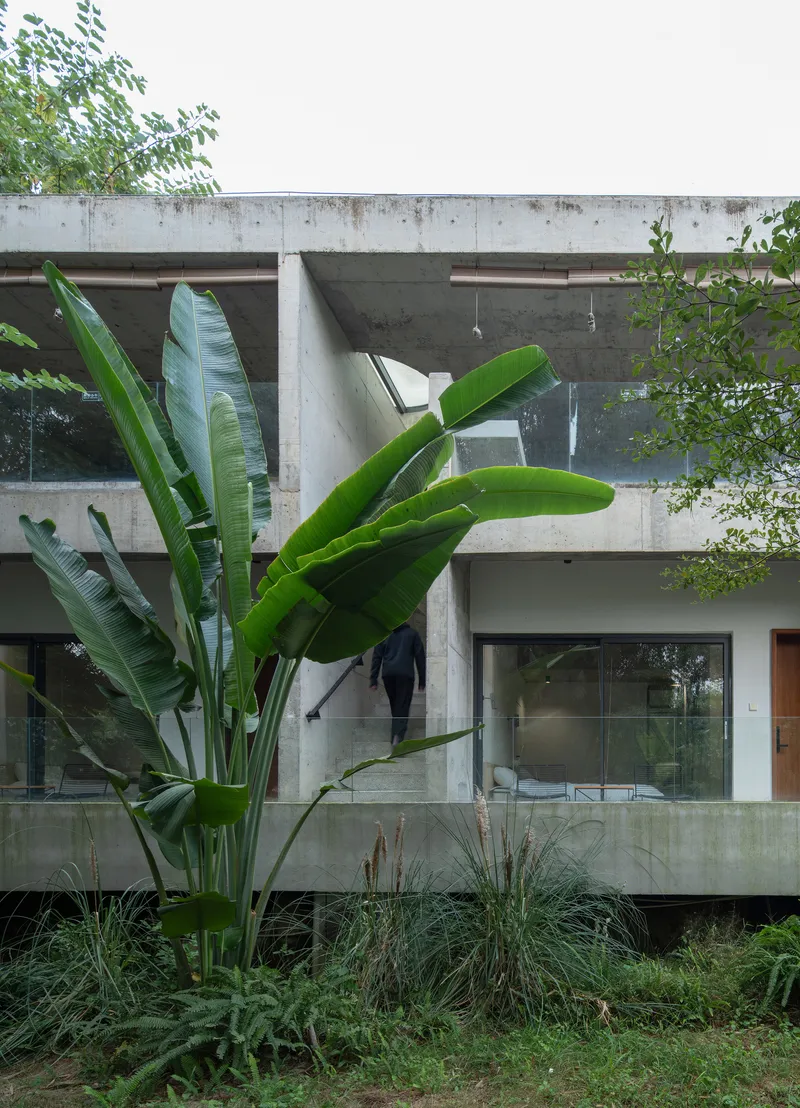
The board-formed concrete facade on this side, with ribbon windows and balconies surrounded by banana plants, shows a rougher, more expressive character than the street elevation. The grain of the formwork is left unapologetically raw, and the planting has been allowed to grow close to the building, blurring its edges. It is a deliberate contrast: civic restraint to the north, a wilder domestic landscape to the south.
Village Context
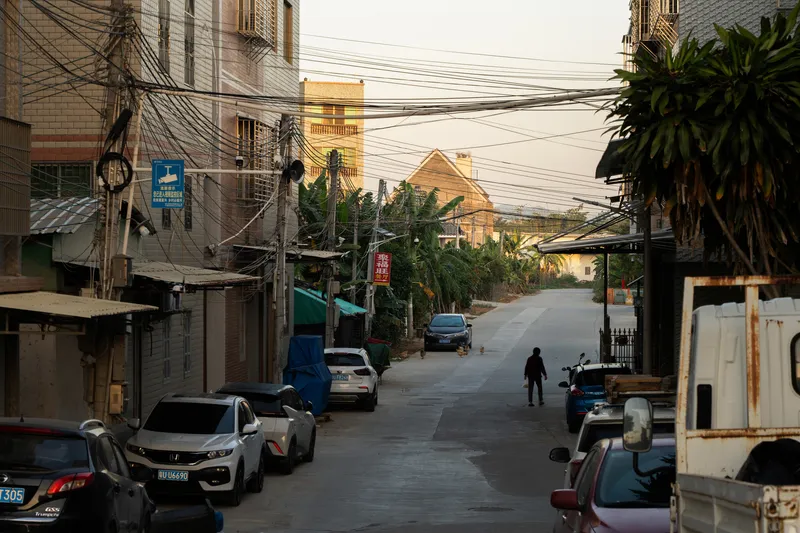
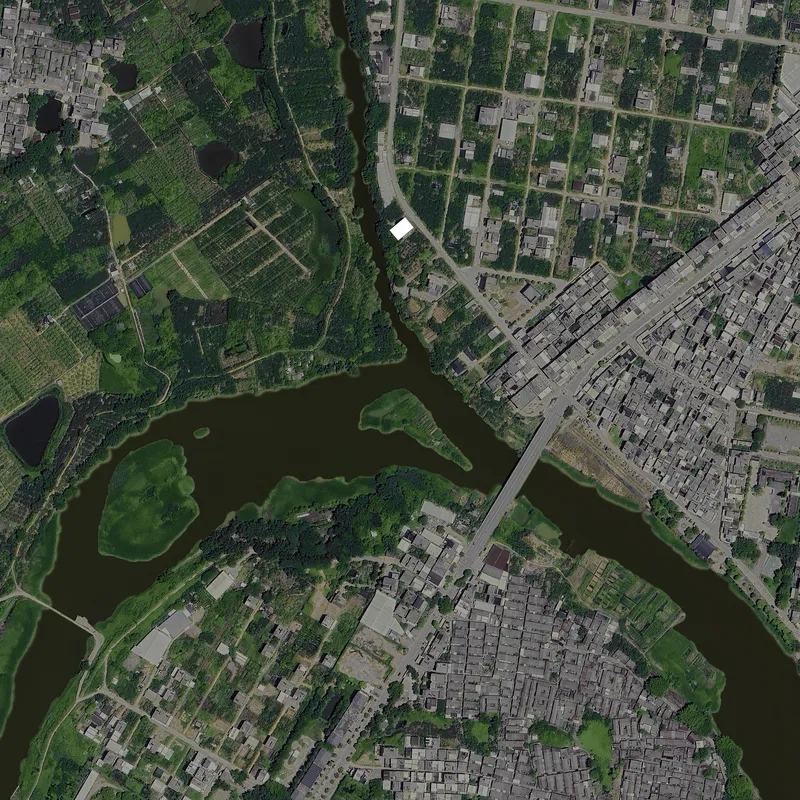
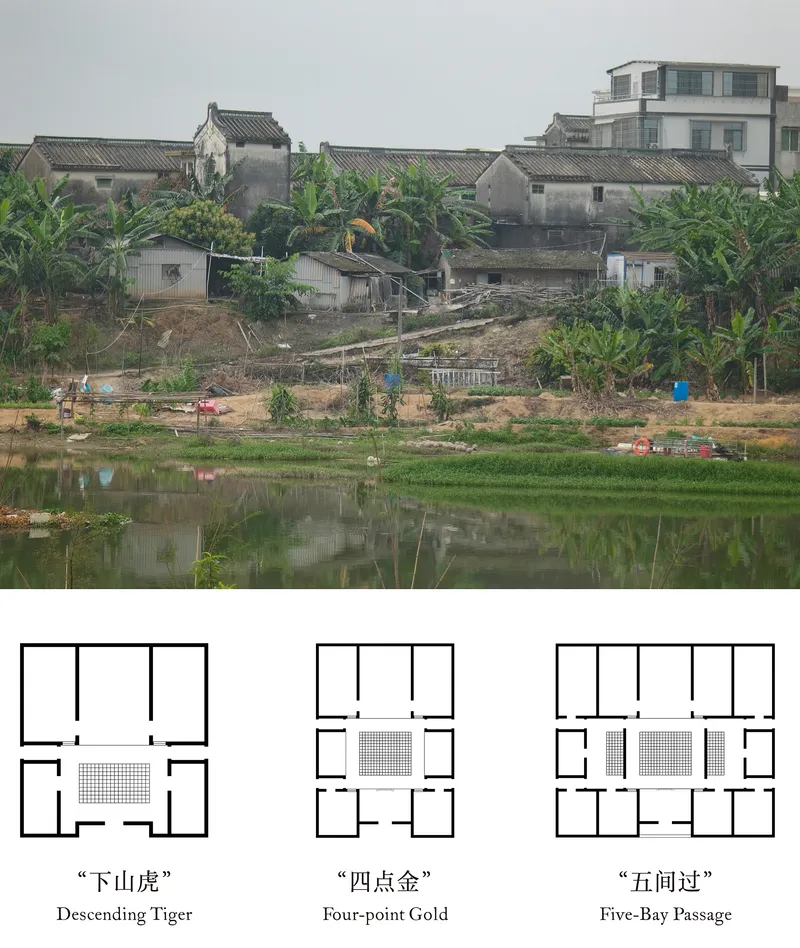
Xikoucuò Dwelling does not exist in isolation, and the architects are clearly aware of that. The surrounding village fabric, visible in the street-level and aerial photographs, is a mix of low-rise houses, overhead power lines, parked vehicles, and the gentle disorder of a Chinese rural settlement undergoing modernization. The house is ambitious, but it does not pretend that its context is a pristine landscape. The meandering river and the linear bridge that connect dense residential neighborhoods are the real infrastructure of this place, and the house engages with them honestly.
Plans and Drawings

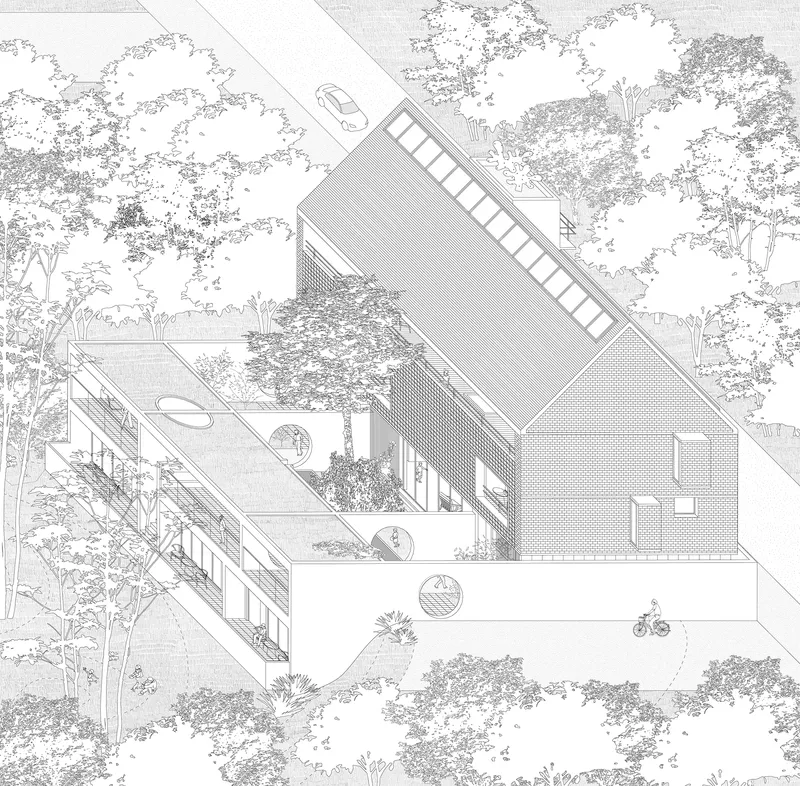
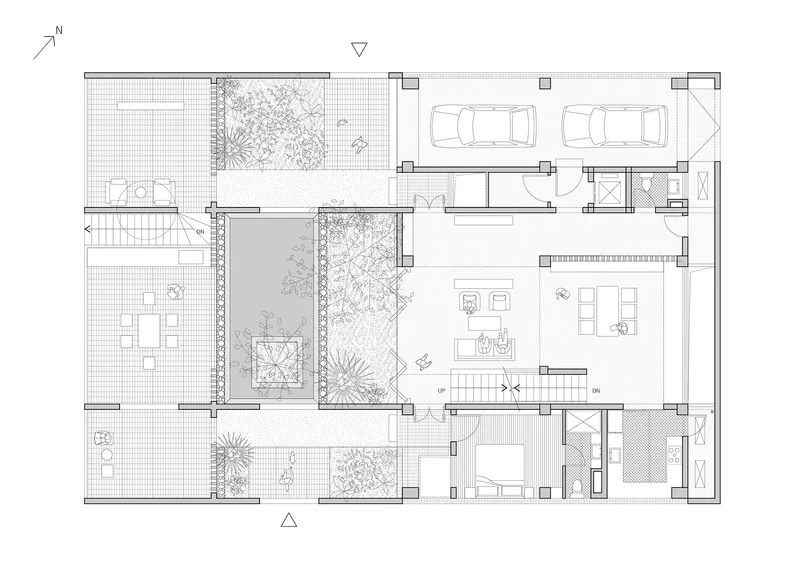
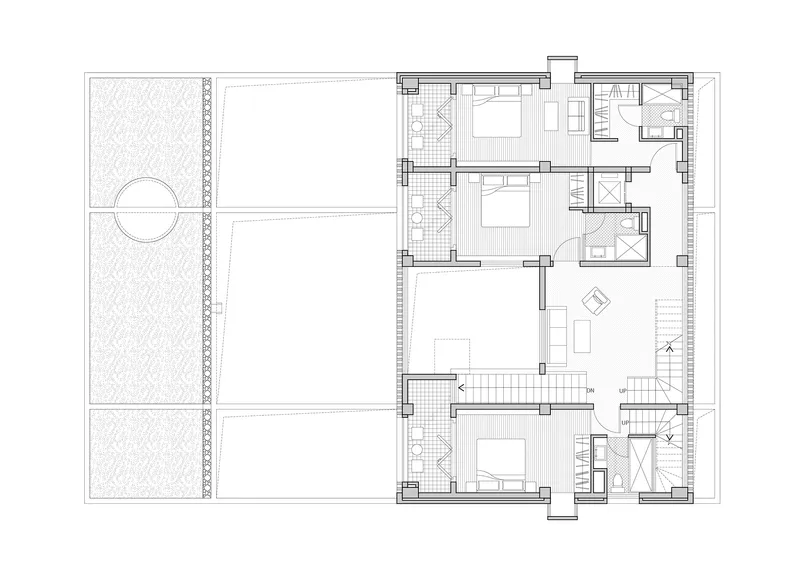
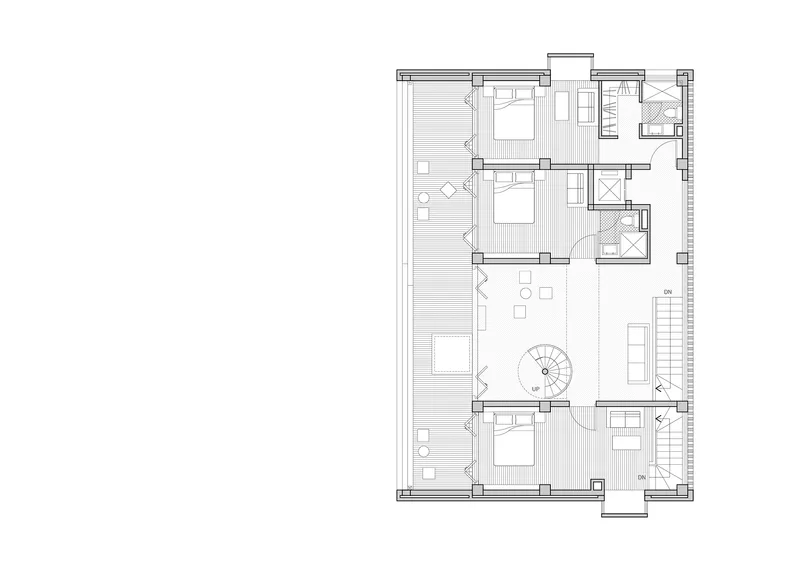

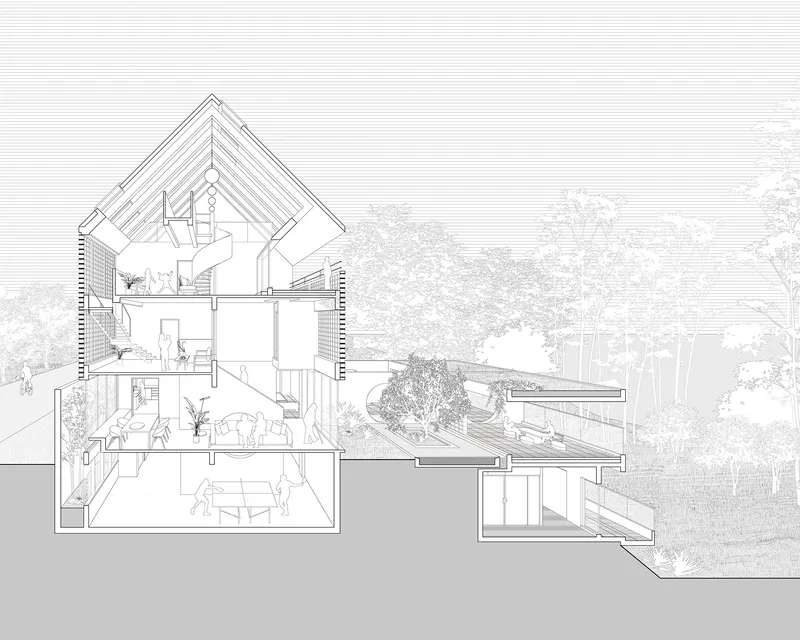
The site plan reveals a compact footprint tucked against a curving waterfront road, with the bulk of the plot given over to trees and landscape. The axonometric drawing clarifies the courtyard strategy: two voids carve into the rectangular volume, creating a pinwheel organization where living spaces wrap around planted gardens. The ground floor plan shows a clear distinction between served and service spaces, with the koi pond and reflecting pools occupying the heart of the plan. Upper floors distribute bedroom suites with ensuite bathrooms around the central spiral staircase, and the sections expose the full drama of the pitched concrete ceiling and the multi-level relationship between house and terrain.
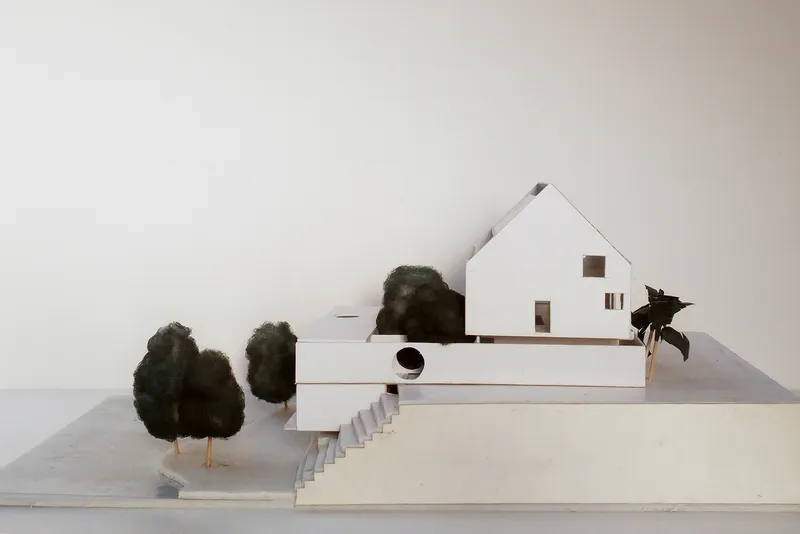
The physical model is instructive. A gabled form sits on a terraced plinth with small trees and steps, reducing the house to its essential moves: a pitched volume, a carved base, and the negotiation between them. What looks complex in the photographs reads as surprisingly legible in diagram form.
Why This Project Matters

Rural housing in China is undergoing rapid transformation, and the results are often dispiriting: generic tile-clad boxes that ignore both climate and culture. Xikoucuò Dwelling demonstrates that a house on a standard rural plot, built within the constraints of local planning, can be spatially rich, climatically responsive, and materially honest without requiring exotic technology or imported aesthetics. The Chaoshan "Cuò" tradition, with its emphasis on courtyards, thresholds, and social space, provides a framework that Liu Congxiao and Liu Xiao have adapted rather than replicated.
The project's real lesson is about porosity. By punching courtyards, circular portals, skylights, and screened walls into a heavy concrete shell, Atelier ALL has created a house that breathes. Light, air, water, and vegetation penetrate every level of the section, dissolving the boundary between architecture and landscape in a way that feels earned rather than performative. In a region where the relationship between dwelling and place carries deep cultural meaning, that porosity is not just a design strategy. It is an argument for what domestic architecture can still do.
Xikoucuò Dwelling by Atelier ALL, led by Liu Congxiao and Liu Xiao. Located in Chaozhou, China. 686 m². Completed in 2022. Photography by Siming Wu.
About the Studio
Atelier ALL
Share Your Own Work on uni.xyz
If projects like this are the kind of work you want to make, uni.xyz is a place to publish your own, find collaborators, and enter design competitions.


Popular Articles
Popular articles from the community


ETEH Reworks the Shared Spaces of São Domingos School in Brazil Around Timber, Color and Hanging Plants
At São Domingos School in Brazil, 436 m² of hall, refectory and library are recast with timber joinery, a yellow and blue code and trailing greenery.

David Ortega Stacks a Two-Story Mexico City Penthouse Around a Steel Stair and a Pergola-Shaded Roof Terrace
In Colonia Roma, a 300 m² penthouse uses oak joinery, a planted steel stair and a slatted roof pergola to make a new-build apartment feel like a house.


Opera on the Sea: Driftwood Logic Shapes a Timber Opera House on Estonia's Coast
Trevor Orgill's opera house translates the entangled drift of floating timber into a civic building where wood, water, and music converge.

graciastudio Turns a Viewless Tijuana Lot Inward Around a Courtyard of Concrete, Timber and Trees
In Tijuana, Jorge Gracia's GA2 House stacks a timber-clad private floor over exposed concrete and replaces a missing view with a planted interior patio.

Similar Reads
You might also enjoy these articles

LAVA Architecten Gives Vocational Education a Sawtooth-Roofed Face on a Mechelen School Campus
In Mechelen, Belgium, a 2,053 m² STEM school on a 6×6 m grid turns workshops and classrooms into rooms that can be rearranged as teaching changes.

KEMA Studio Turns a Derelict Marvila Attic into a 60 m² Lighthouse Apartment Above Lisbon
In Lisbon's Marvila district, a rebuilt roof, four skylights and two plywood volumes turn an unlivable attic into a bright home facing the Tagus.

Pixel Gardens: One Repeated Module Stacked Into a Terraced Social Housing Tower for Famagusta
Salem Bader's shortlisted housing tower builds a vertical neighbourhood from one repeated module, offsetting units to carve terraces, light and air.

Bao Huynh Watercolor Atelier: A Serene Art Retreat in Hội An
Bao Huynh Watercolor Atelier in Hội An blends multifunctional art spaces, sustainable design, local materials, and family-friendly living in a serene environment.


Comments (0)
Please login or sign up to add comments
No comments yet. Be the first to comment!