
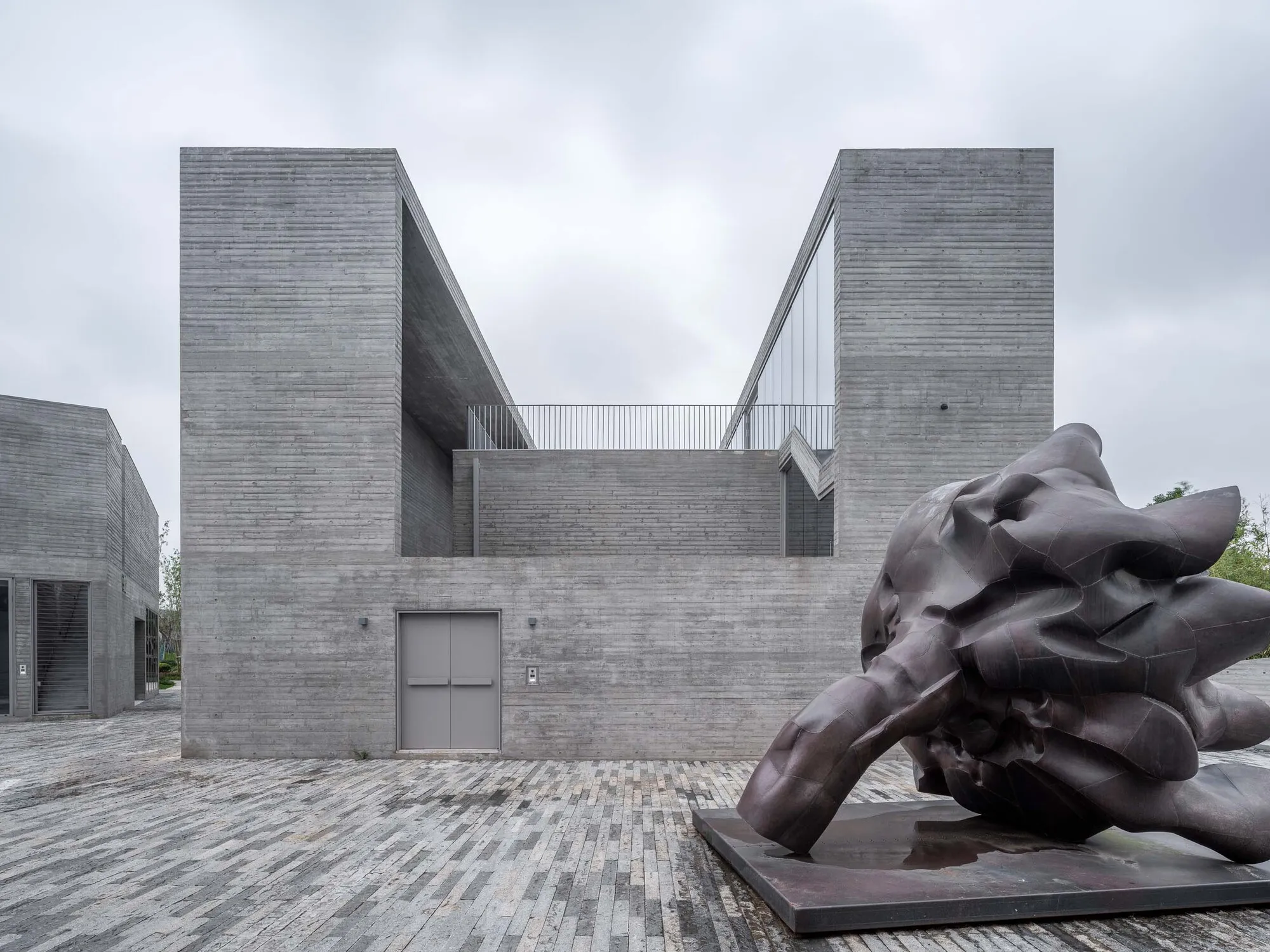
Atelier FCJZ Builds Four Houses That Blur Classicism and Modernism at a Ningbo Lakeside Campus
Conceived in the 1990s and realized three decades later, four board-formed concrete studio-houses sit among autumn trees beside Dongqian Lake.


Some projects arrive fully formed. Others gestate for decades, waiting for the right site and the right moment. The Four Studio-Houses by Atelier FCJZ belong firmly to the second category. Three of the four designs were first conceived by Yung Ho Chang in the early 1990s as theoretical exercises, houses without clients, without sites, generated purely to test what happens when Classical spatial figures collide with Modern material discipline. Thirty years later, they found a home on the shore of Dongqian Lake in Ningbo, part of an Education Forum campus that also includes a convention center, hotel, and art museum.
What makes the project genuinely compelling is not the long timeline but the naming logic. Each house is identified by the single architectural element that governs its entire spatial organization: the House with Face-to-Face Loggias, the House with Cruciform Glass, the House with Walkable Beam, and the House with Flipped Roof. That naming convention is not branding. It is a design method. Each house is an argument that one element, rigorously deployed, can generate a complete domestic world. The result is a cluster of four reinforced concrete volumes that read as siblings rather than twins, each distinct in section and plan yet bound together by board-formed surfaces, restrained palettes, and an insistence on spatial drama over decorative gesture.
Four Volumes in a Landscape

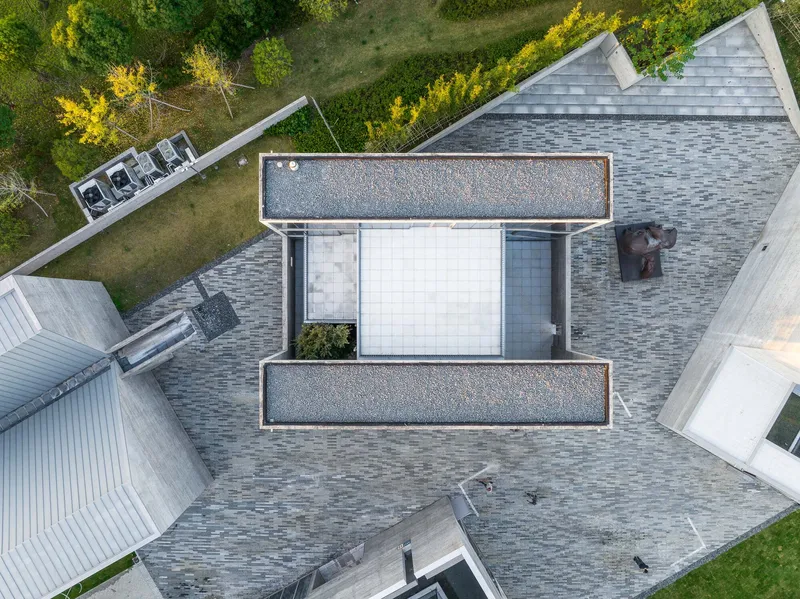

From above, the four houses scatter across 3,900 square meters of gently sloping terrain, their white and grey volumes breaking through canopies of autumn foliage that edge toward the lake. The aerial views reveal a deliberate informality in siting: the houses do not line up on a grid, nor do they radiate from a central point. Instead they cluster like stones in a garden, each oriented to capture a different relationship with the water, the trees, and each other. The cruciform skylights and gravel-filled terraces visible from drone height signal that roofscapes are designed spaces here, not afterthoughts.
The campus is intended for scholars and artists on extended residencies, a program that demands both communal proximity and private retreat. The loose clustering achieves that balance. Courtyards and passages between the houses create shared thresholds without forcing interaction. You move through landscape to reach each front door, not through a corridor.
Board-Formed Concrete as a Unifying Skin
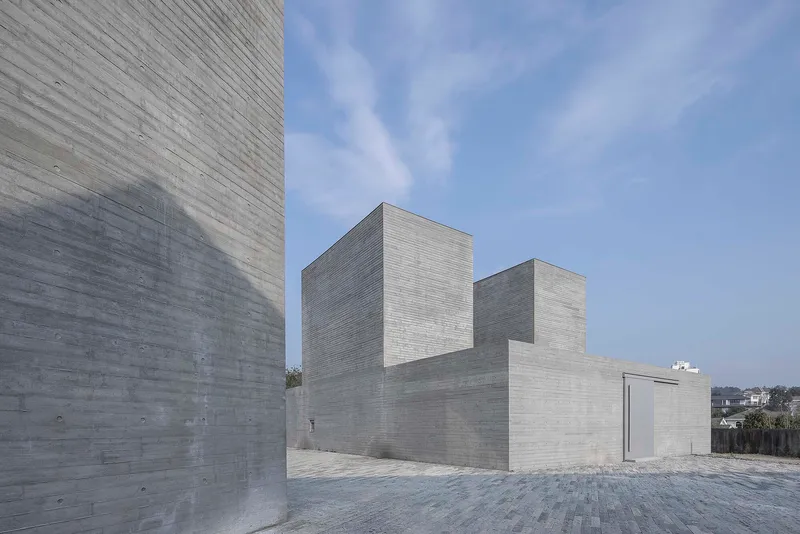


The material that ties everything together is reinforced concrete poured in timber formwork. The horizontal striations left by the boards are visible on nearly every exterior surface, giving the walls a directional grain that reads almost geological. It is a texture that ages well in Ningbo's humid climate, picking up moss and weather staining in ways that smooth render never could. The effect is weighty and tactile, the kind of surface you want to touch.
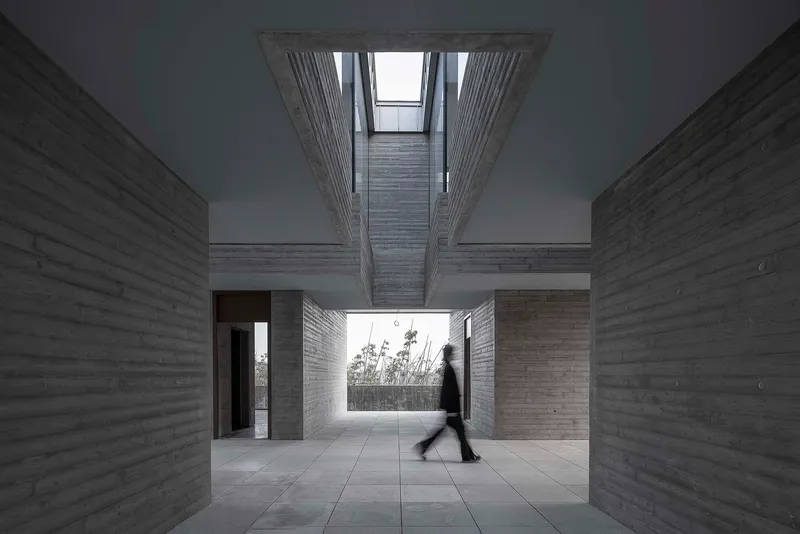
Yung Ho Chang and Lijia Lu use the formwork pattern consistently but not monotonously. On the stepped volumes, the horizontal lines accentuate the terracing. In narrow courtyard passages, they compress space vertically, making the walls feel taller than they are. A single figure walking through one of these slots gives the scale: the walls rise a full two stories on either side, turning a simple path into an almost monastic procession.
Courtyards and the Space Between


Each house is organized around some form of courtyard, but no two courtyards perform the same role. The House with Face-to-Face Loggias splits its symmetrical volume down the middle, pulling the halves apart to slip a pool between two ground-level loggias. Other courtyards are more introverted: brick-paved squares bounded by concrete walls with just enough glazing to connect inside and out. The stone-paved plaza in the larger courtyard reads almost like a Roman atrium, stripped of ornament but loaded with proportional intent.
The narrow slot courtyards deserve special attention. They function as light wells, ventilation channels, and circulatory spines simultaneously. A planted tree in one, a walking figure in another: the scale is intimate, the proportions vertical. These are not leftover gaps between buildings. They are the connective tissue of the project.
The Cruciform as Organizing Principle


The House with Cruciform Glass is perhaps the most architecturally audacious of the four. Its upper level is a transparent volume divided into four equal quarters for living, cooking and dining, sleeping, and bathing by a hollow cruciform double curtain wall. That curtain wall connects the second floor visually to the ground below, turning a structural and spatial divider into a light shaft. Seen from below, the cruciform skylight punches a luminous cross into the board-formed concrete ceiling. From above, its white metal cladding sits like a precise geometric insert within a dark-framed courtyard.
The ground level of the same house uses a pinwheel plan, rotating four spaces around the central axis. The juxtaposition of a pinwheel below and a cruciform above is the kind of formal play that connects directly to Chang's stated ambition of blurring Classicism and Modernism. The cruciform is as classical a figure as architecture possesses. The pinwheel is a Modernist staple. Stacking them produces something that is neither, and both.
Interior Volumes and the Walkable Beam


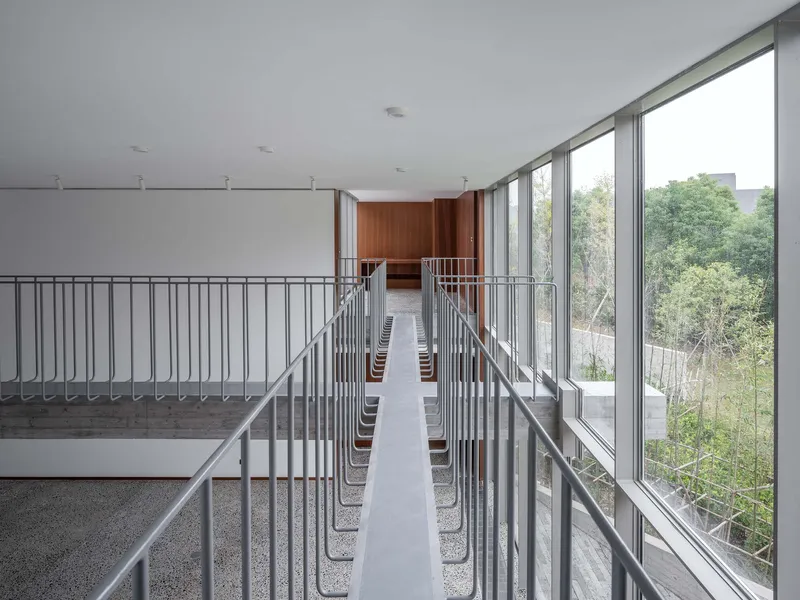
The House with Walkable Beam makes its defining element unmistakable. A cruciform beam floats through a double-height space intended as a plastic arts studio, bookended by two oversized porches. The beam is not merely structural; it is inhabitable, serving as a bridge that connects to a library. Interior photographs show the narrow walkway with metal handrails stretching across the void, seating arranged along its length, a timber-clad volume at one end. It is simultaneously a structural member, a corridor, and a room.
The double-height entry halls across the houses share an angular timber ceiling language that contrasts sharply with the raw concrete exteriors. Silhouetted figures in doorways and on balconies give these spaces a theatrical quality, suggesting that the houses were designed not just to be lived in but to be experienced as sequences of spatial events.
Timber, Light, and Domestic Interiors


Inside, the material palette softens. Timber ceilings and wall panels warm the rooms, while terrazzo floors and polished concrete provide coolness underfoot. The library room is a standout: built-in shelving wraps three walls, a horizontal window admits controlled daylight, and the wood surfaces create the kind of quiet enclosure that invites long residencies. These are rooms designed for concentration.


Skylights appear throughout the houses, often at the tops of staircases where terrazzo treads rise between wood-paneled walls toward a bright aperture overhead. The attic room with its dark timber ceiling and built-in storage feels almost Scandinavian in its restraint. These interiors never compete with the muscular concrete outside; they complement it, offering refuge from the monumental scale of the courtyards.
Brick, Threshold, and the Fourth House
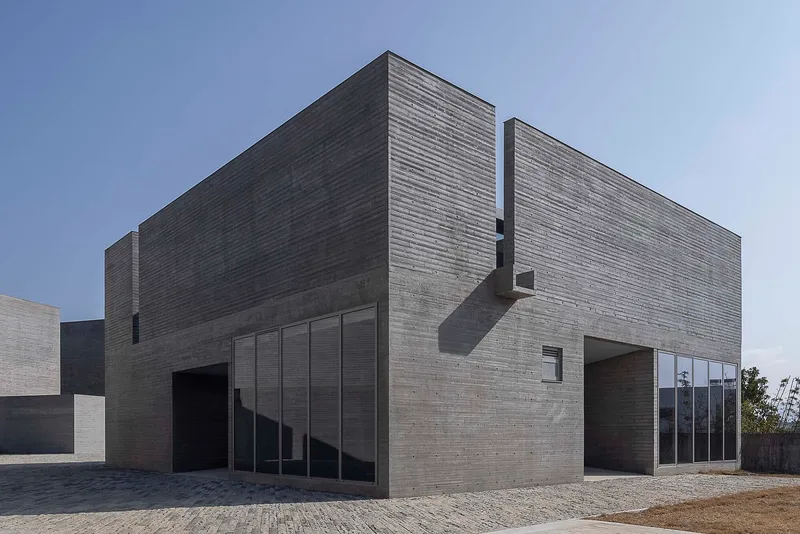


Not everything is concrete. The House with Flipped Roof introduces brick as a primary facade material, its horizontal striations echoing the formwork lines of its neighbors but in a warmer, earthier register. The cantilevered entry canopy and angled brick volumes create a more inviting threshold condition, flanked by bamboo and gravel paths that soften the approach. Layered grey brick walls frame an elevated courtyard in another view, suggesting a house that operates on multiple levels both literally and figuratively.
The brick house is a reminder that Atelier FCJZ never intended the four houses to be identical. They are variations on a theme, each exploring a different element and a different material emphasis. The brick facade domesticates what might otherwise be a forbiddingly sculptural campus.
Plans and Drawings

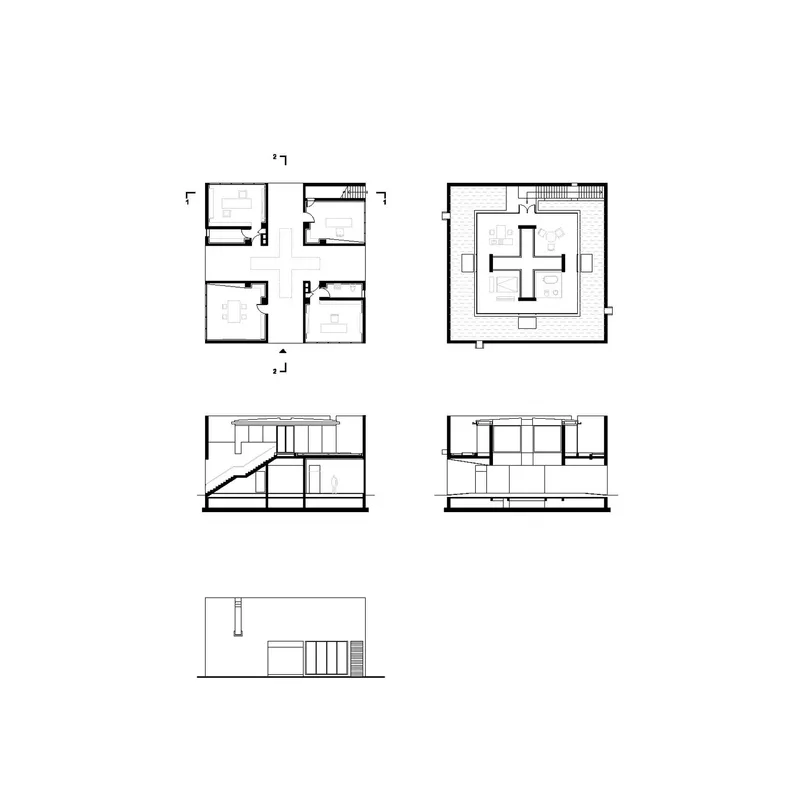
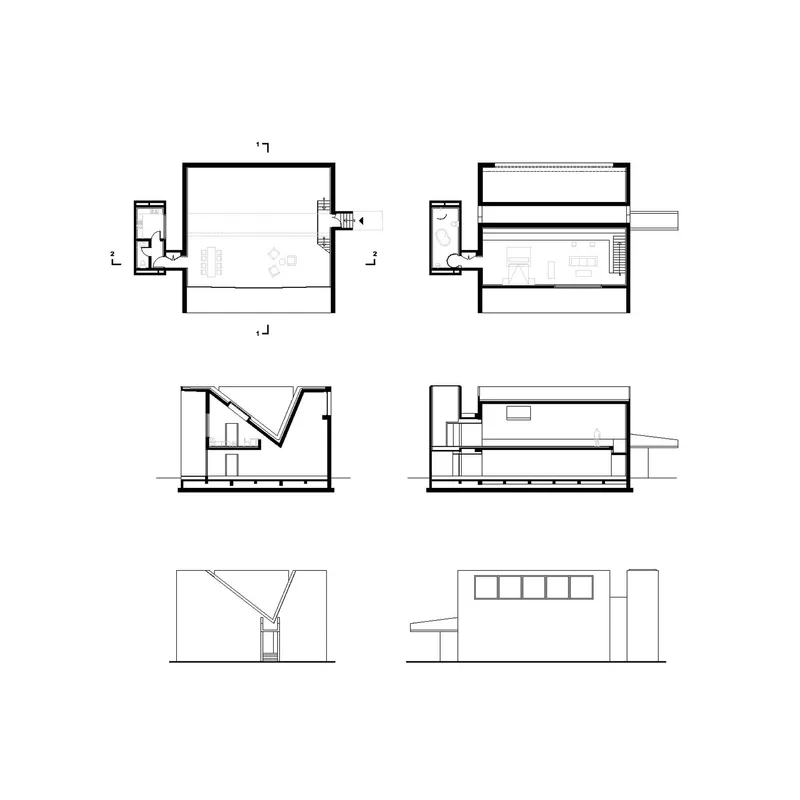


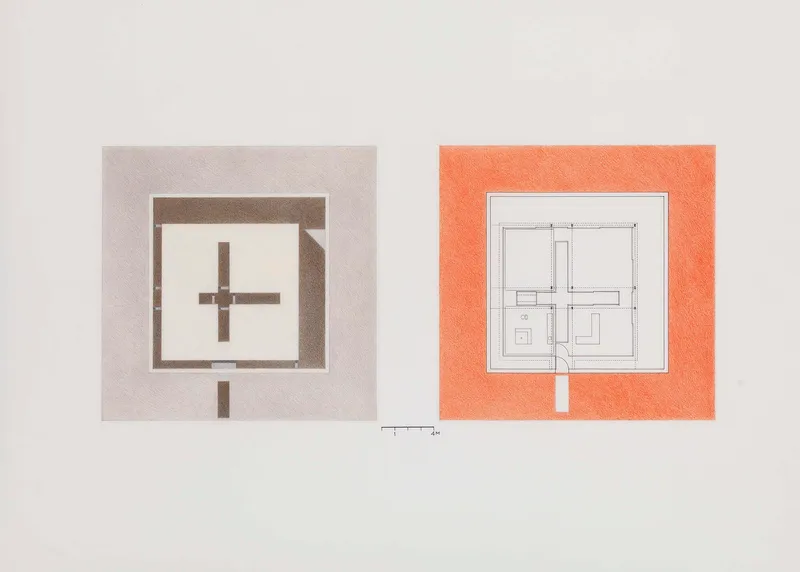
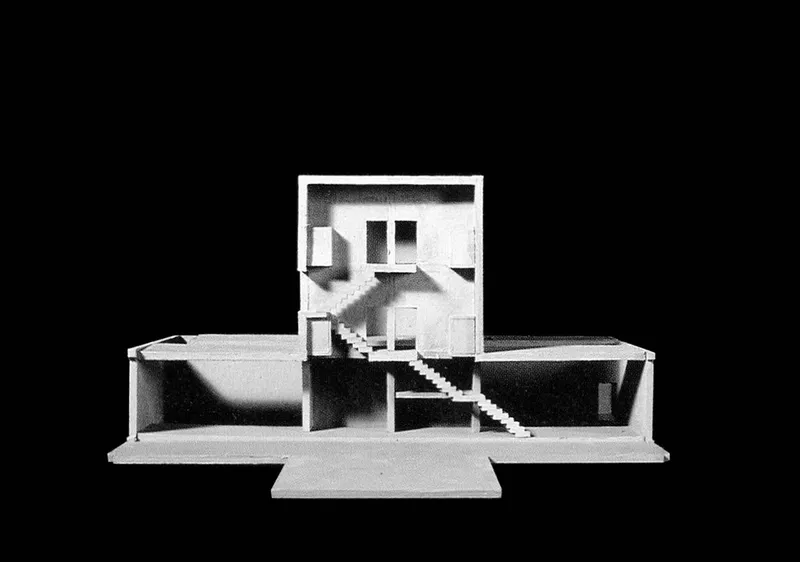

The site plan reveals the curving topography that dictated the loose arrangement of the four houses within the landscape. Individual plan sets confirm the distinctive spatial logic of each house: the cruciform central space of one, the flanking rooms around a central courtyard of another, the diagonal roof element of a third. Sections expose the double-height voids and walkable beams that give the interiors their vertical drama. The physical models, sectioned to reveal interior volumes, show how carefully each house was developed in three dimensions before a single form was poured.
Why This Project Matters
The Four Studio-Houses matter because they prove that theoretical work does not have to stay on paper. Yung Ho Chang conceived three of these houses in the early 1990s as abstract investigations into the boundary between Classical and Modern architecture. That they were eventually built, largely intact, on a lakeside campus in Ningbo is a testament to the durability of strong spatial ideas. The houses are not nostalgic; they do not look like 1990s architecture. They look like what happens when an idea has been refined over thirty years and then executed with uncompromising material clarity.
More broadly, the project offers a model for how multiple houses can coexist without becoming a subdivision. Each house is fiercely individual in plan and section, yet the shared material language and the careful siting create a genuine community rather than a collection of objects. For architects designing artist residencies, academic retreats, or any program that requires balancing solitude with proximity, this is essential reference material. The lesson is simple but rarely heeded: give each building a clear spatial idea, commit to it fully, and trust that shared materials and landscape will do the work of unification.
Four Studio-Houses by Atelier FCJZ (lead architects Yung Ho Chang and Lijia Lu), Ningbo, China. 1,255 m², completed 2022. Photography by Keliang Li and Fangfang Tian.
About the Studio
Share Your Own Work on uni.xyz
If projects like this are the kind of work you want to make, uni.xyz is a place to publish your own, find collaborators, and enter design competitions.




Popular Articles
Popular articles from the community


The Musturak Paradise: Senior Living Architecture for a Connected Future in Temara, Morocco
The Musturak Paradise reimagines senior living architecture in Temara via private homes, social spaces, culture, community, and shared care.

Play: Fragments of Their World
Familiar architecture becomes modular playground design, creating safe spaces where displaced children can learn, connect, imagine and play.

Co-Life: Senior Housing Design That Reconnects Older Adults With the City
Co-Life reimagines senior housing design through healing gardens, shared streets, workshops, and a sustainable community across generations.

The Earth Pod: 3D Printed Homes for Resilient Refugee Communities
The Earth Pod reimagines refugee housing through 3D printed homes made from clay, combining resilience, self-sufficiency, and rapid shelter.


Similar Reads
You might also enjoy these articles

Bao Huynh Watercolor Atelier: A Serene Art Retreat in Hội An
Bao Huynh Watercolor Atelier in Hội An blends multifunctional art spaces, sustainable design, local materials, and family-friendly living in a serene environment.

Atelier Macri Concept Store Interior Design by CASE-REAL
Atelier Macri store features a "ko" counter, walnut wood details, cork displays, blending retail, gallery, and seamless customer experiences.

Manuel Vargas Izquierdo Stadium and High-Performance Sports Center: Architectural Excellence in Jalpa de Méndez
The Manuel Vargas Izquierdo Stadium blends sustainable design, inclusive sports facilities, and cultural-inspired architecture, revitalizing Jalpa de Méndez’s public spaces.

KAKR Buluh Awar Hall: Revitalizing Community and Ecology Through Bamboo Architecture
Community built bamboo hall revitalizes Buluh Awar village, empowering youth, restoring ecology, celebrating vernacular craftsmanship through sustainable architecture and culture.

Explore Studios Competitions
Discover active competitions in this discipline



Challenge to reimagine the Iron Throne


Photograph architecture without architects


Illustrate the lost glory of Angkor Wat - Render Challenge


Design challenge to reuse E-waste
Comments (0)
Please login or sign up to add comments
No comments yet. Be the first to comment!