

Atelier Global Converts Two Shenzhen Gymnasiums into a Mountain-Inspired Academy
Victoria Park Academy channels the hills and waterways of Nanshan District into a school built around a flowing central corridor.


Renovating an existing building into a school is an exercise in persuasion. You have to convince the old structure that it has a new life, and you have to convince students that the space was made for them. At Victoria Park Academy, Atelier Global took two former gymnasiums on the north side of Dananshan Mountain in Shenzhen's Nanshan District and turned them into the first campus of Victoria (China) Education Group in the city. The result is 8,621 square meters of classrooms, creative studios, communal areas, and one very ambitious corridor.
What makes this project worth studying is its refusal to treat circulation as leftover space. The so-called Blue Mountain Corridor runs the length of the campus, connecting a sequence of social moments: a salon, grand steps, and an atrium courtyard. The corridor is not a hallway. It is programmed space that scales from a reading nook to a lecture theater. Paired with an M-shaped gable roof that echoes the surrounding hills, the entire school reads as a topographic sequence rather than a collection of rooms.
The Blue Mountain Corridor
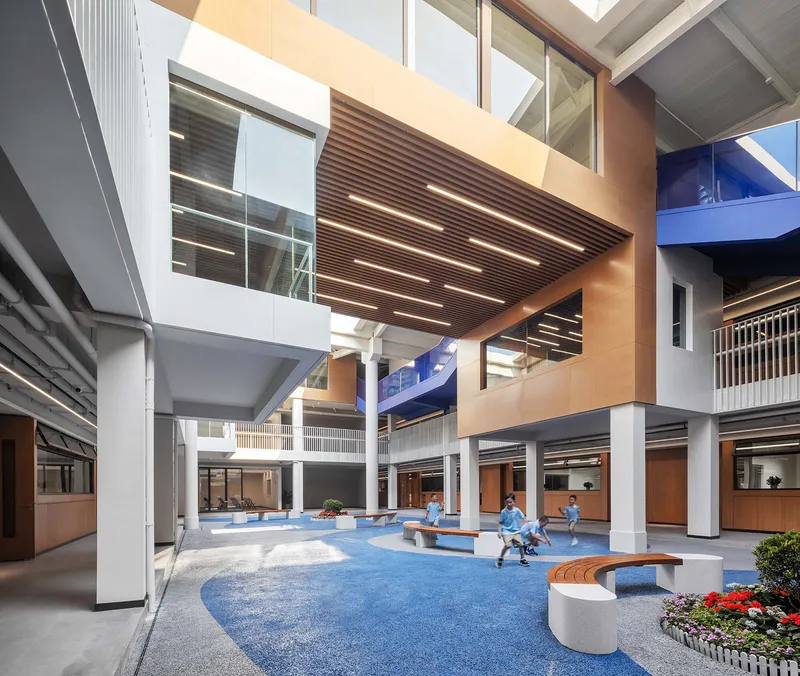


The central idea is a corridor shaped like flowing water, linking the campus end to end. At its most generous, the Blue Mountain Corridor opens into a multi-level atrium where tiered seating in timber and white flanks a central ramp. Students gather here at every scale: pairs reading at a balustrade, small groups on the steps, whole cohorts for assemblies. A glass-enclosed bridge spans the upper level, giving the space vertical legibility without boxing it in.
The perforated soffit overhead filters light through a skylight, casting rhythmic patterns across the staircase treads. It is a deliberate play between density and openness. The corridor facilitates reading, discussions, group play, seminars, and speeches, all within a single continuous spine. Few school circulation systems attempt this range, and fewer pull it off without the space feeling like a shopping mall.
Roof as Landscape


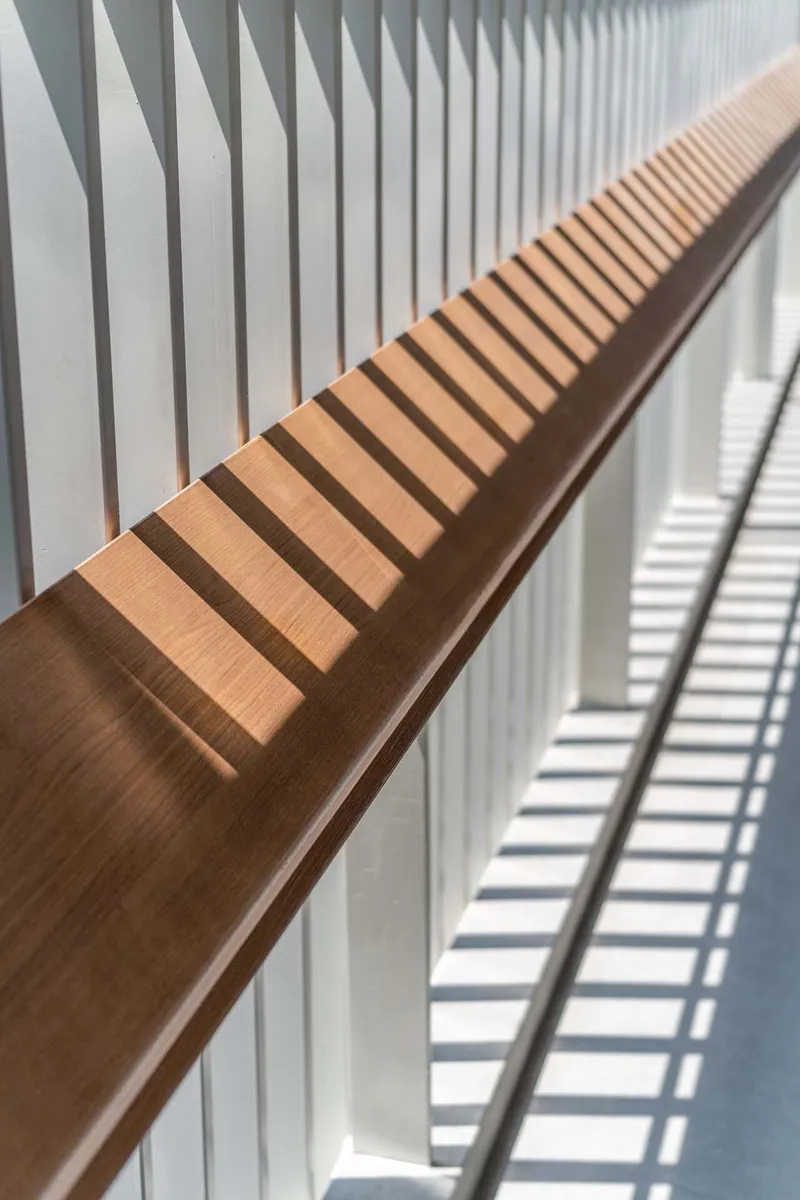
The M-shaped gable roof is the project's most legible gesture from the outside. It directly echoes the ridgeline of Dananshan Mountain and the adjacent Li Lin Park, turning the school's silhouette into a continuation of the topography. Vertical metal cladding covers the gable faces, while a clock tower with a red brick base and white rendered upper section anchors one end of the composition. The covered walkways beneath use white vertical balusters that cast slatted shadows in the Shenzhen sun.
The roofline is more than metaphor. Its sawtooth and undulating forms allow for varied ceiling heights inside, which in turn define the character of each room. High ceilings mark communal and performance spaces; lower ones signal focused classroom work. The roof is the section, and the section is the pedagogy.
Learning Spaces and Material Warmth
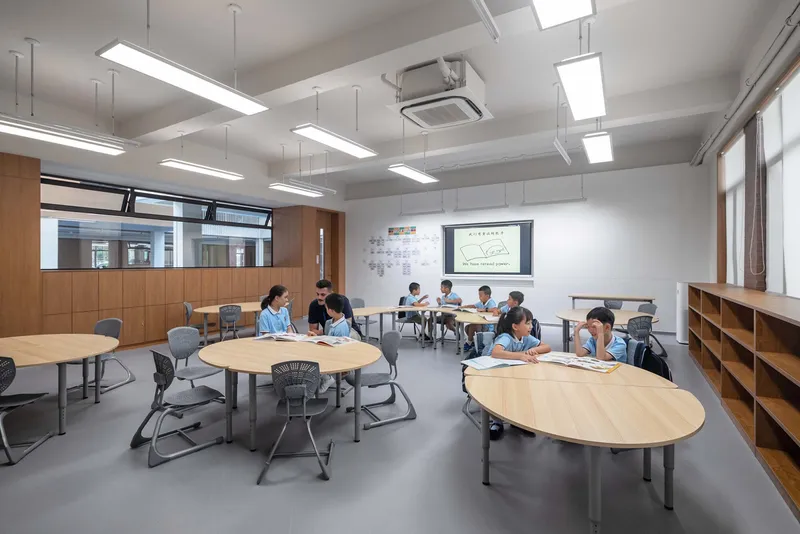
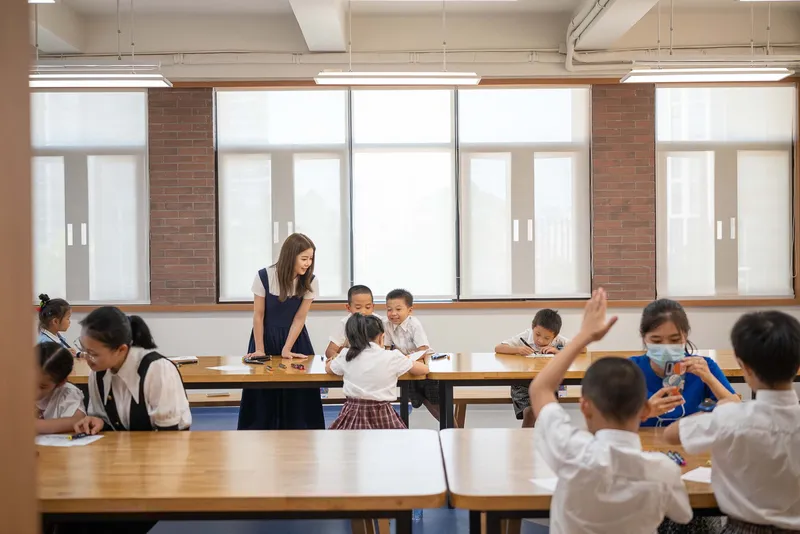
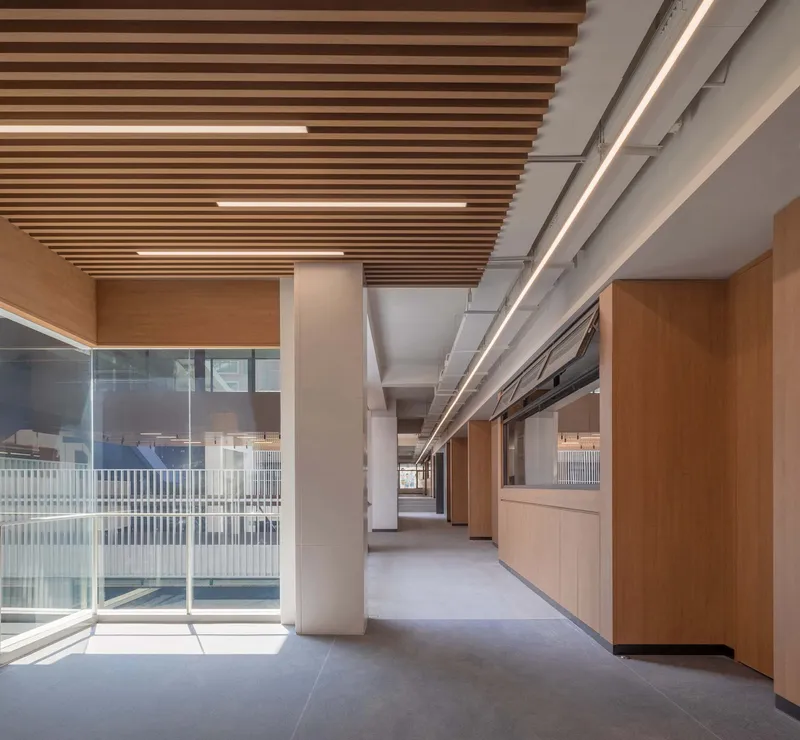
Classrooms retain the exposed red brick piers of the original gymnasiums, grounding the renovation in its structural past. Large gridded windows flood desks with even daylight, reducing reliance on artificial lighting. The palette is honest: reclaimed wood, low-VOC paints, concrete columns left exposed where they anchor the slatted timber ceilings of the corridors. Oval tables and suspended linear lights in the classrooms are arranged to encourage small-group collaboration rather than front-facing lecture formats.
Atelier Global designed multiple furniture configurations for the classrooms, treating desk arrangement as a pedagogical tool. Blue desks and chairs appear in at least four distinct layouts, each tuned to a different mode of learning. It is a small detail that signals a bigger commitment: the architecture does not just house a curriculum, it actively shapes how teaching happens.
Libraries and Quiet Inhabitation

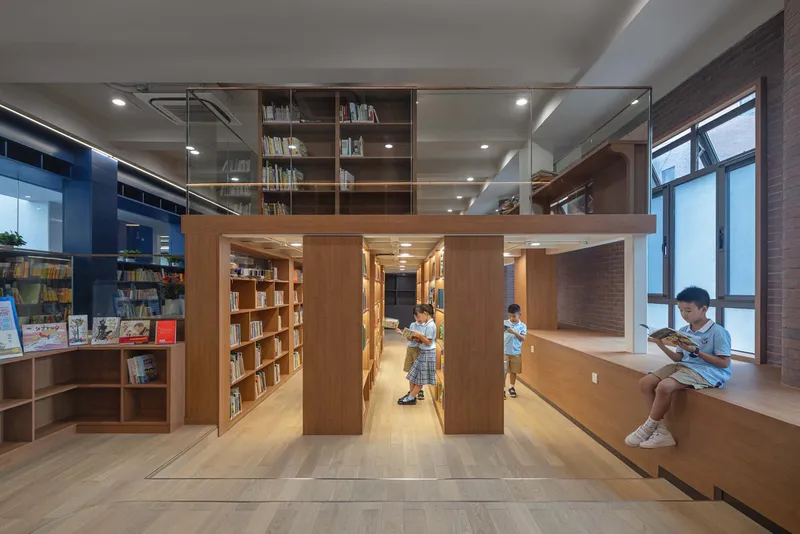
The library spaces are among the most atmospheric rooms in the school. Floor-to-ceiling timber bookshelves line the walls while stepped seating creates informal reading terraces. Morning light enters through generous windows and washes across children sitting cross-legged with open books. Built-in window seats transform the building envelope into furniture, collapsing the boundary between wall and room.
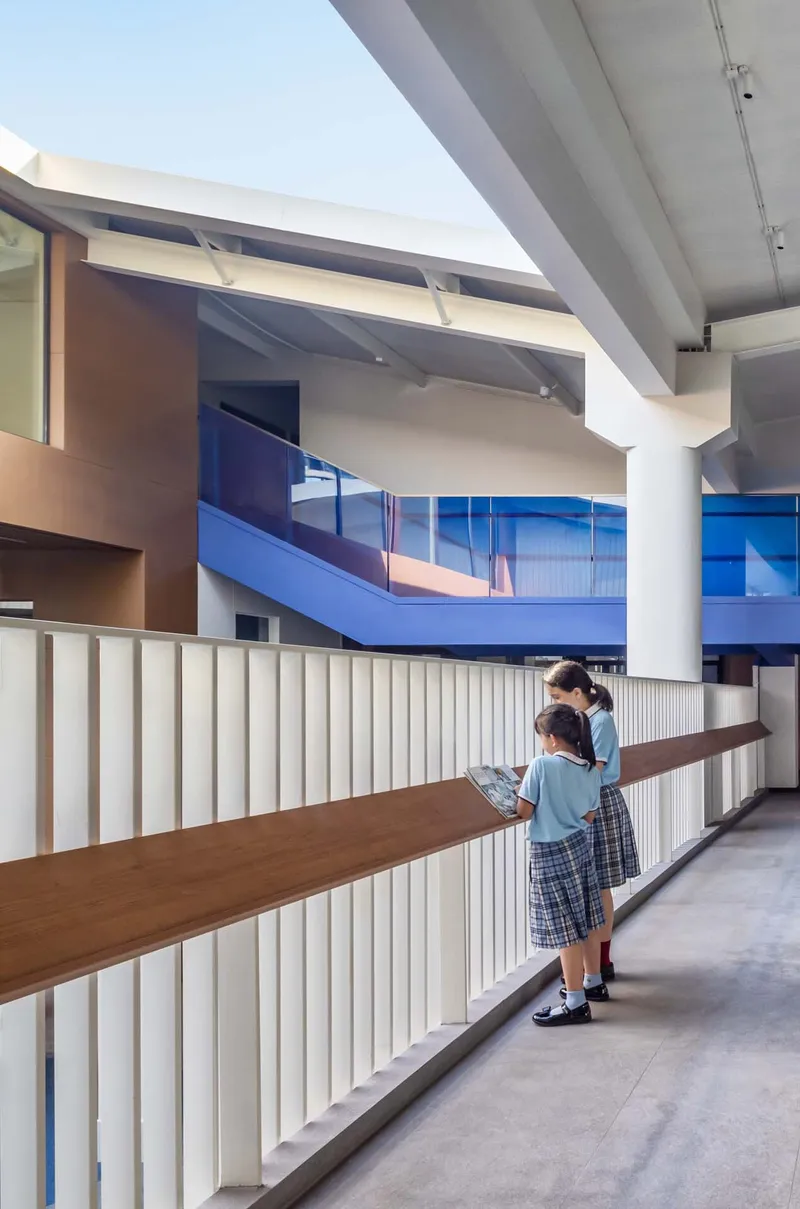
At upper levels, a white slatted balustrade with a timber handrail overlooks the atrium below, offering students a quieter vantage point from which to read or simply watch the social life of the corridor. These in-between zones, neither fully room nor fully hallway, are where the design is most successful. They acknowledge that children do not learn only at desks.
Social and Performance Spaces
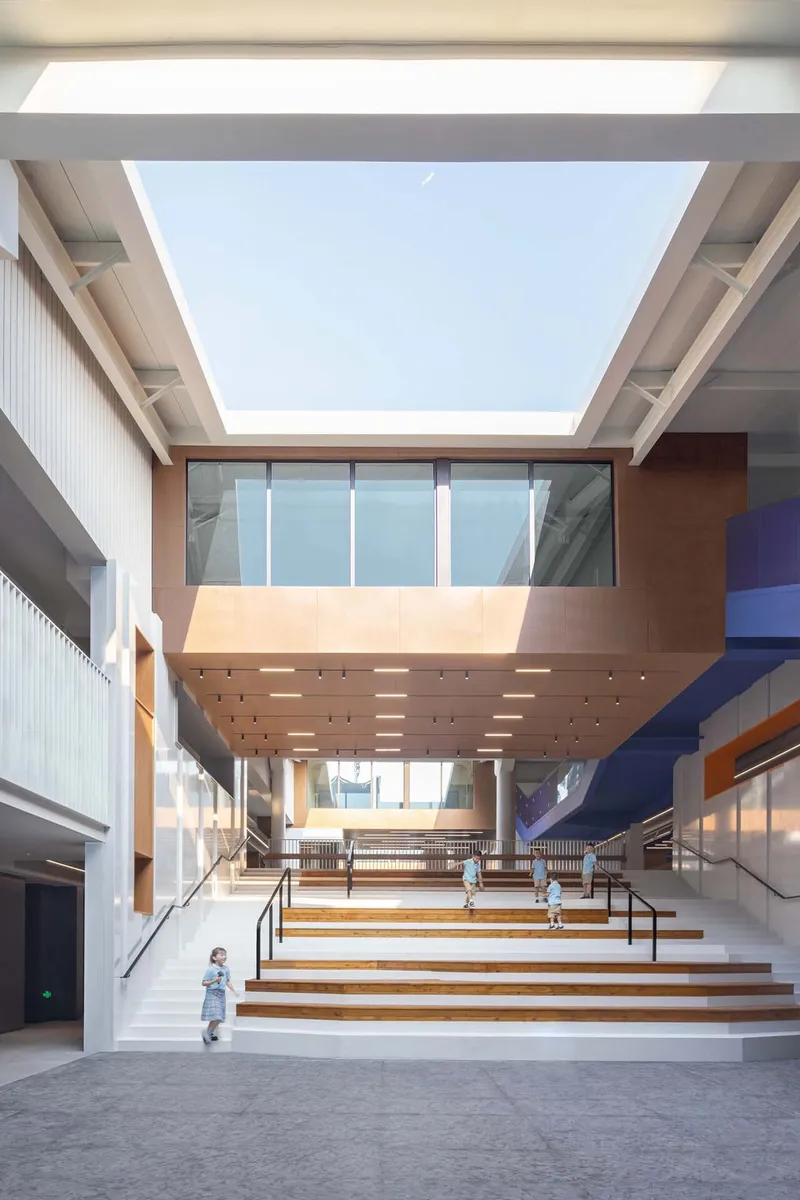

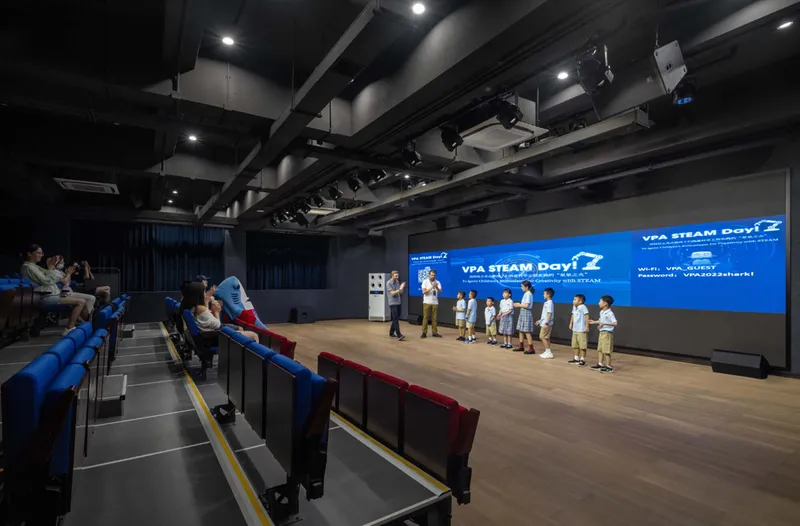
A wide timber staircase ascends beneath a perforated ceiling toward a skylight, serving as both vertical circulation and a gathering spot. Nearby, a cafe with a marbled island counter and timber seating under a brown ceiling gives students a less formal social setting. The auditorium, with tiered seating and an exposed black ceiling, handles presentations and assemblies. Each of these spaces operates at a different register of formality, giving the school the programmatic richness of a small community center.
The sequence matters. Moving from the cafe's casual warmth through the staircase's vertical drama to the auditorium's focused darkness, students experience a gradient of atmosphere. Atelier Global treats mood as infrastructure.
Plans and Drawings

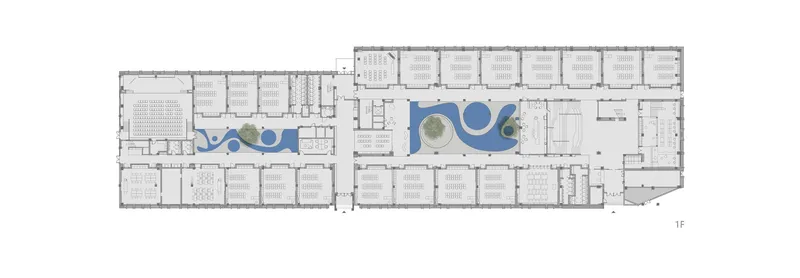
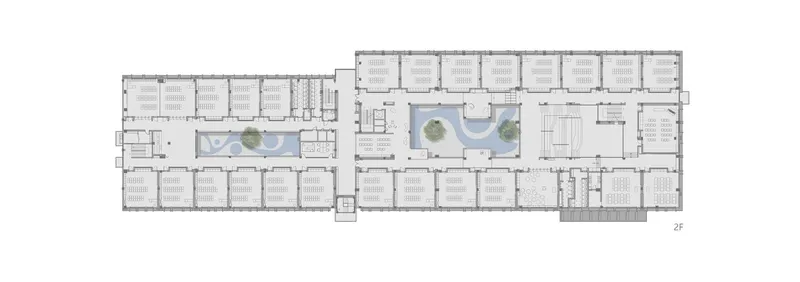
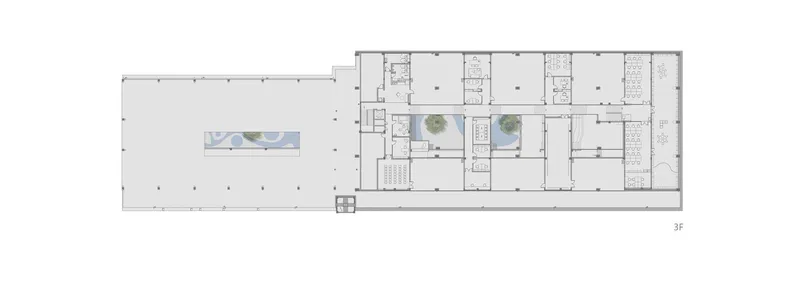
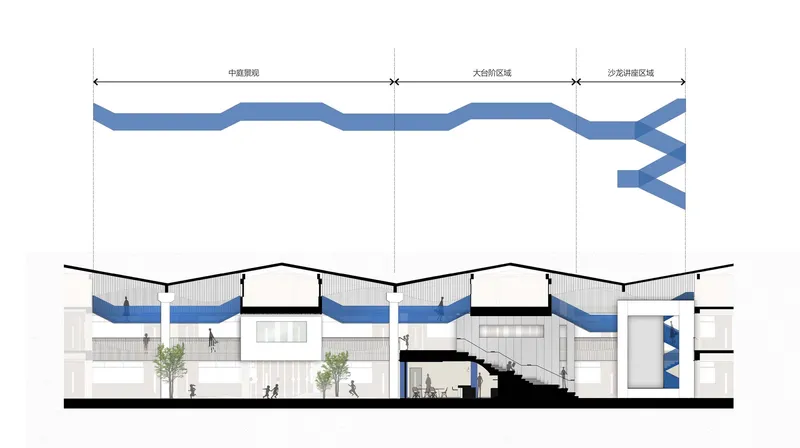

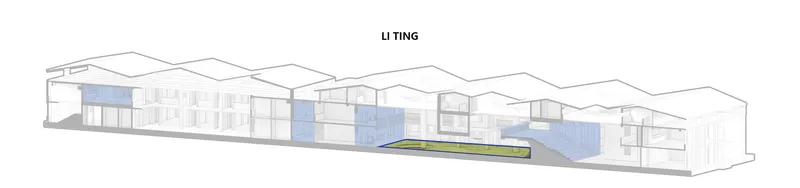
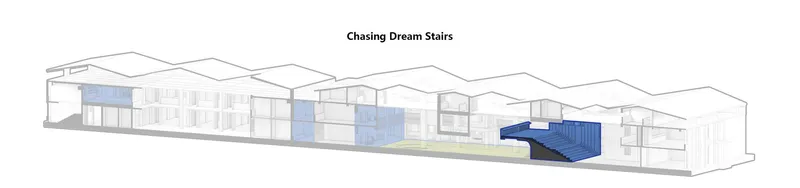
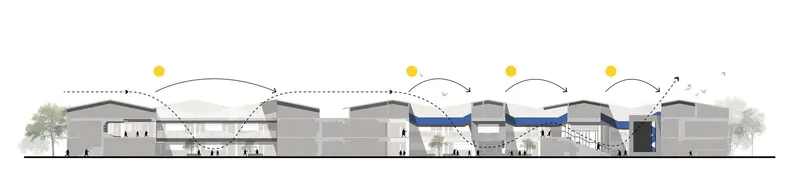
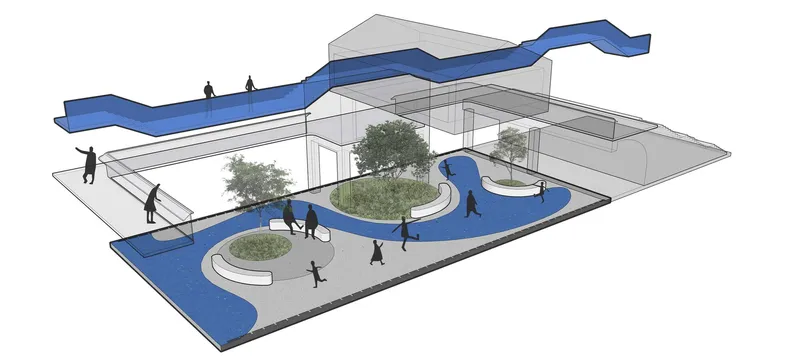


The axonometric and section drawings reveal the project's spatial logic with clarity. The elongated plan shows two parallel wings flanking central courtyards planted with trees and threaded with curving blue water features. Section drawings make the undulating roofline legible, showing how the blue-highlighted circulation volumes rise and fall beneath the gables. A separate axonometric of the courtyard details curved water features, planted beds, and gathering spaces, while classroom layout diagrams illustrate the four distinct furniture configurations Atelier Global developed for different teaching modes.
The floor plans across multiple levels show how the program distributes: classrooms line the perimeter for daylight access, while the courtyards provide ventilation and visual relief at the center. The longitudinal sections confirm that the Blue Mountain Corridor is the project's true structural spine, with the staircase volume punching up through the roofline as a lantern element. These drawings make a strong case that the renovation's complexity rivals that of new construction.
Why This Project Matters
School design in fast-growing Chinese cities often defaults to efficiency: pack the program, maximize the floor area ratio, move on. Victoria Park Academy pushes back against that impulse. By starting with two existing gymnasiums rather than a blank site, Atelier Global inherited constraints that forced inventiveness. The M-shaped roof, the retained brick piers, the proportions of the original spans all became design drivers rather than obstacles. The result is a school with character that a new-build template could not replicate.
More importantly, the project demonstrates that circulation can carry pedagogical weight. The Blue Mountain Corridor is the school's most significant space, and it is not a classroom. It is where students negotiate the transition between structured learning and free social life, between small-group intimacy and large-group spectacle. By investing architectural ambition in a hallway, Atelier Global makes an argument about what schools are actually for. The corridor is the curriculum.
Victoria Park Academy, designed by Atelier Global, Shenzhen, China. 8,621 m². Completed 2022. Photography by Hangtian Zheng.
About the Studio
Share Your Own Work on uni.xyz
If projects like this are the kind of work you want to make, uni.xyz is a place to publish your own, find collaborators, and enter design competitions.


Popular Articles
Popular articles from the community


Opera by the Sea Estonia: Three Shells Dissolving Architecture into Tallinn's Coastline
A winning opera house proposal replaces monumental form with interconnected shells that blur the boundary between building, park and Baltic Sea.

Faces of the Soviet Avant-Garde: Turning Moscow's Street Names into an Open-Air Museum
A network of sculptural installations across a Moscow residential district transforms forgotten architect names into spatial encounters with cultural memor

Manzana Morphosis: Stretching Barcelona's Grid into a Living Landscape for 2050
A radical reworking of the Eixample manzana turns density into a tool for generous public space, vertical ecology, and environmental performance.
Temporary Home for Dogs: A Reversed Zoo Rethinks Animal Shelter Architecture
In Bucharest, a sinuous corridor and freed landscape flip the logic of containment, designing a shelter that works to make itself unnecessary.

Similar Reads
You might also enjoy these articles

Bao Huynh Watercolor Atelier: A Serene Art Retreat in Hội An
Bao Huynh Watercolor Atelier in Hội An blends multifunctional art spaces, sustainable design, local materials, and family-friendly living in a serene environment.

Atelier Macri Concept Store Interior Design by CASE-REAL
Atelier Macri store features a "ko" counter, walnut wood details, cork displays, blending retail, gallery, and seamless customer experiences.

Manuel Vargas Izquierdo Stadium and High-Performance Sports Center: Architectural Excellence in Jalpa de Méndez
The Manuel Vargas Izquierdo Stadium blends sustainable design, inclusive sports facilities, and cultural-inspired architecture, revitalizing Jalpa de Méndez’s public spaces.

KAKR Buluh Awar Hall: Revitalizing Community and Ecology Through Bamboo Architecture
Community built bamboo hall revitalizes Buluh Awar village, empowering youth, restoring ecology, celebrating vernacular craftsmanship through sustainable architecture and culture.


Comments (0)
Please login or sign up to add comments
No comments yet. Be the first to comment!