
Atelier Kaiser Shen Designs a Dormitory in Southern Germany That Expects to Be Changed
A CLT and steel hybrid in Schönaich treats flexibility not as a buzzword but as a structural principle for social housing.


Most housing projects claim adaptability. Few actually plan for it at the level of structure. In Schönaich, a small municipality in Baden-Württemberg, Atelier Kaiser Shen has completed a 2,142 square meter residential building that serves two overlapping mandates: refugee accommodation at a minimum of seven square meters per person, and subsidized social housing that meets regional standards. The building does not choose between these programs. It holds both in a single structural grid, designed so that conversion between them requires no demolition, no new foundations, no renegotiation with the envelope.
What makes the Flexible Dormitory genuinely interesting is the honesty of its unfinishedness. Designed between 2019 and 2021 and built from 2022 to 2025, the project by Florian Kaiser, Guobin Shen, and their team treats the building as a long-term container whose interior partitions, unit sizes, and programmatic identity are expected to shift over decades. The cross-laminated timber (CLT) wall panels sit inside an external steel frame that acts as both structure and organizing device, a cage of potential that invites rather than resists alteration. It is rare to see a building commissioned by a municipality that so openly embraces the idea that the architect's vision is temporary.
A Steel Frame That Organizes Without Constraining


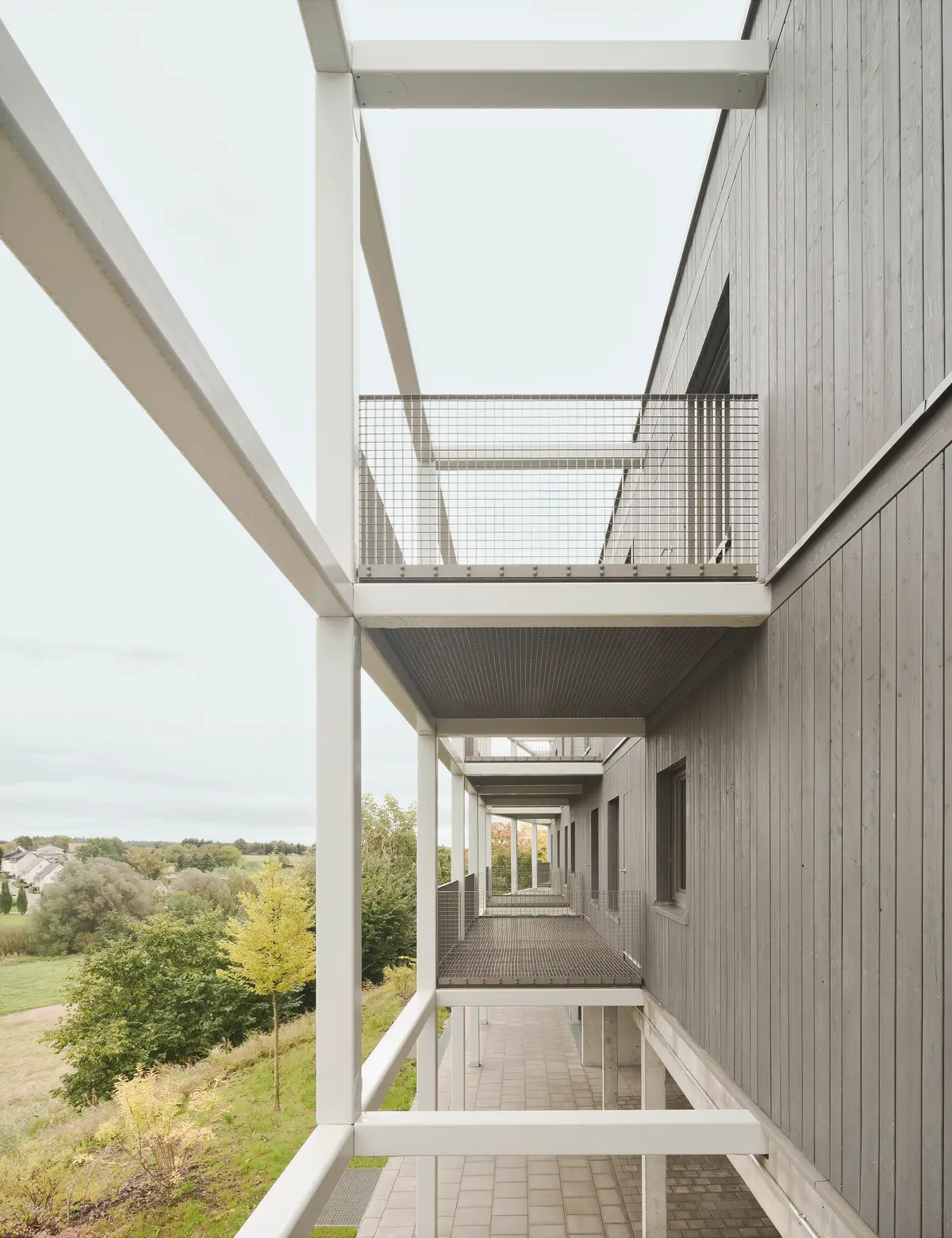
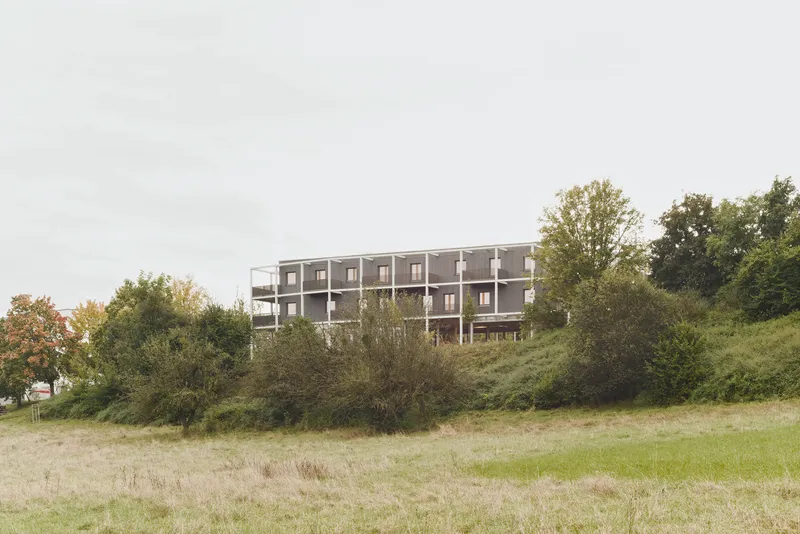
The white steel exoskeleton is the building's most visible move. It wraps the three-story volume in a legible, repeating module that reads clearly from every angle, giving the facade a rhythmic order that has nothing to do with decoration. Each bay of the frame corresponds to a potential unit boundary or a balcony zone, so the grid is not ornamental: it is a diagram of the building's logic made physical. The columns land on a paved plaza at ground level, creating a covered public threshold that avoids the institutional feel of a typical foyer.
Crucially, the steel frame is independent of the CLT interior. The timber panels carry loads on their own grid, and the frame provides lateral bracing plus the framework for balconies, walkways, and future extensions. Separating these two systems is the key technical decision. It means the interior can be reconfigured without touching the facade, and the facade can age, be maintained, or be modified without disrupting the units behind it.
Timber Interiors Built for Revision
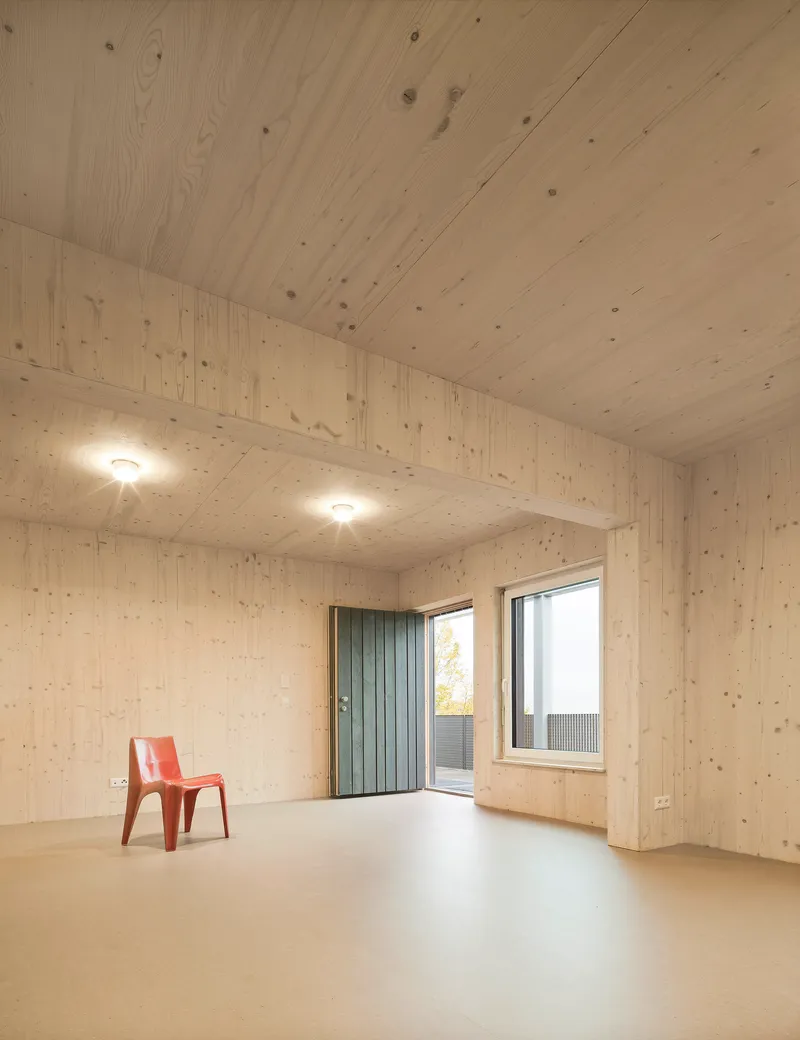
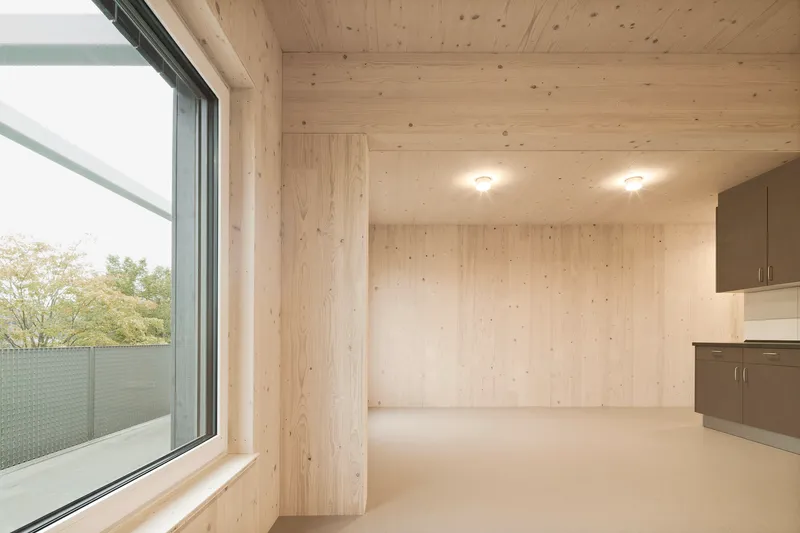
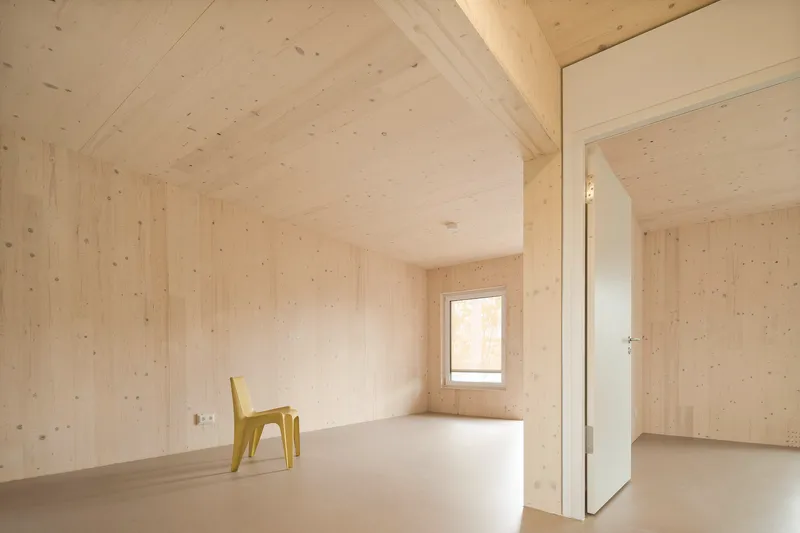
Inside, everything is CLT. Walls, ceilings, and exposed structural panels are left in their natural light-wood finish, giving the rooms a warmth that belies the building's social housing brief. The material palette is deliberately restrained: pale resin flooring, white-painted partition walls where needed, and the raw timber everywhere else. A single colored chair in each room (orange, yellow) becomes an almost comic focal point, underlining how little the architecture relies on furnishing to feel habitable.
The CLT panels were highly prefabricated, arriving on site as finished wall and floor elements that slot into the steel grid. Prefabrication here is not just an efficiency measure; it is an ethical commitment. It shortens the construction timeline, reduces waste, and, critically, makes future reconfiguration feasible. When a wall is a panel bolted into place rather than a poured slab, removing or relocating it is a realistic proposition, not a demolition project.
Corridors as Social Infrastructure

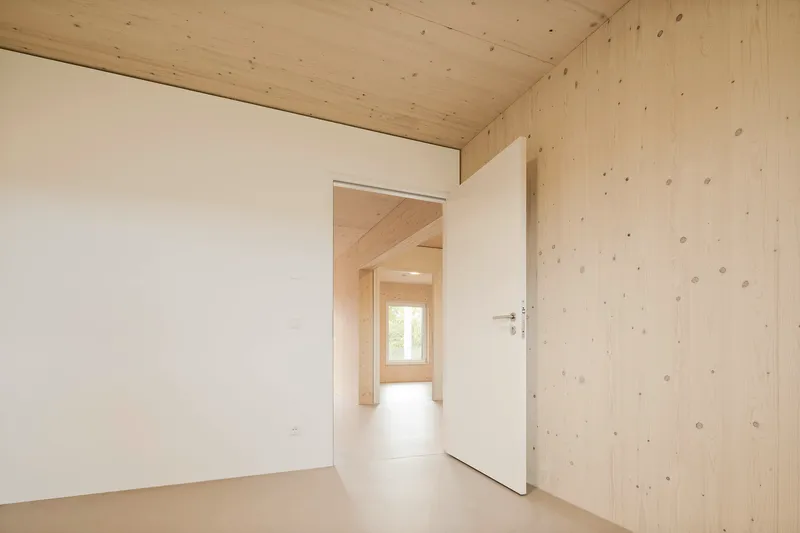

The central corridor is generous by social housing standards. Aligned doorways create long sight lines through the building's depth, punctuated by natural light from windows at both ends. The sequence of timber-lined thresholds has a monastic calm that quietly resists the image most people hold of refugee accommodation. These are not grudging passageways; they are spaces where encounters happen.
Atelier Kaiser Shen understands that in shared housing, the corridor is the most politically charged space. It is where residents negotiate proximity, privacy, and belonging. Making it wide, bright, and materially consistent with the private rooms is a small decision with outsized social impact. The building refuses to draw a hierarchy between communal and individual space.
Outdoor Circulation and the Landscape Edge
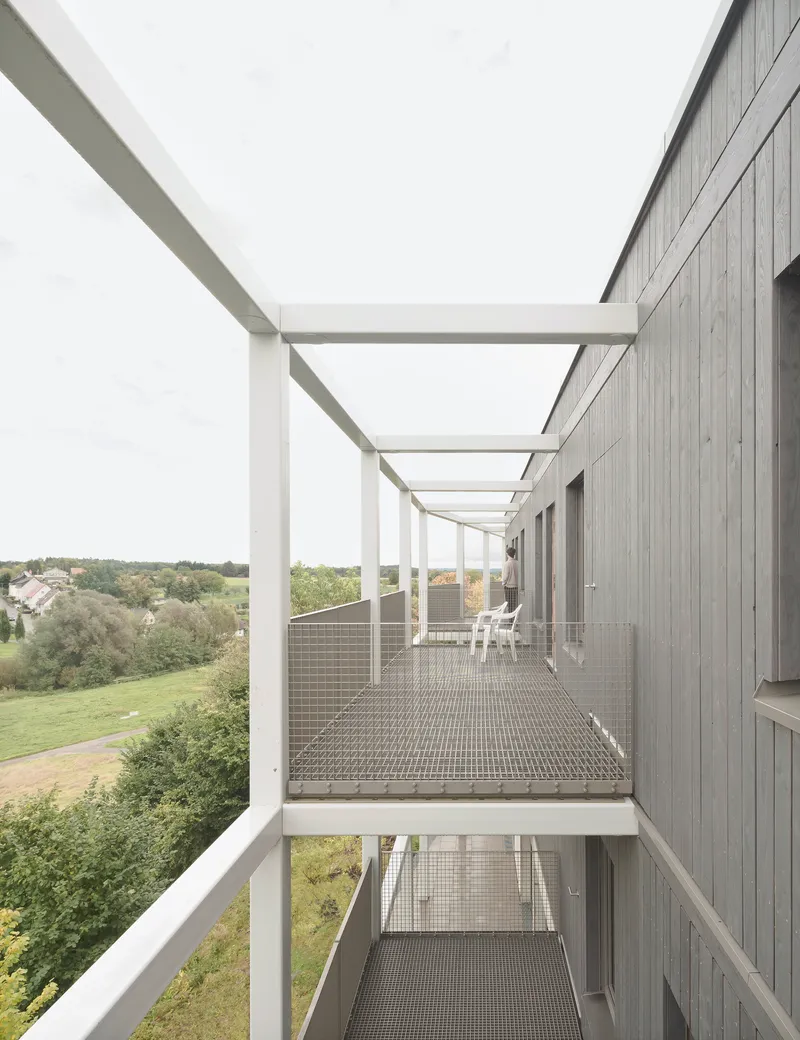
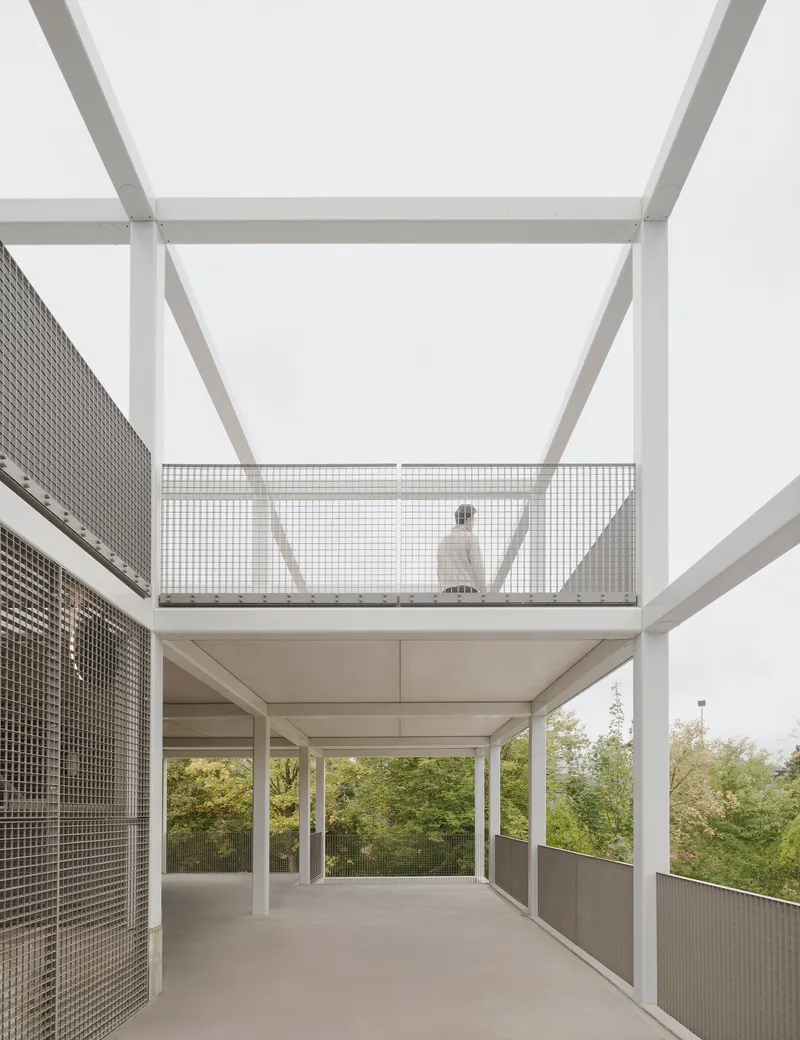
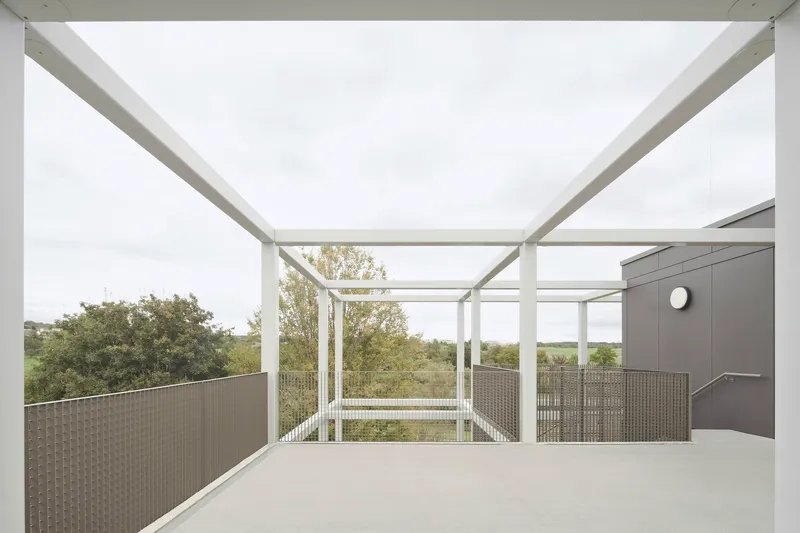
The exterior walkways and terraces are threaded through the steel frame, creating a second layer of circulation that is open to the air and to the surrounding countryside. Steel grating decks and perforated metal balustrades keep these zones lightweight and transparent, so they read as extensions of the landscape rather than fortified edges. Upper-level terraces look out over rolling farmland and autumn foliage, a view that would be the selling point of a luxury development but here belongs to everyone.
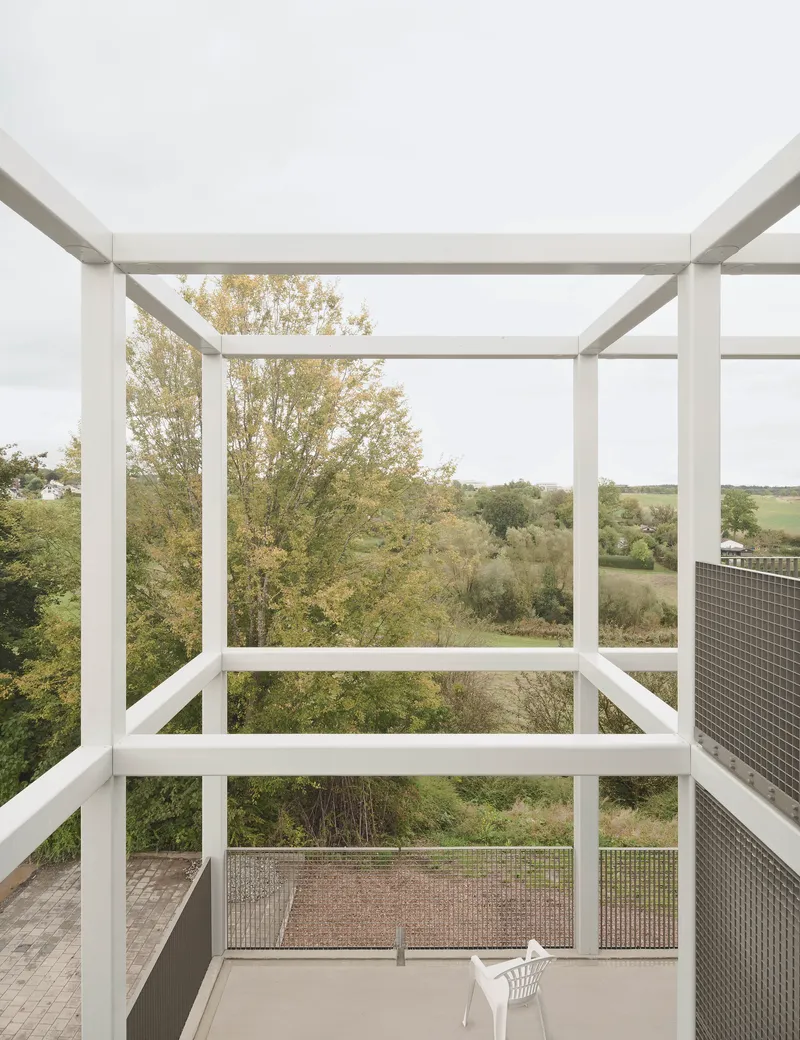
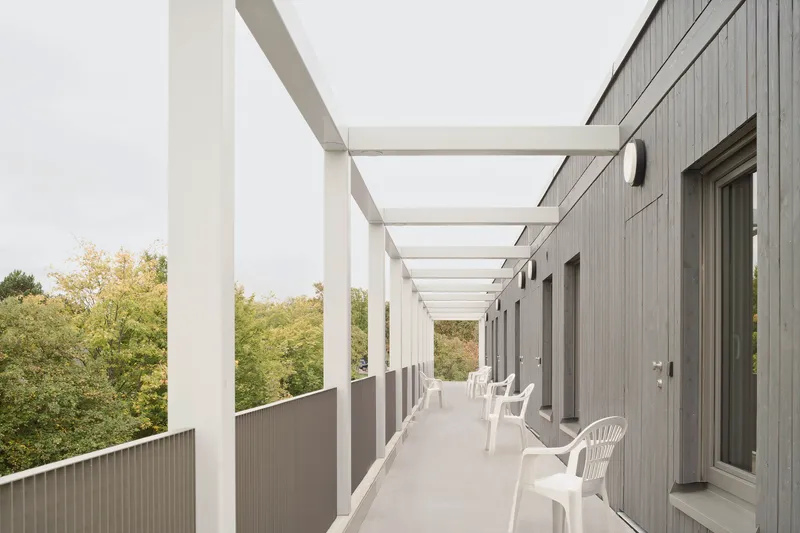

At ground level, a covered terrace with an exposed concrete ceiling and white plastic chairs functions as a communal living room without walls. The simplicity is intentional. No built-in barbecue stations, no landscaped seating nooks. Just shelter, a surface, and a view. The building trusts its residents to activate these spaces rather than scripting their behavior.
Facade Texture and Material Layering
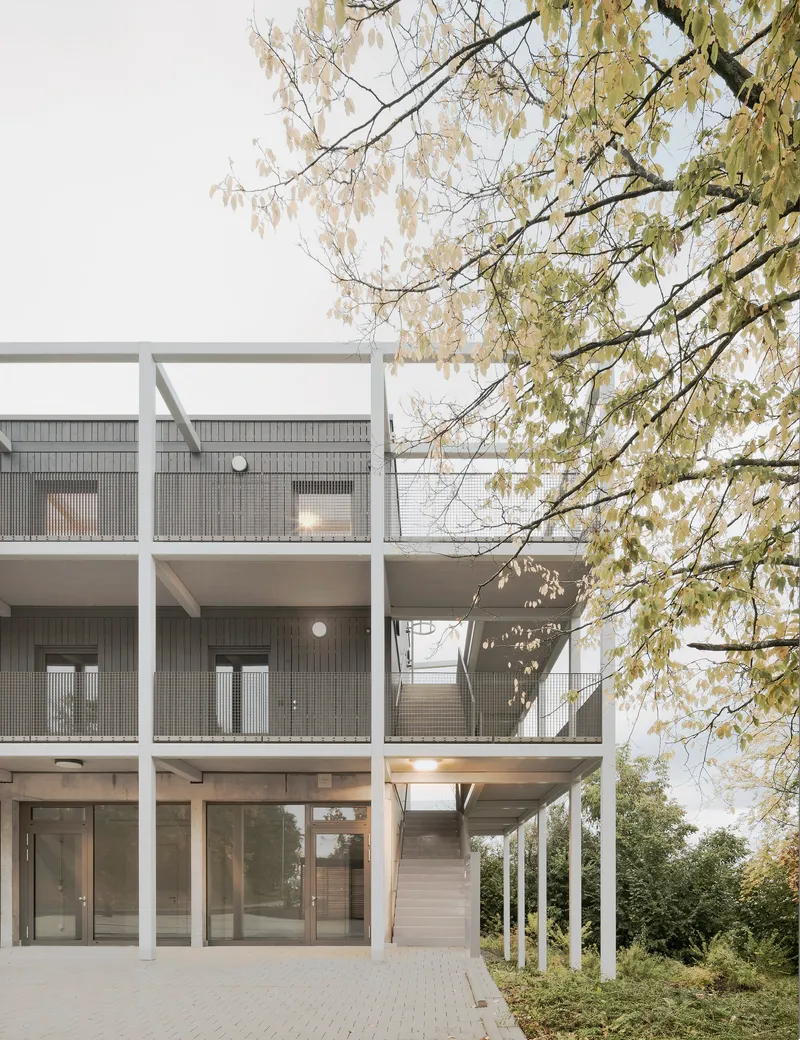
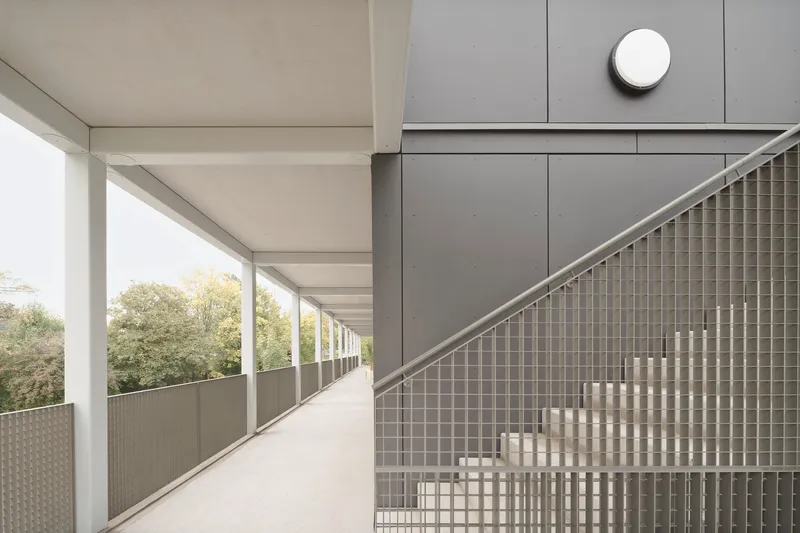

Up close, the facade reveals itself as a layered assembly: white steel members in the foreground, perforated metal screens at the balcony plane, dark timber cladding behind. The depth between these layers shifts as you move around the building, producing a parallax effect that gives the elevation a visual richness far beyond its material cost. Overhanging tree branches frame several of these compositions, softening what could otherwise read as an industrial aesthetic.
The grey panel cladding and woven metal mesh on the circulation corridors add a third register. The building is never just one material at any given point; it is always a sandwich of systems, each legible, each performing a distinct role. Structure, weather screen, privacy filter, and safety barrier are all visually separated, which means any one layer can be replaced or upgraded without cascading consequences.
The Dusk Void

One image captures the building's argument better than any diagram. At dusk, the three-story circulation void glows with warm interior light filtered through wire mesh balconies and vertical timber cladding. The white beams of the steel frame become luminous lines, and the building looks less like housing and more like a lantern set into the hillside. It is a reminder that even the most pragmatic structures can produce moments of genuine atmosphere when their materials are allowed to be themselves.
Plans and Drawings
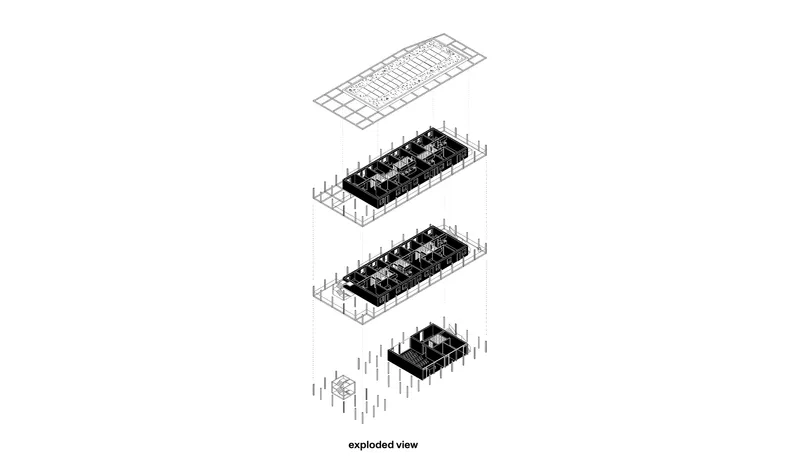
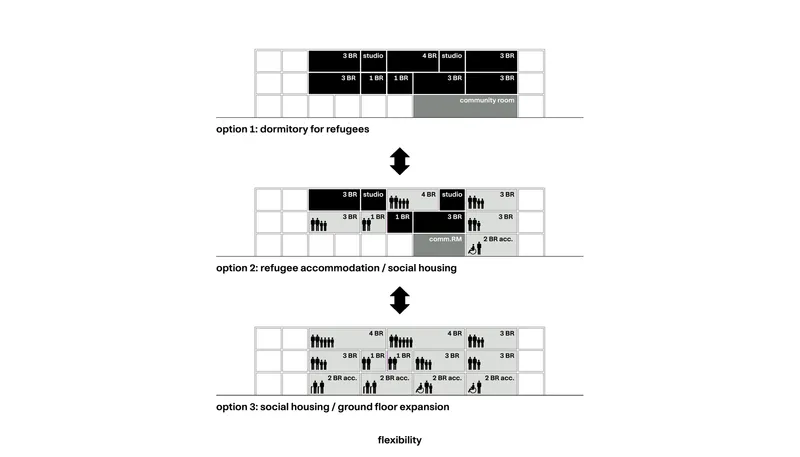

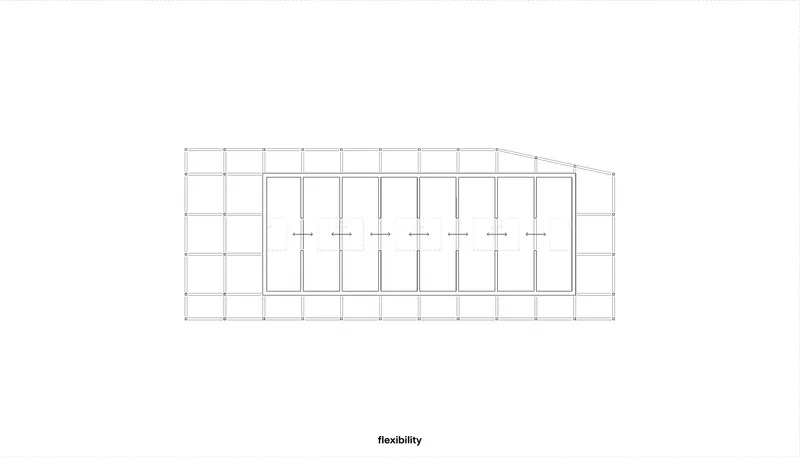
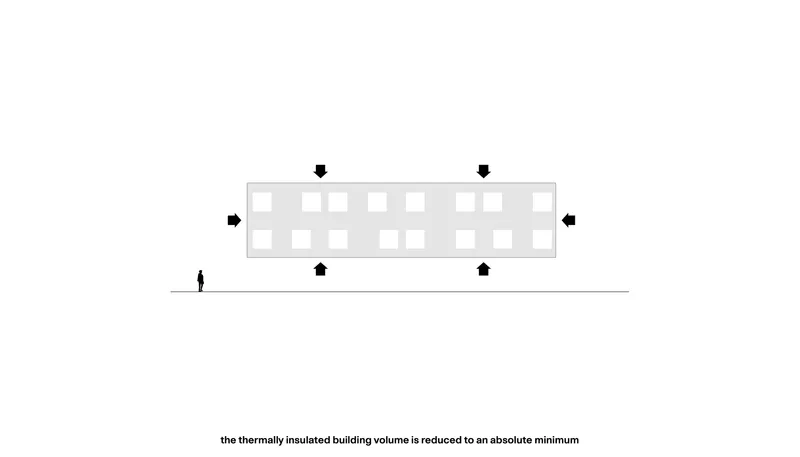
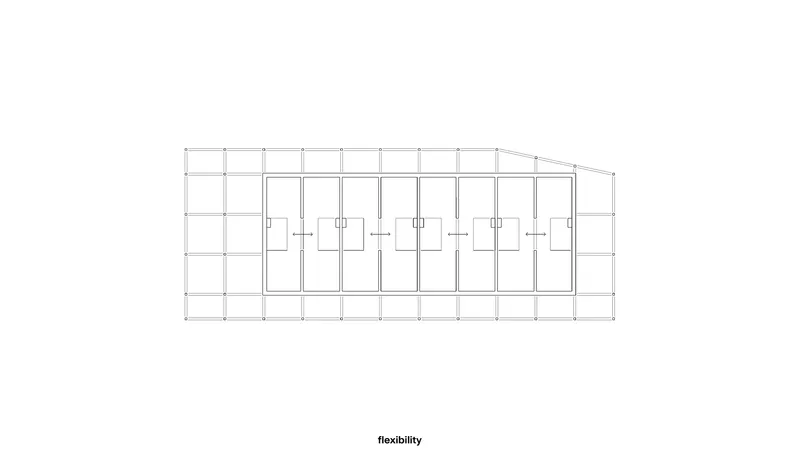
The exploded axonometric reveals the building's layered logic at a glance: basement parking below, two residential floor plates stacked above a ground-level common zone, and a roof slab sitting on the column grid. The plan diagrams showing three programmatic options are the project's intellectual core. Black zones represent fixed service cores; grey zones represent circulation; everything else is negotiable. The site plan shows the building's orientation relative to a diagonal roadway and surrounding trees, confirming its deliberate engagement with the sloped terrain.

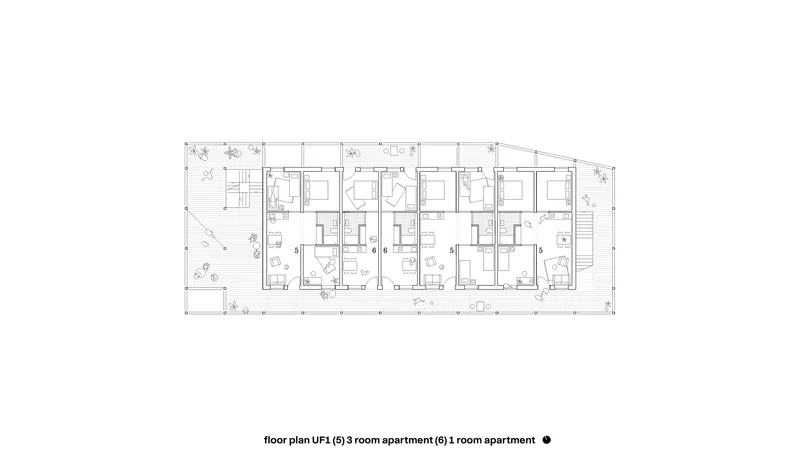

Floor plans show the range of possible configurations: three larger residential units with rooms and balconies along a corridor in one version, multiple smaller units in a linear configuration in another, and five distinct apartment typologies ranging from studio to multi-bedroom layouts in a third. The corridor remains constant across all versions, which is the structural point. It is the one element that does not move.
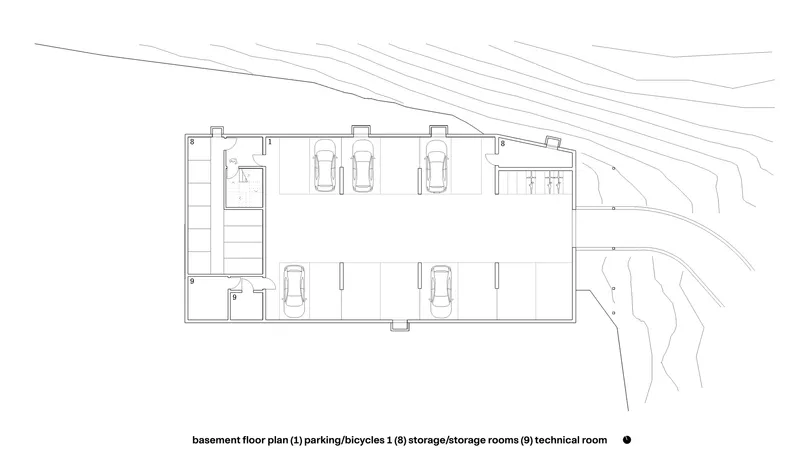


The basement plan reveals a parking garage and storage rooms shaped by topographic contours, while the ground floor plan clarifies the relationship between the parking zone and the common spaces above. The roof plan shows a central open area flanked by perimeter units, suggesting that even the top of the building has been considered as usable territory.
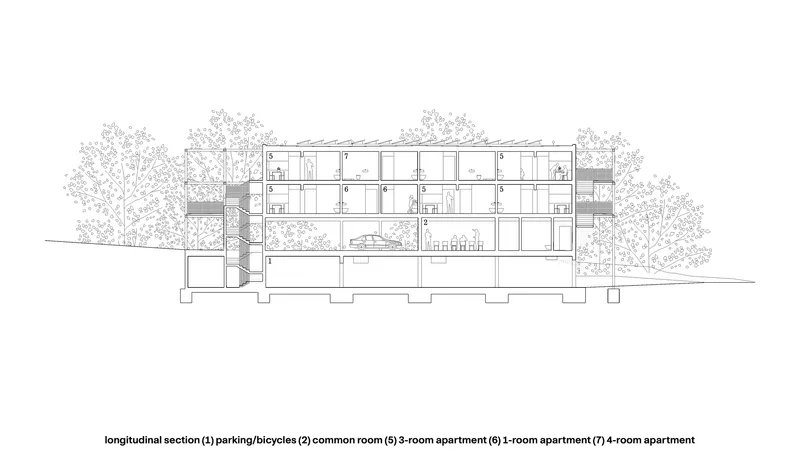
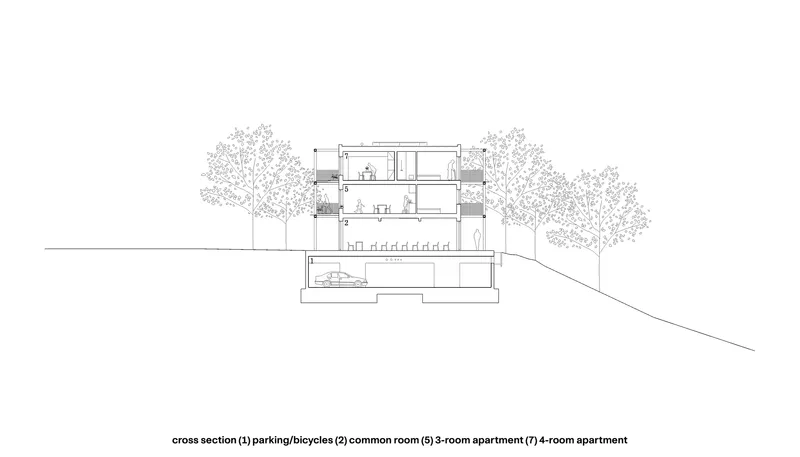
The longitudinal section stacks the full program legibly: cars below, people above, trees at grade. The cross section shows how the sloped site is absorbed into the basement level, allowing the building to meet the ground naturally on one side while rising a full story above it on the other. A structural section isolates the steel frame, revealing the angled roof line and the vertical column rhythm.

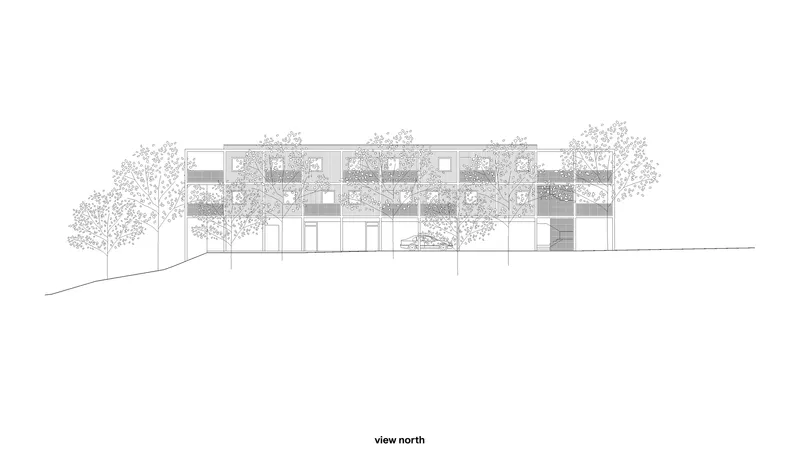
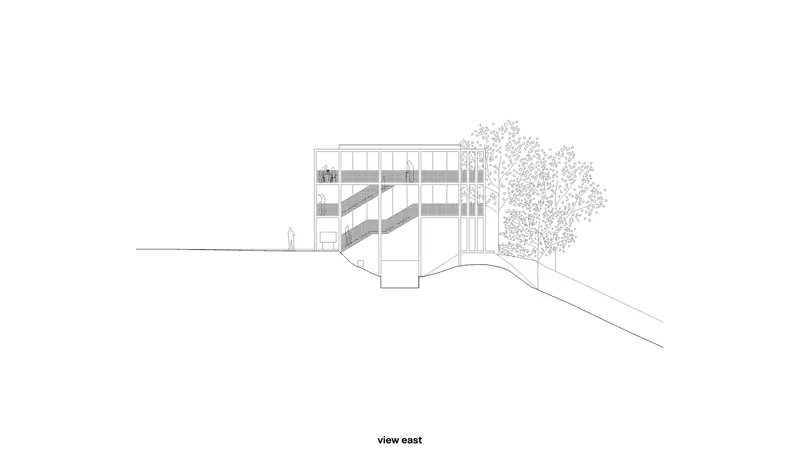
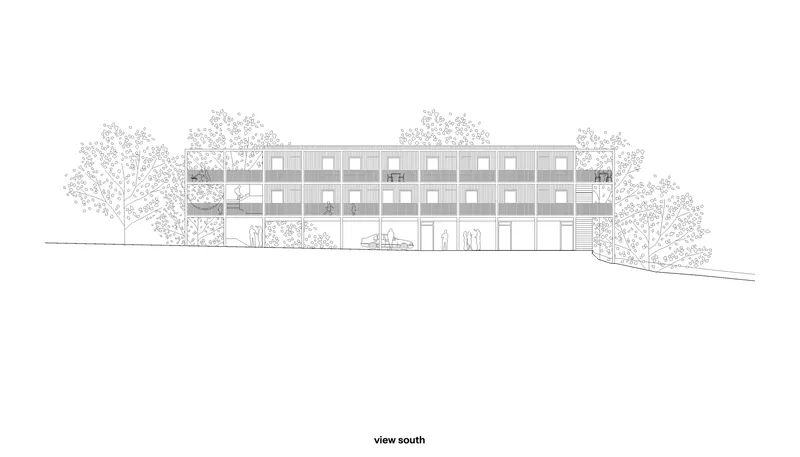
The four elevation drawings confirm the building's disciplined modularity from every direction. The north elevation shows planted balconies softening the horizontal facade. The east and west elevations reveal the panelized grid and its relationship to the hillside. The south elevation presents the full gridded face framed by trees, the most public and representative view.

Why This Project Matters
The Flexible Dormitory matters because it takes the most politicized building type in contemporary Europe and treats it with genuine architectural intelligence. Refugee housing is too often designed as a temporary fix: containers, modular units bolted together in haste, buildings that signal their own disposability. Atelier Kaiser Shen has done the opposite. They have built a permanent structure that is designed to be impermanent on the inside, a building that can serve refugees today and families in subsidized apartments tomorrow without a single structural intervention. That is not idealism; that is engineering.
More broadly, the project is a quiet rebuke to the notion that flexibility requires high budgets or technological novelty. The materials here are ordinary: CLT, steel, concrete, glass. The construction methods are proven. What is extraordinary is the discipline of the grid and the refusal to lock the building into a single programmatic identity. In a political climate where housing debates are defined by scarcity and suspicion, a building that says "I will be whatever you need me to be" is a genuinely radical proposition.
Flexible Dormitory by Atelier Kaiser Shen, Schönaich, Germany. 2,142 m². Completed 2025. Photography by Brigida Gonzalez.
About the Studio
Share Your Own Work on uni.xyz
If projects like this are the kind of work you want to make, uni.xyz is a place to publish your own, find collaborators, and enter design competitions.


Popular Articles
Popular articles from the community


LT2A and OPEN Architectes Thread a Brick and Glass High School Through a Wooded Belgian Campus
In Braine-l'Alleud, a 3,000 m² wing for Collège Cardinal Mercier pairs pale brick with a glazed colonnade, deferring to a small chapel and a dense wood.

GROUP A Strips a 1969 Rotterdam Harbor Headquarters to Its Frame and Wraps It in Timber Louvers
In Rotterdam's M4H harbor district, Ferro Offices reuses a 1969 frame, adds one timber storey and reaches BREEAM-NL Outstanding.

Architekt Andreas Gruber Scatters 23 Dark Timber Chalets Across a South Tyrolean Forest Edge
In Molini di Tures, Amonti Chalets breaks a resort into a hamlet of gabled timber houses, with parking, storage and services pushed into the slope.

U.GA Architects Wraps an Oval Rooftop Pool in Curved Board-Formed Concrete on Busan's Jeollidan-gil
In Busan's Jeonpo-dong, a 454 m² mixed-use block stacks a neighborhood facility, guest rooms and an oval rooftop pool inside spiraling concrete walls.

Similar Reads
You might also enjoy these articles


LAVA Architecten Gives Vocational Education a Sawtooth-Roofed Face on a Mechelen School Campus
In Mechelen, Belgium, a 2,053 m² STEM school on a 6×6 m grid turns workshops and classrooms into rooms that can be rearranged as teaching changes.

KEMA Studio Turns a Derelict Marvila Attic into a 60 m² Lighthouse Apartment Above Lisbon
In Lisbon's Marvila district, a rebuilt roof, four skylights and two plywood volumes turn an unlivable attic into a bright home facing the Tagus.

Pixel Gardens: One Repeated Module Stacked Into a Terraced Social Housing Tower for Famagusta
Salem Bader's shortlisted housing tower builds a vertical neighbourhood from one repeated module, offsetting units to carve terraces, light and air.

Bao Huynh Watercolor Atelier: A Serene Art Retreat in Hội An
Bao Huynh Watercolor Atelier in Hội An blends multifunctional art spaces, sustainable design, local materials, and family-friendly living in a serene environment.

Explore Dorms Competitions
Discover active competitions in this discipline

Challenge to reimagine the Iron Throne

Photograph architecture without architects

Illustrate the lost glory of Angkor Wat - Render Challenge

Design challenge to reuse E-waste
Comments (0)
Please login or sign up to add comments
No comments yet. Be the first to comment!