

Atelier Messaoudi Architects Builds a Colonnaded House in Algeria for Aging Parents
A single-storey concrete home in Tipasa wraps accessibility, climate control, and Algerian family life into one quiet colonnade.


The brief was personal and specific: a son wanted to give his aging parents a home they could actually live in. Previously confined to the first floor of the family house on the same plot in Tipasa, about 50 kilometers west of Algiers, the parents needed a single-storey dwelling designed around reduced mobility. Atelier Messaoudi Architects, led by Lounes Messaoudi, answered with a 98-square-metre concrete house organized entirely on one level, where a continuous colonnade does most of the architectural heavy lifting.
What makes the project worth studying is how much it refuses to do. There are no dramatic glass walls, no double-height voids, no gestures toward spectacle. Instead, the colonnade, a row of cylindrical concrete columns supporting a generous roof overhang, becomes the building's primary spatial device. It mediates between indoors and outdoors, shields the interior from Tipasa's summer heat, enables cross ventilation in both seasons, and creates a flexible zone where the family circulates, dines, and receives guests. It is an accessibility project that never feels clinical, and a climate strategy that never feels like engineering.
The Colonnade as Living Room
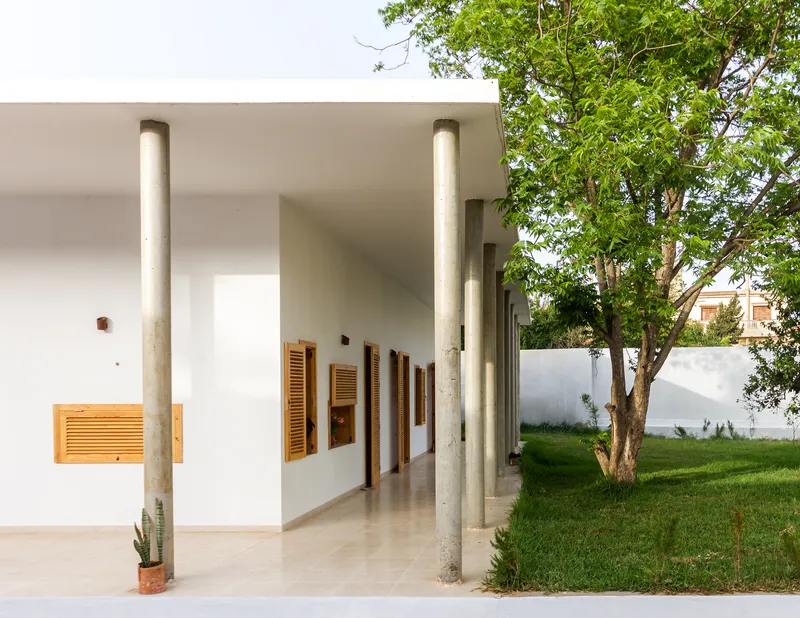


The colonnaded gallery is not a corridor. It is an intermediate space, occupied by textiles, furniture, and the daily rhythms of family life. Patterned rugs cover the tiled floor. Timber louvered doors swing open along its length, collapsing the boundary between the covered porch and the rooms behind it. A wheelchair is visible in several views, a quiet reminder that the architecture was shaped by a specific physical need rather than an abstract idea.
Messaoudi avoids the temptation of huge glazed openings, a move he frames as culturally and climatically inappropriate for Algerian family life. The louvered shutters give residents control: light and air enter when invited, and privacy is maintained without resorting to curtains or blinds. The colonnade filters what the shutters do not, casting long shadow lines across the porch that shift through the day.
White Walls, Timber Shutters, and a Pecan Tree


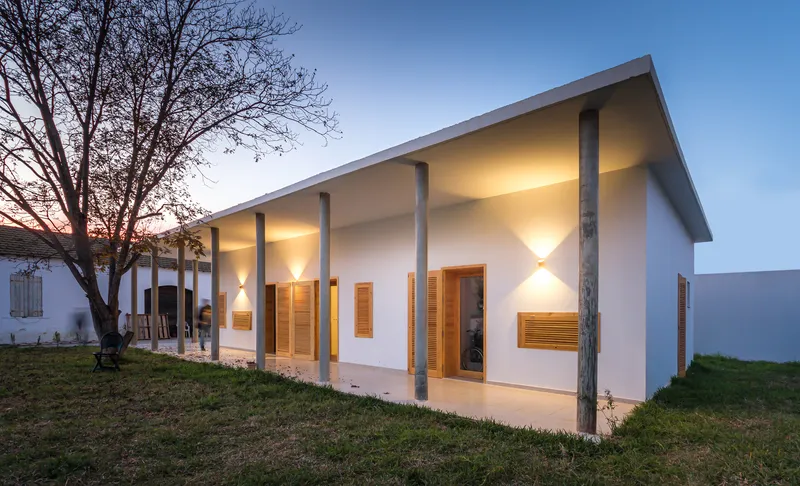
The material palette is restrained to the point of discipline. White stucco walls, cylindrical concrete columns, and locally crafted timber shutters. That is essentially the entire exterior vocabulary. The pecan tree that predates the house anchors the composition, its canopy reaching over the roof in several views and grounding the building in a timeline longer than its own construction.
At dusk and twilight, the house glows softly through its timber screens, transforming from a solid white volume into a lantern of warm horizontal lines. The gabled roofline, visible in the west-facing elevation, gives the building a domestic silhouette that sits comfortably among the surrounding family houses of the dense Tipasa neighborhood. There is nothing confrontational about its presence.
Accessibility Without Compromise


Designing for accessibility in a residential context often produces spaces that feel institutional: wide corridors, grab bars, surfaces chosen for maintenance rather than warmth. The Colonnade House sidesteps that trap entirely. The single-storey plan eliminates stairs. The colonnaded gallery is wide enough for a wheelchair to pass comfortably but proportioned so that it reads as generous rather than clinical. The garden is flush with the porch, so moving between inside and outside requires no threshold negotiation.
Image after image shows a wheelchair user navigating the space with evident ease, on grass beneath the afternoon sun, under the colonnade in dappled light. These are not staged accessibility demonstrations; they look like scenes from a life being lived. The architecture recedes, which is exactly the point.
Orientation and the Two Gardens


The plan places the main living spaces along the south facade, overlooking the large garden and the pecan tree. Secondary spaces, including the kitchen and an outdoor cooking terrace, face north toward a second, more utilitarian garden. This dual orientation is pragmatic: the south garden is the social face of the house, the north garden is where daily domestic work happens. Both are accessible, and both extend the usable area of a 98-square-metre footprint well beyond its walls.
The roof overhang, supported by the colonnade, protects the south-facing rooms from direct summer sun while admitting low winter light. Horizontal and vertical openings in the envelope enable cross ventilation through both seasons. None of this is novel technology. It is attentive design, calibrated to a specific latitude and a specific family.
Interior Detail and Local Craft

The interior is spare but not austere. Built-in wardrobes in white flank a timber panel door in the bedroom; the same louvered frames that define the exterior carry through to the interior joinery. Materials, furniture, and carpentry were all made locally by artisans from the Tipasa region, a decision that roots the project in its economy as much as its geography.
The consistency of the timber work, from shutters to doors to built-in storage, gives the house a coherence that more expensive projects often lack. There is a single material logic at work, and it does not depend on imported finishes or specialist fabricators.
Plans and Drawings


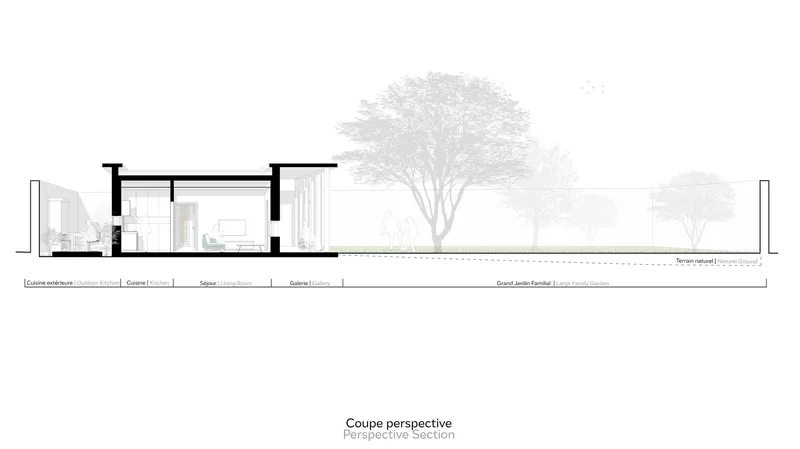


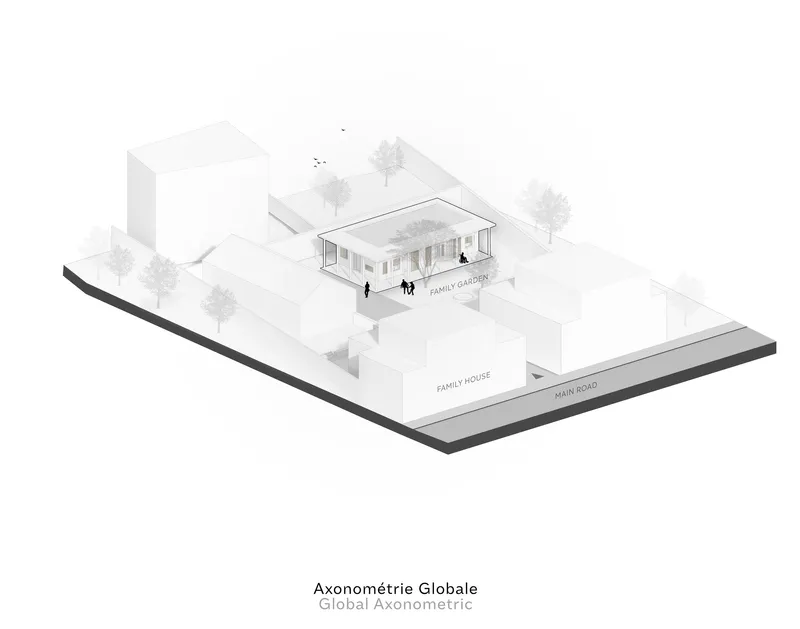
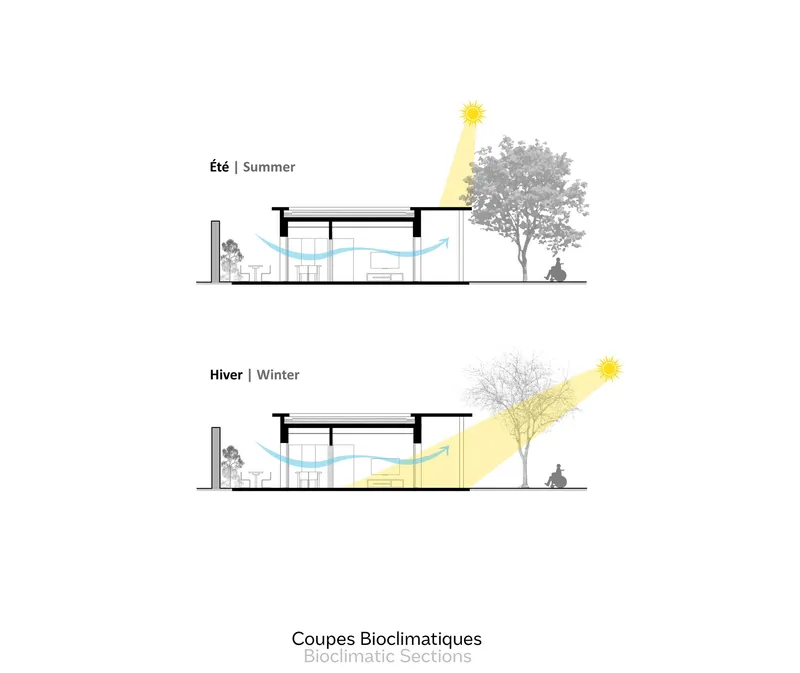

The site plan reveals the house's position on a corner lot, tucked between surrounding block forms with the pecan tree and garden occupying the majority of the plot. The ground floor plan confirms the directness of the spatial organization: living rooms, kitchen, and bedrooms arranged in a linear sequence, all opening onto the colonnaded gallery. The bioclimatic section diagrams are particularly instructive, showing how summer and winter sun angles interact with the roof overhang and how ventilation paths move through the interior.
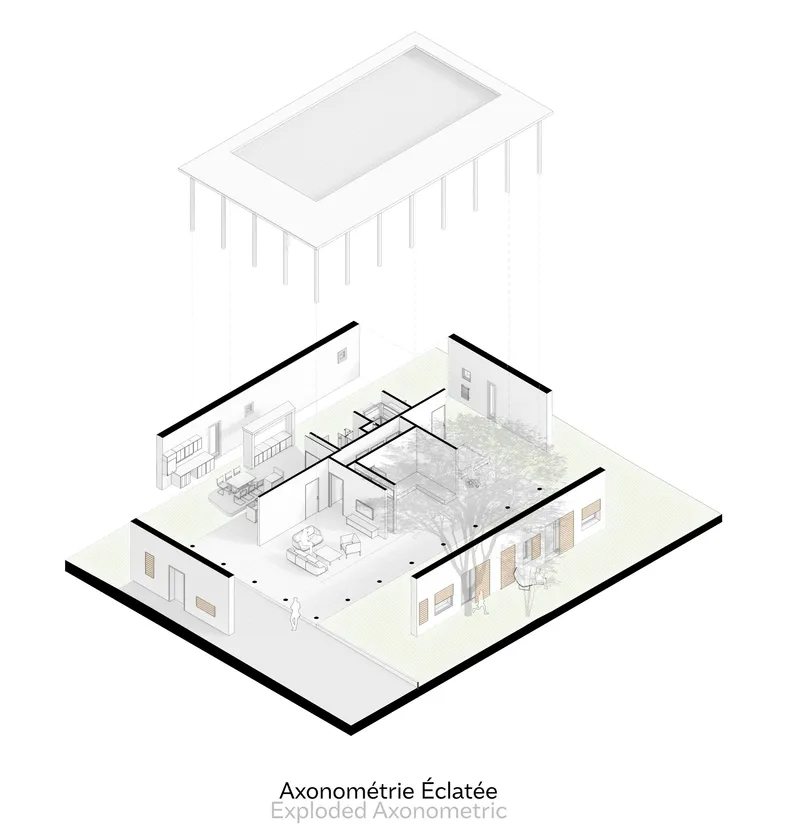
The exploded axonometric is revealing. It shows the gabled roof floating above the rooms like a separate element, the columns acting as mediators between structure and enclosure. The perspective section and elevations confirm what the photographs suggest: the house is a simple volume, carefully perforated and shaded, that gains its richness from proportion and orientation rather than formal complexity.
Why This Project Matters
The Colonnade House is a corrective to several tendencies at once. It pushes back against the assumption that residential architecture in North Africa should either mimic European modernism or retreat into nostalgic vernacular. It demonstrates that designing for disability and aging does not require a separate architectural language. And it proves that a 98-square-metre house, built with local labor and materials on a tight urban lot, can be spatially generous if the architect understands what generosity actually means in context.
Messaoudi's decision to let the colonnade do the work, rather than inventing novel forms, reflects a maturity that is rare in houses this small. The columns create shade, define a threshold, support a roof, and frame a garden. They do not perform; they serve. In an era of overwrought residential design, that restraint is the most interesting move the project makes.
The Colonnade House by Atelier Messaoudi Architects (lead architect: Lounes Messaoudi), Tipasa, Algeria. 98 m², completed 2021. Photography by Reda Ait Saada.
About the Studio
Share Your Own Work on uni.xyz
If projects like this are the kind of work you want to make, uni.xyz is a place to publish your own, find collaborators, and enter design competitions.


Popular Articles
Popular articles from the community


graciastudio Turns a Viewless Tijuana Lot Inward Around a Courtyard of Concrete, Timber and Trees
In Tijuana, Jorge Gracia's GA2 House stacks a timber-clad private floor over exposed concrete and replaces a missing view with a planted interior patio.


Manzana Morphosis: Stretching Barcelona's Grid into a Living Landscape for 2050
A radical reworking of the Eixample manzana turns density into a tool for generous public space, vertical ecology, and environmental performance.

ETEH Reworks the Shared Spaces of São Domingos School in Brazil Around Timber, Color and Hanging Plants
At São Domingos School in Brazil, 436 m² of hall, refectory and library are recast with timber joinery, a yellow and blue code and trailing greenery.

Opera on the Sea: Driftwood Logic Shapes a Timber Opera House on Estonia's Coast
Trevor Orgill's opera house translates the entangled drift of floating timber into a civic building where wood, water, and music converge.

Similar Reads
You might also enjoy these articles

LAVA Architecten Gives Vocational Education a Sawtooth-Roofed Face on a Mechelen School Campus
In Mechelen, Belgium, a 2,053 m² STEM school on a 6×6 m grid turns workshops and classrooms into rooms that can be rearranged as teaching changes.

KEMA Studio Turns a Derelict Marvila Attic into a 60 m² Lighthouse Apartment Above Lisbon
In Lisbon's Marvila district, a rebuilt roof, four skylights and two plywood volumes turn an unlivable attic into a bright home facing the Tagus.

Pixel Gardens: One Repeated Module Stacked Into a Terraced Social Housing Tower for Famagusta
Salem Bader's shortlisted housing tower builds a vertical neighbourhood from one repeated module, offsetting units to carve terraces, light and air.

Bao Huynh Watercolor Atelier: A Serene Art Retreat in Hội An
Bao Huynh Watercolor Atelier in Hội An blends multifunctional art spaces, sustainable design, local materials, and family-friendly living in a serene environment.

Explore Digital Colosseum Competitions
Discover active competitions in this discipline

Challenge to design mud housing for contemporary communities

Bring back Drive In's
Comments (0)
Please login or sign up to add comments
No comments yet. Be the first to comment!