
Atelier PRO Turns a Dated Dutch Greenhouse Office into a Transparent Corporate Campus
In Bleiswijk's vast horticultural corridor, a 2,930 m² head office reframes the relationship between corporate identity and plant science.


The glass horticultural zones around Bleiswijk exist in a strange liminal state: neither city nor farmland, packed with enormous greenhouses that sprawl across the Dutch flatlands with almost no architectural oversight. Buildings here tend to just happen. So when Anthura, a global specialist in plant and seed breeding operating from a 450,000 m² greenhouse complex, asked Atelier PRO architects to overhaul their severely outdated head office, the question was less about square meters and more about meaning. How do you create a legible corporate identity in a landscape that resists conventional urban design?
The answer is a 2,930 m² building that works on two registers simultaneously. One layer is an exhibition sequence: a curated path that guides visiting clients from reception through the building toward a fully transparent display greenhouse, turning plant science into spectacle. The other is a staff layer organized around a central canteen, with flexible workspaces radiating outward to capture daylight. These two circuits overlap and intersect, creating a building that is equal parts showroom and workplace. The existing metal structure and floors were retained, the facade was completely rethought, and what was once cluttered and forgettable became something deliberately legible.
A Facade That Borrows from the Greenhouse

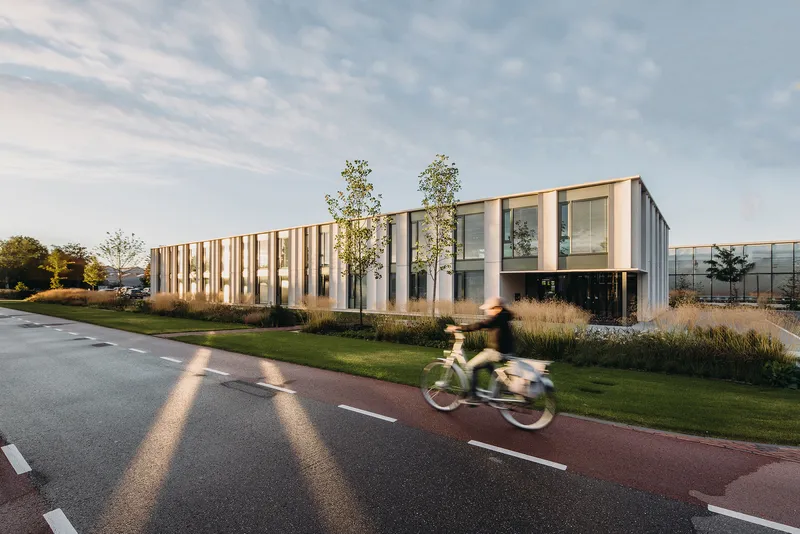
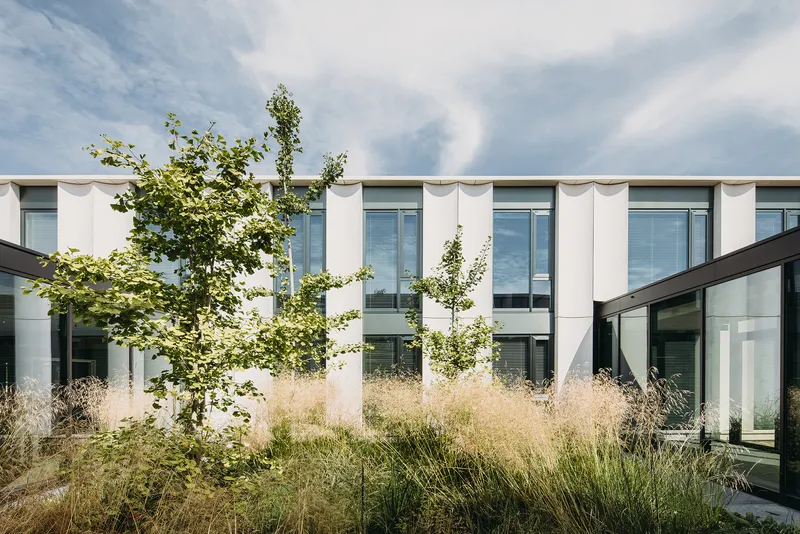
The vertical facade elements are the project's most visible move. They optically enlarge the building, obscuring the individual floor lines to create the impression of a single tall volume rather than a modest two-story structure. More importantly, they mirror the vertical rhythm of the surrounding greenhouse architecture. It is a deliberate formal echo that ties the office to its context without mimicry. The building sits on a slightly raised pedestal, visually detaching it from the continuous glass facades behind, so it reads as a distinct object rather than an appendage of the production landscape.
At dusk, the ribbed white panels catch raking light while the glazed openings behind glow warmly. The effect is of a lantern set into a field of infrastructure. Ornamental grasses and young trees planted along the base soften the transition to the surrounding hardscape, a small but effective landscape gesture that signals a different kind of care.
The Enclosed Garden as Mediator
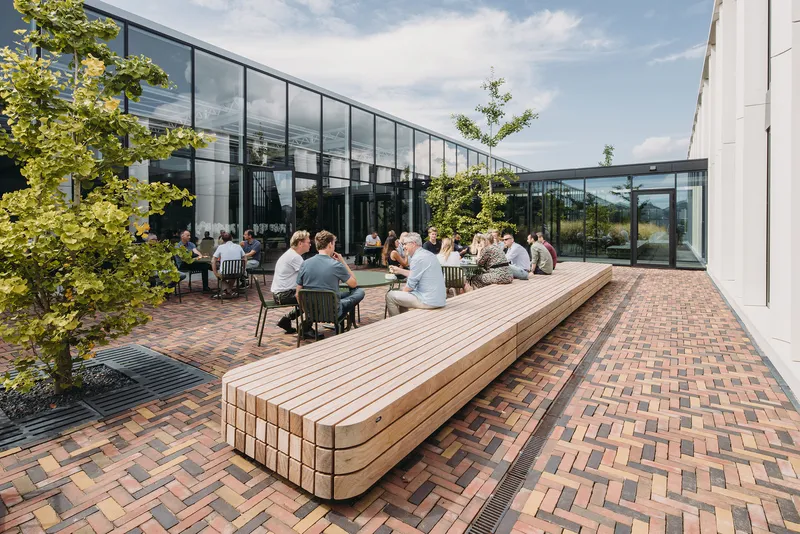


Between the office building and the greenhouses, Oase Landscape and Urban Design carved out an enclosed courtyard garden that acts as a decompression zone. The herringbone brick paving, timber bench seating, and young trees give this space a domestic quality that stands in deliberate contrast to the industrial scale of the surrounding complex. It is where the company's tropical interior world gets translated, conceptually, into an outdoor atmosphere.
The courtyard does double duty. For staff, it provides a sheltered outdoor break area. For the building's exhibition circuit, it offers a moment of pause before visitors reach the greenhouse itself. The glass facades on either side of the courtyard make the relationship between office and production visible at all times: you can see plants growing while you eat lunch. That transparency is not just aesthetic, it is organizational philosophy made spatial.
The Canteen as Social Core

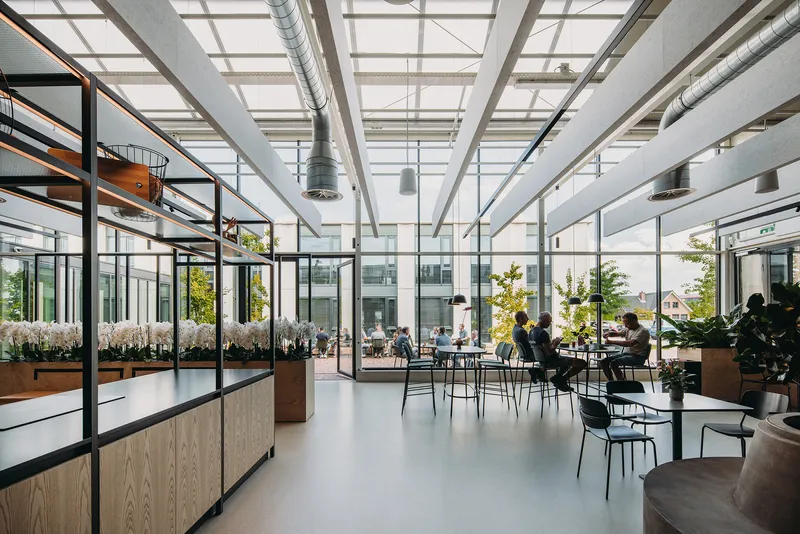

Atelier PRO placed the canteen at the heart of the staff layer, a decision that reads as straightforward but carries real consequences for how the building works. Technical facilities and services that do not require daylight occupy the center of the plan, freeing the perimeter for workspaces and communal areas. The canteen benefits from a gridded skylight structure overhead, exposed ducts, and a long communal counter that encourages informal interaction across departments.
The material palette here is warm but restrained. Black-framed glazed partitions define zones without closing them off. A 300 m² Heartfelt ceiling in brown tones provides acoustic absorption in spaces that were opened up during the renovation, managing the noise that comes with removing walls from an existing structure. The planted dividers between dining zones bring a touch of the company's core product into everyday life, a gentle reminder of what everyone here actually works on.
Two Layers of Experience


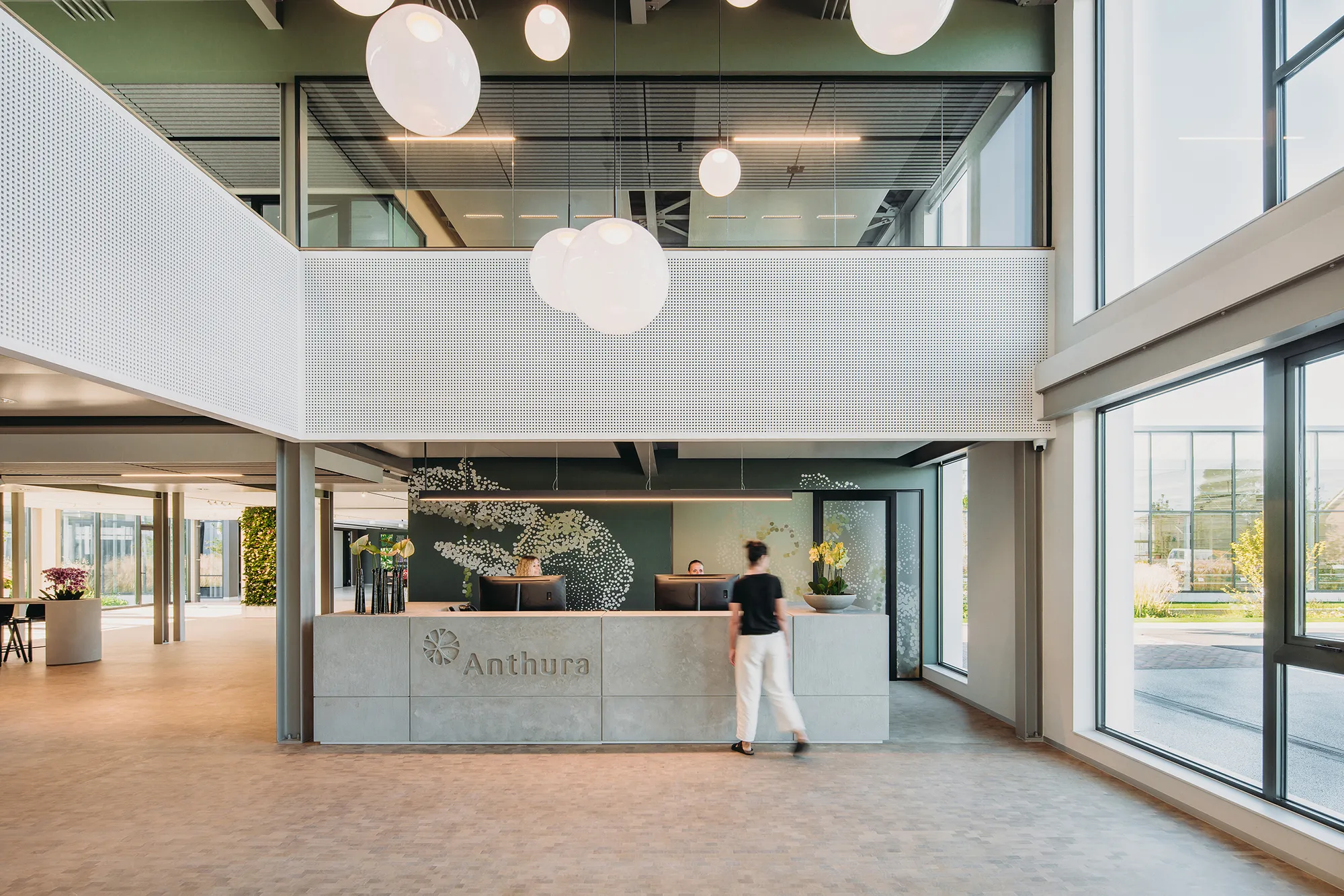
The reception lobby sets the tone for the exhibition layer. A double-height space with concrete desk, spherical pendant lights, and floor-to-ceiling glazing establishes a sense of scale that the rest of the building's intimate workspaces do not attempt. The sequence from here moves through a series of curated spaces with reception functions, each designed in collaboration with a graphic designer and exhibition designer, until visitors reach the display greenhouse. The existing greenhouse facade was replaced with a fully transparent glass wall, turning the lab-like interior into a living backdrop for the office.
The staff layer operates differently. Corridors with perforated film patterns on the glass walls filter views and manage solar gain. Lounge areas with modular sofas offer informal meeting zones. The two circuits share structure and circulation but create distinct experiences: one performative, one quotidian. It is a smart way to handle a building that must serve both brand storytelling and daily work without either compromising the other.
Workspaces and the Perimeter Strategy


The workspace planning follows a clear logic. By pushing technical zones to the center, Atelier PRO kept the perimeter open for flexible workplaces that alternate with concentration areas. Black-framed glass partitions with dotted film patterns provide visual privacy without killing sightlines. Conference rooms offer views into interior courtyard gardens through floor-to-ceiling glazing, maintaining the connection to greenery that defines the entire project.
A terracotta accent wall in one conference room and a wall mural visible through the partitions introduce color in controlled doses. The overall palette of warm tones, timber, and greenery avoids the sterile corporate neutrality that often plagues office renovations. These are not radical gestures, but they accumulate into an environment that feels considered rather than default.
Circulation and Materiality


The upper-floor corridors reveal how the existing metal structure was retained and reintegrated. A planted atrium opening punches through the floor plate, pulling light down into the core and creating vertical sightlines. Mezzanine walkways with mint green guardrails and perforated ceiling panels introduce color without overwhelming the structural honesty of the exposed beams and ducts above. The slatted ceilings and timber wall panels in the corridors add acoustic warmth to what would otherwise be hard, reverberant surfaces.
The material choices are pragmatic but not unambitious. PVC ground boards with linen texture, Durastone resilient flooring applied seamlessly without joints, and strategically placed acoustic baffles in the reception areas all serve functional requirements while maintaining a cohesive visual language. This is a renovation that respected its existing bones while giving them an entirely new skin and interior life.
Interior Details and Atmosphere


The smaller moments matter. High-top tables with teal upholstered chairs face sage green walls and potted plants, creating breakout zones that feel deliberately casual. A threshold at open glass doors captures the blur of movement between dining and corridor, a reminder that the building is designed for flow rather than compartmentalization. Diagonal shadow patterns from overhead skylights play across steel railings, evidence of the attention paid to how light enters and moves through the building over the course of a day.
Plans and Drawings


The site plan reveals the scale disparity at play: the office footprint is a sliver against the vast greenhouse grid behind it. The floor plans confirm the central service core strategy, with the courtyard acting as an organizing void that separates the exhibition and staff circuits. The sections are revealing. A sawtooth roof profile on the greenhouse side contrasts with the clean two-story volume of the office, and the multiple interior staircases show how vertical circulation was distributed rather than concentrated, keeping movement fluid across the building.
Why This Project Matters
The Dutch greenhouse landscape is one of the most architecturally neglected territories in a country otherwise famous for design ambition. These are highly built-up zones with minimal building regulation, where pragmatism overrules everything else. Atelier PRO's Anthura headquarters does not pretend this context does not exist. Instead, it borrows from it: the vertical rhythms, the transparency, the relationship between controlled interior environments and the world outside. The result is a corporate office that belongs to its place without surrendering to its usual indifference.
The dual-circuit strategy is worth studying. Separating the exhibition experience from the daily workplace within a single compact building, using shared structure and overlapping spaces, is a model that could apply far beyond horticulture. Any company that needs to tell its story to visitors while also providing a humane work environment faces the same challenge. The Anthura head office solves it with spatial intelligence rather than square footage, proving that 2,930 m² can do the work of a building twice its size when the plan is right.
Head Office Anthura by Atelier PRO architects. Bleiswijk, The Netherlands. 2,930 m². Completed 2022. Photography by Eva Bloem.
About the Studio
Share Your Own Work on uni.xyz
If projects like this are the kind of work you want to make, uni.xyz is a place to publish your own, find collaborators, and enter design competitions.



Popular Articles
Popular articles from the community


Riyadh For All: Intergenerational Urban Design for Active Aging in Rabat
Riyadh For All reimagines urban design in Rabat with intergenerational co-living, adaptive courtyards, and Moroccan cultural exchange today.

The Earth Pod: 3D Printed Homes for Resilient Refugee Communities
The Earth Pod reimagines refugee housing through 3D printed homes made from clay, combining resilience, self-sufficiency, and rapid shelter.
AL-JANNAH: Sustainable Architecture and Permaculture for Afghan Widows
AL-JANNAH uses sustainable architecture and permaculture to create resilient oasis of housing, learning, work and renewal for Afghan widows.

Hill & Cross Opera: Sculptural Opera House Architecture Shaped by Tallinn’s Landscape and Identity
Hill & Cross Opera reimagines opera house architecture in Tallinn through its sculptural hill, civic plaza, glass wave and a luminous cross.

Similar Reads
You might also enjoy these articles

Bao Huynh Watercolor Atelier: A Serene Art Retreat in Hội An
Bao Huynh Watercolor Atelier in Hội An blends multifunctional art spaces, sustainable design, local materials, and family-friendly living in a serene environment.

Atelier Macri Concept Store Interior Design by CASE-REAL
Atelier Macri store features a "ko" counter, walnut wood details, cork displays, blending retail, gallery, and seamless customer experiences.

Manuel Vargas Izquierdo Stadium and High-Performance Sports Center: Architectural Excellence in Jalpa de Méndez
The Manuel Vargas Izquierdo Stadium blends sustainable design, inclusive sports facilities, and cultural-inspired architecture, revitalizing Jalpa de Méndez’s public spaces.

KAKR Buluh Awar Hall: Revitalizing Community and Ecology Through Bamboo Architecture
Community built bamboo hall revitalizes Buluh Awar village, empowering youth, restoring ecology, celebrating vernacular craftsmanship through sustainable architecture and culture.


Comments (0)
Please login or sign up to add comments
No comments yet. Be the first to comment!