

Atelier TAs Splits a 5-Meter-Wide Vietnamese Tube House into Breathing Halves
On a slender corner plot in Dong Nai, staggered white volumes and planted voids turn the tube house typology inside out.


Vietnam's tube houses are famously narrow, deep, and dark. Built to maximize every centimeter of street frontage, they stack rooms back to back with little room for air or light to reach the interior. Atelier TAs, led by Tuan Anh Ngo, took the opposite approach with The Gap House in Dong Nai. Rather than filling the 5×20 meter plot wall to wall, the studio cleaved the building into two offset volumes separated by a continuous planted void, turning the house's greatest constraint into its defining spatial strategy.
The result is a house that feels twice its size. Every room borrows light and ventilation from the central gap, which functions simultaneously as courtyard, garden, and vertical chimney. Sitting at the intersection of two narrow alleys, an unusual corner condition for the type, the building presents staggered white masses to the street that hint at the split within. It is a compact house that insists on generosity.
A Corner Condition Exploited

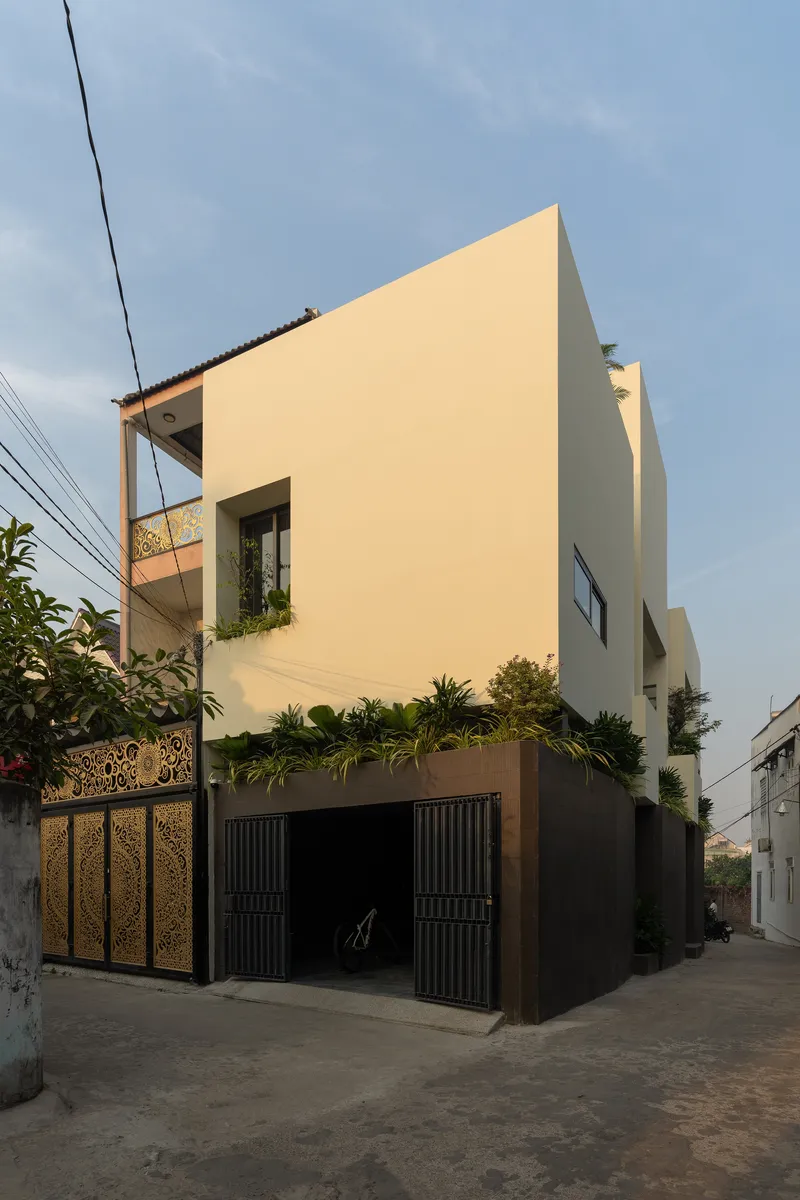
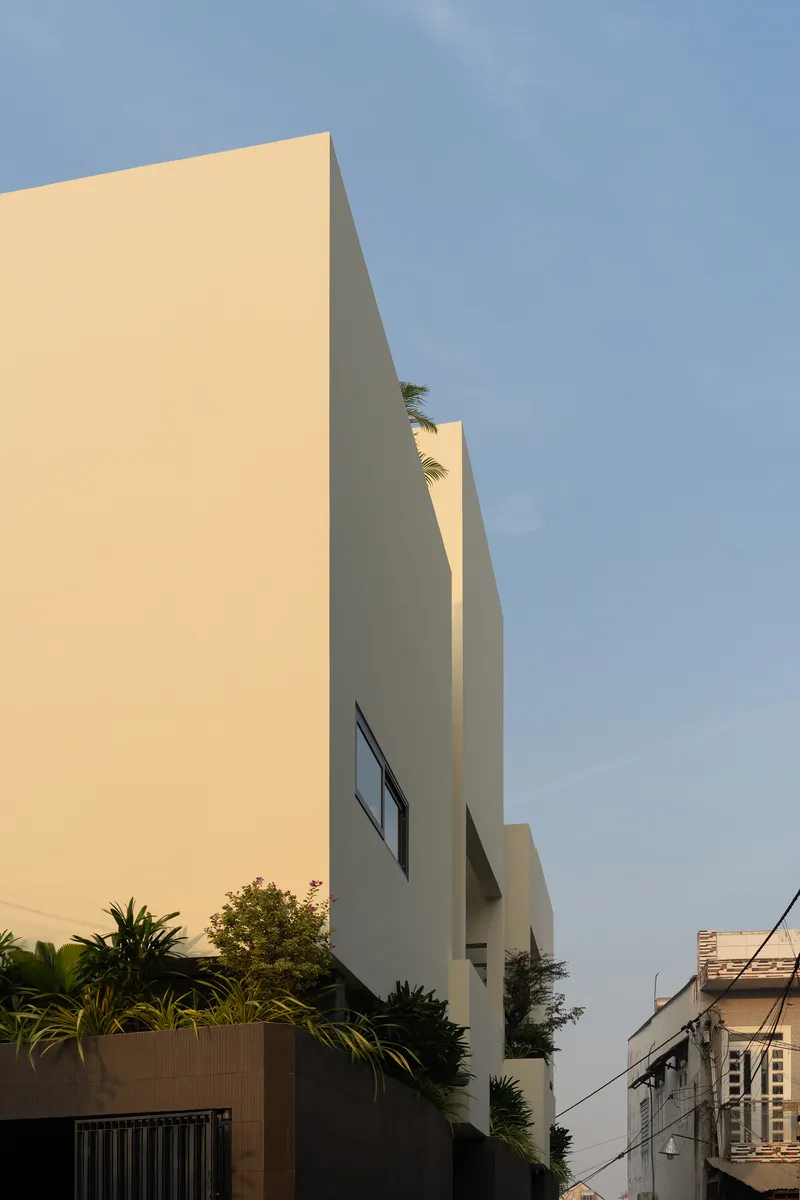
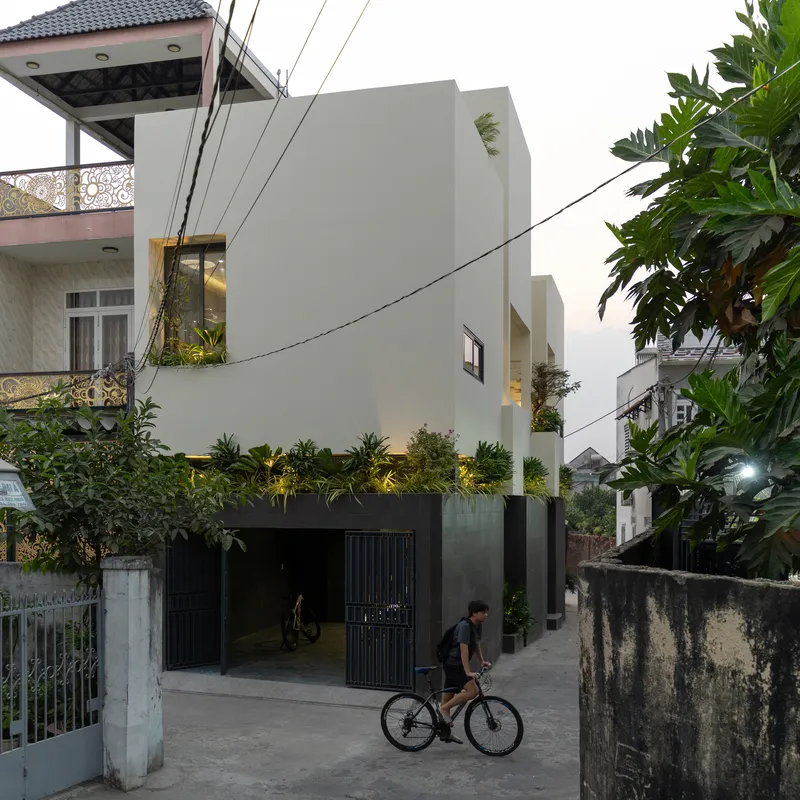
Most tube houses face one alley and disappear into the block. The Gap House sits where two alleys meet, giving it two public faces. Atelier TAs uses this to full advantage: the stacked white volumes rotate slightly against each other, presenting different profiles to each street and creating pockets of planting at the base. The dark tiled boundary wall grounds the composition, anchoring the lighter volumes above like a plinth.
The corner also solves a practical problem. With two frontages, the architects could position the garage door on one alley and the pedestrian entry on the other, separating circulation in a way that would be impossible on a standard mid-block site. From the street, the building reads as a series of offset boxes rather than a single extrusion, a welcome disruption in a neighborhood of repetitive facades.
White Volumes, Planted Seams
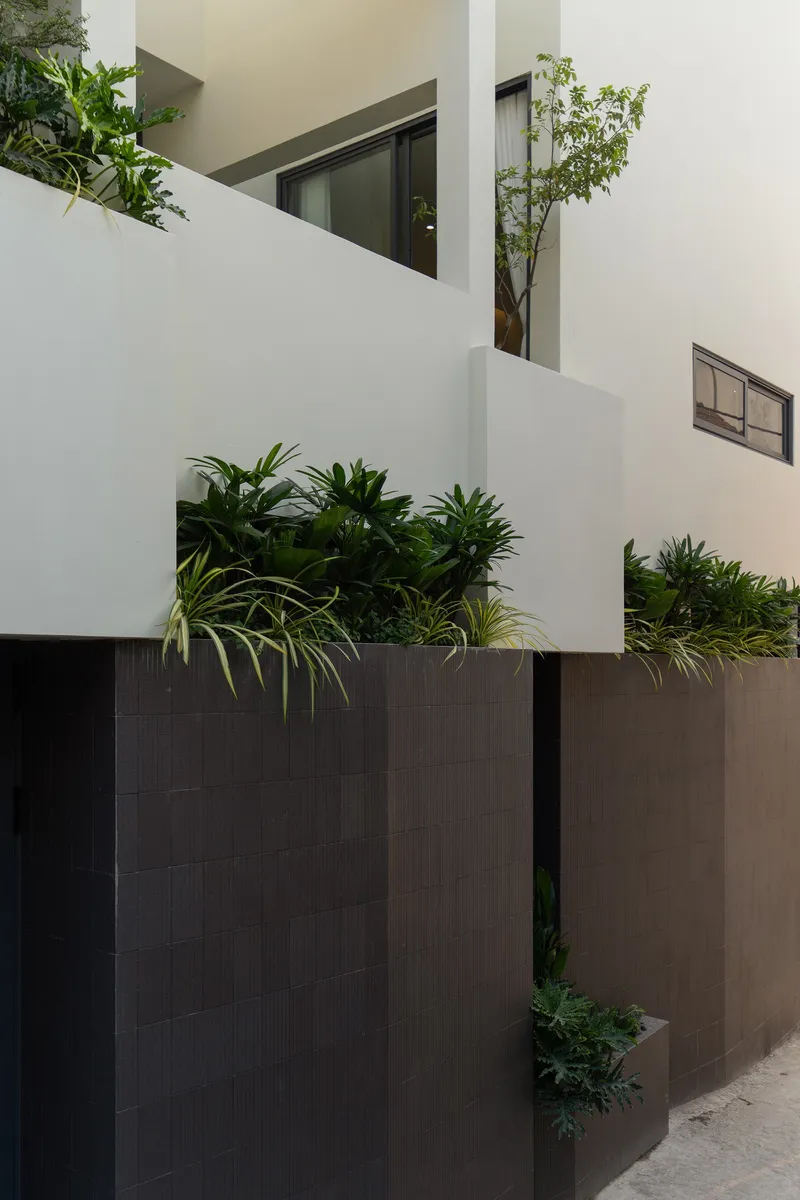
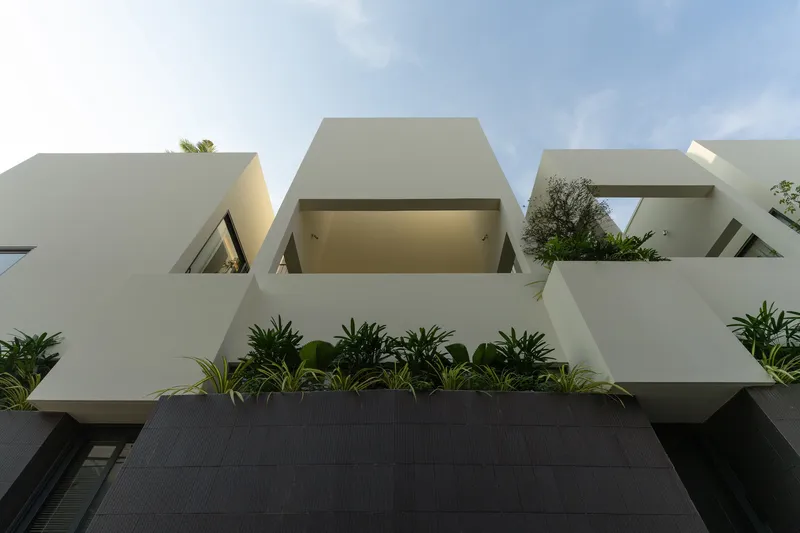
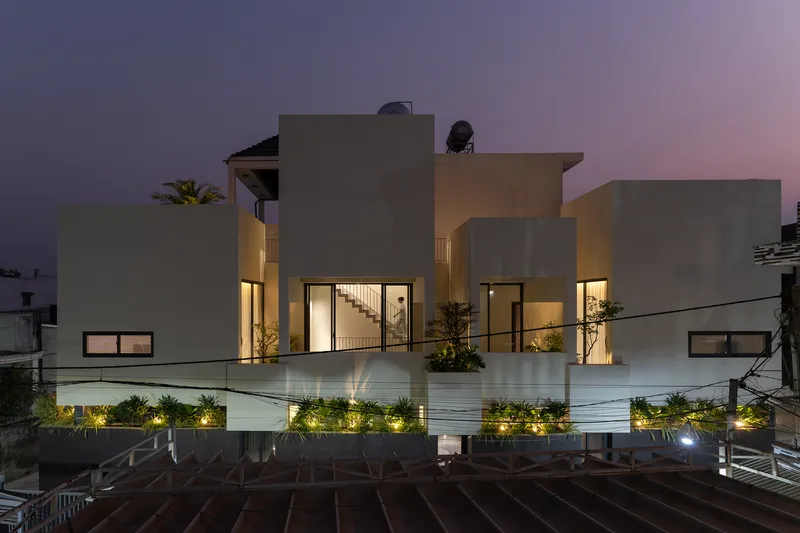
The facade is best understood as a section revealed. Each floor steps back or forward from its neighbor, and the resulting ledges are filled with planting beds that cascade greenery down the elevation. The horizontal window openings punched into the white plaster are narrow and precise, calibrated to frame sky from inside while giving away little privacy from the street.
At dusk, backlit foliage glows between the volumes, and the house transforms into something closer to a lantern than a box. The planted terraces are not decorative afterthoughts; they are the gaps between structural masses, visible evidence of the courtyard strategy at work behind the facade.
The Central Void as Engine
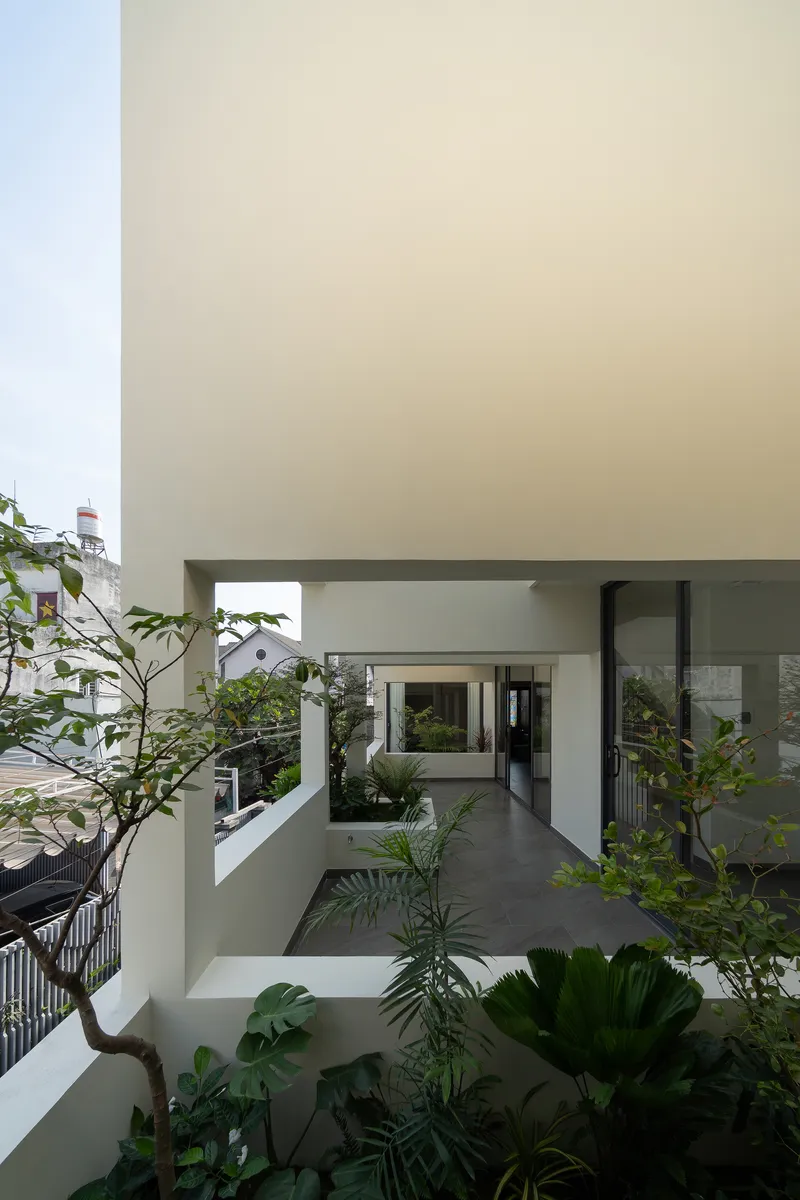
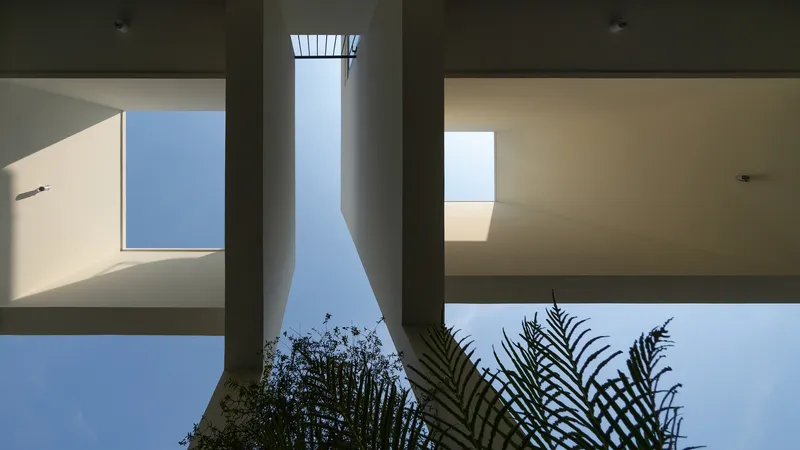
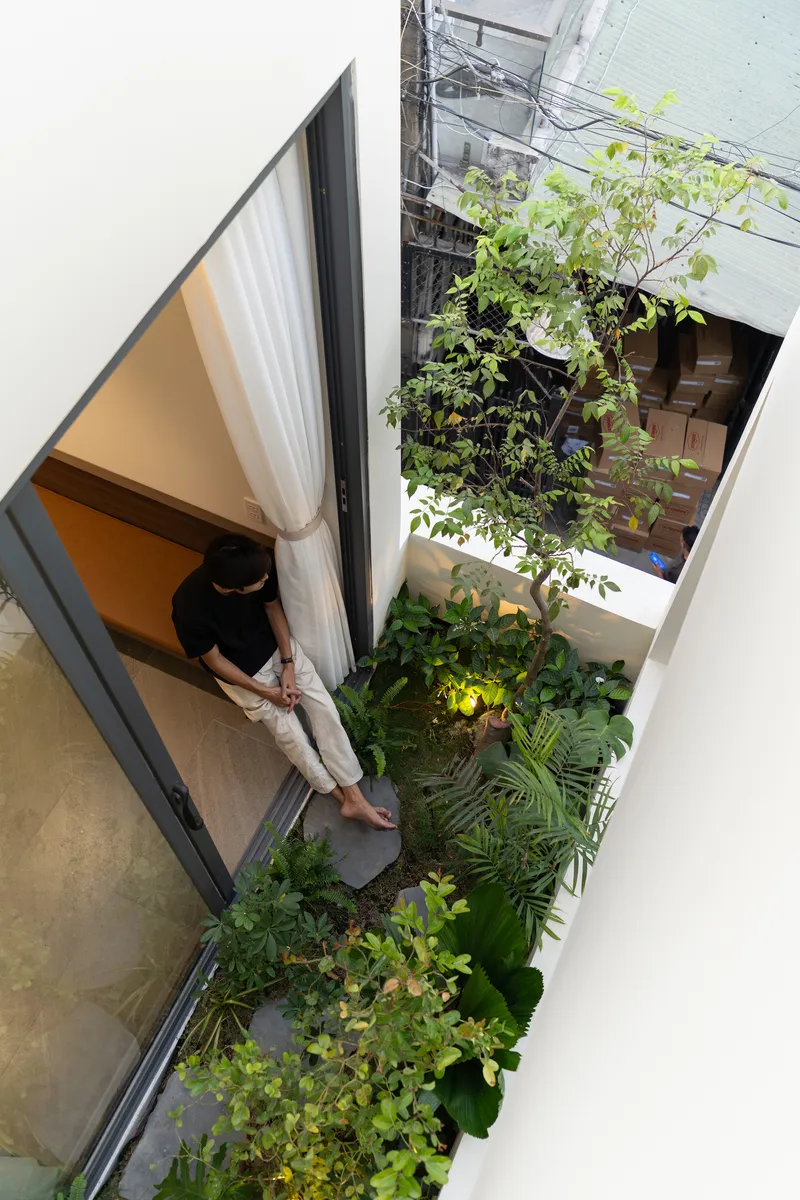
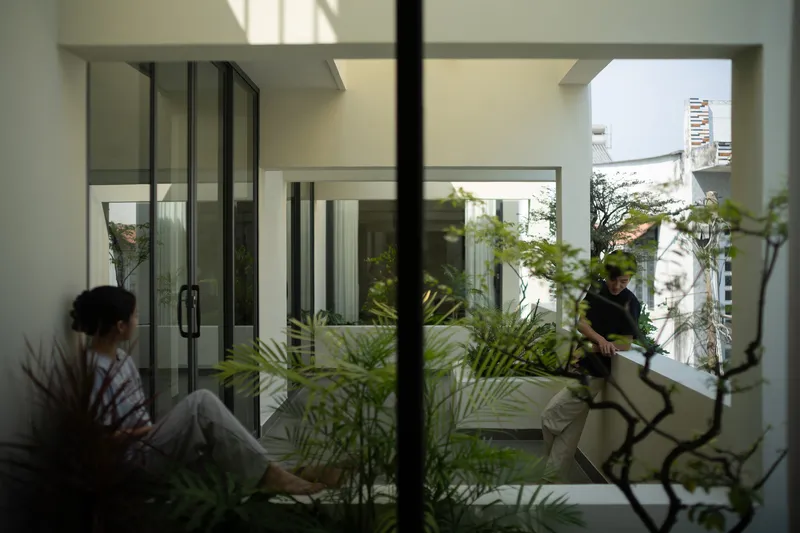
Step inside and the logic becomes clear. A narrow courtyard runs the depth of the house, open to the sky and lined with palms, climbing vines, and raised planting beds. Looking straight up, you see concrete beams bridging the gap between the two halves, with light pouring down through a skylight at the roof. It is a vertical garden and a stack ventilation shaft in one move.
From above, the courtyard appears almost absurdly lush for a 107 square meter house. A figure seated beside the planted beds looks like they are in a much larger garden, not wedged between two halves of a tube house. The void does heavy lifting: it brings cross ventilation to every room, eliminates the need for corridors by making the courtyard the primary circulation spine, and gives every bedroom a garden view.
Ground Floor: Entry, Gathering, Threshold
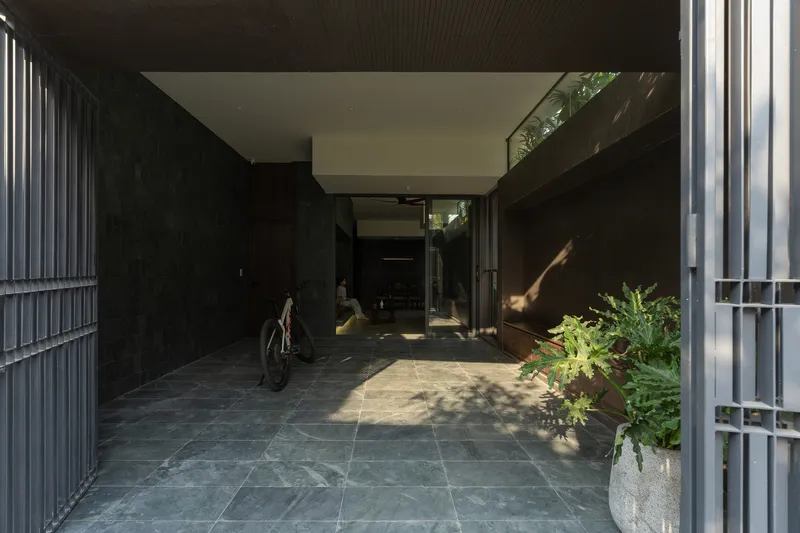
The arrival sequence is deliberately compressed. A covered passage with dark stone paving and slatted walls leads from the street into the courtyard, filtering light and slowing the transition from public to private. The dark stone and vertical metal screening create a moody threshold that contrasts sharply with the bright, open courtyard beyond.
Once inside, the ground floor opens into a living and dining zone that wraps around the void. Glass doors on both sides of the courtyard can swing open to merge interior and exterior into a single continuous space. The architects have effectively doubled the usable area of the ground floor by treating the courtyard as a room without a roof.
Living with Timber and Concrete
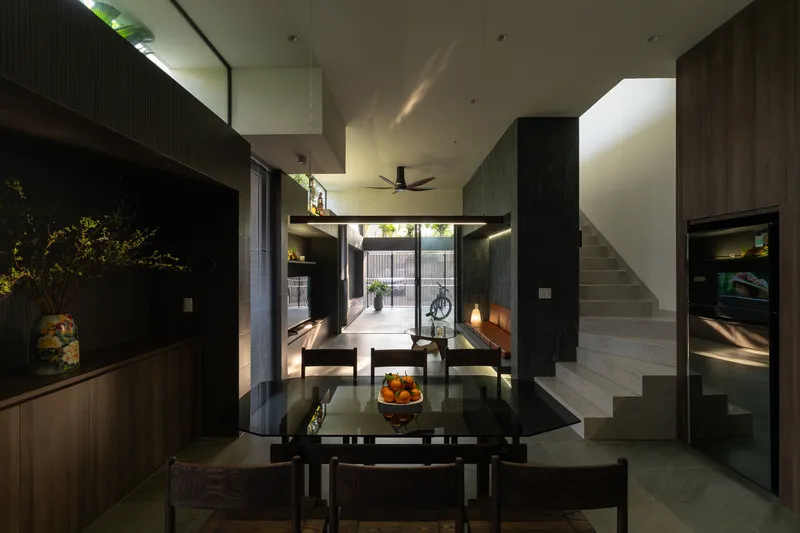

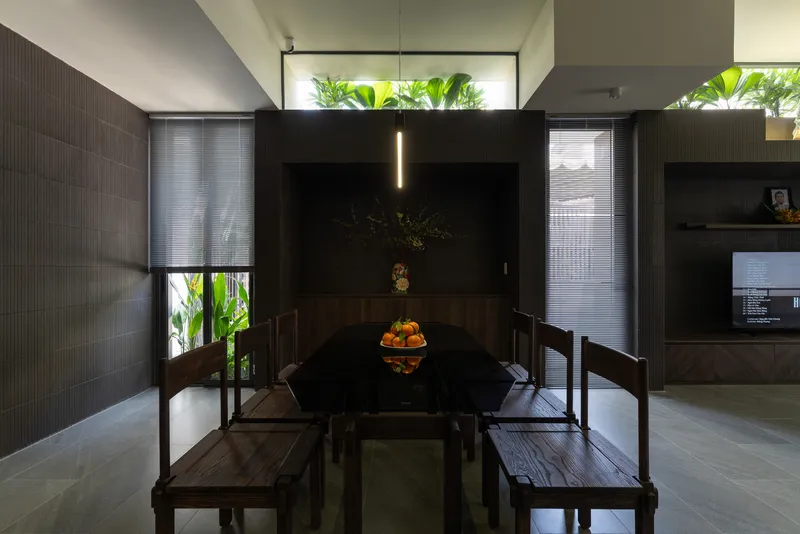
The material palette inside is restrained: dark timber joinery, exposed concrete stairs, and white plastered walls. The double-height dining area is the spatial climax of the ground floor, with a floating staircase threading upward and a high clerestory window stuffed with palm fronds filtering green light into the room. It is a moment that feels generous without being extravagant.
The kitchen tucks neatly against the staircase wall, its dark wood cabinetry and under-cabinet lighting creating an intimate workspace. There is a discipline here that keeps the interiors from competing with the courtyard. The rooms are simple containers; the garden does the talking.
Bedrooms and Private Courtyards
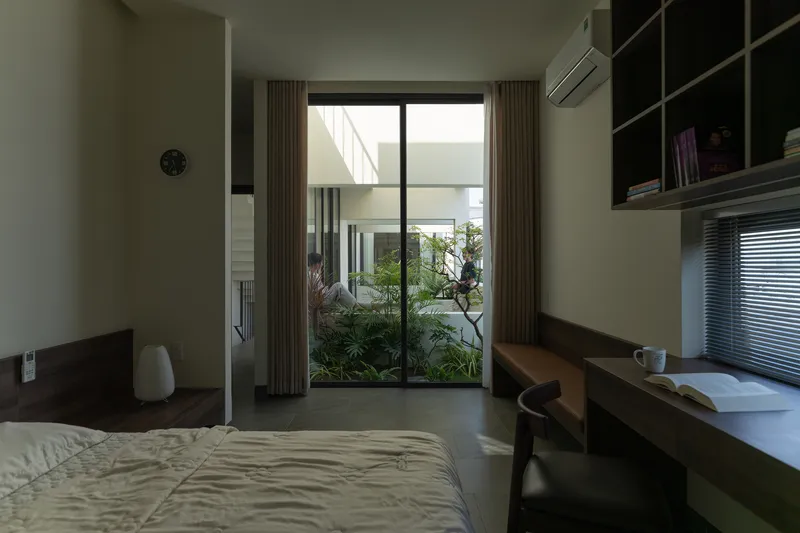
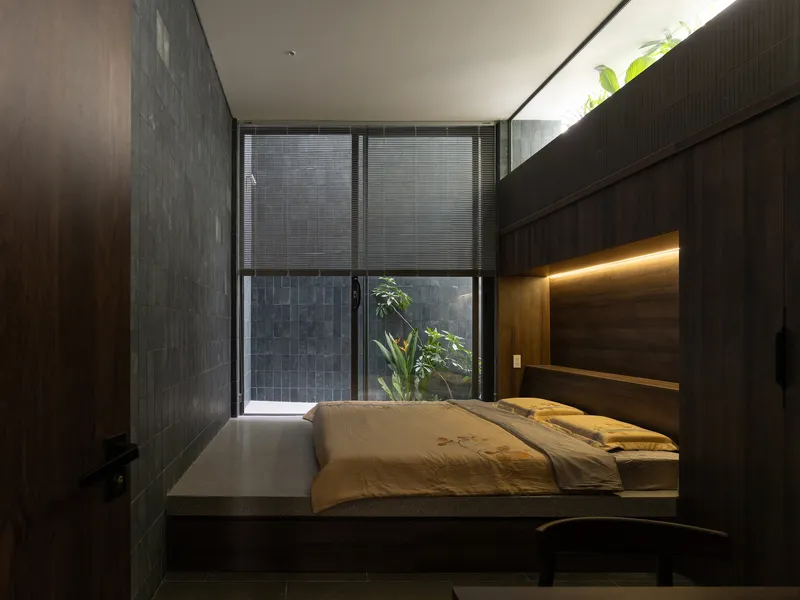
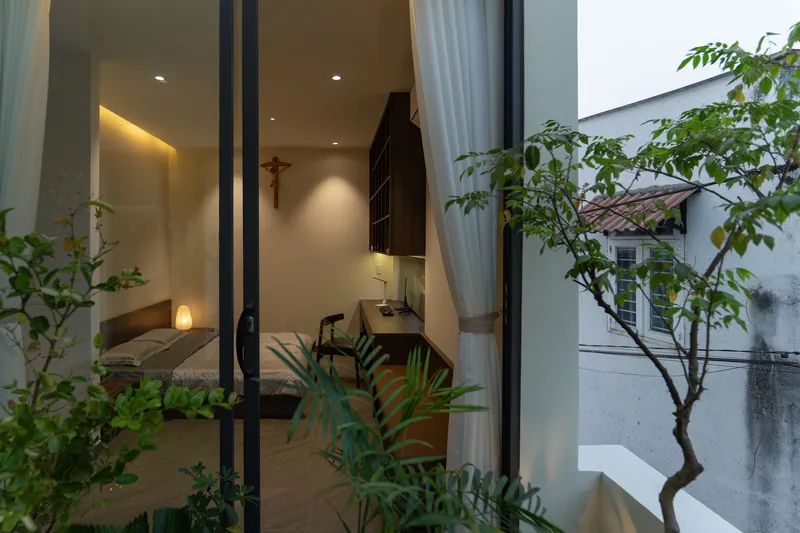
Each bedroom opens to its own fragment of the central void through glass doors or translucent sliding screens. One room pairs a timber desk with a view directly into a small planted courtyard. Another places the bed against a dark timber wall with a lightwell beyond, the translucent screen softening the boundary between sleep and garden.
At dusk, these rooms glow from within, and the planted courtyards become backlit shadow plays visible from the street. The bedrooms are modest in size but never feel cramped, because each one borrows space from the void. Privacy is handled through layering: screen, glass, planting, air gap, then the next room.
Bathrooms and Detail
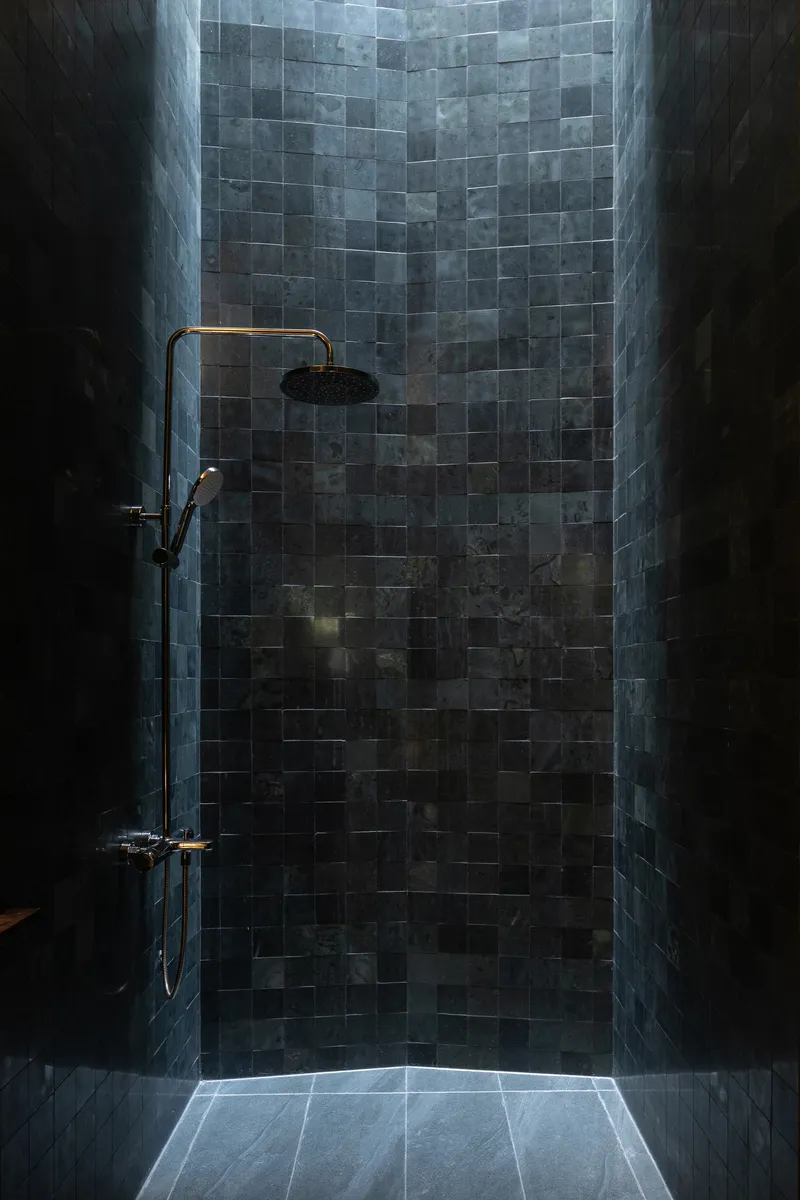
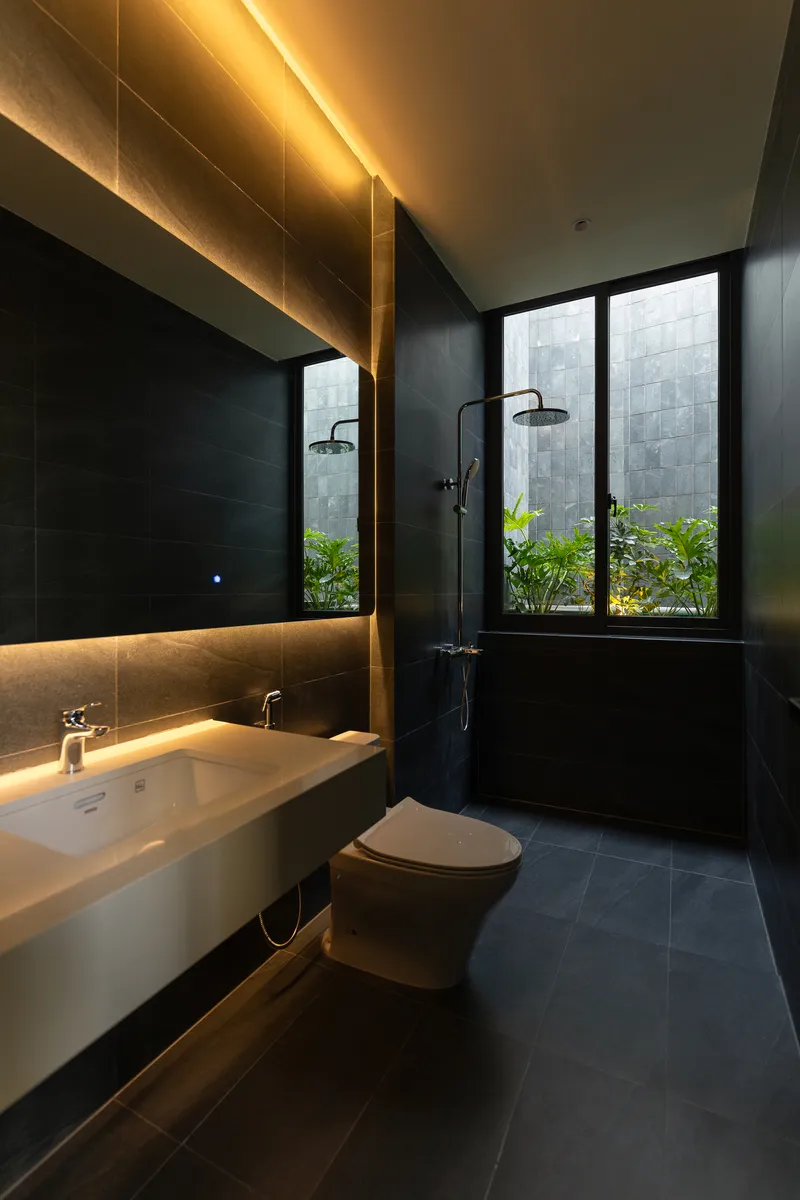
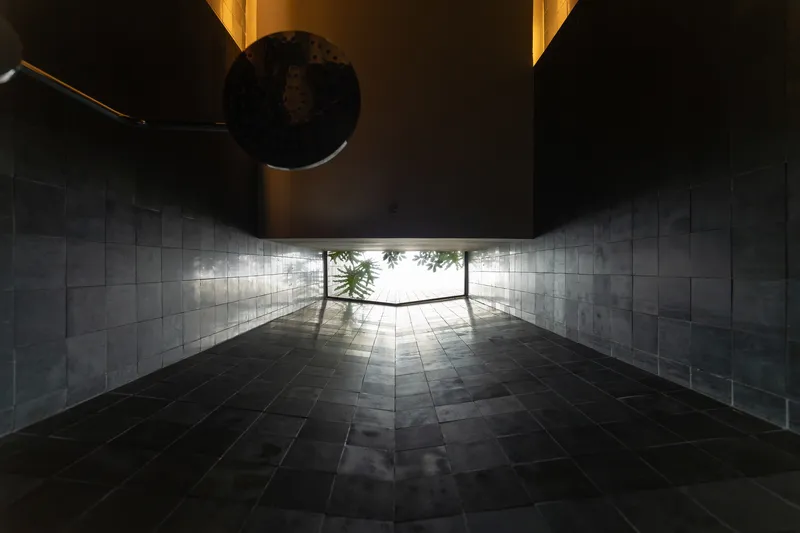
Even the wet rooms participate in the courtyard strategy. A bathroom with a floating vanity and backlit mirror overlooks a planted void through its window. The shower enclosure is clad in blue-grey glazed tile with brass fixtures and a backlit floor slit that introduces a thin line of light at the base. These are small spaces treated with real care, not afterthoughts hidden behind closed doors.
Rooftop and Twilight
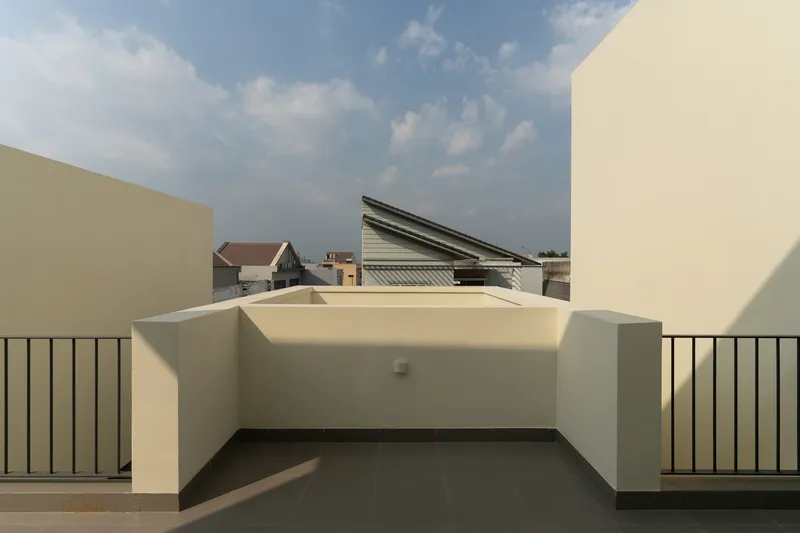
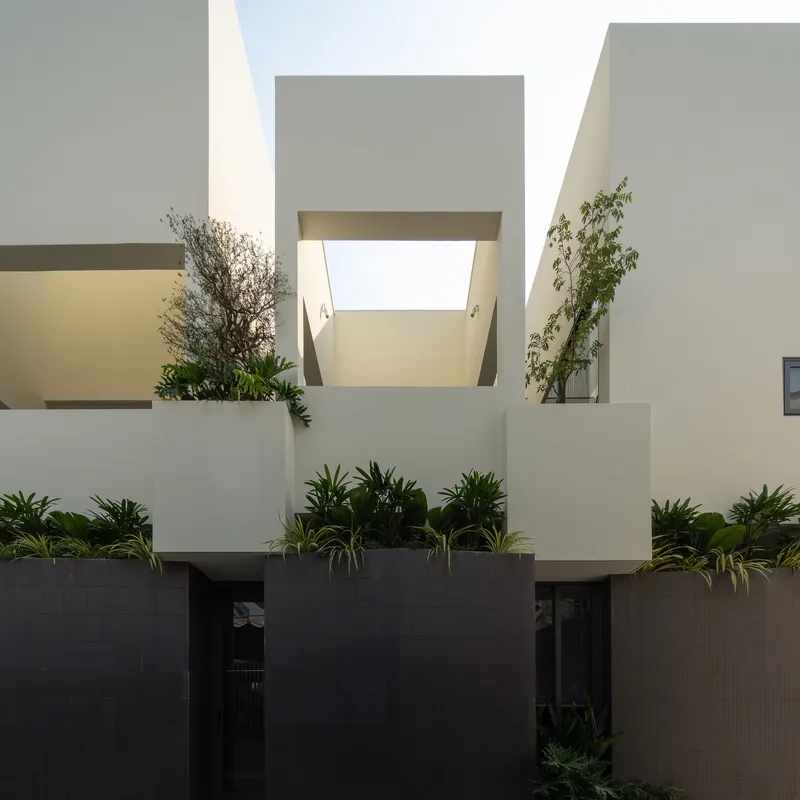
The rooftop terrace sits between the cream-colored parapet walls of the two volumes, offering a view over the neighborhood's low-rise roofscape. It is a simple outdoor room, functional rather than spectacular, but it completes the vertical sequence from dark entry passage to open sky.
From the street at dusk, the house reads as an illuminated stack of gardens. The planted terraces glow, the white volumes catch the last light, and the dark base recedes into shadow. A cyclist passes without looking up. The house does not demand attention; it simply breathes in a context that rarely allows it.
Plans and Drawings
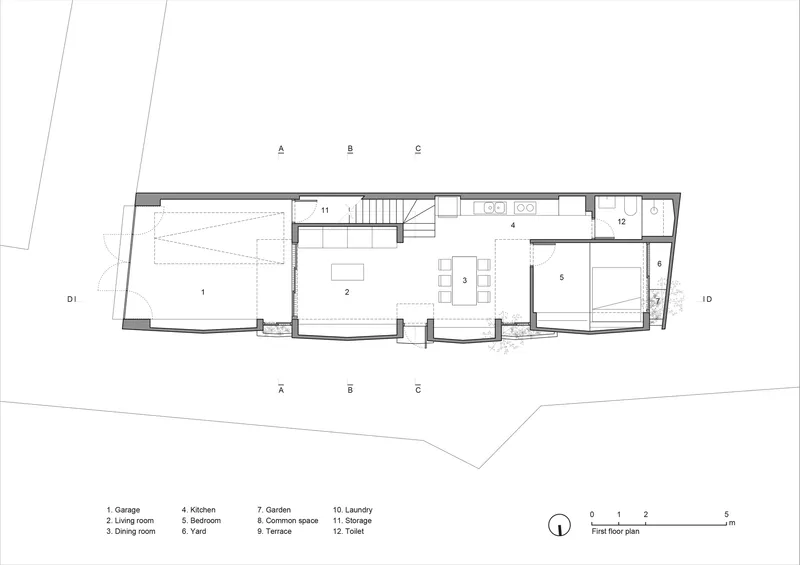

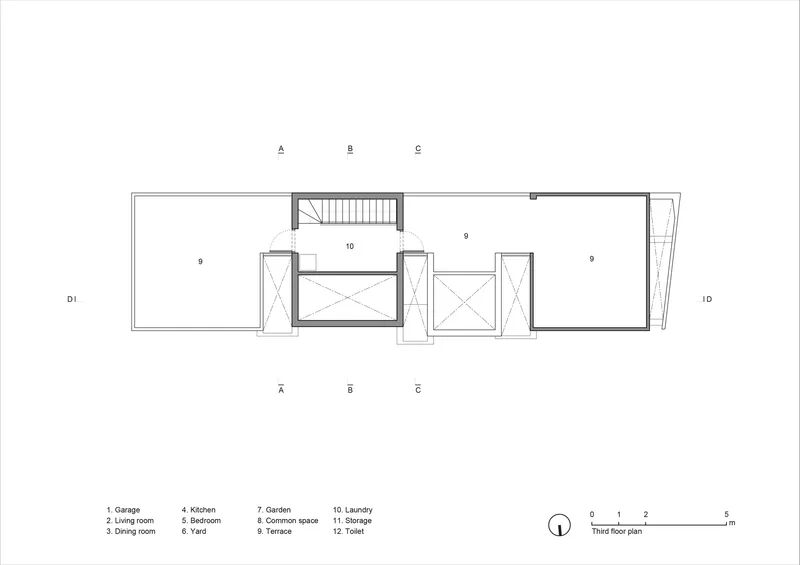
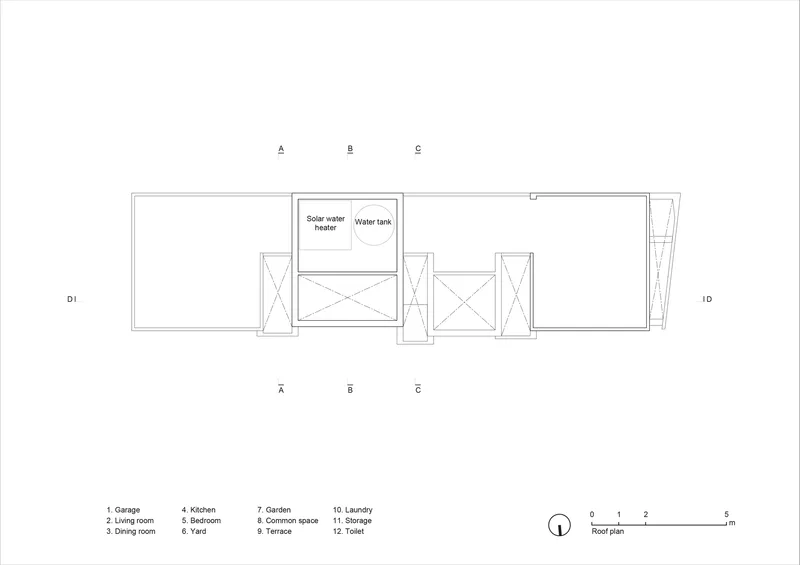
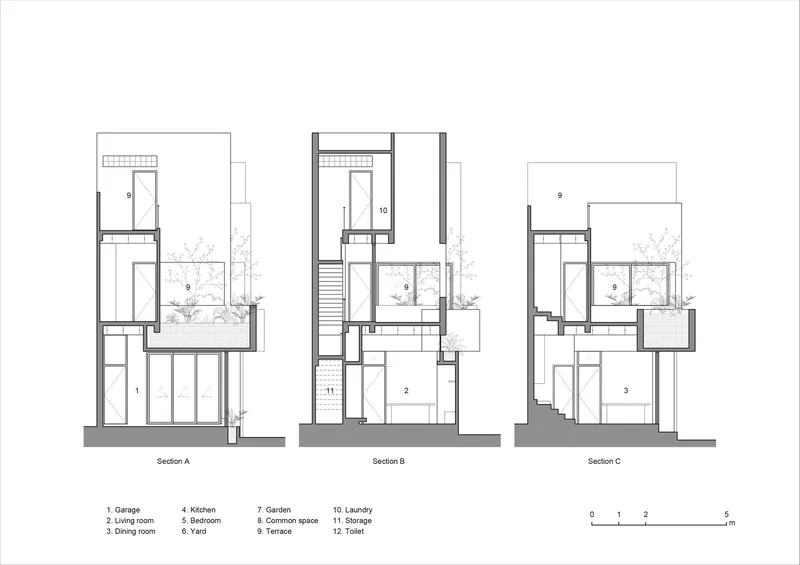
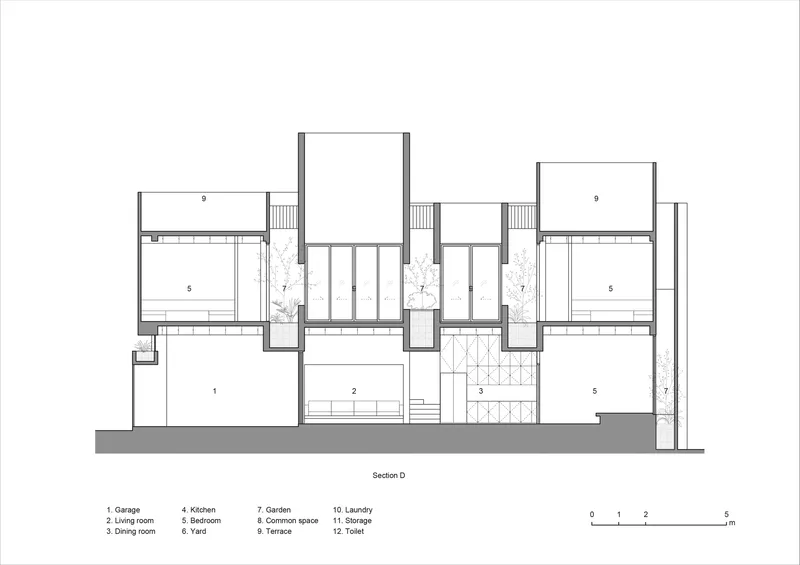
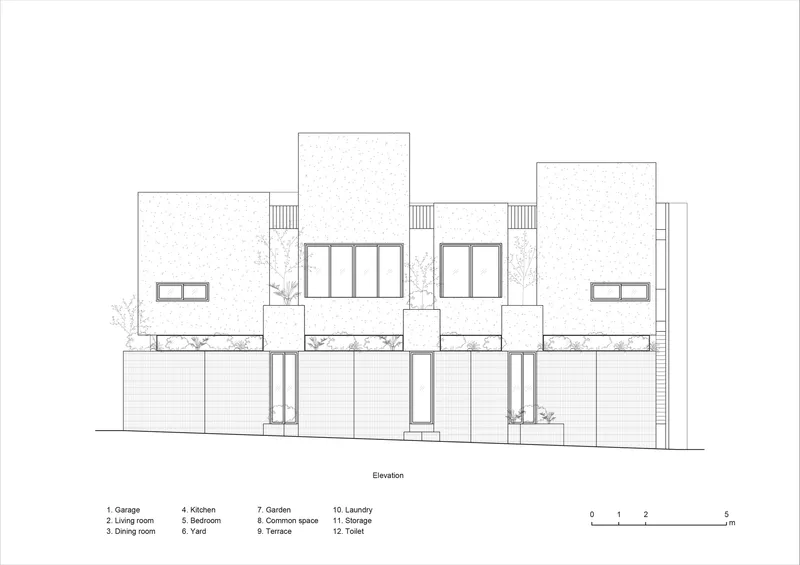
The floor plans reveal how tightly the program is packed into the 5-meter width. The ground floor fits a living room, dining room, bedroom, and garage. The second floor places two bedrooms on either side of the central void, confirming that the gap is not leftover space but the organizing principle of the plan. The sections are the most revealing drawings: they show how the split-level strategy creates half-floor offsets between the two volumes, allowing sightlines and airflow to pass diagonally through the house.
Three section cuts illustrate the staggered floor levels and the planted courtyard voids threading between volumes from ground to roof. The elevation drawing makes explicit what the photos suggest: the offset massing is not arbitrary but calibrated to maximize the surface area exposed to the central gap, ensuring that every room touches the void.
Why This Project Matters
The Vietnamese tube house is one of the most constrained housing typologies in Southeast Asia, and architects working within it face a recurring dilemma: fill the plot and sacrifice livability, or carve out voids and lose precious floor area. The Gap House demonstrates that the trade-off is not as zero-sum as it appears. By splitting the building into two halves and threading a continuous garden between them, Atelier TAs delivers 107 square meters that feel open, ventilated, and connected to nature, all on a plot where most developers would produce a sealed concrete box.
What makes the project compelling is its replicability. The strategy does not depend on expensive materials, heroic engineering, or an unusual site. It works because of a simple organizational decision: prioritize the gap. In a region where urban density is accelerating and tube houses are multiplying by the thousands, that decision could be genuinely transformative if adopted more widely. Atelier TAs has built a proof of concept that is also, quietly, a very good house.
The Gap House by Atelier TAs (lead architect: Tuan Anh Ngo), Dong Nai, Vietnam. 107 m², completed 2025. Photography by Quang Dam.
About the Studio
Share Your Own Work on uni.xyz
If projects like this are the kind of work you want to make, uni.xyz is a place to publish your own, find collaborators, and enter design competitions.


Popular Articles
Popular articles from the community


Cube Design Draws an Ecological Corridor Between Two Shenzhen Hills with the Nankai Building
Beside Shenzhen's container docks, the Nankai Building pairs stacked balconies with a climbing green screen to connect two hillsides across its height.

GROUP A Strips a 1969 Rotterdam Harbor Headquarters to Its Frame and Wraps It in Timber Louvers
In Rotterdam's M4H harbor district, Ferro Offices reuses a 1969 frame, adds one timber storey and reaches BREEAM-NL Outstanding.

U.GA Architects Wraps an Oval Rooftop Pool in Curved Board-Formed Concrete on Busan's Jeollidan-gil
In Busan's Jeonpo-dong, a 454 m² mixed-use block stacks a neighborhood facility, guest rooms and an oval rooftop pool inside spiraling concrete walls.

LT2A and OPEN Architectes Thread a Brick and Glass High School Through a Wooded Belgian Campus
In Braine-l'Alleud, a 3,000 m² wing for Collège Cardinal Mercier pairs pale brick with a glazed colonnade, deferring to a small chapel and a dense wood.

Similar Reads
You might also enjoy these articles


LAVA Architecten Gives Vocational Education a Sawtooth-Roofed Face on a Mechelen School Campus
In Mechelen, Belgium, a 2,053 m² STEM school on a 6×6 m grid turns workshops and classrooms into rooms that can be rearranged as teaching changes.

KEMA Studio Turns a Derelict Marvila Attic into a 60 m² Lighthouse Apartment Above Lisbon
In Lisbon's Marvila district, a rebuilt roof, four skylights and two plywood volumes turn an unlivable attic into a bright home facing the Tagus.

Pixel Gardens: One Repeated Module Stacked Into a Terraced Social Housing Tower for Famagusta
Salem Bader's shortlisted housing tower builds a vertical neighbourhood from one repeated module, offsetting units to carve terraces, light and air.

Bao Huynh Watercolor Atelier: A Serene Art Retreat in Hội An
Bao Huynh Watercolor Atelier in Hội An blends multifunctional art spaces, sustainable design, local materials, and family-friendly living in a serene environment.
Explore Plug-In House Competitions
Discover active competitions in this discipline

Comments (0)
Please login or sign up to add comments
No comments yet. Be the first to comment!