
Atelier Téqui Architects Builds a Frugal Timber Research Center on a Former Livestock Market in Arras
A prefabricated wood and stamped concrete laboratory in Saint-Laurent-Blangy channels soil science into a sober, light-filled architecture.


A research building devoted to the relationship between soil, plants, and food might reasonably look industrial, tucked into a business park and forgotten. Atelier Téqui Architects refused that script. Sited on the former parking lot of a livestock market at the seam of three communes near Arras, the Grand Arras Agronomic and Agri-food Research & Development Center is a 1,821 m² facility for INRAE and the University of Artois that treats frugality as an architectural discipline rather than a constraint. The building reads as a deliberate instrument: sober on the outside, generous on the inside, with every material choice legible and every system exposed.
What makes the project genuinely interesting is its insistence that a laboratory can be both ecologically rigorous and spatially pleasurable. A central patio organizes all program around daylight and views, timber structure achieves long spans without intermediate pillars, and the entire envelope was prefabricated off-site before assembly. The result is a building that practices what its researchers preach: a careful, evidence-based cycle from raw material to finished environment.
Two Materials, One Legible Expression
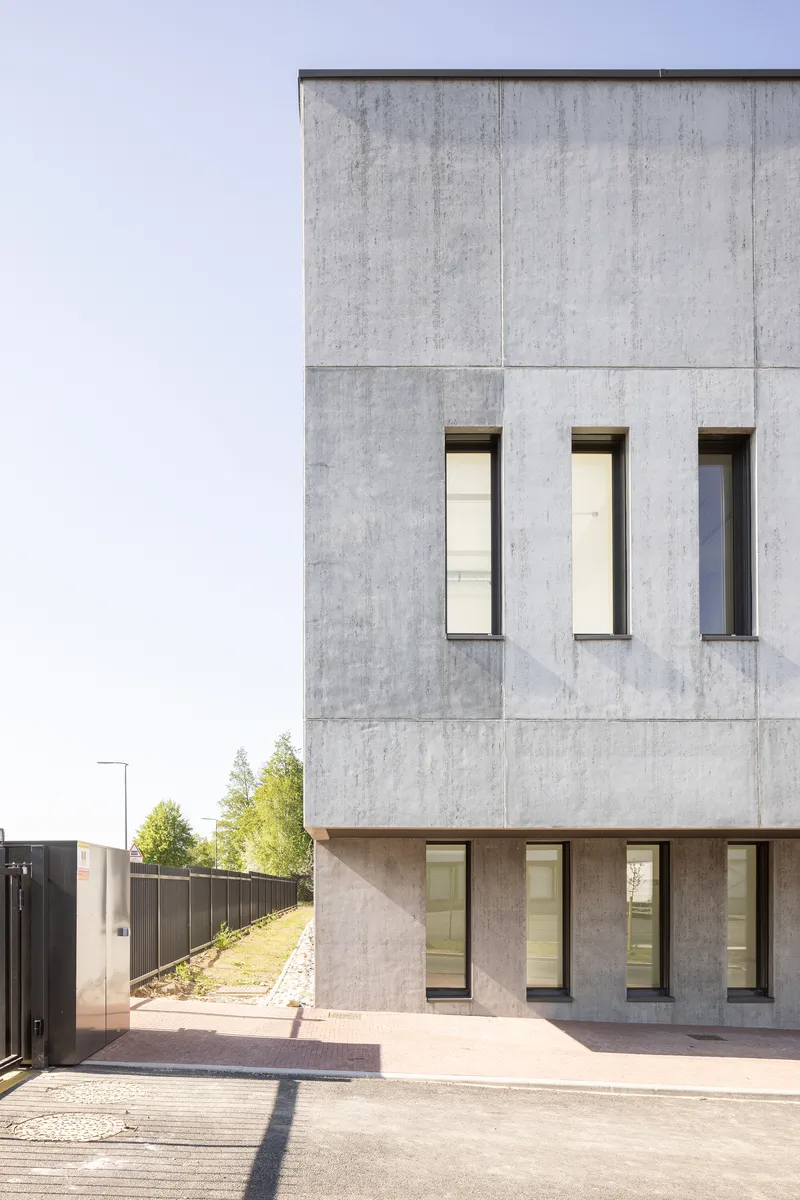
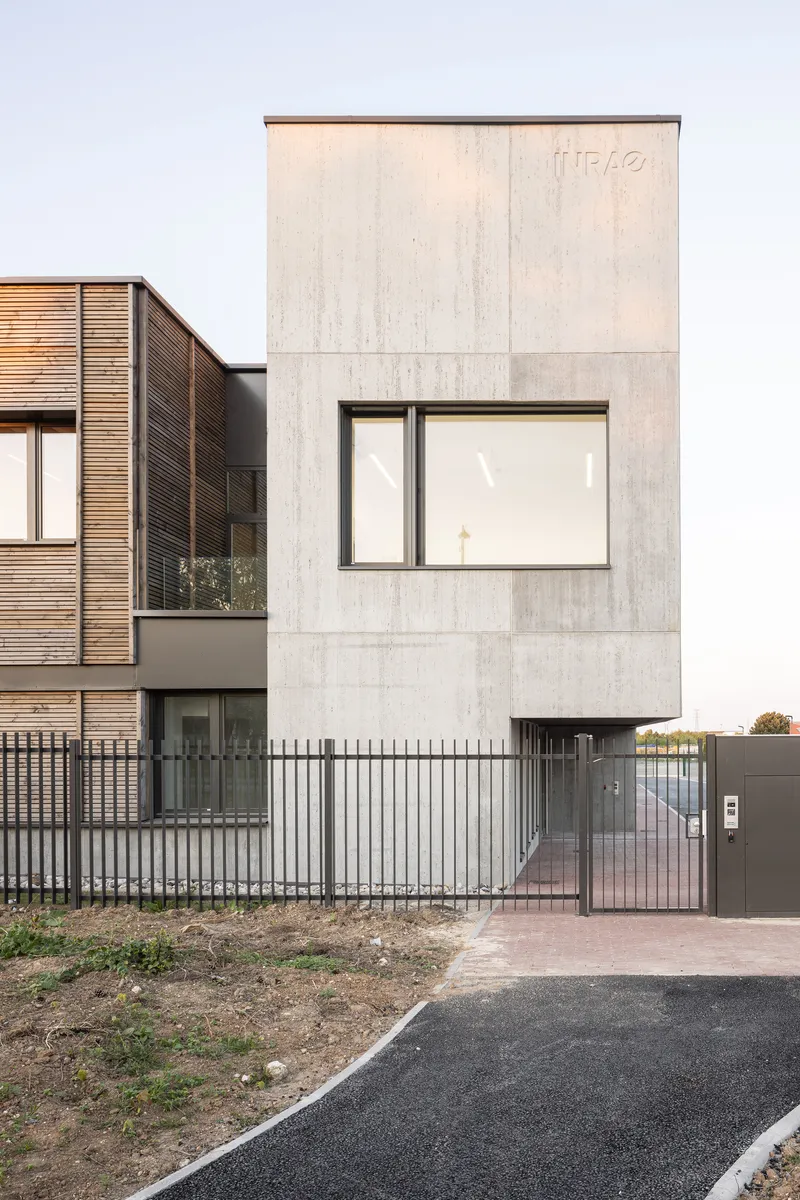
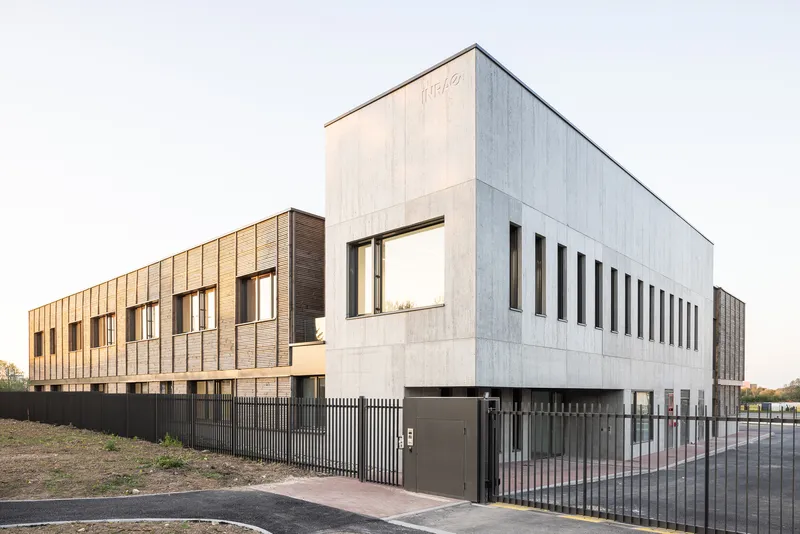
The street-facing volume is stamped concrete, rising to a double-height mass punctured by tall vertical windows. It reads as a civic marker in a peri-urban context that otherwise lacks architectural punctuation. The adjacent main volume is wrapped in horizontal timber slats over a concrete plinth, and a dark gray metal profile traces the boundary between ground and first floor, carrying special fluid networks for the laboratories. The material pairing is not decorative; it is a direct expression of structural logic. Concrete anchors the entrance and houses rooftop technical installations for both volumes, while the timber frame delivers the large, column-free spans that laboratories demand.
Factory prefabrication of both wood-frame walls and stamped concrete panels kept site disruption low and construction tolerances tight. You can see this precision in the joinery: wood inside, aluminum tinted deep gray outside, with no fussy detailing to distract from the honest assembly.
Timber Cladding and the Dusk Silhouette
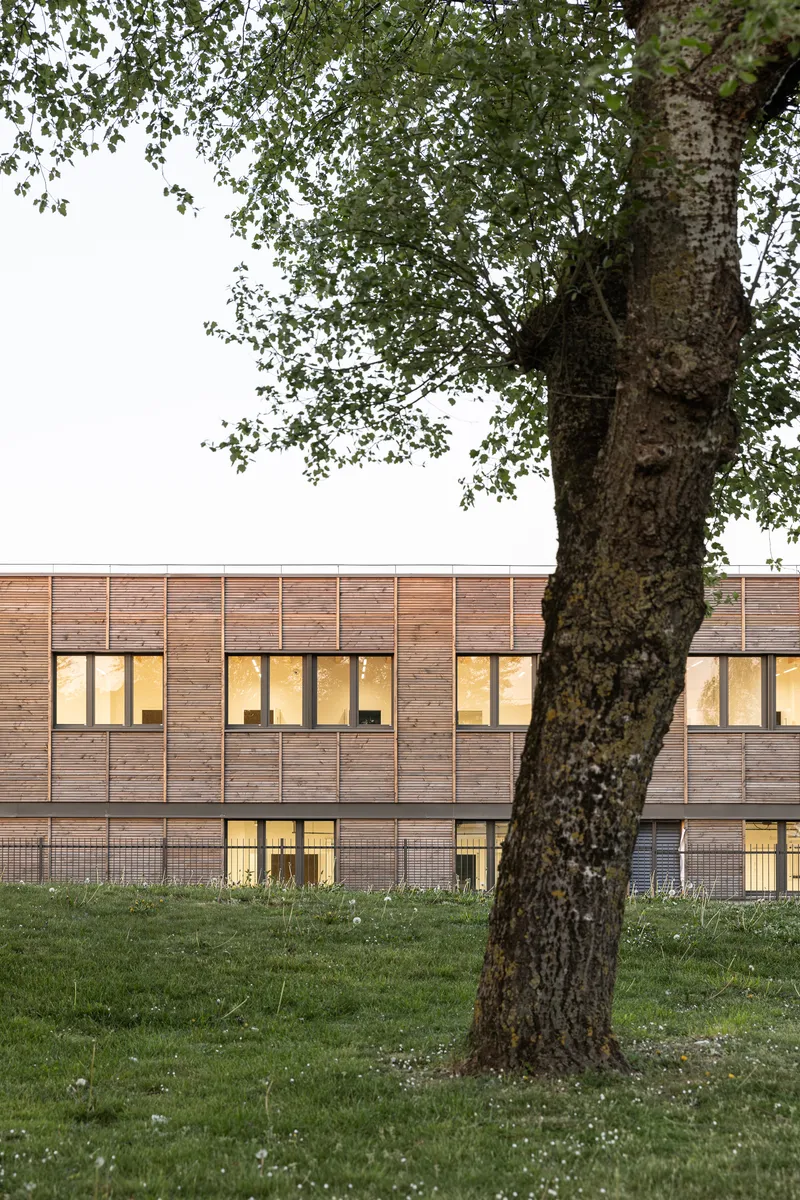
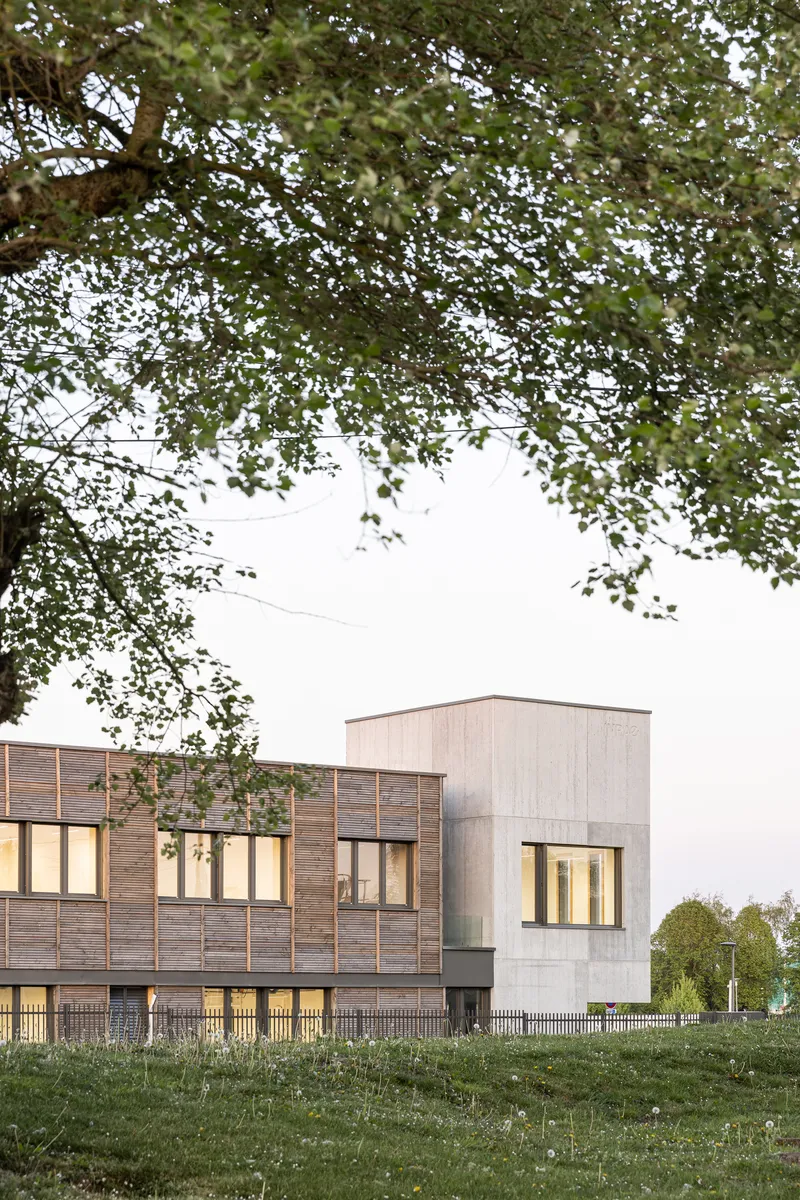
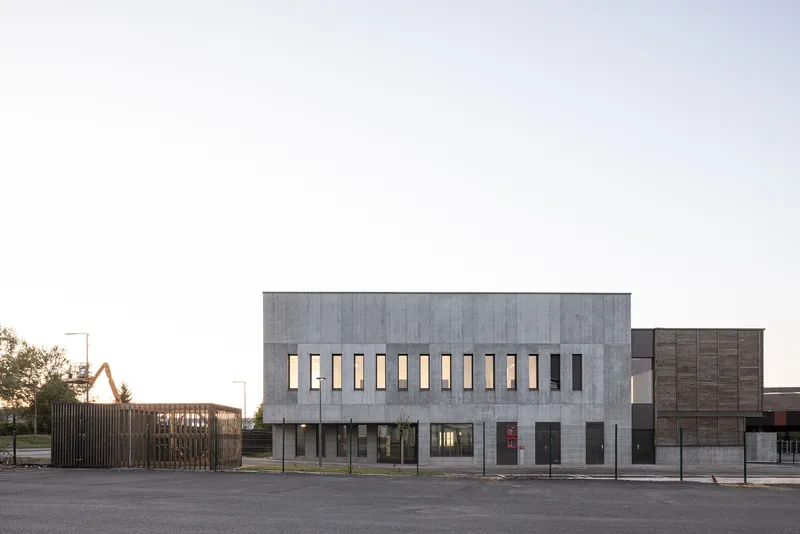
At dusk the building transforms. The horizontal timber screens glow from behind, turning the facade into a lantern that announces activity without exposing lab interiors. Mature trees on the planted berm filter views from the street, and the south-facing cantilever shelters the entrance without resorting to a canopy. The night character is important because it demonstrates that the facade is not just a rain screen; it is a mediating layer between public street and controlled research environment, calibrated for privacy, light modulation, and ventilation.
The Patio as Organizational Engine
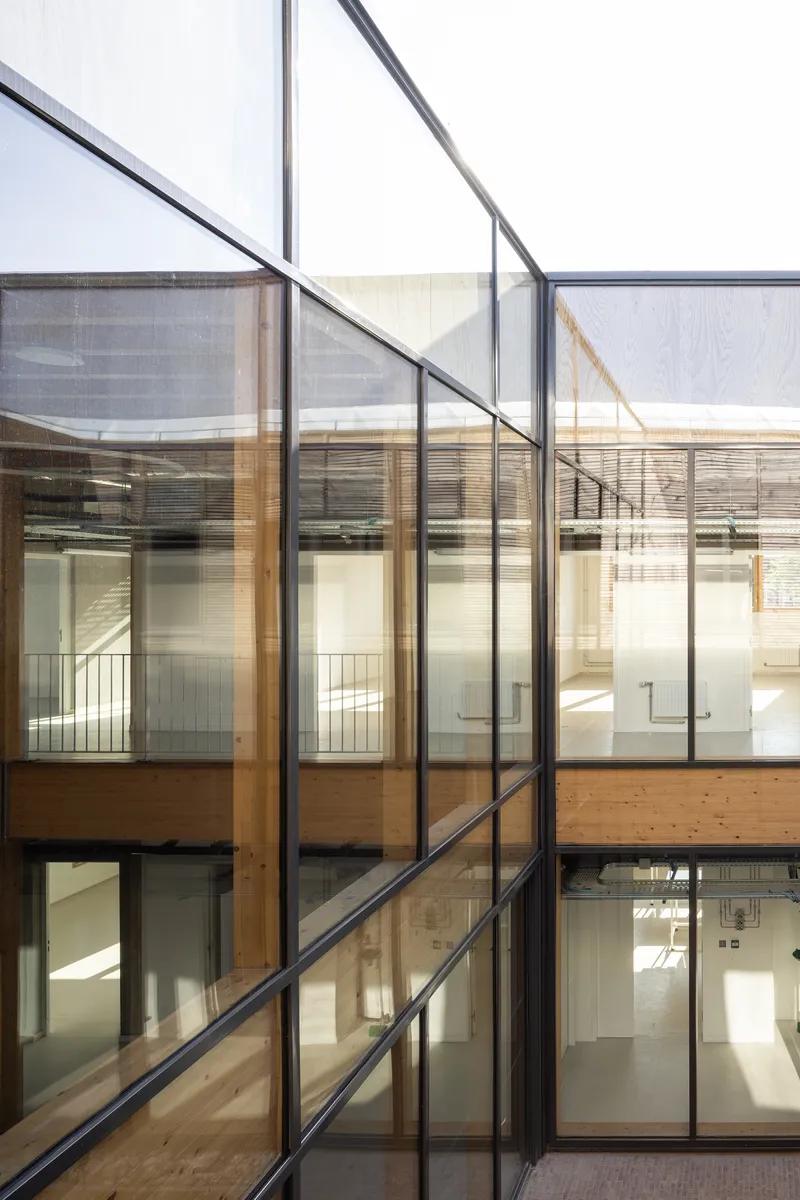
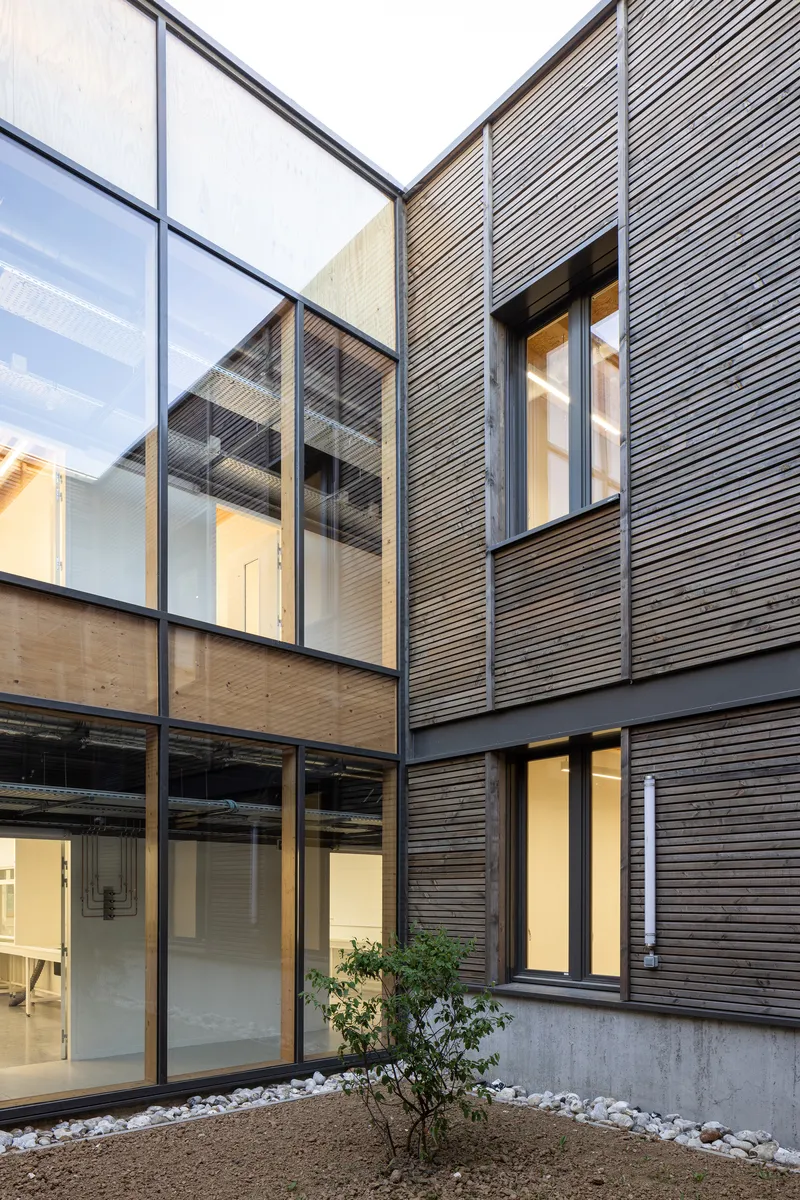
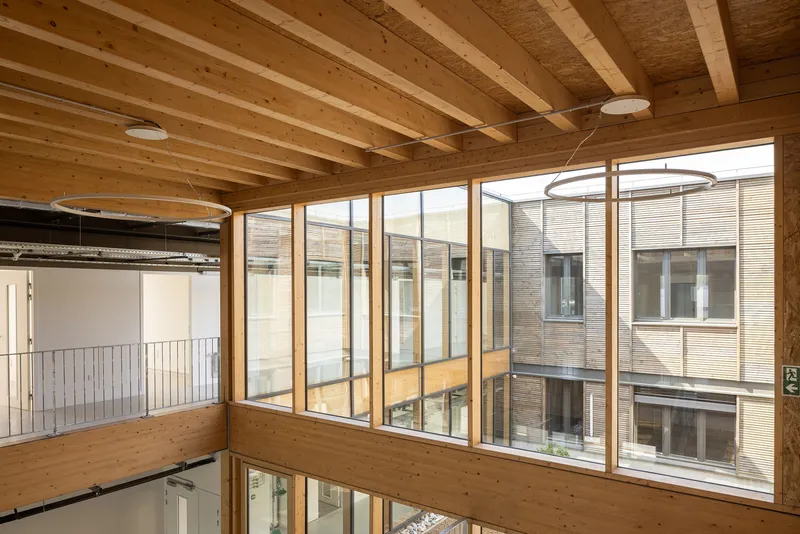
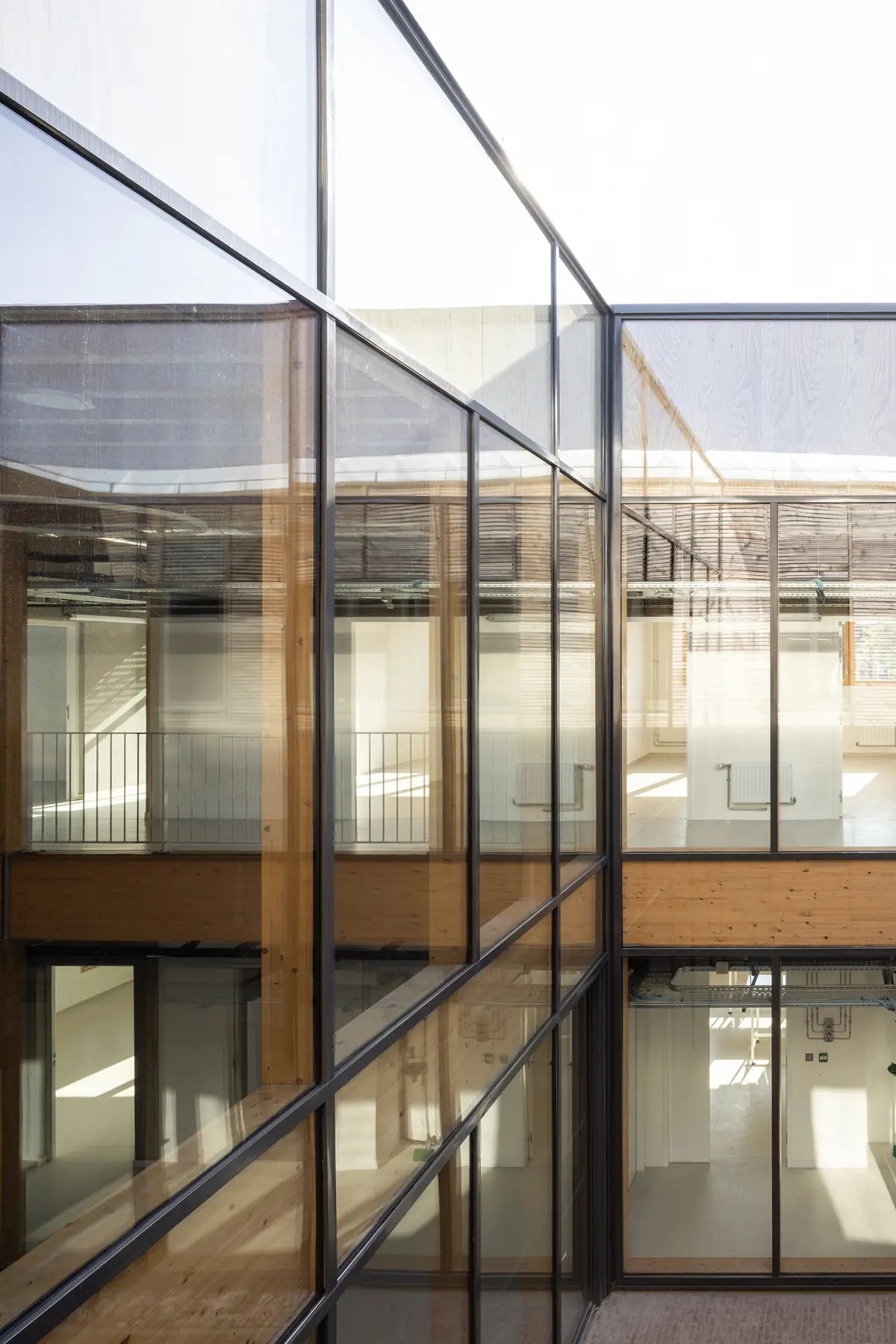
The courtyard is the single most consequential design decision. By wrapping 680 m² of laboratories, 335 m² of offices, and shared spaces around a landscaped void, the architects guarantee natural light penetration to every room and create a social focus that a double-loaded corridor plan could never provide. Floor-to-ceiling glazing on the courtyard facades exposes the timber beams spanning between levels, making the structure legible from every angle. A small planted shrub in the courtyard operates as a quiet reminder of the soil-to-food research happening inside.
Crucially, the patio arrangement also future-proofs the building. Laboratories evolve as research priorities shift, and the courtyard plan allows medium- to long-term restructuring without demolishing load-bearing partitions. It is adaptive design embedded in the plan, not bolted on as an afterthought.
Exposed Systems and the Honest Interior
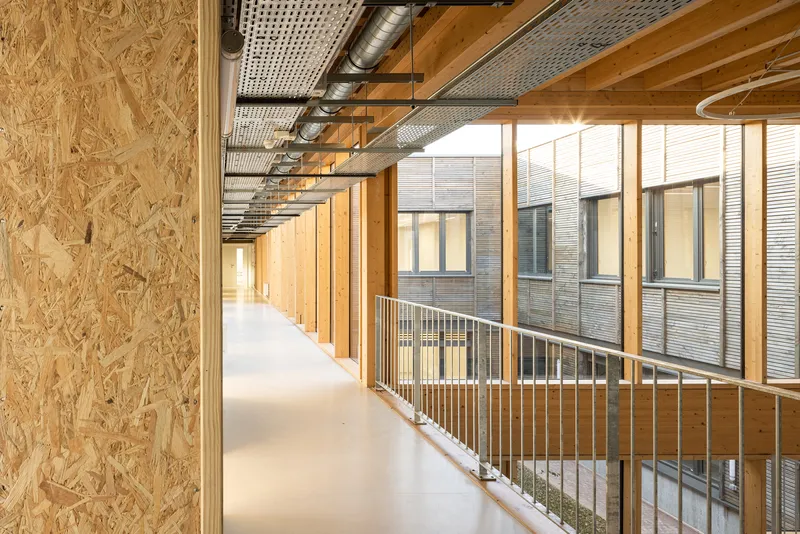
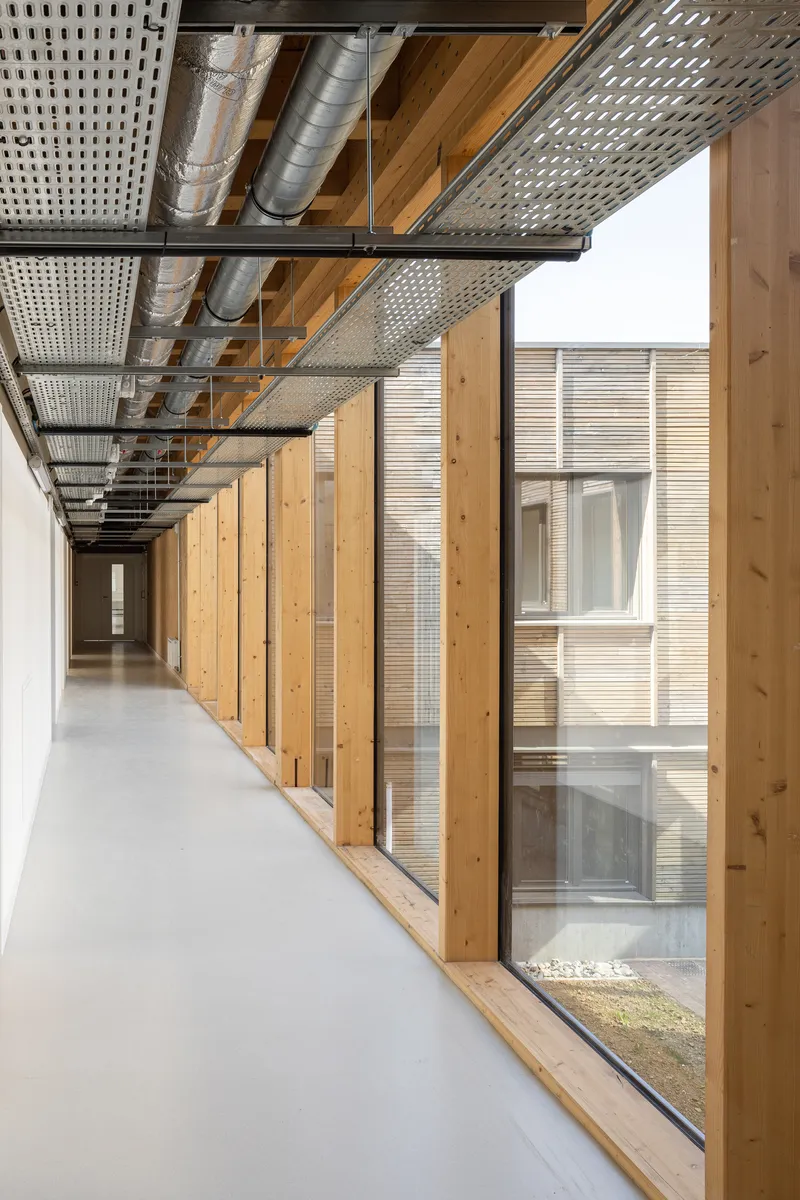
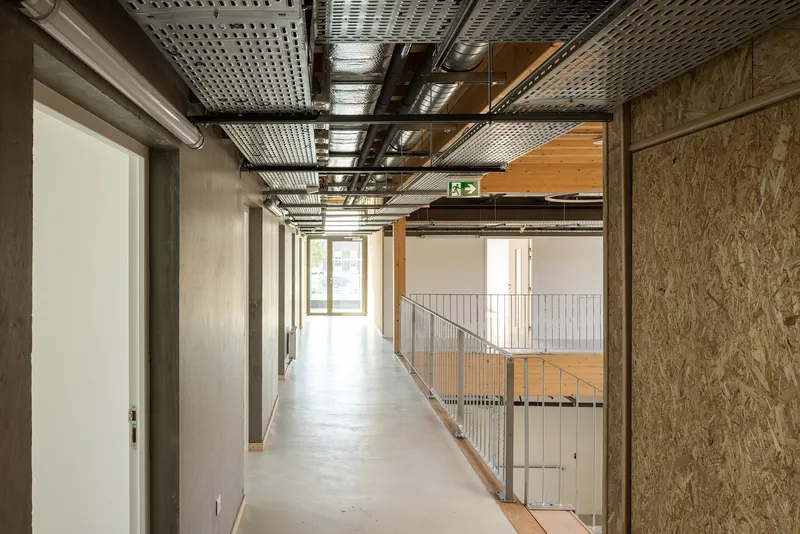
Step inside and every network is visible: ductwork, perforated metal ceiling panels, steel guardrails, oriented strand board walls left unfinished. The decision to expose services is partly pragmatic, since visible networks are easier to maintain, but it also gives researchers a direct understanding of how their building breathes and circulates. In a laboratory context, where environmental control is paramount, the legibility of mechanical systems is not a style choice; it is operational intelligence.
Corridors are generous, running alongside the courtyard glazing so that circulation becomes a moment of daylight rather than a dead zone. The upper-level walkways double as informal meeting points, reinforcing the idea that research thrives on casual encounter.
Laboratories and Workspaces Under Timber Spans
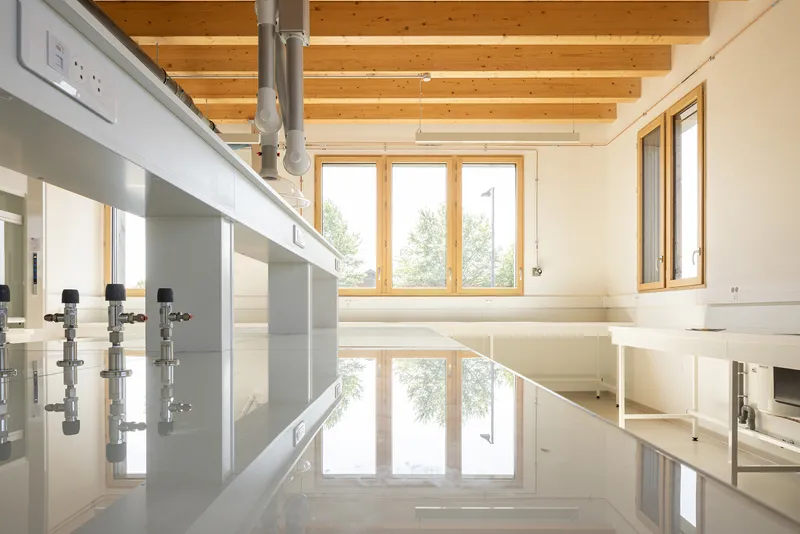
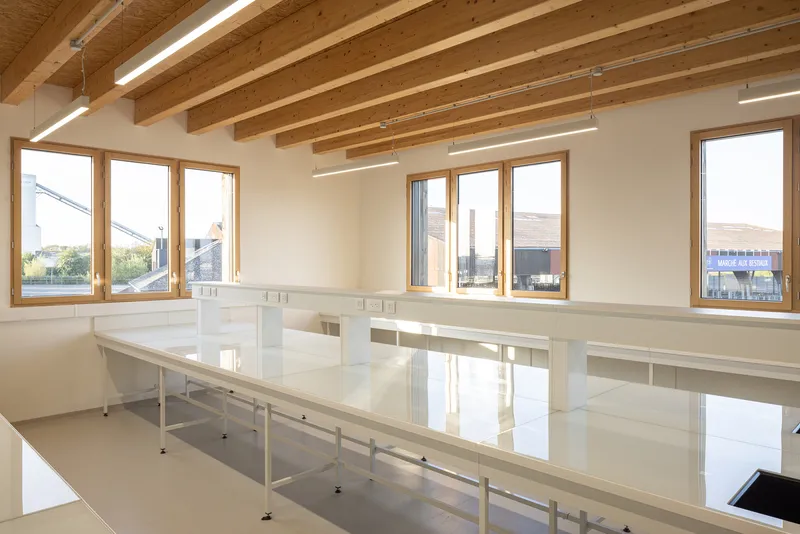
The laboratories occupy the largest share of the program, and their quality sets this project apart from typical institutional fitouts. Polished epoxy floors, triple casement windows, and exposed timber beams give the lab spaces a warmth rarely associated with scientific work. Wood and concrete composite floors achieve the long spans that allow flexible bench layouts, and the absence of intermediate pillars means equipment can be rearranged without confronting structural obstacles.
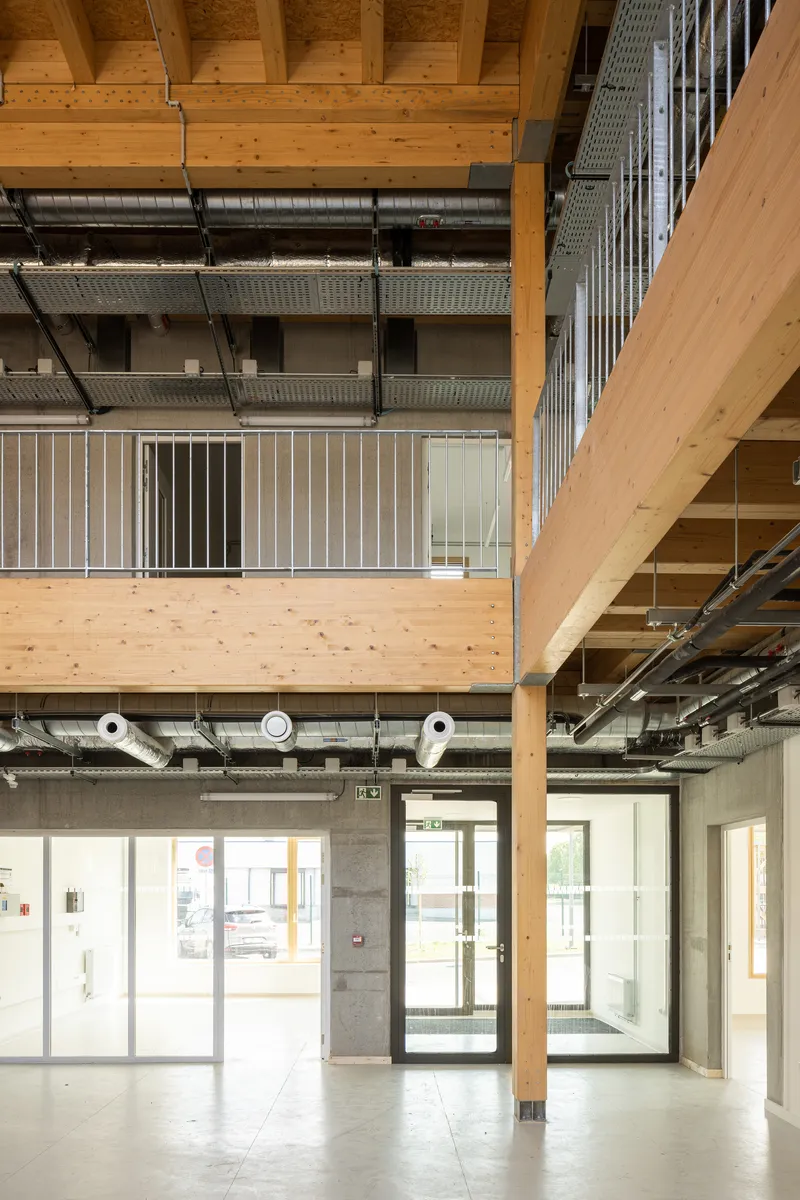
Office areas follow the same material logic: white tables under exposed timber joists, linear pendant lighting, and no suspended ceilings to conceal the reality of the structure. The double-height atrium with its metal ductwork spanning across levels provides generous volume where the program could have accepted compression. This is what the architects mean by "frugal but generous." Resources are allocated to spatial quality, not decorative finish.
The Staircase and Vertical Circulation
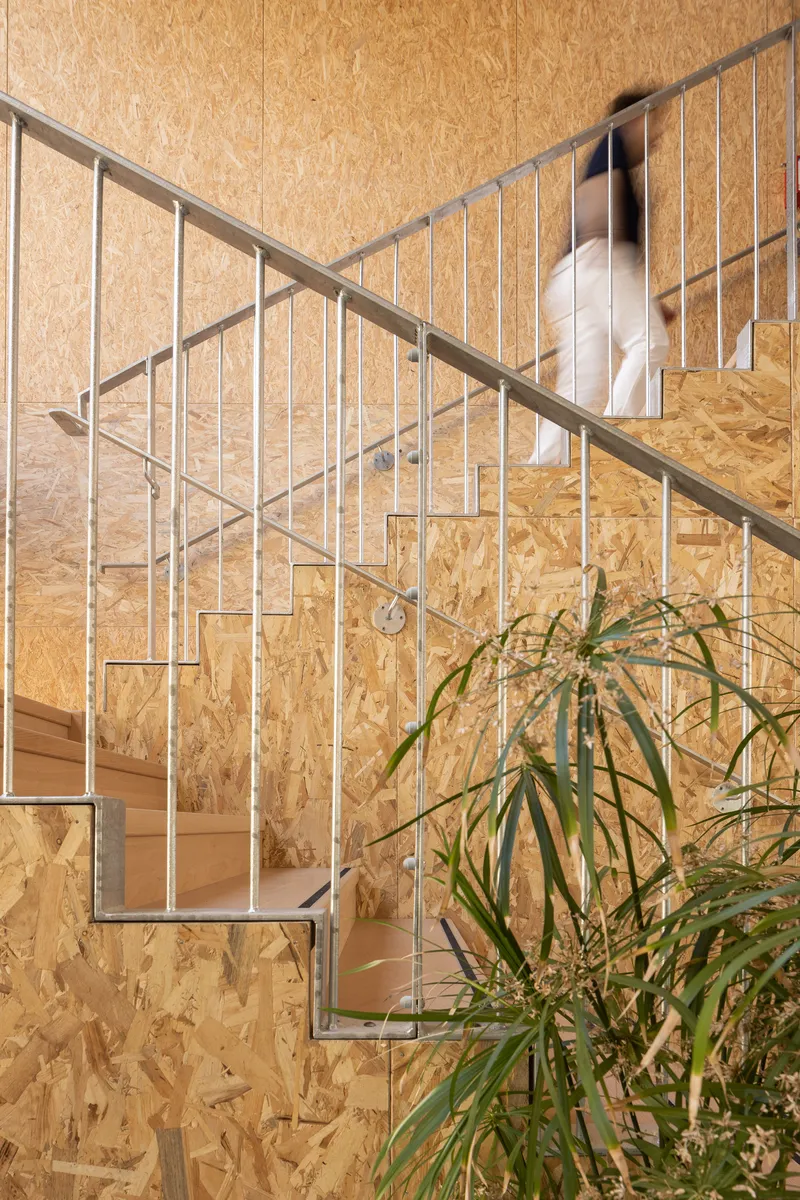
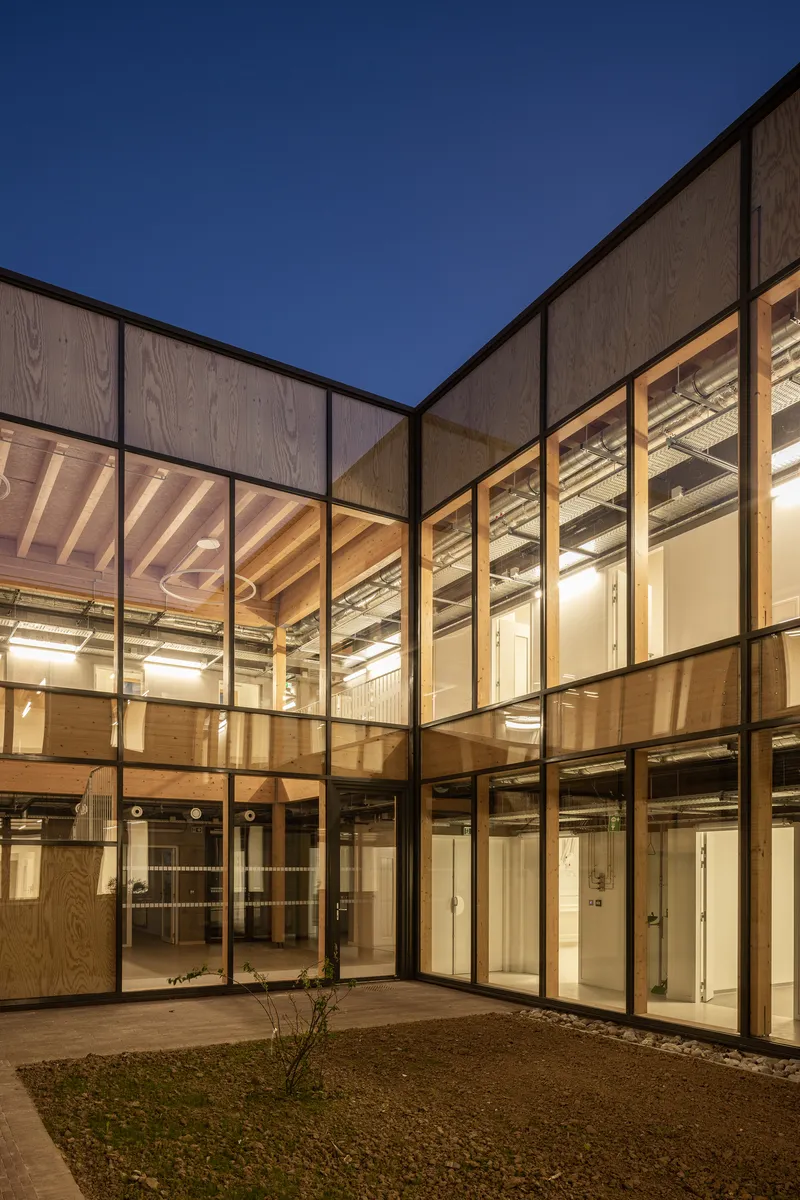
The main staircase is attached to both the patio and the reception area, a deliberate decision to make vertical movement a public event. Metal rod balustrades and oriented strand board walls frame the ascent without adding mass. At night, the corner glazing at the stair landing reveals the timber-framed interior to the street, collapsing the boundary between institution and neighborhood. It is a small gesture that carries weight in a business district that could easily default to opacity.
Landscape and the Mineral-to-Plant Threshold
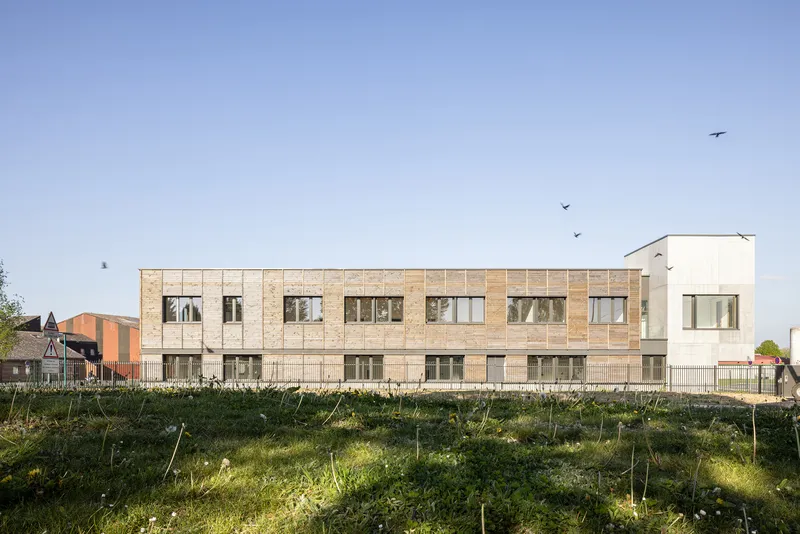
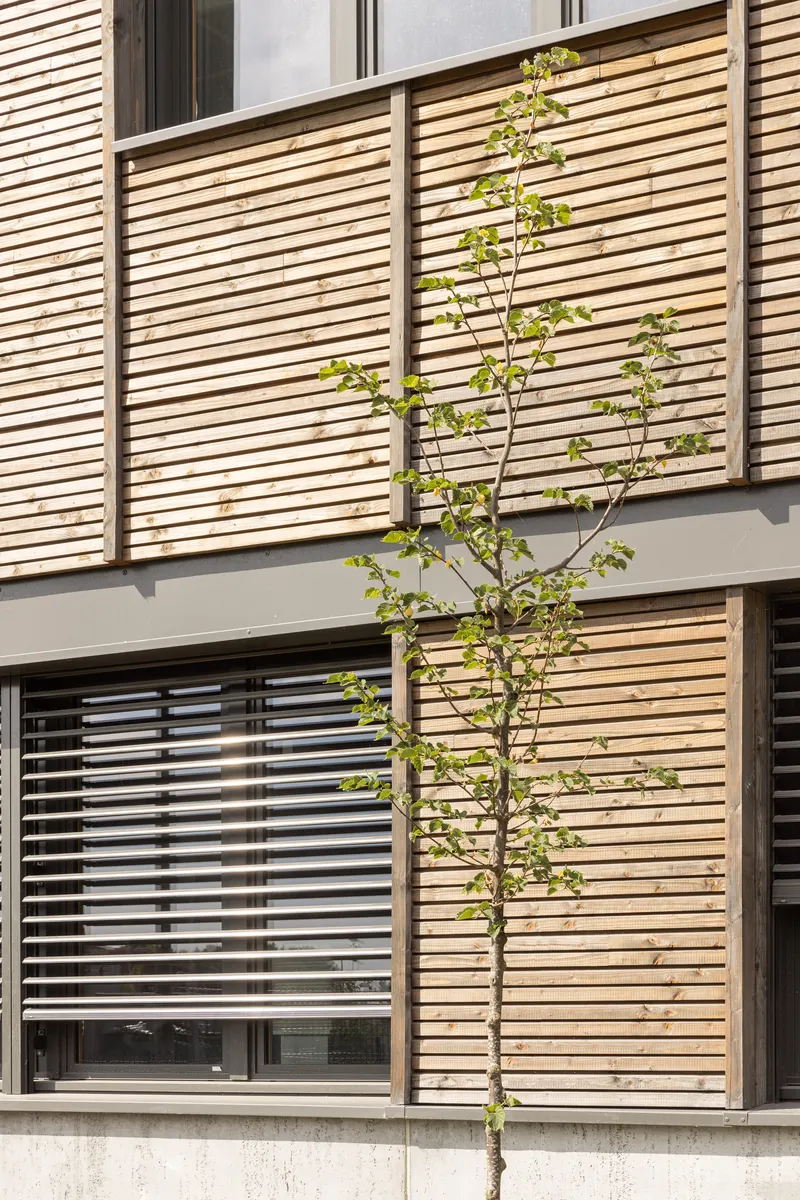
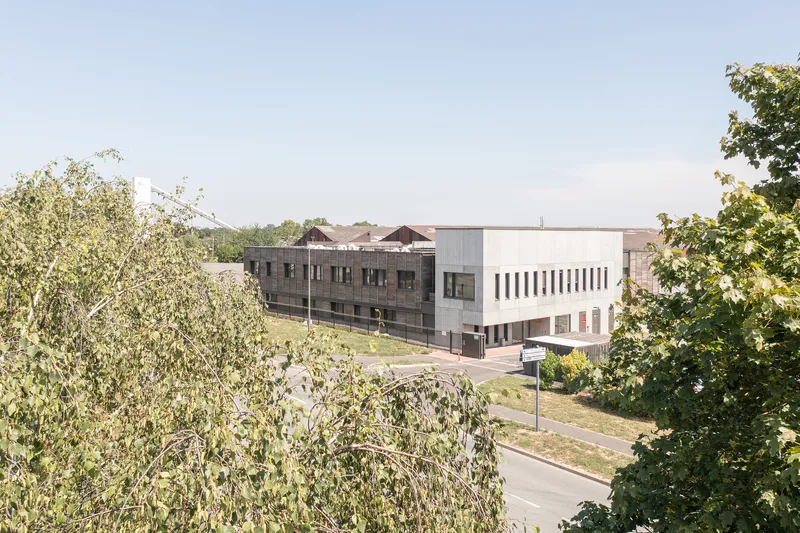
The west terrace creates a deliberate gradient from mineral surface to planted ground, a threshold that mirrors the building's research into soil and ecology. Young saplings along the planted berm soften the long timber facade, and the grassy slope absorbs the grade change between street and ground floor. In a peri-urban environment prone to parking lots and blank walls, this landscape strategy anchors the building in its site rather than merely occupying it.
The timber slat screens at ground level, set above a concrete plinth with sliding glass doors, allow the interior courtyard to extend outward on temperate days. It is a simple move, but it connects the building's users to exactly the environmental conditions their research investigates.
Plans and Drawings
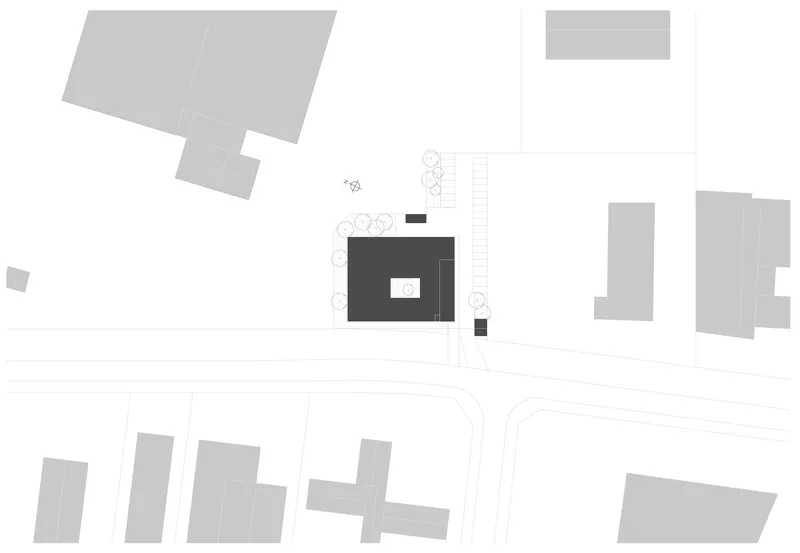
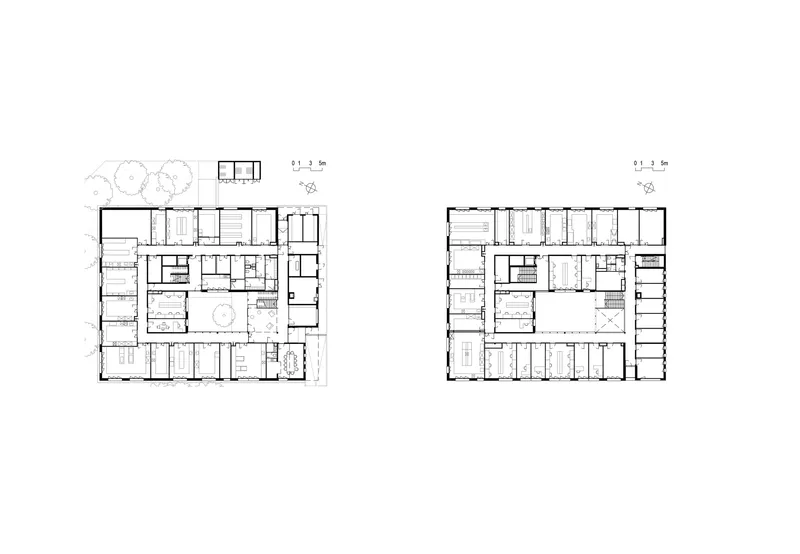
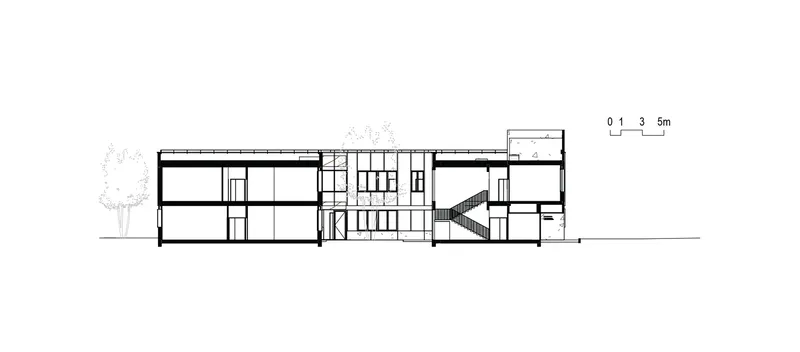
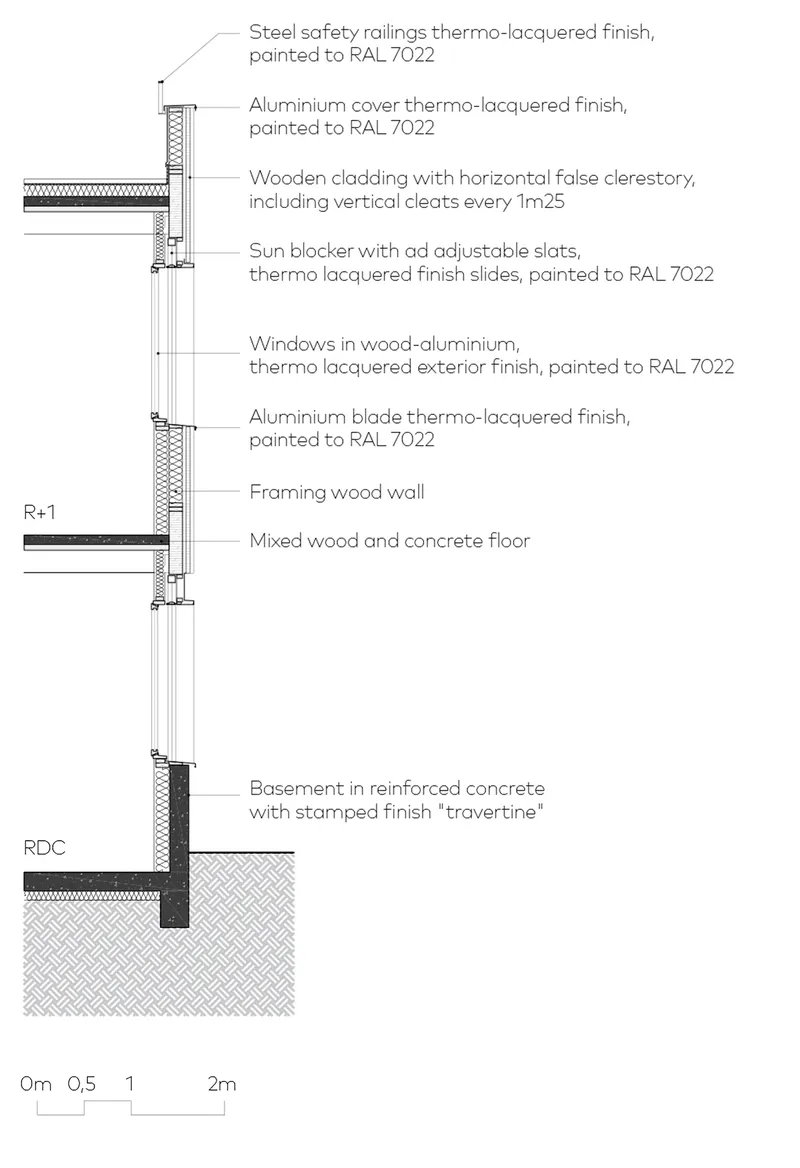
The site plan confirms the courtyard's centrality: the building footprint wraps a rectangular void, with perimeter trees softening the boundary to neighboring structures. Floor plans of both levels show rooms arranged around the central atrium with circulation pushed to the courtyard edge, maximizing frontage for labs and offices alike. The section through the three-story entrance volume reveals how the upper portion accommodates technical installations serving both buildings, a compact solution that keeps rooftop clutter off the timber volume. The detailed wall section documents the facade assembly from basement to roof, labeling every layer of the biosourced envelope and confirming the precision of the prefabrication strategy.
Why This Project Matters
Research buildings rarely enter architectural discourse because they are usually designed as functional containers, optimized for compliance rather than experience. The Grand Arras center demonstrates that a laboratory can be frugal in resource use and simultaneously rich in spatial quality. Every decision, from the prefabricated timber and stamped concrete envelope to the exposed mechanical networks, serves both operational performance and architectural legibility. The patio plan is not just a daylight strategy; it is a commitment to adaptability that will outlast any single research program.
For architects working on institutional commissions with tight budgets and complex technical requirements, Atelier Téqui's approach offers a credible model. Frugality here does not mean austerity. It means spending intelligence where it counts: on structure, light, and the honest expression of how a building is made. In a discipline increasingly anxious about embodied carbon and lifecycle thinking, a research center that investigates soil health while practicing material honesty is more than a functional brief fulfilled. It is architecture that walks its own talk.
The Grand Arras Agronomic and Agri-food Research & Development Center by Atelier Téqui Architects. Saint-Laurent-Blangy, France. 1,821 m². Completed 2022. Photography by Nicolas da Silva Lucas.
About the Studio
Share Your Own Work on uni.xyz
If projects like this are the kind of work you want to make, uni.xyz is a place to publish your own, find collaborators, and enter design competitions.


Popular Articles
Popular articles from the community


Singing Woman: An Opera House That Performs Before the Curtain Rises
Ovidiu Cristian Pavel's conceptual opera house translates Estonia's choral identity into a sculpted waterfront landmark facing the Baltic Sea.

Cloaked Colonization: A Mobile Underwater Habitat That Moves Like a Fish
Micah Abaya's shortlisted EHC Pacific entry reimagines ocean settlement as a dispersed network of self-sustaining architectural organisms.

Manzana Morphosis: Stretching Barcelona's Grid into a Living Landscape for 2050
A radical reworking of the Eixample manzana turns density into a tool for generous public space, vertical ecology, and environmental performance.

Opera by the Sea Estonia: Three Shells Dissolving Architecture into Tallinn's Coastline
A winning opera house proposal replaces monumental form with interconnected shells that blur the boundary between building, park and Baltic Sea.

Similar Reads
You might also enjoy these articles

Pixel Gardens: One Repeated Module Stacked Into a Terraced Social Housing Tower for Famagusta
Salem Bader's shortlisted housing tower builds a vertical neighbourhood from one repeated module, offsetting units to carve terraces, light and air.

Bao Huynh Watercolor Atelier: A Serene Art Retreat in Hội An
Bao Huynh Watercolor Atelier in Hội An blends multifunctional art spaces, sustainable design, local materials, and family-friendly living in a serene environment.

Atelier Macri Concept Store Interior Design by CASE-REAL
Atelier Macri store features a "ko" counter, walnut wood details, cork displays, blending retail, gallery, and seamless customer experiences.

Manuel Vargas Izquierdo Stadium and High-Performance Sports Center: Architectural Excellence in Jalpa de Méndez
The Manuel Vargas Izquierdo Stadium blends sustainable design, inclusive sports facilities, and cultural-inspired architecture, revitalizing Jalpa de Méndez’s public spaces.


Comments (0)
Please login or sign up to add comments
No comments yet. Be the first to comment!