
Atelier Wen'Arch Turns a Qing Dynasty Study into a Meditation Art Space in Rural Huizhou
A 108-square-meter adaptive reuse project in Zhongxin Village layers brass, warm light, and restraint over late Qing brick and earth walls.


Some buildings earn their beauty by surviving. The old study at the eastern end of Zhongxin Village in Longmen County, Huizhou, is one of them: a late Qing Dynasty structure built with grey brick on the outside and earthen walls within, following a traditional technique called "Gold Wrapped in Silver." By the time Atelier Wen'Arch arrived, the building was classified as hazardous. The walls had loosened, the timber roof was decaying, and fragments of a wooden mezzanine hung on in the interior like afterthoughts. The team, led by Shen Wen, faced a familiar question in Chinese rural heritage work: how do you save a building without embalming it?
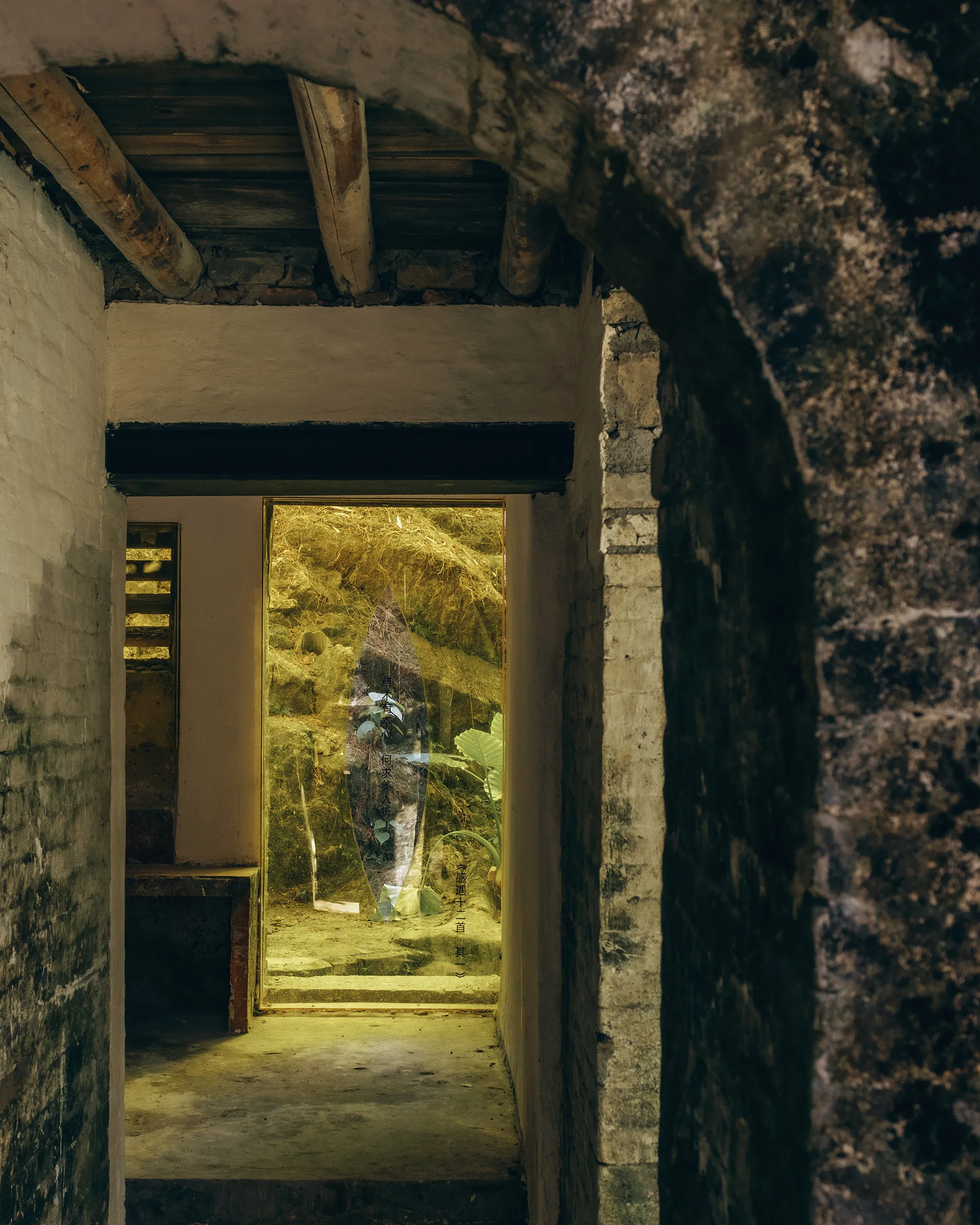
Their answer is a meditation-themed art space that refuses to hide the passage of time. Part of the broader Nankunshan-Luofushan Rim Pioneer Zone architectural art project organized by Fengyuzhu, the 108-square-meter intervention reads as a careful negotiation between decay and precision. Brass panels, polished concrete floors, and a deliberate choreography of warm and cool light give the space new programmatic life. But what makes it genuinely compelling is the legibility it preserves: the patina on the brickwork, the scars left by collapsed elements, and the strata of materials that let you read the building's history as you move through it.
Gold Wrapped in Silver


The original construction technique lends the project its most evocative metaphor. Grey brick forms the exterior shell while rougher earthen walls compose the interior. Atelier Wen'Arch kept this duality visible rather than flattening it beneath new finishes. The weathered brick courtyard entrance, still stacked with firewood and tucked beneath the forested hillside, announces a building that belongs to its terrain. Window openings in the brick reveal glimpses of bamboo and broad-leafed plants outside, anchoring the interior to the lush subtropical landscape.
From the courtyard, doorways framed by aged white brick walls open into polished concrete interiors that catch afternoon light. The contrast is deliberate. Rather than smoothing the transition between old and new, the architects made each threshold a visible seam, a place where the building's two lives overlap.
Brass as Temporal Counterpoint

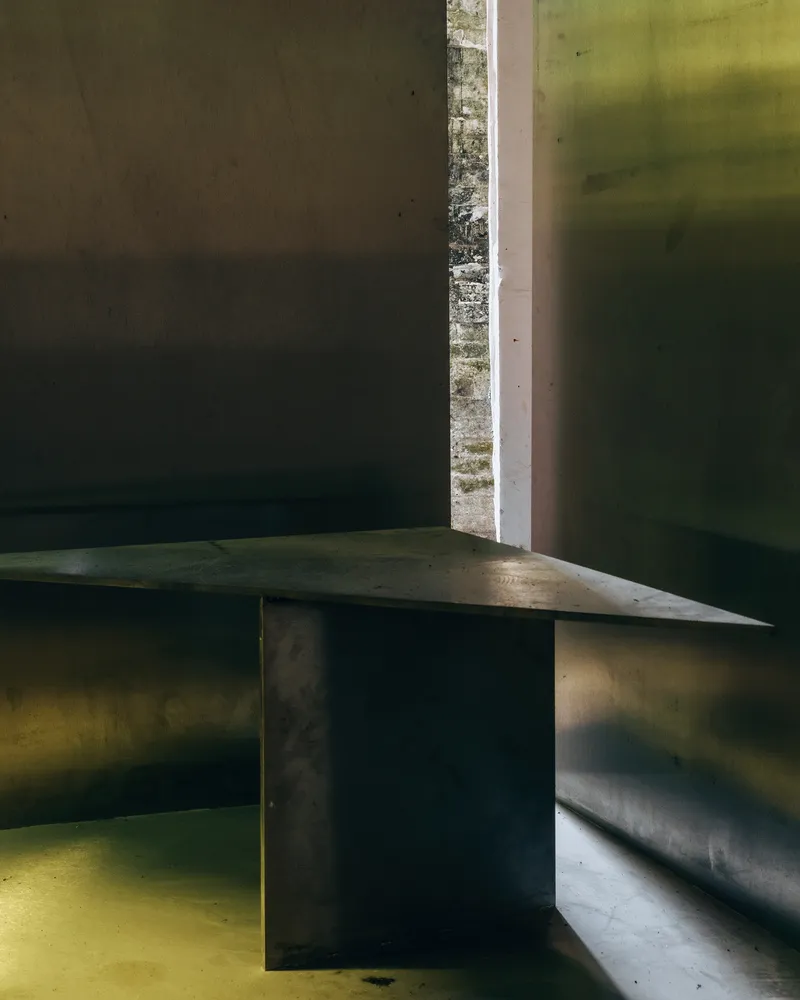
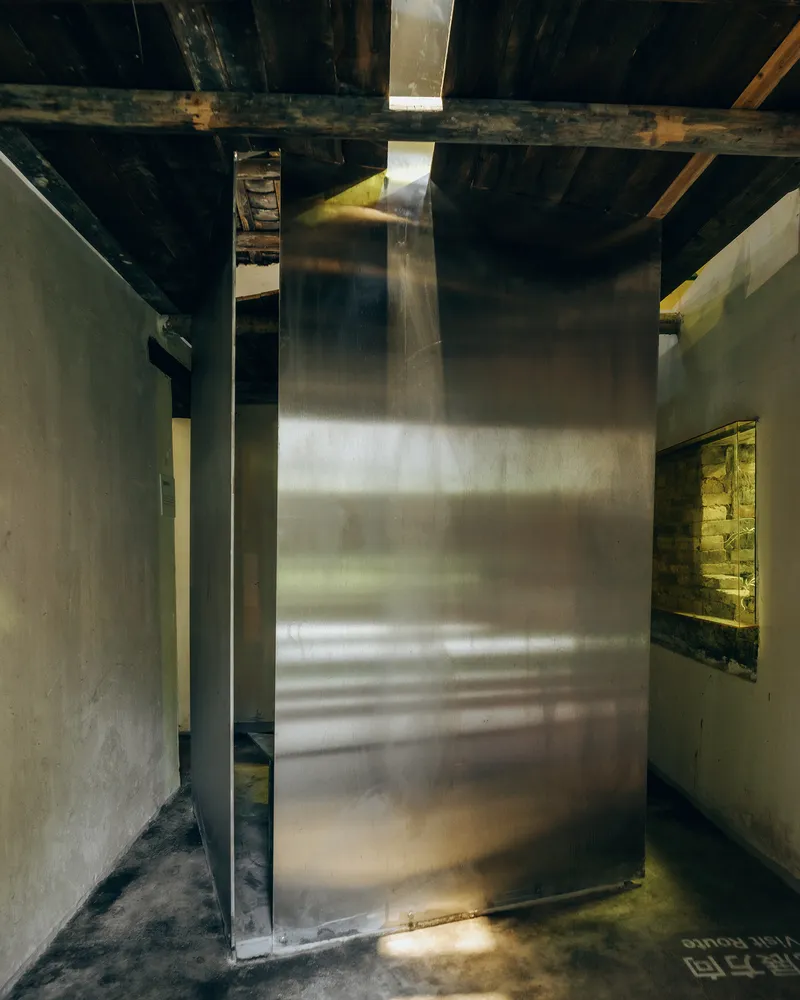
The single boldest material decision is the insertion of polished brass panels and fixtures into the decayed plaster and brick interior. In a room where the walls are crumbling and the concrete floor is raw, a brass doorway and window opening stand as precisely machined counterpoints. They are not trying to match the patina of the old work; they are obviously new, obviously industrial, and that candor is what makes them succeed.
A brass wall panel rises through exposed timber ceiling joists, catching light from above and distributing it downward. The detail of a brass bench ledge meeting a vertical brass panel beside a doorway shows the level of craft involved: tight tolerances, clean edges, surfaces that will age alongside the brick but never pretend to be the same material. The brass will oxidize over time, narrowing the gap between old and new. That long game is part of the design.
Choreographing Light


Atelier Wen'Arch describes their approach as sculpting a spatial field with warm and cool light, and the photographs bear that out convincingly. A sequence of brick arches frames a passageway where warm sunlight floods the far courtyard, pulling visitors forward. In another moment, warm light spills from a doorway onto a threshold and courtyard beyond, turning a simple opening into a glowing frame.
An illuminated brick ledge casts yellow light and shadow patterns on a plaster wall, a detail that reads less as architectural lighting and more as a kind of quiet installation. The palette of golden warmth inside the ancestral study plays against the natural cool daylight of the courtyard, and that oscillation gives the small building a sense of depth that far exceeds its 108 square meters.
The U-Shaped Courtyard


The building organizes itself around a U-shaped courtyard, a common southern Chinese typology that Atelier Wen'Arch retained and clarified. A covered portion of the courtyard reveals exposed timber roof beams and a white gallery entrance beneath a traditional tile roof. On the opposite side, a timber colonnade frames a courtyard path with carved wooden signage and tropical ferns in dappled sunlight.
The courtyard does more than organize circulation. It mediates between the enclosed meditation spaces and the hillside landscape, bringing weather, light, and vegetation into the heart of the plan. For a project concerned with solitude and contemplation, this threshold space is where the program genuinely lives.
Artifacts of Use


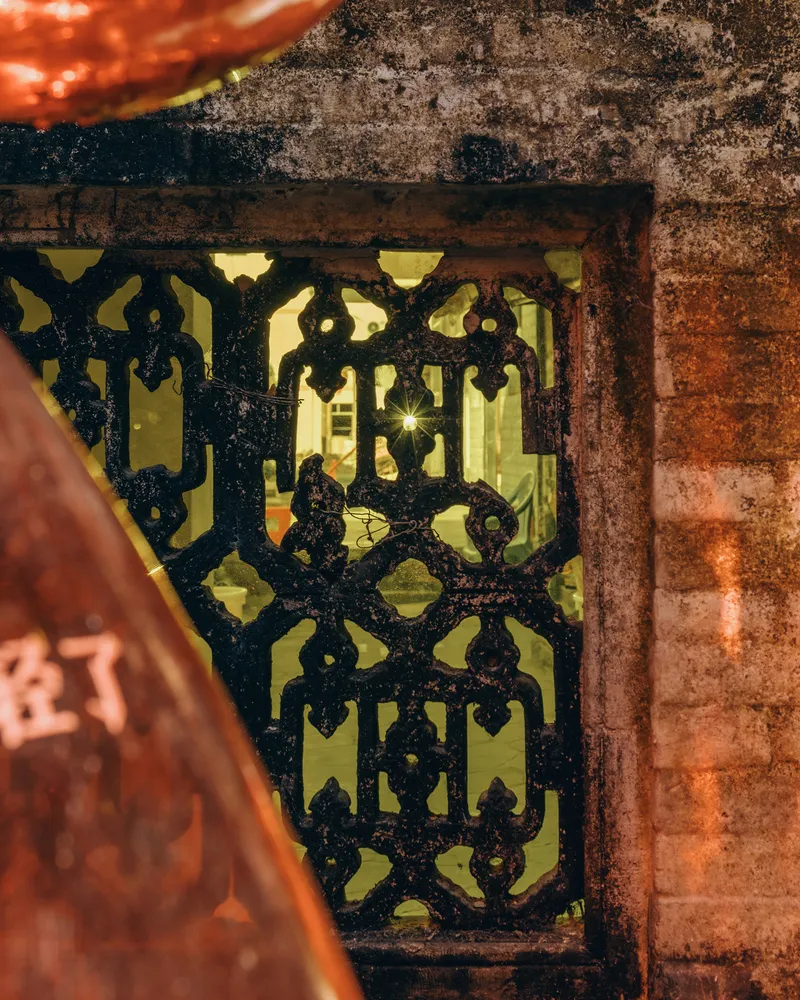
Several interior moments reveal a deliberate preservation of found objects and traces of prior inhabitation. A terracotta tile stove with circular brass burner openings sits beside a deteriorated wall, treated as part of the installation rather than a relic to be removed. An ornate cast iron grate set within a weathered brick opening catches dusk light. A cylindrical metal ventilation duct coexists with calligraphy panels beneath exposed timber ceiling beams.
These elements resist the tendency of adaptive reuse projects to sanitize. Atelier Wen'Arch's concept of "stratified readability" is visible here at the scale of objects: each artifact is left in place or repositioned with care, and the layers of time remain legible rather than curated into a single, frozen moment.
The Glass Threshold
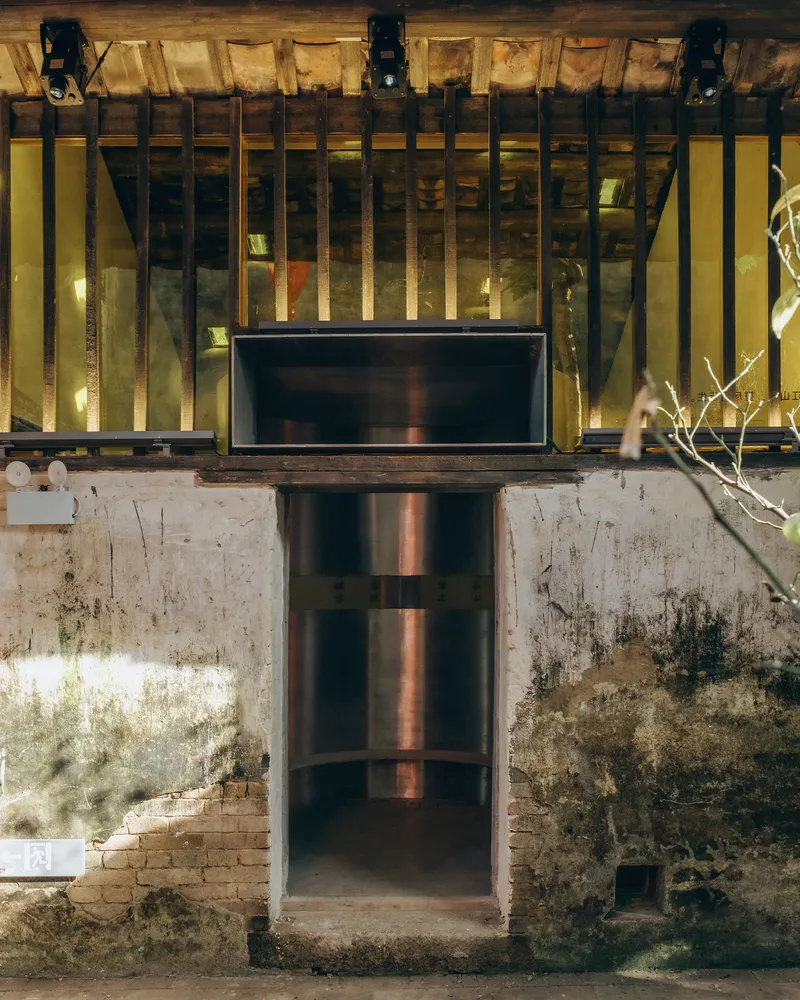
One of the more striking insertions is a glass doorway and upper balcony set into a weathered masonry wall under exposed timber rafters. The glass is unapologetically transparent, offering a full view into and out of the space. It sits in tension with the opacity of the original brick and earth walls, creating a moment where the building's introverted character is momentarily broken.
For a meditation art space, this balance between enclosure and openness matters. The staggered window openings across the building ensure that no single room is either entirely sealed or entirely exposed. Privacy and connection alternate as you move through the plan, which is exactly the spatial rhythm you want for contemplative use.
Plans and Drawings
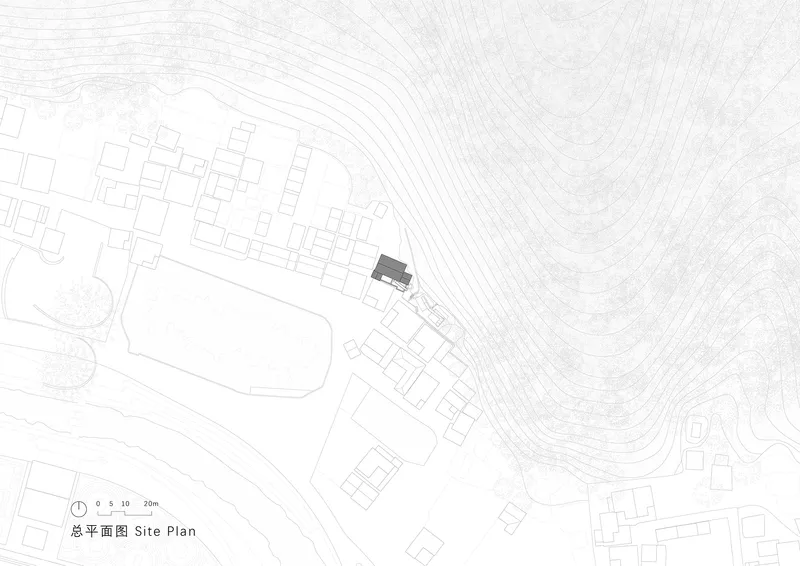

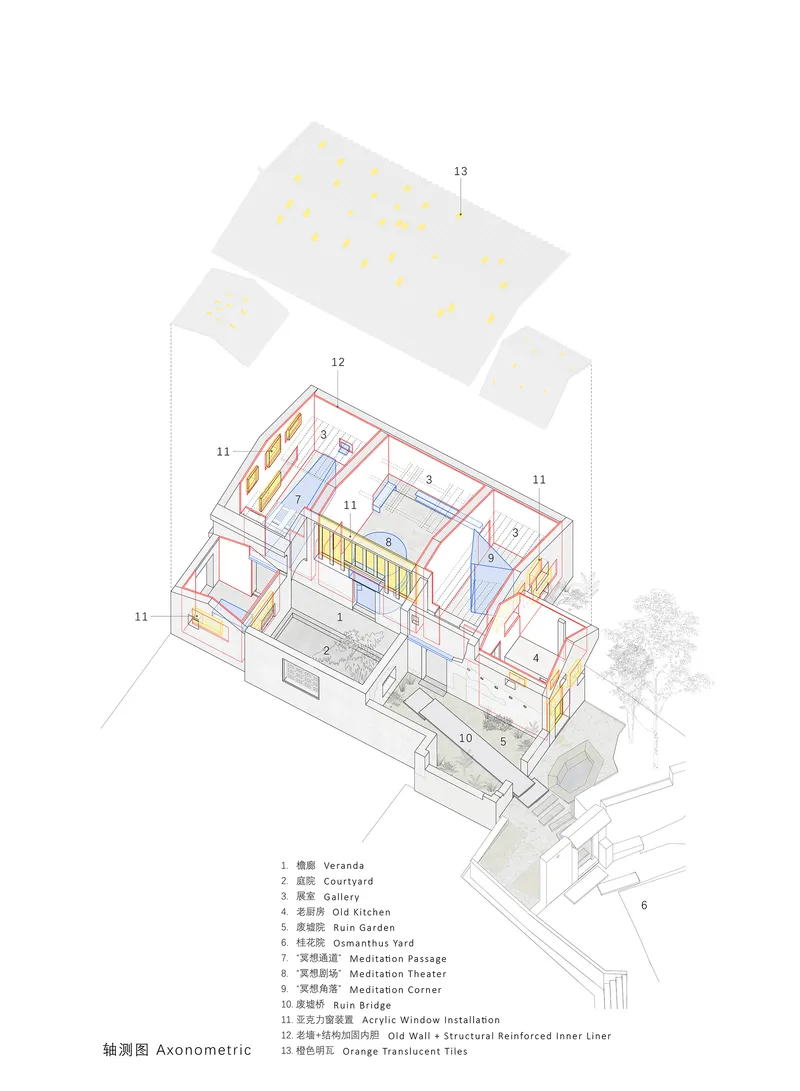
The site plan reveals the building's relationship to its neighbors and the contoured hillside terrain, confirming how tightly it sits within the village fabric. The floor plan makes legible the U-shaped courtyard organization, with interconnected rooms, integrated planting areas, and labeled spaces that clarify the program's distribution. The axonometric drawing is particularly helpful: it shows the spatial organization of rooms around courtyards with colored material zones and a floating roof, making the layering of new and old systems visible in a way the photographs alone cannot.
Why This Project Matters
Rural heritage projects in China often fall into one of two traps. The first is wholesale demolition and reconstruction in a nostalgic idiom. The second is precious conservation that turns buildings into museums of themselves. Atelier Wen'Arch's work in Zhongxin Village sidesteps both. By treating the late Qing study as an active site rather than a frozen artifact, and by introducing materials like brass and polished concrete that declare their newness, the firm produces an intervention that is honest about time.
At 108 square meters, the project is small. But its lessons scale. The idea that adaptive reuse should produce stratified readability, that every layer of a building's life can remain visible and contribute to its current program, is one that applies far beyond a single village in Huizhou. The Old Study in Solitude earns its name: it is quiet, specific, and entirely itself.
Old Study in Solitude, by Atelier Wen'Arch. Zhongxin Village, Longmen County, Huizhou, China. 108 m². Completed 2025. Photography by Yumeng Zhu.
About the Studio
Share Your Own Work on uni.xyz
If projects like this are the kind of work you want to make, uni.xyz is a place to publish your own, find collaborators, and enter design competitions.




Popular Articles
Popular articles from the community


Riyadh For All: Intergenerational Urban Design for Active Aging in Rabat
Riyadh For All reimagines urban design in Rabat with intergenerational co-living, adaptive courtyards, and Moroccan cultural exchange today.

Hill & Cross Opera: Sculptural Opera House Architecture Shaped by Tallinn’s Landscape and Identity
Hill & Cross Opera reimagines opera house architecture in Tallinn through its sculptural hill, civic plaza, glass wave and a luminous cross.

Co-Life: Senior Housing Design That Reconnects Older Adults With the City
Co-Life reimagines senior housing design through healing gardens, shared streets, workshops, and a sustainable community across generations.

Conexión: Biophilic Design Reimagines High-Rise Living in Hong Kong
Conexión reimagines high-rise living in Hong Kong through biophilic design, green facades, shared spaces, daylight, water and nature within.

Similar Reads
You might also enjoy these articles

Bao Huynh Watercolor Atelier: A Serene Art Retreat in Hội An
Bao Huynh Watercolor Atelier in Hội An blends multifunctional art spaces, sustainable design, local materials, and family-friendly living in a serene environment.

Atelier Macri Concept Store Interior Design by CASE-REAL
Atelier Macri store features a "ko" counter, walnut wood details, cork displays, blending retail, gallery, and seamless customer experiences.

Manuel Vargas Izquierdo Stadium and High-Performance Sports Center: Architectural Excellence in Jalpa de Méndez
The Manuel Vargas Izquierdo Stadium blends sustainable design, inclusive sports facilities, and cultural-inspired architecture, revitalizing Jalpa de Méndez’s public spaces.

KAKR Buluh Awar Hall: Revitalizing Community and Ecology Through Bamboo Architecture
Community built bamboo hall revitalizes Buluh Awar village, empowering youth, restoring ecology, celebrating vernacular craftsmanship through sustainable architecture and culture.




Comments (0)
Please login or sign up to add comments
No comments yet. Be the first to comment!