
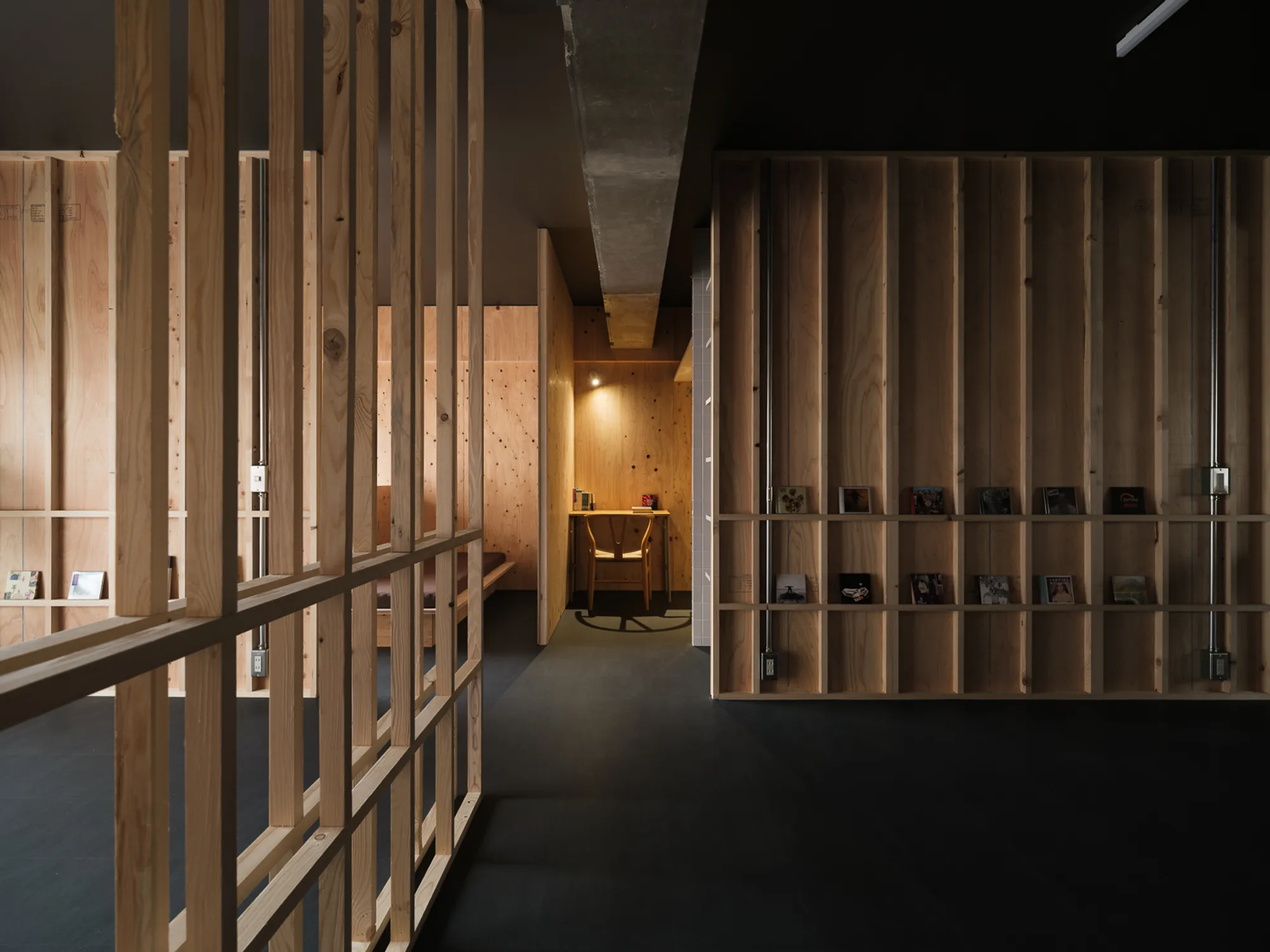
ATELIER405 Splits a 63 Square Meter Osaka Apartment into Six Zones for Three Lives
A Portugal-based studio rethinks domestic cohabitation in Japan with timber grids, sliding glass, and strategic ambiguity.


Three people living under one roof is not unusual. Three people living under one roof with fundamentally different schedules, habits, and spatial needs is a design problem most architects solve with walls and doors. ATELIER405, a Portugal-based practice, takes a different approach in this Osaka refurbishment. Instead of sealing off rooms, they divide a modest 63 square meter apartment into six interconnected zones using timber slat screens, steel-framed glass partitions, and sliding panels that let each resident calibrate their own degree of privacy.
The result is a home that operates more like a small neighborhood than a conventional flat. Boundaries exist, but they are negotiable. Light passes through every partition. Sound is softened, not blocked. The project's real ambition is not spatial efficiency, though it achieves that. It is the idea that cohabitation does not require sameness, that a dwelling can hold multiple rhythms simultaneously without forcing anyone to compromise.
The Grid as Social Contract


The six-grid organizing principle is legible the moment you step inside. Timber-framed glass partitions carve the open floor plate into distinct zones without ever severing the spatial continuity. The living area, visible in its full breadth under a dark ceiling plane, reads as a single room until you notice the sliding panels and slat walls that define sleeping alcoves, work nooks, and circulation paths. Dark grey rubber flooring unifies the ground plane while sheer curtains over glazed openings introduce a layer of atmospheric softness.
What makes the grid work is its inconsistency. Not every partition is the same material or opacity. Some zones are enclosed by solid plywood; others by translucent screens. The hierarchy is deliberate: the most private functions get the densest enclosure, while communal spaces remain porous. It is a social contract materialized in joinery.
Timber Screens and the Politics of Visibility
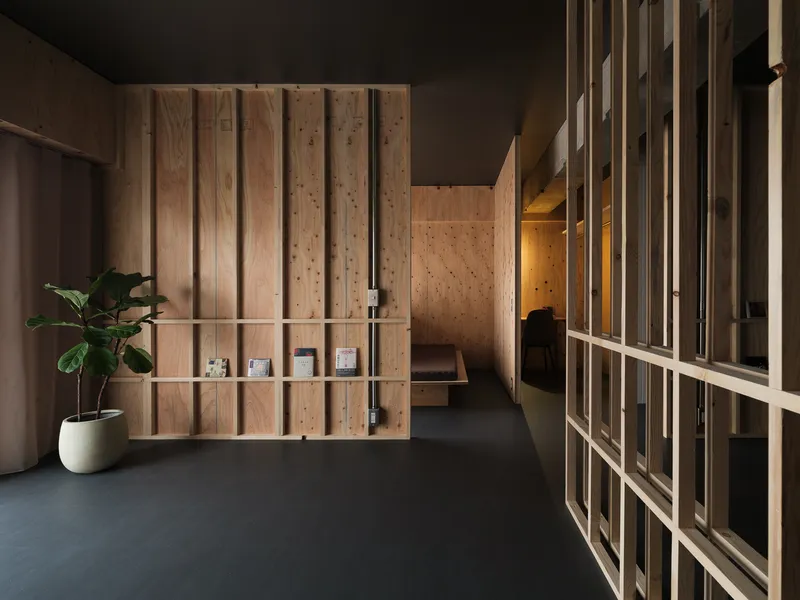


The vertical timber slat partitions do the heaviest lifting in this project, both structurally and conceptually. They filter daylight into corridors, cast long shadow patterns across the dark flooring, and create a visual rhythm that makes a 63 square meter apartment feel measured rather than cramped. Flanking both sides of the central corridor, the screens transform a simple passageway into something closer to an engawa, that characteristically Japanese threshold between inside and outside.
Visibility here is always partial. You catch movement through the slats, register the warmth of a lamp in an adjacent zone, but you never get a full, unobstructed view of another person's space. ATELIER405 understands that privacy in a small home is not about being unseen. It is about controlling the terms of being seen.
Compact Rooms That Punch Above Their Weight

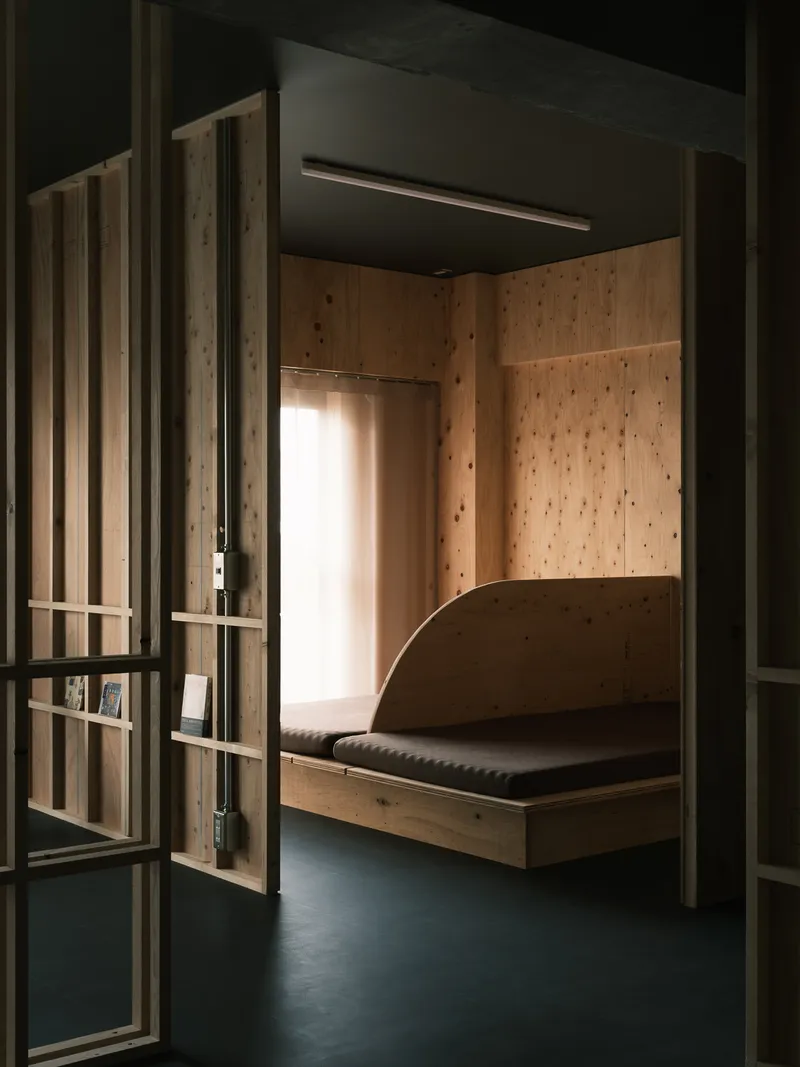

Each of the more enclosed zones is a study in compact design discipline. The plywood-clad study nook fits a wall-mounted desk and a single chair beneath warm overhead lighting, nothing more, nothing less. The sleeping alcove wraps its occupant in timber, with a built-in bench and a glazed door that lets daylight seep in without exposing the bed to the rest of the apartment. The galley kitchen, narrow and utilitarian, pairs a white tile backsplash with open plywood shelving and keeps everything within arm's reach.
None of these spaces would feel generous on their own. Together, connected by the grid logic and the sliding partitions, they create an experience of variety that belies the total square footage. Moving through the apartment feels like moving through a sequence of distinct atmospheres rather than passing through rooms.
Material Honesty at Close Range


ATELIER405 keeps the material palette tight: plywood, black steel, concrete, timber, grey tile. The exposed concrete beams overhead are left unapologetic, a reminder that this is a refurbishment working within the skeleton of an existing structure. The black steel-framed glazing panels act as interior windows, borrowing the formal language of industrial architecture to partition domestic space. They are elegant, but they also signal that the boundaries they create are deliberate additions, not original walls.
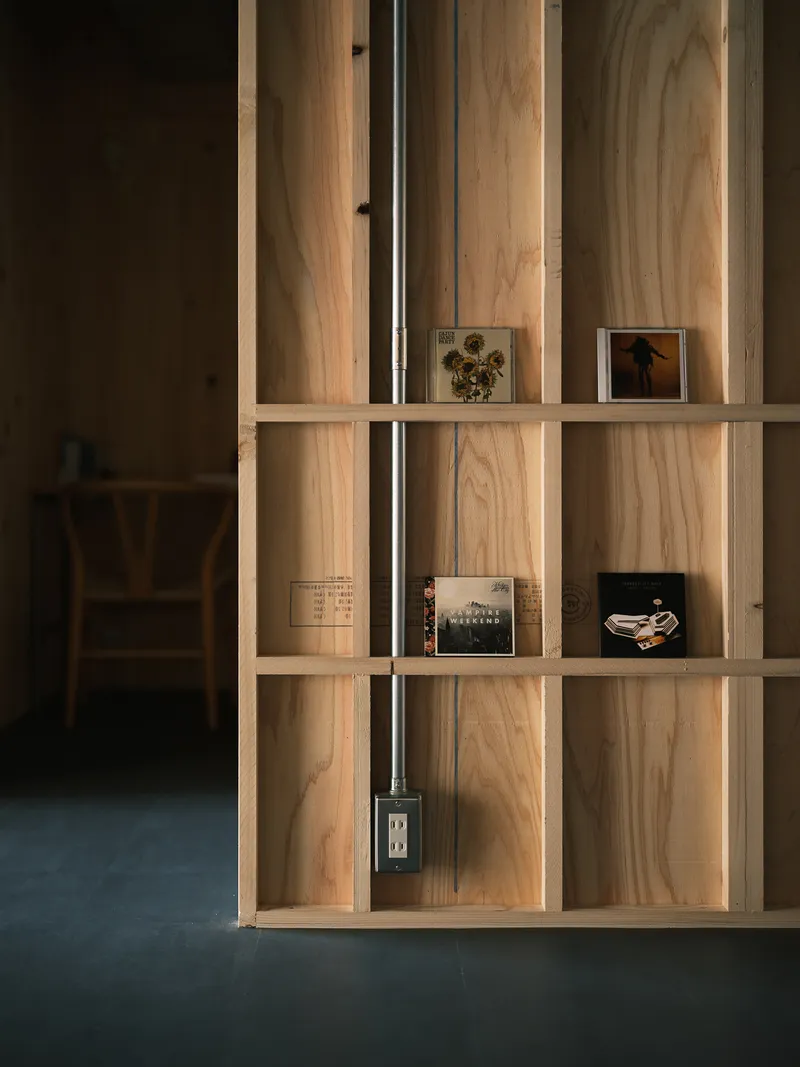
The honesty extends to small details. Vertical conduit runs openly beside plywood shelving. Electrical outlets sit flush with the wood grain. There is no attempt to conceal the building's systems, and the effect is one of quiet candor. Everything you see is exactly what it is.
Corridors as Rooms


In most small apartments, corridors are dead space, the price you pay for separating rooms. Here they are activated. One passage doubles as a pantry, with floating steel shelves lined with bottles against grey tile walls. Another functions as a library of sorts, with open shelving running its full length. The dark corridor leading toward a sunlit doorway is not just circulation; it is a compression point that makes the release into the bright room beyond feel deliberate and theatrical.
This is one of the project's smartest moves. By treating every linear meter of the plan as inhabitable, ATELIER405 effectively adds functional area without adding square meters. The corridors are not leftover space. They are the connective tissue that holds the six zones together.
Color as Punctuation
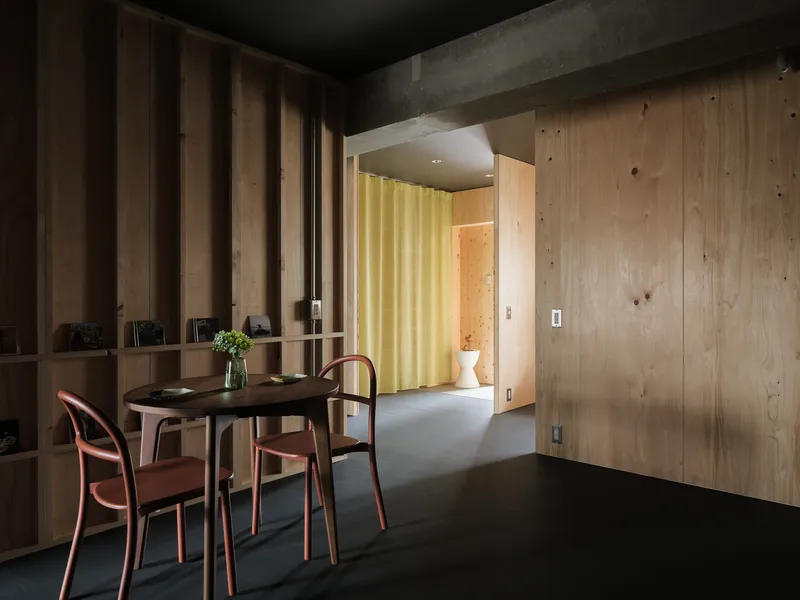
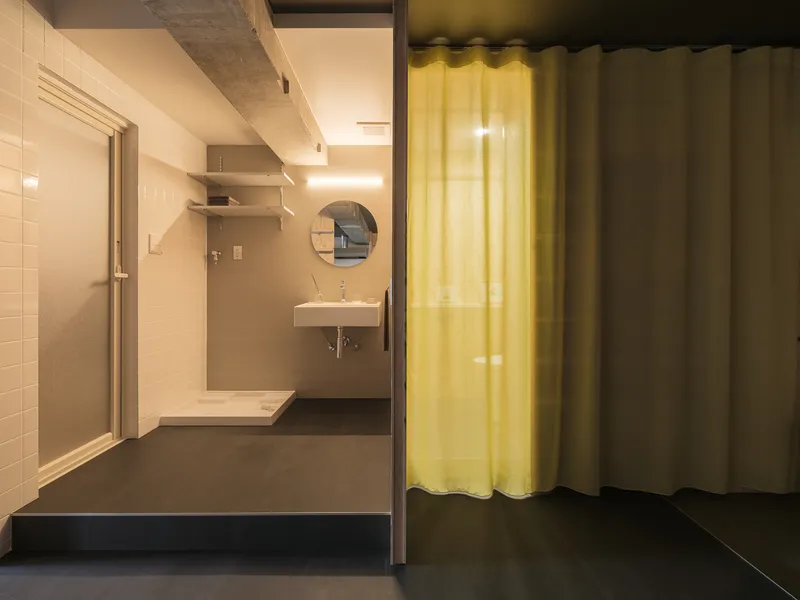
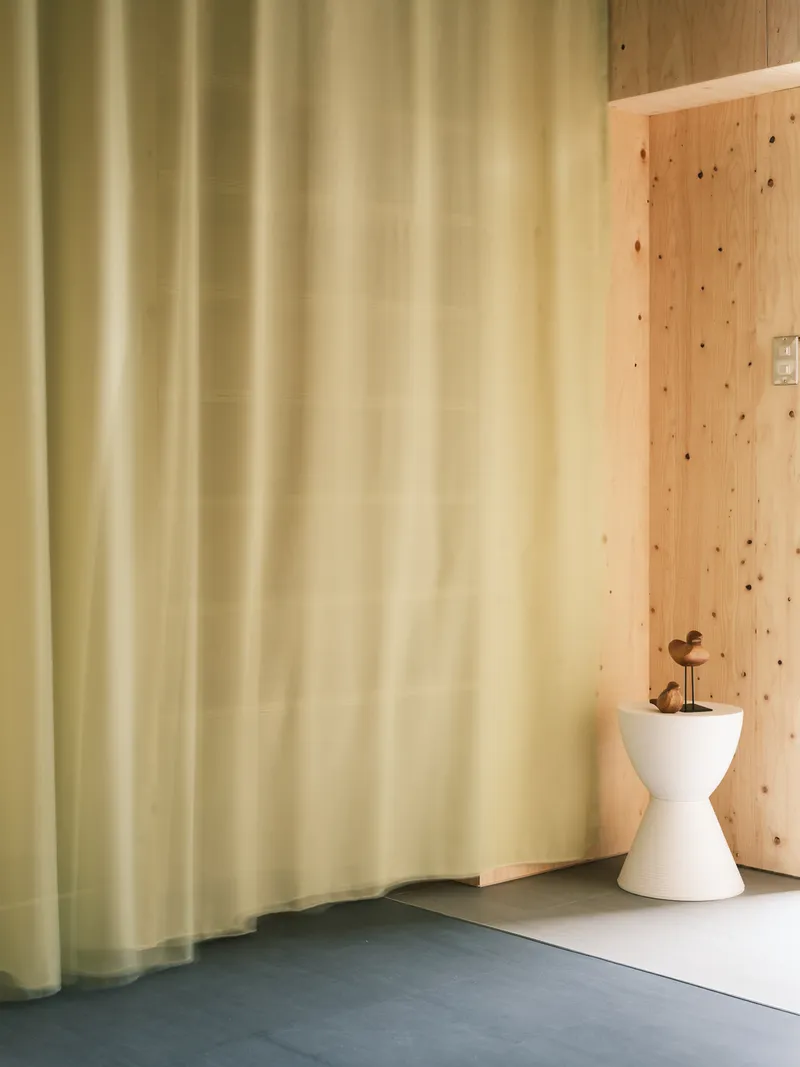
Against the restrained palette of wood, steel, and concrete, the yellow curtains land with real impact. They appear in the bathroom, beside the plywood walls, and in glimpses beyond the dining area. They are the only chromatic departure in the entire apartment, and they work precisely because they are used sparingly. The yellow signals a threshold, a soft boundary that is even more negotiable than the sliding glass panels. Pull it aside and the bathroom connects to the corridor. Let it fall and you get a moment of complete enclosure.
Small objects do similar work. A white hourglass stool and a tiny figurine beside a plywood wall, a round mirror above a wall-mounted sink, framed photographs on open shelves. These are not styling choices; they are evidence that the spaces are calibrated to absorb personal life without being overwhelmed by it.
Dining as the Center of Gravity
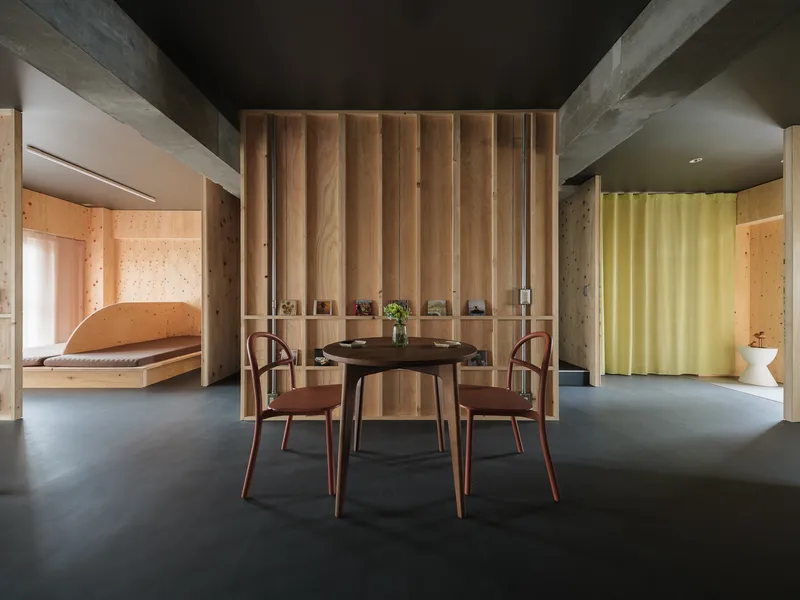
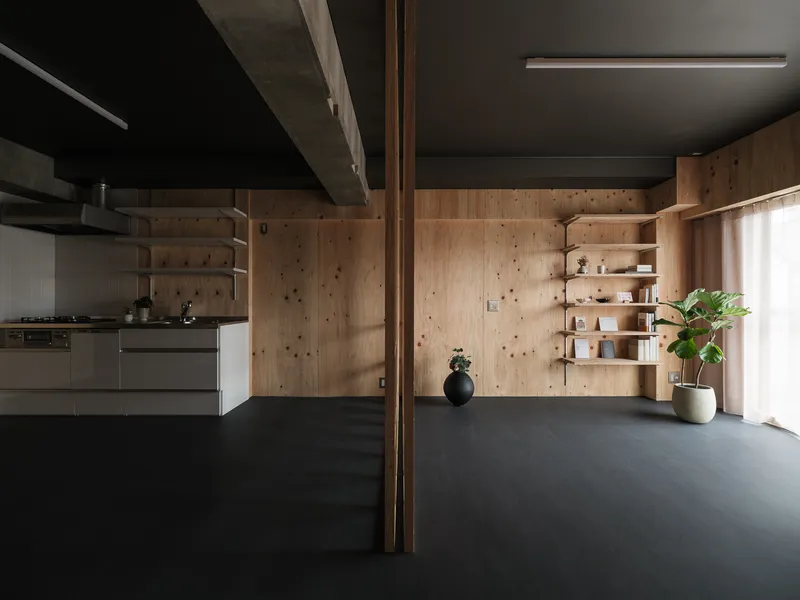
The round dining table with three chairs sits at the heart of the plan, centered beneath the vertical timber slat wall. It is the one space that belongs equally to all three residents. The circular form is not incidental; at a round table, there is no head, no hierarchy. ATELIER405 positions this shared zone where the grid lines intersect, making it the spatial and social anchor of the apartment.
From this point, the kitchen zone, the open shelving against plywood walls, and the timber column that marks the structural grid are all visible. The dining area is simultaneously the most public space in the home and the calmest, a clearing in the forest of screens and partitions.
Plans and Drawings


The floor plan reveals the six-grid logic in full. Bedrooms, kitchen, study, and shared living spaces are laid out in a tight matrix where no zone is more than a few steps from any other. The axonometric diagram, drawn on a coral background with annotations, unpacks the vertical relationships and circulation paths that the photographs can only hint at. What stands out is how much of the apartment's character comes from the partitions themselves rather than from the rooms they define. Remove the screens and you have a generic open plan. Add them back and you have a home for three distinct lives.
Why This Project Matters
The Six-Grid House is a refurbishment, not a new build, and that fact matters. ATELIER405 did not get to choose the floor plate, the ceiling height, or the structural grid. They inherited constraints and turned them into a spatial argument about how multiple people can share a small home without flattening their individuality. The project's relevance extends well beyond Osaka. In cities worldwide where housing is shrinking and cohabitation is rising, the question of how to give each person autonomy within a shared dwelling is becoming urgent.
What makes this answer convincing is its refusal to rely on technology or novelty. The tools are ancient: wood, glass, fabric, light. The intelligence is in the arrangement, in knowing that a timber slat screen does something fundamentally different from a glass panel, and that a yellow curtain does something neither of them can. ATELIER405 proves that even at 63 square meters, architecture can hold complexity, contradiction, and care.
Six-Grid House in Osaka by ATELIER405. Osaka, Japan. 63 m². Completed 2025. Photography by Shotaro Kaide.
About the Studio
Share Your Own Work on uni.xyz
If projects like this are the kind of work you want to make, uni.xyz is a place to publish your own, find collaborators, and enter design competitions.



Popular Articles
Popular articles from the community


Co-Life: Senior Housing Design That Reconnects Older Adults With the City
Co-Life reimagines senior housing design through healing gardens, shared streets, workshops, and a sustainable community across generations.

The Ocean Hive: Sustainable Architecture for a Self-Sufficient Civilization at Sea
The Ocean Hive imagines sustainable architecture at sea, where modular habitats, algae, wave power and ocean waste sustain a growing colony.

Hill & Cross Opera: Sculptural Opera House Architecture Shaped by Tallinn’s Landscape and Identity
Hill & Cross Opera reimagines opera house architecture in Tallinn through its sculptural hill, civic plaza, glass wave and a luminous cross.

AL-JANNAH: Sustainable Architecture and Permaculture for Afghan Widows
AL-JANNAH uses sustainable architecture and permaculture to create resilient oasis of housing, learning, work and renewal for Afghan widows.


Similar Reads
You might also enjoy these articles

Bao Huynh Watercolor Atelier: A Serene Art Retreat in Hội An
Bao Huynh Watercolor Atelier in Hội An blends multifunctional art spaces, sustainable design, local materials, and family-friendly living in a serene environment.

Atelier Macri Concept Store Interior Design by CASE-REAL
Atelier Macri store features a "ko" counter, walnut wood details, cork displays, blending retail, gallery, and seamless customer experiences.

Manuel Vargas Izquierdo Stadium and High-Performance Sports Center: Architectural Excellence in Jalpa de Méndez
The Manuel Vargas Izquierdo Stadium blends sustainable design, inclusive sports facilities, and cultural-inspired architecture, revitalizing Jalpa de Méndez’s public spaces.

KAKR Buluh Awar Hall: Revitalizing Community and Ecology Through Bamboo Architecture
Community built bamboo hall revitalizes Buluh Awar village, empowering youth, restoring ecology, celebrating vernacular craftsmanship through sustainable architecture and culture.


Explore Housing Competitions
Discover active competitions in this discipline


Challenge to design luxury tourism on rails


VR headsets Storefront design competition


Designing a staircase for a client
Comments (0)
Please login or sign up to add comments
No comments yet. Be the first to comment!