
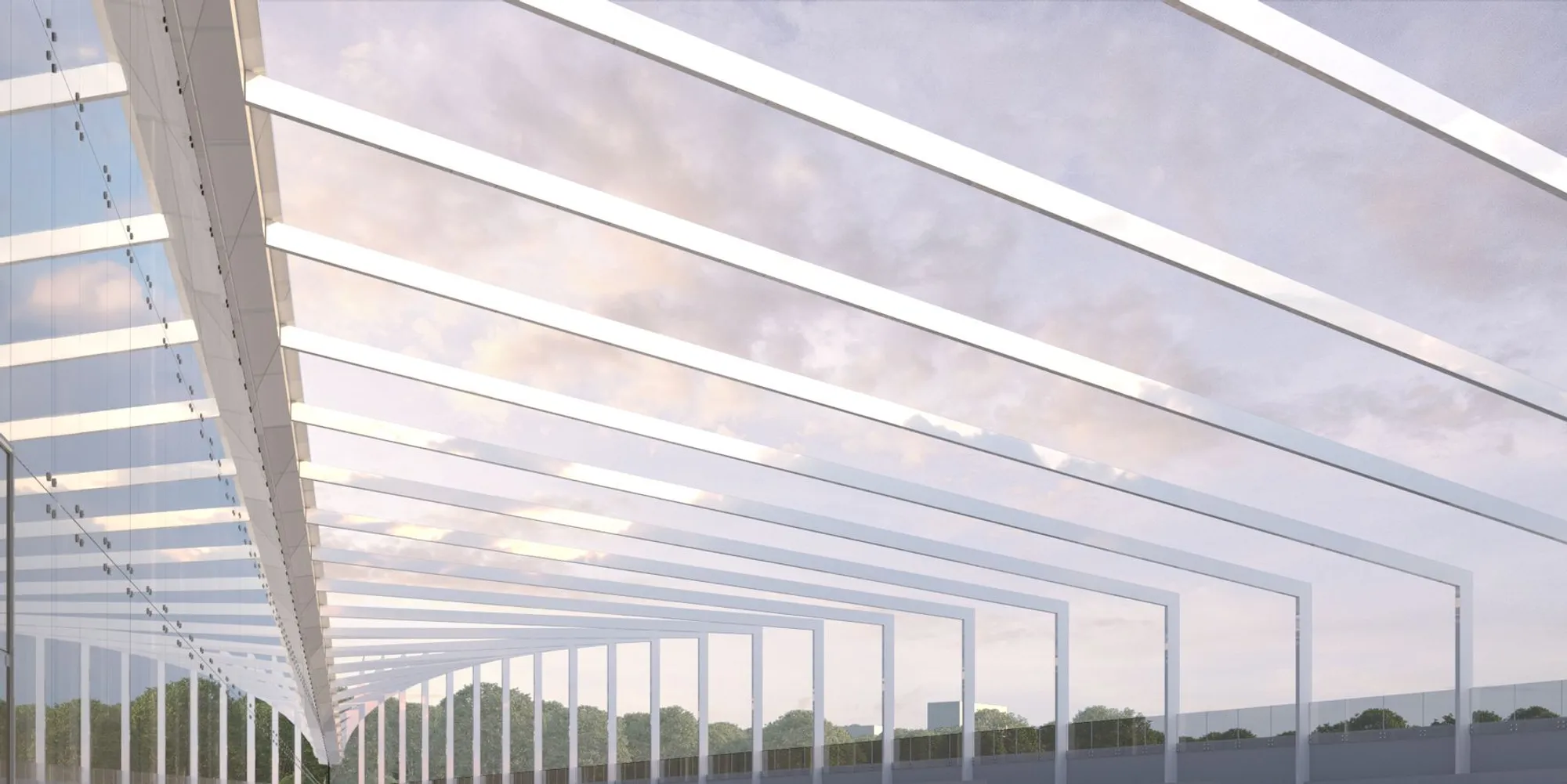
Athenaeum: A Waterfront Structure That Narrates Movement and Ambition
Directional geometry and repetitive structural rhythm merge land, sea, and sky into a unified cultural destination along a dramatic coastal edge.


A building that points somewhere. Not metaphorically, but literally: the Athenaeum stretches along its waterfront site with a directional force that feels less like a structure and more like a vector. Its elongated planes, triangular roof fins, and rhythmic columns pull the eye outward toward the horizon, encoding into built form what its designers describe as humanity's eternal pursuit of the unknown. The result is a piece of contemporary waterfront architecture that refuses to sit still, shifting its visual character with weather, light, and the movement of people across its surfaces.
Designed by Alexandr Rybalka, Aleks Alekseev, Сергій Голомах, and Darya Zavyalova, the Athenaeum is sited along a dramatic coastal edge where it acts as an anchor within the urban waterfront. The team conducted a meticulous study of city context, road networks, navigation points, and public spaces to determine the building's orientation, length, and gradients. That analytical rigor grounds what could easily have been a purely sculptural exercise: the Athenaeum is not merely iconic, but strategically positioned to connect with transport hubs, civic life, and the existing urban fabric.
A Roof That Extends the Earth's Surface
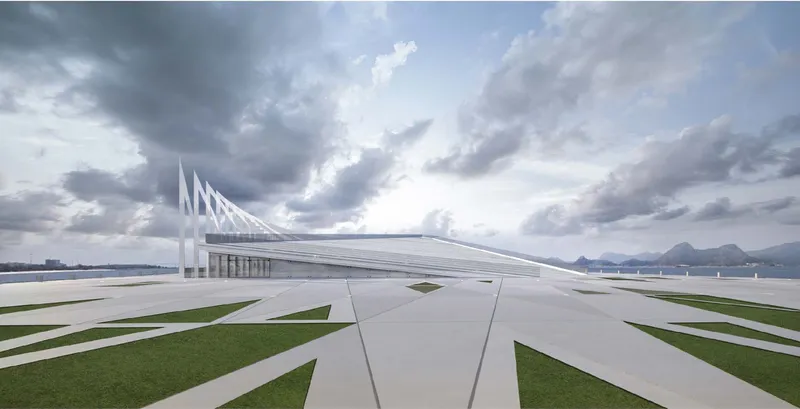
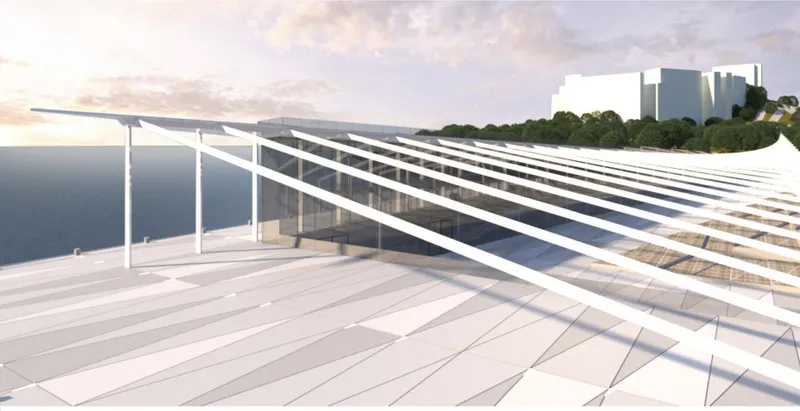
From a wide angle, the Athenaeum reads as a landscape intervention rather than a conventional building. Its roof extends like a continuation of the ground plane, its white triangular fins marching in strict rhythm across a striped green lawn. The form development follows four deliberate moves: extraction of a central axis, creation of a linear void that introduces light and views, vertical interventions that define structural rhythm, and roof articulation that transforms shelter into topography. The transition from a simple rectangular plane to this sculpted result is both rational and poetic.
At sunset, the slatted roof deck reveals its second life. Exposed structural ribs cast deep shadows that shift throughout the day, and the open framework allows weather to participate in the architecture. The slender structural elements mirror the rhythm of waves and wind, a deliberate response to the coastal condition rather than an aesthetic afterthought. Walking beneath this canopy, one senses the building less as enclosure and more as a calibrated filter between interior program and the expansive sky.
Repetitive Columns, Still Water, and the Logic of Reflection
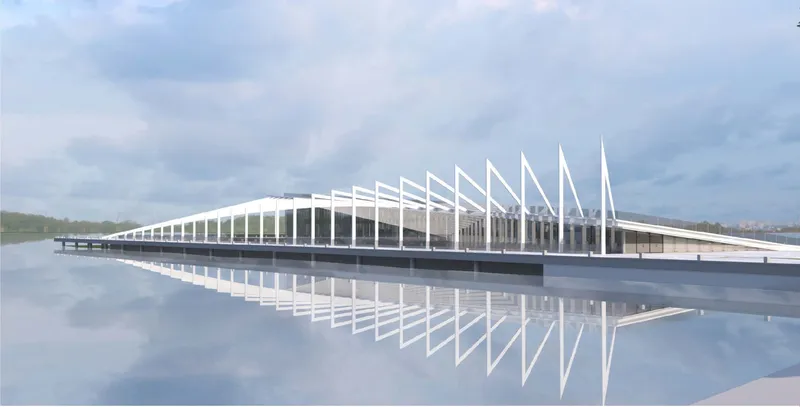
Seen from across the water, the Athenaeum reveals the full impact of its repetitive white triangular columns. Their reflection in still water doubles the visual rhythm, creating an almost hypnotic cadence that reinforces the building's horizontal emphasis. The interplay between land, sea, and sky that the designers sought is most legible in this view: the structure appears to hover at the seam between earth and water, its linear shadows and sweeping geometric patterns stretching the eye along the entire length of the waterfront. The architecture does not dominate its environment; it integrates with it, treating context as a co-author.
Linear Perspective as Architectural Experience
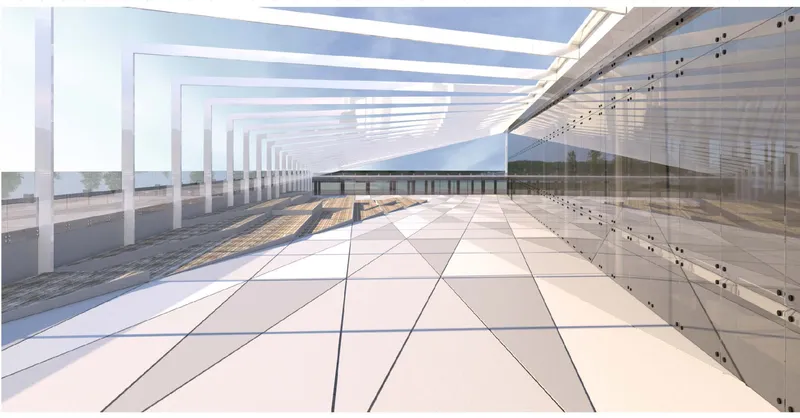
Step inside and the exterior rhythm translates into a corridor of converging white frames. The glass-walled passage, floored in white tile and structured by repetitive vertical members, produces a vanishing-point perspective that is both spatial and psychological. The long linear views connect distinct programmatic zones: a flexible stage space, a contemplative courtyard, terraces for informal gathering, a creativity hub, an art gallery, and a conference hall. Each zone functions independently yet remains visually and spatially linked through these corridors, ensuring that movement through the building is itself a curated sequence.
The courtyard sits at the center as a calm inner void offering sheltered interaction, flanked by stepped terrace platforms and an entrance square that serves as a welcoming open plaza. Parking and underground access are seamlessly integrated below grade to avoid disrupting the visual clarity of the ground plane. The sweeping geometry of that ground plane, visible in plan, creates a distinctive pattern that reinforces the building's directional identity at every scale.
Structure as Signal: The Elevation and Its Tensions
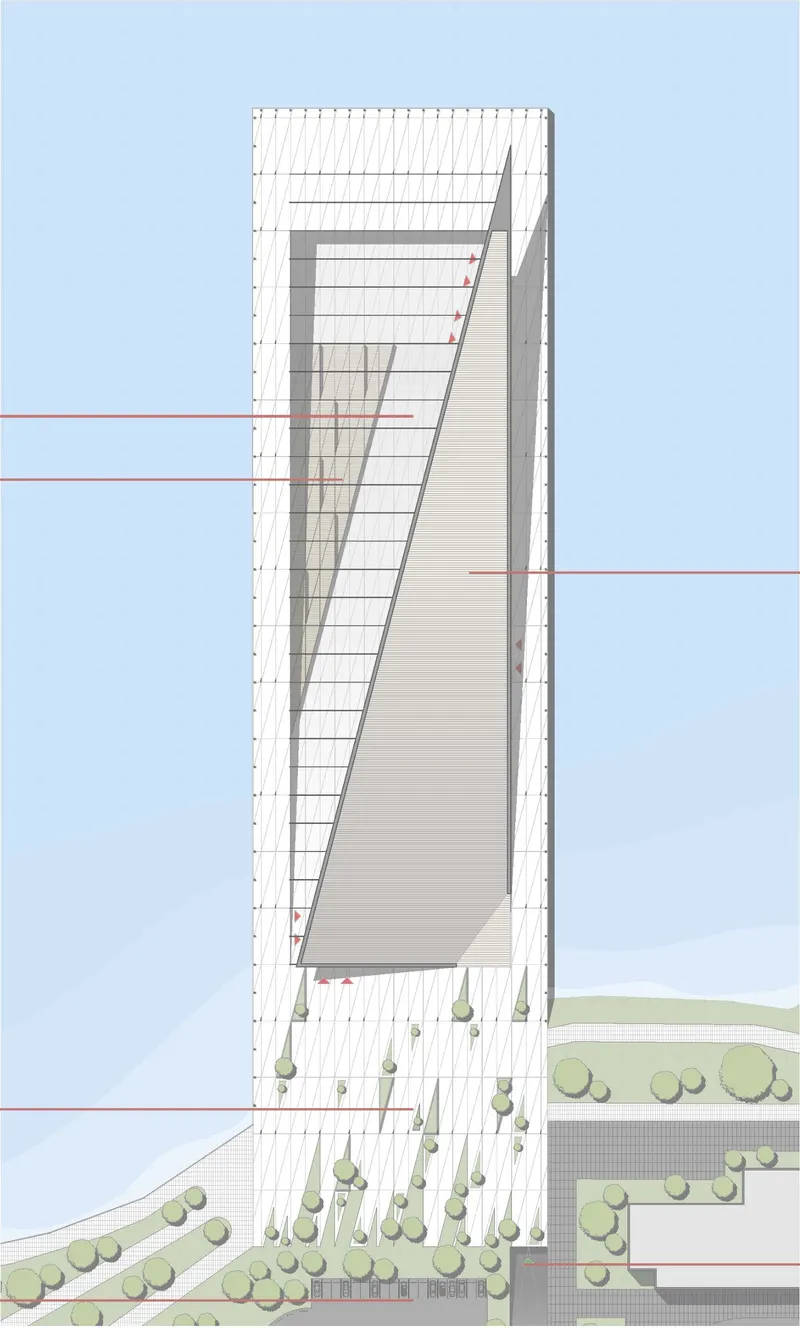
The elevation drawing reveals an element not immediately apparent in the rendered views: a slender tower with an angled cable structure that punctuates the otherwise horizontal composition. It functions as a vertical counterpoint, a landmark gesture that signals the Athenaeum's presence from a distance and anchors the sweeping landscape into a legible silhouette. The landscaped ground plane beneath it confirms the designers' ambition to blur the boundary between building and terrain, with gradients and planting extending the architecture into its site without hard edges.
Why This Project Matters
Waterfront projects carry an inherent risk of spectacle over substance. The Athenaeum sidesteps that trap by grounding its formal ambitions in rigorous site analysis and a clearly articulated programmatic strategy. The four-step form development, moving from axis to void to vertical rhythm to roof landscape, demonstrates that the building's sculptural presence is the outcome of spatial logic, not arbitrary gesture. Its cultural program, spanning performance, exhibition, collaboration, and conference, is distributed with enough independence and connectivity to make the building genuinely useful as a civic institution.
What stays with you is the consistency of intent across scales. The directional force that defines the plan is the same force that shapes the roof profile, the corridor perspective, and the column rhythm reflected in water. Rybalka, Alekseev, Голомах, and Zavyalova have proposed a building that narrates movement and ambition without relying on complexity for its own sake. In that restraint, the Athenaeum finds its strength: architecture as a single, sustained gesture aimed at the horizon.
View the Full Project
About the Designers
Designers: Alexandr Rybalka, Aleks Alekseev, Сергій Голомах, Darya Zavyalova
Enter a Design Competition on uni.xyz
uni.xyz runs architecture and design competitions year-round that reward proposals with spatial conviction and real site intelligence.
Project credits: Athenaeum by Alexandr Rybalka, Aleks Alekseev, Сергій Голомах, Darya Zavyalova.




Popular Articles
Popular articles from the community


Hill & Cross Opera: Sculptural Opera House Architecture Shaped by Tallinn’s Landscape and Identity
Hill & Cross Opera reimagines opera house architecture in Tallinn through its sculptural hill, civic plaza, glass wave and a luminous cross.

Co-life: Sustainable Architecture for Age-Friendly Community Living
Co-life reimagines sustainable architecture for seniors through courtyards, rammed earth, shared gardens, and spaces designed for belonging.

Co-Life: Senior Housing Design That Reconnects Older Adults With the City
Co-Life reimagines senior housing design through healing gardens, shared streets, workshops, and a sustainable community across generations.

Conexión: Biophilic Design Reimagines High-Rise Living in Hong Kong
Conexión reimagines high-rise living in Hong Kong through biophilic design, green facades, shared spaces, daylight, water and nature within.

Similar Reads
You might also enjoy these articles

The Musturak Paradise: Senior Living Architecture for a Connected Future in Temara, Morocco
The Musturak Paradise reimagines senior living architecture in Temara via private homes, social spaces, culture, community, and shared care.

The Leaf Center: Cultural Center Architecture for Social Integration in Amsterdam
Cultural center architecture becomes a bridge at The Leaf Center, connecting international students with Amsterdam through art and exchange.
Conexión: Biophilic Design Reimagines High-Rise Living in Hong Kong
Conexión reimagines high-rise living in Hong Kong through biophilic design, green facades, shared spaces, daylight, water and nature within.

Wander to Wonder: Modular Playground Design for Children in Kutupalong Refugee Camp
Wander to Wonder uses modular playground design to create flexible, imaginative play spaces for children in Kutupalong refugee camp.


Comments (0)
Please login or sign up to add comments
No comments yet. Be the first to comment!