

Athenaeum: A Dissolving Pavilion Where Architecture Yields to Nature in Rio de Janeiro
Patrycja Jędra's shortlisted Athenaeum unfolds through eight phases of architectural surrender, letting water, mangroves, and light reclaim the built form.


What if the most meaningful thing a building could do was disappear? In Rio de Janeiro, an elongated pavilion choreographs its own dissolution across eight narrative phases, each one ceding more territory to water, mangroves, and sunlight. The Athenaeum is not a monument to architecture; it is a controlled experiment in architecture's obsolescence, designed to prove that the discipline's highest purpose may be to amplify the landscape it occupies rather than compete with it.
Designed by Patrycja Jędra, this shortlisted entry in the Athenaeum competition reimagines the classical agora as a space for collective debate on architecture's past, present, and future. Sited in Rio de Janeiro, the project rejects the idea that architectural discourse belongs to specialists. Instead, it proposes a public forum where gravity, water circulation, and light oscillation become the primary instruments of spatial argument, and where visitors confront the fragility of human constructs set against the resilience of natural systems.
A Colonnade That Reads as Landscape
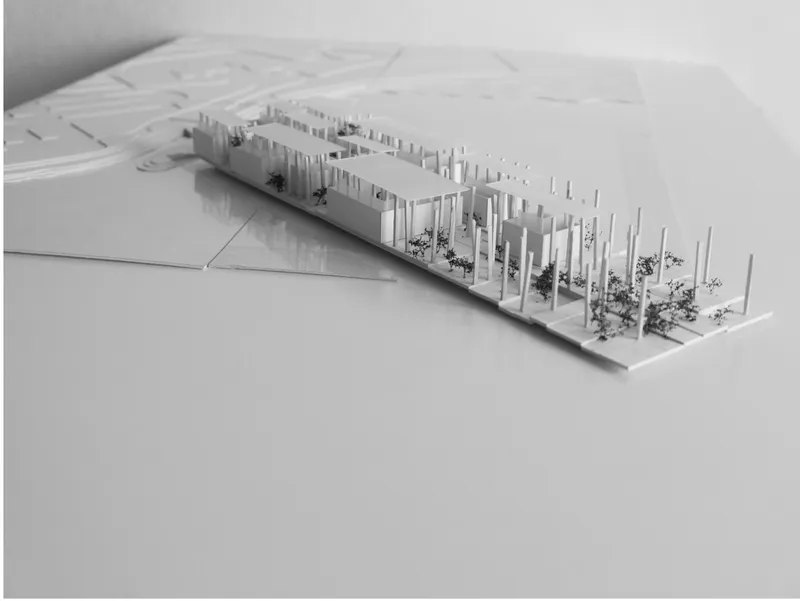

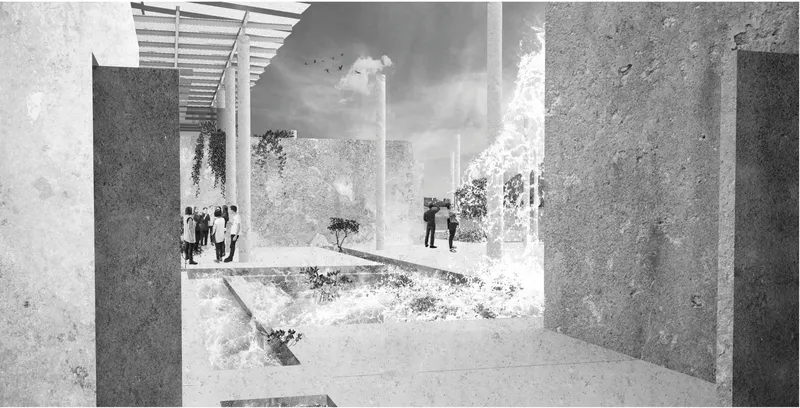
The physical model reveals the project's fundamental gambit: a linear building stretched along its site, punctuated by slender vertical columns and planted courtyards that break the mass into a rhythm indistinguishable from a grove. The rendering of rain falling through an open courtyard is where the design logic becomes visceral. Concrete walls frame the deluge while timber louvers overhead filter it into streams, and visitors shelter at the edges, watching water do the work architecture usually resists. This is Phase II in action, the symbolic dissolution of architecture in water to signal humility and renewal.
The Eight Phases of Surrender
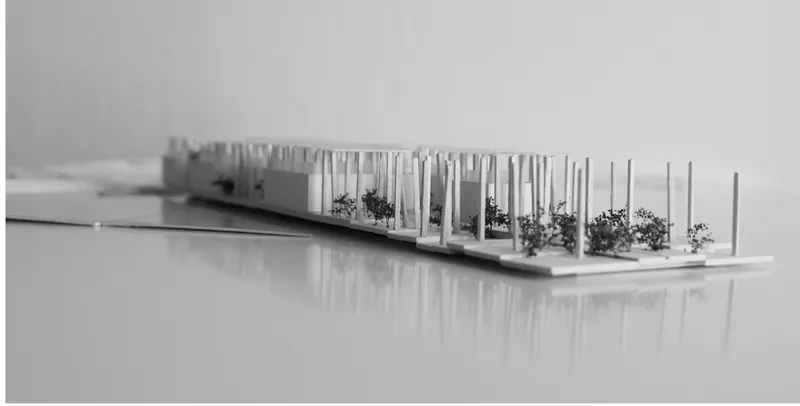
Jędra organizes the Athenaeum's spatial narrative into eight transformative phases that move from architectural assertion to natural reclamation. The sequence begins by rejecting the overpowering object in favor of revealing the landscape, then proceeds through inundation and erosion, the blurring of interior and exterior boundaries, and the gradual revival of nature within the structure. The final phase proclaims the victory of nature over architecture, positioning sustainability not as a feature but as the project's philosophical terminus.
The physical model of the elongated pavilion, with its miniature trees lining the length, makes this trajectory legible at a glance. Slender vertical supports carry minimal material overhead, allowing planting to dominate the section. The interior rendering, looking through heavy concrete walls toward a sun-drenched courtyard where visitors gather beneath a slatted pergola, captures the midpoint of the sequence: Phase VI, where the boundary between inside and outside has effectively ceased to exist. The architecture is still present, but it reads as a frame for the life happening beyond it.
Concrete, Water Reservoirs, and Mangroves as Building Systems
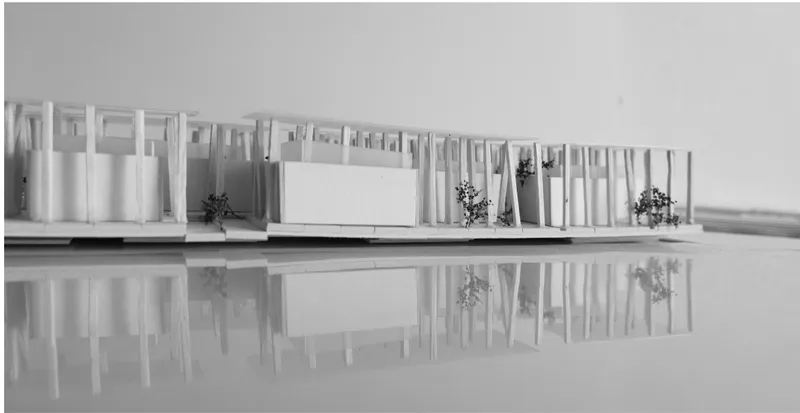
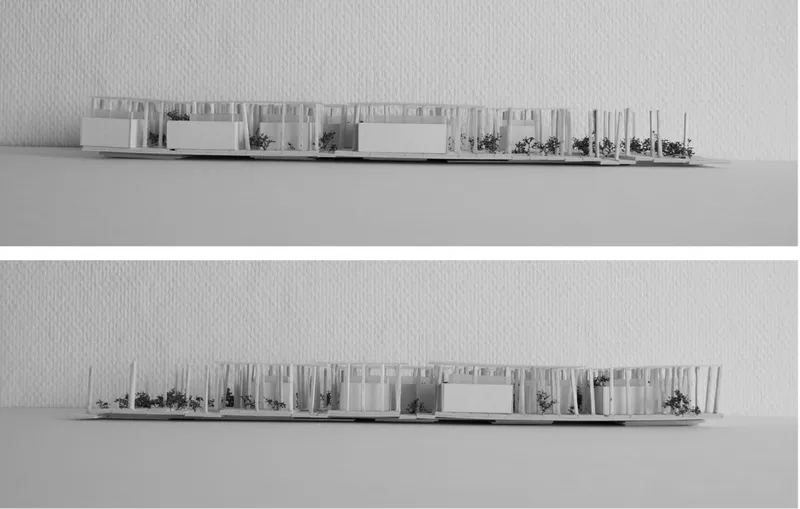
The material palette is deliberately austere. Concrete walls integrate water reservoirs that feed planted zones, and semi-transparent roofing modulates light to support mangrove growth within the building's footprint. The elevation model, reflected on a mirrored surface, reveals how varied column spacing creates pockets of density and openness along the colonnade. The sectional elevation models, displayed from opposite sides, expose the interior landscape features layered between structural elements. These are not decorative gestures; the mangroves and water systems function as active ecological agents within the pavilion's metabolism.
The layering strategy is meticulous. Axonometric and plan studies (referenced in the project documentation) show transparency and environmental responsiveness as structural principles rather than stylistic choices. Every wall thickness, every gap in the roof plane, serves the passage of water or light to a planted zone below. The result is a building that operates less like a container and more like a constructed ecosystem, one where previously hidden landscapes become accessible and charged with meaning.
Why This Project Matters
The Athenaeum takes a competition brief about architectural discourse and answers it with a building that stages its own erasure. That is a bold conceptual move, and Jędra executes it with disciplined restraint. The eight-phase narrative gives the project intellectual structure without turning it into a diagram; the material choices, from water-integrated concrete to mangrove habitats, ground the concept in ecological specificity rather than vague sustainability rhetoric.
More importantly, the project insists that architecture's audience extends beyond architects. By framing the Athenaeum as a modern agora open to everyone, Jędra challenges the insular tendencies of design culture. The building invites non-specialists to observe erosion, inundation, and regrowth firsthand, transforming abstract climate discourse into lived spatial experience. In a discipline often accused of talking to itself, that accessibility is the most radical proposal on the table.
View the Full Project
About the Designers
Designer: Patrycja Jędra
Enter a Design Competition on uni.xyz
uni.xyz runs architecture and design competitions year-round that reward proposals with spatial conviction and real site intelligence.
Project credits: The modern agora as a field of architectural debate: Athenaeum, Rio de Janeiro by Patrycja Jędra Athenaeum (uni.xyz).


Popular Articles
Popular articles from the community

Extended Shell: Retrofitting Kolkata's Balconies as Living Urban Thresholds
A modular retrofit system recovers the social and environmental intelligence of Kolkata's historic verandas for contemporary Park Street residents.
Temporary Home for Dogs: A Reversed Zoo Rethinks Animal Shelter Architecture
In Bucharest, a sinuous corridor and freed landscape flip the logic of containment, designing a shelter that works to make itself unnecessary.

Manzana Morphosis: Stretching Barcelona's Grid into a Living Landscape for 2050
A radical reworking of the Eixample manzana turns density into a tool for generous public space, vertical ecology, and environmental performance.
Opera by the Sea Estonia: Three Shells Dissolving Architecture into Tallinn's Coastline
A winning opera house proposal replaces monumental form with interconnected shells that blur the boundary between building, park and Baltic Sea.

Similar Reads
You might also enjoy these articles

The Amber Palace Opera: A Geological Fiction Surfaces on Tallinn's Baltic Waterfront
Pierre Brillard reimagines a Baltic legend as a public landscape, opera house, and waterfront promenade rooted in Tallinn's coastal identity.
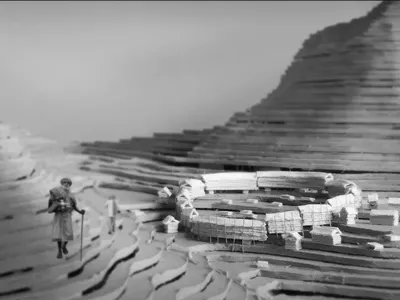
Dynamic Modules Shelter: A Telescopic Ring for Mountain Pilgrimage
A circular modular framework of steel, bamboo, and fabric grows vertically with demand, wrapping communal ground in adaptable shelter.

Singing Woman: Contemporary Architecture Inspired by Estonia’s Voice and the Sea
Singing Woman turns Estonia’s song culture into flowing opera house architecture, blending public life, landscape, sea, and national memory.
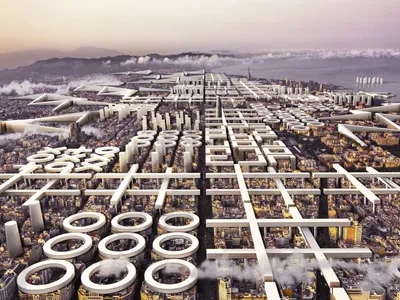
HYPERBLOCK: Flexible Urban Design for Barcelona’s Future City
HYPERBLOCK reimagines Barcelona as flexible urban design, layering density, daylight, public space and adaptable housing above Cerdà’s grid.


Comments (0)
Please login or sign up to add comments
No comments yet. Be the first to comment!