

Atlas Architects Wraps a Brighton Family Home in Corrugated Metal and Curved Timber
Havenwood turns a gifted cul-de-sac block into a considered suburban house defined by cylindrical forms and dark materiality.


Most houses built on gifted land carry the weight of obligation. Havenwood, designed by Atlas Architects and led by Aaron Neighbour and Ton Vu, accepts that weight and converts it into something architecturally specific: a 334 square metre home in suburban Brighton, Australia, that refuses to look suburban. The house occupies a quiet cul-de-sac lot and responds with a street presence that is equal parts restrained and theatrical, a dark corrugated facade punctuated by a cylindrical upper volume clad in ribbed panels and vertical timber.
What makes Havenwood worth attention is the tension between its moody, almost industrial exterior and its warm, skylit interior. The architects constructed a house that reads as deliberately opaque from the street but opens generously to the rear garden through full-height glazing, timber decks, and a cantilevered upper floor. That duality, opacity on one side and openness on the other, is well-worn in Australian residential architecture, but here the formal moves are sharper. The curved volume, the bay window punched out of it, the retained red brick gable wall at the rear: each gesture is precise enough to avoid feeling like a catalogue of ideas.
Street Presence Without Spectacle
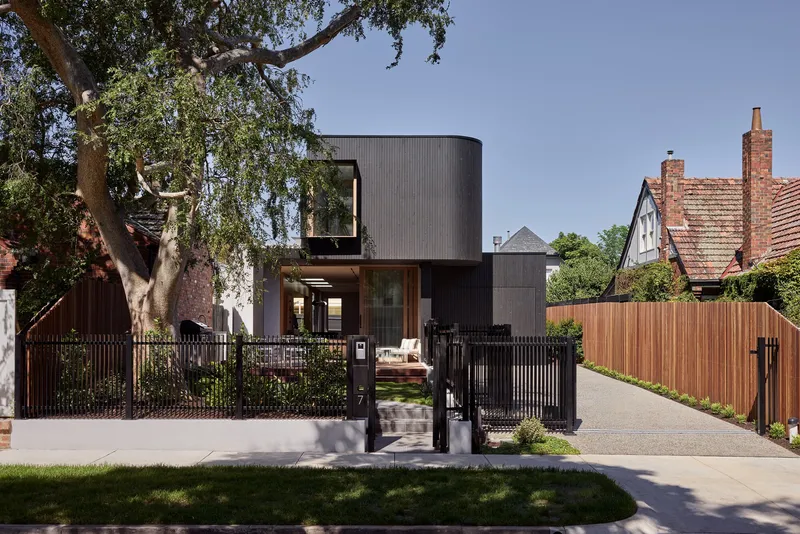
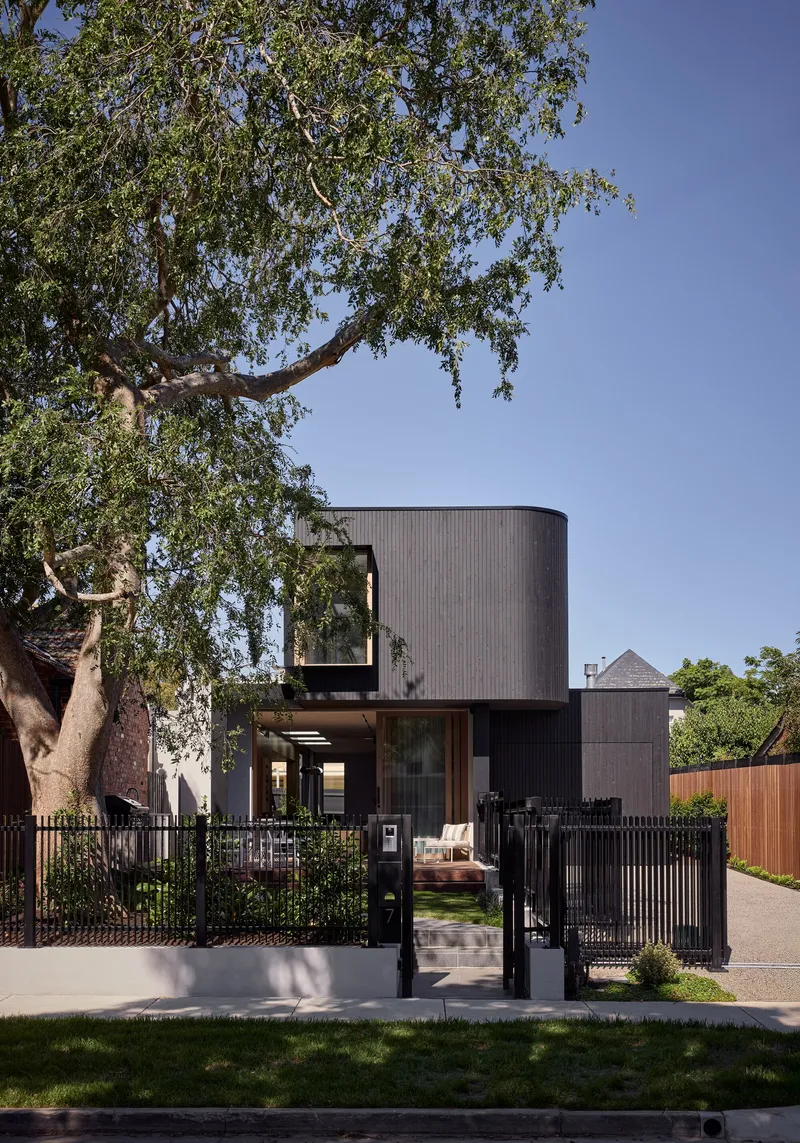
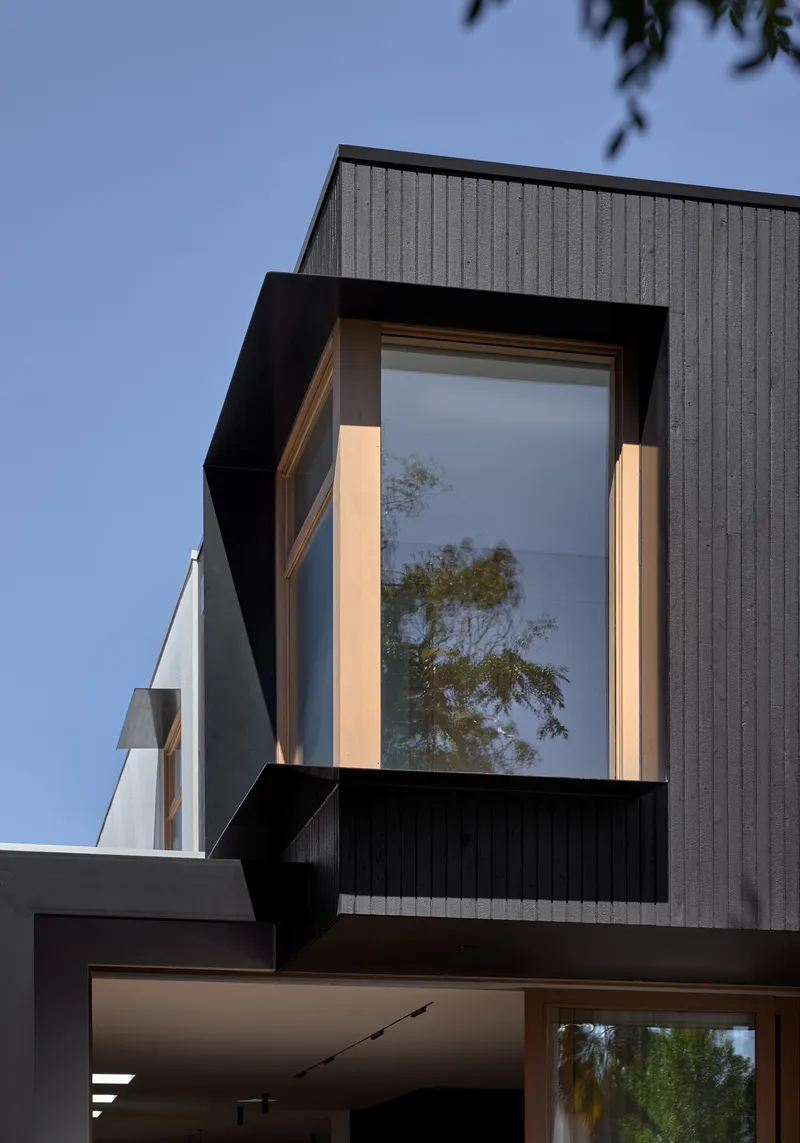
The front facade is an exercise in controlled introversion. Black corrugated metal wraps the ground level, set behind a vertical slat fence and screened by a mature tree. Above, the curved volume distinguishes itself through a shift in material: dark vertical timber cladding replaces the metal, and a single circular window provides a focused aperture where a row of conventional openings might otherwise appear. The cantilevered bay window, lined in timber and framed in black steel, projects from this curved surface like a carefully aimed periscope. At dusk, it becomes the one point where the interior reveals itself to the street.
The effect is a house that acknowledges its neighbours without performing for them. There is no front garden theatrics, no oversized entry portico. Just material discipline and a few geometric surprises that reward a second look.
Entry and Stair as Threshold
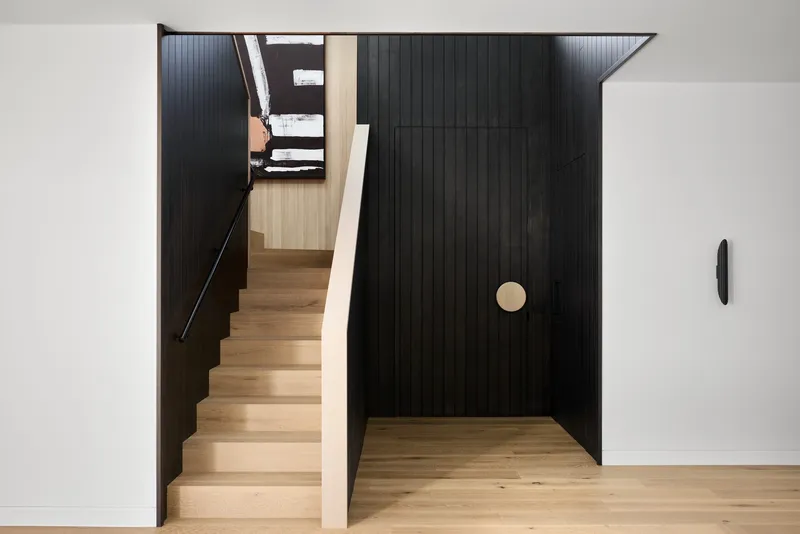
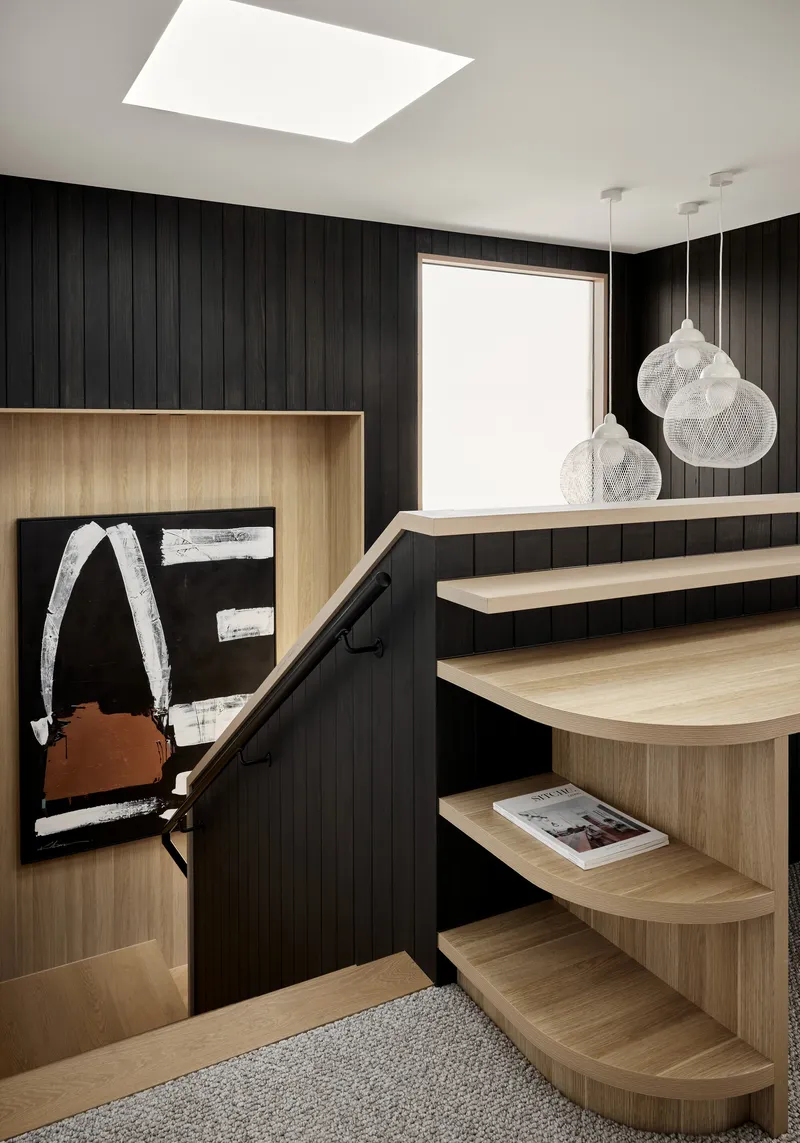
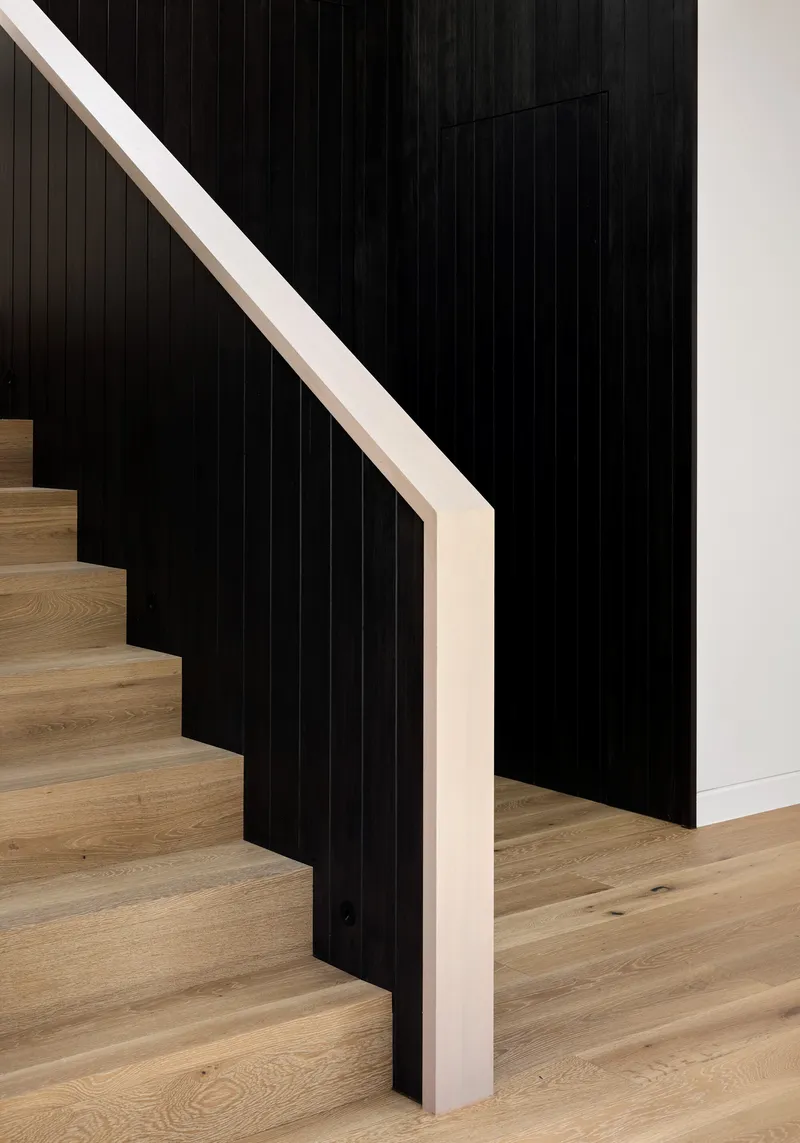
Inside, the transition from street to home hinges on a staircase and entry hall clad in black vertical panelling. The palette here is deliberately compressed: dark walls, light timber treads, a circular door pull that echoes the round window above. It is a narrow, vertical space that compresses before releasing you into the open plan below or the bedrooms above.
The stair itself curves gently, its pale timber treads forming a contrast stripe against the dark wall. Mesh pendant lights hang in the stairwell, adding a diffuse glow that softens what could easily feel severe. Beneath the angled soffit, the architects carved out a display niche in timber, proof that even the residual space under a stair was considered programmatically rather than sealed off.
The Kitchen as Central Engine
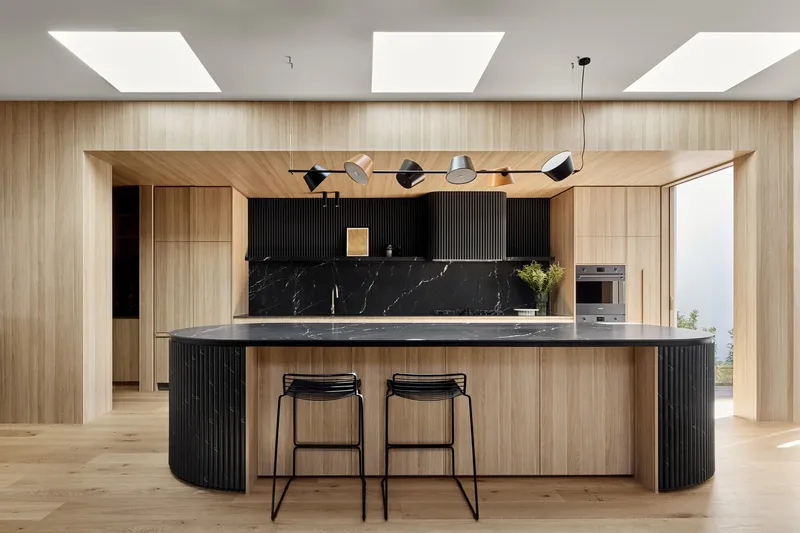
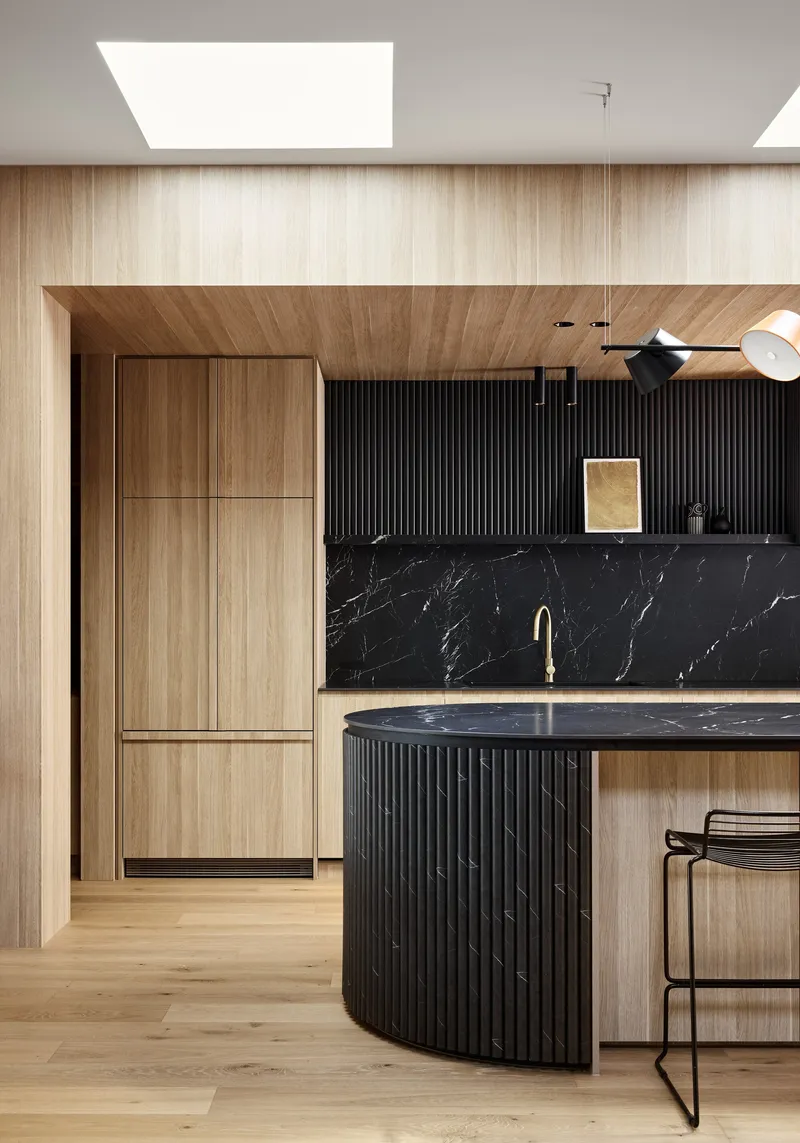

Three rectangular skylights wash the kitchen island in overhead light, and the effect is almost sacral. The island sits under a timber-clad ceiling with a black marble countertop that anchors the room's material palette. Around it, light timber cabinetry and fluted detailing meet a black marble backsplash, creating a tension between warmth and weight that defines the entire ground floor.


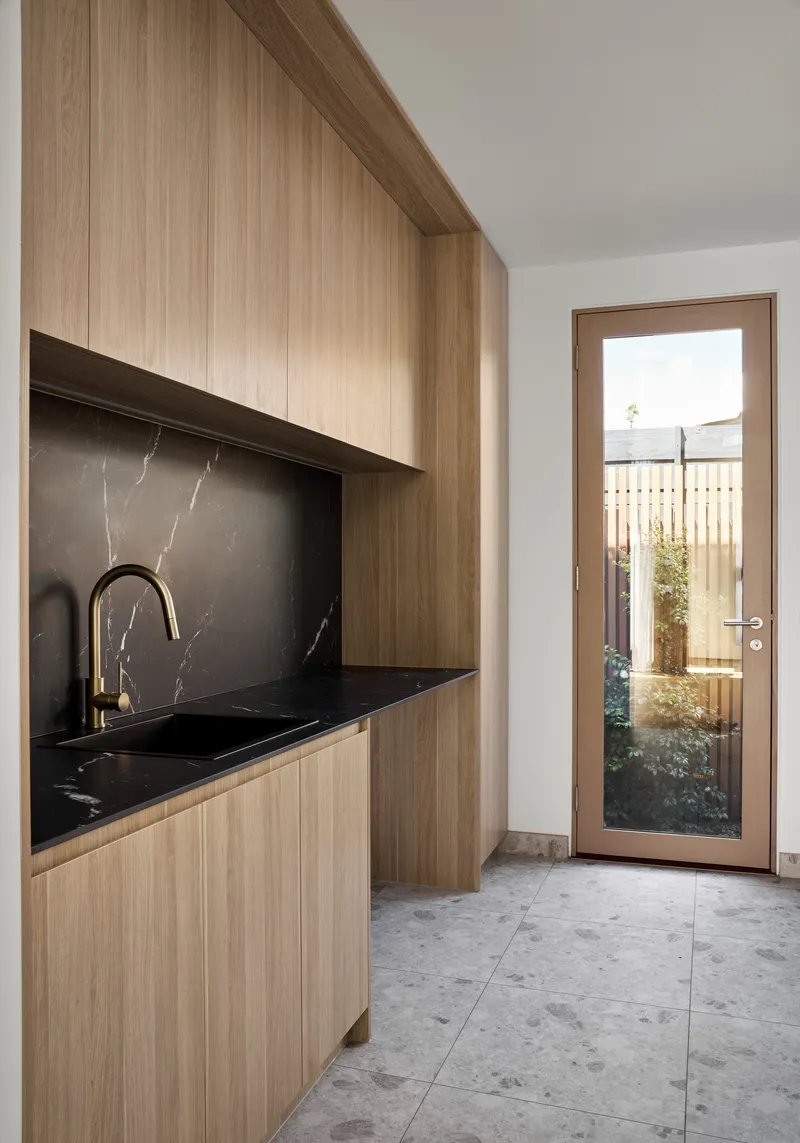
Sunlight streams across the floor from the garden side, illuminating a portal of timber that frames the built-in ovens. Open shelving above the counter and a built-in wine fridge signal that this is a kitchen designed for daily life rather than magazine-ready minimalism. A glazed door beside the counter opens to a planted courtyard, reinforcing the connection between cooking and the outdoors that Australian residential design does so well.
Living Room: Sheer Light and Dark Stone


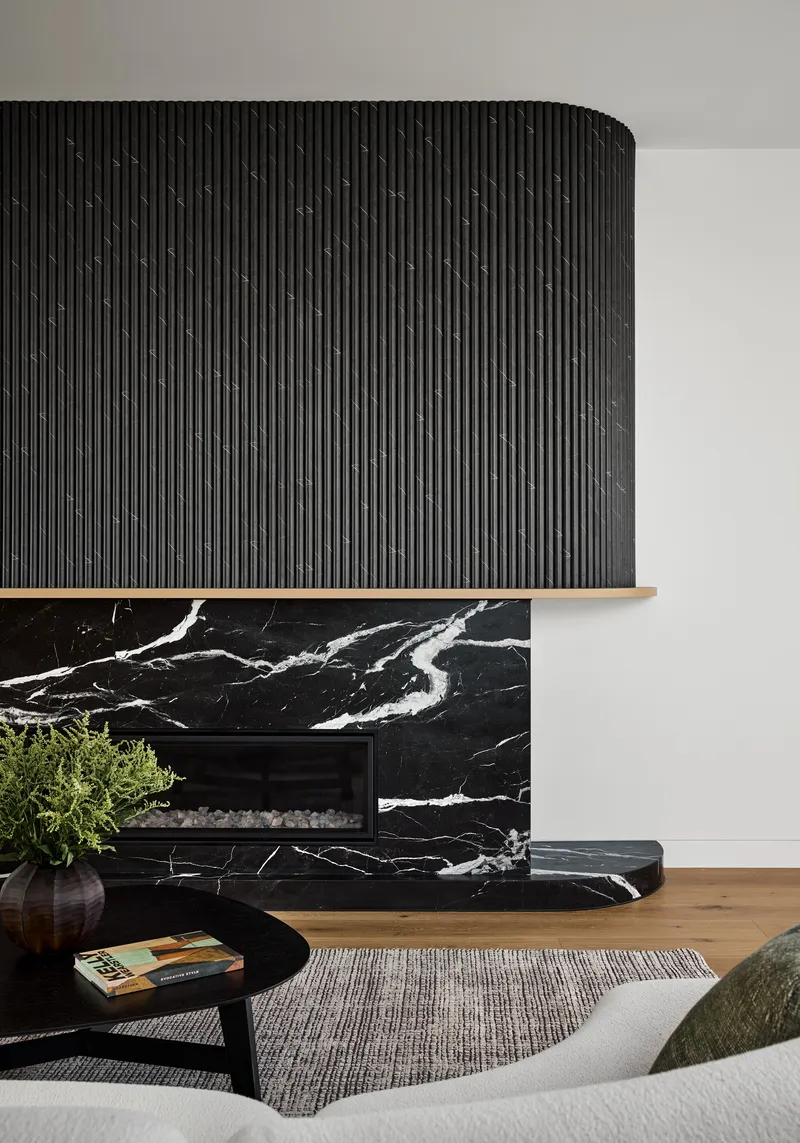
The living room pivots on two elements: a wall of sheer curtains that filter garden light into a soft haze, and a fireplace surround in black veined marble with a vertical batten hood above. The curtains are doing more work than they might appear to. They regulate both light and privacy while lending the room a quality of atmosphere that hard glazing alone cannot achieve. Behind them, a timber-lined door opens directly to the outdoor terrace, collapsing the boundary between inside and garden.
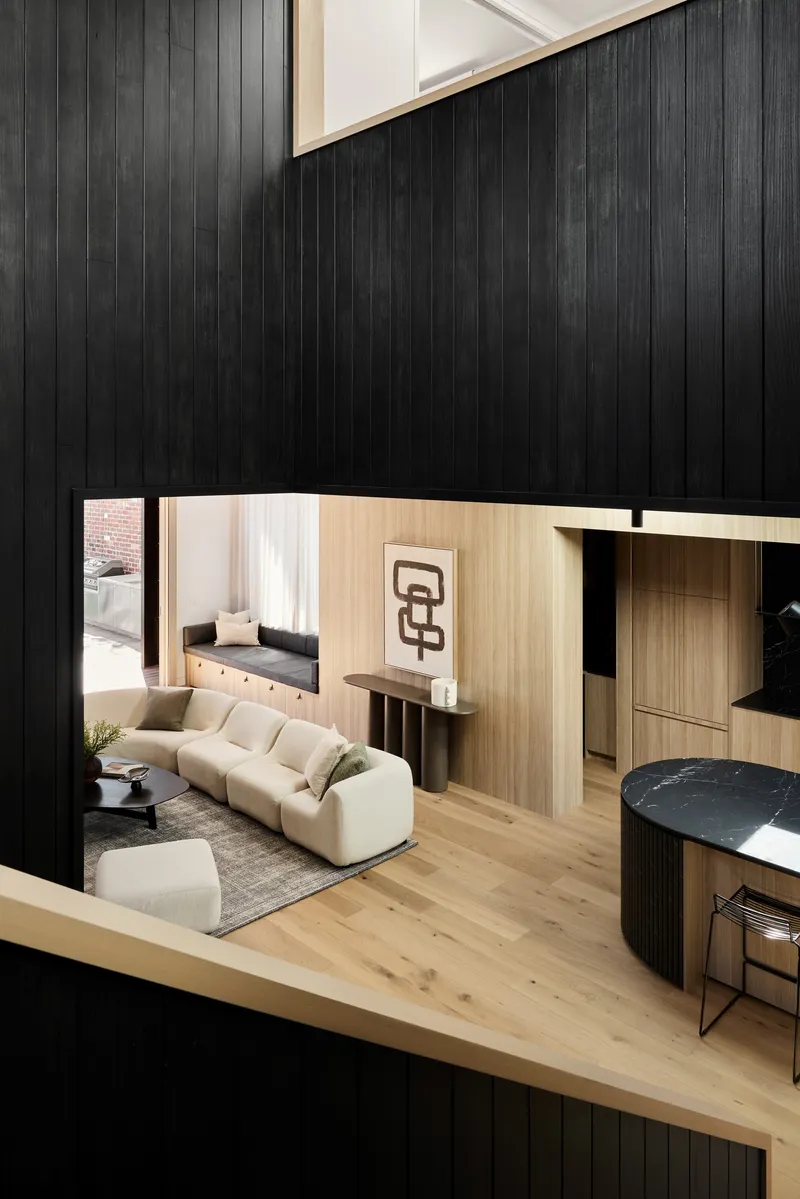
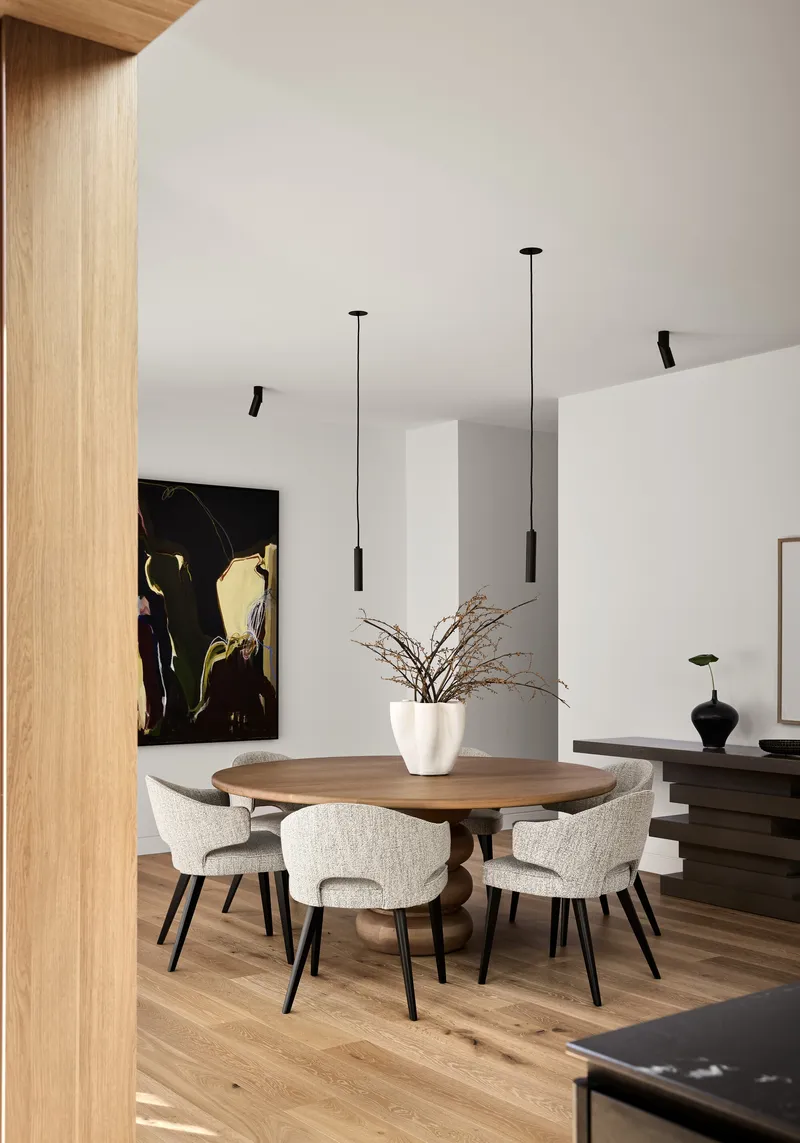
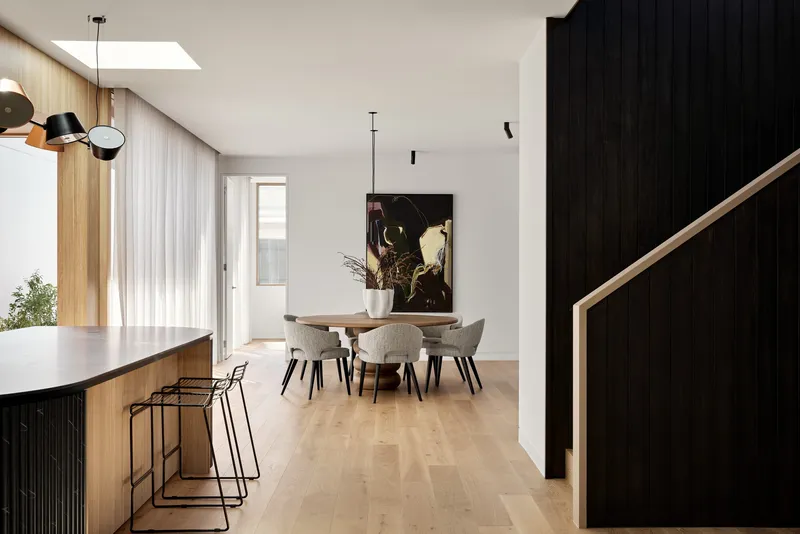
From the mezzanine above, the living room reads as a layered composition: black vertical timber walls, the sheer-curtained window wall, and furniture arranged around the fireplace. The open-plan dining area sits alongside, anchored by a round table and pendant lights that keep the space domestic in scale. The architects resisted the urge to double-height everything; the mezzanine overlook gives vertical drama without sacrificing the intimacy that a family room needs.
The Rear: Garden, Deck, and Retained Memory


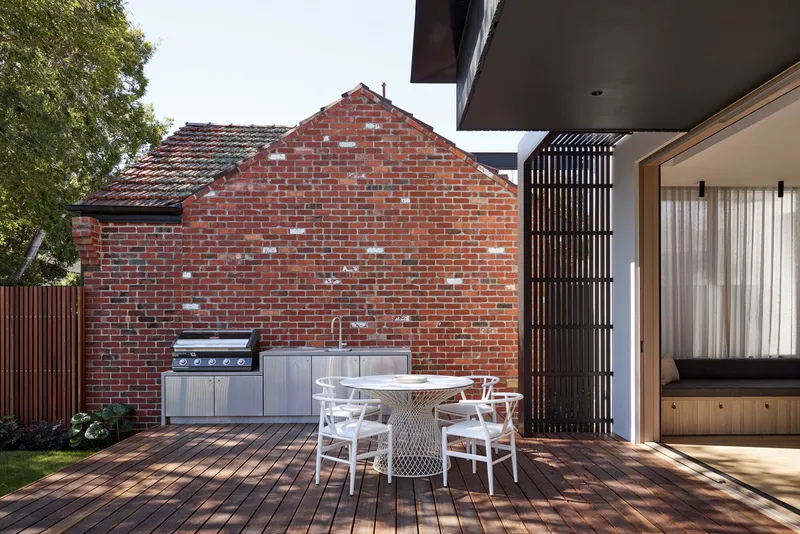
At the back of the house, the architecture relaxes. A timber deck extends the living space outdoors, hosting a dining setting beneath the cantilever of the upper floor. The most notable gesture here is the retained red brick gable wall, a fragment of whatever previously occupied the site. It reads as both a boundary marker and a deliberate act of memory, holding the new house in dialogue with its suburban context rather than erasing it entirely.
The cylindrical volume reveals its full geometry from the garden. Grey ribbed panels wrap its surface, and the cantilevered bay window projects overhead, framing a view back down to the deck. It is the kind of rear facade that does not apologize for being seen; in fact, it may be the most resolved elevation of the entire project.
Bathrooms: Brass, Marble, and Curve


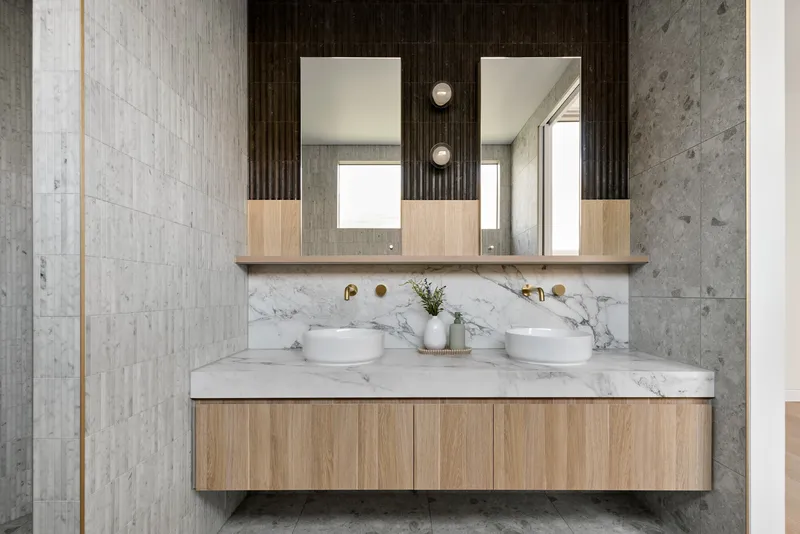
The bathrooms push the curved motif further. A shower niche with integrated ceiling lighting and a brass rainfall head uses a sweeping wall line that mirrors the cylindrical volume outside. Twin circular mirrors with timber frames sit above marble vanities, and brass fittings appear throughout. The material vocabulary is consistent: timber cabinetry, marble countertops, fluted black wall panels. None of it reads as gratuitous luxury; it reads as a palette applied with conviction.
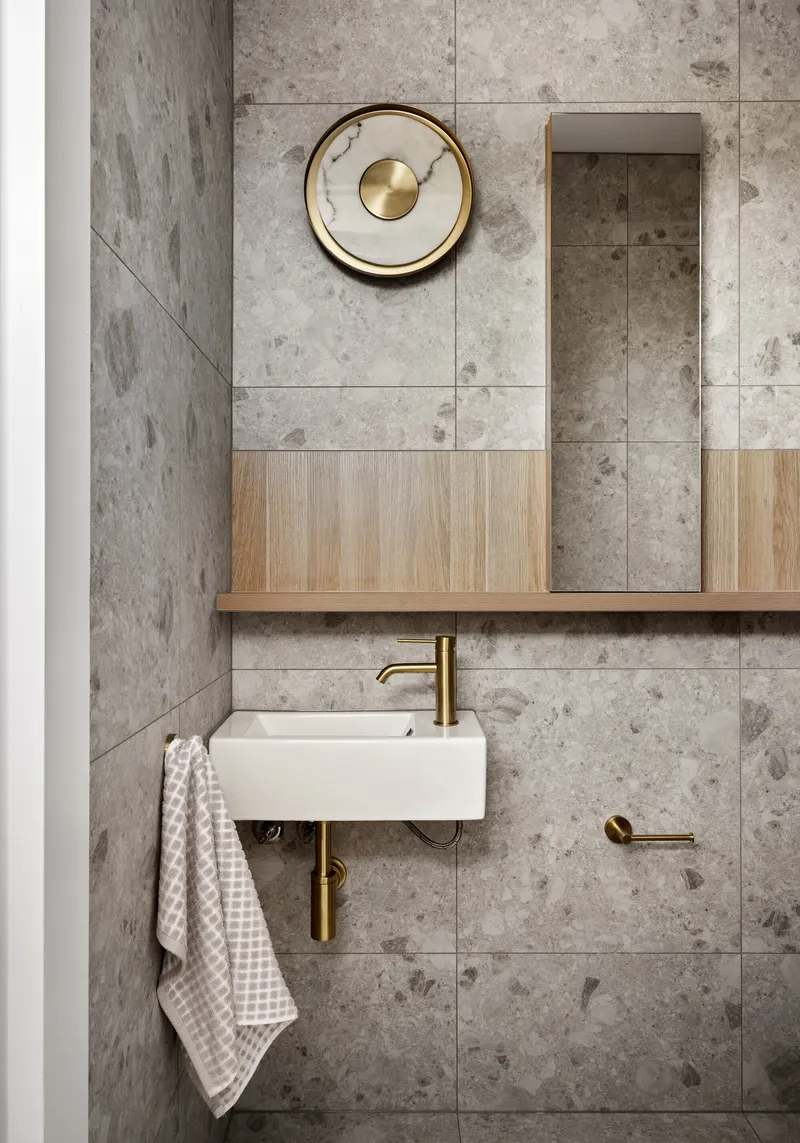

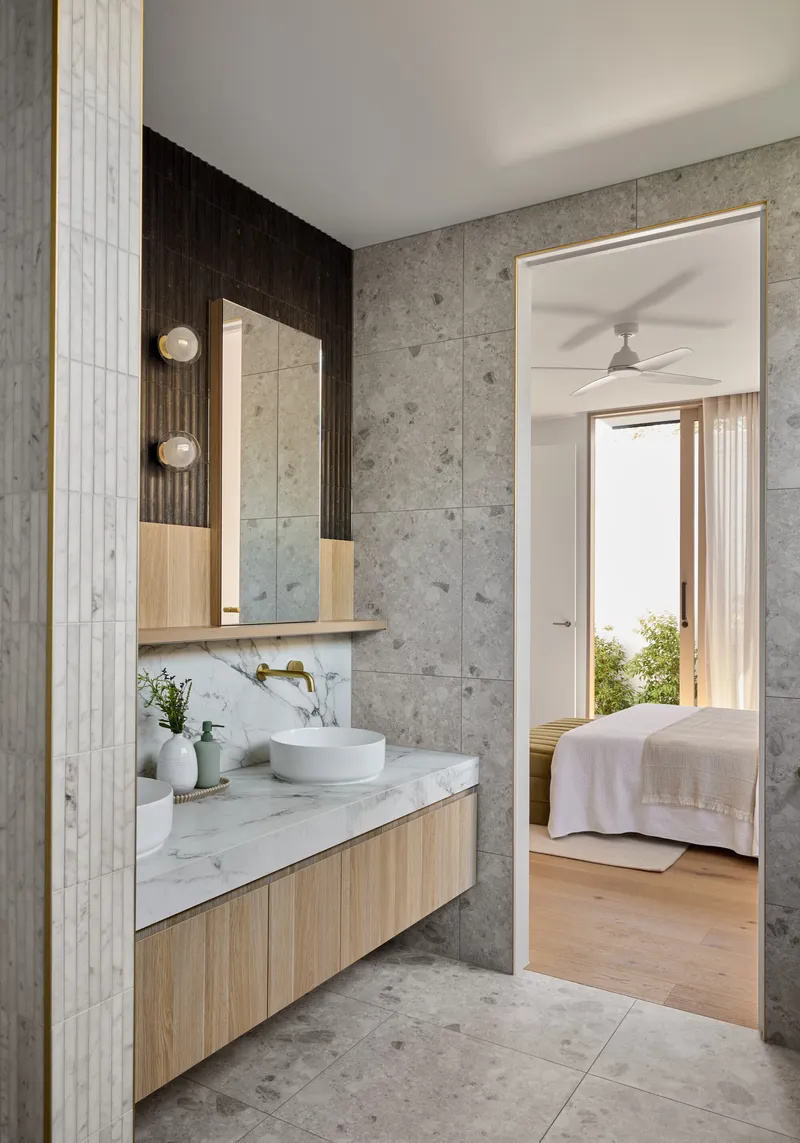
Smaller bathrooms and ensuites maintain the same standard. A wall-mounted basin with brass fittings and grey tile, a double vanity beneath tall mirrors and sconces, a view through a doorway to a bedroom flooded with natural light. The consistency across wet rooms is worth noting because it suggests a project where the interior specification was not reduced by budget pressure as the architects moved room to room.
Window Seat and Joinery Details
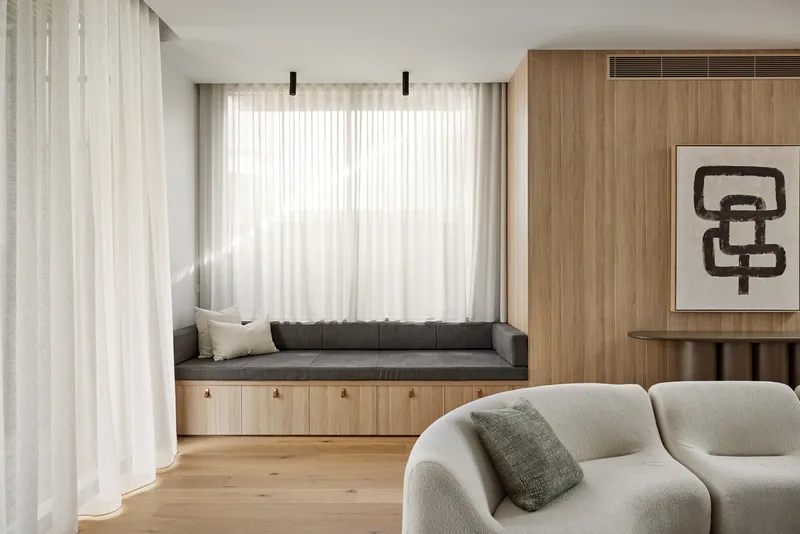
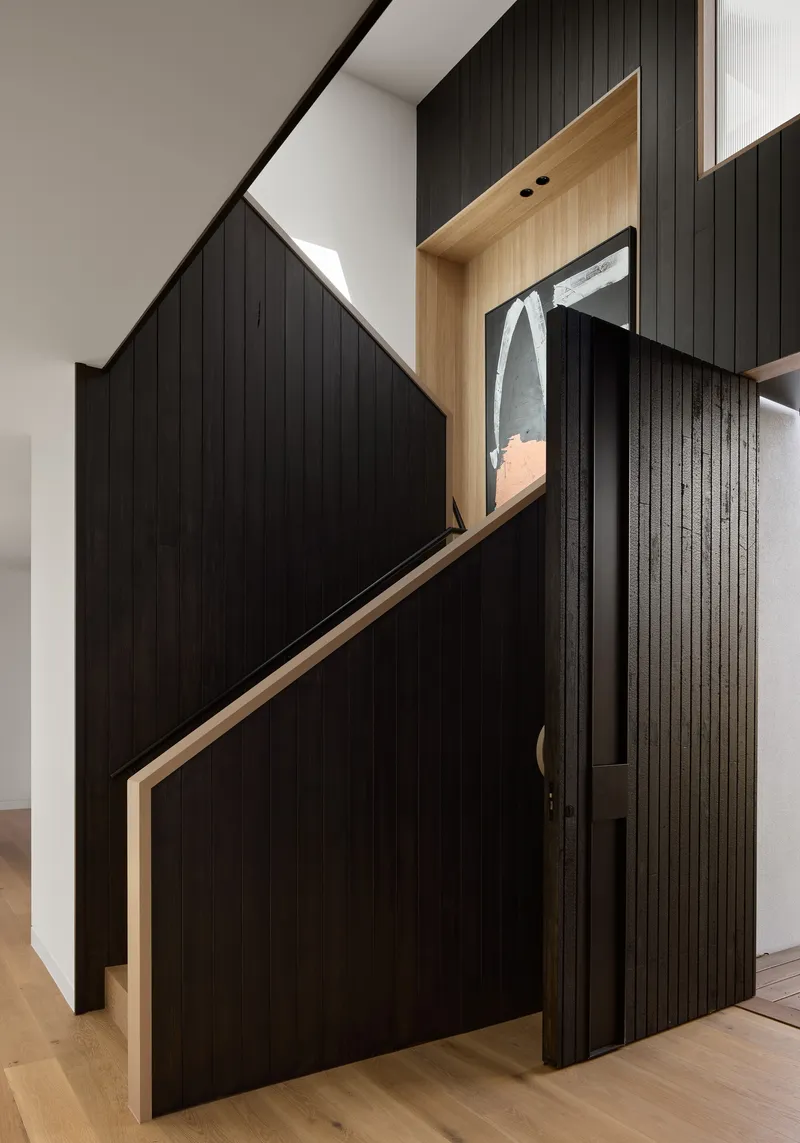
A built-in window seat with storage below and sheer curtains captures a moment of domestic generosity that plans and sections cannot convey. The understairs niche, timber-lined and set into the dark cladding, is another such moment. These details reveal the care taken at the scale of furniture and joinery, where the house stops being architecture and starts being a place to sit, store, and inhabit.
Plans and Drawings

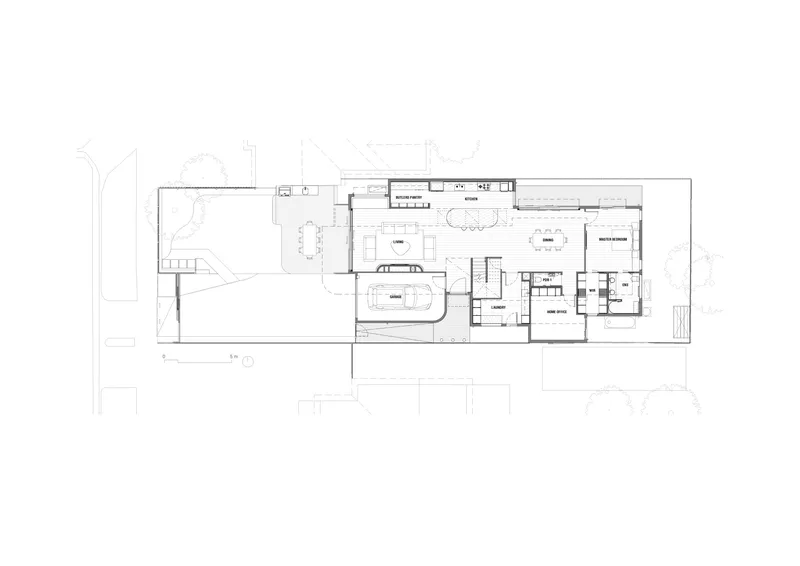
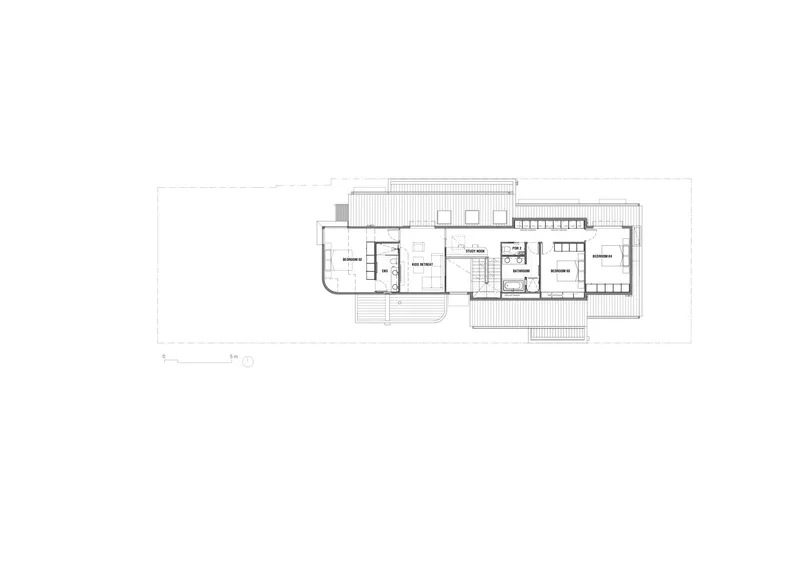
The site plan confirms the constraints: a narrow rectangular footprint wedged among neighbouring structures with landscape wrapping its perimeter. The ground floor plan reveals an open living sequence running from the rear garden through kitchen and living room to the entry, with a central staircase mediating between public and private zones. Upstairs, bedroom suites line a central corridor, each with access to its own bathroom. The plans show a house that is spatially efficient without feeling compressed, proof that 334 square metres on a tight suburban lot can accommodate generosity when the planning is disciplined.
Why This Project Matters
Havenwood matters because it demonstrates that a suburban house on gifted family land does not have to default to safe choices. Atlas Architects took a quiet cul-de-sac in Brighton and delivered a house with genuine formal ambition: a curved volume, a dark street facade, a retained heritage wall, and an interior material palette that carries from kitchen to bathroom without dilution. The project navigated what its architects describe as challenges at every turn, yet the finished house shows no sign of compromise.
It also offers a model for how Australian suburban homes can engage their street without either hiding behind hedges or showing everything. The calibrated opacity of the front facade, the controlled generosity of the rear garden elevation, and the skylit warmth of the interior create a sequence of experiences that is specifically architectural. Not every family home needs a cylinder on its roof. But this one earns it.
Havenwood by Atlas Architects (lead architects Aaron Neighbour and Ton Vu). Brighton, Australia. 334 m², completed 2025. Photography by Tess Kelly.
About the Studio
Share Your Own Work on uni.xyz
If projects like this are the kind of work you want to make, uni.xyz is a place to publish your own, find collaborators, and enter design competitions.


Popular Articles
Popular articles from the community


Manzana Morphosis: Stretching Barcelona's Grid into a Living Landscape for 2050
A radical reworking of the Eixample manzana turns density into a tool for generous public space, vertical ecology, and environmental performance.

Opera on the Sea: Driftwood Logic Shapes a Timber Opera House on Estonia's Coast
Trevor Orgill's opera house translates the entangled drift of floating timber into a civic building where wood, water, and music converge.

Cloaked Colonization: A Mobile Underwater Habitat That Moves Like a Fish
Micah Abaya's shortlisted EHC Pacific entry reimagines ocean settlement as a dispersed network of self-sustaining architectural organisms.

Singing Woman: An Opera House That Performs Before the Curtain Rises
Ovidiu Cristian Pavel's conceptual opera house translates Estonia's choral identity into a sculpted waterfront landmark facing the Baltic Sea.

Similar Reads
You might also enjoy these articles

Pixel Gardens: One Repeated Module Stacked Into a Terraced Social Housing Tower for Famagusta
Salem Bader's shortlisted housing tower builds a vertical neighbourhood from one repeated module, offsetting units to carve terraces, light and air.

Bao Huynh Watercolor Atelier: A Serene Art Retreat in Hội An
Bao Huynh Watercolor Atelier in Hội An blends multifunctional art spaces, sustainable design, local materials, and family-friendly living in a serene environment.

Atelier Macri Concept Store Interior Design by CASE-REAL
Atelier Macri store features a "ko" counter, walnut wood details, cork displays, blending retail, gallery, and seamless customer experiences.

Manuel Vargas Izquierdo Stadium and High-Performance Sports Center: Architectural Excellence in Jalpa de Méndez
The Manuel Vargas Izquierdo Stadium blends sustainable design, inclusive sports facilities, and cultural-inspired architecture, revitalizing Jalpa de Méndez’s public spaces.


Comments (0)
Please login or sign up to add comments
No comments yet. Be the first to comment!