
Baranca Student Housing
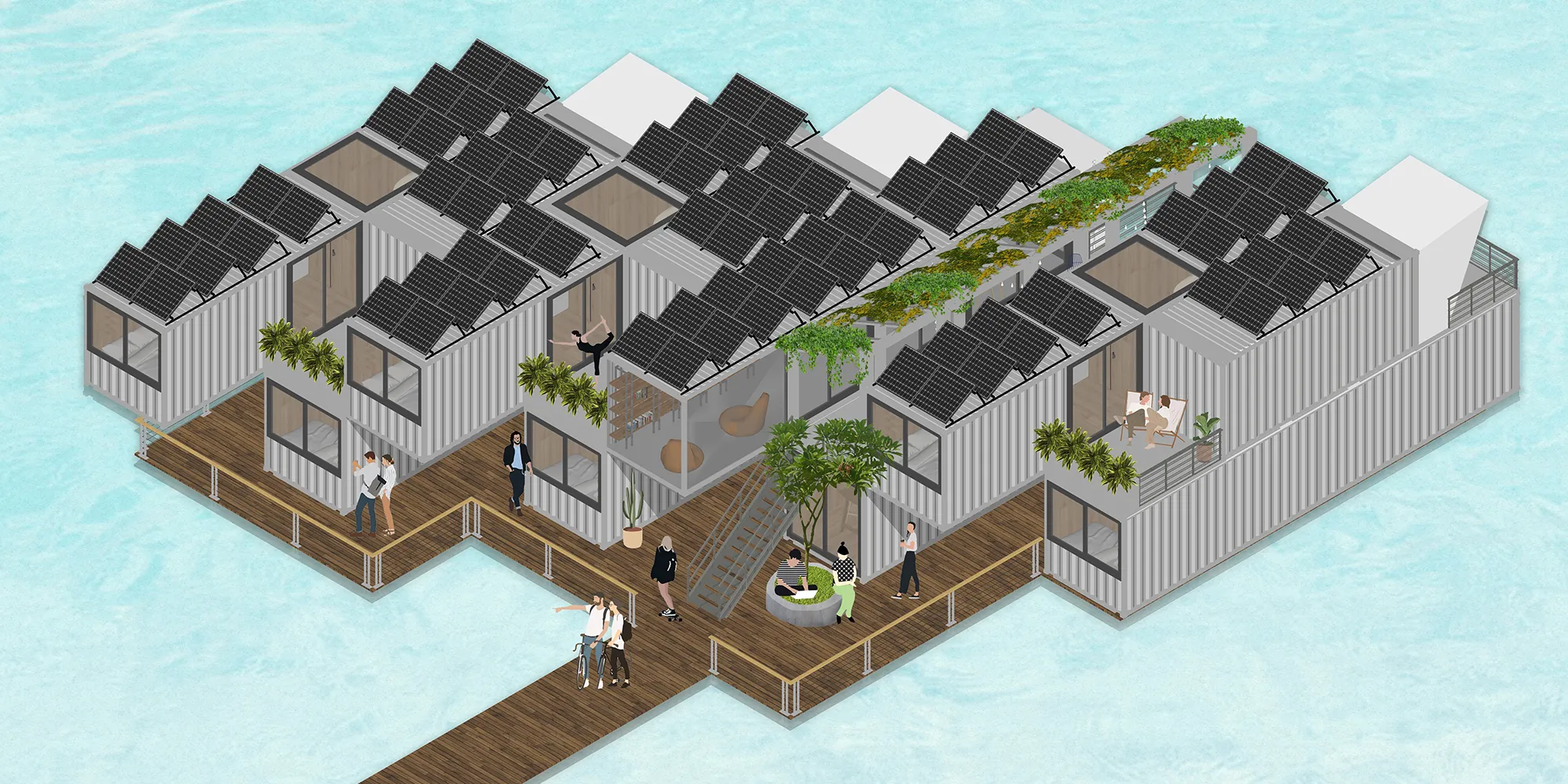
Baranca offers students the opportunity to explore a new lifestyle. In essence, the structure challenges the notion of what seaside architecture means and who is intended for.

Brief and Background
The task at hand was to design a student housing made of up to 15 shipping containers. We decided to bring such a proposal to the Dutch Caribbean island of Aruba. Affordable temporary housing for students is rather limited or non-existing. Such condition translates to students living in shared spaces destined for short term needs. Aruba’s infrastructure was developed with the intent to support the tourism industry. Seaside hotels, convenience stores, restaurants, plazas, and shopping centers shaped the urban fabric of Aruba. Financial groups and developers in coordination with governmental policies and investments facilitated these establishments. The result has been a fast-paced, and continuous creation of infrastructures that fulfills the demands of the tourism industry. Typically, developments aimed at the tourism industry are in close proximity or right in front of the seaside. Thus, waterfront properties are exclusive to hotels, resorts, and luxury homes. Additionally, Aruba’s economy is reliant on imported goods, and with very limited internal production, the availability of shipping containers is rather abundant. So it’s a fitting use of material for this proposal.
Concept
The concept behind Baranca lies in placing an unexpected structure right on the crystal clear waters off the island, in front of luxury homes, in the middle of Oranjestad, the capital of the island. The building is located in the waters of Paardenbaai, next to Aruba Linear Park, a walking and biking trail that also works as a buffer between the city of Oranjestad and the coastline. The word “baranca” means cliff, an ode to the many cliffs that exist on the North coast of the island and served as inspiration for the location and final layout of the complex. Our student housing has the potential to be a great example of urbanism that benefits Aruba’s growing student community. It offers students the opportunity to explore a new lifestyle. In essence, the structure challenges the notion of what seaside architecture means and who is intended for.
Final Outcome
The entire complex measures 163 sqm and it’s made out of 15 shipping containers, eight 40’ long and seven 20’ long. It can host up to 18 people comfortably. Early on we decided to limit the number of stories to two with the intent of diminishing the disruption of the coastline view. Additionally, in order to facilitate the replicability of the structure as a whole, we designed model units that consist of four connected shipping containers (two 40’ and two 20’) where up to 6 people can temporarily live. Such arrangements make the student complex easier to expand.
Quality of Living
The spatial limitations of the containers is offset by the location of the complex. Blessed by warm weather and very little rain all year long, students have the opportunity to embrace the outdoors as part of their daily lives. Each room faces either the sea or the city side buffered by Linear Park. The structure is completely surrounded by nature. To increase living spaces, we decided to dedicate three shipping containers to communal purposes; a kitchen, a laundromat, and a study room. Such arrangement encourages students to use the structure and explore beyond their living quarters. Finally, the location of the structure is accessible to public transportation, right off the middle of a park while simultaneously connected to the city and educational centers. We also encourage the use of clean energy by adding solar panels, skylights, and a circular water system to the complex.
Space Programming
To enter Baranca, students and visitors have to walk a long pier surrounded by crystalline calm waters. Such experience provides a moment to disconnect from the noise of the city and daily life. It’s an unintended but welcome experience that brings peace and encourages mental and physical health. The entire complex counts with 3 individual apartment units of four bedrooms. Each private room has a desk, storage space, and a single or a double bed with seaside or nature views. Each apartment has, additionally, one full spacious bathroom with seaside views, one small kitchen, one cozy lounge, and two private terraces upstairs. The communal laundry room has space for four laundry machines and four dryer machines, space for folding laundry, and two seating areas. The communal kitchen has enough space to seat up to 14 people at the same time and it counts with enough storage space to compliment the private kitchen inside the apartments. The communal study room has the look and feel of a lounge. It’s located upstairs and has study tables, a library, lounge chairs and an ample terrace for exercising or lounging.
Materials
The finishes are monochromatic, it was decided early on to use a duo-chromatic color palette. Light wooden finishes cover the majority of the surfaces in combination with a pop of color. Aruba is a desert island, so the color palette calls for the neutral shades of Aruba’s soil and sand and the use of color in colonial architecture. Greenery is added to the rooftop with the intent of providing shade, a feature that will change with the passing of time, when it grows and starts to cover the shipping containers.




Popular Articles
Popular articles from the community


Co-life: Sustainable Architecture for Age-Friendly Community Living
Co-life reimagines sustainable architecture for seniors through courtyards, rammed earth, shared gardens, and spaces designed for belonging.

Hill & Cross Opera: Sculptural Opera House Architecture Shaped by Tallinn’s Landscape and Identity
Hill & Cross Opera reimagines opera house architecture in Tallinn through its sculptural hill, civic plaza, glass wave and a luminous cross.

Riyadh For All: Intergenerational Urban Design for Active Aging in Rabat
Riyadh For All reimagines urban design in Rabat with intergenerational co-living, adaptive courtyards, and Moroccan cultural exchange today.

The Musturak Paradise: Senior Living Architecture for a Connected Future in Temara, Morocco
The Musturak Paradise reimagines senior living architecture in Temara via private homes, social spaces, culture, community, and shared care.


Similar Reads
You might also enjoy these articles

Day and Night Park: A Time-Based Urban Newsstand in Beijing
A temporary urban newsstand in Beijing blending travel, light, and reading through poetic colors, compact form, and community-focused design.

Modernist Patio Renovation in El Masnou, Barcelona by Oliver Segura Arquitectura + Cebrià Arquitectura
Modernist patio renovation blending tradition and innovation with a movable pool, leveled floors, and Catalan materials in El Masnou.

Alto Residencial Coop: Cooperative Housing Development in Santiago de Compostela by Carbajo Barrios Arquitectos
A linear cooperative housing complex blending white volumes and perforated metal façades, enhancing community living, natural light, privacy, and urban integration.

Vil Genis School by BPA ARCHITECTURE – Massy, France
Vil Genis School in Massy, France, features sustainable design, south-facing classrooms, community integration, accessible spaces, and modern educational architecture.


Explore Student Housing Competitions
Discover active competitions in this discipline


Challenge to design mud housing for contemporary communities


Design challenge to reuse E-waste
Comments (0)
Please login or sign up to add comments
No comments yet. Be the first to comment!