
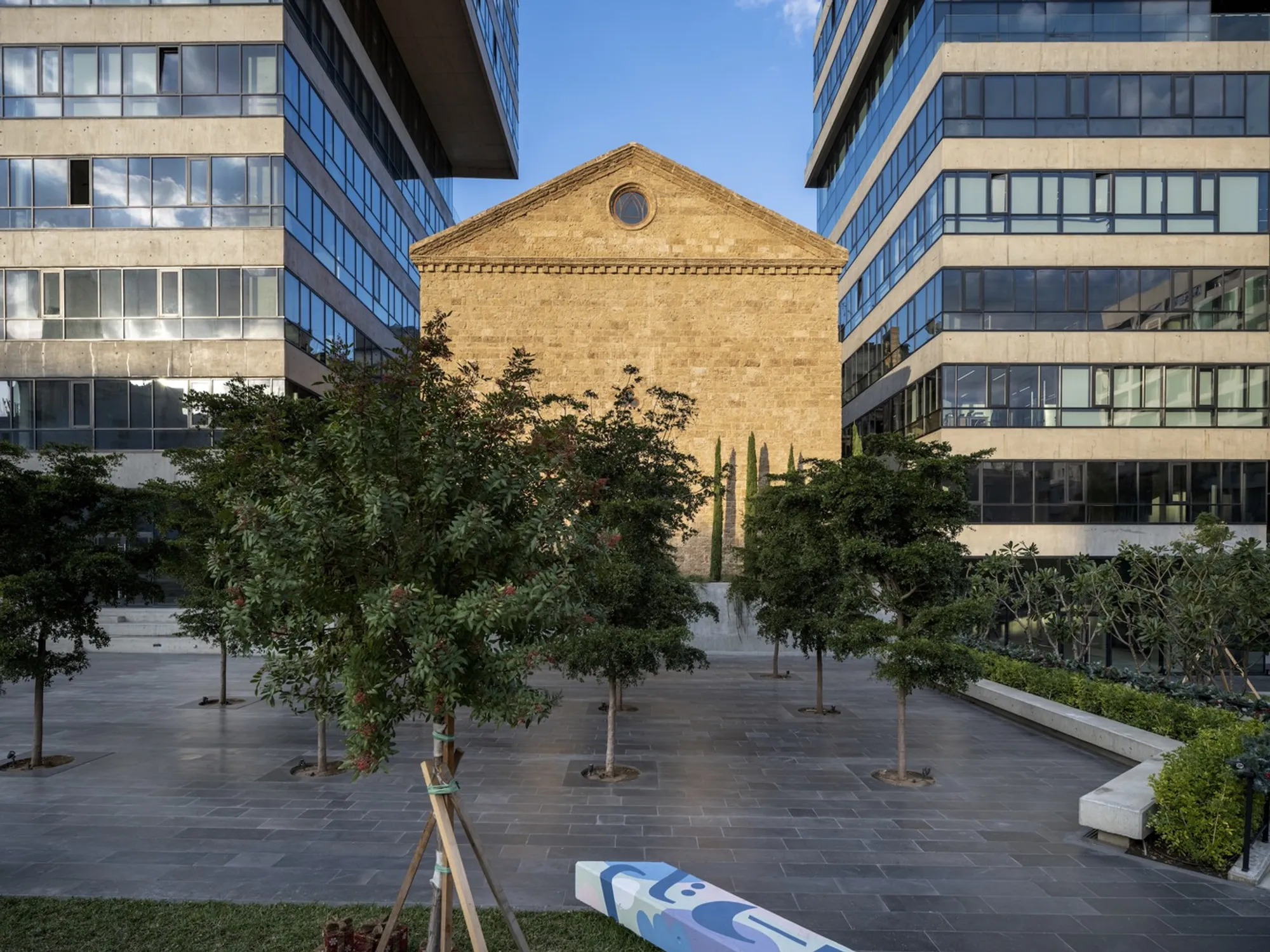
PARALX Threads a 19th-Century Church Between Two Office Towers on Beirut's Former Green Line
BDD 1227 and St. George Church bind heritage preservation to LEED Gold workspace across a civil war fault line in Beirut.


Some sites carry so much history that anything you build on them is, whether you like it or not, a political act. The 1.8-hectare plot that PARALX inherited for Beirut Digital District's BDD 1227 complex sits along the city's former Green Line, the boundary that sliced Beirut in two during the 1975 to 1990 civil war. Wedged between the two new office buildings is a 19th-century sandstone chapel, St. George Church, that somehow survived the conflict. Rather than treating the church as an obstacle, lead architect Karim Moussawer turned it into the project's organizing principle: two cantilevered glass-and-stone volumes frame the chapel on either side, and an underground parking garage passes beneath it without so much as cracking a wall.
The result is 18,032 square meters of LEED Gold certified office space, 2,415 square meters of public outdoor space, and a restored ecclesiastical interior capped by a parametrically designed roof that funnels daylight through truncated pyramidal skylights. It is a project that refuses to choose between preservation and development, and in doing so it argues that post-conflict urbanism does not have to erase what came before.
A Chapel Held Between Shifting Volumes
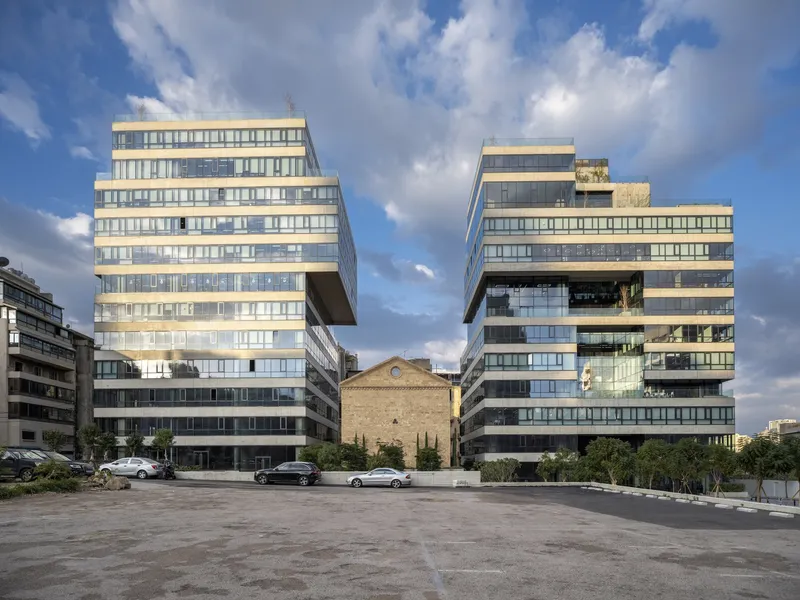
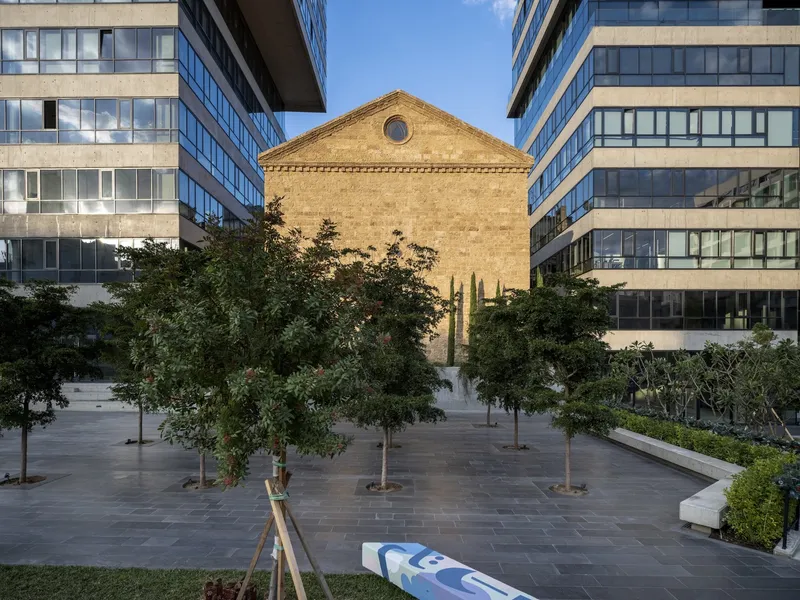
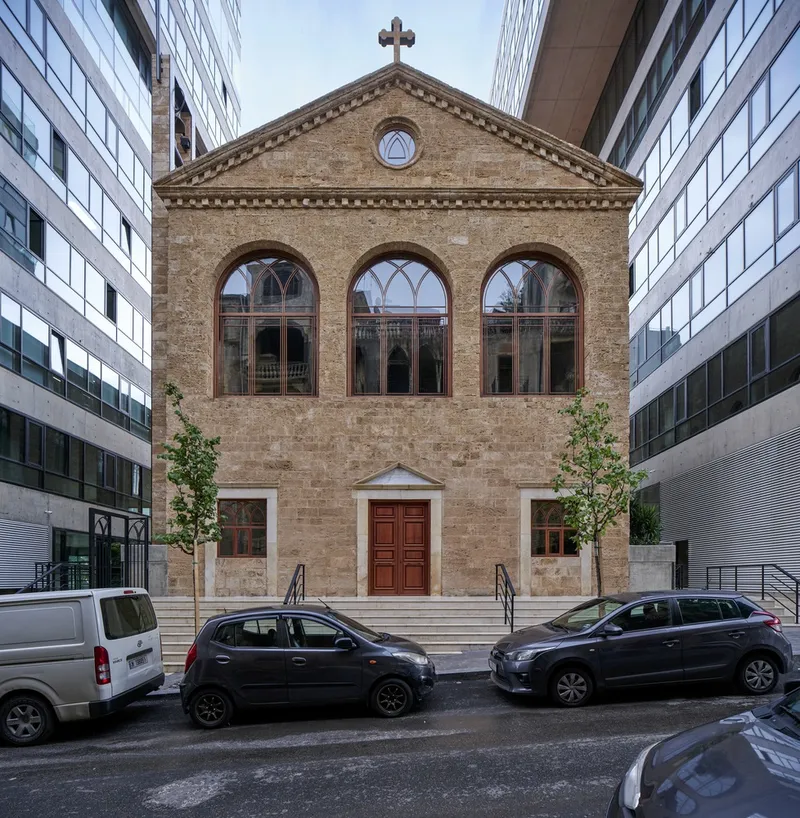
The most striking move is visible from the street: the two office towers lean into each other over the chapel courtyard, their masses shifting floor by floor so that sight lines toward the Mediterranean, the central piazza, and the wider city remain open. The chapel's triple-arched facade, complete with its original timber door, reads as a civic threshold between the two buildings rather than a relic trapped between them. Planted trees and a paved courtyard soften the scale differential, making the outdoor space feel genuinely public rather than corporate.
Constructing six and seven basement levels beneath the lower and upper buildings respectively, while threading a connecting parking garage under a 19th-century structure, demanded extraordinary engineering discipline. The structural consultants at CODE had to control soil erosion, airborne dust, and vibration throughout the excavation. That the sandstone walls show no signs of distress is the most understated achievement of the entire project.
Restoring the Interior of St. George Church
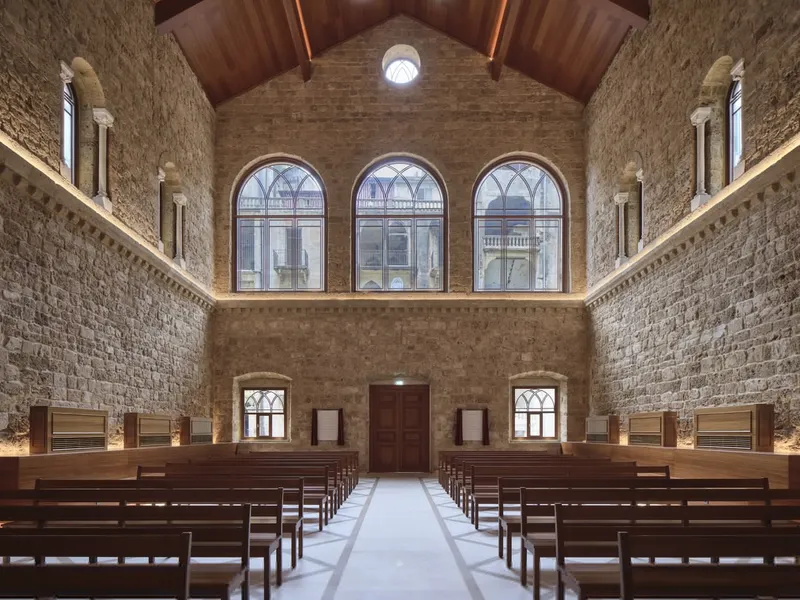
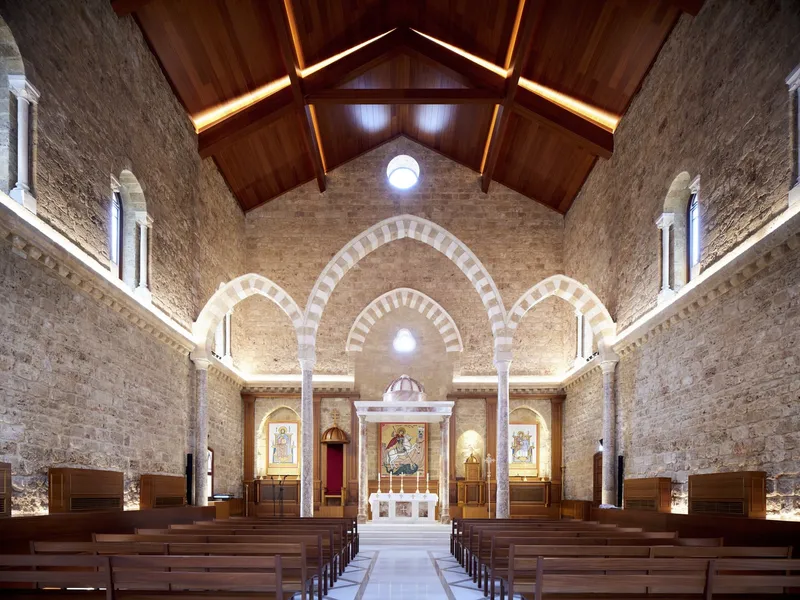
Inside the church, the intervention reads as a conversation between old masonry and new geometry. The existing sandstone walls, with their distinctive striped arches and central oculus, were preserved in place. Above them, PARALX added a new roof structure of parametrically generated truncated pyramids that channel natural light down into the 50-foot-tall nave. The effect transforms what could have been a dim interior into a luminous space where beams of daylight move across stone throughout the day.
The roof design is not arbitrary decoration. Its pyramidal forms reference traditional Lebanese church ornament, abstracted through computational tools into something that honors the source without imitating it. Combined with Black Body Design's lighting scheme, the restored nave holds a quiet intensity that justifies the entire preservation effort. Wooden pews and a timber vaulted ceiling keep the material palette warm and grounded against the cool stone.
The Glass Threshold
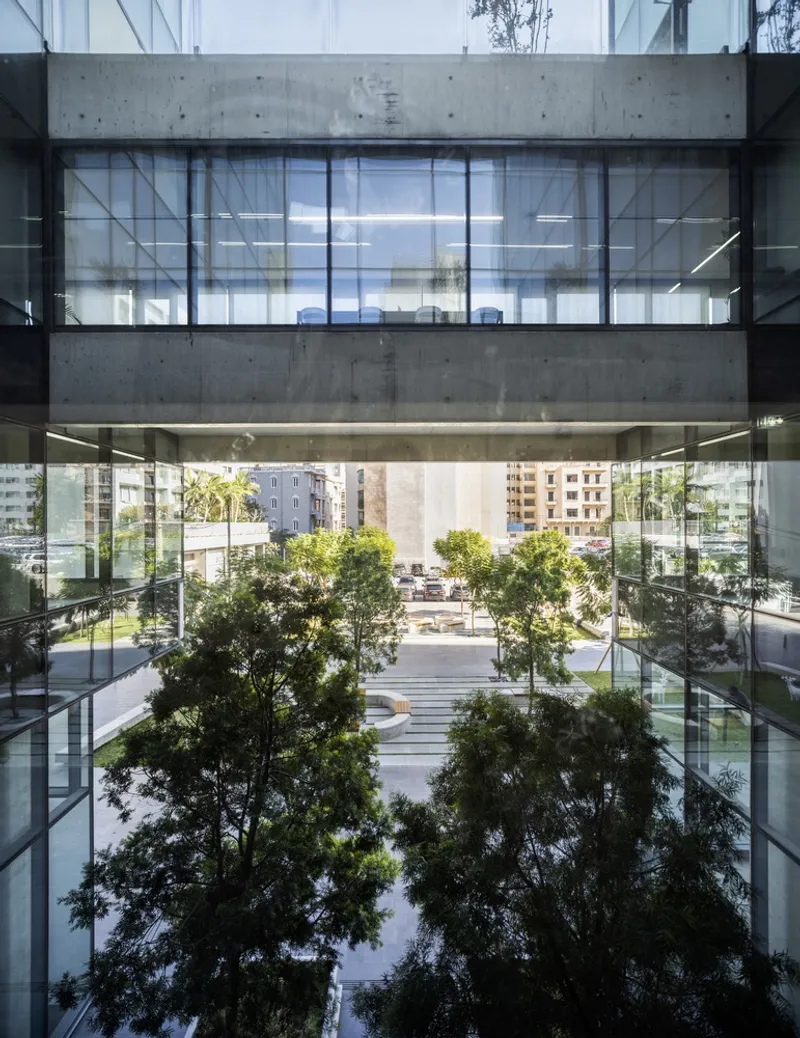
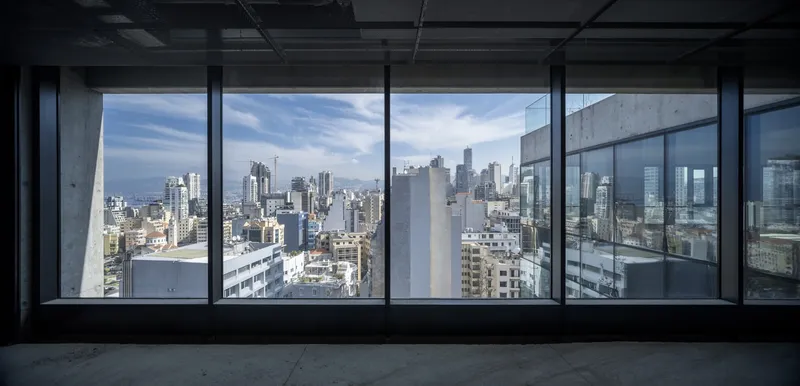
One of the subtler design moves is the way the office lobbies are treated as transparent membranes rather than barriers. Floor-to-ceiling glazing frames the courtyard trees from inside, and concrete beams visible through the glass give the lobbies a structural honesty that avoids the polished anonymity of typical corporate entries. From upper floors, the same glazing strategy opens panoramic views to Beirut's dense urban skyline, situating workers visually within the city rather than above it.
The decision to orient both buildings toward the main piazza to the east, rather than toward each other, keeps the complex outward-facing. Porosity was a stated design goal, and you can feel it in the way the buildings breathe: terraces on multiple floors create semi-public outdoor zones, and the shifting massing ensures that no corridor feels sealed off from daylight or context.
Workspaces That Resist the Generic
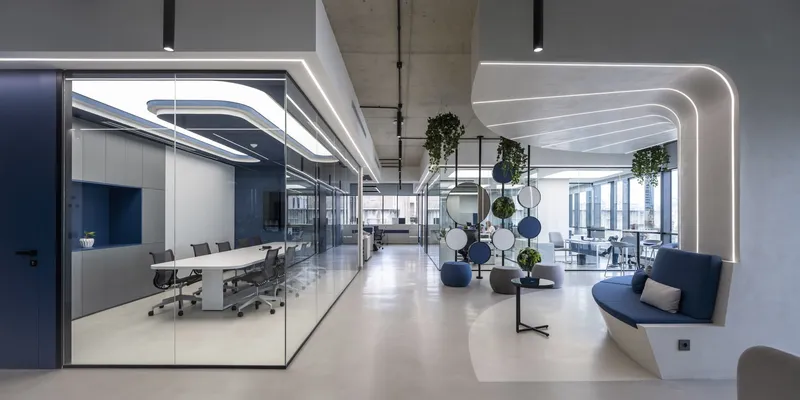
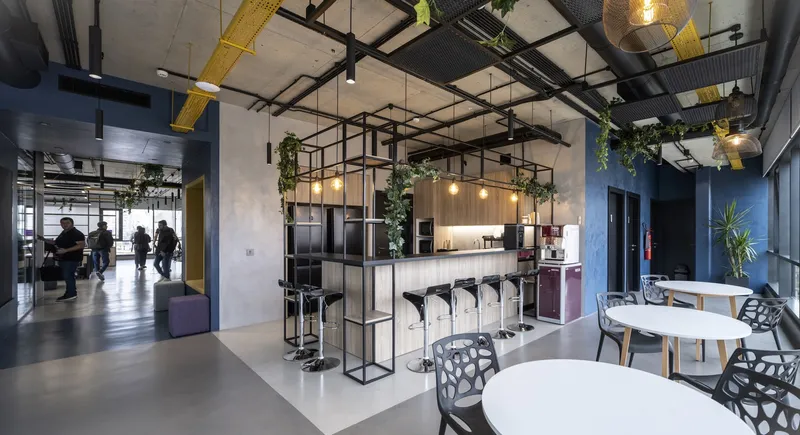
The interior office floors lean into biophilic strategies without overplaying them. Suspended planters trail from curved linear lighting fixtures along open-plan corridors, and glass-walled meeting rooms maintain visual continuity across the floor plate. Nothing here feels like a wellness trend pasted onto a spec office; the greenery reads as deliberate spatial layering rather than decoration.
A freestanding steel-frame kitchenette with integrated bar seating and pendant lights serves as one of several informal gathering points. These micro-interventions matter: they break the monotony of open-plan work and give employees reasons to move through the building. The use of low-emitting paints and coatings, recycled and regionally sourced materials, and provisions for 27 bicycle racks and 19 low-emission vehicle parking spaces contribute to the LEED Gold certification. None of these features are individually revolutionary, but their integration across 194,000 square feet is rigorous.
Why This Project Matters
BDD 1227 and the restoration of St. George Church matter because they demonstrate that heritage and commercial development can coexist without one patronizing the other. The chapel is not a decorative artifact preserved behind glass; it is an active anchor that shapes the massing, circulation, and public space of the entire complex. PARALX's willingness to let a small, old building dictate the logic of a large, new one is a lesson that many firms working in historically charged contexts should study carefully.
More broadly, the project positions the Beirut Digital District as something more than a tech park. By rooting a forward-looking creative economy hub in the layered memory of the Green Line, PARALX makes the argument that Beirut's future cannot be built by bulldozing its past. In a city that has endured decades of destruction and reconstruction, that argument carries weight. The fact that it is delivered through careful engineering, a restrained material palette, and genuinely public outdoor space only makes it more convincing.
BDD 1227 & St. George Church by PARALX (Lead Architect: Karim Moussawer). Beirut, Lebanon. 18,032 square meters. Completed 2023. Lighting: Black Body Design. Landscape: Greener on the Other Side. LEED Consulting: Eco Consulting. Structural Engineering: CODE. MEP: Jamal Mehio. Life Safety: Socotec. Photography by Wissam Chaaya.
About the Studio
Share Your Own Work on uni.xyz
If projects like this are the kind of work you want to make, uni.xyz is a place to publish your own, find collaborators, and enter design competitions.




Popular Articles
Popular articles from the community


The Ocean Hive: Sustainable Architecture for a Self-Sufficient Civilization at Sea
The Ocean Hive imagines sustainable architecture at sea, where modular habitats, algae, wave power and ocean waste sustain a growing colony.

Riyadh For All: Intergenerational Urban Design for Active Aging in Rabat
Riyadh For All reimagines urban design in Rabat with intergenerational co-living, adaptive courtyards, and Moroccan cultural exchange today.

The Earth Pod: 3D Printed Homes for Resilient Refugee Communities
The Earth Pod reimagines refugee housing through 3D printed homes made from clay, combining resilience, self-sufficiency, and rapid shelter.

Lunar Spiral: Space Architecture Shaped by the Mathematics of the Universe
Lunar Spiral reimagines space architecture through Fibonacci geometry, lunar regolith, levitating habitats, and self-sustaining Moon living.

Similar Reads
You might also enjoy these articles


Hodi-Mandai Geram
Project Function: Preservation and revitalization of the Intangible heritage and socio-spatial identity of the Hodi by Housing, Cultural Memory Center, Sacred Grove, landscape, local tourism economy


Olio Towers: A Mid-Rise for Performers That Fuses Housing, Rehearsal, and Stage
Located blocks from Houston's Theater District, this modular tower stacks living units around a central performance atrium.

Oasis: Modular Green Housing Carved into Dhaka's Urban Fabric
A shortlisted Plugin Housing entry reclaims unauthorized settlements in Dhaka with stepped concrete volumes, green roofs, and ventilation-driven design.

Black Hole: A Floating Megastructure for the Post-Physical Era
Emiliano Mazzarotto envisions a spherical, self-scaling arena where e-sports, digital hotels, and holographic stadiums replace traditional public space.

Explore Parallax Design Studio Competitions
Discover active competitions in this discipline



Challenge to reimagine the Iron Throne


Photograph architecture without architects


Illustrate the lost glory of Angkor Wat - Render Challenge


Design challenge to reuse E-waste
Comments (0)
Please login or sign up to add comments
No comments yet. Be the first to comment!