

Besahapio: A Modular Desert City That Feels Real
A nine-quarter modular city on a climate-rotated grid, with courtyard housing, perforated stone screens, and pedestrian-first streets in the Sahara.


Most modular city proposals look modular. They read as diagrams: clean grids, identical units, systems-level thinking that forgets the street. Besahapio, a project by Beatrix Baltabol, is a modular city that looks like a city. The facades are textured. The streets are shaded. The plazas have steps to sit on. The system is there, but it is hidden behind the experience.
Shortlisted in the Extreme Habitat Challenge: Sahara on uni.xyz, Besahapio proposes a scalable urban settlement built on an iron grid framework, divided into nine quarters, and organised around courtyards, pedestrian streets, and public plazas. It is one of the most architecturally resolved entries in the competition.
The Grid: Rotated for Climate
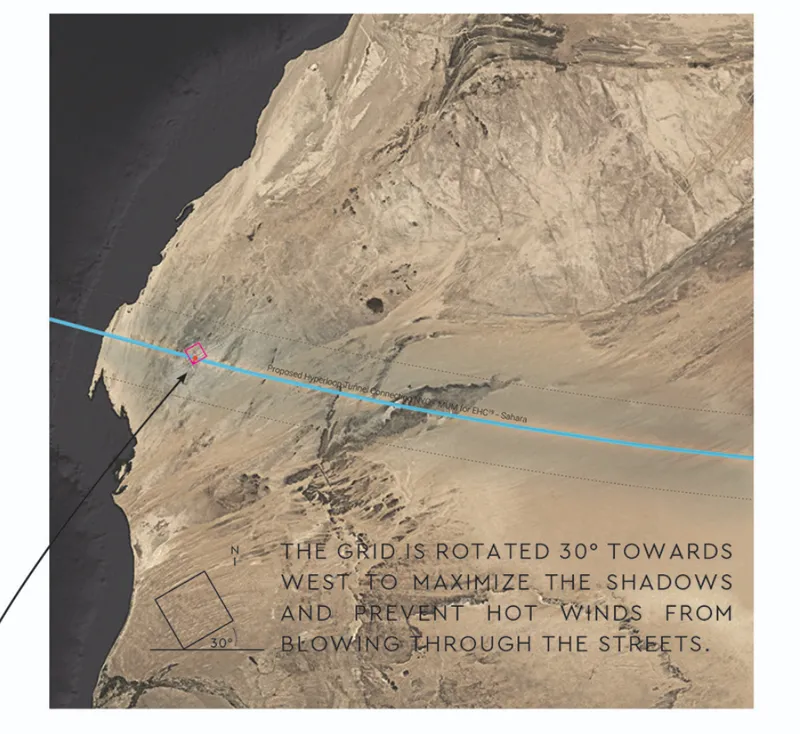
The master plan sits on a grid rotated 30 degrees west of north. This is not a formal decision. It is a climate decision. The rotation maximises shadow coverage on the streets during the hottest hours and prevents the prevailing hot winds from blowing straight down the corridors. Every street in the city is shaded for most of the day because the grid angle was chosen for the sun, not for the map.
This is the kind of detail that separates a serious desert proposal from a diagram placed on sand. The rotation is invisible in the renders. You would never notice it walking through the city. But you would feel it: the streets are cooler because someone did the geometry.
Courtyard Housing: Traditional Logic, Modern Scale
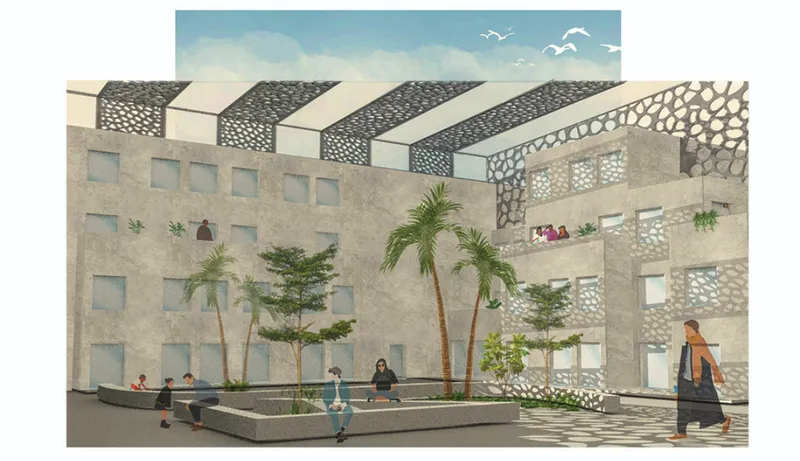
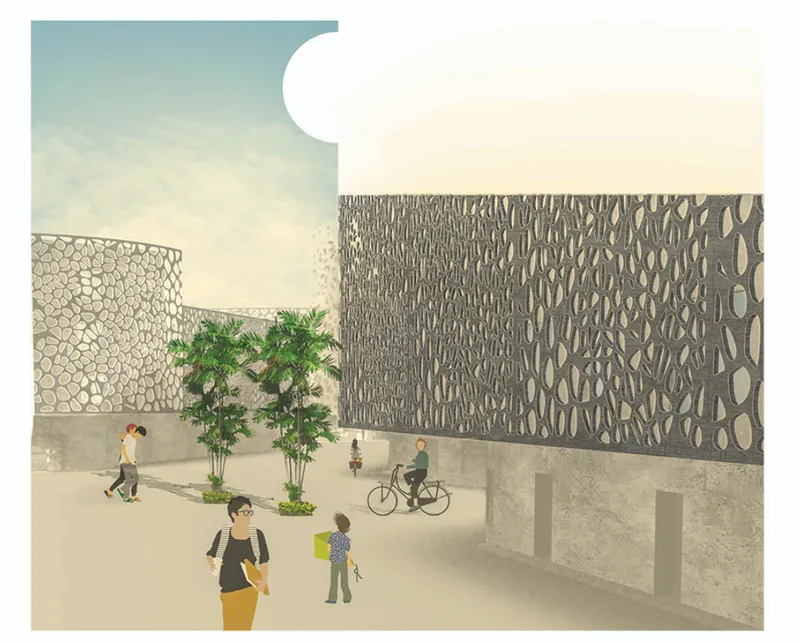
The residential blocks are inspired by traditional Saharan courtyard houses. Dwellings wrap around shared green spaces, three to four storeys tall, with perforated stone facade screens that filter light and ventilate passively. The courtyards provide shade, privacy, and a social centre for each cluster. The screens are the most visually distinctive element: organic patterns cut into stone that read as both decoration and climate infrastructure.
The housing is not uniform. Heights vary between three and four storeys. Facades mix stone textures and screen patterns. The result is a neighbourhood that has the coherence of a system but the variety of a real place. This balance is difficult to achieve in modular design and the project handles it well.
Mixed-Use Blocks and the Street
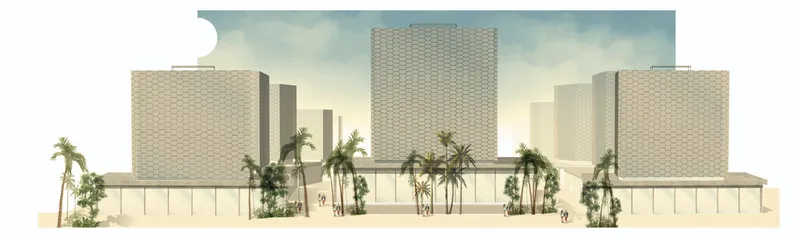
The mixed-use prototypes stack retail, offices, clinics, and apartments into single structures. Lower floors face the street with commercial frontages. Upper floors step back for residential terraces. The city elevation shows this layering clearly: a varied skyline of perforated and patterned facades along a palm-lined boulevard.
The pedestrian priority is explicit. Streets are designed for walking, cycling, and micro-mobility. Below street level, a hyperloop network handles longer distances and connects Besahapio to external settlements. Cars are not part of the plan.
Public Plazas: Nine Quarters, Nine Centres
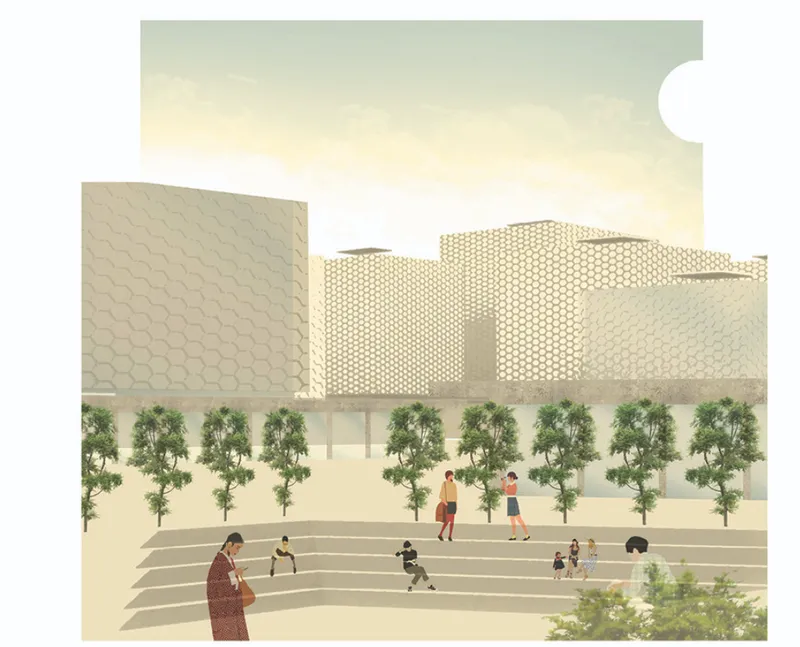
The city is divided into nine quarters, each with its own plaza. The plaza renders show stepped terraces with shade trees, seating, and open ground for markets and gatherings. These are not leftover spaces between buildings. They are the reason the buildings are arranged the way they are. The plan starts from the plazas and builds outward.
This approach, where public space organises the plan rather than filling its gaps, is what gives Besahapio its urban quality. The city feels inhabitable in the renders because the social spaces came first.
The Master Plan: Grid, Oval, Hyperloop
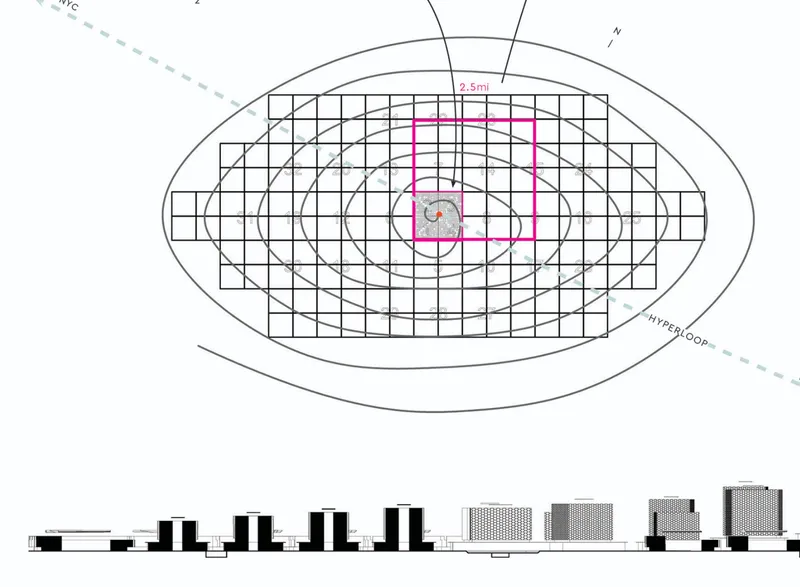
The overall plan is an oval grid with the hyperloop running tangentially and connecting to external networks. The building profile silhouettes show how height increases toward the centre and drops at the edges, creating a city that reads as a mound rather than a wall. This profile is both climatic (the centre is more protected) and social (the tallest, densest buildings are at the civic core).
Why This Project Matters
Besahapio is one of the most complete urban proposals in the EHC Sahara competition. It addresses climate at the grid level (rotation), housing at the block level (courtyards), public life at the quarter level (plazas), mobility at the city level (hyperloop), and identity at the facade level (perforated screens). Most entries address one or two of these scales. This one addresses all five.
For anyone studying modular urbanism, desert housing, or pedestrian city design, Besahapio demonstrates that systems thinking and spatial quality are not opposed. You can have a scalable grid and still have a city that is worth walking through.
View the Full Project
About the Designer
Designer: Beatrix Baltabol
Enter a Design Competition on uni.xyz
If modular urbanism, climate-responsive planning, or desert architecture is the kind of work you want to pursue, uni.xyz runs competitions year-round that reward rigorous, multi-scale design thinking.
Project credits: Besahapio by Beatrix Baltabol. Shortlisted, Extreme Habitat Challenge: Sahara (uni.xyz).



Popular Articles
Popular articles from the community


Conexión: Biophilic Design Reimagines High-Rise Living in Hong Kong
Conexión reimagines high-rise living in Hong Kong through biophilic design, green facades, shared spaces, daylight, water and nature within.

The Ocean Hive: Sustainable Architecture for a Self-Sufficient Civilization at Sea
The Ocean Hive imagines sustainable architecture at sea, where modular habitats, algae, wave power and ocean waste sustain a growing colony.

Hill & Cross Opera: Sculptural Opera House Architecture Shaped by Tallinn’s Landscape and Identity
Hill & Cross Opera reimagines opera house architecture in Tallinn through its sculptural hill, civic plaza, glass wave and a luminous cross.
AL-JANNAH: Sustainable Architecture and Permaculture for Afghan Widows
AL-JANNAH uses sustainable architecture and permaculture to create resilient oasis of housing, learning, work and renewal for Afghan widows.

Similar Reads
You might also enjoy these articles

Bao Huynh Watercolor Atelier: A Serene Art Retreat in Hội An
Bao Huynh Watercolor Atelier in Hội An blends multifunctional art spaces, sustainable design, local materials, and family-friendly living in a serene environment.

Atelier Macri Concept Store Interior Design by CASE-REAL
Atelier Macri store features a "ko" counter, walnut wood details, cork displays, blending retail, gallery, and seamless customer experiences.

Manuel Vargas Izquierdo Stadium and High-Performance Sports Center: Architectural Excellence in Jalpa de Méndez
The Manuel Vargas Izquierdo Stadium blends sustainable design, inclusive sports facilities, and cultural-inspired architecture, revitalizing Jalpa de Méndez’s public spaces.

KAKR Buluh Awar Hall: Revitalizing Community and Ecology Through Bamboo Architecture
Community built bamboo hall revitalizes Buluh Awar village, empowering youth, restoring ecology, celebrating vernacular craftsmanship through sustainable architecture and culture.


Comments (0)
Please login or sign up to add comments
No comments yet. Be the first to comment!