

Beyer Blinder Belle has completed the Rubell Museum in Washington, D.C.
The museum is a state-of-the-art facility that hosts a variety of exhibitions and programs.
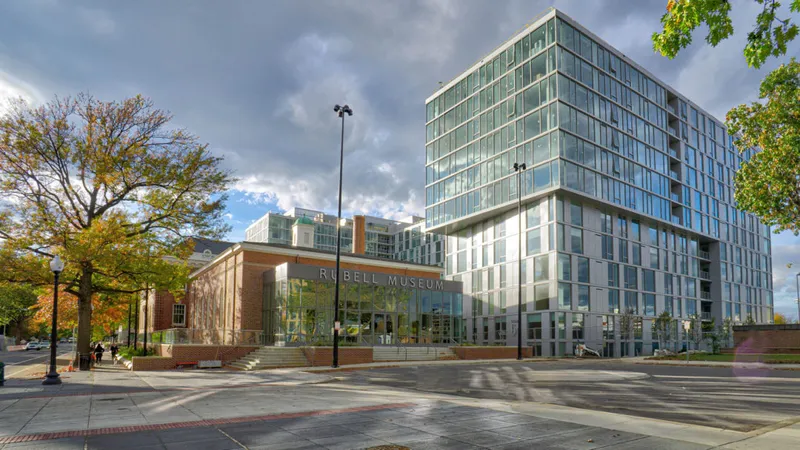 The second location of the Miami-based Rubell Museum opened last week in Southwest D.C with a wide-ranging exhibition of contemporary art. Image courtesy Beyer Blinder Belle
On October 29, the Rubell Museum opened its doors to the public in Washington, D.C. The museum is part of a development that began more than a decade ago, and it is situated on the side of the freeway away from the progression of Smithsonian museums that line the National Mall. The Rubell Museum offers a sizable influx of contemporary art that expands the city’s cultural centre.
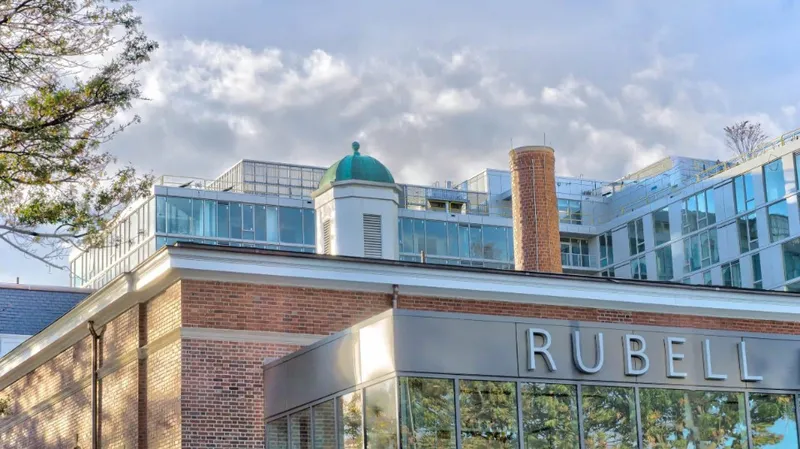 Image courtesy Beyer Blinder Belle
The other part of the site’s development is Gallery 64, a 12-story apartment building immediately north of the museum that was designed concurrently by BBB. Museum founders Mera and Don Rubell, along with their son, Jason, had previously opened a Miami museum designed by Selldorf Architects in 2019; the DC location marks the second outpost for an art-collecting family whose collection has grown to nearly 7,500 objects.
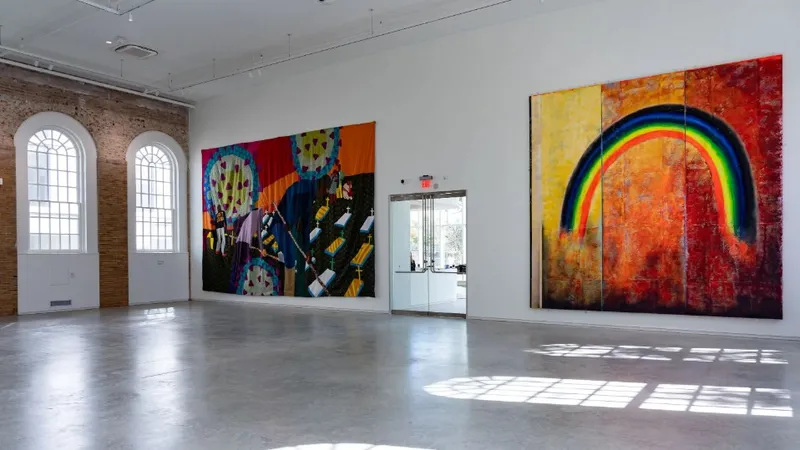 Installation view left to right: Christopher Myers and Vaughn Spann in What’s Going On. Photo © Chi Lam
The Rubells are known for their eclectic and expanding art collection, which features contemporary artists such as Andy Warhol, Jean-Michel Basquiat, and Jeff Koons. The family decided to open a second museum location in order to provide more exposure to their growing collection. Gallery 64 was designed with the purpose of being an accessible space for art lovers of all types.
 Installation view, left to right: Gary Simmons, Leonardo Drew and Natalie Ball, What’s Going On. Photo © Chi Lam
When approaching the Rubell Museum, visitors are first greeted by a line of brick school buildings - the 1906 Cardozo Elementary School and 1927 additions which later became the Randall Junior High School. The museum's glass-and-steel entry pavilion faces an open courtyard, with the Randall Recreation Center and Pool located to the east. The taller apartment building, Gallery 64, which serves as a backdrop and highway noise buffer for the Rubell Museum, has townhouse-style apartments at ground level surrounding an interior courtyard. This courtyard allows for natural light to bounce into the museum’s north-facing gallery windows, and it also reserves space for the shorter building in perpetuity.
 Installation view left to right: Kehinde Wiley and El Anatsui. Photo © Chi Lam
The small, unassuming entry pavilion houses the usual visitor amenities like a check-in desk, restrooms, and a bookstore before leading into the former school’s 4,000-square-foot auditorium, which now serves as a sizable, double-height gallery. This space is big enough to contain large paintings, like Kehinde Wiley’s 11-by-25-foot painting Sleep, or El Anatsui’s 13-by-17-foot tapestry-like assemblage of bottle caps and wire Another Man's Cloth. Mera Rubell pointed out that this was the auditorium where Marvin Gaye, a student at the time, was first identified as having great potential. Later on, he used his talents to create the hit song “What’s Going On.” The name of the Rubell Museum's first exhibition is based on this tune.
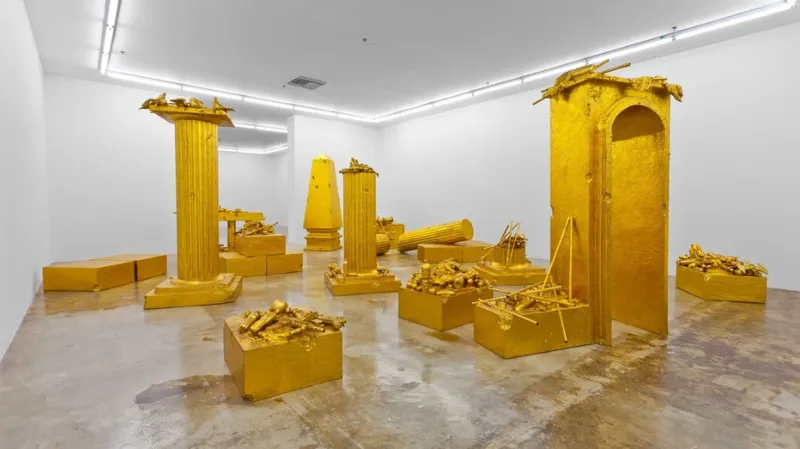 A Refusal to Accept Limits (2007) by John Miller. Image courtesy of the Rubell Museum.
In 1989, artist Keith Haring was creating a series of pieces called Untitled (Against All Odds) while listening to Marvin Gaye's music; those 20 pieces make up one of the galleries, with a boombox on the floor playing "What's Going On" to further invoke Haring's experience.

Two panels from Keith Haring's Untitled (Against All Odds) series (1989). Images courtesy the Rubell Museum
In the oldest building of the complex, BBB has strategically deployed a restrained palette of typical gallery materials, pulling back the white gallery walls and finishes at corners to reveal brickwork that has been retained; uncovered ceilings reveal original joists paired with new “sister” beams bolted alongside to add support where necessary. By using typical gallery materials in this way, BBB has managed to create a sense of cohesion between the old and new elements of the building.
The museum's main galleries are arranged over three levels, with the two upper floors preserving their original pine flooring and brick archways between galleries. The lower level is slightly below grade but admits ample daylight through downstairs windows. It features an installation of broken columns and other architectural details coated in imitation gold leaf by John Miller, titled A Refusal to Accept Limits. The galleries not only juxtapose contemporary art within historic architecture, but they also contrast the historic schoolhouse with the new residential building in terms of style and texture. This contrast creates a unique and delightful experience for the viewer.
Hany Hassan, principal of BBB, is excited about the newly opened museum and the forthcoming residences (set to open in spring 2023) to revitalize the area. "It's an overall development to really transform this area," he said at the opening. "The absence of this building, when it was vacant—for a very long time, almost a decade or more—created a void in the heart of the southwest area between South Capitol Avenue and the water." The Rubell Museum is making a good impression on the neighbourhood by offering free admission to District residents. The development will have a positive impact on the neighbourhood because of its scale.
References (2)

Popular Articles
Popular articles from the community


David Ortega Stacks a Two-Story Mexico City Penthouse Around a Steel Stair and a Pergola-Shaded Roof Terrace
In Colonia Roma, a 300 m² penthouse uses oak joinery, a planted steel stair and a slatted roof pergola to make a new-build apartment feel like a house.


The Amber Palace Opera: A Geological Fiction Surfaces on Tallinn's Baltic Waterfront
Pierre Brillard reimagines a Baltic legend as a public landscape, opera house, and waterfront promenade rooted in Tallinn's coastal identity.

FCC Arquitectura Expands a Portuguese Granite House with a Board-Marked Concrete Wing
In Portugal, JV House pairs a cleaned-up whitewashed and granite dwelling with a timber-shuttered concrete extension, courtyards and a garden pool.

LT2A and OPEN Architectes Thread a Brick and Glass High School Through a Wooded Belgian Campus
In Braine-l'Alleud, a 3,000 m² wing for Collège Cardinal Mercier pairs pale brick with a glazed colonnade, deferring to a small chapel and a dense wood.

Similar Reads
You might also enjoy these articles

Rede Arquitetos Turns Circulation into Civic Space at the Educar II SESC School in Fortaleza
In Fortaleza, Brazil, Educar II SESC-CE trades a signature form for mesh screens, yellow thresholds and courtyard walkways built for equatorial heat.
116 Rokeby Building, Collingwood
Sustainable Collingwood office building featuring double-skin façade, natural ventilation, rooftop amenities, and carbon-neutral design focused on wellbeing and longevity.
Contemporary Apartment Renovation in Spain: RV House by BIAN Opens Up to the Sea
A minimalist 1930s apartment in Santander is transformed into a flexible, sea-facing home through contemporary Spanish renovation.
3 Marías House: A Contemporary Mediterranean Courtyard Retreat by Bajet Giramé + Burckhardt
Mediterranean courtyard home blending traditional architecture with modern design, terracotta flooring, flexible interiors, sustainable climate strategies, and garden integration.
Explore Cultural Architecture Competitions
Discover active competitions in this discipline


Challenge to reimagine the Iron Throne

Photograph architecture without architects

Illustrate the lost glory of Angkor Wat - Render Challenge

Bring back Drive In's
Comments (0)
Please login or sign up to add comments
No comments yet. Be the first to comment!