
Bharat Bhavan: Architecture as Dialogue in the Heart of Srinagar
A cultural campus on the banks of the Jhelum River transforms a dilapidated warehouse into a space for art, memory, and civic life.


What happens when architecture refuses to look away from conflict? In Srinagar, a city shaped equally by beauty and political tension, a team of designers proposes something deceptively simple: a building that talks. Not with rhetoric but with brick, concrete, skylights, and sunken plazas. Bharat Bhavan – संवाद (A Dialogue) takes a dilapidated warehouse near Lal Chowk, once a thriving centre for local handicrafts, and turns it into a democratic cultural campus where the state meets its people, the past meets the future, and the Jhelum River meets the street.
Designed by Pradeep Nadar, Jeevan Pawaskar, and Ankit Patil, the project is sited on the banks of the Jhelum River near one of Srinagar's most historically charged intersections. Density mapping of hotels, restaurants, landmarks, and pedestrian flows reveals the area as a nexus of tourism and local commerce. The designers leverage this energy, positioning Bharat Bhavan where tourists, artisans, institutions, and cultural flows converge. The damaged warehouse, with its residual memory of craft and labour, becomes the project's narrative anchor.
Retain, Replicate, Intervene, Access: A Four-Stage Spatial Strategy


The design unfolds through four deliberate stages. First, Retain: the existing warehouse structure is preserved and augmented with skylights, mezzanine floors, and curated spaces for an art gallery and exhibition hall. Second, Replicate: the structural language of the original building is reinforced, maintaining material continuity between old and new volumes. The covered pavilion with its exposed timber roof structure and brick walls shows this strategy at work. The warmth of the masonry reads as both heritage and habitable space, a deliberate refusal to treat the ruin as mere scenery.
Inside, the adaptive reuse is visceral. Exposed timber trusses span the industrial hall while planted floor beds introduce greenery directly into the gallery volume, softening the rawness of brick and steel. The decision to let the warehouse's bones remain visible, trusses, textures, and all, means visitors encounter the building's past not as a caption on a wall but as the structure holding the roof over their heads.
A Sunken Plaza as the Heart of Public Life
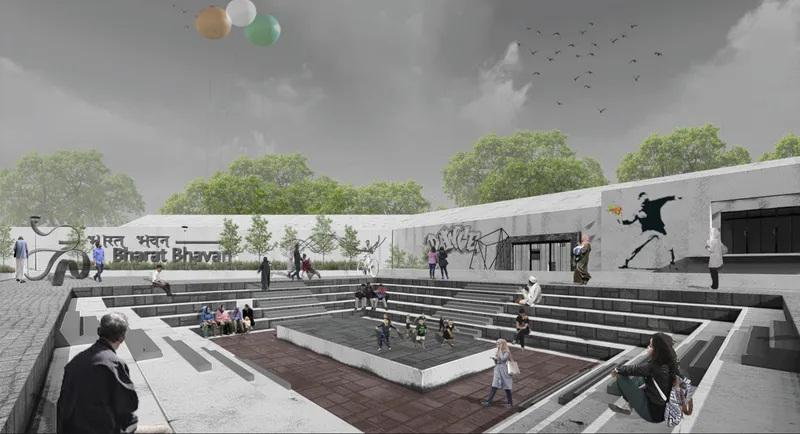

The third and fourth stages, Intervene and Access, generate the campus's public ground. New built forms introduce feature walls, open display areas, and circulation elements that guide visitor movement outward from the warehouse core. The Central Art Plaza takes the form of a sunken amphitheatre, its terraced concrete steps descending to a paved gathering floor where festivals, performances, and cultural dialogues can occur. Figures cluster on the steps naturally, suggesting a space that earns its crowd rather than mandating one.
The aerial view reveals the masterplan's generosity: planted beds, young trees, and scattered pavilion structures create a landscape that reads less like an institutional campus and more like a public park with cultural ambitions. Pedestrian networks stitch the riverfront to the adjacent mosque and central plazas, creating what the designers call inclusive access. Transitional courtyards between the mosque and Bharat Bhavan are shared public zones reflecting coexistence. The programme is broad, housing art galleries, a library, workshops and studios, an auditorium, administrative blocks, and an open-air amphitheatre.
Murals, Sculptures, and Circulation as Cultural Experience

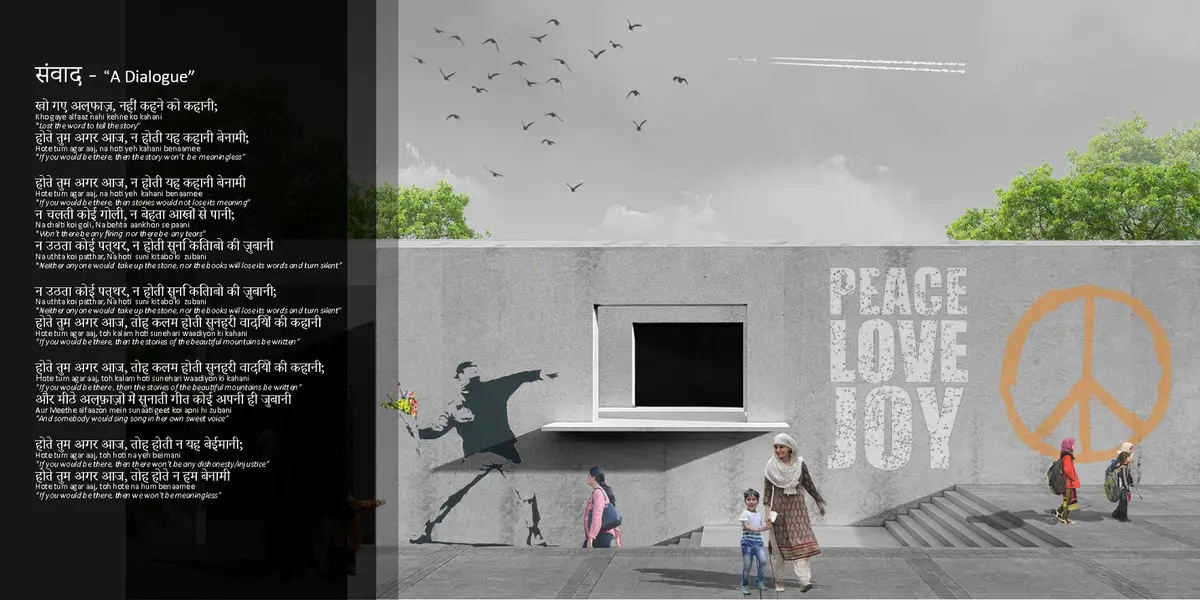
One of the project's sharpest moves is the treatment of circulation. Rather than isolating art within gallery walls, the designers transform rooftop walkways and exterior paths into immersive cultural journeys. Painted murals cover adjacent walls, metal sculptures punctuate the route, and pedestrians move through an environment where art is not destination but atmosphere. The overcast Srinagar sky, a near-constant companion, becomes a neutral backdrop that amplifies the colour and form of the installations. Walking here is not transit; it is participation.
Light and Stillness in the Library

If the plaza is the project's extroverted heart, the library is its contemplative counterpart. Large vertical glazing panels pull natural light deep into the reading volume, while the exposed concrete ceiling maintains the honest material palette established throughout the campus. Display walls organize the interior without fragmenting it, and the spatial quality shifts palpably from the bustling courtyards outside to a serene environment tuned for students, researchers, and local readers. Skylights supplement the glazing, ensuring the space remains generous even under Srinagar's frequently overcast skies.
Why This Project Matters
Cultural centres in contested regions often default to one of two modes: monument or memorial. Bharat Bhavan does neither. Its strength lies in the refusal to erase the warehouse's damage or to freeze it as spectacle. The four-stage strategy of retain, replicate, intervene, and access gives the project a legible logic that moves from preservation through to public connectivity, treating architecture not as an object to be admired but as a process of civic repair.
Nadar, Pawaskar, and Patil ground their ambition in specifics: the Jhelum riverbank, the proximity to Lal Chowk, the mosque next door, the craft heritage embedded in the warehouse's walls. The result is a proposal that understands dialogue not as abstract metaphor but as spatial condition, a campus where different publics share courtyards, walkways, and amphitheatre steps, and where the architecture itself mediates between memory and forward motion.
View the Full Project
About the Designers
Designers: Pradeep Nadar, Jeevan Pawaskar, Ankit Patil
Enter a Design Competition on uni.xyz
uni.xyz runs architecture and design competitions year-round that reward proposals with spatial conviction and real site intelligence.
Project credits: Bharat Bhavan – संवाद (A Dialogue) by Pradeep Nadar, Jeevan Pawaskar, Ankit Patil.


Popular Articles
Popular articles from the community


Architekt Andreas Gruber Scatters 23 Dark Timber Chalets Across a South Tyrolean Forest Edge
In Molini di Tures, Amonti Chalets breaks a resort into a hamlet of gabled timber houses, with parking, storage and services pushed into the slope.

Juan García Correa, John González and Claudia Rueda Sink a Circular Amphitheater into a Manizales Engineering Building
On the La Nubia campus in Manizales, Colombia, the S1 Building folds labs and offices into a hillside of ramped lawns that double as a campus route.

Cube Design Draws an Ecological Corridor Between Two Shenzhen Hills with the Nankai Building
Beside Shenzhen's container docks, the Nankai Building pairs stacked balconies with a climbing green screen to connect two hillsides across its height.

longwave studio Reorganizes a 112 m² Tainan Apartment Around the Daily Routines of a Family and Two Cats
In Tainan, Taiwan, birch plywood, rust-red furniture and a freestanding plaster wall link arrival, storage, work and family life in one apartment.

Similar Reads
You might also enjoy these articles


Aquadapt: An Underwater Habitat That Rewrites Its Rooms by the Hour
Curved modules ring the seabed while one shell shifts from breakfast room to cinema, farm and football pitch as residents' needs change.

Play: Fragments of Their World: Remembered Architecture Rebuilt as a Modular Playground for Refugee Camps
Tom Gardner abstracts domes, arches and towers from the homelands of displaced families into a kit of child-scaled play parts for camp settlements.
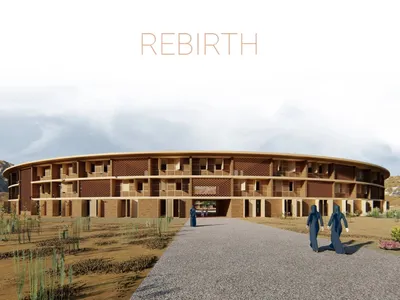
REBIRTH: A Circular Settlement Where Afghan Widows and Their Children Rebuild Life Together
A shortlisted Resile entry turns the circle into a protective ring of timber and brick, gathering homes, classrooms and gardens around a shared landscape.
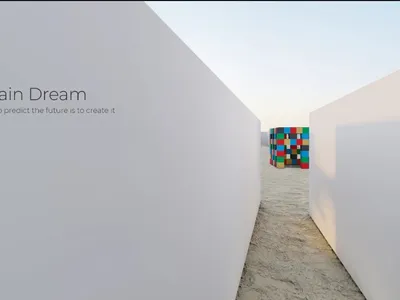
The Main Dream: A Recycled Plastic Kit That Lets Refugee Children Build Their Own Playground
Thirty-centimetre interlocking cubes that connect on three axes turn play into construction, letting children author the spaces they occupy.


Comments (0)
Please login or sign up to add comments
No comments yet. Be the first to comment!