

Bhopal: Finding a Middle Path Between a Divided City's Two Identities
A network of lakeside public spaces uses modular furniture, touch-sensitive pathways, and adaptive shade to bridge Bhopal's cultural and gender divides.


Between the informal settlements of Bhopal's Old City and the planned grid of its New City lies a chain of neglected lakeside spaces that almost nobody uses. Parul Gupta, Kashish Kochhar, Panisthi Jindal, and Garima Agarwal saw in those voids a civic opportunity: stitch them together into a continuous public spine of modular seating, reconfigurable play structures, adaptive shade canopies, and touch-sensitive lit pathways that make the city's lakefronts safe, social, and genuinely inclusive across genders, ages, and times of day.
Bhopal, capital of Madhya Pradesh, has been shaped by centuries of layered history, from the rule of the Begums through the British Raj to the catastrophic 1984 Gas Tragedy that still defines its global perception. Yet the city's deeper, quieter rift is geographic and cultural: two halves sitting on opposite shores of the Upper Lake, divided not just by water but by class, infrastructure quality, and social habit. The designers' project, Bhopal: Finding a Middle Path, argues that small-scale spatial gestures along this water edge can do what grand master plans have not: reconnect communities separated by history and habit.
A Social Spine Drawn Across Three Lakes
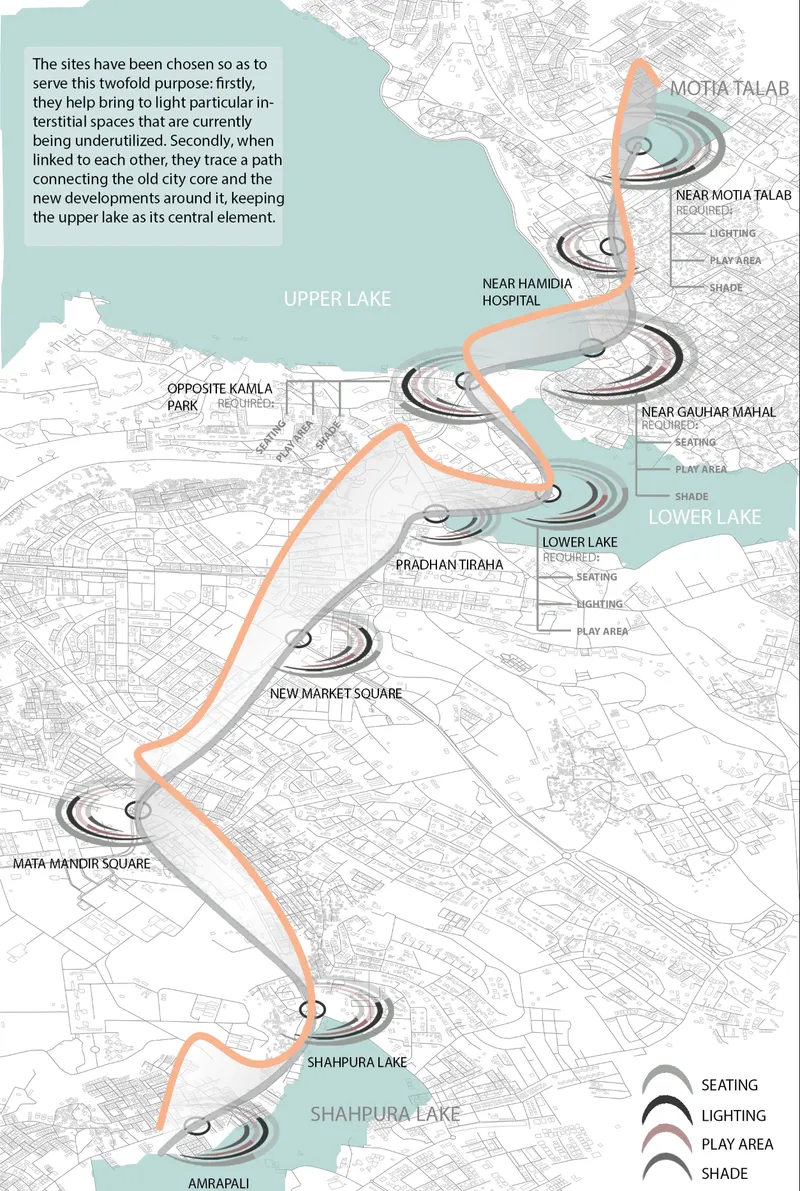
The site plan reveals the project's organizational logic: a linear pedestrian path linking a series of interventions along Bhopal's Upper Lake, Lower Lake, and extending toward Shahpura Lake. Each node, from Motia Talab to Amrapali, is selected for its position between the historical and contemporary halves of the city. Concentric circular gathering spaces mark the major stops, turning what was a disconnected series of urban voids into a legible route of public engagement. When traced together, these points create what the designers call the city's "middle path," a social spine where architecture mediates between two coexisting but rarely interacting worlds.
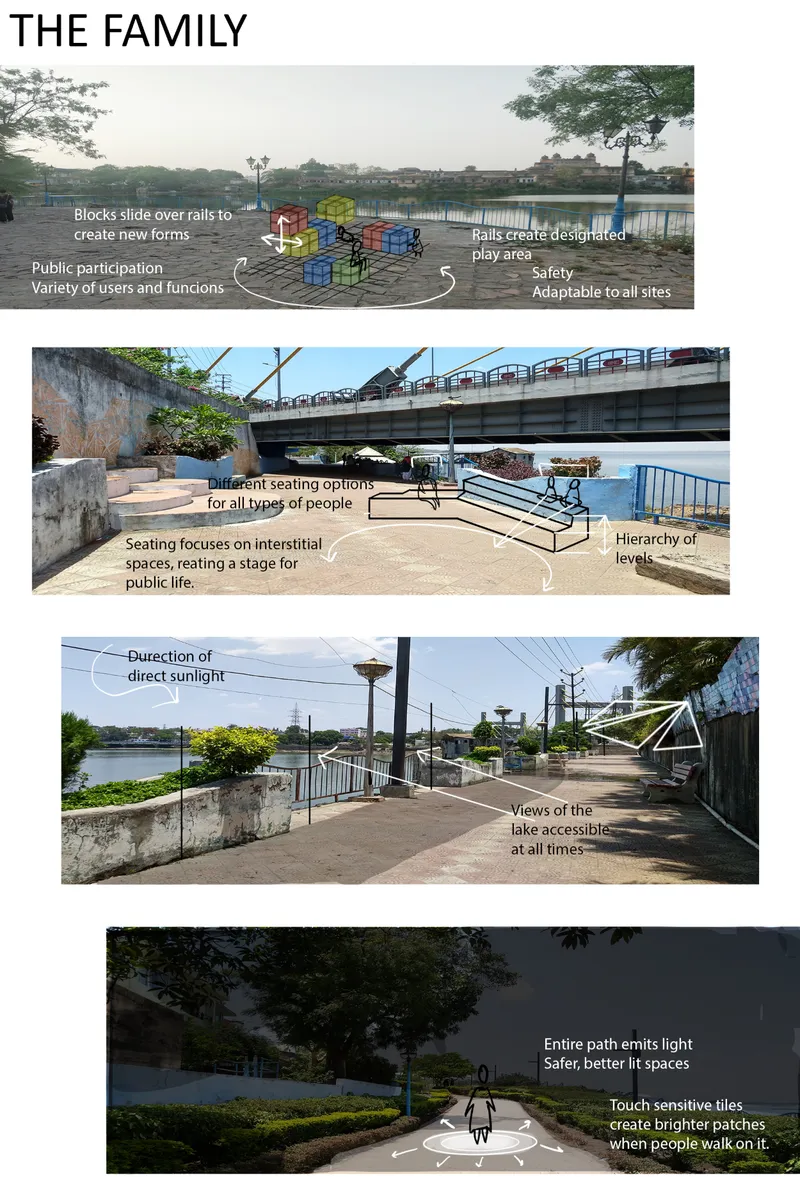
The waterfront intervention diagram breaks down the strategy at a finer grain. Colorful play structures sit alongside tiered seating that steps down to the lake edge, while elevated transit infrastructure runs above, allowing pedestrians to claim the ground plane. The layering is deliberate: infrastructure above, social life below, water alongside. It is an argument that reclaiming leftover space beneath transit corridors can yield genuinely vibrant public ground without requiring new land.
Concrete Blocks and Lakeside Calm
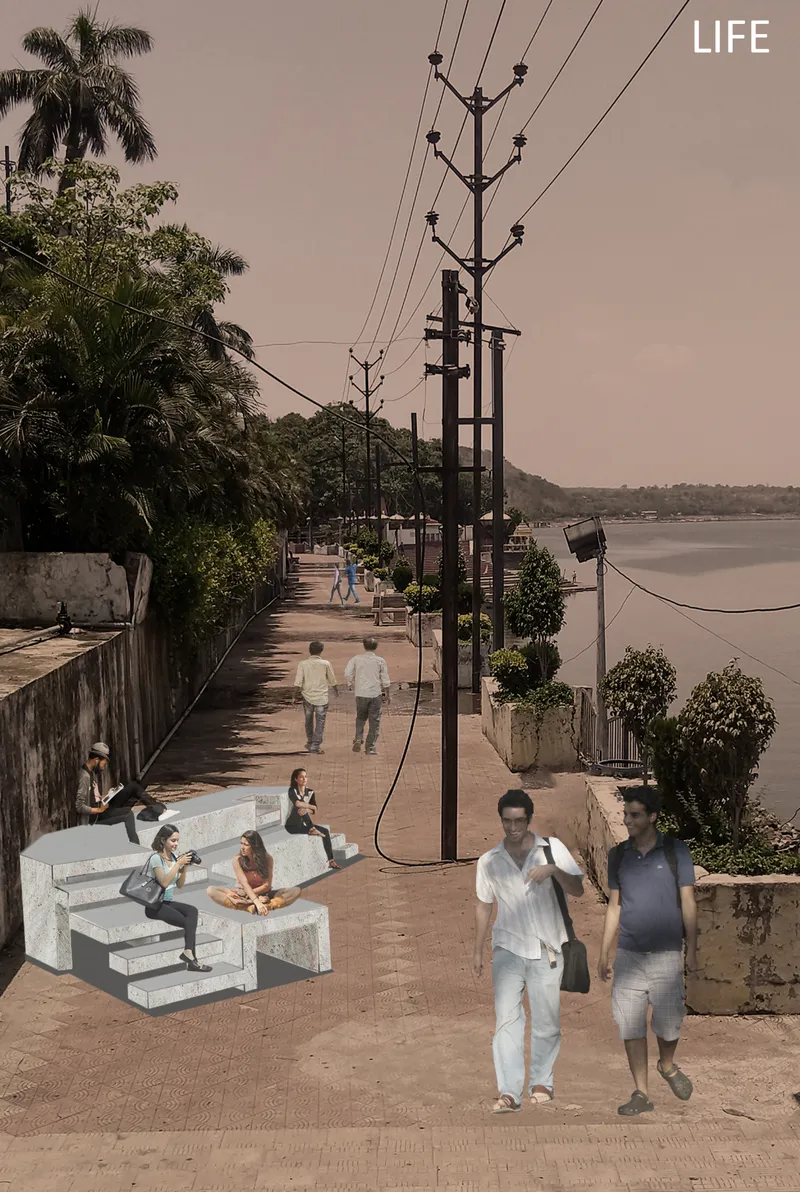
The lakeside promenade visualization shows the simplest move in the project's toolkit: white concrete seating blocks arranged along a paved path beneath palm trees and existing power lines. There is no attempt to erase the infrastructural clutter of the site. Instead, the design accepts the overhead wires and utility poles as a given condition and works around them, dropping robust furniture that invites people to sit, linger, and watch the water. The blocks are heavy enough to feel permanent yet compact enough to leave generous walking width. It is public space as low-key hospitality, not spectacle.
Shade Canopies and the Question of Gender
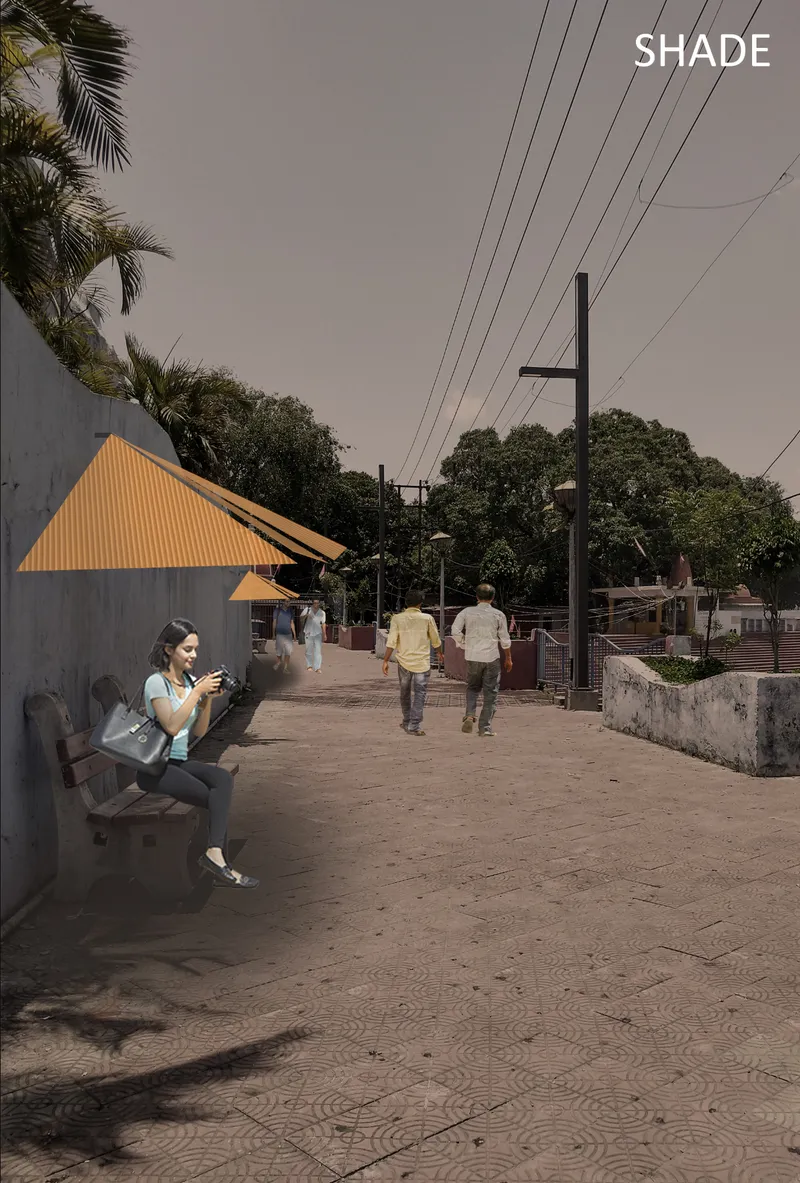
A yellow triangular shade canopy tilts over a paved walkway where a woman sits alone on a bench. The image is quiet, but the implication is pointed. The designers note that Bhopal's public spaces have historically catered primarily to men; women, children, and families are underrepresented in the city's outdoor life due to poor lighting, inadequate amenities, and a pervasive sense of insecurity. Lightweight canopies like this one do double duty: they offer physical comfort from the Central Indian sun and signal, through their color, form, and placement, that a space has been designed with specific attention to the people who are usually excluded from it.
Modular Play Platforms That Grow With Their Users
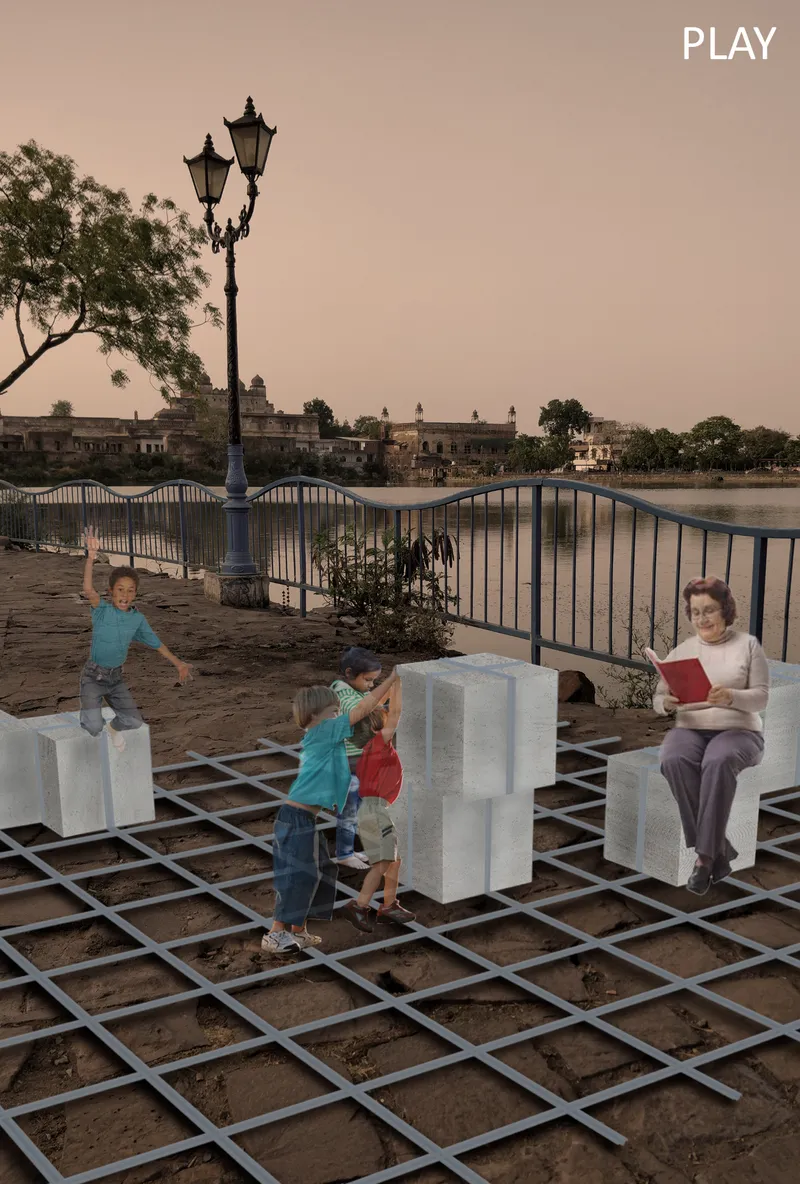
A raised metal grid platform supports white cubic seating elements where children play near a blue railing and lamppost. The modular blocks can be rearranged, stacked, or spread out, turning the platform into whatever its occupants need at a given moment: a stage, a picnic table, a climbing obstacle. The designers describe these as "democratic platforms where children and adults coexist," and the visualization supports that claim. The furniture is scaled to fit a child's body but sturdy enough for an adult to sit on. It is a space that does not segregate play from rest, or children from caregivers, but lets both activities overlap on the same surface.
Light as Safety: Touch-Sensitive Paths at Dusk
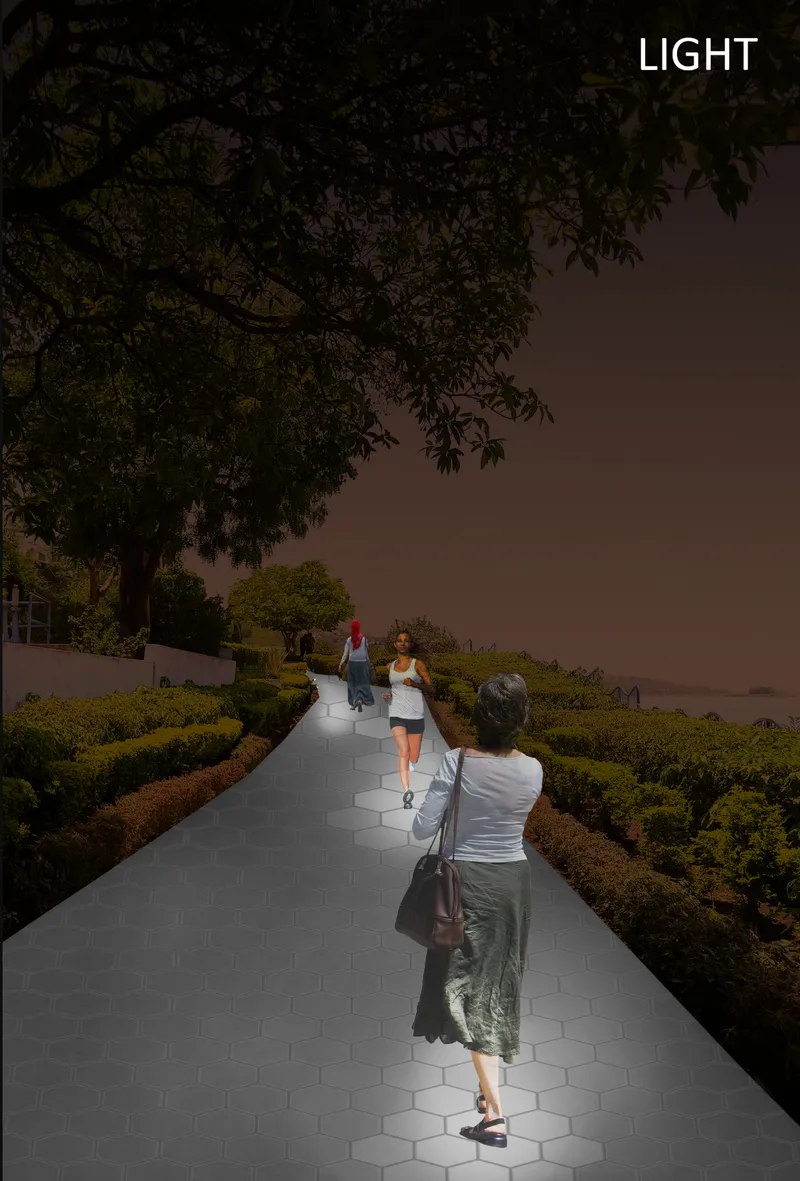
The most atmospheric image in the series shows illuminated hexagonal paving cutting through planted hedges as people walk at dusk beneath a tree canopy. The designers propose touch-sensitive pathways that emit gentle light as people step on them, creating a sense of safety and visibility during night hours. It is a smart inversion of the typical approach to public lighting, which relies on overhead fixtures that cast harsh pools of light and deep shadows. Here, the ground itself glows, marking a walker's presence and making the path legible to others without flooding the landscape with glare. For a project centered on gender safety, this is arguably the most consequential design decision: it transforms nighttime from a deterrent into an invitation.
Why This Project Matters
Bhopal: Finding a Middle Path makes a persuasive case that urban renewal does not require demolition or monumental construction. The interventions proposed here are small in footprint but cumulative in effect. A concrete bench, a shade canopy, a lit paving module, a reconfigurable play block: each is a modest gesture on its own. Linked together along a lakefront spine, they form a continuous public environment that addresses the city's two deepest divides, cultural and gendered, through spatial generosity rather than grand rhetoric.
What distinguishes Gupta, Kochhar, Jindal, and Agarwal's work is the clarity of their diagnosis. They do not treat Bhopal's divided identity as a problem to be erased but as a condition to be navigated. The "middle path" is not a compromise; it is a new kind of ground, one that belongs equally to the Old City and the New City, to men and women, to children and elders. In a discipline that often reaches for formal spectacle, this project finds its power in restraint, specificity, and a genuine commitment to the people who will use these spaces every day.
View the Full Project
About the Designers
Designers: Parul Gupta, Kashish Kochhar, Panisthi Jindal, Garima Agarwal
Enter a Design Competition on uni.xyz
uni.xyz runs architecture and design competitions year-round that reward proposals with spatial conviction and real site intelligence.
Project credits: Bhopal: Finding a middle path by Parul Gupta, Kashish Kochhar, Panisthi Jindal, Garima Agarwal.


Popular Articles
Popular articles from the community


David Macias Steps a Doorless Stone and Plaster House Down a Tropical Colombian Hillside
In the humid hills of Colombia, Threshold House replaces the front door with an open void and terraces its 850 m² down the slope instead of fighting it.

longwave studio Reorganizes a 112 m² Tainan Apartment Around the Daily Routines of a Family and Two Cats
In Tainan, Taiwan, birch plywood, rust-red furniture and a freestanding plaster wall link arrival, storage, work and family life in one apartment.

Jaramillo Van Sluys Arquitectura and Urbanismo Turn a Demolished Registry Lot in Quito into an Orchard Plaza
In Quito's Centro Histórico, a 2,800 m² plaza exposes the San Agustín convent wall and redraws its lost Augustinian orchard in volcanic stone.

LT2A and OPEN Architectes Thread a Brick and Glass High School Through a Wooded Belgian Campus
In Braine-l'Alleud, a 3,000 m² wing for Collège Cardinal Mercier pairs pale brick with a glazed colonnade, deferring to a small chapel and a dense wood.

Similar Reads
You might also enjoy these articles


Aquadapt: An Underwater Habitat That Rewrites Its Rooms by the Hour
Curved modules ring the seabed while one shell shifts from breakfast room to cinema, farm and football pitch as residents' needs change.

Play: Fragments of Their World: Remembered Architecture Rebuilt as a Modular Playground for Refugee Camps
Tom Gardner abstracts domes, arches and towers from the homelands of displaced families into a kit of child-scaled play parts for camp settlements.
REBIRTH: A Circular Settlement Where Afghan Widows and Their Children Rebuild Life Together
A shortlisted Resile entry turns the circle into a protective ring of timber and brick, gathering homes, classrooms and gardens around a shared landscape.
The Main Dream: A Recycled Plastic Kit That Lets Refugee Children Build Their Own Playground
Thirty-centimetre interlocking cubes that connect on three axes turn play into construction, letting children author the spaces they occupy.

Explore Urban Design Competitions
Discover active competitions in this discipline

Challenge to design a portable theatre

Challenge to design a portable music platform

Challenge to design an open learning module for the elderly

Design challenge to equip cities with modern furniture
Comments (0)
Please login or sign up to add comments
No comments yet. Be the first to comment!