
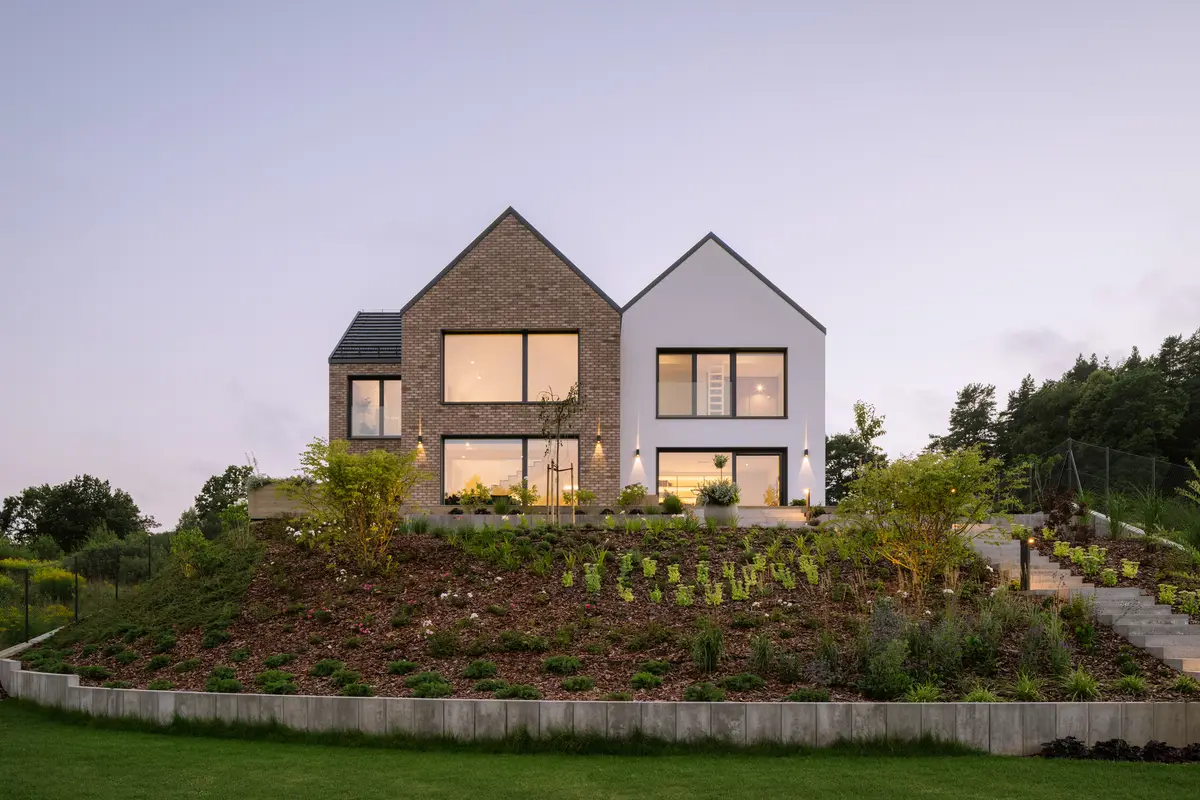
bkm group Splits a Hilltop Home into Stacked Gables Overlooking a Polish Landscape Park
On a seven-meter slope at the edge of Gdynia, a cluster of brick and plaster volumes frames views of the Tri-City Landscape Park.


A house on a seven-meter slope could easily become a retaining-wall exercise, all engineering and no architecture. bkm group sidesteps that outcome by breaking the program into a cluster of gabled volumes that step down the terrain at the outskirts of Gdynia, each roof pitch framing a different sightline toward the Tri-City Landscape Park. Rather than fight the topography, the design treats it as the organizing principle: the house reads less like a single dwelling and more like a small hillside settlement, its profiles shifting as you move around the site.
What makes the Multi Gable House genuinely interesting is the disciplined relationship between the roof geometry and the interior volumes it produces. Every gable is pushed to its ridge height on the first floor, generating double-height spaces that would be impossible under a conventional hip or flat roof. The result is a house where ceiling height is not uniform luxury but a deliberate tool: tall where views and communal life demand it, compressed where privacy and intimacy are the goal.
A Village of Gables on the Slope
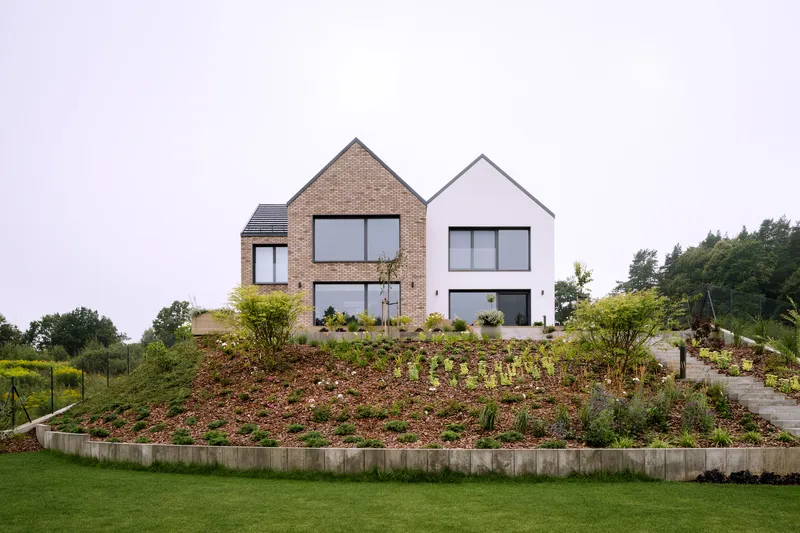
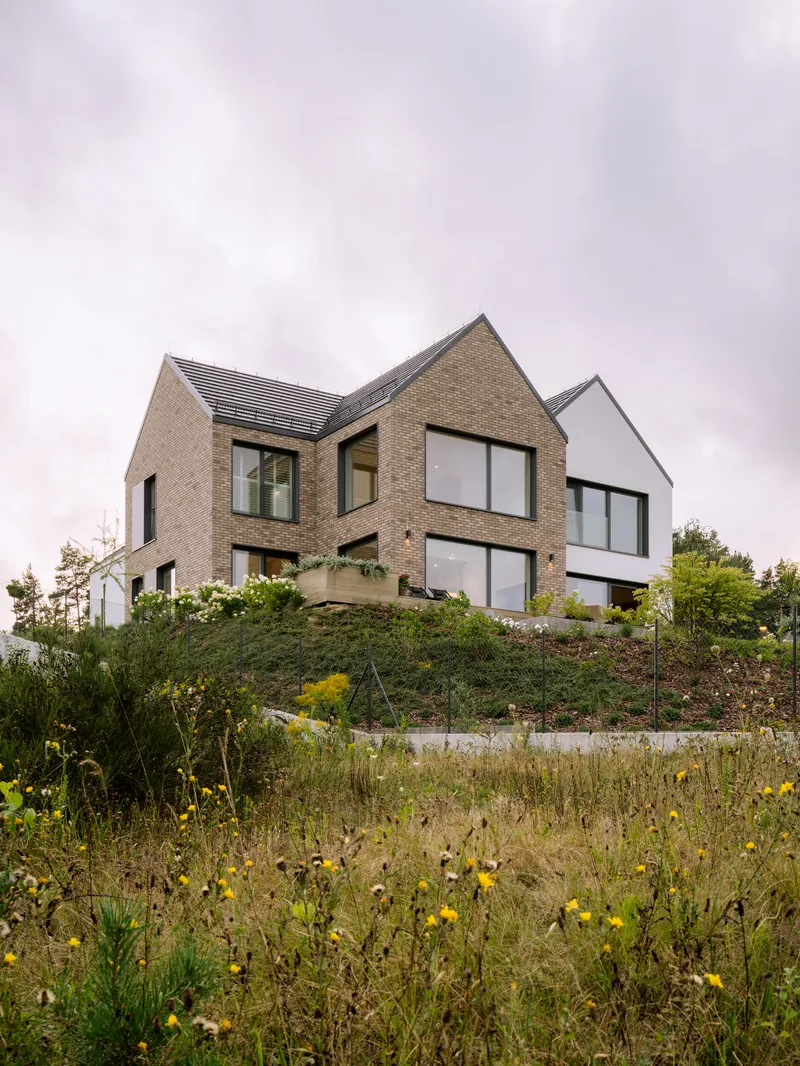
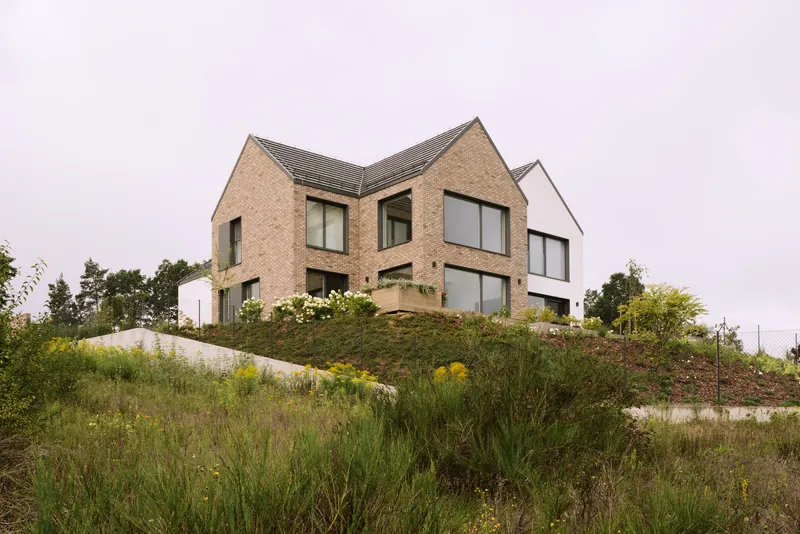
From the garden side, the house reveals its split personality. Two one-story blocks sit in front: a garage to the west and the kitchen wing to the east, both finished in off-white plaster. Behind and above them, a taller volume clad in light gray-beige brick houses the living room and bedrooms, its gable rising conspicuously higher than its neighbors. The composition avoids the monolithic quality that 280 square meters of program could easily produce. Instead, the house looks assembled, almost accretive, as if each generation of a family added another wing.
The material logic reinforces this reading. Brick signals the dominant volume; white render marks the subsidiary blocks. Dark gray HPL panels appear as precise insertions, marking transitions and window surrounds. It is a limited palette applied with enough variation to give each gable its own identity without drifting into pastiche.
Street Face and Garden Face
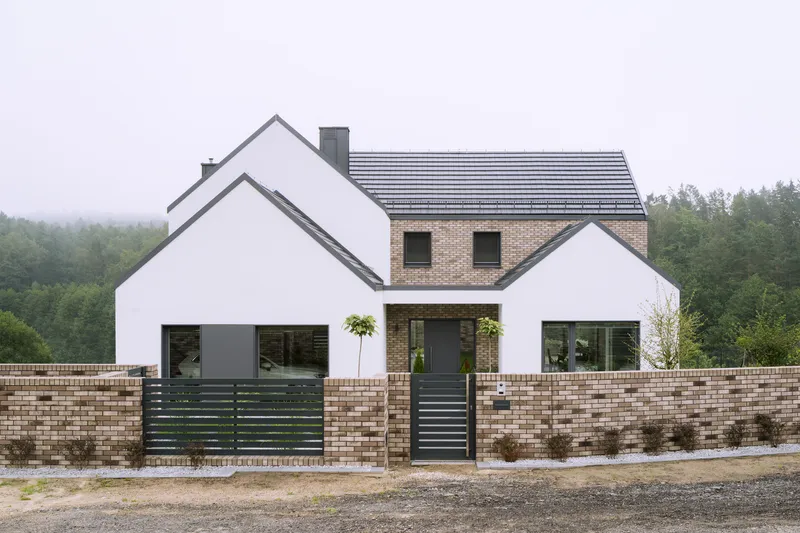
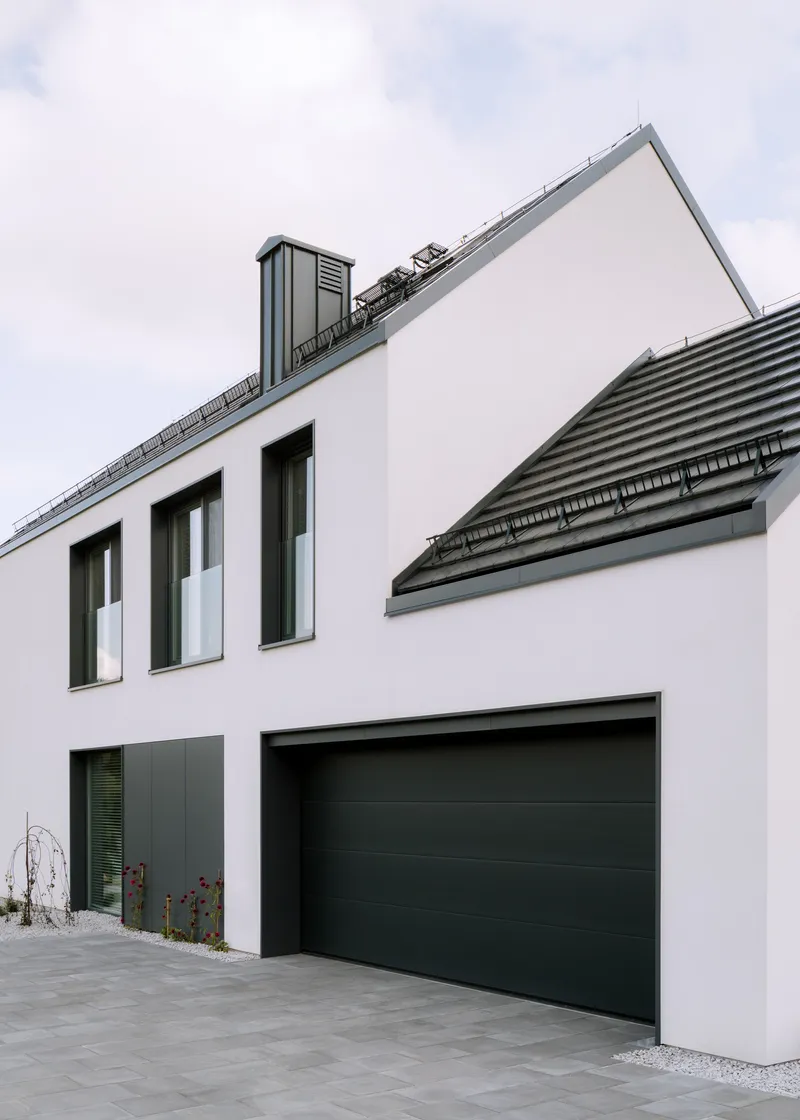
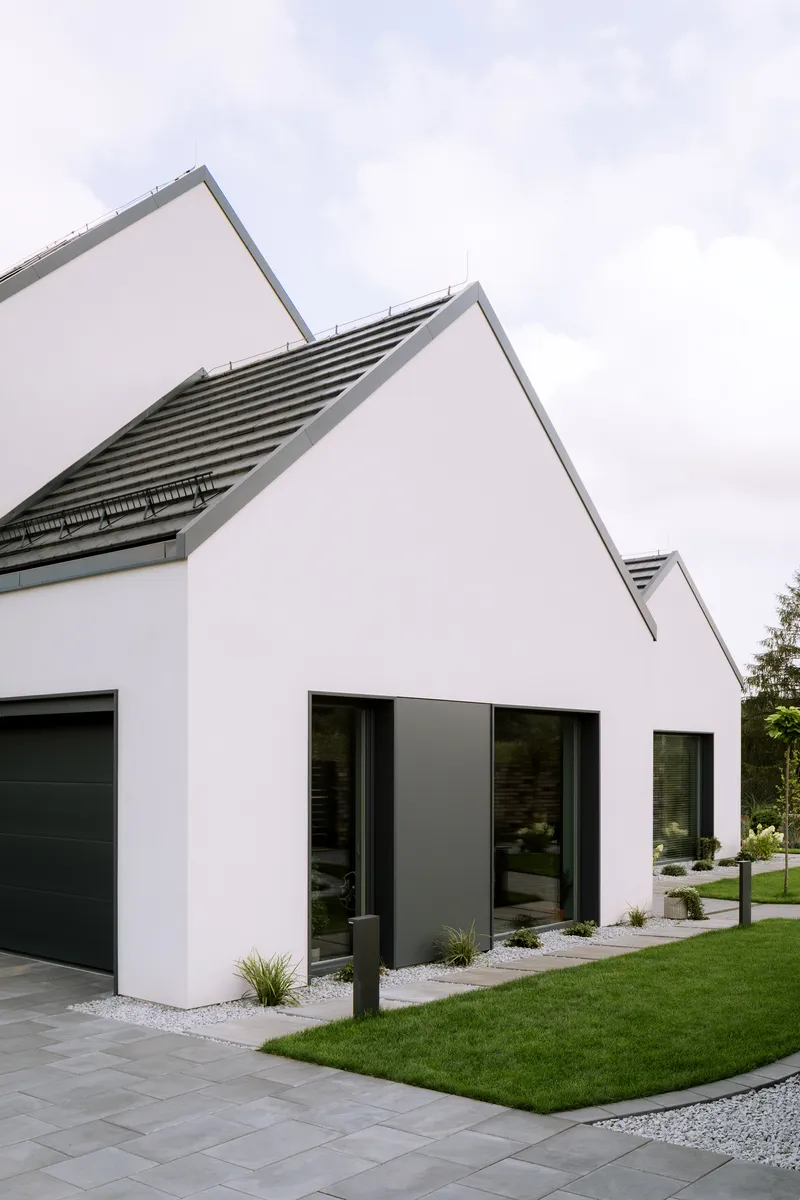
The street elevation is deliberately restrained. Intersecting gabled rooflines, a garage door, and limited glazing present a composed, almost closed face to the neighborhood. A low variegated brick wall defines the property edge, and horizontal tile coursing on the upper walls adds texture without drama. The entry path threads between potted plants and a young tree before arriving at a recessed doorway, signaling that the real spatial events happen elsewhere.
Turn to the garden side and the house opens up entirely. The central living room block is pulled forward toward the slope, its full-height sliding doors dissolving the boundary between interior and landscape. The steep grade drop between the street and the private garden creates a natural buffer: the house is essentially a single story from the road and a two-story presence from the meadow below. It is a classic topographic trick, but bkm group executes it cleanly.
Terraces, Meadows, and the Edge of the Forest
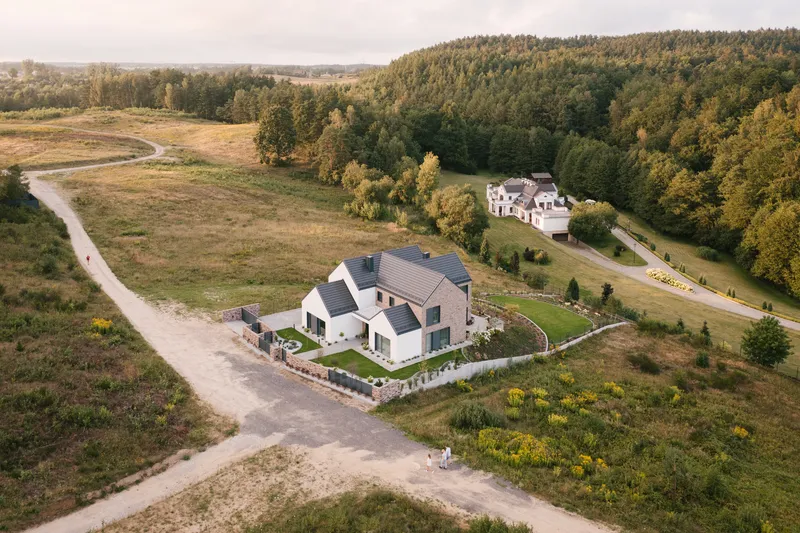
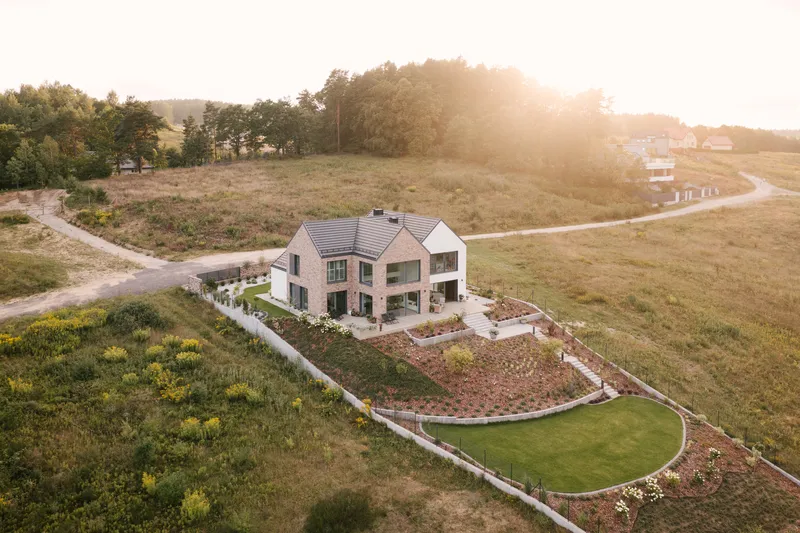
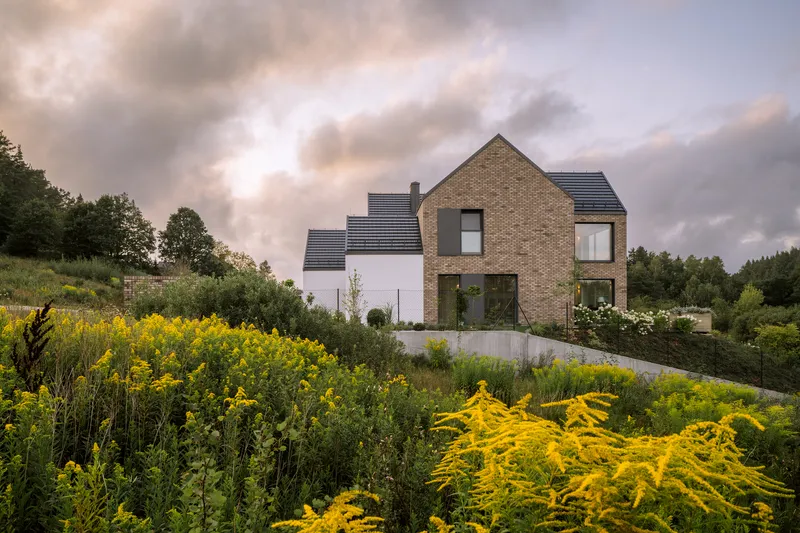
Aerial views reveal how precisely the house is sited. The built footprint occupies the upper portion of a rectangular lot, with terraced garden beds curving down the slope in a series of planted shelves. Beyond the property line, open farmland gives way to dense forest, and the Tri-City Landscape Park extends to the horizon. The house is positioned not at the crest of the hill but slightly below it, sheltered from wind while maintaining unobstructed views to the south and east.
The landscape strategy is low-maintenance and ecologically sympathetic. Wildflower meadows replace conventional lawn on the steepest grades, yellow perennials and ornamental grasses soften the concrete retaining walls, and hydrangeas bank against the brick base. A timber deck terrace on the garden side functions as an outdoor room, furnished with lounge chairs and wicker seating that make the slope habitable rather than merely scenic.
The Outdoor Room
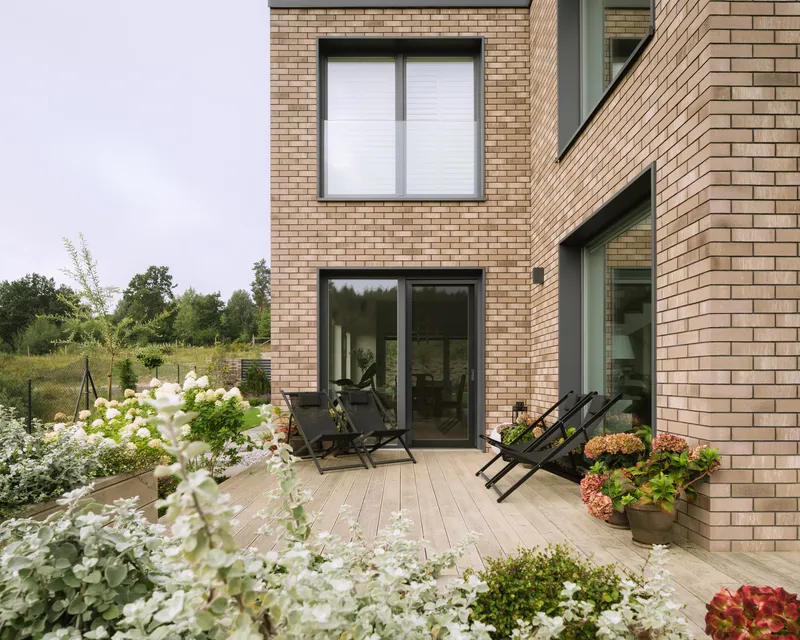
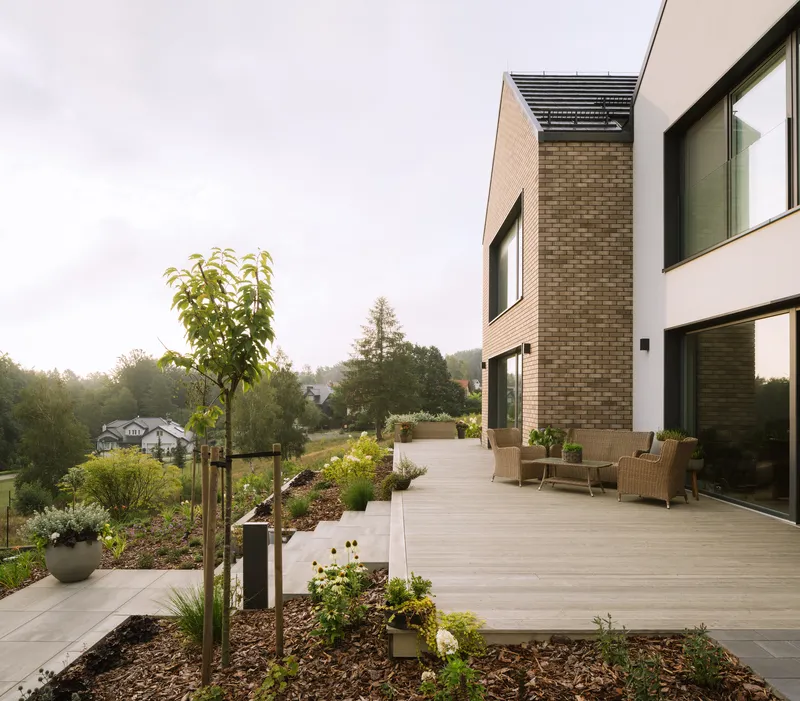
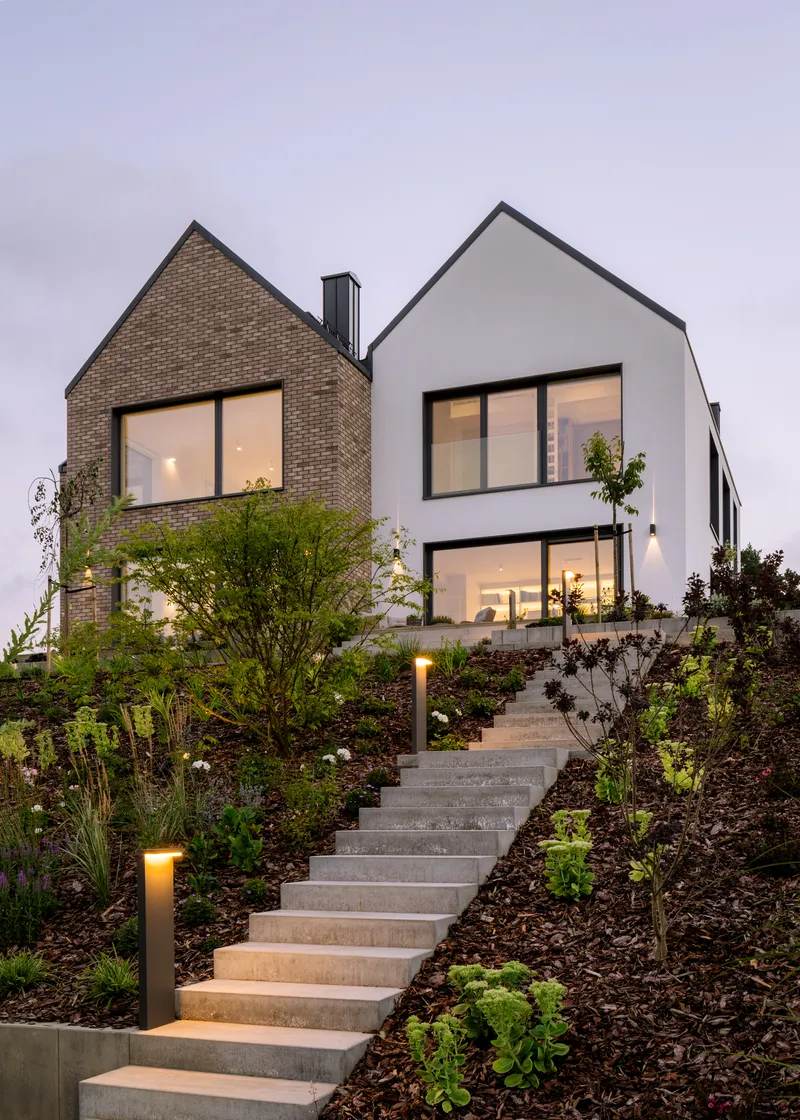
The timber deck is worth isolating as a design element. Positioned between the brick and white-rendered volumes, it occupies the seam between the two material worlds. Planted beds push right up to its edges, and the pale brick wall behind radiates warmth even under overcast skies. At dusk, when the facades are illuminated from below, this threshold space becomes the most atmospheric part of the house. It is not a balcony tacked onto a facade; it is architecture that happens to have no roof.
Double Heights and Controlled Light
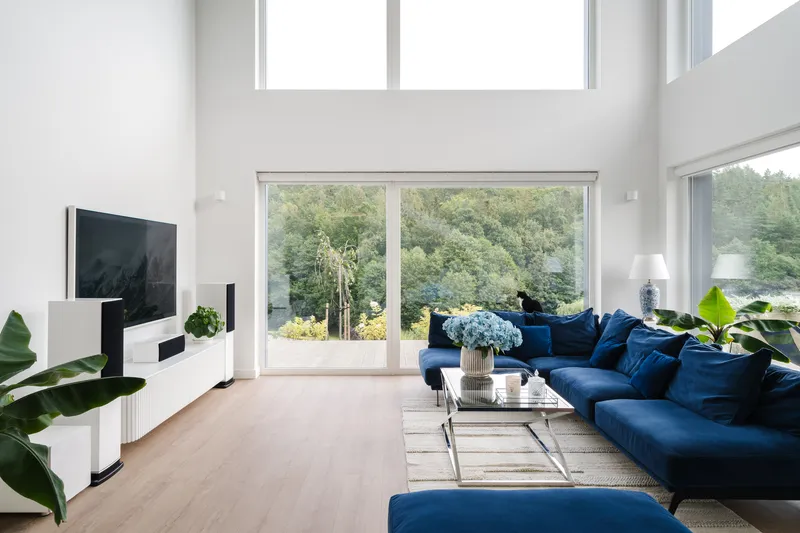
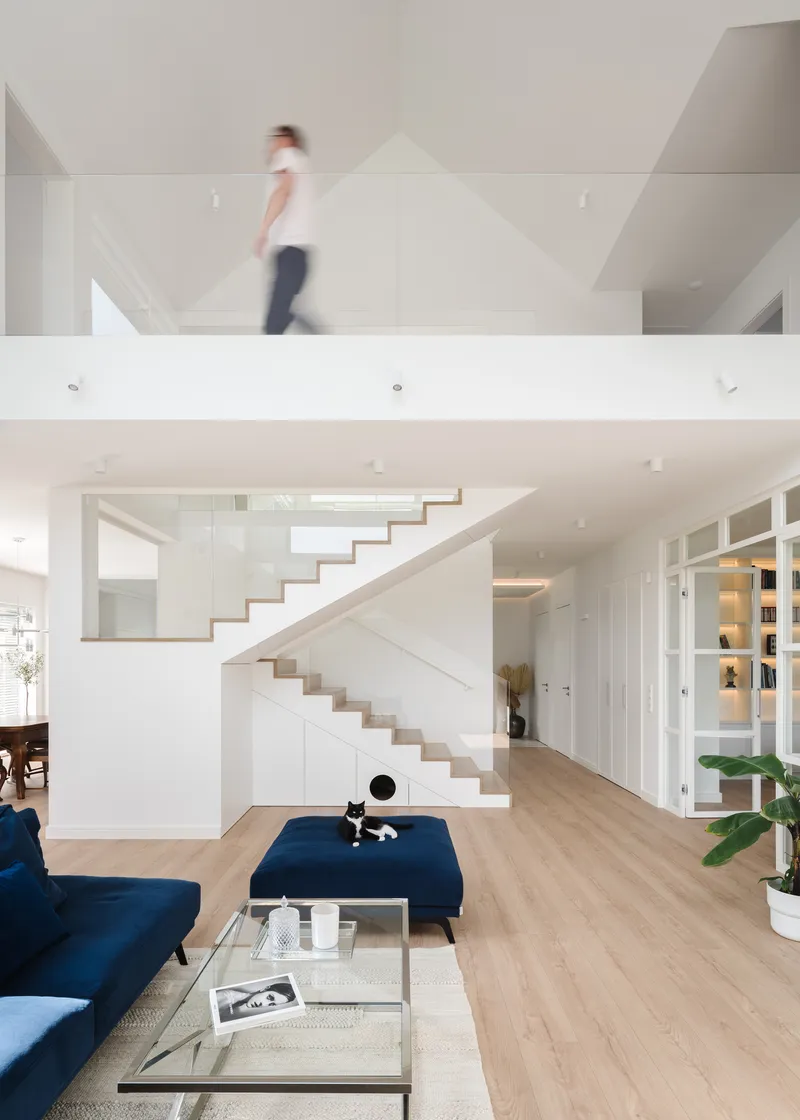
Inside, the multi-gable concept pays its biggest dividend. The living room stretches to the full ridge height, with floor-to-ceiling sliding doors on one wall and a floating staircase climbing the opposite side. Light wood flooring runs continuously through the space, and the palette stays deliberately neutral: white walls, pale timber, thin steel handrails. The restraint is the point. With views this strong, the interior needs to be a frame, not a competing spectacle.
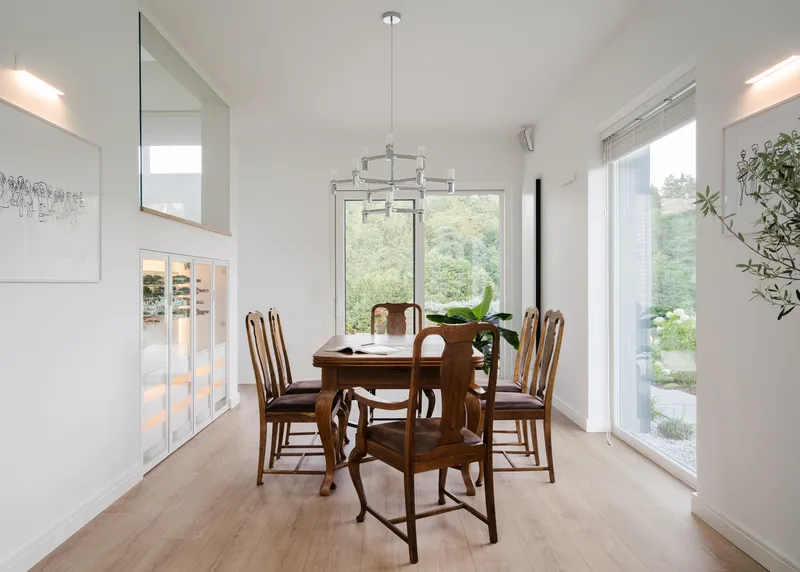
The dining area deploys a similar strategy: glass pendant lights hang in front of tall windows that look directly into the garden canopy. A figure crossing the upper landing, visible through the open stairwell, gives the house a sense of vertical connection that most two-story homes struggle to achieve. Rooms on the first floor borrow height from the roof pitch, making bedrooms feel generous without inflating the footprint.
Kitchen, Recreation, and the Quieter Rooms
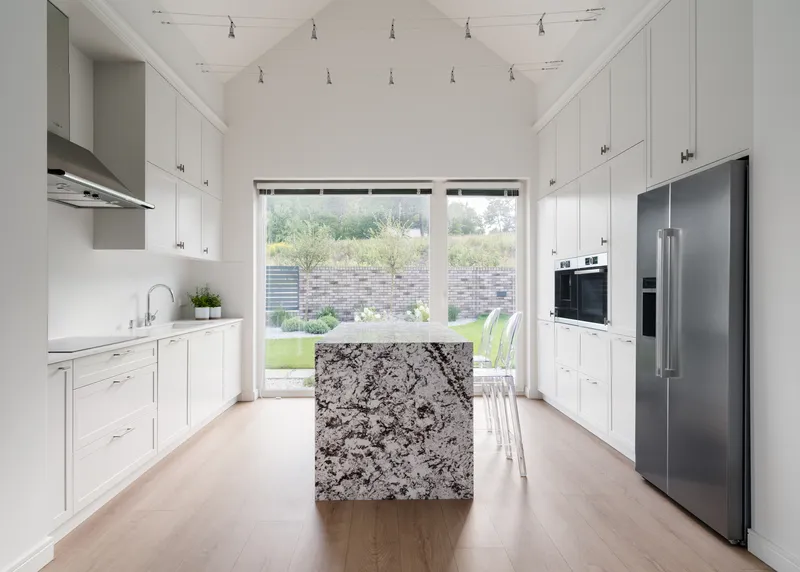
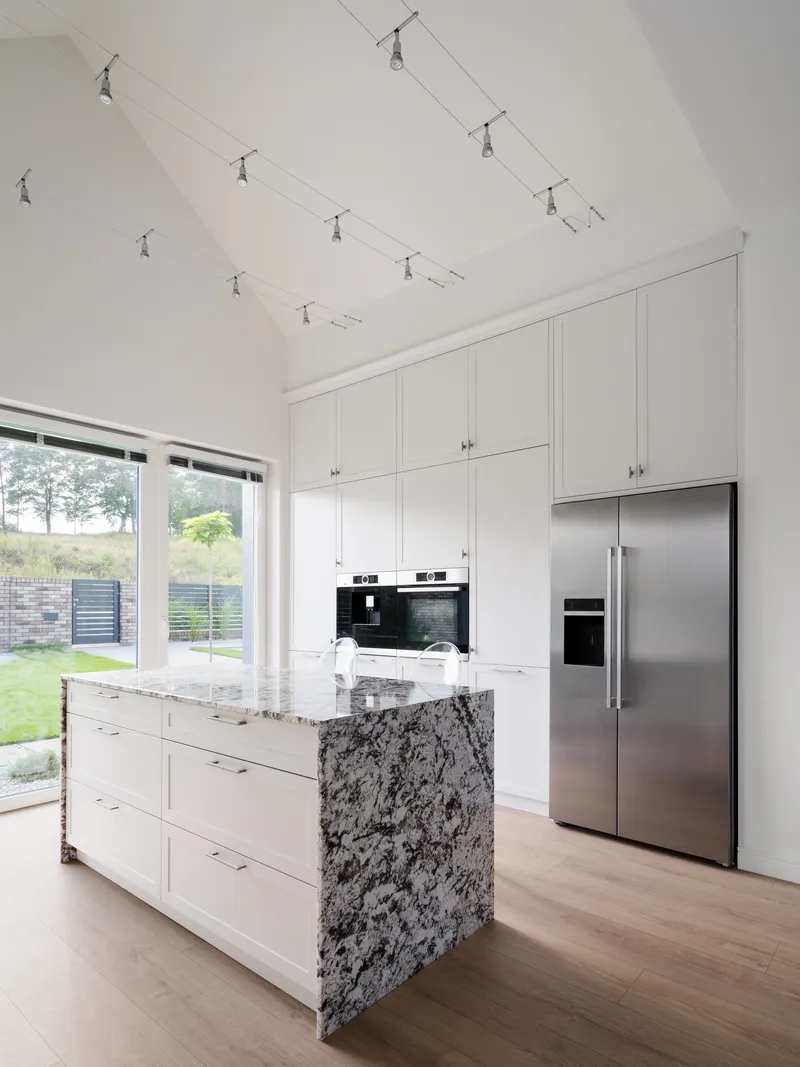
The kitchen occupies the eastern ground-floor block, configured as a white galley with a granite island, track lighting, and glass doors that open to the lawn. It is efficient and unfussy, calibrated for daily use rather than Instagram theatrics. A veined stone island provides visual weight, and stainless steel appliances line the back wall without pretending to be hidden.
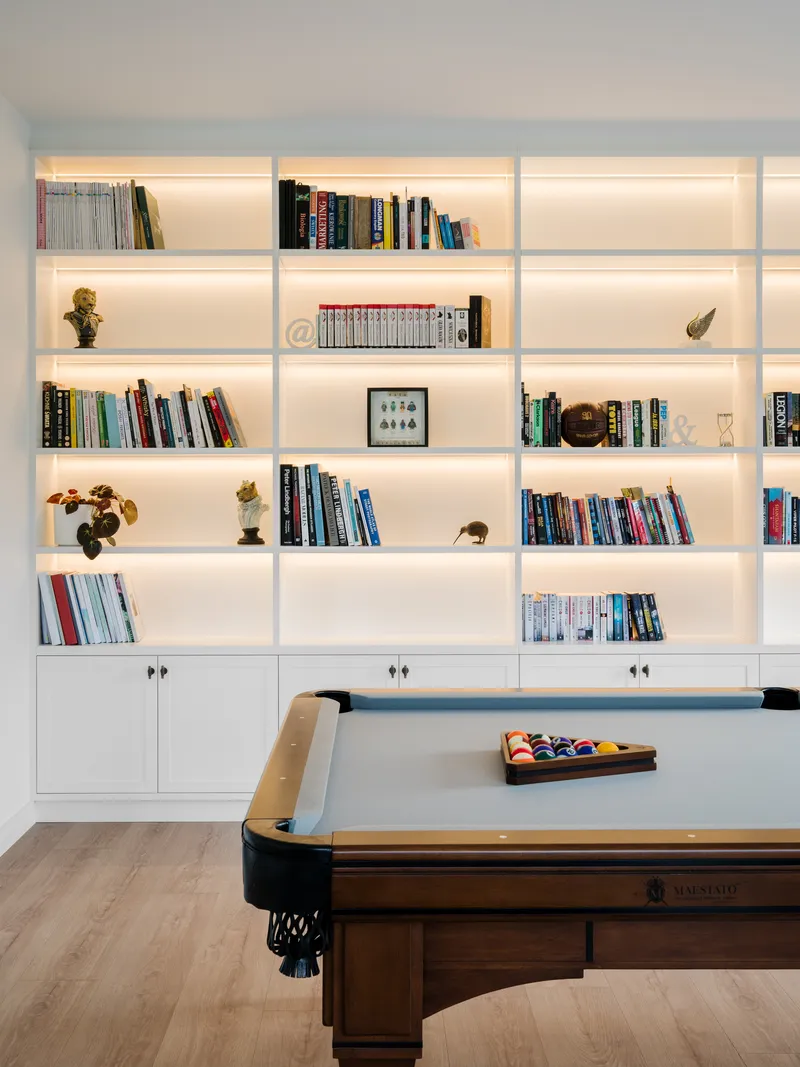
Deeper inside the white-rendered block, a recreation room centers on a billiard table flanked by a backlit shelving wall. The shelving is the most expressive interior element in the house: a grid of illuminated niches holding books and objects, glowing softly against the light wood floor. It doubles as a room divider, separating the recreation zone from the corridor beyond.
Stair, Corridor, and Material Details
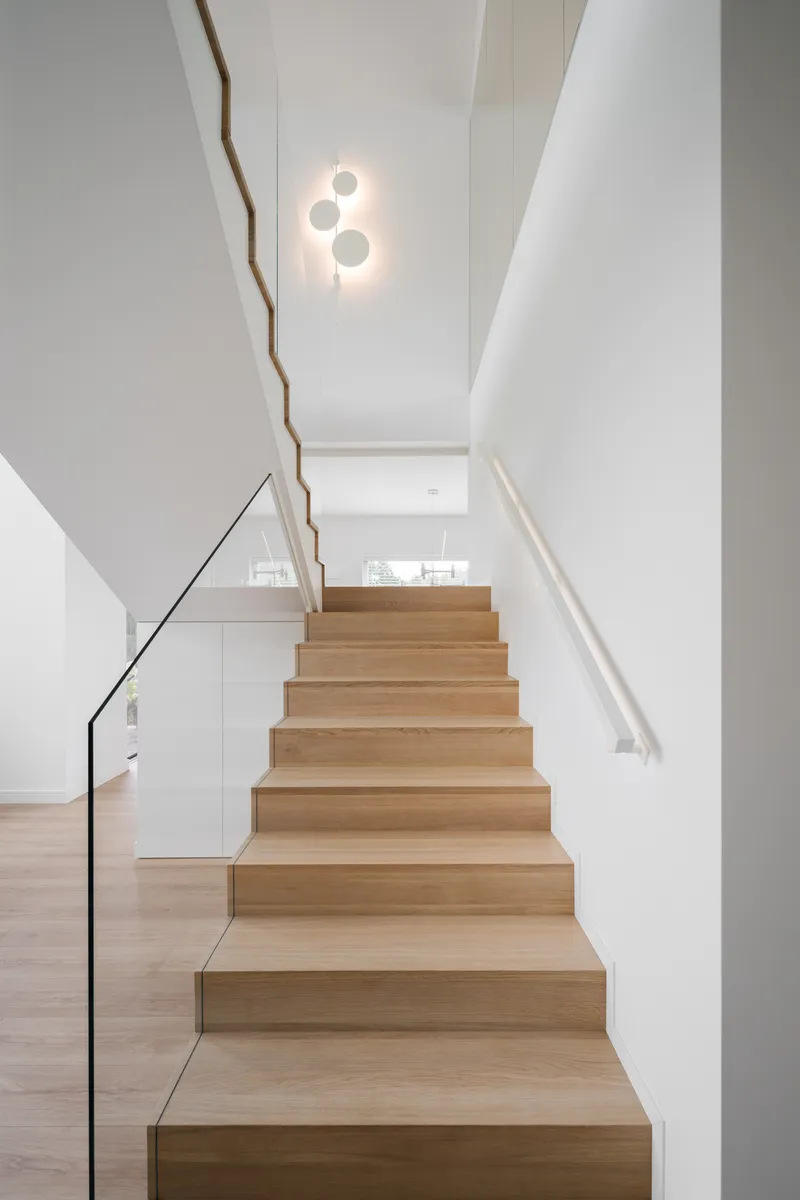
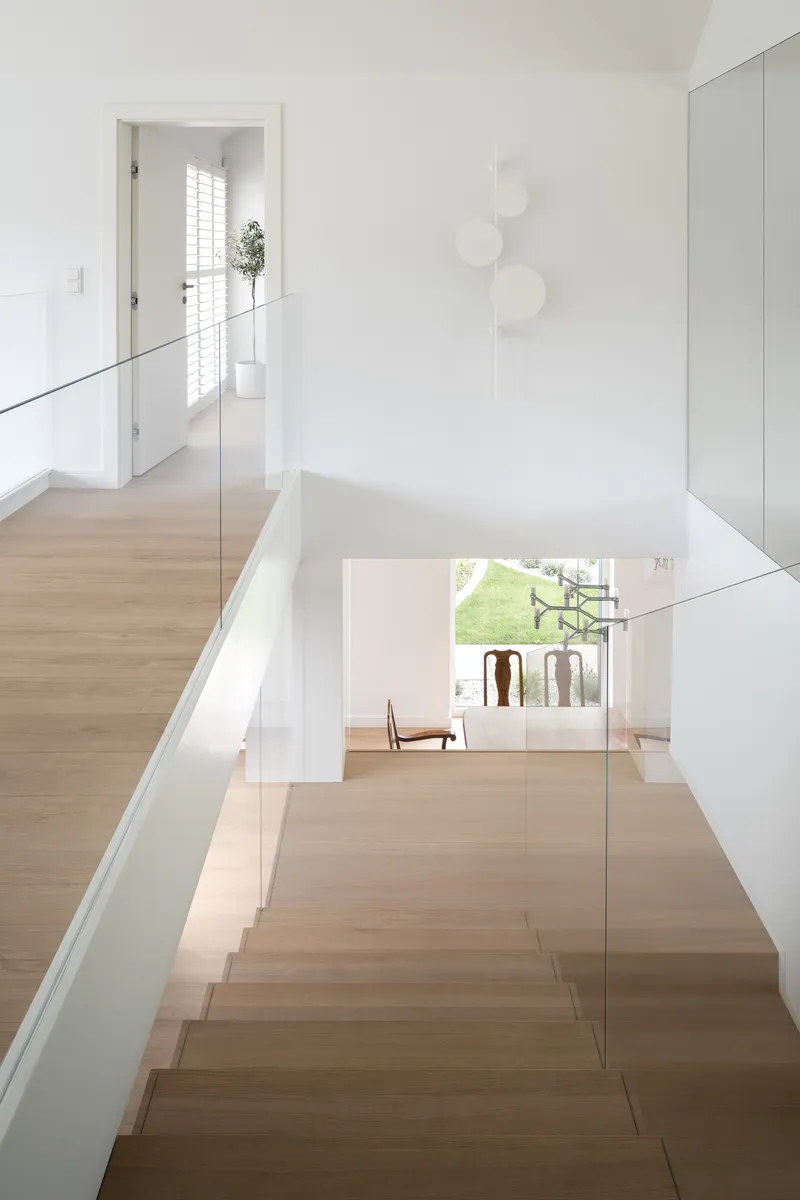
The staircase is a clean piece of joinery: light timber treads cantilevered from a white wall, a thin steel handrail, and a circular pendant fixture hanging in the void. At the upper landing, a glass balustrade maintains visual continuity between floors. Corridors are lined with built-in white cabinetry, flush to the walls, that eliminates the need for freestanding storage and keeps circulation paths uncluttered.
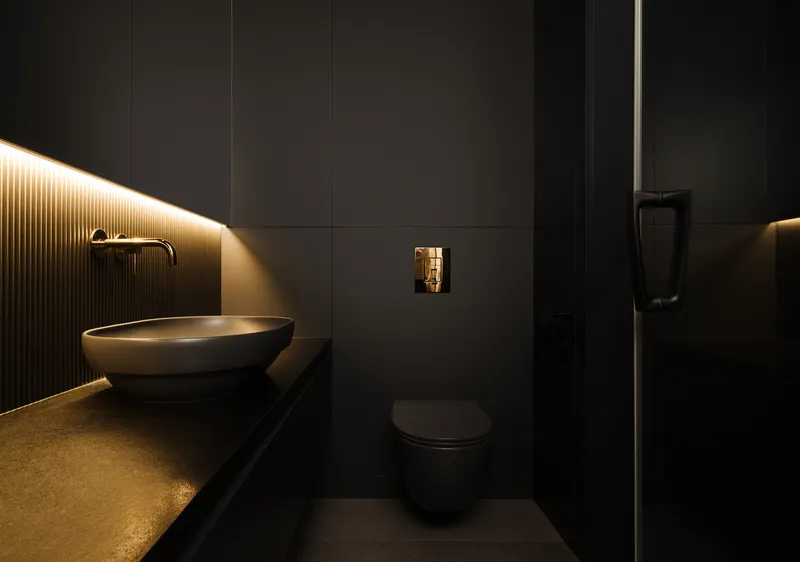
The bathroom introduces the sharpest material contrast in the house. Fluted black wall panels, integrated strip lighting, and an oval vessel sink on a cantilevered counter create a space that feels deliberately separate from the pale, airy palette elsewhere. It is a small, dark, precise room, and the shift in register is welcome after the relentless lightness of the main living spaces.
Plans and Drawings
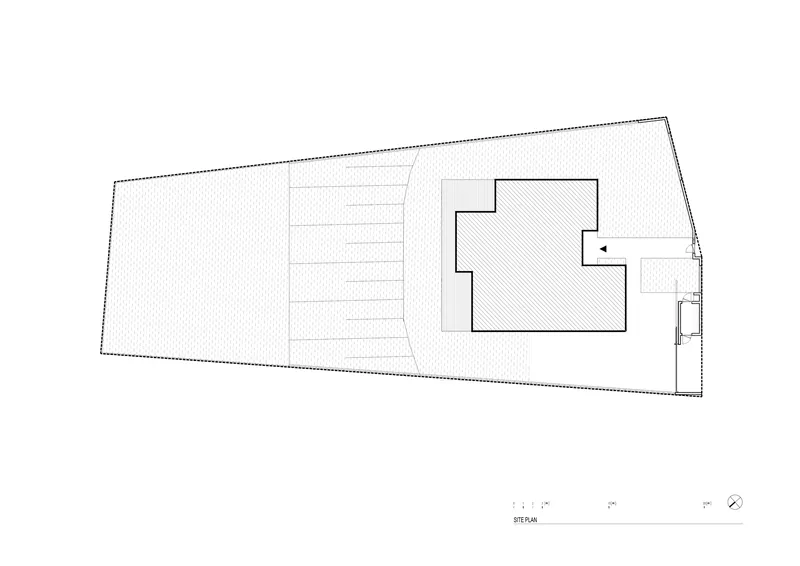
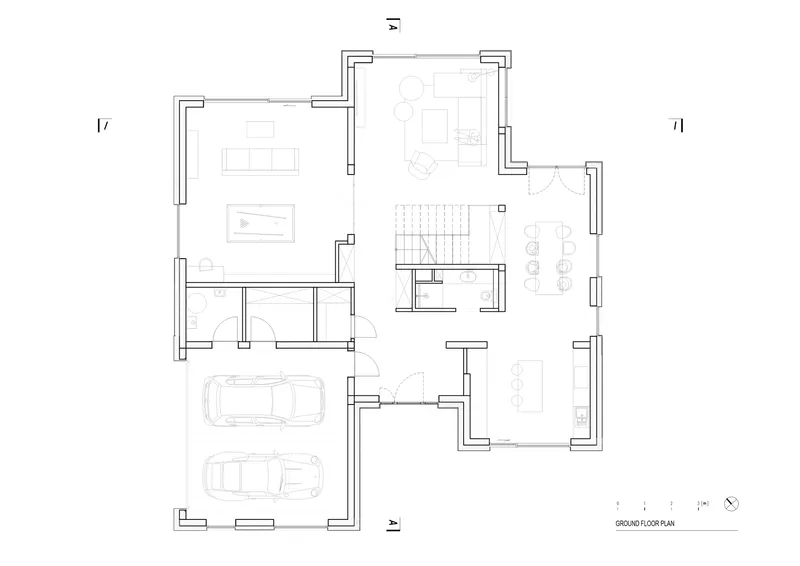
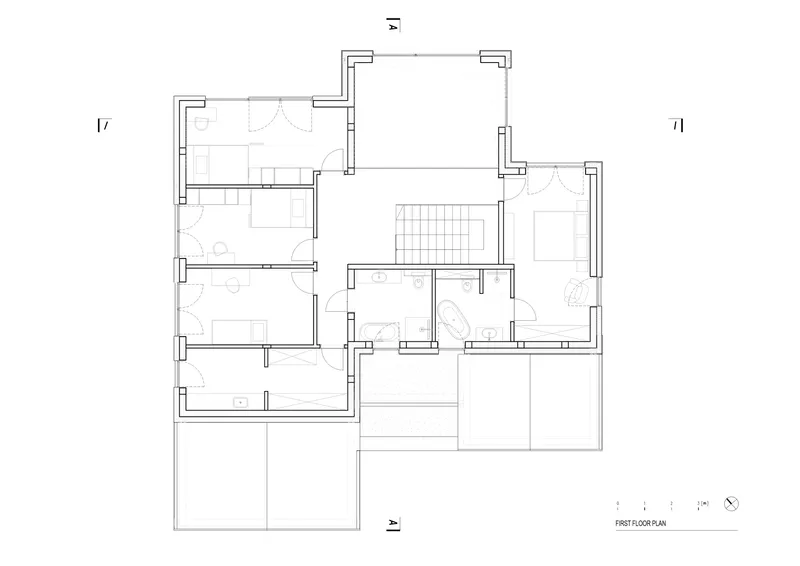
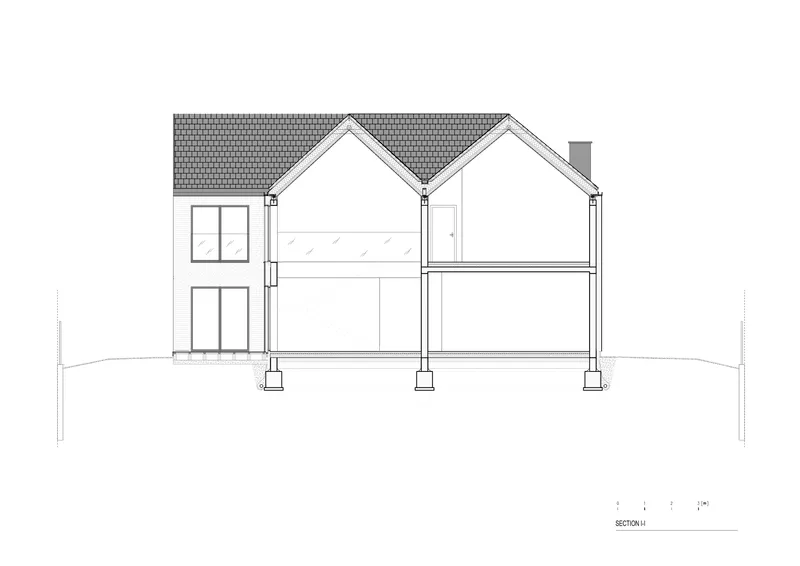
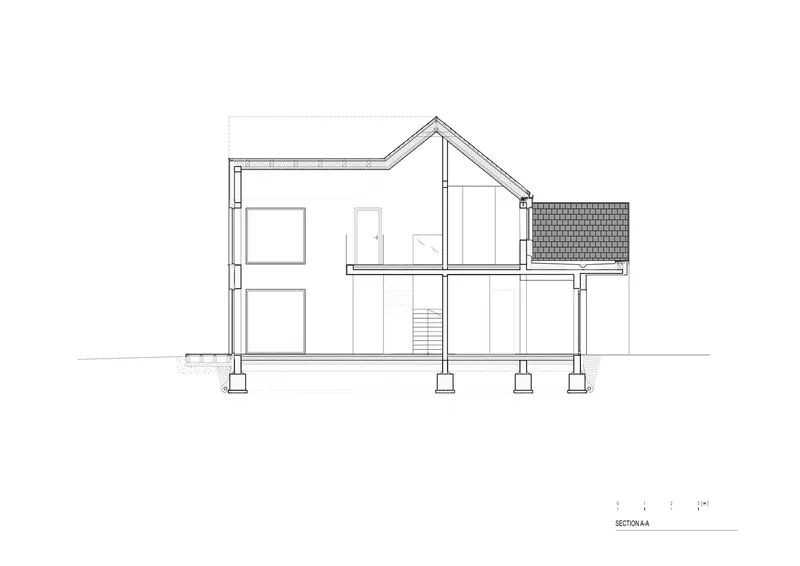
The site plan shows two connected volumes aligned along the fall line of the slope, their footprints offset to create sheltered outdoor pockets. The ground floor plan confirms the front-to-back logic: garage and kitchen flank the entry on the street side, while the living room pushes toward the garden. A central stair core connects to the first floor, where bedrooms and bathrooms cluster around the stair and a terrace that looks out over the park.
The sections are the most revealing drawings. They show how the seven-meter grade change is absorbed by concrete pier foundations, with the house effectively bridging between the upper street level and the lower garden. Double-height spaces under the tallest gable are clearly legible, and the angled roof planes create varied ceiling conditions on the first floor. The decision to extend rooms to the ridge rather than inserting a flat ceiling is what gives the upper bedrooms their spatial character.
Why This Project Matters
The Multi Gable House is a quiet argument against the flat-roofed box that dominates contemporary residential design in Northern Europe. By splitting the program into gabled volumes and letting each roof shape the rooms beneath it, bkm group recovers a formal language that is both historically familiar and spatially productive. The house does not look nostalgic; it looks like someone thought carefully about what a pitched roof can actually do when you take it seriously as a section-generating device.
More broadly, the project demonstrates how a steep site can be an asset rather than a constraint. The seven-meter drop creates privacy, separates the garden from the street, and opens panoramic views that a flat lot could never provide. bkm group's response is calibrated and specific: the house belongs to this slope, this orientation, this park edge. It would not work anywhere else, and that is precisely the point.
Multi Gable House by bkm group, Gdynia, Poland. 280 m², completed 2022. Photography by Nate Cook.
About the Studio
Share Your Own Work on uni.xyz
If projects like this are the kind of work you want to make, uni.xyz is a place to publish your own, find collaborators, and enter design competitions.


Popular Articles
Popular articles from the community


Cloaked Colonization: A Mobile Underwater Habitat That Moves Like a Fish
Micah Abaya's shortlisted EHC Pacific entry reimagines ocean settlement as a dispersed network of self-sustaining architectural organisms.

The Amber Palace Opera: A Geological Fiction Surfaces on Tallinn's Baltic Waterfront
Pierre Brillard reimagines a Baltic legend as a public landscape, opera house, and waterfront promenade rooted in Tallinn's coastal identity.
Temporary Home for Dogs: A Reversed Zoo Rethinks Animal Shelter Architecture
In Bucharest, a sinuous corridor and freed landscape flip the logic of containment, designing a shelter that works to make itself unnecessary.

Faces of the Soviet Avant-Garde: Turning Moscow's Street Names into an Open-Air Museum
A network of sculptural installations across a Moscow residential district transforms forgotten architect names into spatial encounters with cultural memor

Similar Reads
You might also enjoy these articles

Bao Huynh Watercolor Atelier: A Serene Art Retreat in Hội An
Bao Huynh Watercolor Atelier in Hội An blends multifunctional art spaces, sustainable design, local materials, and family-friendly living in a serene environment.

Atelier Macri Concept Store Interior Design by CASE-REAL
Atelier Macri store features a "ko" counter, walnut wood details, cork displays, blending retail, gallery, and seamless customer experiences.

Manuel Vargas Izquierdo Stadium and High-Performance Sports Center: Architectural Excellence in Jalpa de Méndez
The Manuel Vargas Izquierdo Stadium blends sustainable design, inclusive sports facilities, and cultural-inspired architecture, revitalizing Jalpa de Méndez’s public spaces.

KAKR Buluh Awar Hall: Revitalizing Community and Ecology Through Bamboo Architecture
Community built bamboo hall revitalizes Buluh Awar village, empowering youth, restoring ecology, celebrating vernacular craftsmanship through sustainable architecture and culture.

Explore Green Houses Competitions
Discover active competitions in this discipline

Challenge to design mud housing for contemporary communities

Challenge to reimagine the Iron Throne

Photograph architecture without architects

Illustrate the lost glory of Angkor Wat - Render Challenge
Comments (0)
Please login or sign up to add comments
No comments yet. Be the first to comment!