

Boundary Residence: A Contemporary Traditional Hanok Renovation by CMM Architects
A poetic hanok renovation in Gyeongju blending traditional Korean architecture with soft geometry and nature-centric contemporary living.


Reinterpreting Korean Heritage Through Space
In the historic city of Gyeongju, South Korea, Boundary Residence by CMM Architects is a refined reinterpretation of the traditional hanok renovation. This project rethinks how architecture can honor Korea’s cultural memory while reconfiguring space to serve contemporary living. Designed by architects Eom Taegyu and Bang Giae, the 61 m² residence offers a meditative dialogue between structure, material, and the natural environment.


Architecture as Threshold: Blurring Inside and Outside
The design emerged from a simple yet profound question: How can we begin our day with quiet reflection, surrounded by filtered light and the presence of nature? This intention shaped every architectural decision. Rather than drawing a distinct boundary, the design seeks to erase it—merging interior and exterior realms through subtle transitions in materials, light, and layout.

Upon entering through the main gate, one is met with textural ground surfaces, wooden columns, and tiled rooflines that evoke the language of the hanok. These tactile cues ease the visitor into the circular sequence of spaces, each one carefully composed to frame views of the surrounding garden. The house becomes not only a shelter but a lens for seeing.

Curved Geometry and Framing Nature
Curvature plays a key role in this hanok renovation—not as a literal circle, but as a visual strategy. Gently curved interior lines guide the gaze, creating a soft flow between rooms and toward the garden. These spatial arcs do not just enclose; they reveal and expand, forming a quiet architectural choreography.

The garden is not secondary but central. It functions as a living backdrop to every space. Windows, doorways, and circulation paths are carefully aligned to maintain this presence of nature at all times. The curved enclosure allows the garden to anchor the home without enclosing it.

Material Harmony and Timeless Detail
In contrast to stark modernist interventions, this hanok renovation is rooted in material sensitivity. Natural wood finishes dominate the interiors, their warmth enhanced by filtered sunlight that slips beneath the extended eaves. Furnishings are minimal and crafted, supporting the architectural goal of letting material, light, and space speak quietly.


Traditional elements—such as exposed beams and low thresholds—are preserved, yet they are reinterpreted within a cleaner, more fluid plan. The result is a balance between tradition and modern minimalism, where the structure supports a life of quiet observation and retreat.


A Hanok for Contemporary Life
Boundary Residence is a small but profound statement about the relevance of traditional Korean architecture in the 21st century. It doesn't simply restore a hanok; it reimagines its spirit—where living is intimately connected to nature, and where architecture performs best when it steps aside.
By embracing the hanok’s essence while applying a contemporary lens, CMM Architects deliver a house that breathes with light, frames every shadow, and lets the landscape complete the architecture. This is not only a traditional hanok renovation—it is a poetic return to architectural humility and experiential richness.

All the photographs are works of texture on texture


Popular Articles
Popular articles from the community


Aquadapt: An Underwater Habitat That Rewrites Its Rooms by the Hour
Curved modules ring the seabed while one shell shifts from breakfast room to cinema, farm and football pitch as residents' needs change.


ETEH Reworks the Shared Spaces of São Domingos School in Brazil Around Timber, Color and Hanging Plants
At São Domingos School in Brazil, 436 m² of hall, refectory and library are recast with timber joinery, a yellow and blue code and trailing greenery.

Singing Woman: An Opera House That Performs Before the Curtain Rises
Ovidiu Cristian Pavel's conceptual opera house translates Estonia's choral identity into a sculpted waterfront landmark facing the Baltic Sea.

Opera on the Sea: Driftwood Logic Shapes a Timber Opera House on Estonia's Coast
Trevor Orgill's opera house translates the entangled drift of floating timber into a civic building where wood, water, and music converge.

Similar Reads
You might also enjoy these articles

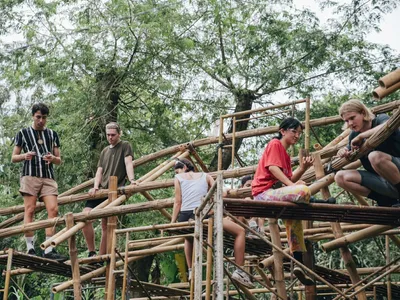
Bamboo Housing Challenge 2026: Design Affordable, Sustainable Homes Using Bamboo
An international design competition by Bamboo U and IBUKU inviting architects and designers to reimagine affordable housing using bamboo — with the winning design built full-scale in Bali.

Computational Design & Education: Beegraphy Design Awards Introduces 7th Category (Featuring Jiyun's Innovative Approach)
Dive into Beegraphy’s 7th Design Awards category, where computational design meets education to create immersive, interactive learning tools, inspired by Jiyun’s work.
From Parametric Lighting to Urban Furniture: Join the 2nd Workshop in Beegraphy’s Computational Design Series
Dive into Cutting-Edge Design Techniques and Practical Applications with Industry Experts

Last Call: Unleash Your Architectural Genius in SHAK's Kindergarten Design Competition
Urgent call for architects to join SHAK's kindergarten design competition before the looming deadline

Explore Architecture Competitions
Discover active competitions in this discipline

Challenge to reimagine the Iron Throne

Photograph architecture without architects

Illustrate the lost glory of Angkor Wat - Render Challenge

Design challenge to reuse E-waste
Comments (0)
Please login or sign up to add comments
No comments yet. Be the first to comment!