

Bright futures: Architects envision new-age schools for visually impaired children
‘Visionary’ - architecture competition - Result story


The dawn of new-age progressive schools was started around the 1900s by John Dewey as a movement of bringing up kids in lab-like schools where they learn by doing. The model helped break the stereotypes of traditional conservative methods of education which believe in teaching through books and preset lessons.
But with passing time, the curiosity of children is far by leaps and bounds. Questions raised in the classes today are far more expansive as a generation compared to previous centuries. From being students following a certain curriculum, their rigour is challenging every dimension of learning. These times push for new means to learn constantly, no matter what the subject is.
This becomes a privilege for schools that have people who are able and can be provided with such exploratory means of teaching.
But children who are differently/specially-abled and the facilities available to them are never pushed so far – nor even looked at in the same light.
School for the blind has been around for a while in various informal to retrofitted scenarios. The first formal educational institute was established in 1795.
Before formally schooling blind children, only asylums were sought for these kids as the civilization did not know how to handle them. These schools had bare minimum braille scripts that only taught them manual crafts and menial work at large.
Today a lot of these blind children go to the same schools in their neighborhoods that abled kids go to and are assisted by special faculties but still have the same environment and means.
The design attention that goes into such spaces is fairly limited to the users they are catering to.
What if we could bring equal curiosity and attention to the issue to this uncharted territory of barrier-free design? How would be a tailormade school for the blind be? How would the open/liberal values of today imbibe into the built fabric of these educational institutions?
Designing learning spaces for children with low or no sight requires a lot more attention than designing for abled kids.
Can there be various models for implementing such education environments that multiply their potential? Can design help us identify modules/methods of upgrading existing schools for differently-abled teaching? Can we implement a new kind of pedagogy for the users in consideration?
The challenge here was to design a school for the blind that engages – promotes - teaches almost as well as a general school for the abled children.
Taking into account the parallels between these learning environments can’t be equal, but exercise looks more towards raising the bar than meeting it at equal capacity. The design must also focus on methods to mentally stimulate the kids through other sensory ways.
The jury for the competition consisted of esteemed designers, professionals, and academicians from around the world. The Lead Jurors for the competitions were as follows:
Kazumasa Takada, Co-founder, Architect, PAN-PROJECTS, UK
Yuriko Yagi, Co-founder, Architect, PAN-PROJECTS, UK
Siiri Vallner, Architect, Kavakava Architects, Estonia

Some of the Best of competition projects are:
Winning Project: Sensory Corridor
By: 將人 竹内, Kaiji Kobayashi & Takashi KOBAYASHI
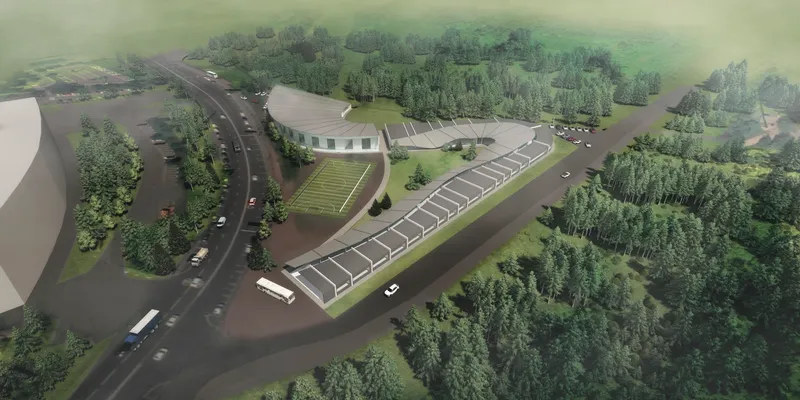
Fig: 1 Cover image
Description: Sensory corridor
--------------------
Editor’s Choice: Enabling Abode
By: Aceson Han
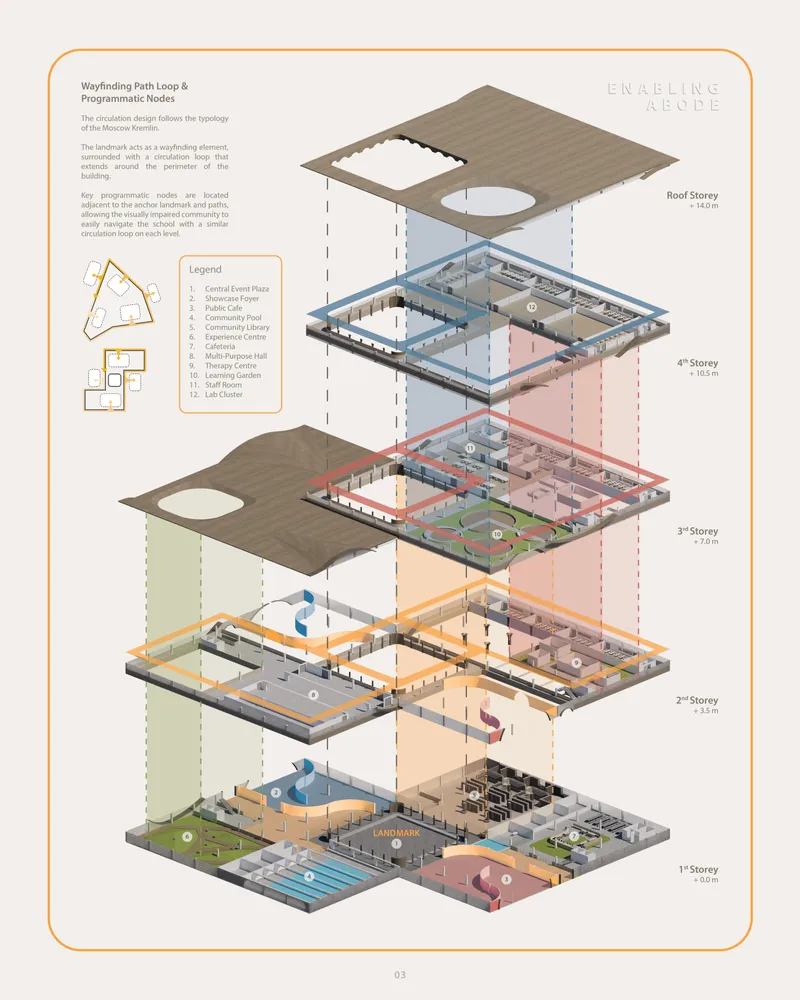
Fig: 2 Isometric plan
Description: The proposal aims to ameliorate the stigma that the visually impaired are limited by their disabilities, by creating a safe space for the students to engage in meaningful interaction with the public. The circulation is inspired by the urban planning of the Moscow Kremlin. The simple route guides students around different nodes with a loop pathway design.
--------------------
Editor’s Choice: Visionary
By: Akshat Barve, Kritik Kapoor, Nancy Sahu & Rashi Desadla
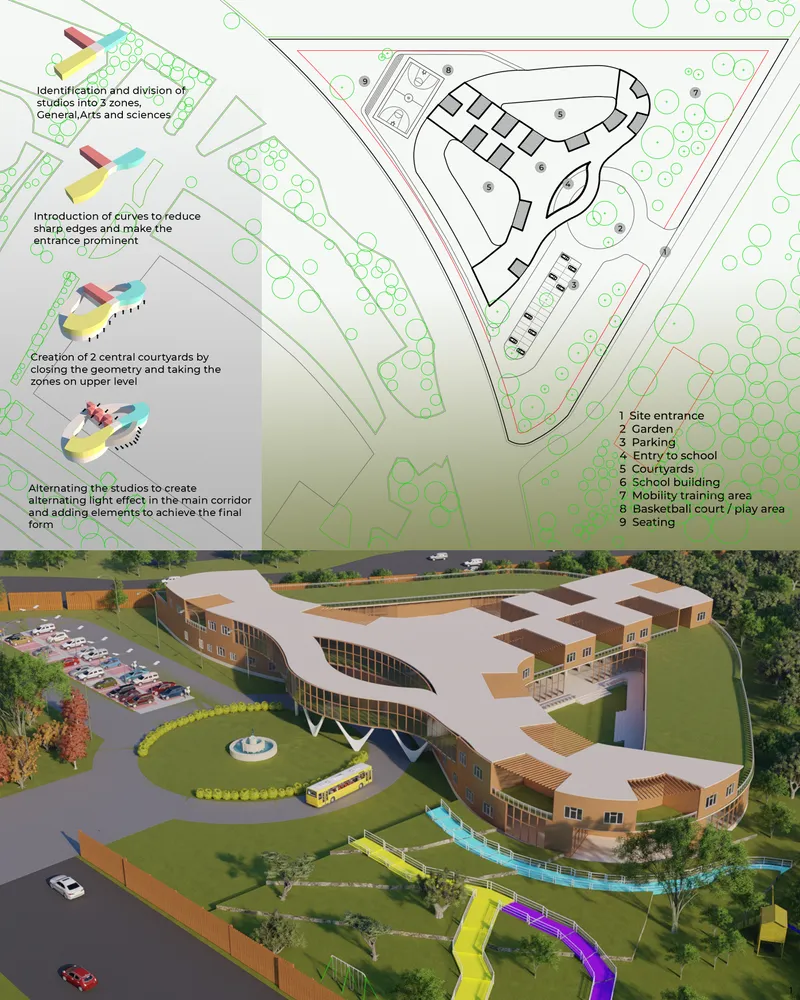
Fig: 3 Site plan and view
Description: School design for visually impaired children.
--------------------
Editor’s Choice: THE SCHOOL OF SEEING
By: Sudharsan
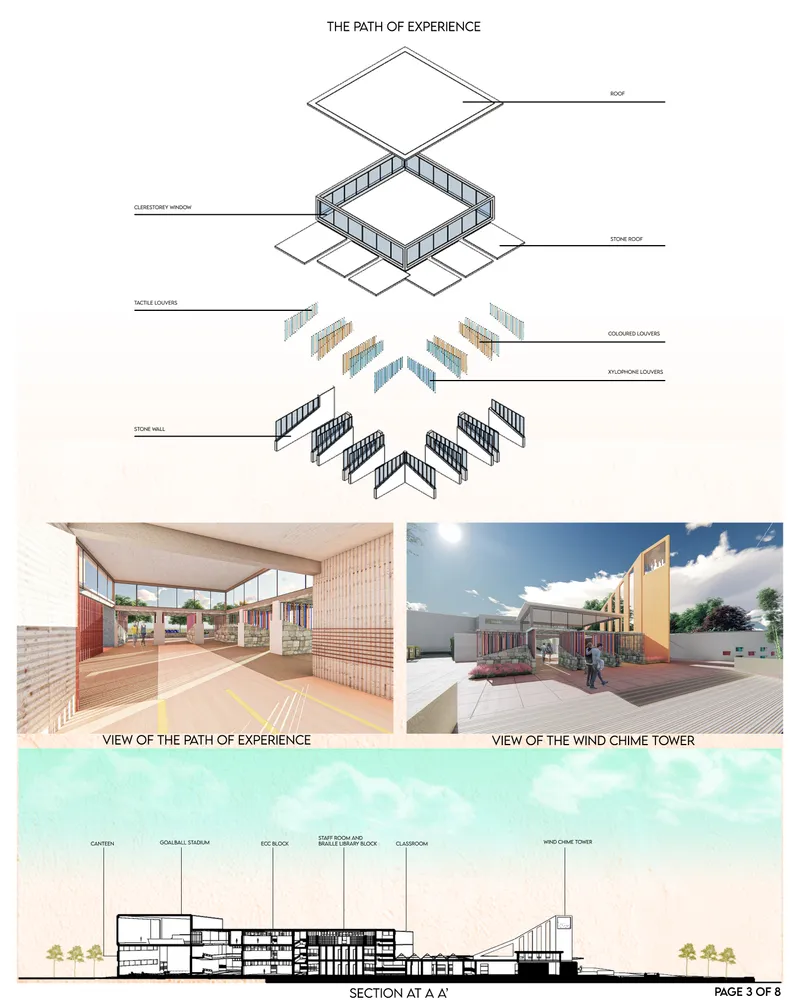
Fig: 4 Section plan and isometric plan
Description: The experiencing of space through the senses is executed in this project.
--------------------
Editor’s Choice: Beyond Sight Preparatory School
By: Cynthia Fishman & Juhi Parikh
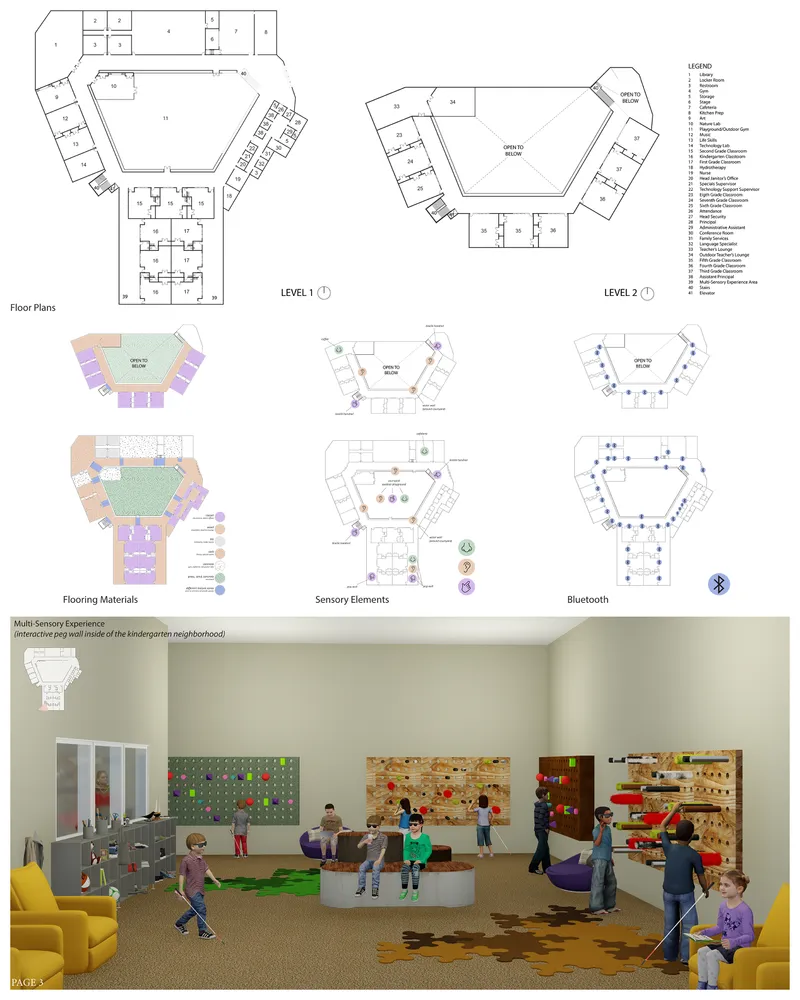
Fig: 5 Floor plan and interior view
Description: A school for visually impaired children in grades K-8 that is located in the Krylatskoye district in Moscow, Russia. This school is built around the principles of sustainability and resiliency while focusing on connecting the inhabitants to nature by utilizing biomimicry as a design lens.
--------------------
Editor’s Choice: Sensory Landmark
By: 유진 강, 세진 박 & DongJin Kang
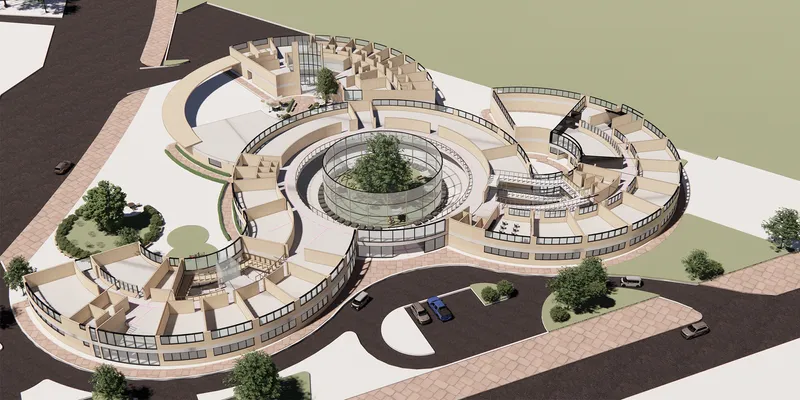
Fig: 6 Cover image
Description: Fear of the unknown environment leads to a lack of activity, directly linked to children's creativity. The focus was on spending the most extended hours of the day and living without fear in the most stimulated schools. What if they could perceive the school's environment with their own senses? What if they had their maps in their heads?

Follow us on social media: Facebook | Instagram | LinkedIn | Twitter | Youtube
References (3)


Popular Articles
Popular articles from the community


Architekt Andreas Gruber Scatters 23 Dark Timber Chalets Across a South Tyrolean Forest Edge
In Molini di Tures, Amonti Chalets breaks a resort into a hamlet of gabled timber houses, with parking, storage and services pushed into the slope.

Juan García Correa, John González and Claudia Rueda Sink a Circular Amphitheater into a Manizales Engineering Building
On the La Nubia campus in Manizales, Colombia, the S1 Building folds labs and offices into a hillside of ramped lawns that double as a campus route.

longwave studio Reorganizes a 112 m² Tainan Apartment Around the Daily Routines of a Family and Two Cats
In Tainan, Taiwan, birch plywood, rust-red furniture and a freestanding plaster wall link arrival, storage, work and family life in one apartment.

U.GA Architects Wraps an Oval Rooftop Pool in Curved Board-Formed Concrete on Busan's Jeollidan-gil
In Busan's Jeonpo-dong, a 454 m² mixed-use block stacks a neighborhood facility, guest rooms and an oval rooftop pool inside spiraling concrete walls.

Similar Reads
You might also enjoy these articles


Aquadapt: An Underwater Habitat That Rewrites Its Rooms by the Hour
Curved modules ring the seabed while one shell shifts from breakfast room to cinema, farm and football pitch as residents' needs change.

Play: Fragments of Their World: Remembered Architecture Rebuilt as a Modular Playground for Refugee Camps
Tom Gardner abstracts domes, arches and towers from the homelands of displaced families into a kit of child-scaled play parts for camp settlements.
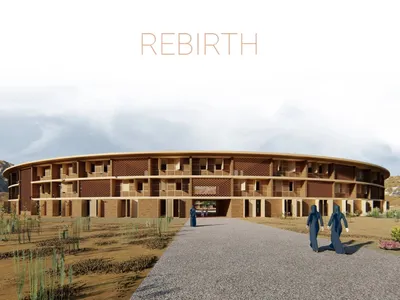
REBIRTH: A Circular Settlement Where Afghan Widows and Their Children Rebuild Life Together
A shortlisted Resile entry turns the circle into a protective ring of timber and brick, gathering homes, classrooms and gardens around a shared landscape.
The Main Dream: A Recycled Plastic Kit That Lets Refugee Children Build Their Own Playground
Thirty-centimetre interlocking cubes that connect on three axes turn play into construction, letting children author the spaces they occupy.

Explore Visionary Architecture Competitions
Discover active competitions in this discipline

Challenge to design public laboratory

Challenge to imagine architecture inspired by fiction
Comments (0)
Please login or sign up to add comments
No comments yet. Be the first to comment!