

Bufen Atelier Carves a Marble Monolith into a Sidewalk Kiosk on a Beijing Avenue
A 16-square-meter triangular volume of three marbles and hammered copper hovers above a tree-lined plaza in Beijing.


A kiosk is, almost by definition, a throwaway object. It is the architecture of impulse: a counter, a canopy, a transaction. So when a studio decides to build one out of three kinds of marble and hammered copper, and to give it a geometric logic that recalls geological strata more than retail infrastructure, the result deserves scrutiny. Bufen Atelier's Floating Kiosk, completed in 2026 on a tree-lined avenue in Beijing, is a 16-square-meter triangular volume that reads less as a point of sale and more as a fragment of quarry deposited on an otherwise undifferentiated stretch of pavement.
The project's central conceit is weight rendered weightless. The kiosk is slightly elevated above grade, creating a shadow gap that visually severs the structure from the ground and strips it of the gravitational logic you expect from stone. A circular aperture punches through the marble shell, housing a copper disc and casting diffused light inward. Staff enter through a concealed marble door. All equipment hides inside the walls. The result is an object that simultaneously asserts its mass and denies it, functioning as a spatial interruption along a continuous flow of pedestrian movement.
Three Stones, One Surface
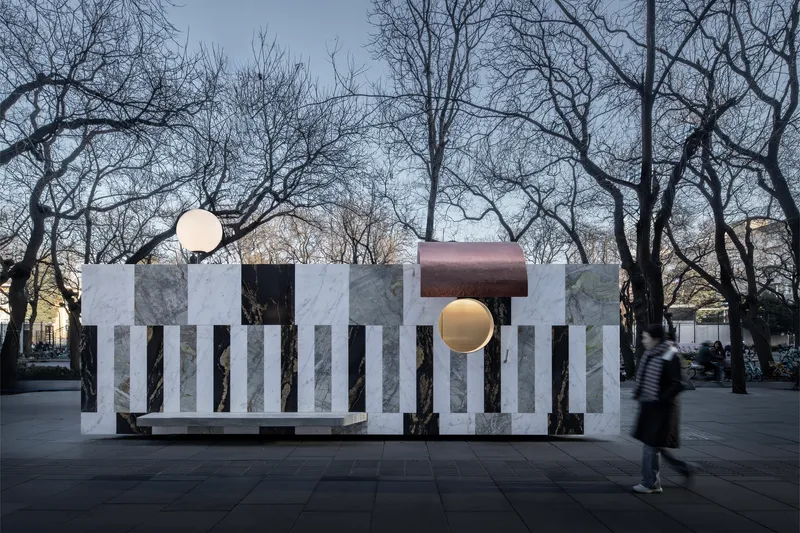
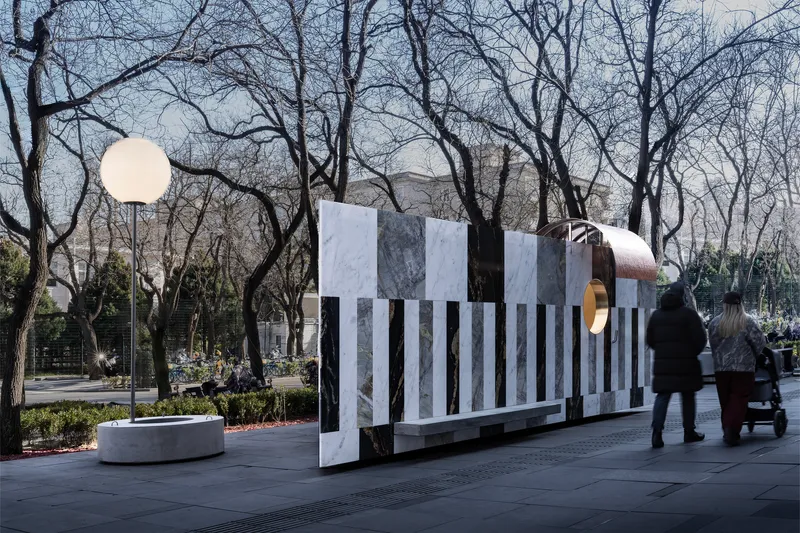
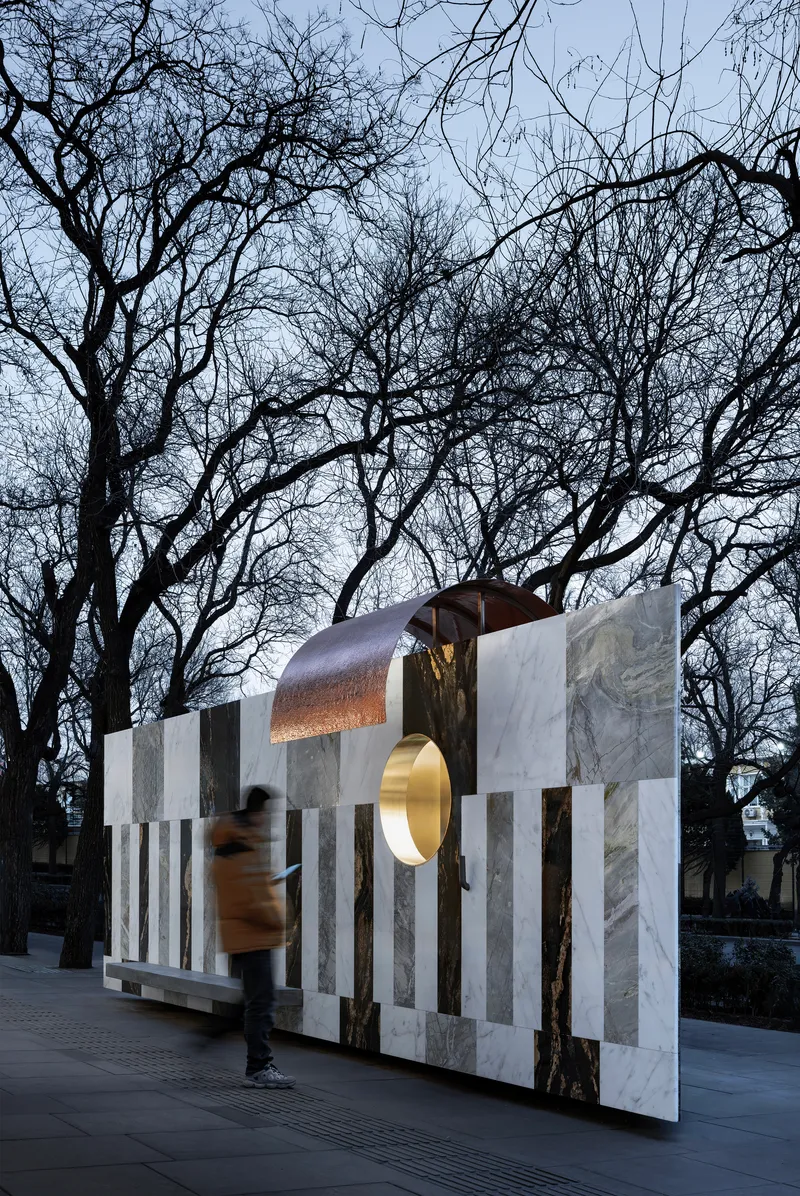
The most striking decision here is the material palette. Bufen Atelier selected gray-white, black-gold, and muted green marble, cutting them into vertical slats and assembling them in alternating rhythm. The effect is closer to textile weaving than masonry: each panel is distinct in grain and hue, but the repetition creates a unified surface that shifts in tone depending on your angle and the time of day. The stone is not cladding. It is the architecture.
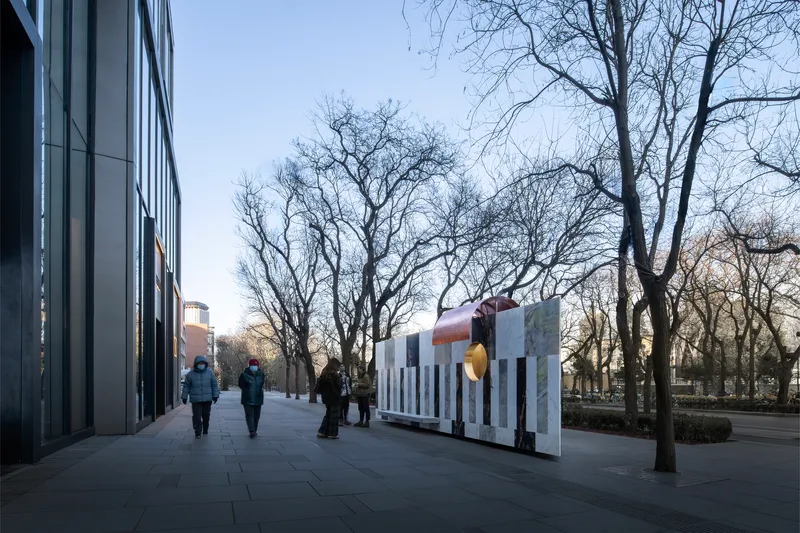
Seen from the side, the slat rhythm becomes almost hypnotic, especially as pedestrians move past and the depth of the gaps produces a parallax effect. The texture is assertive enough to register from a distance but detailed enough to reward close inspection. It is a quiet rebuttal to the default material language of temporary urban installations, which tends toward steel, plywood, or vinyl wrap.
The Copper Aperture
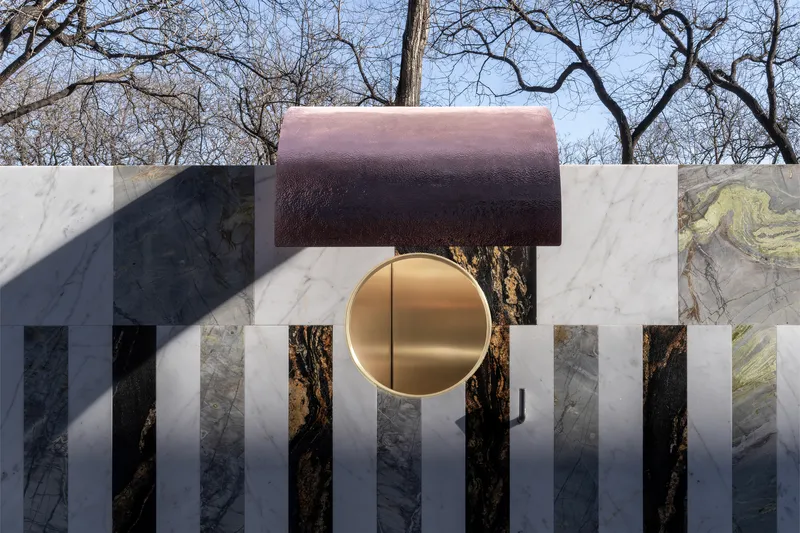
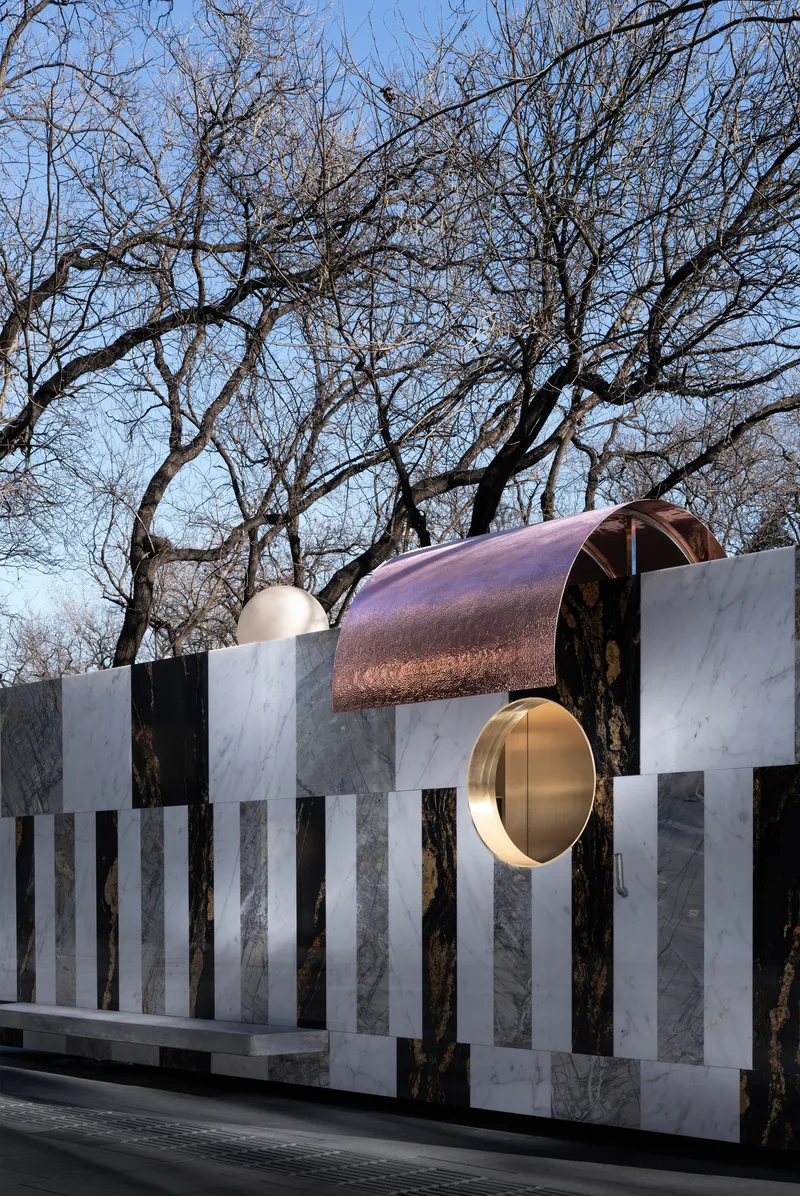
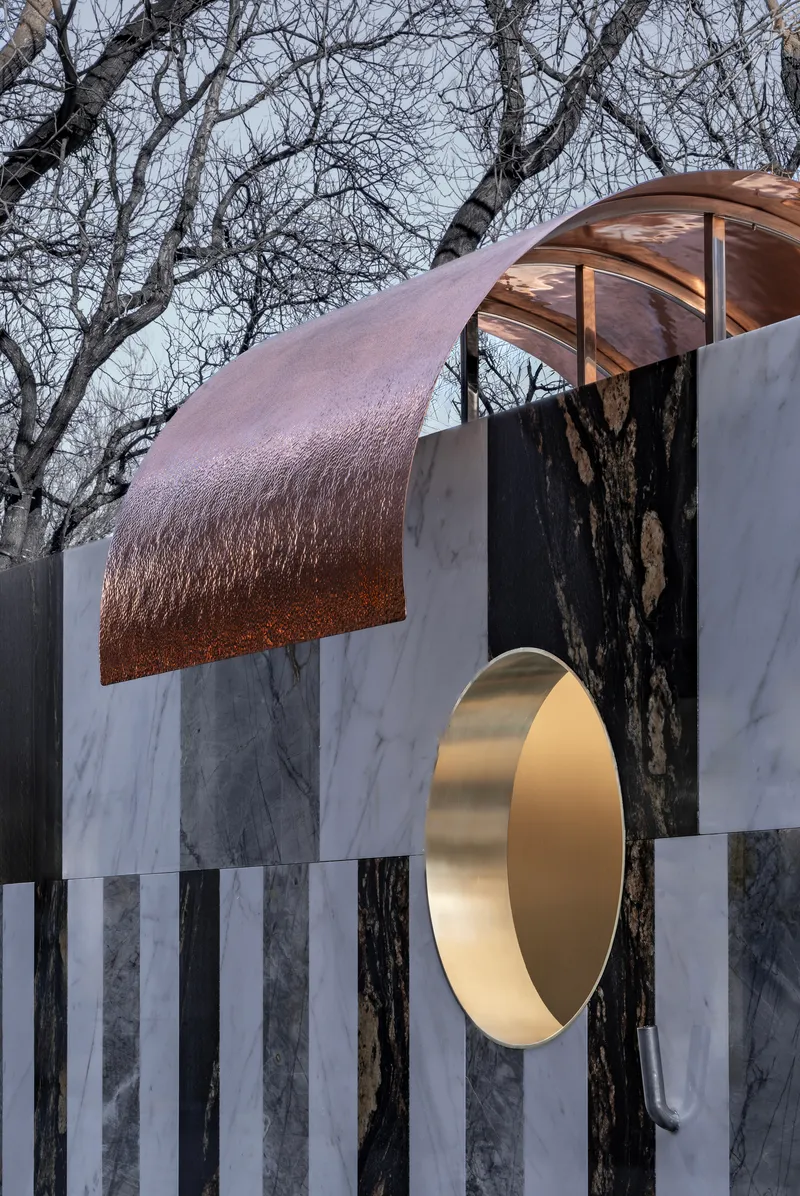
The circular opening is the project's most provocative gesture. A copper disc, set within the marble face, doubles as a service counter and a visual anchor. It interrupts the continuity of the stone volume with a material and geometric logic that is entirely its own: round against angular, warm metal against cool mineral. A hammered copper canopy extends outward from this aperture, its barrel vault form creating a threshold between the kiosk's interior world and the public sidewalk.
The copper will patina. The marble will not. Over time, the contrast between the two will sharpen rather than diminish, giving the kiosk a temporal dimension that most temporary structures never achieve. Bufen Atelier has essentially designed obsolescence out of an inherently impermanent program.
Floating at Dusk
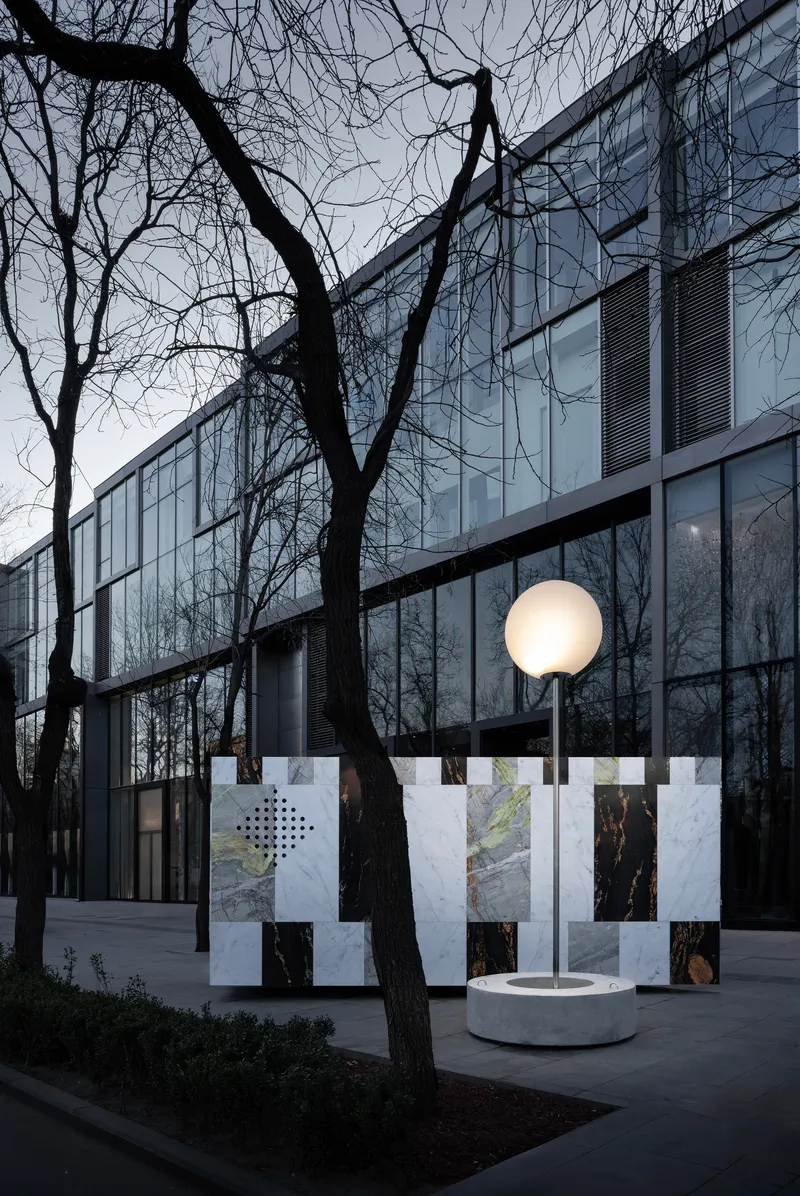
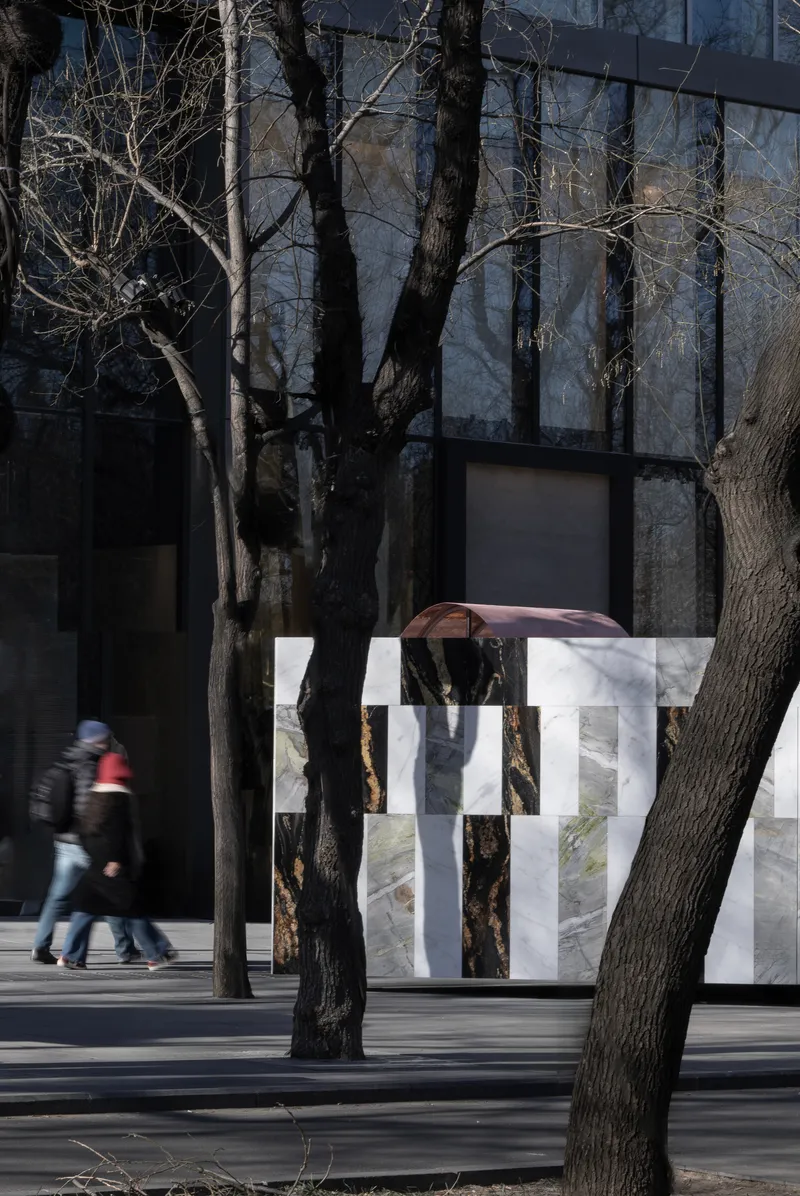
The kiosk's relationship to its surroundings changes dramatically between day and evening. Under afternoon sun, the stone reads as opaque and monolithic, its shadow gap barely perceptible. At dusk, the globe lamp mounted within the circular opening begins to glow, and the shadow gap darkens into a decisive void. The triangular mass appears to lift off the pavement. The name stops being metaphorical.
These twilight images also reveal how well the kiosk holds its own against the glass curtain walls behind it. A dark reflective tower and a row of bare winter trees provide a neutral backdrop, and the stone stripes register as almost geological against the corporate grid. The kiosk does not try to disappear into its context. It establishes, as Bufen Atelier intended, a clear distinction from the surrounding urban fabric.
Urban Object, Social Furniture
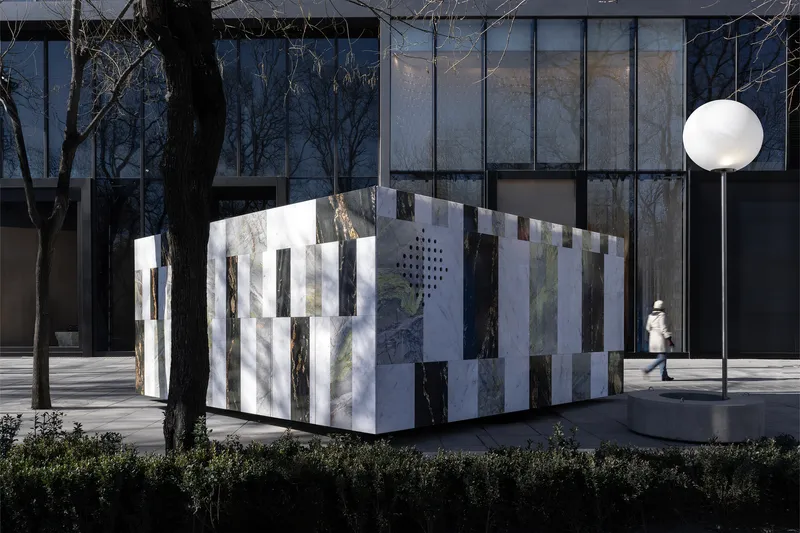
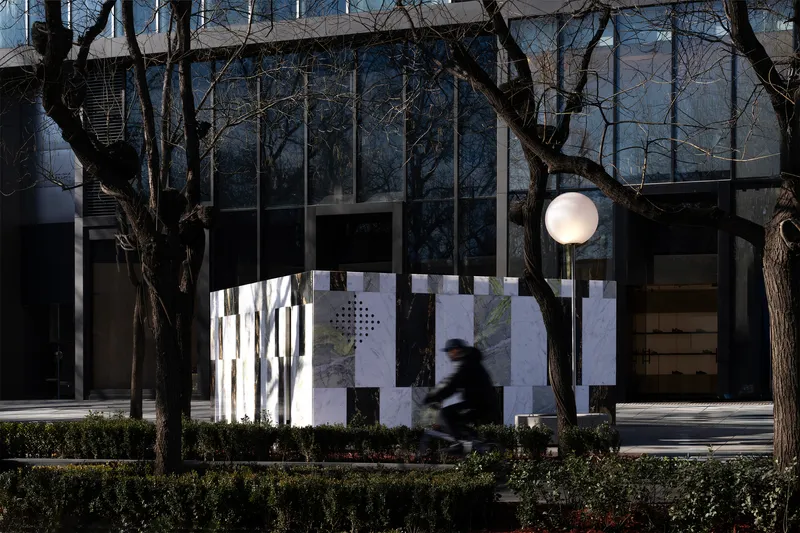
A concrete bench is embedded within the marble surface, converting one face of the triangle into public seating. This is a small move with outsized consequences. It transforms the kiosk from a transactional node into a destination, blurring the line between retail architecture and urban furniture. A cyclist passes. A parent pushes a stroller. Someone sits. The kiosk creates a moment of pause, a reason to slow down along a stretch of city that otherwise offers none.
The triangular plan was chosen for its inherent structural stability, but it also generates three distinct faces, each of which can address its context differently: one serves, one shelters, one screens. There is an economy to that geometry that a rectangular plan could not replicate at 16 square meters.
Plans and Drawings
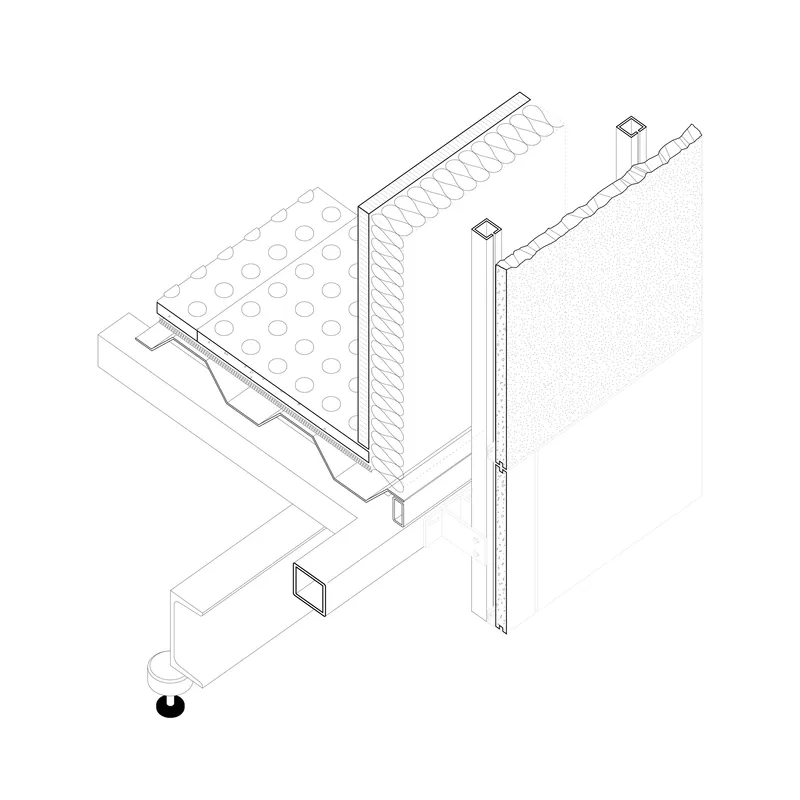
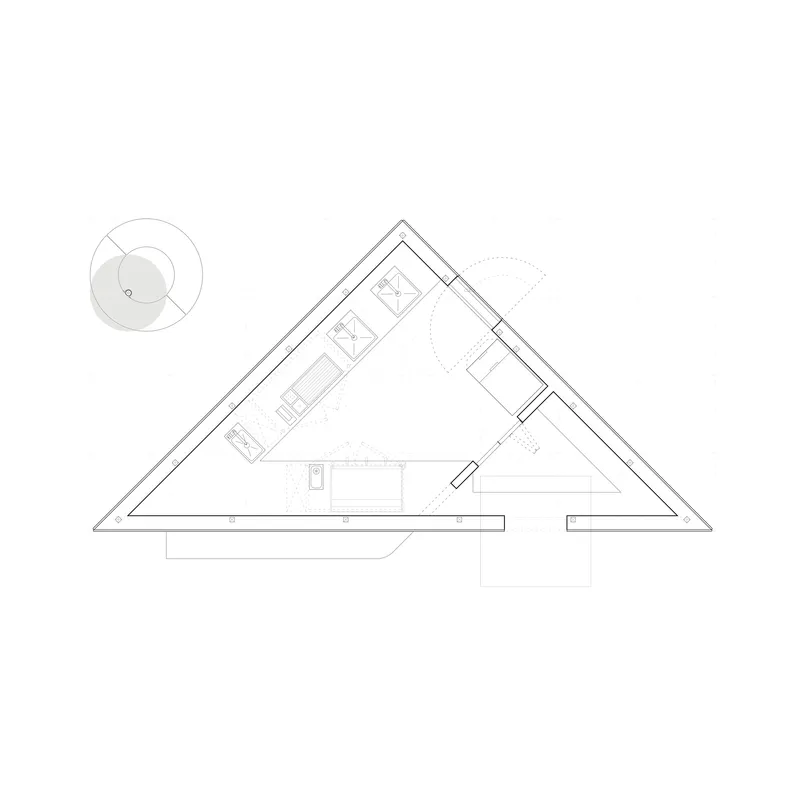
The isometric drawing reveals the construction logic behind the surface: a structural frame supports the individual marble panels, with perforations allowing ventilation and servicing. The globe fixture is suspended within the circular void, and every piece of operational equipment slots into the wall cavity. The floor plan confirms the triangular geometry and shows how the interior is divided into compact service rooms, with the circular element positioned to the left as the primary point of public engagement.
What the drawings make clear is that this is not a sculptural exercise with a retail program attached. The plan is genuinely functional, its compactness a product of rigorous dimensional discipline rather than formal indulgence. Every surface does double duty: structure, enclosure, display, and seating are all embedded in the same envelope.
Why This Project Matters
The Floating Kiosk matters because it refuses the premise that temporary architecture must look temporary. By deploying stone and copper at a scale where most designers would reach for off-the-shelf systems, Bufen Atelier makes an argument for permanence within impermanence. The kiosk will eventually be removed, but the material and geometric decisions it embodies are durable ideas, transferable to other sites and other programs.
More broadly, the project demonstrates that a 16-square-meter brief can sustain real architectural ambition. In a discipline that often equates significance with scale, the Floating Kiosk is a reminder that the smallest commissions can produce the most concentrated thinking. When every square meter has to justify its existence, there is no room for laziness, and the result, in this case, is a piece of the city that earns its place on the sidewalk.
Floating Kiosk by Bufen Atelier. Located in Beijing, China. 16 m². Completed in 2026. Photography by ObjectLens.
About the Studio
Share Your Own Work on uni.xyz
If projects like this are the kind of work you want to make, uni.xyz is a place to publish your own, find collaborators, and enter design competitions.


Popular Articles
Popular articles from the community


Cube Design Draws an Ecological Corridor Between Two Shenzhen Hills with the Nankai Building
Beside Shenzhen's container docks, the Nankai Building pairs stacked balconies with a climbing green screen to connect two hillsides across its height.


Manzana Morphosis: Stretching Barcelona's Grid into a Living Landscape for 2050
A radical reworking of the Eixample manzana turns density into a tool for generous public space, vertical ecology, and environmental performance.

The Amber Palace Opera: A Geological Fiction Surfaces on Tallinn's Baltic Waterfront
Pierre Brillard reimagines a Baltic legend as a public landscape, opera house, and waterfront promenade rooted in Tallinn's coastal identity.

Opera on the Sea: Driftwood Logic Shapes a Timber Opera House on Estonia's Coast
Trevor Orgill's opera house translates the entangled drift of floating timber into a civic building where wood, water, and music converge.

Similar Reads
You might also enjoy these articles

LAVA Architecten Gives Vocational Education a Sawtooth-Roofed Face on a Mechelen School Campus
In Mechelen, Belgium, a 2,053 m² STEM school on a 6×6 m grid turns workshops and classrooms into rooms that can be rearranged as teaching changes.

KEMA Studio Turns a Derelict Marvila Attic into a 60 m² Lighthouse Apartment Above Lisbon
In Lisbon's Marvila district, a rebuilt roof, four skylights and two plywood volumes turn an unlivable attic into a bright home facing the Tagus.

Pixel Gardens: One Repeated Module Stacked Into a Terraced Social Housing Tower for Famagusta
Salem Bader's shortlisted housing tower builds a vertical neighbourhood from one repeated module, offsetting units to carve terraces, light and air.

Bao Huynh Watercolor Atelier: A Serene Art Retreat in Hội An
Bao Huynh Watercolor Atelier in Hội An blends multifunctional art spaces, sustainable design, local materials, and family-friendly living in a serene environment.

Comments (0)
Please login or sign up to add comments
No comments yet. Be the first to comment!