
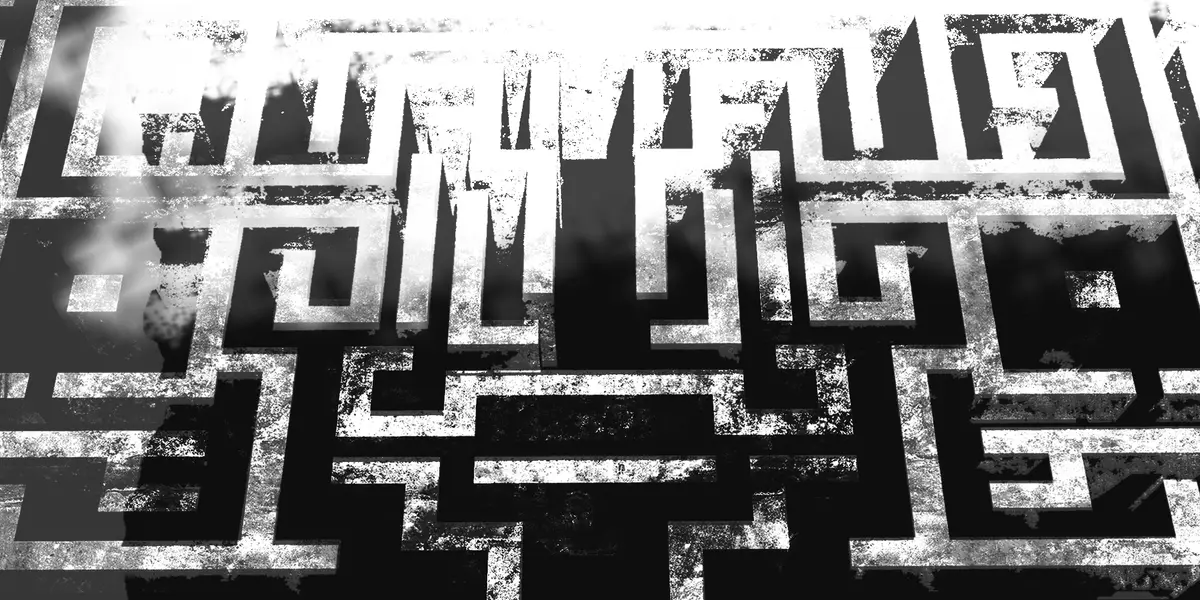
BUREACURACY LABYRINTH
Underground labyrinth | above-ground public square

In today's society, the relationship between individuals and government is a key element of social dynamics. Issues of justice, transparency and citizen participation are becoming increasingly important in the ever-evolving political and social landscape. This context provides a foundation for exploring an architectural approach that aims to design a public pavilion suitable for holding political and social events.
The architecture of traditional public government buildings has contributed to a visible distance between citizens and government, often presenting these structures as symbols of power. This physical and symbolic distance is further increased by the presence of bureaucracy, a significant factor that plays a key role in shaping the dynamics of the relationship between individuals and their government.
BUREAUCRACY
The bureaucratic structure forms the operational flow of government, conducting policies that affect the lives of citizens. With its intricate and often complex organizational structures, it represents a significant obstacle for citizens' participation in political processes. The bureaucratic framework can create a sense of alienation, creating a challenge when engaging an individual in government institutions. The analysis of bureaucratic processes and their influences allows a better insight into the way citizens' participation, government transparency and fairness of political processes are shaped.
THE TRIAL
Franz Kafka, Czech writer of the 20th century, with his literary works goes into the topics of nonsense and absurdity present in social and legal systems, introducing the concept of "Kafkaesque". This term has become crucial for describing situations in which the individual experiences paradoxical and dysfunctional aspects of the bureaucratic structures.
The novel "The Trial" is recognized as a main tool for researching the topic of the bureaucratic process through the term " Kafkaesque ". The focus of the plot is on the individual resistance of the main character, Josef K, towards powerful institutions, raising the issue of justice, guilt and human freedom. The analysis of the novel represents the foundation for the concept of the pavilion.
THE CONCEPT
The pavilion consists of two sections - an underground, bureaucratic labyrinth, and an above-ground public square.
The bureaucratic labyrinth was designed as an underground structure that emphasizes the concept of individuality, while at the same time representing a kind of homage to the complexity and absurdity of bureaucratic procedures.
To the contrary, the above-ground section is designed as a public square, which contrasts with the concept unfolding beneath the surface.
Therefore, the architecture of the pavilion forms a complete concept, combining the openness and transparency of the above-ground area with the enigma of the underground system, thus creating an intriguing and symbolic architectural entirety.
THE PROGRAM
• UNDERGROUND
Examing the chapters in the book identified the key events that shape the (bureaucratic) process that the main character goes through, along with the emotional experiences that accompany his journey. As a result, seven typological entities were defined, which in the form of ernironmental installations will shape the bureaucratic labyrinth encountered by Josef K.
The main chapters / emotional responses / instalation typologies:
1. THE ACCUSATION / shock / sudden entry into the system
2. LIFE DOESN'T CHANGE / illogicality / encounter with unclear and illogical structures
3. THE TRIALL / uncertainty / choosing the next step
4. POTENTIAL PROGRESS / hope / connecton with the above-ground structure
5. INEVITABLE ACCUSATION / impossibility / barrier in achieving a specific goal
6. THE ACCEPTANCE / impossibility of escaping the system
7. THE VERDICT / freedom / overcoming all obstacles and exiting the process
• ABOVE GROUND
The above-ground program is aligned with the metaphor of transparency and openness. In addition to the spacious pedestrian zone, there is a cafe, amphitheater and reading spots. Each element aims to inform users about bureaucratic processes. Through micro-libraries, visitors will be able to get acquainted with books, similar to ‘’The Triall’’, which explore the topic of the complexity of social and legal systems. The amphitheater was designed as a space for holding public debates and presentations in order to reduce the distance between the individual and the government.
ARCHITECTURAL COMPOSITION
• UNDERGROUND
The structure of the labyrinth was designed using the principle of combinatorics. By creating different versions of the emotional sequence, a unit is projected to provide a unique experience at every step. The system of emotions is primarily defined on the horizontal underground plan – the labyrinth strukture is intricated by adding vertical levels. In certain segments, the typological units of "hope", aligning with the symbolism of emotion, emerging to the surface, which connects the above-ground and underground parts of the project.
Access to the pavilion is provided through five entrances, one of which is central, while four are side entrances. The entrances are positioned along the podestrian routes within the park, so visitors cannot anticipate their destination. There is only one exit.
• ABOVE GROUND
As the primary users are pedestrians who come into contact with the pavilion through a walk in Hyde Park, the idea is to project modulated slabs that will direct the visitors journey. The shape of the elements is a symbol of fluidity and freedom, which enhances the contrast between the underground and above-ground units. Certain elements form openings for observing the underground process, while others are designed as a reading spots with a displayed books. The cafe was designed with the intention of connecting the above-ground units of ‘’hope’’ with its position, providing the users of the underground process to encounter everyday activities. The amphitheater is envisioned to be situated below ground level, providing the opportunity to observe certain segments of the labyrinth.
THE PURPOSE
The architecture is designed for users to experience the bureaucratic processes. With its spatial structure and program, the pavilion draws attention to the issues of non-transparency and complexity of legal systems, as well as the distance between the individual and the government. It forms an dialogue with visitors, inviting them to understand the nature of bureaucracy and the impact it has on daily life. Architecture becomes a tool which inspires citizens to ask questions, consider changes in society and actively participate in shaping a better relationship between the people and the government.

Popular Articles
Popular articles from the community


graciastudio Turns a Viewless Tijuana Lot Inward Around a Courtyard of Concrete, Timber and Trees
In Tijuana, Jorge Gracia's GA2 House stacks a timber-clad private floor over exposed concrete and replaces a missing view with a planted interior patio.

FCC Arquitectura Expands a Portuguese Granite House with a Board-Marked Concrete Wing
In Portugal, JV House pairs a cleaned-up whitewashed and granite dwelling with a timber-shuttered concrete extension, courtyards and a garden pool.


Aquadapt: An Underwater Habitat That Rewrites Its Rooms by the Hour
Curved modules ring the seabed while one shell shifts from breakfast room to cinema, farm and football pitch as residents' needs change.

Juan García Correa, John González and Claudia Rueda Sink a Circular Amphitheater into a Manizales Engineering Building
On the La Nubia campus in Manizales, Colombia, the S1 Building folds labs and offices into a hillside of ramped lawns that double as a campus route.

Similar Reads
You might also enjoy these articles
Aquadapt: An Underwater Habitat That Rewrites Its Rooms by the Hour
Curved modules ring the seabed while one shell shifts from breakfast room to cinema, farm and football pitch as residents' needs change.

Play: Fragments of Their World: Remembered Architecture Rebuilt as a Modular Playground for Refugee Camps
Tom Gardner abstracts domes, arches and towers from the homelands of displaced families into a kit of child-scaled play parts for camp settlements.
REBIRTH: A Circular Settlement Where Afghan Widows and Their Children Rebuild Life Together
A shortlisted Resile entry turns the circle into a protective ring of timber and brick, gathering homes, classrooms and gardens around a shared landscape.
The Main Dream: A Recycled Plastic Kit That Lets Refugee Children Build Their Own Playground
Thirty-centimetre interlocking cubes that connect on three axes turn play into construction, letting children author the spaces they occupy.

Explore Urban Layers Competitions
Discover active competitions in this discipline


Challenge to reimagine the Iron Throne

Photograph architecture without architects

Illustrate the lost glory of Angkor Wat - Render Challenge

Design challenge to reuse E-waste
Comments (0)
Please login or sign up to add comments
No comments yet. Be the first to comment!