
Hello Wood's Cabin Fever Turns Czech Parkland Wild
A summer design-build festival in Česká Kamenice produces six experimental pavilions from straw, timber, rope, and fabric on a single clearing.


Every summer, Hello Wood gathers architects, students, and makers for a compressed burst of construction that treats a landscape as both campus and gallery. For 2025, the Hungarian studio's Cabin Fever program planted itself in Česká Kamenice, a small town in the Bohemian Switzerland region of Czechia, where a grassy clearing next to a weathered institutional building became the stage for six pavilions built in roughly two weeks. The results are scattered across the park like a field guide to alternative construction: straw bale walls, tensioned rope canopies, geodesic timber frames, and corrugated metal skins all coexist within walking distance of one another.
What makes the collection worth attention is not any single structure but the range of structural and material ambitions compressed into one site. Each pavilion tests a different thesis about shelter, from the almost primitive insulation of straw to the precise geometry of a faceted timber shell. They are small enough to be prototypes yet resolved enough to be occupied, which is exactly the territory where design-build programs generate their most useful knowledge.
A Landscape of Experiments


Seen from the air, the installations read as a constellation of distinct geometries on an otherwise uniform green field. The drone views reveal how deliberately the pavilions are spaced: far enough apart to give each structure its own territory, close enough together to invite comparison. A yellow fabric canopy sits just uphill from a faceted timber form, while a radial lattice pavilion anchors one corner of the clearing. The surrounding forest frames everything, giving the ensemble the character of a temporary settlement rather than an exhibition.
Siting matters here because the pavilions are not gallery objects. They sit on ground screws and stilts, touching the land lightly enough to be removed when the festival ends. That reversibility is part of the pedagogical point: students learn to build structures that perform structurally and spatially while leaving almost no trace.
The Faceted Timber Pavilion
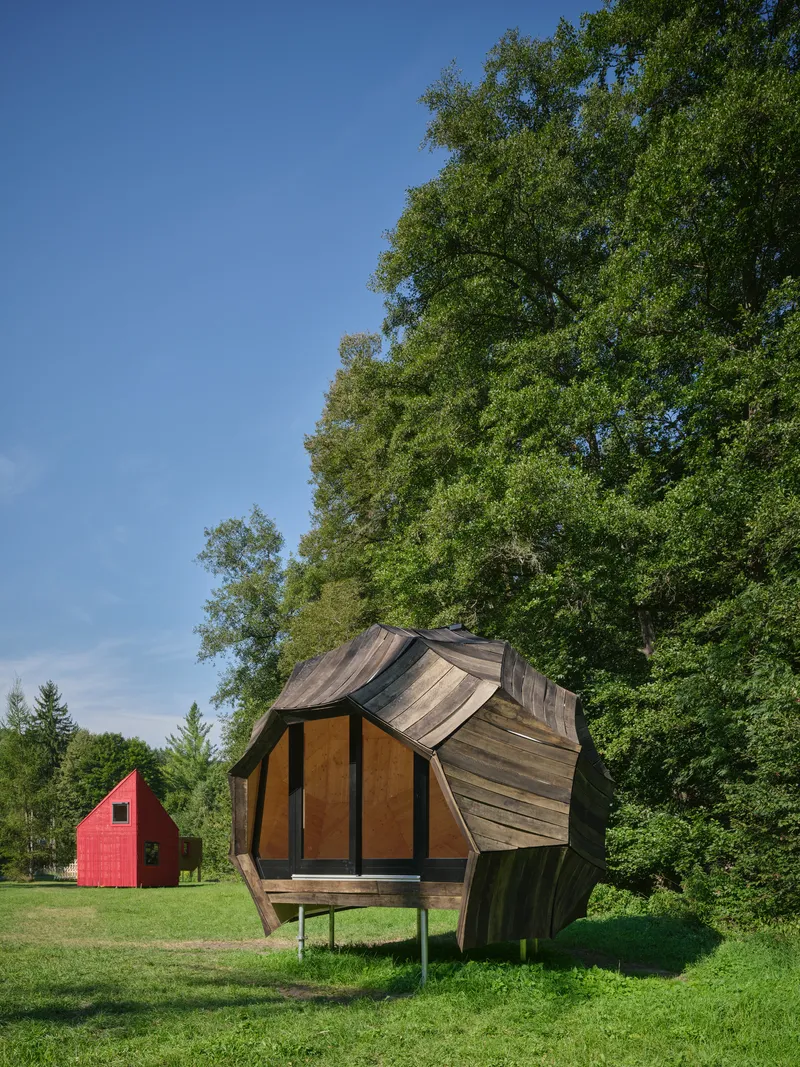

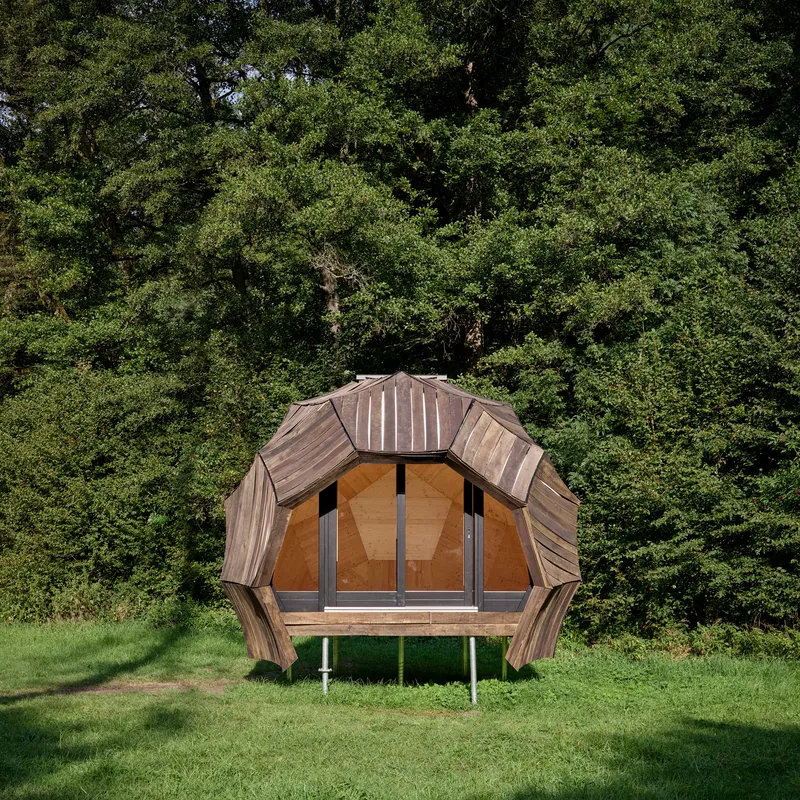
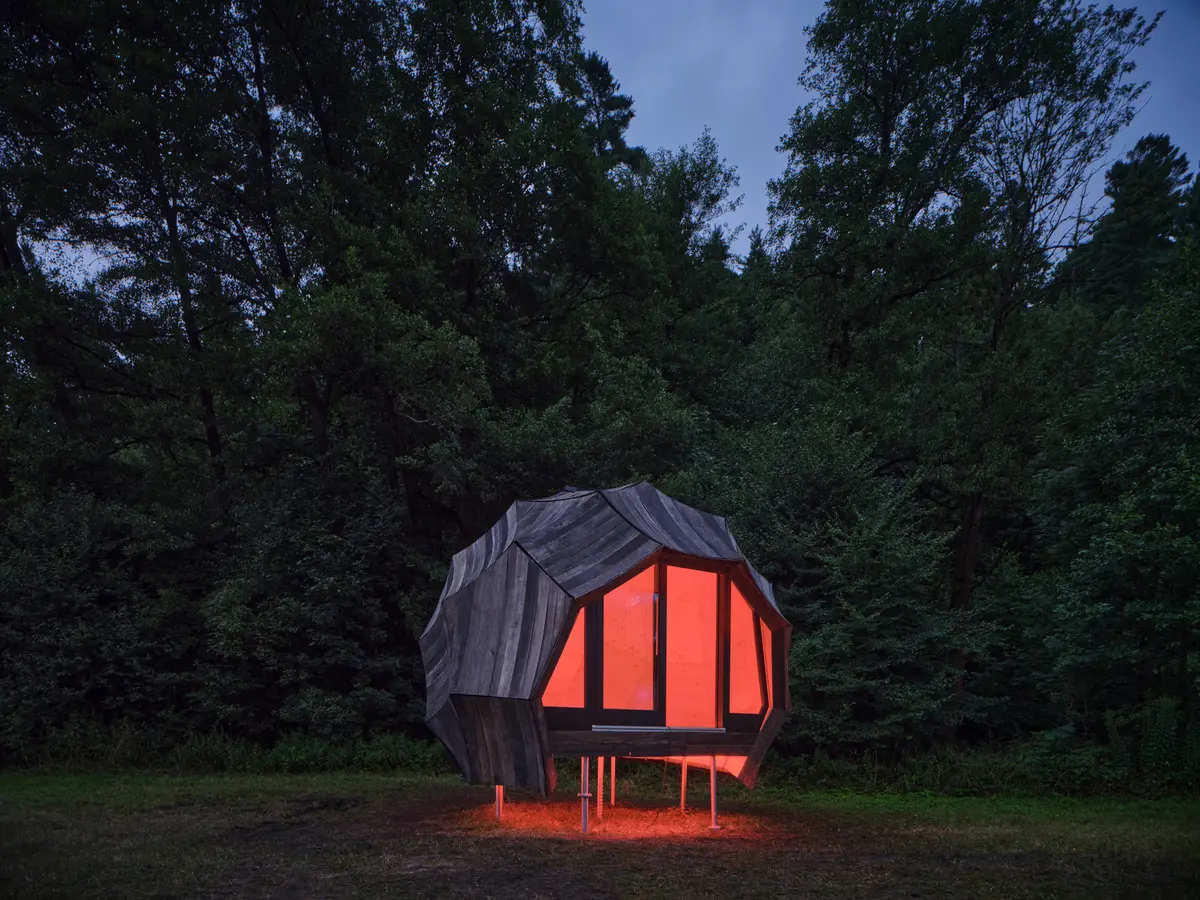
The most resolved piece in the group is a faceted timber cabin lifted on stilts beneath tall deciduous trees. Its angular roof planes fold in multiple directions, meeting a metal standing seam skin that gives the form a sharpness unusual for a student-built project. Plywood door panels close the lower face, while the upper geometry opens toward the canopy. At dusk, the interior glows red through its seams, turning the structure into a lantern that announces habitation without revealing much of the space inside.
The choice to elevate the cabin creates a deliberate threshold. You climb up into it, leaving the meadow behind. That vertical separation, even at a modest height, changes the relationship between occupant and landscape entirely. You are no longer on the ground; you are in the trees.
Straw, Red Stairs, and Thick Walls

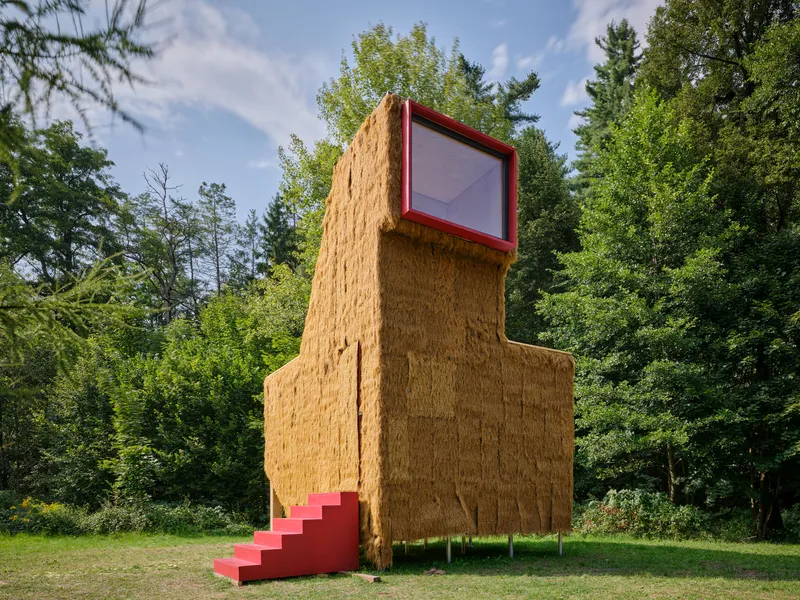

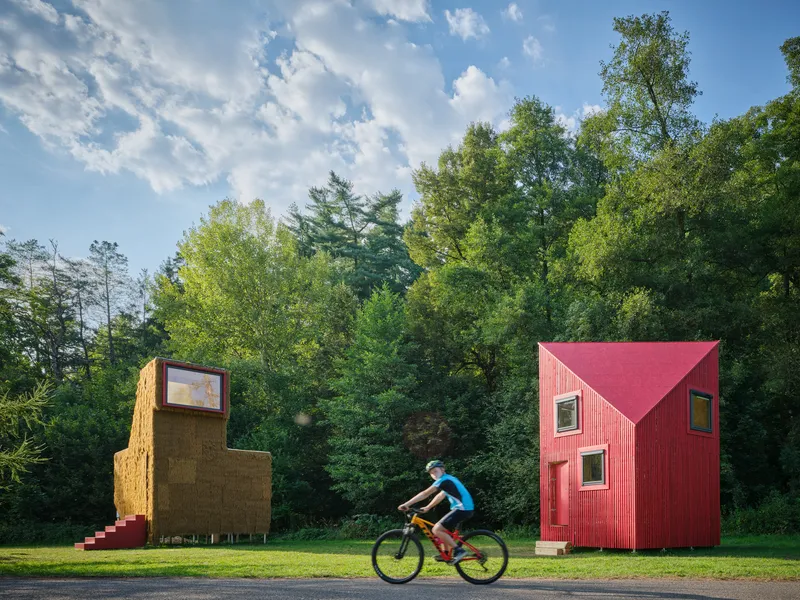
The straw bale pavilion is the most tactile structure on site. Its walls are thick and rough, their surfaces reading almost like geological strata, and a bright red staircase punches up through the mass to reach an upper window. The color contrast is deliberate and effective: the organic warmth of straw against the industrial precision of painted steel. Red window frames punch openings that feel carved rather than cut, reinforcing the sense that this is a building made by hand rather than by machine.
Elevating a straw structure on a platform is a practical decision as much as an aesthetic one. Straw needs to stay dry, and lifting the floor off the ground is the simplest way to manage moisture. But the gesture also turns the pavilion into a lookout, a small inhabited volume that peers back at the adjacent institutional buildings as if questioning their permanence.
Yellow Canopy and Rope Tension
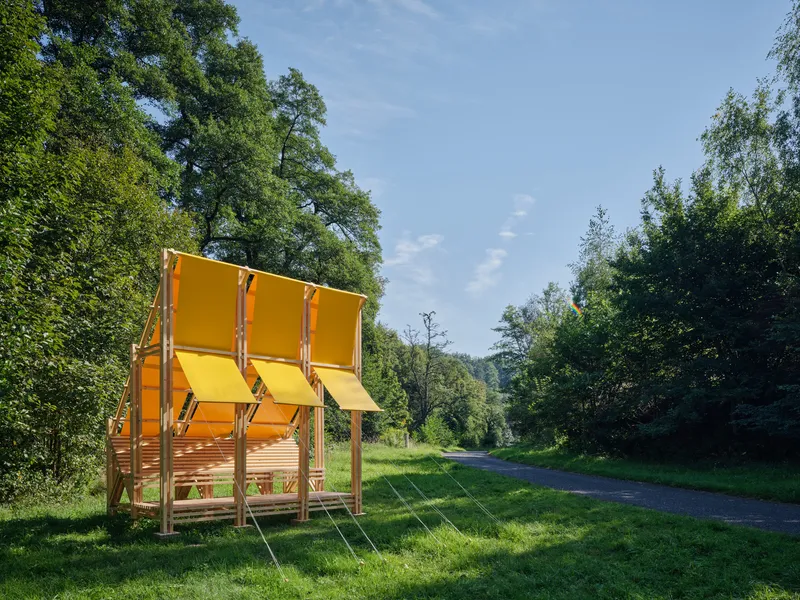


Two of the installations rely on fabric and rope rather than solid enclosure. A yellow canopy stretches over a timber slat base along the road, its form held aloft by a rope suspension system that gives the structure an almost tent-like informality. Nearby, a similar yellow fabric shelters visitors seated on a timber platform in the meadow. These are not cabins in any conventional sense; they are shade structures, social condensers, places where people pause and gather rather than sleep.
The rope tensioning is the technical lesson here. Fabric on its own sags; rope on its own is invisible. Together they produce a surface that is simultaneously structural and atmospheric, filtering sunlight into a warm glow. The simplicity of the system makes it ideal for a design-build context: students can adjust tension in real time, learning how forces flow through a flexible assembly without the unforgiving rigidity of timber joinery.
The Red Cabin and the Lattice Dome
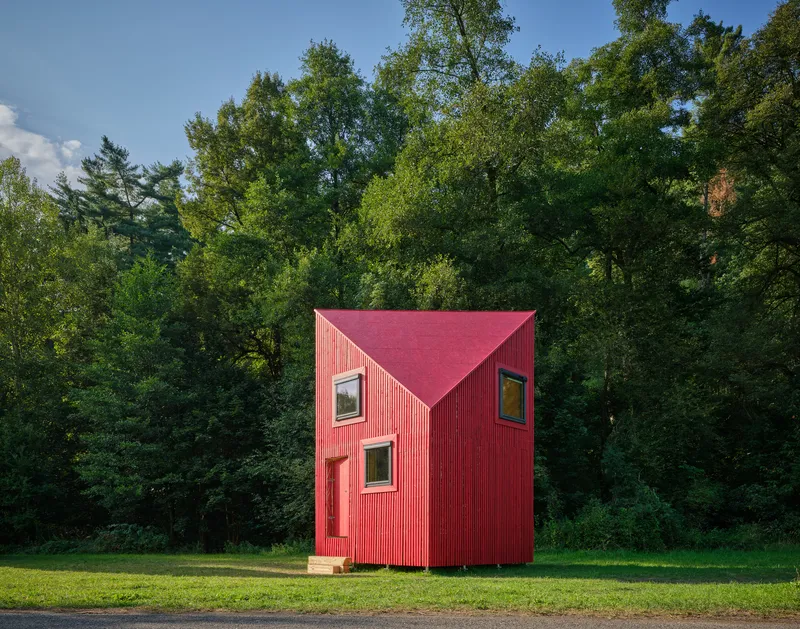


Tucked into a forest clearing, a small red corrugated metal cabin offers the most conventional silhouette in the collection: a gable roof, asymmetrical windows, a single door. Yet its placement among the trees gives it a storybook quality, as if it had always been there. The corrugated skin is honest and cheap, a material that acknowledges its own temporality while still providing real weather protection.
On the other end of the geometric spectrum sits a radial timber pavilion topped with a white lattice canopy. The aerial view reveals its plan as a near-perfect circle, with slender members radiating from a central platform. Two figures standing at its center give the structure scale: it is intimate, perhaps four meters across, but its openness makes it feel far larger. Where the red cabin turns inward, the lattice dome opens outward to sky and landscape.
Fabric, Frame, and In-Between


One installation stretches orange fabric panels across a diagonal timber frame, creating a surface that is neither wall nor roof but something in between. The panels catch the wind, flex slightly, and glow when backlit. It is the least resolved structure on site in terms of enclosure, but it may be the most provocative in terms of what it asks about the minimum conditions for architecture. When does a frame with fabric become a building? The question lingers.
The roadside views show how the pavilions register at pedestrian and cyclist speed: as brief interruptions in an otherwise pastoral landscape. A white slatted timber fence, a flash of straw and yellow canvas, and then the road continues. The installations are generous in that way. They do not demand your attention; they reward it if you choose to stop.
Plans and Drawings
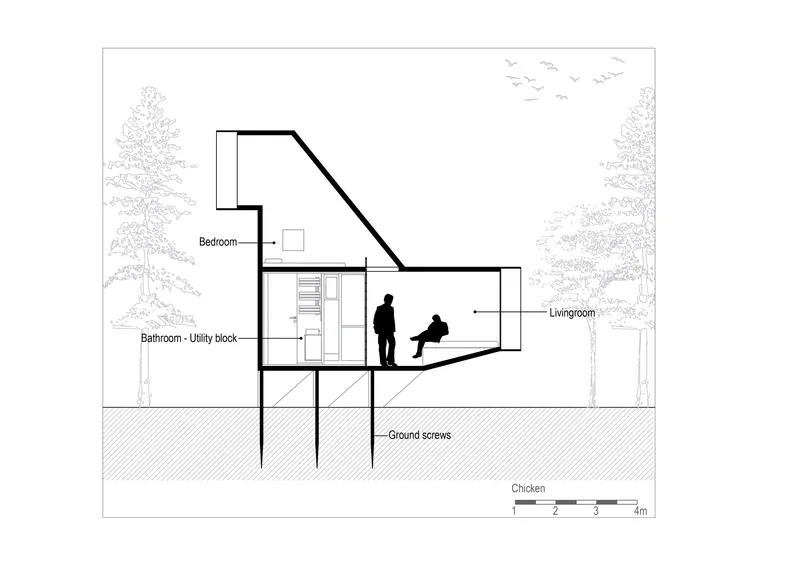


The section drawings reveal the structural logic behind three of the pavilions. The split-level dwelling sits on ground screws with a bedroom above and living space below, a compact vertical organization that maximizes floor area on a minimal footprint. The mirrored twin units use piloti and angled roofs to create two independent volumes that share a structural datum. And the geodesic domes, drawn in section, show how their spherical geometry distributes loads evenly to the stilts below while enclosing a surprising amount of usable volume for their size.
What the drawings make clear is how seriously the structural ambitions were taken. These are not decorative follies; they are small buildings with considered load paths, environmental strategies, and spatial sequences. The human figures included for scale remind us that each structure is designed for occupation, not just observation.
Why This Project Matters
Design-build programs are easy to celebrate in the abstract and difficult to execute well. The risk is always that the results look like student work: earnest but unresolved. Hello Wood's Cabin Fever avoids that trap by giving each team a focused material and structural brief while letting them push the formal outcomes in unexpected directions. The six pavilions in Česká Kamenice are varied enough to sustain genuine comparison, and several of them, the faceted timber cabin and the straw bale structure in particular, achieve a level of craft and spatial presence that would hold up in any professional context.
The broader lesson is about the value of building at speed and at a scale where failure is affordable. Every one of these pavilions taught its team something that could not have been learned from a screen: how straw bales compress under load, how rope tension changes in humidity, how a standing seam roof sheds water at a fold. Those lessons accumulate, and the architects who carry them forward will build better for having started here, on a clearing in Bohemia, with two weeks and a pile of timber.
Cabin Fever 2025 Installations by Hello Wood. Česká Kamenice, Czechia. Completed 2025. Category: Pavilion. Photography by BoysPlayNice, Harvey Cooper, Filip Beranek, and Martin Tuma.
About the Studio
Share Your Own Work on uni.xyz
If projects like this are the kind of work you want to make, uni.xyz is a place to publish your own, find collaborators, and enter design competitions.


Popular Articles
Popular articles from the community


Opera on the Sea: Driftwood Logic Shapes a Timber Opera House on Estonia's Coast
Trevor Orgill's opera house translates the entangled drift of floating timber into a civic building where wood, water, and music converge.
Faces of the Soviet Avant-Garde: Turning Moscow's Street Names into an Open-Air Museum
A network of sculptural installations across a Moscow residential district transforms forgotten architect names into spatial encounters with cultural memor
Temporary Home for Dogs: A Reversed Zoo Rethinks Animal Shelter Architecture
In Bucharest, a sinuous corridor and freed landscape flip the logic of containment, designing a shelter that works to make itself unnecessary.
Extended Shell: Retrofitting Kolkata's Balconies as Living Urban Thresholds
A modular retrofit system recovers the social and environmental intelligence of Kolkata's historic verandas for contemporary Park Street residents.

Similar Reads
You might also enjoy these articles

Pixel Gardens: One Repeated Module Stacked Into a Terraced Social Housing Tower for Famagusta
Salem Bader's shortlisted housing tower builds a vertical neighbourhood from one repeated module, offsetting units to carve terraces, light and air.

Bao Huynh Watercolor Atelier: A Serene Art Retreat in Hội An
Bao Huynh Watercolor Atelier in Hội An blends multifunctional art spaces, sustainable design, local materials, and family-friendly living in a serene environment.

Atelier Macri Concept Store Interior Design by CASE-REAL
Atelier Macri store features a "ko" counter, walnut wood details, cork displays, blending retail, gallery, and seamless customer experiences.

Manuel Vargas Izquierdo Stadium and High-Performance Sports Center: Architectural Excellence in Jalpa de Méndez
The Manuel Vargas Izquierdo Stadium blends sustainable design, inclusive sports facilities, and cultural-inspired architecture, revitalizing Jalpa de Méndez’s public spaces.

Explore Czech Cubism Competitions
Discover active competitions in this discipline

Challenge to design public laboratory

Bring back Drive In's
Comments (0)
Please login or sign up to add comments
No comments yet. Be the first to comment!