
ARCHITECTS OFFICE Turns a Decade-Old São Paulo Home into a Study in Symmetry and Slowness
Caburi House pairs travertine, mahogany panels, and Brazilian modernist furniture across 210 square meters of social space in São Paulo.


After ten years in a residence, most owners have a sharp sense of what works and what doesn't. That clarity is the starting point for Caburi House, a 210 m² interior renovation in São Paulo completed in 2022 by ARCHITECTS OFFICE. Rather than gut the place, the studio reconfigured the social areas around a strict symmetrical logic: matching circulation paths, mirrored material treatments, and furniture arranged to create two parallel zones of activity within a single living room. The result is a home that feels both composed and lived-in, a difficult balance to strike when the design language is this deliberate.
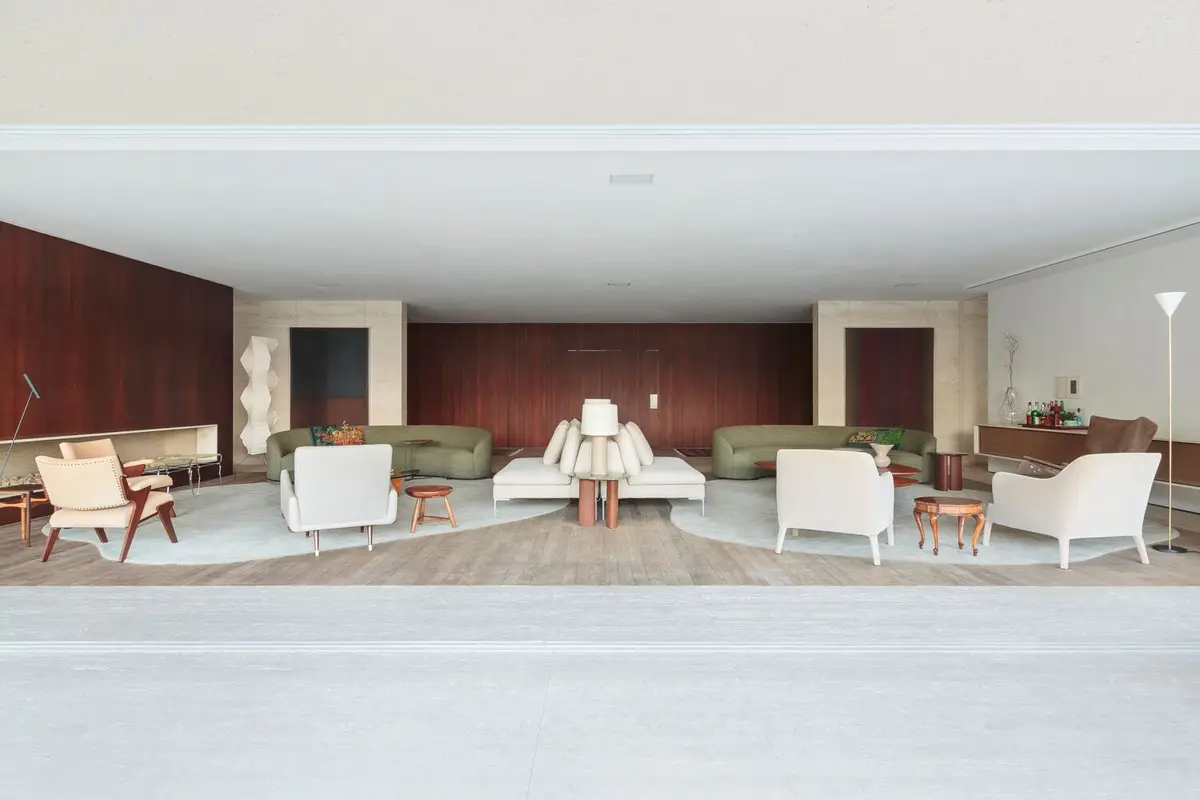
What makes Caburi House worth studying is the way it treats interior design as spatial architecture. The symmetry here is not decorative wallpaper stretched over a loose plan. It is structural: the living room splits into two equal halves, one anchored by a bar on a long straight sideboard, the other by an elongated rectangular fireplace in stone. Two off-white sofas sit back-to-back at the center, forming a soft partition that organizes movement through the room. Every furniture piece, every material transition, every artwork placement serves this underlying geometry. The discipline is quiet, but it holds.
The Living Room as Bilateral Diagram


The living room is the project's core argument. Split into two halves that mirror each other across a central axis, it deploys the back-to-back sofas as both a spatial divider and a social connector. To the right, a long sideboard doubles as a bar. To the left, a stone fireplace with clean rectangular proportions echoes the sideboard's linearity. The effect is one of calm equilibrium: wherever you sit, the room reads as complete.
The wide shot reveals how mahogany wall panels and stone-clad columns reinforce this bilateral logic. The panels are flush and warm, absorbing light rather than bouncing it, while the columns provide vertical punctuation that frames views toward the veranda and pool beyond. The palette stays tight, ranging from cream to brown, and the textures do the talking: smooth travertine, grained wood, soft upholstery. Nothing competes. Everything belongs.
Material Weight and the Travertine Entrance
At the entrance, two travertine marble slabs establish the tonal register for the entire project. An expansive wooden panel softens the threshold, partially obscuring the front door and creating a moment of ambiguity before the main spaces unfold. Paintings by Arcangelo Ianelli hang from steel cables rather than wall-mounted hardware, a detail that protects the marble surface and turns the artwork into a floating element within the composition.
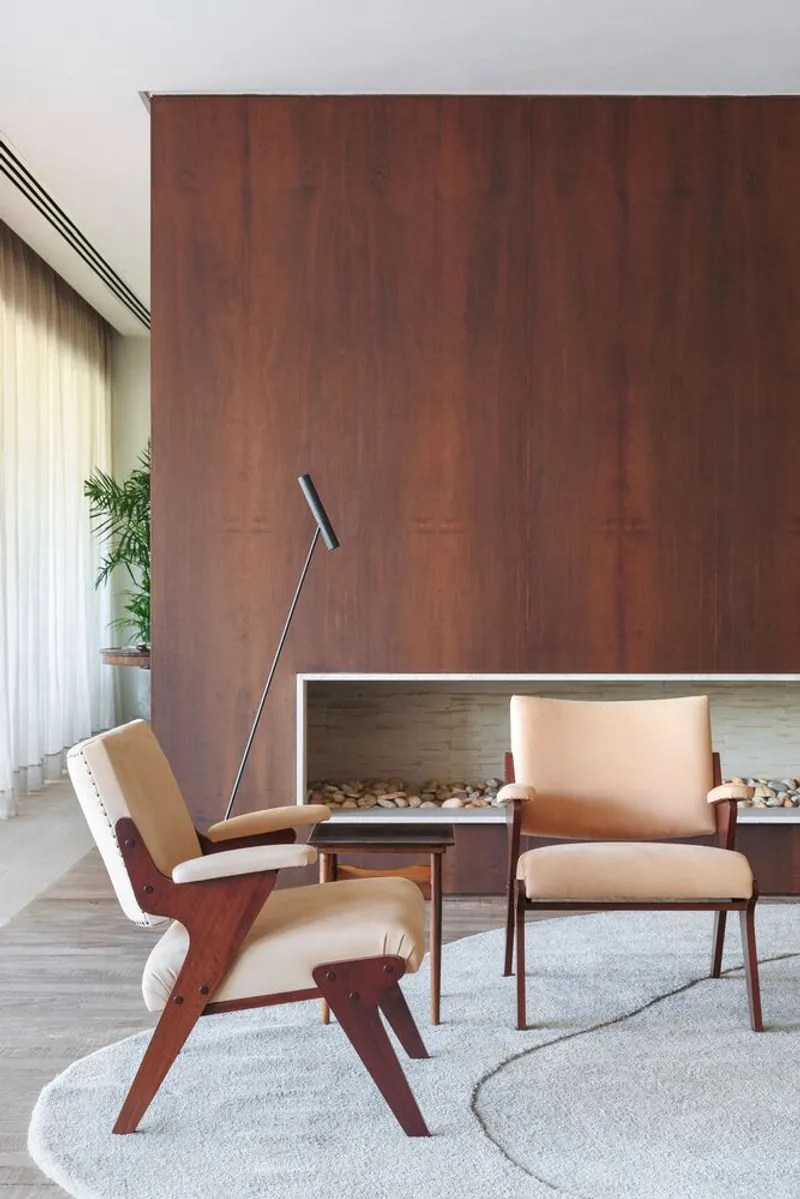
The fireplace wall, visible in the lounge area, continues this material conversation. The recessed niche with illumination carves a sculptural void into the mahogany surface, giving the stone insert room to breathe. Flanking it, a pair of upholstered lounge chairs sit low and wide. The proportions are generous without being wasteful: every element occupies exactly the territory it needs.
Brazilian Modernism as a Living Collection
The furniture selection is where Caburi House reveals its curatorial ambition. Jorge Zalszupin's Paulistana and ZC1 armchairs share the floor with a Sérgio Rodrigues bench and an Akari UF4 33N paper lamp by Isamu Noguchi. These are not trophies lined up on a shelf. They are deployed as working elements of the spatial plan, each piece chosen for its scale, silhouette, and relationship to the symmetrical grid.
The hybrid design language, where mid-century Brazilian pieces coexist with contemporary items and family heirlooms, avoids the sterility that strict symmetry can produce. ARCHITECTS OFFICE understood that a room divided into two identical halves needs variety within its furniture to feel inhabited rather than staged. The organic coffee table in the living room, for instance, breaks the linearity of the layout just enough to remind you that people actually sit here.
Inside and Outside, Held Together
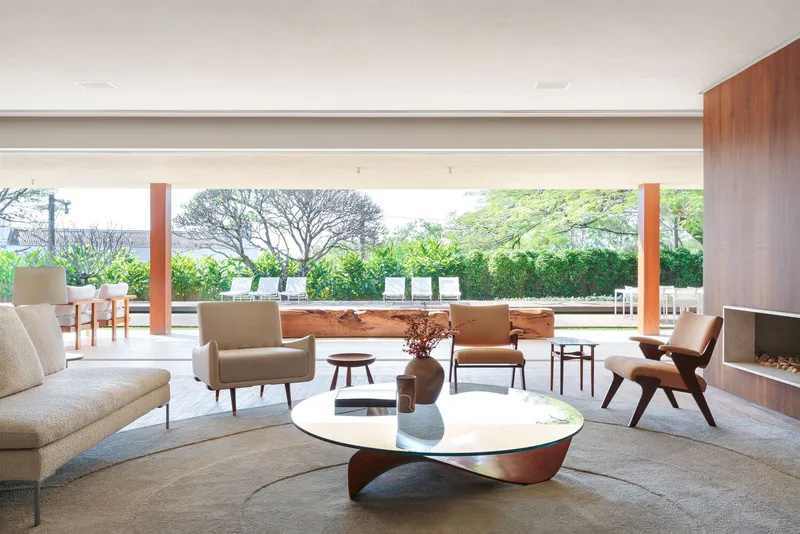
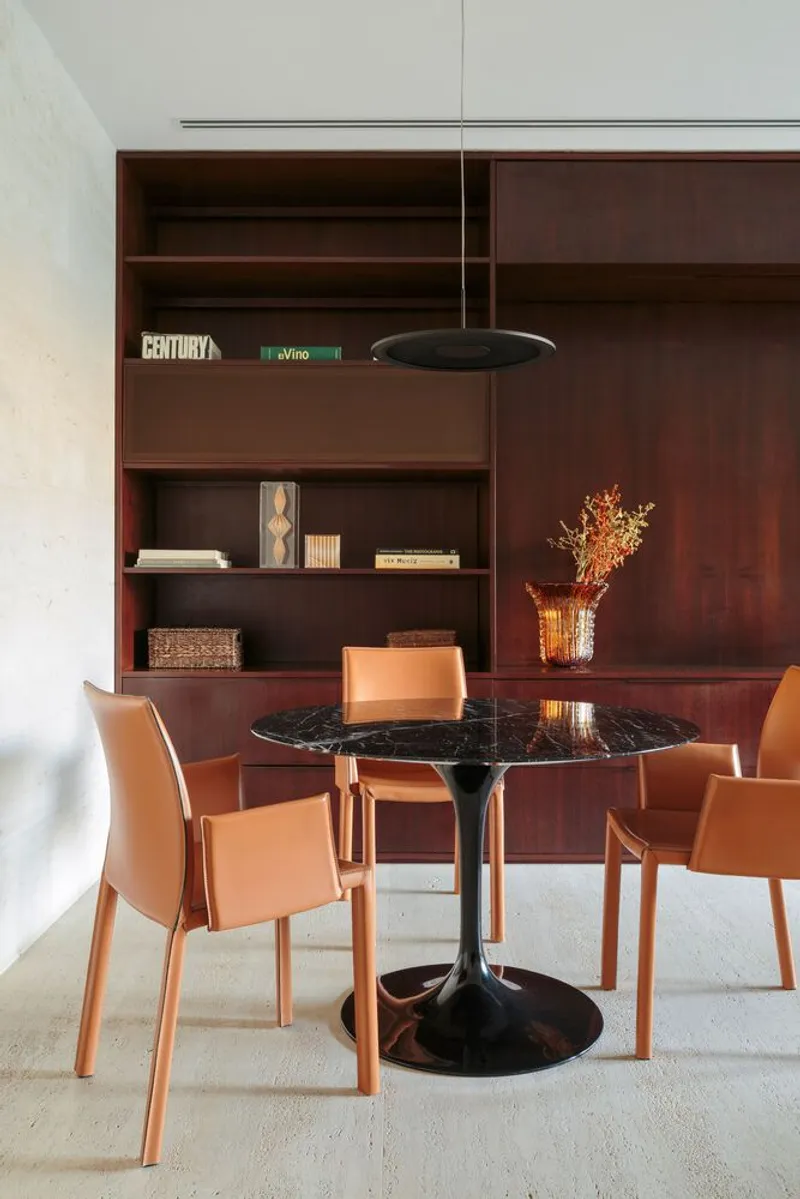
The connection to the veranda and garden is handled with restraint. Timber columns frame views of the pool and mature trees, but the architecture does not dissolve the boundary between inside and out. Instead, it treats the exterior as a backdrop, a framed landscape that enriches the interior without overwhelming it. The dining nook, tucked against built-in mahogany shelving with a black marble tulip table and leather chairs, reinforces this sense of contained intimacy.
For a renovation that focuses exclusively on social areas, the spatial range is impressive. The living room is open and symmetrical, the dining area is compact and enclosed, and the veranda reads as a decompression zone between the two. Each space has its own register of formality, yet the material palette and color logic keep them stitched into a single narrative. Cream, brown, stone, wood: the vocabulary is small, and that is entirely the point.
Why This Project Matters
Caburi House is a reminder that interior design, when practiced with spatial intelligence, can be as rigorous as any ground-up build. The symmetrical plan is not a gimmick. It is a framework that gives every decision, from the placement of a sofa to the hanging method for a painting, a clear reason for existing. In a field where interior renovations often default to mood boards and finishes, this project insists on structure first.
It also demonstrates how to honor a client's existing life within a new design. The owners brought a decade of accumulated furniture, art, and habits to the table. Rather than clearing the slate, ARCHITECTS OFFICE absorbed those elements into a cohesive system. The Zalszupin chairs and the Noguchi lamp are not new purchases styled for a photoshoot; they are inherited presences given fresh spatial logic. That negotiation between memory and geometry is what gives Caburi House its warmth.
Caburi House by ARCHITECTS OFFICE. São Paulo, Brazil. 210 m². Completed 2022. Photography by Felco.
About the Studio
Share Your Own Work on uni.xyz
If projects like this are the kind of work you want to make, uni.xyz is a place to publish your own, find collaborators, and enter design competitions.


Popular Articles
Popular articles from the community

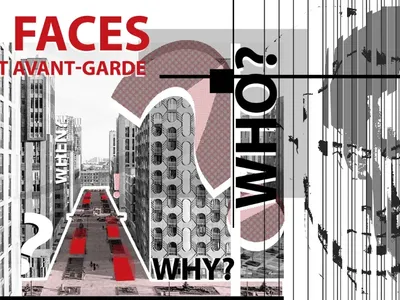
Faces of the Soviet Avant-Garde: Turning Moscow's Street Names into an Open-Air Museum
A network of sculptural installations across a Moscow residential district transforms forgotten architect names into spatial encounters with cultural memor

Singing Woman: An Opera House That Performs Before the Curtain Rises
Ovidiu Cristian Pavel's conceptual opera house translates Estonia's choral identity into a sculpted waterfront landmark facing the Baltic Sea.
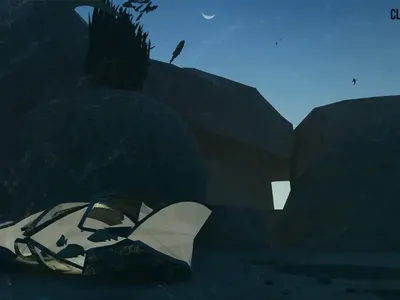
Cloaked Colonization: A Mobile Underwater Habitat That Moves Like a Fish
Micah Abaya's shortlisted EHC Pacific entry reimagines ocean settlement as a dispersed network of self-sustaining architectural organisms.

Opera on the Sea: Driftwood Logic Shapes a Timber Opera House on Estonia's Coast
Trevor Orgill's opera house translates the entangled drift of floating timber into a civic building where wood, water, and music converge.

Similar Reads
You might also enjoy these articles


Hodi-Mandai Geram
Project Function: Preservation and revitalization of the Intangible heritage and socio-spatial identity of the Hodi by Housing, Cultural Memory Center, Sacred Grove, landscape, local tourism economy


Olio Towers: A Mid-Rise for Performers That Fuses Housing, Rehearsal, and Stage
Located blocks from Houston's Theater District, this modular tower stacks living units around a central performance atrium.

Oasis: Modular Green Housing Carved into Dhaka's Urban Fabric
A shortlisted Plugin Housing entry reclaims unauthorized settlements in Dhaka with stepped concrete volumes, green roofs, and ventilation-driven design.

Black Hole: A Floating Megastructure for the Post-Physical Era
Emiliano Mazzarotto envisions a spherical, self-scaling arena where e-sports, digital hotels, and holographic stadiums replace traditional public space.

Explore Brazilian Architecture Competitions
Discover active competitions in this discipline

Challenge to reimagine the Iron Throne

Photograph architecture without architects

Illustrate the lost glory of Angkor Wat - Render Challenge

Design challenge to reuse E-waste
Comments (0)
Please login or sign up to add comments
No comments yet. Be the first to comment!