

Car Park Pavilion
Universal pavilion inspired by japanese culture

Reading greatly improves, intelligence, memory and concentration. Children who are exposed to books from an early age will acquire knowledge faster, have fewer or no learning problems in the future. Reading a book allows the brain to get a kind of workout, stimulating the brain to work.
Regular reading also reduces stress, develops imagination, improves focus and expands vocabulary. Exercising the brain is especially important in old age, it can significantly help people with dementia, Alzheimer's. Therefore, it is very important for everyone to have access to books.
In the Car Park Pavilion project we started our search from the places where people read the least. In this way we wanted to help the community and spread reading to where it is most needed. According to our analysis and research, one of the countries with the highest ratio of low readers is Japan. We have also noticed a trend away from traditional books and back to e-books.
In the reading pavilion, the following zones have been designated: tea room, calligraphy, ceramics, and public gathering place. They are inspired by Japanese culture and diversify the reading space, giving it a new dimension. Nowadays it has been noticed that traditional reading places are transforming and changing their function in order to maintain continuity. Many libraries and reading pavilions have decided to introduce new features to attract readers.
In the cark park pavilion we wanted to emphasize this as well, so in addition to books there are audio books that you can listen to while doing ceramics and calligraphy. A tea room is located in the center of the pavilion as a distinctive element of Japanese culture.
This pavilion is mobile, our idea is to make it move around Japan, more precisely in parking lots. Nowadays, one notices a trend where cars are not so important anymore and one moves away from them. More and more people are using bicycles, public transportation or other means of transportation because cars are not eco-friendly, they pollute the environment. The problem arises with vacant parking spaces that do not serve their purpose. More and more parking lots remain empty, so we wanted to give this space back to the community. We decided to put the pavilion on the parking lots, so we based the module on the width of one parking space, because parking space has its fixed dimension, which allows us to create modules. The pavilion consists of such modules, which makes the transport of the pavilion in Japan easier.
The zones have been designed with square projections that are on different levels, so as to emphasize each zone and its variation. Each zone goes up in order to emphasize its individuality and distinctiveness. The pavilion is composed of modules that are made of wood. We chose this material because of its ease of transport, mobility and foldability with appropriately designed modules. Wood is also an ecological and natural material, additionally it refers to the Japanese architecture, because after folding the modules openwork, fine clearances and characteristic play of shadows are created. For contrast in
For contrast, in each of the zones we introduced wooden, white panels, which organize the elevations and add breath. The remaining free spaces we covered with glass, which protects against rain and wind, weather conditions, and emphasizes the decorative shadows that form inside the pavilion. They make the space even more interesting and inviting.
The furniture in the pavilion is also designed from modules. Tables and shelves are mobile, which allows for transport. Each element has been carefully thought out, everything is consistent, creates a whole. Interior with subdued colors, allows you to focus, meditate and relax while reading. The space is conducive to reading, you can feel relaxed here, rested. Books can also be placed inside the walls of the pavilion, which makes the reading space even more distinctive and characteristic of its function. In the area where the tea room is located, readers can sit on comfortable pouffes, which will make their time more pleasant. Tea will allow them to relax and unwind, they can take it with them and taste the traditional Japanese tea in any place of the pavilion.
The pavilion's design will undoubtedly attract new readers, which may result in the development of reading in Japan. The project also provides a solution for people who are tired of the traditional way of reading books, and we have made sure that there is something for everyone, so the pavilion also has audiobooks. You can read in many ways, just one of the forms of reading is listening to audiobooks, which you can listen to while doing ceramics and calligraphy. Ceramics and calligraphy are inseparable elements of Japanese culture, thanks to which listening to audio books can also be spread. There is something for everyone at the pavilion. Certainly, a visit to the pavilion will be memorable, and readers will be eager to return there.
We wanted to obtain a simple, functional block, which will be universal, at the same time its form will also refer to Japanese architecture, because we believe that these features can harmonise and intertwine.
Books are the easiest way to learn, develop, access to advice, tips. A good book is a great way to relax, be entertained and broaden your mind. Studies have shown that it is reading that can act as a relaxant. Researchers prove that reading reduces stress by up to 69 percent. They also claim that it does not matter what book we reach for, it is important to get completely engrossed in it. It will allow us to escape from our worries, allowing us to be drawn into the author's world of vision and imagination.

Popular Articles
Popular articles from the community


Temporary Home for Dogs: A Reversed Zoo Rethinks Animal Shelter Architecture
In Bucharest, a sinuous corridor and freed landscape flip the logic of containment, designing a shelter that works to make itself unnecessary.

Opera on the Sea: Driftwood Logic Shapes a Timber Opera House on Estonia's Coast
Trevor Orgill's opera house translates the entangled drift of floating timber into a civic building where wood, water, and music converge.
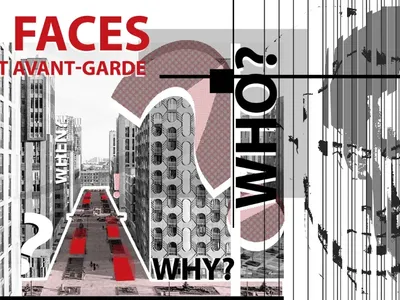
Faces of the Soviet Avant-Garde: Turning Moscow's Street Names into an Open-Air Museum
A network of sculptural installations across a Moscow residential district transforms forgotten architect names into spatial encounters with cultural memor

Singing Woman: An Opera House That Performs Before the Curtain Rises
Ovidiu Cristian Pavel's conceptual opera house translates Estonia's choral identity into a sculpted waterfront landmark facing the Baltic Sea.

Similar Reads
You might also enjoy these articles

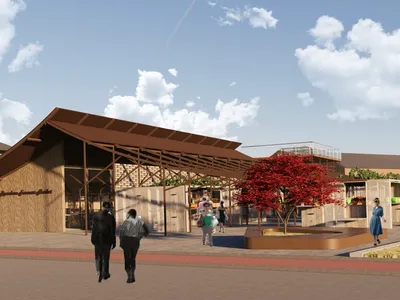
The Rhythm of Seasons
A Farmers' Market Connecting Nature and the City

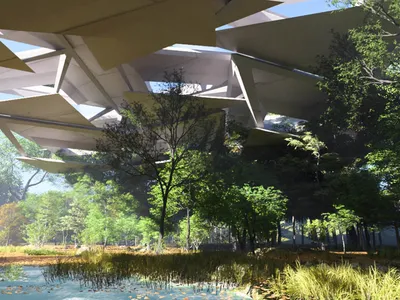


More Than a Building-Designing a Living System
More Than a Building-Designing a Living System
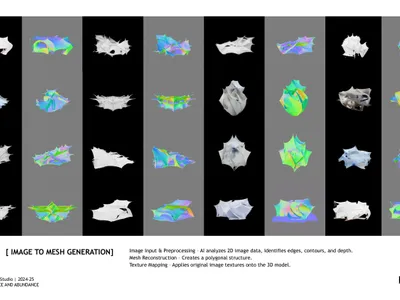
Base Beyond
DESERT COMPOUND ARID: TOURISM OF ABSENCE AND ABUNDANCE

Explore Pavilion Competitions
Discover active competitions in this discipline


Challenge to reimagine the Iron Throne

Photograph architecture without architects

Illustrate the lost glory of Angkor Wat - Render Challenge

Design challenge to reuse E-waste
Comments (0)
Please login or sign up to add comments
No comments yet. Be the first to comment!