
Cart-Home: A Mobile Shelter That Reclaims the Street for Those Who Need It Most
Foldable, upcycled, and wheel-mounted, this emergency dwelling turns informal street behaviors into dignified architecture for the displaced.


What if architecture could be pushed down the sidewalk? The Cart-Home collapses the distinction between furniture, shelter, and livelihood into a single wheeled device that a person can build, fold, and roll through the city. It is not a building in any conventional sense. It is a mobile spatial system constructed from recycled wood, jute, tarpaulin, and bicycle wheels, designed so that the most vulnerable people in a city can carry their home and their workspace with them.
Designed by Kruti Shah and Sebastian, the Cart-Home received an Honorable Mention in Urbanscape 2018. The project was prototyped and tested in Ahmedabad, India, a city where pedestrian vulnerability, inadequate footpaths, informal vending, and homelessness converge into a daily crisis. Rather than proposing a new building type, the designers synthesized pre-existing street behaviors (vending carts, mobile stalls, improvised shade structures) into one adaptable device that operates as a public good with decentralized administration.
Modularity Drawn from the Logic of the Street


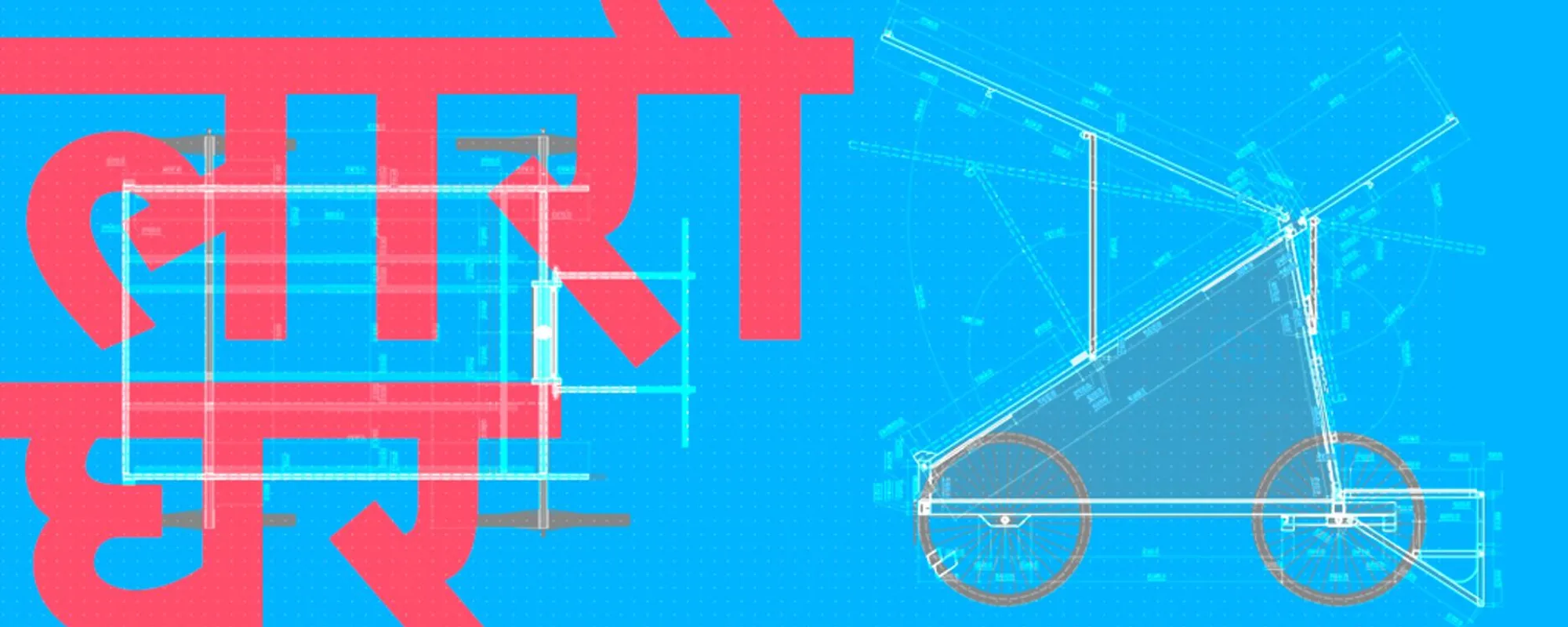
The assembly diagrams reveal how the Cart-Home moves from flat-packed components to a fully operational shelter through a clear sequence of modular configurations. Circular detail views isolate each joint and folding mechanism, showing how surfaces transform into worktables, canopies, or enclosed sleeping areas depending on the time of day and the user's needs. The axonometric drawing of the deployed cart confirms the spatial result: a wheeled unit with an integrated canopy and seating that occupies no more space than a typical vending stall, yet provides emergency shelter, a shaded workspace, and a place to rest.
What matters here is the source of the design logic. Shah and Sebastian did not impose a prefabricated housing typology onto the street. They observed how informal vendors and homeless populations already appropriate leftover urban space, then gave those behaviors a more durable, dignified form. The foldable surfaces expand the cart's footprint for vending or community interaction, then collapse back for transport. It is architecture that respects the rhythms of the people it serves.
Upcycled Materials, Do-It-Yourself Construction
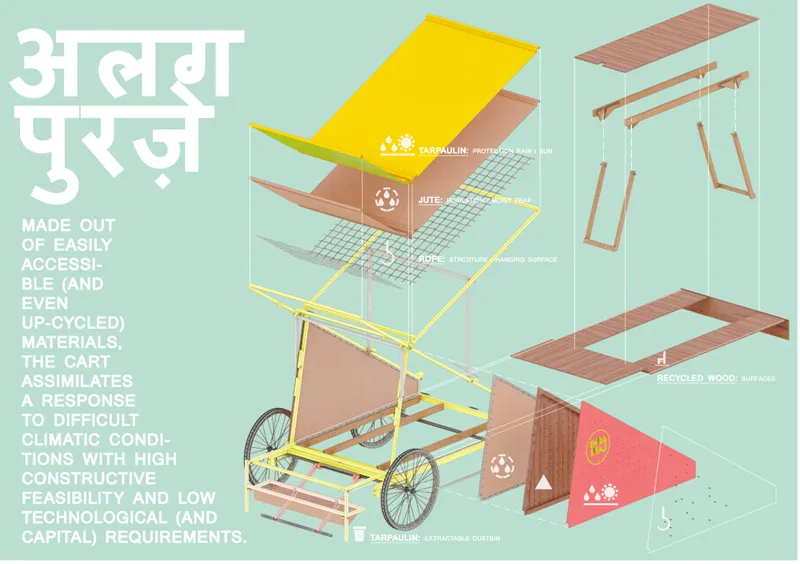
The exploded axonometric is the most telling drawing in the set. Each layer of the cart is labeled with its material: recycled wood for the structural frame, jute and tarpaulin for enclosure and weather protection, bicycle wheels for mobility. These are not exotic specifications. They are materials already circulating in the informal economies of cities like Ahmedabad, available at low cost or through salvage. The designers deliberately chose simple fabrication techniques so the Cart-Home can be replicated within communities through do-it-yourself construction, without specialized tools or professional labor.
This commitment to material reutilization aligns the project with circular economy principles. Low energy consumption during fabrication, combined with the upcycled material palette, gives the Cart-Home a minimal ecological footprint. But the real sustainability argument is social: if a displaced person can build their own shelter from locally available materials, the dependency on centralized housing systems drops dramatically.
A Cycle of Use That Shifts Throughout the Day
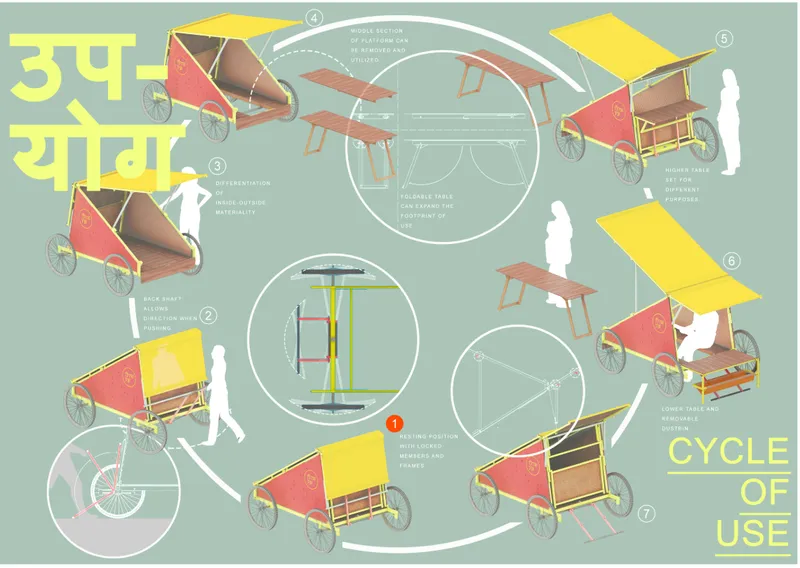
The configuration diagram maps the Cart-Home's cycle of use across different moments. Detail callouts show how the same components convert from a closed sleeping unit at night to an open vending surface during the day, with intermediate states for resting, cooking, or storing goods. A movable dustbin and solar-powered features add self-sufficiency, allowing the user to operate independently of municipal infrastructure. The design differentiates between inside and outside materiality, giving the enclosed shelter a distinct quality from the outward-facing work surface.
This temporal flexibility is what elevates the Cart-Home beyond emergency shelter. It functions as ephemeral architecture, a flexible urban furniture system that adapts to contingencies rather than demanding permanence. The user is not locked into a single mode of inhabitation. They negotiate with the city on their own terms, folding and unfolding space as circumstances require.
Transforming Leftover Spaces into Zones of Exchange
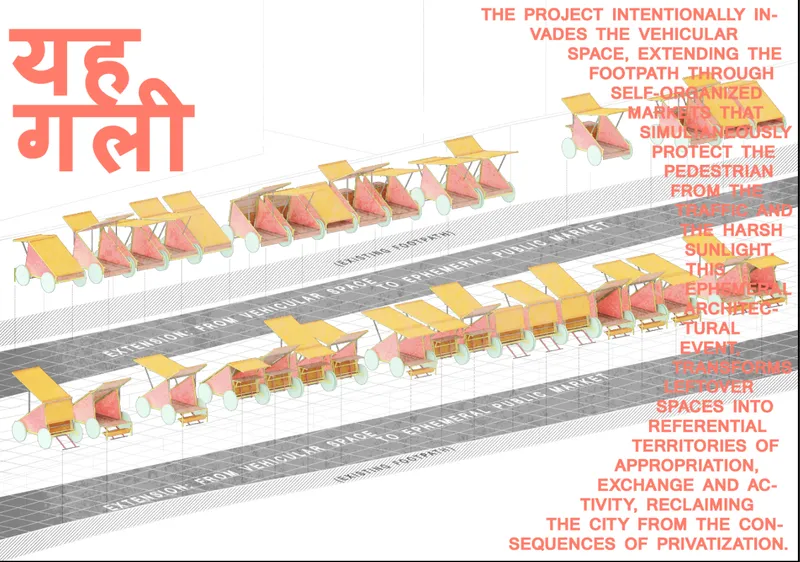
The aerial view drawing shows the Cart-Home at urban scale: multiple units arranged along both sides of a street, creating an ephemeral public market. Pedestrian figures move between the carts, which extend the effective width of the footpath and generate shaded zones that shield people from harsh climates and vehicular dangers. Neglected street edges become active frontages. The drawing makes a spatial argument that is hard to ignore: a few dozen lightweight, movable carts can reclaim leftover space and produce a vibrant corridor of commerce and social interaction without a single permanent structure.
Tested in Ahmedabad's urban fabric, this street-scale deployment demonstrated how Cart-Home challenges privatization trends by promoting self-organized markets and inclusive public space. The intervention does not wait for policy changes or large capital investments. It works now, with what exists, for the people who are already there.
Why This Project Matters
The Cart-Home takes a position that most architecture avoids: it accepts that some people live on the street, and it designs for that reality with care and rigor rather than looking away. By grounding its material choices in local availability, its formal logic in observed street behaviors, and its deployment strategy in the actual conditions of Ahmedabad, the project avoids the trap of speculative humanitarianism. It offers a replicable, buildable device that gives displaced individuals agency over their own spatial conditions.
Shah and Sebastian's work reflects a growing movement among young designers who treat resilience and equity as core architectural problems, not peripheral concerns. The Cart-Home is small, inexpensive, and impermanent. It is also a pointed critique of cities that invest billions in skylines while failing to provide safe ground-level space for their most vulnerable residents. Architecture does not always need foundations. Sometimes it needs wheels.
View the Full Project
About the Designers
Designers: Kruti Shah, Sebastian
Enter a Design Competition on uni.xyz
uni.xyz runs architecture and design competitions year-round that reward proposals with spatial conviction and real site intelligence.
Project credits: The Cart-Home by Kruti Shah, Sebastian Urbanscape 2018 (uni.xyz).



Popular Articles
Popular articles from the community


Riyadh For All: Intergenerational Urban Design for Active Aging in Rabat
Riyadh For All reimagines urban design in Rabat with intergenerational co-living, adaptive courtyards, and Moroccan cultural exchange today.

Co-Life: Senior Housing Design That Reconnects Older Adults With the City
Co-Life reimagines senior housing design through healing gardens, shared streets, workshops, and a sustainable community across generations.

Conexión: Biophilic Design Reimagines High-Rise Living in Hong Kong
Conexión reimagines high-rise living in Hong Kong through biophilic design, green facades, shared spaces, daylight, water and nature within.

Lunar Spiral: Space Architecture Shaped by the Mathematics of the Universe
Lunar Spiral reimagines space architecture through Fibonacci geometry, lunar regolith, levitating habitats, and self-sustaining Moon living.

Similar Reads
You might also enjoy these articles
Lunar Spiral: Space Architecture Shaped by the Mathematics of the Universe
Lunar Spiral reimagines space architecture through Fibonacci geometry, lunar regolith, levitating habitats, and self-sustaining Moon living.
The Main Dream: Modular Architecture for Play, Learning, and Community
A modular playground turns recycled plastic into adaptable spaces where refugee children can play, build, learn, and reconnect.

Play: Fragments of Their World
Familiar architecture becomes modular playground design, creating safe spaces where displaced children can learn, connect, imagine and play.

Wadi Rum Observatory: Desert Architecture Designed for the Night Sky
Wadi Rum Observatory turns desert architecture into a quiet instrument for astronomy, hiding research spaces under Jordan's starlit terrain.


Comments (0)
Please login or sign up to add comments
No comments yet. Be the first to comment!