
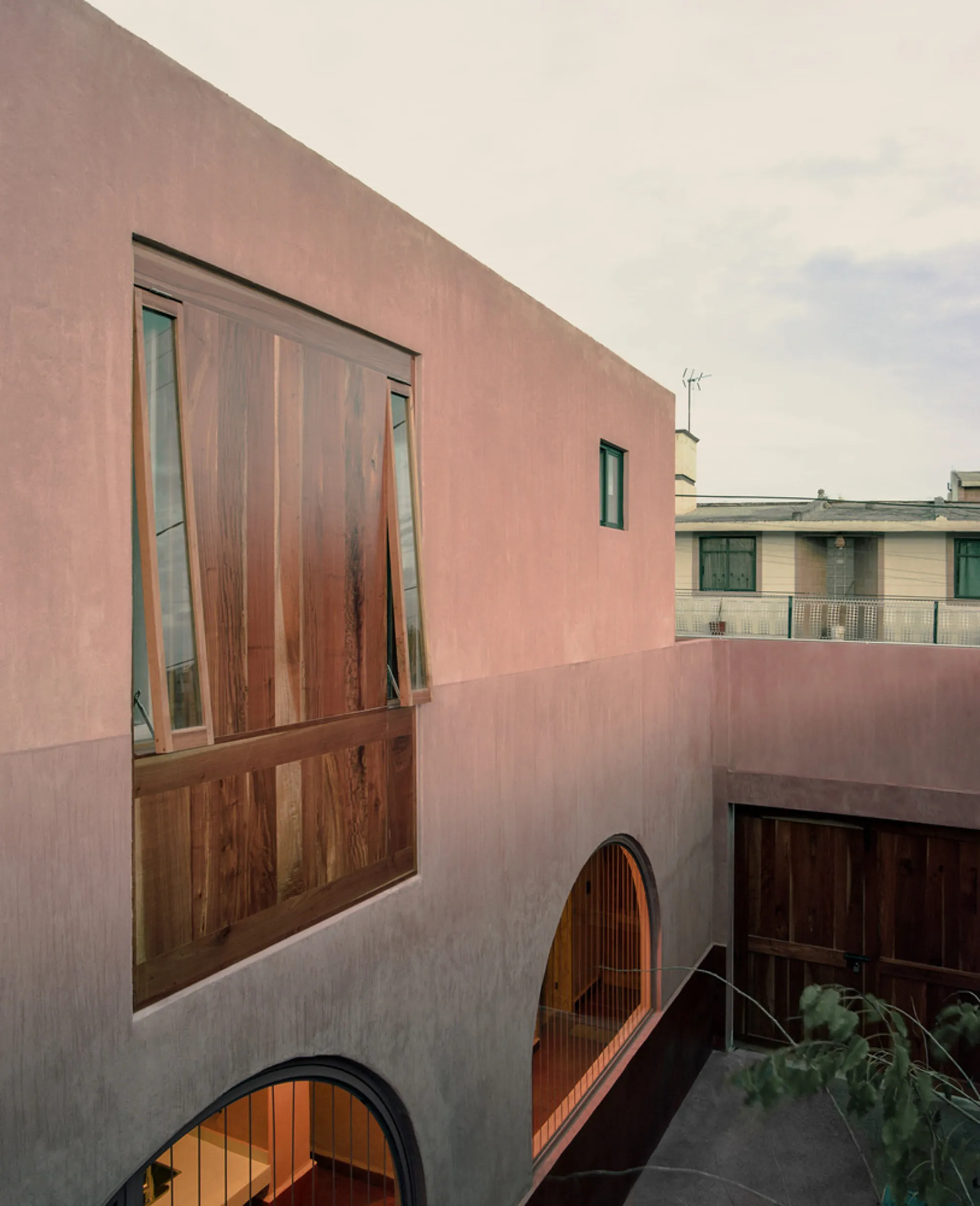
o.d.e. Builds a Pink Stone Retirement Home Around Two Courtyards in Hidalgo, Mexico
Casa Zempoala channels the region's quarried pink stone and colonial aqueduct arches into a bioclimatic refuge for a retired couple.


Retirement houses rarely get this much architectural attention. Casa Zempoala, completed in 2024 by o.d.e. (Oficina Documental de Espacio) in Zempoala, Hidalgo, is a 189 square meter home for an older couple that refuses to treat aging as a reason to simplify. Instead, it doubles down on spatial richness: two planted courtyards, arched openings borrowed from the 16th-century Padre Tembleque aqueduct, and a material palette pulled directly from nearby quarries. The result is a house that feels both deeply rooted in its town and quietly sophisticated.
What makes the project genuinely interesting is how it balances two competing demands. On one hand, it needs to be a single-story home with accessible daily living on the ground floor. On the other, it wants to host family, accommodate guests upstairs, and perform as a social hub organized around open-air rooms. The architects, led by Andrés Guzmán Chávez, Rafael Jaime Barbato, and Alejandro Gutiérrez Robles, solved this by treating the courtyards not as leftover voids but as the primary organizing elements, placing every room in dialogue with planted, sky-lit outdoor space.
A Pink Facade That Belongs to Its Street
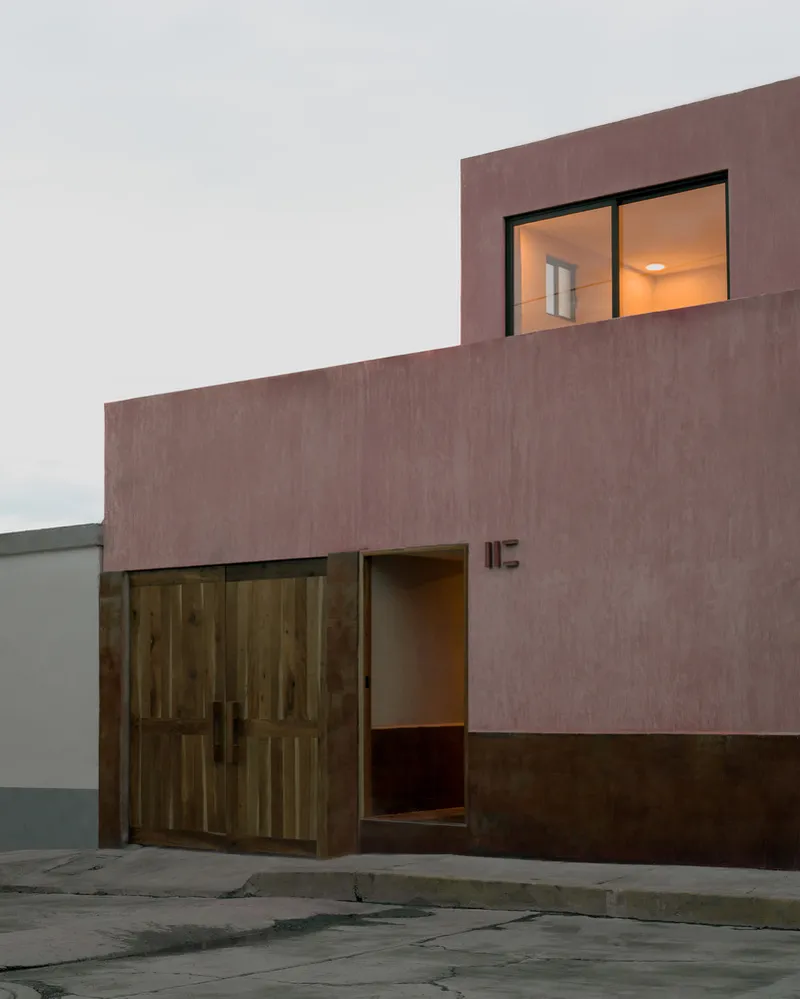
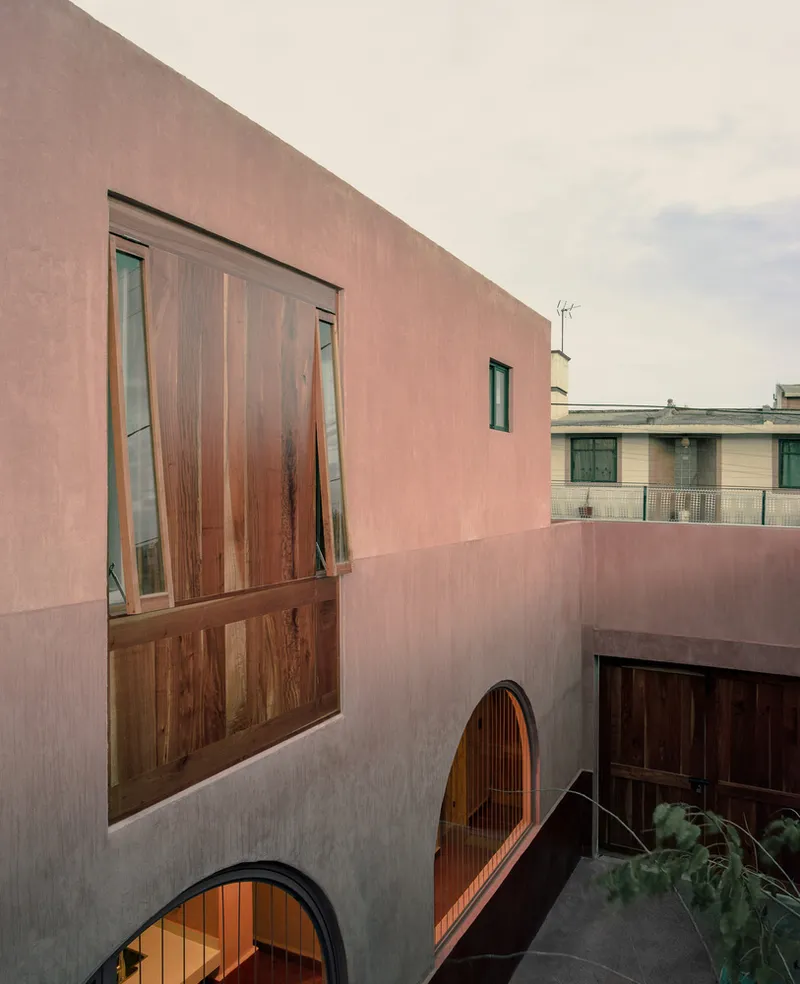
The street elevation is restrained and neighborly. Textured pink render wraps a compact volume that matches the heights and proportions of adjacent buildings, avoiding the trap of standing out for its own sake. A timber door at grade and a single illuminated window above give the facade a domestic warmth at dusk that reads more like a well-kept village house than a designed object. The rosy tone is not arbitrary: it comes from the pink stone quarried in surrounding hills, a material that has colored the architecture of this region for centuries.
Vertical slat screens appear at key openings, modulating light and privacy without heavy curtains or shutters. These timber elements, paired with the monolithic pink walls, create a layered reading of the facade: solid masonry punctuated by warm, breathable wood. It is a simple move, but one that keeps the house from feeling fortress-like despite its protective orientation against prevailing winds.
Courtyards as Rooms Without Ceilings
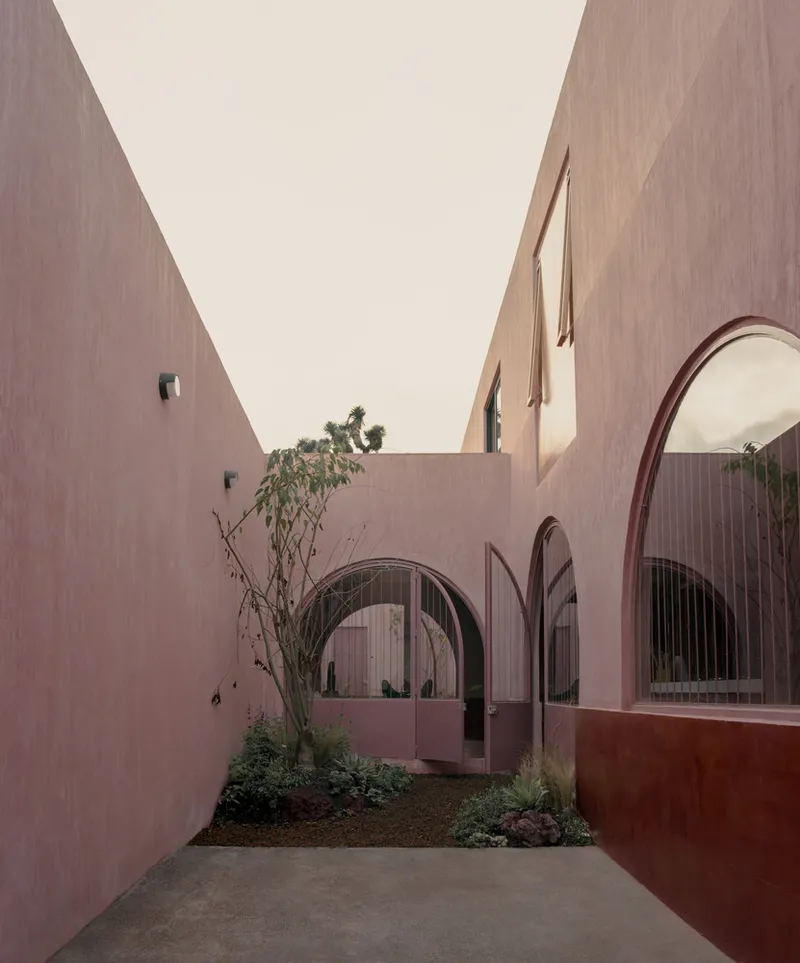
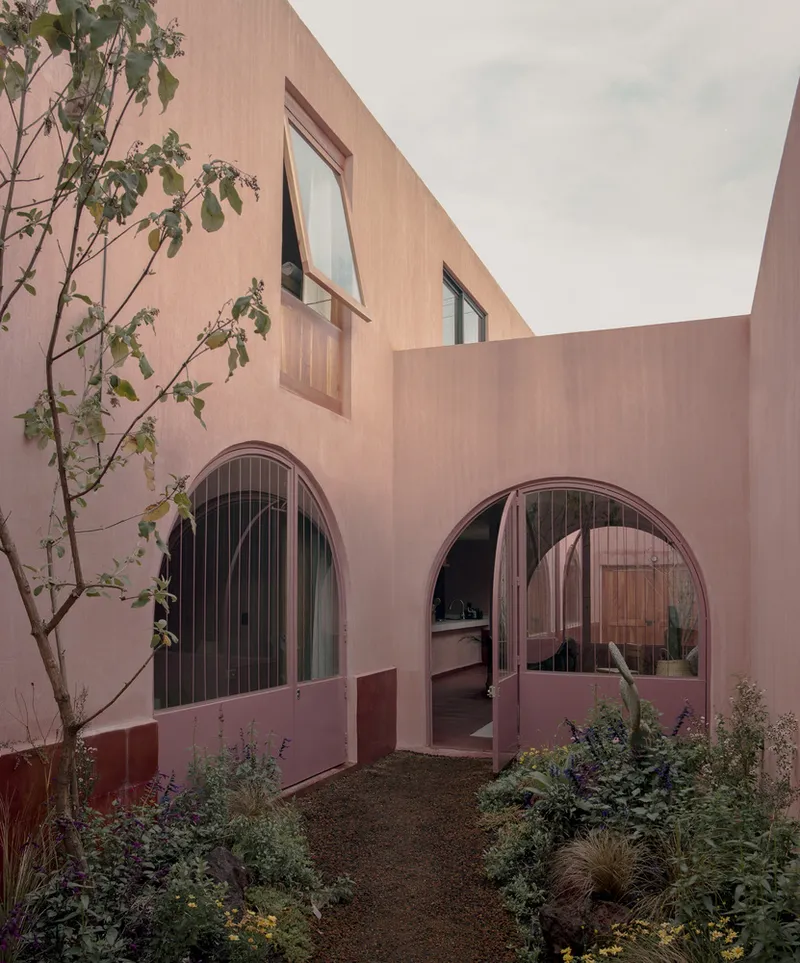
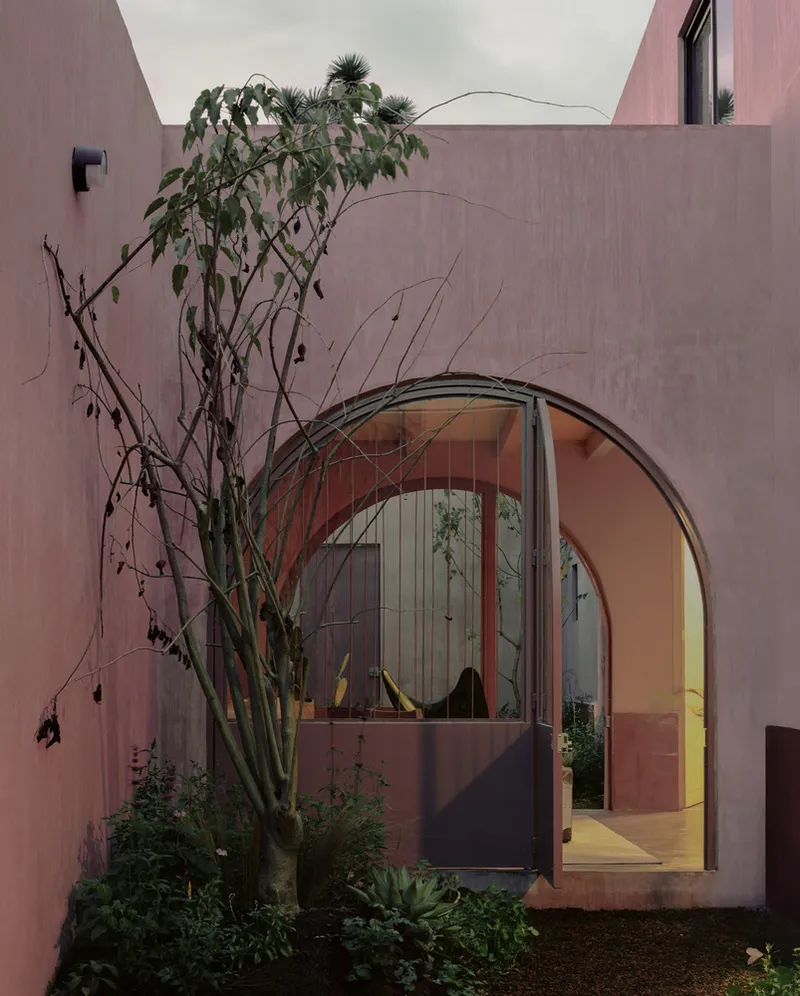
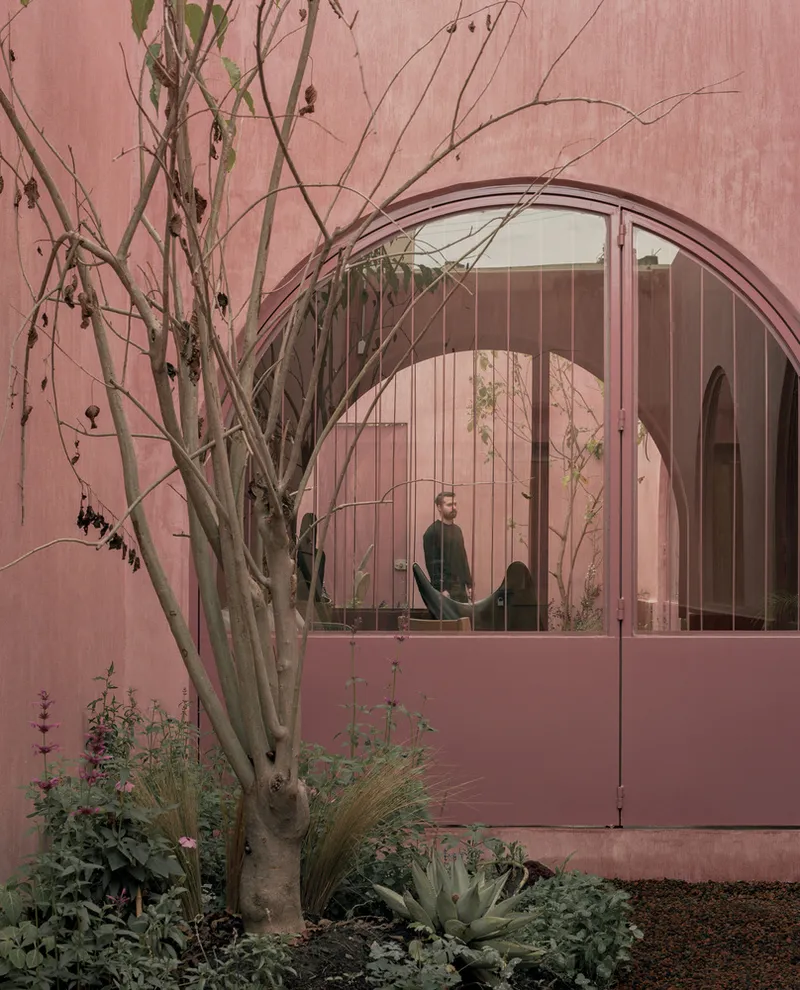
The two interior courtyards are the real protagonists here. Ringed by arched openings and glazed walls, they pull daylight deep into the plan while creating outdoor rooms that serve different moods. One is tighter, almost cloister-like, with a single tree and low planting against pink walls. The other opens up more generously, framed by larger arches and a planted bed of native species selected by landscape designer Gabriel Guízar for low maintenance and sensory impact: textures, colors, fragrances.
The arches deserve attention. They are clearly referencing the Padre Tembleque aqueduct, a UNESCO-listed hydraulic system built in the 1500s just kilometers away. But the architects avoid pastiche by keeping the arches clean and unornamented, using them as structural and spatial gestures rather than decorative appliqué. Glazed infill behind the arches lets the boundary between inside and outside dissolve when doors are opened, turning the courtyards into extensions of the living and dining areas.
Ground Floor Living, Upstairs Gathering
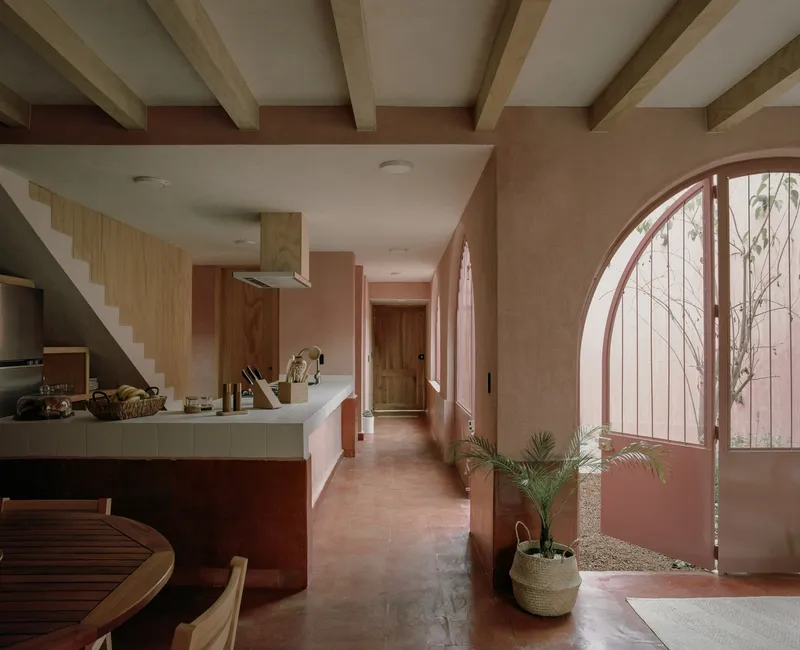
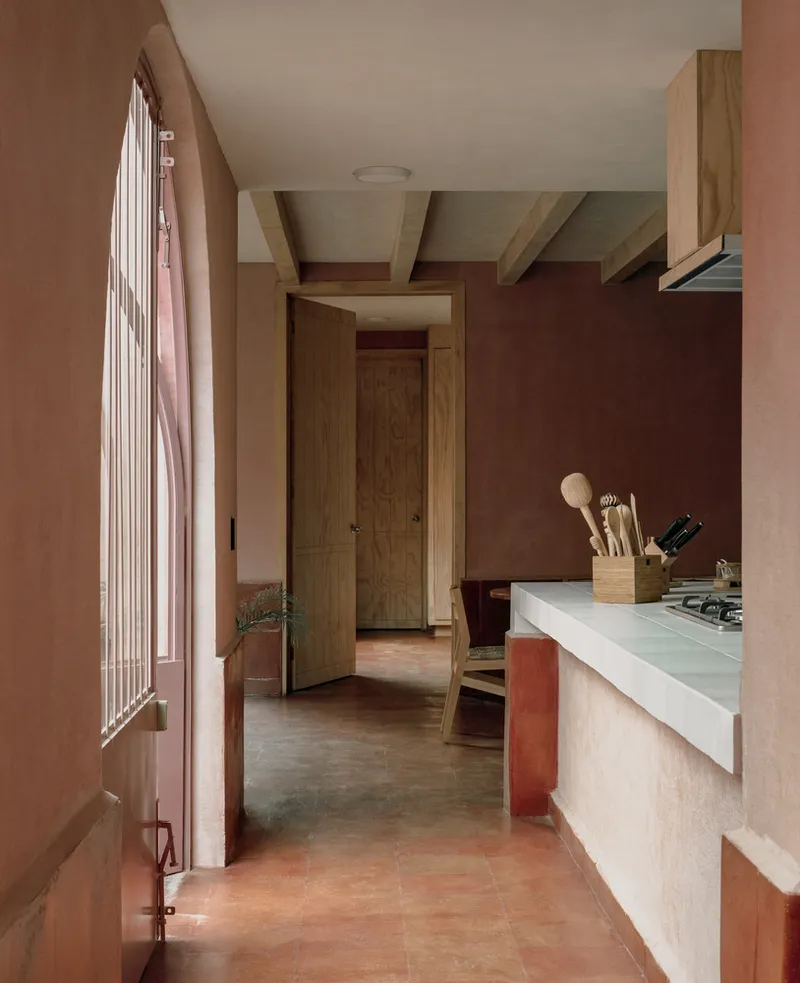
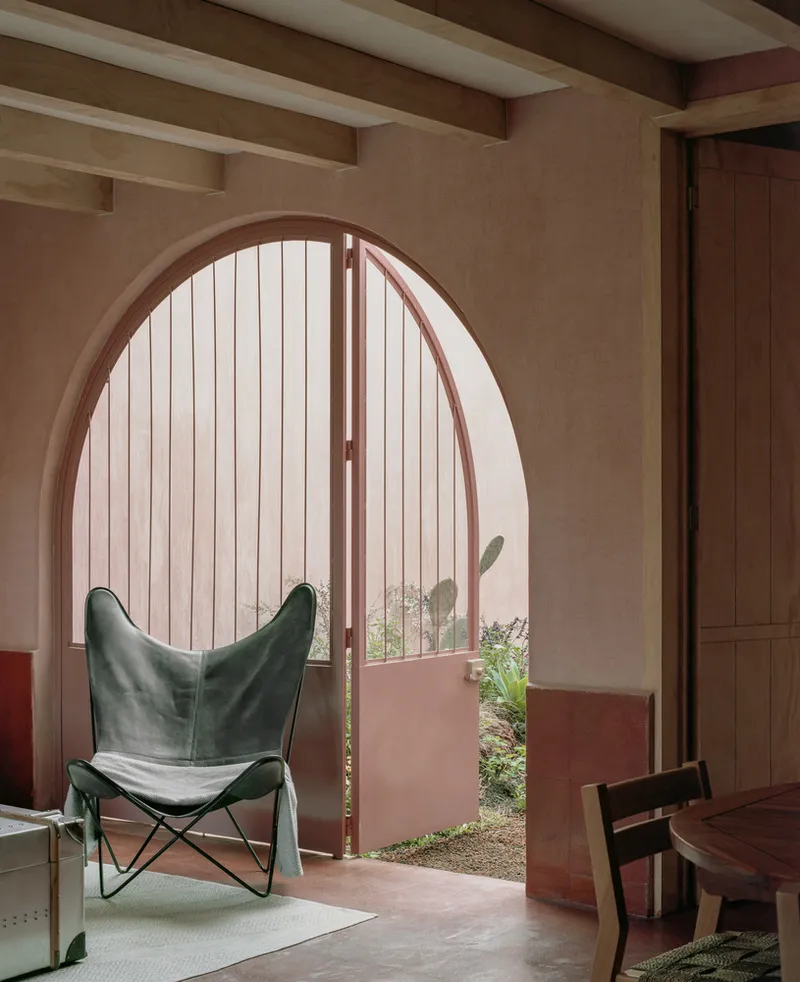
The ground level concentrates everything the couple needs daily: a main bedroom, a living room, a kitchen, and a dining area, all opening onto the courtyards through doors and generous windows. The kitchen is a standout space, with exposed timber ceiling beams in pine and an arched window that frames a direct view into planted greenery. It feels simultaneously sheltered and connected, a room where you could cook while watching a grandchild play outside.
Upstairs, two guest bedrooms with en-suite bathrooms and a family room provide space for visiting relatives without crowding the couple's daily routine. The division is smart: it respects the physical realities of aging by keeping the stair climb optional, while still offering the house enough capacity to host multi-generational gatherings. A vertical slat window in the kitchen filters light along the pink interior walls, creating a warm, shifting pattern throughout the day.
The Stairwell as Light Well
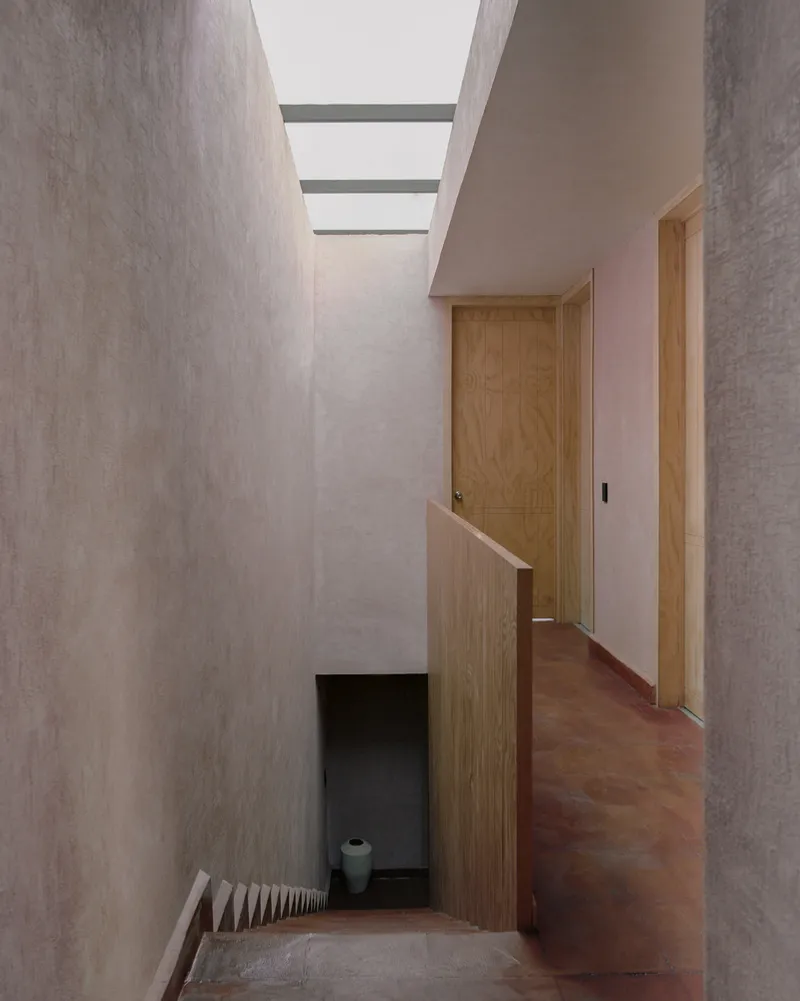
Connecting the two levels is a staircase topped by a clerestory skylight, an element that transforms a utilitarian passage into the house's most luminous moment. The skylight floods the timber handrail and surrounding corridor with overhead light, making the stair feel generous rather than confined. In a bioclimatic strategy calibrated for Hidalgo's cold, arid climate, this skylight also serves as a passive solar gain device, warming the central spine of the house during the day.
The south-facing orientation of the house is part of a broader environmental calculation. By shielding the plan from prevailing cold winds and opening it to southern light, the architects reduce the need for mechanical heating. The courtyards act as thermal buffers, absorbing heat during the day and releasing it slowly. None of this is flashy or labeled as sustainable technology. It is simply intelligent siting and planning.
Material Honesty in Pink Stone, Clay, and Pine
The material palette is deliberately local: pink stone from nearby quarries, clay, and pinewood. Interior designer Marisol Macías worked within this framework to keep finishes warm and tactile. Traditional baseboards made from local materials ground the walls at their base, a detail that ties the house to vernacular construction practice without mimicking it. The exposed timber ceilings, visible in both the kitchen and upper rooms, give every space a sense of handmade weight.
What the material choices accomplish together is a consistent atmosphere. The house does not shift register between inside and out or between modern and traditional. The pink stone reads the same whether you are looking at the exterior stucco, the courtyard walls, or the interior surfaces. It evokes what the architects describe as the essence of a "village home," where material and place are inseparable.
Plans and Drawings
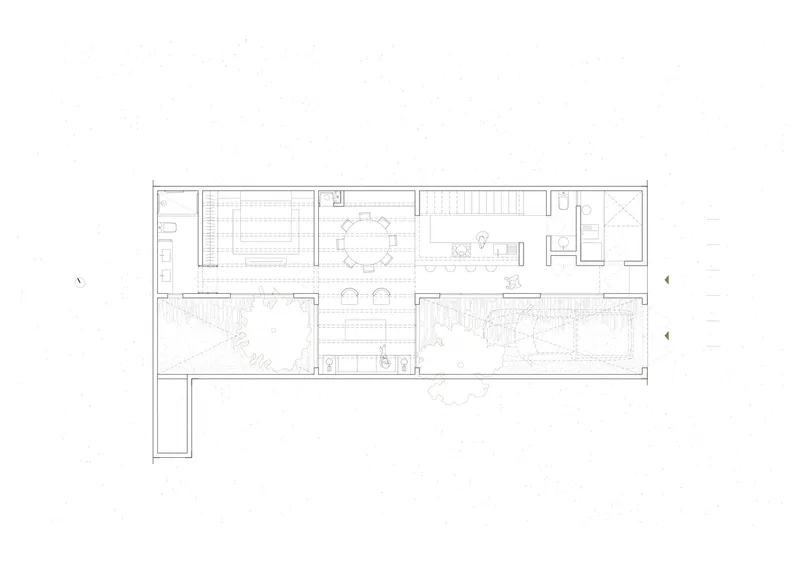
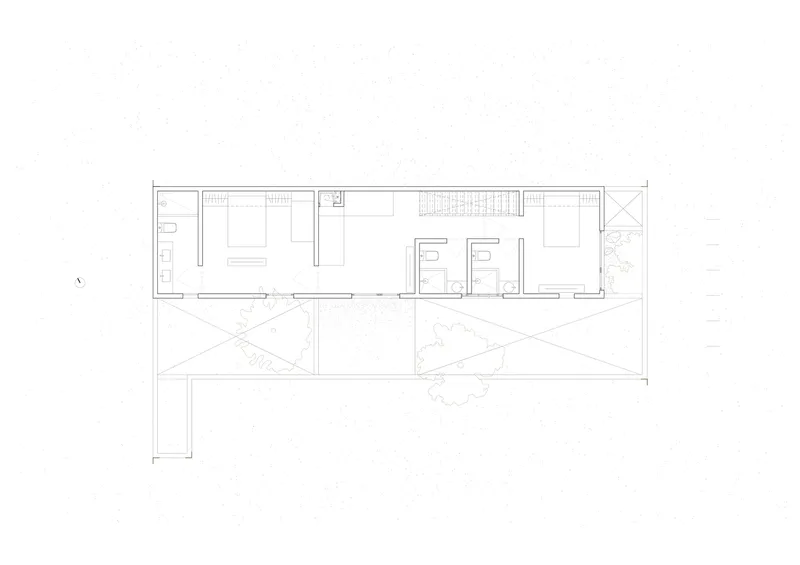
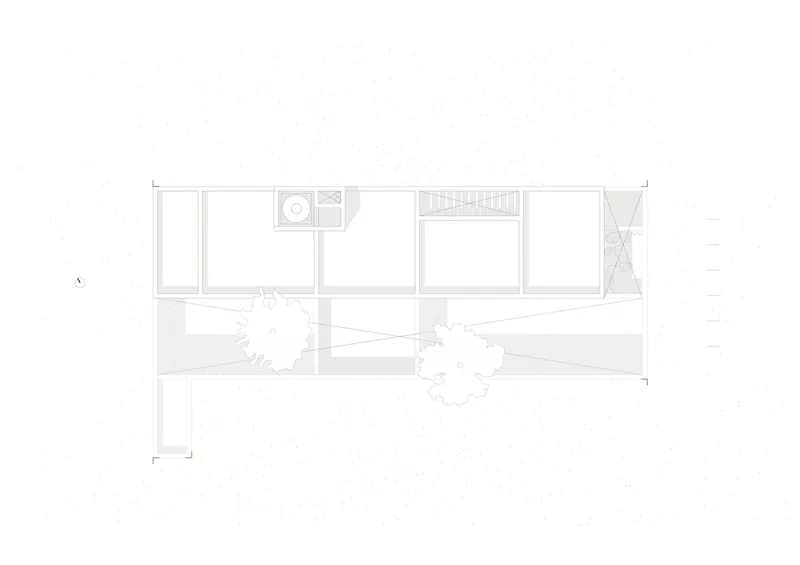
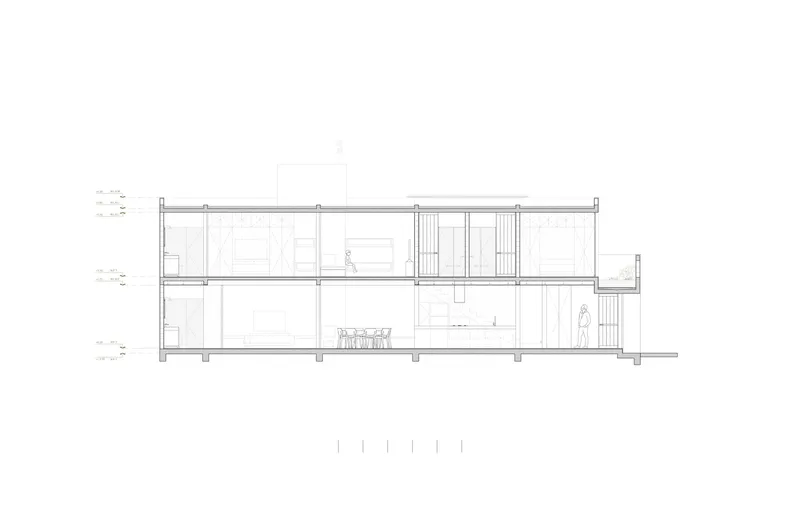
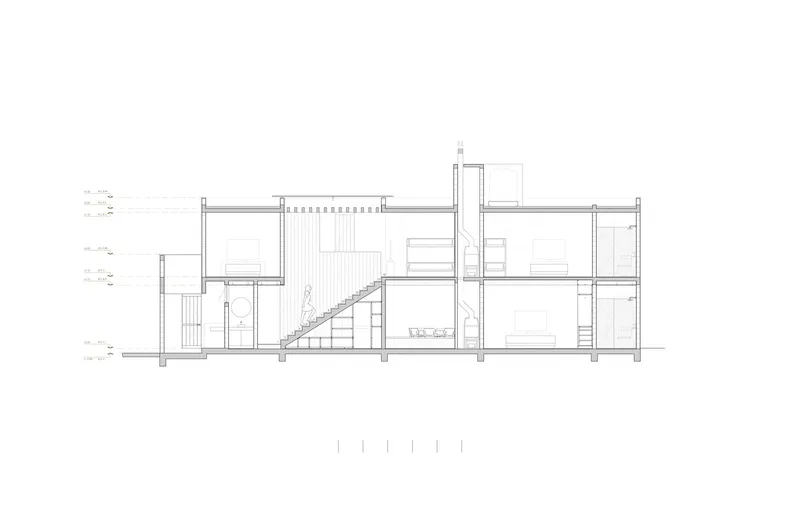
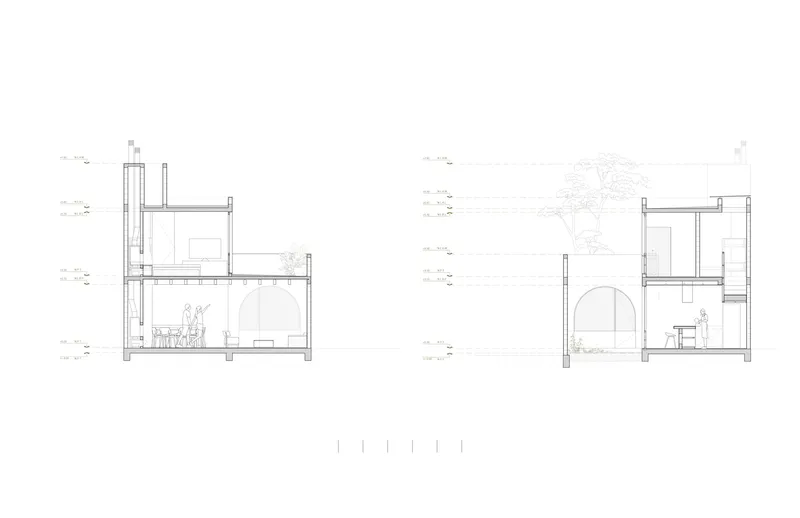
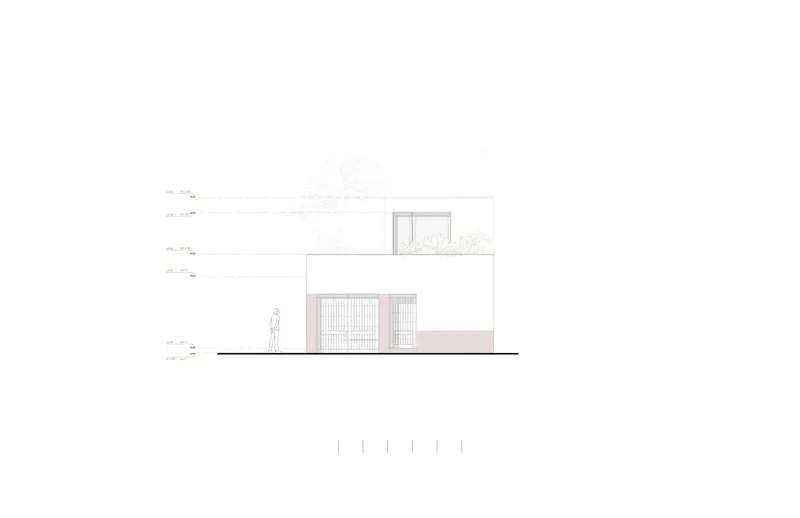
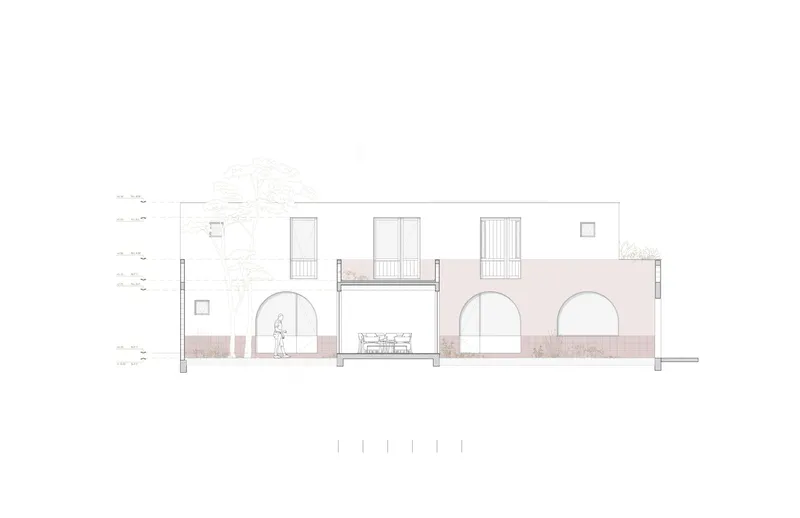
The floor plans reveal how tightly the courtyards control the layout. On the ground level, the two planted voids sit on either side of a central living spine, pulling every room toward daylight and greenery. The upper level plan shows how the guest bedrooms are offset from the main volume, creating a split-level condition visible in the sections. The sections themselves are the most revealing drawings: they show the staircase skylight, the relationship between arched ground-floor openings and the more enclosed upper rooms, and the way the roof volumes step down to match neighboring buildings.
The elevation and section-elevation drawings illustrate the pink-toned masonry with arched openings at grade and a recessed balcony above, confirming that the arches are concentrated at the courtyard and ground level while the upper story retreats into simpler, planar surfaces. An angled diagonal element visible in one plan suggests a site-specific response to the lot geometry, keeping the plan from defaulting to a simple rectangle.
Why This Project Matters
Casa Zempoala matters because it treats a retirement home as a legitimate architectural problem rather than a downsized afterthought. The program, designing for an aging couple who still want to host family, is one that most architects will face with increasing frequency as populations age. The solution here, concentrating daily life on a single accessible level while keeping a social upper floor for guests, is replicable and smart. The courtyard typology ensures that accessibility does not come at the cost of spatial interest.
It also matters as a regionalist project that avoids nostalgia. The arches, the pink stone, the clay baseboards: these are not applied signs of locality but structural and material decisions that emerge from available resources and climatic logic. In a moment when many architects reach for imported materials or generic sustainable technologies, o.d.e. demonstrates that the most responsive design often comes from looking at what is already in the ground, already in the tradition, and already proven by centuries of use.
Casa Zempoala by o.d.e. (Oficina Documental de Espacio), located in Zempoala, Hidalgo, Mexico. 189 m², completed 2024. Photographs by Zaickz Moz.
About the Studio
Share Your Own Work on uni.xyz
If projects like this are the kind of work you want to make, uni.xyz is a place to publish your own, find collaborators, and enter design competitions.




Popular Articles
Popular articles from the community


The Earth Pod: 3D Printed Homes for Resilient Refugee Communities
The Earth Pod reimagines refugee housing through 3D printed homes made from clay, combining resilience, self-sufficiency, and rapid shelter.

Co-life: Sustainable Architecture for Age-Friendly Community Living
Co-life reimagines sustainable architecture for seniors through courtyards, rammed earth, shared gardens, and spaces designed for belonging.

Conexión: Biophilic Design Reimagines High-Rise Living in Hong Kong
Conexión reimagines high-rise living in Hong Kong through biophilic design, green facades, shared spaces, daylight, water and nature within.

Hill & Cross Opera: Sculptural Opera House Architecture Shaped by Tallinn’s Landscape and Identity
Hill & Cross Opera reimagines opera house architecture in Tallinn through its sculptural hill, civic plaza, glass wave and a luminous cross.


Similar Reads
You might also enjoy these articles


Hodi-Mandai Geram
Project Function: Preservation and revitalization of the Intangible heritage and socio-spatial identity of the Hodi by Housing, Cultural Memory Center, Sacred Grove, landscape, local tourism economy


Olio Towers: A Mid-Rise for Performers That Fuses Housing, Rehearsal, and Stage
Located blocks from Houston's Theater District, this modular tower stacks living units around a central performance atrium.

Oasis: Modular Green Housing Carved into Dhaka's Urban Fabric
A shortlisted Plugin Housing entry reclaims unauthorized settlements in Dhaka with stepped concrete volumes, green roofs, and ventilation-driven design.

Black Hole: A Floating Megastructure for the Post-Physical Era
Emiliano Mazzarotto envisions a spherical, self-scaling arena where e-sports, digital hotels, and holographic stadiums replace traditional public space.


Explore Mexican Design Competitions
Discover active competitions in this discipline



Challenge to reimagine the Iron Throne


Photograph architecture without architects


Illustrate the lost glory of Angkor Wat - Render Challenge


Design challenge to reuse E-waste
Comments (0)
Please login or sign up to add comments
No comments yet. Be the first to comment!