
CASE-REAL Wraps a Chofu City House in Bengara-Stained Cedar That Fights the Green
A compact 82-square-meter Tokyo home uses traditional Japanese pigment and a gallery-like plan to blur public and private life.


Most residential projects in Tokyo's leafy suburbs try to disappear into the canopy. CASE-REAL chose the opposite strategy for House in Jindaiji, a two-story wood-frame dwelling in Chofu City's quiet residential belt. The exterior is clad in red cedar boards finished with Bengara, a traditional Japanese pigment prized for its weather resistance and its deep, ruddy color. Set against the green buffer of mature trees on an adjacent public green area, the house reads like a warm terracotta shard dropped into a watercolor landscape. The contrast is deliberate: the architects wanted the architecture to announce itself, not camouflage.
What makes the project worth studying, though, is not just its color. At only 82 square meters of floor area on a 116-square-meter site, the house manages to function simultaneously as a private dwelling and as a semi-public gallery space. A double-height atrium, a raised dining counter that doubles as a display stand, and furniture arranged along the entrance threshold so visitors can browse without removing their shoes: these are not gimmicks but carefully calibrated moves that let a tiny house live much larger than its footprint.
A Reddish Shell Against the Green
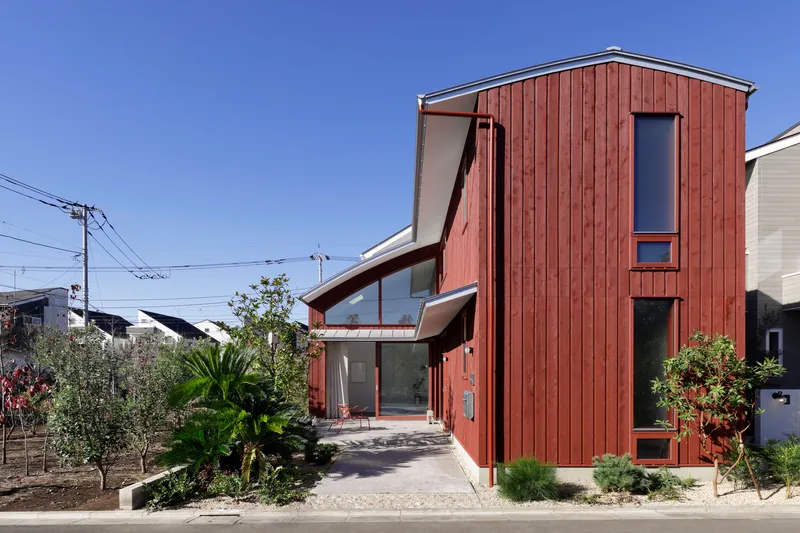
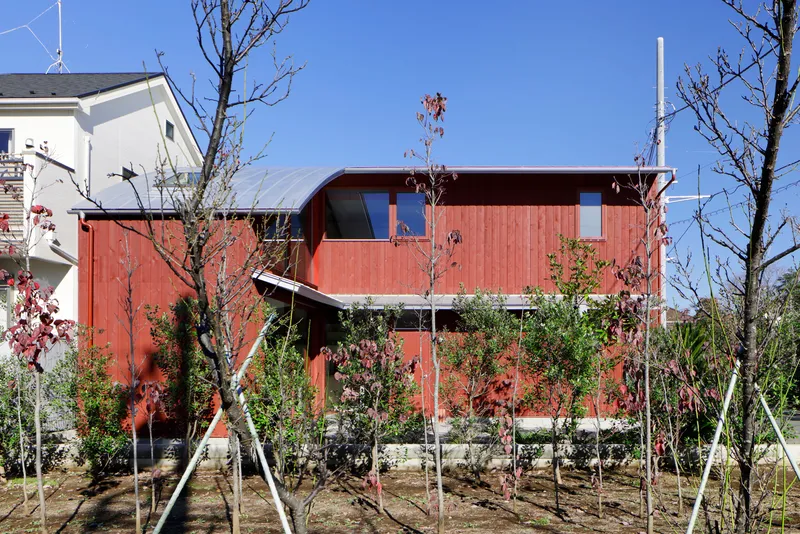
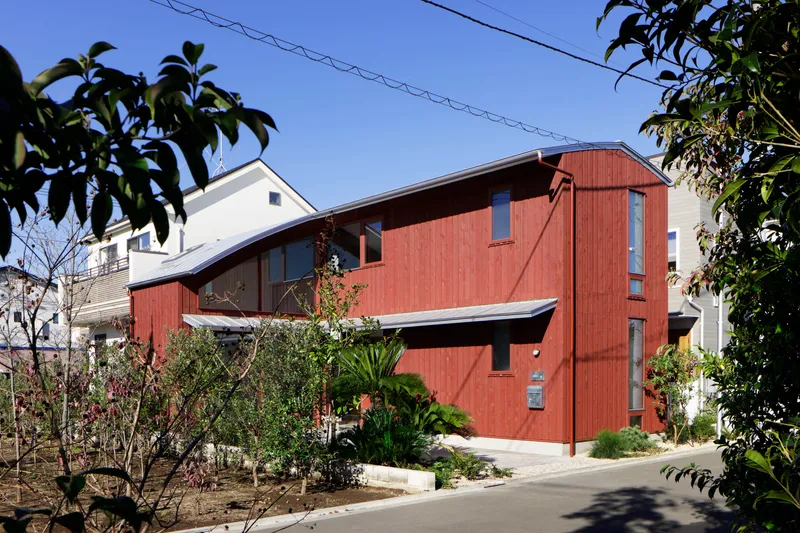
Bengara pigment has been used on Japanese buildings for centuries, particularly on temples and merchant houses, because it resists UV degradation and moisture. CASE-REAL borrows the material not for nostalgia but for chromatic punch. The cedar boards, stained in this reddish-brown tone, gain depth as they age, and the color intensifies rather than fades. From the street, the two timber volumes sit shoulder to shoulder, their curved Galvalume roof sweeping between them in a gentle arc that references the mukuri, a traditional Japanese roof form defined by a broad, convex curvature.
Japanese tropical plants fill exterior gutters and garden beds around the base, pushing the red-green dialogue right up to the threshold. Where the surrounding neighborhood is muted greens and grays, the house becomes a focal point without resorting to sculptural excess. The color does the work.
The Atrium as Social Engine
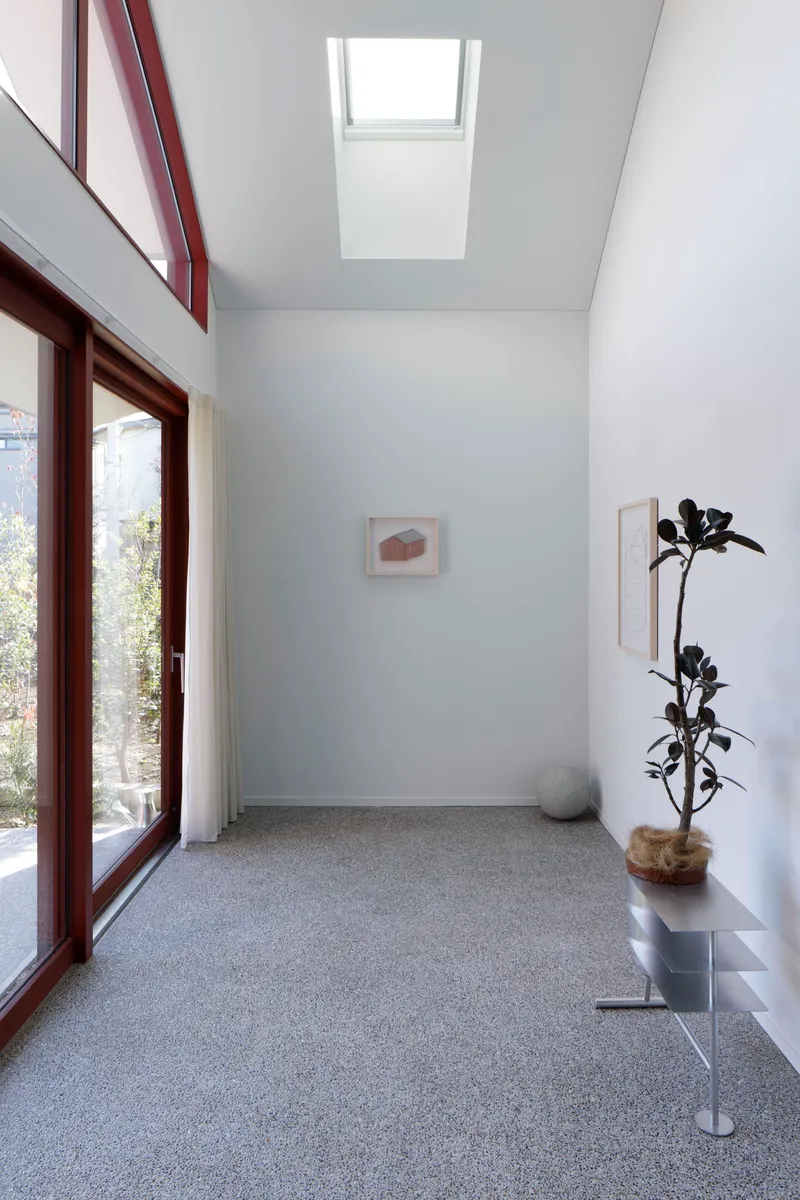
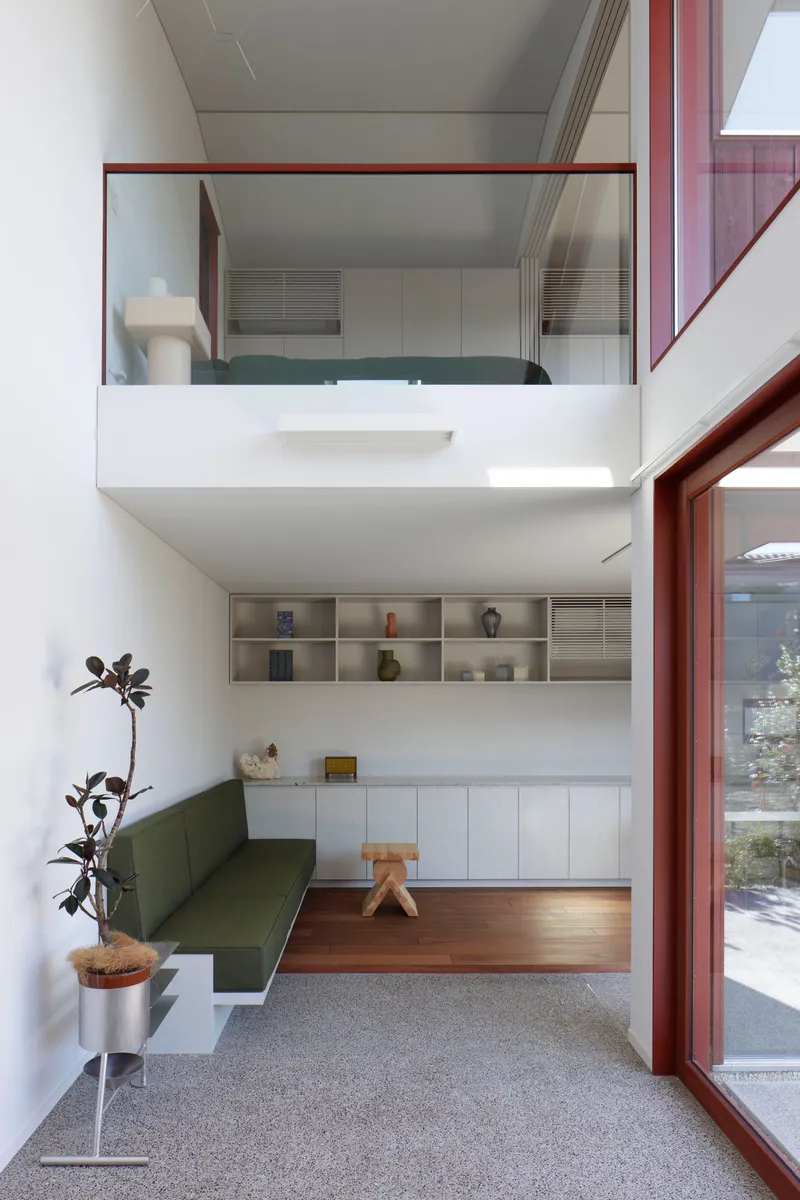
Step through the mahogany-framed glass door and the entry sequence opens into a double-height hall with a reddish stone and washed-out stone finish underfoot. A skylight overhead washes the space in even, top-down light, giving it the atmosphere of a small gallery. This is intentional: the ground floor living and dining area is designed to transform into an exhibition space for community events, with the elevated dining counter repurposed as a buffet or display stand.
The atrium connects both floors visually and environmentally. Air circulates through the void, reducing the need for mechanical ventilation across the compact plan. A mezzanine study overlooks the living space below, keeping sight lines long in a house that could easily feel cramped. Built-in shelving along the walls reinforces the gallery reading while providing everyday storage.
Ground Floor: Standing, Displaying, Hosting
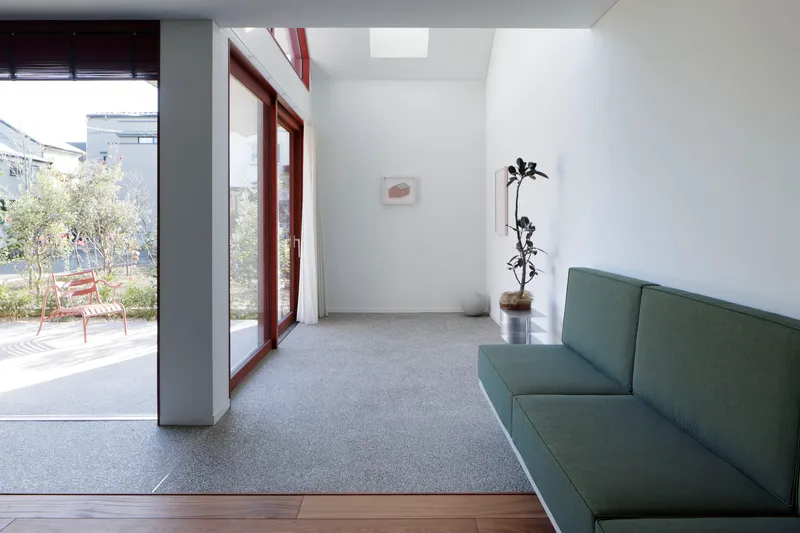
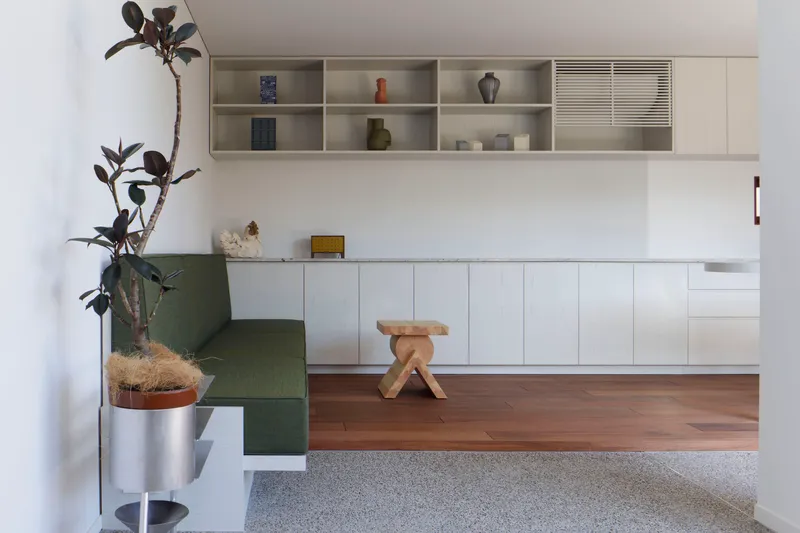
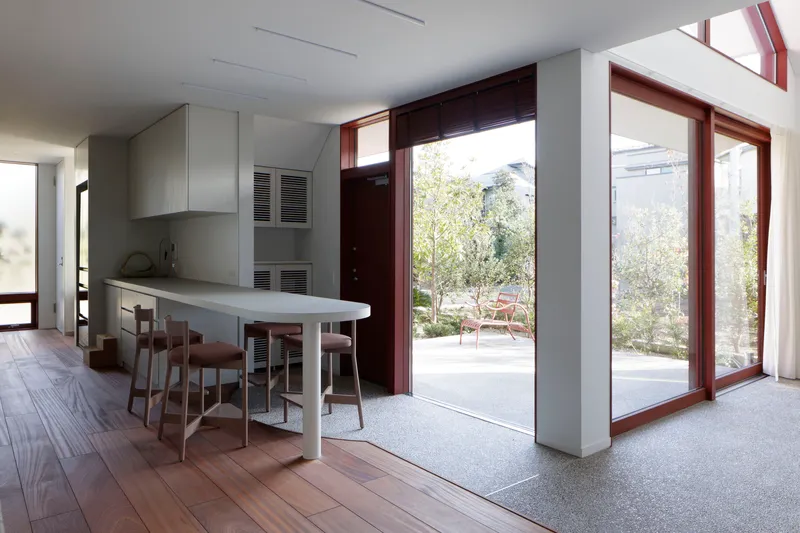
The first floor is organized around activities done on your feet. The dining counter sits higher than a standard table, calibrated so it can serve as a standing bar, a buffet surface, or a product display. Furniture along the building's boundary, near the entrance, is positioned so that guests during public events can interact with objects or sit down without crossing the shoe-removal threshold, a social innovation that respects Japanese domestic etiquette while opening the house to the neighborhood.
A green upholstered bench with a timber step-up platform provides a transitional seating zone between the public-facing earth floor and the more intimate living area. The galley kitchen, lined in white cabinetry, opens through tall mahogany-framed doors onto the courtyard, collapsing the boundary between cooking and outdoor entertaining.
The Courtyard as a Room Without a Roof
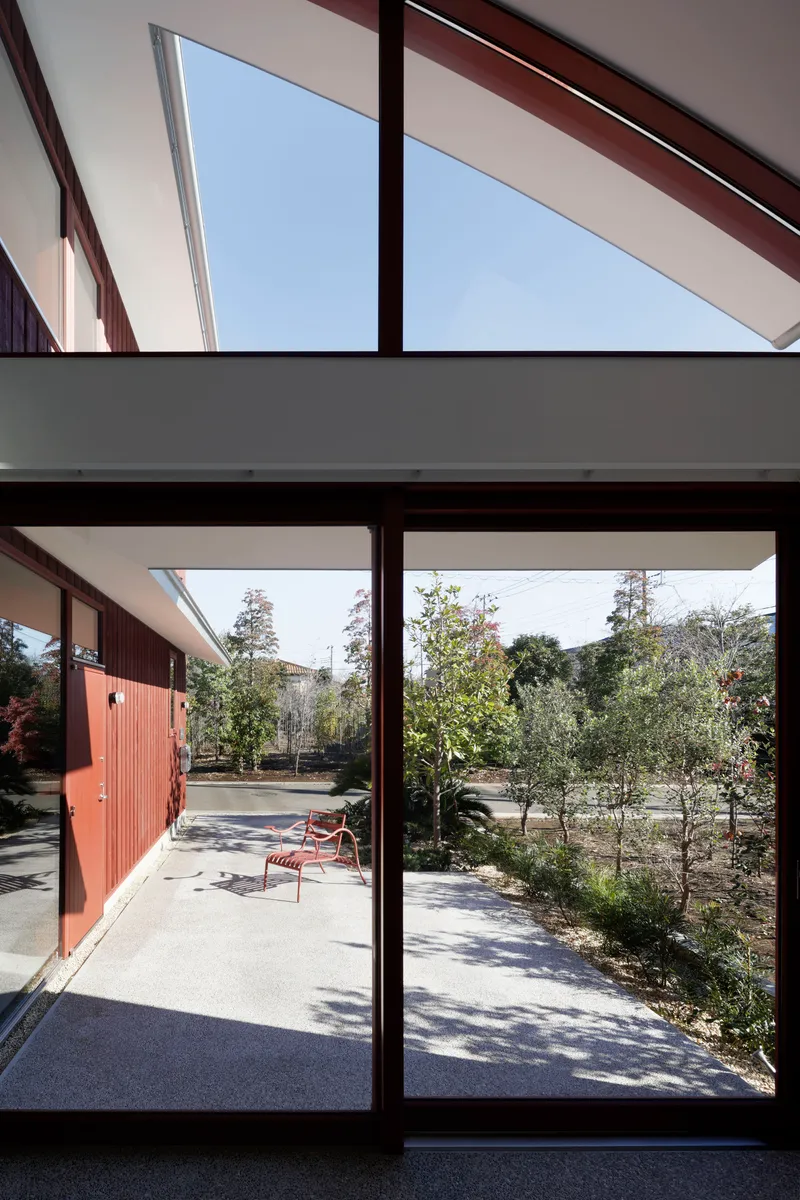
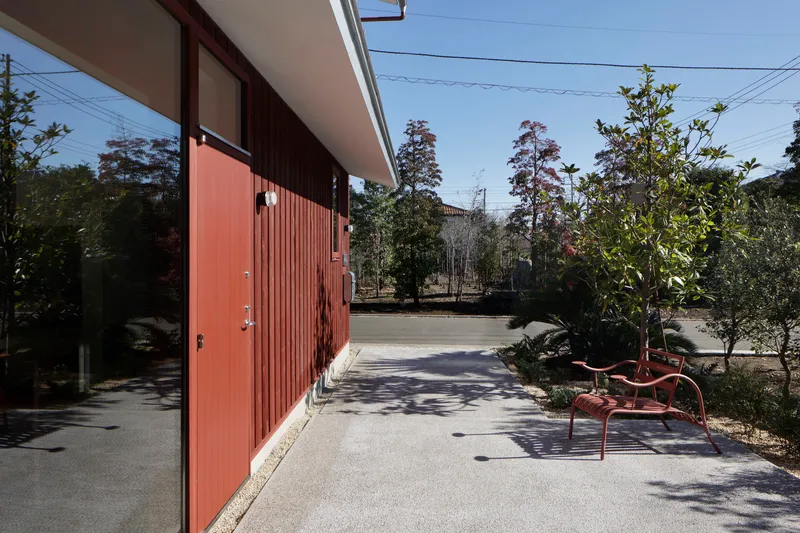
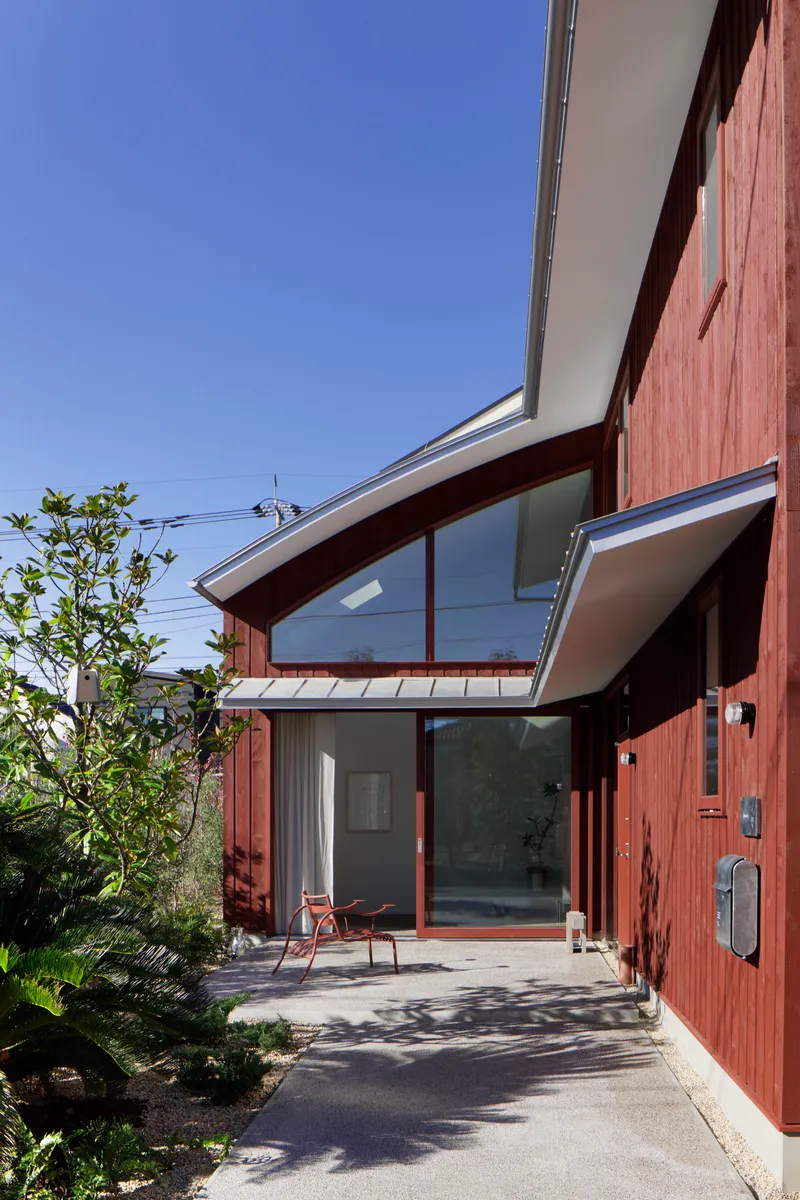
Between the two timber volumes, a courtyard garden acts as the house's lungs. Concrete paving, newly planted saplings, and a red bench create an outdoor room that feels both contained and open. The vertical timber cladding wraps around the courtyard walls, ensuring the reddish tone is experienced from inside as well as out. Dappled shade filters through the young trees, and the space reads as a direct extension of the living room when the glazed doors are slid open.
The entry porch, covered by a curved glazed roof, mediates between street and courtyard. Its concrete path channels visitors along a precise route, shadows from the overhead structure striping the ground in the afternoon. The approach is choreographed: you are drawn in before you fully understand the plan.
Upstairs: Low, Private, Quiet
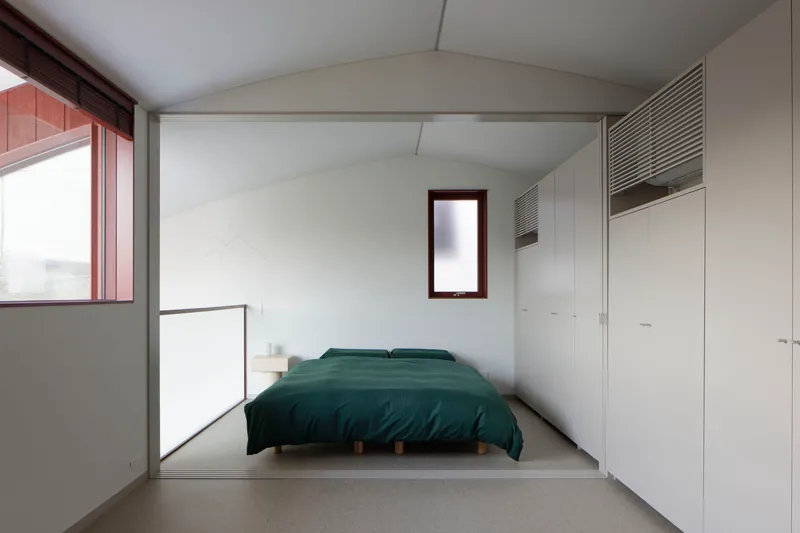
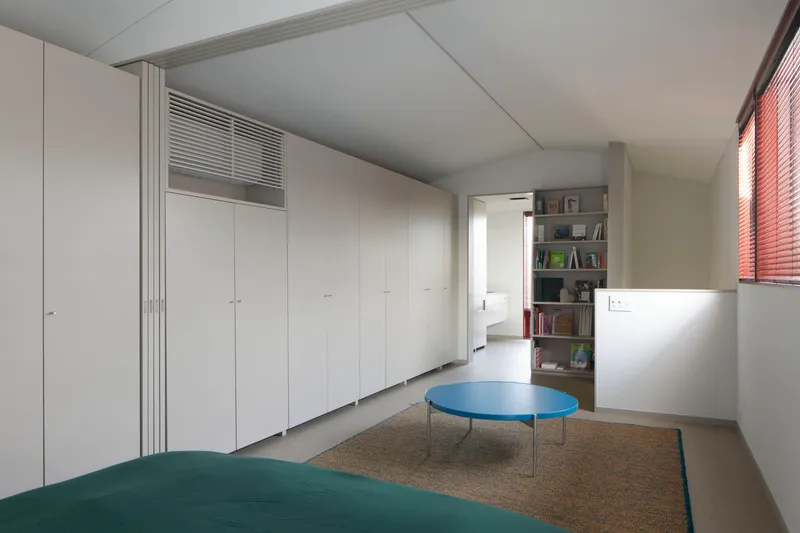
The second floor inverts the ground floor's posture. Where the first floor favors standing height and public openness, the bedrooms upstairs are scaled for floor-level living. A low table and floor seating area encourage a different rhythm. Vaulted ceilings, referencing the mukuri form visible on the exterior, lift the sense of enclosure without adding volume. Narrow vertical windows frame precise views of distant trees, editing the landscape into slender portraits.
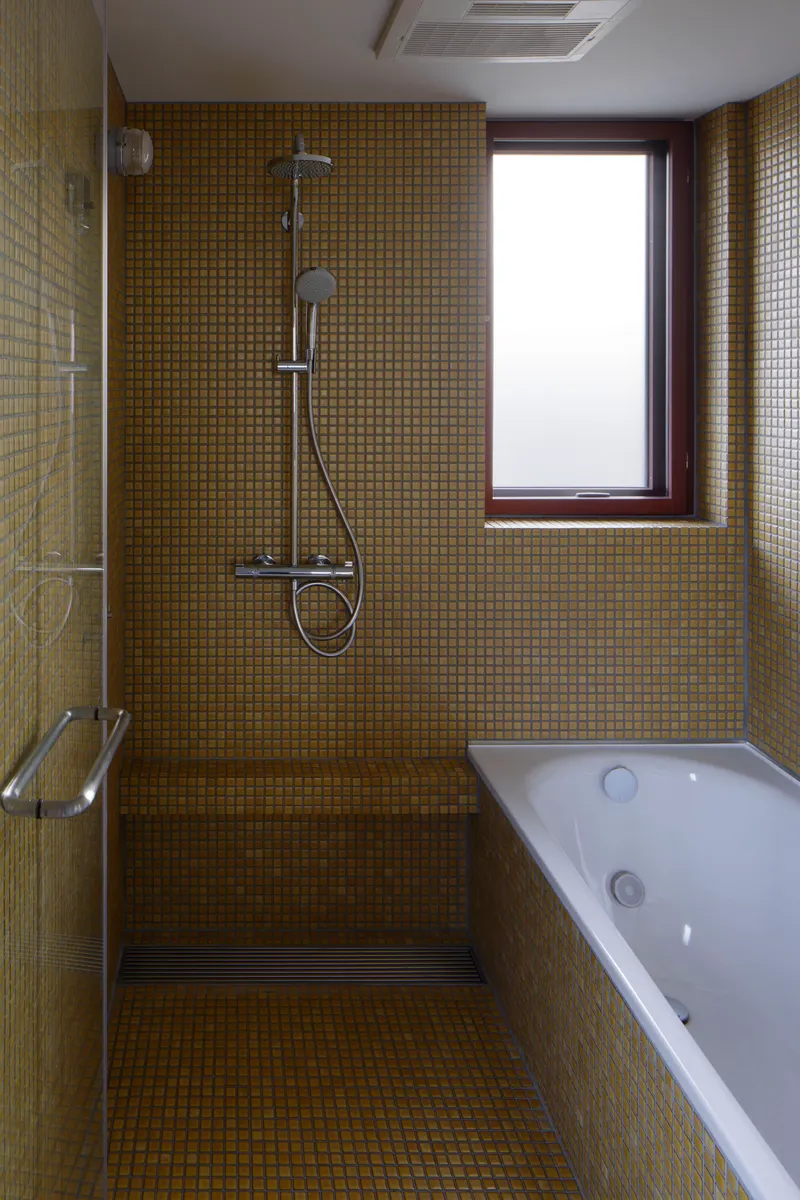
A bathroom clad in golden mosaic tile adds unexpected richness. The walk-in shower and white bathtub occupy a compact footprint, but the shimmering wall surface makes the room feel generous. Built-in wardrobes in white fill an entire wall of one bedroom, keeping the floor clear. The contrast with the gallery-like ground floor is stark and deliberate: upstairs belongs to the inhabitants alone.
Light, Corridors, and Thresholds
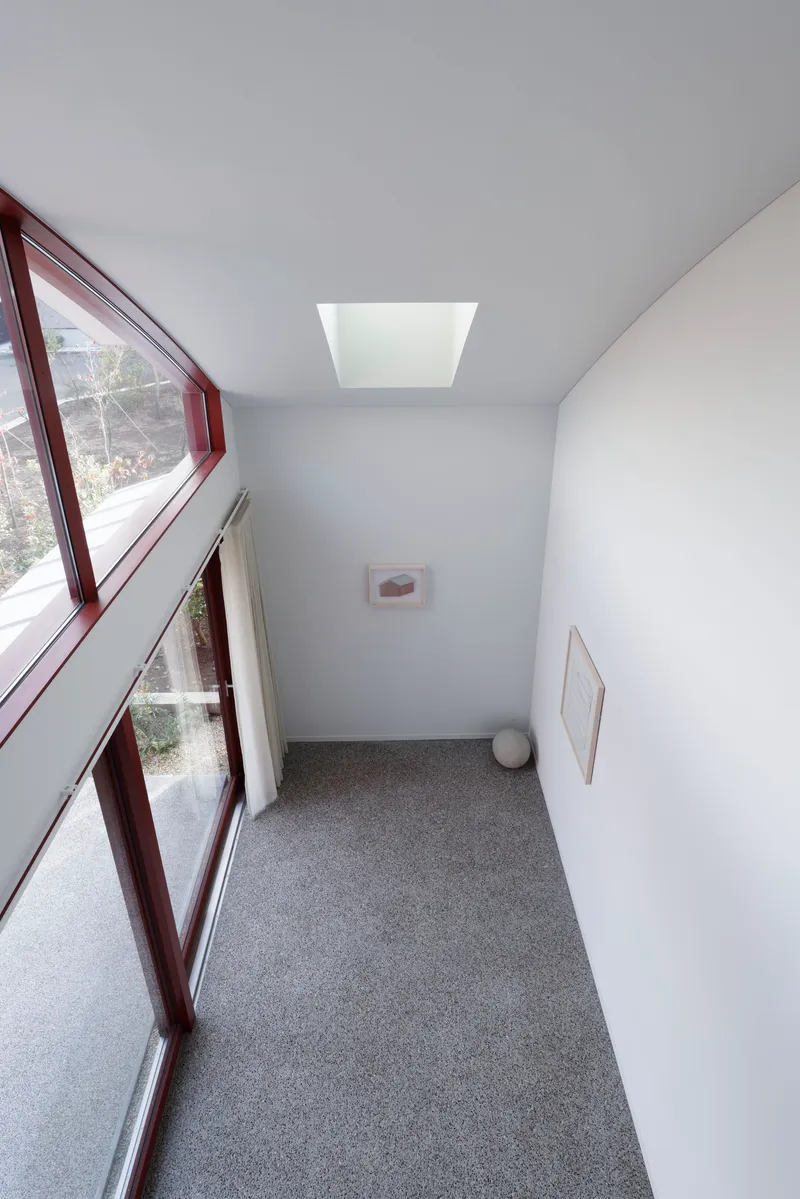
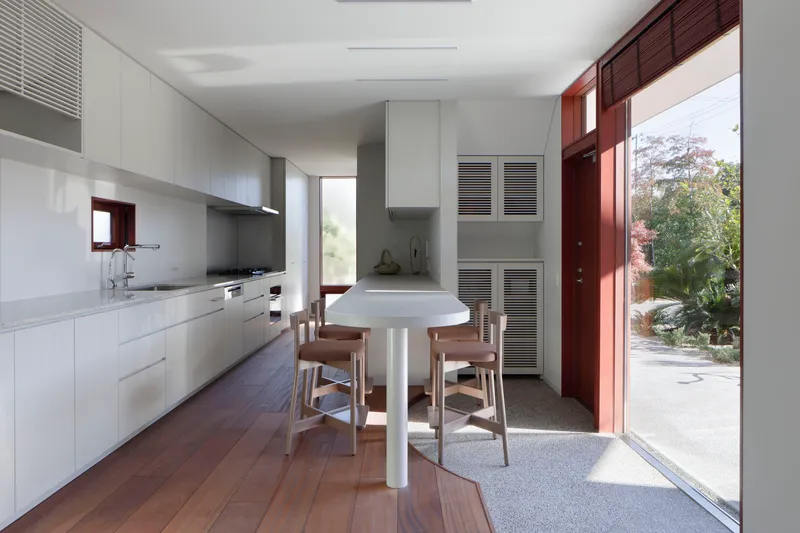
Circulation in the house is not merely functional. A narrow hallway with angled glazing and a central skylight becomes a light well, turning what could be dead space into a moment of pause. Terrazzo flooring runs through these transitional zones, providing a cool, neutral ground that ties disparate rooms together. White walls amplify reflected light from the skylights, keeping the interior bright despite the compact footprint and the proximity of neighboring structures.
After Dark
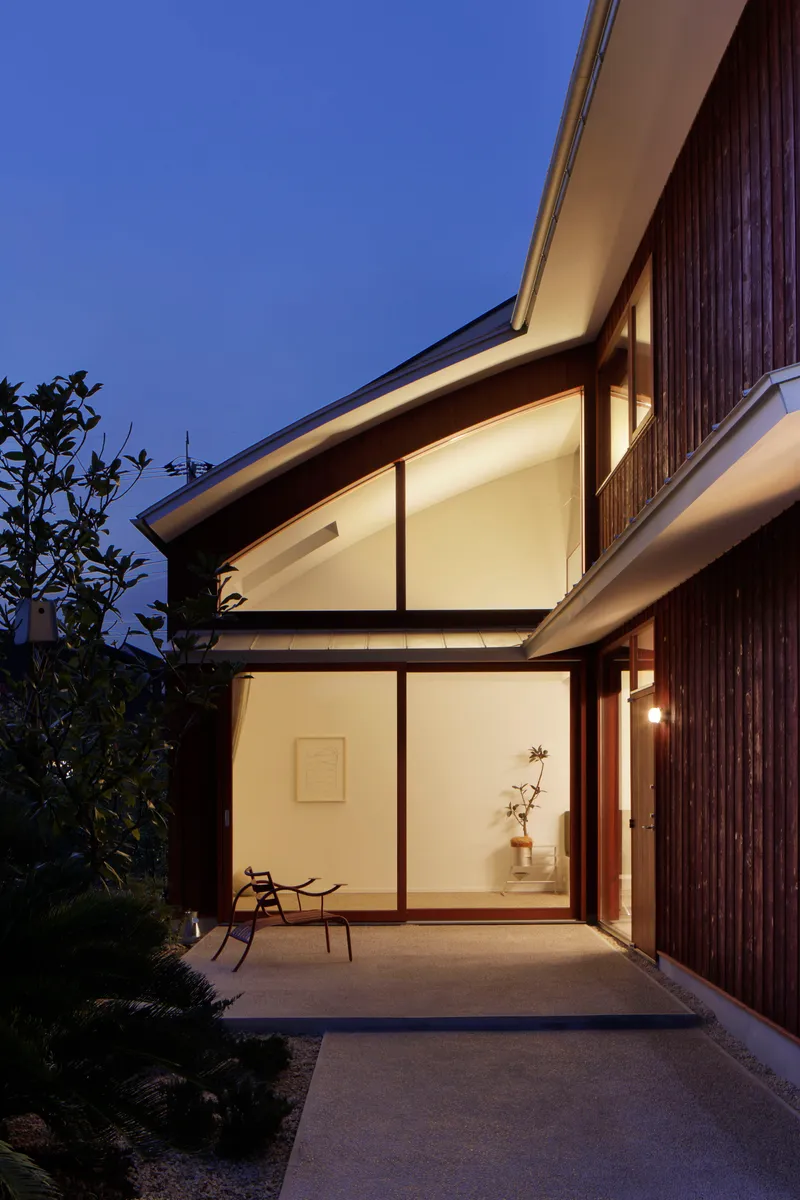
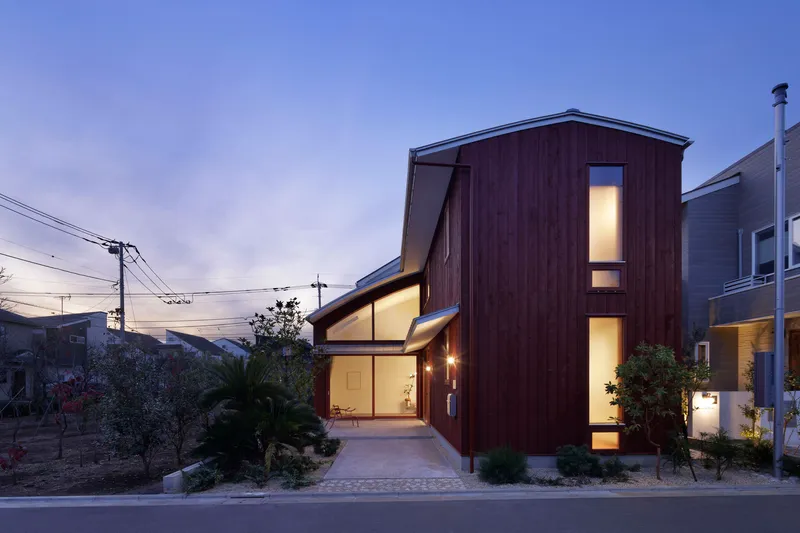
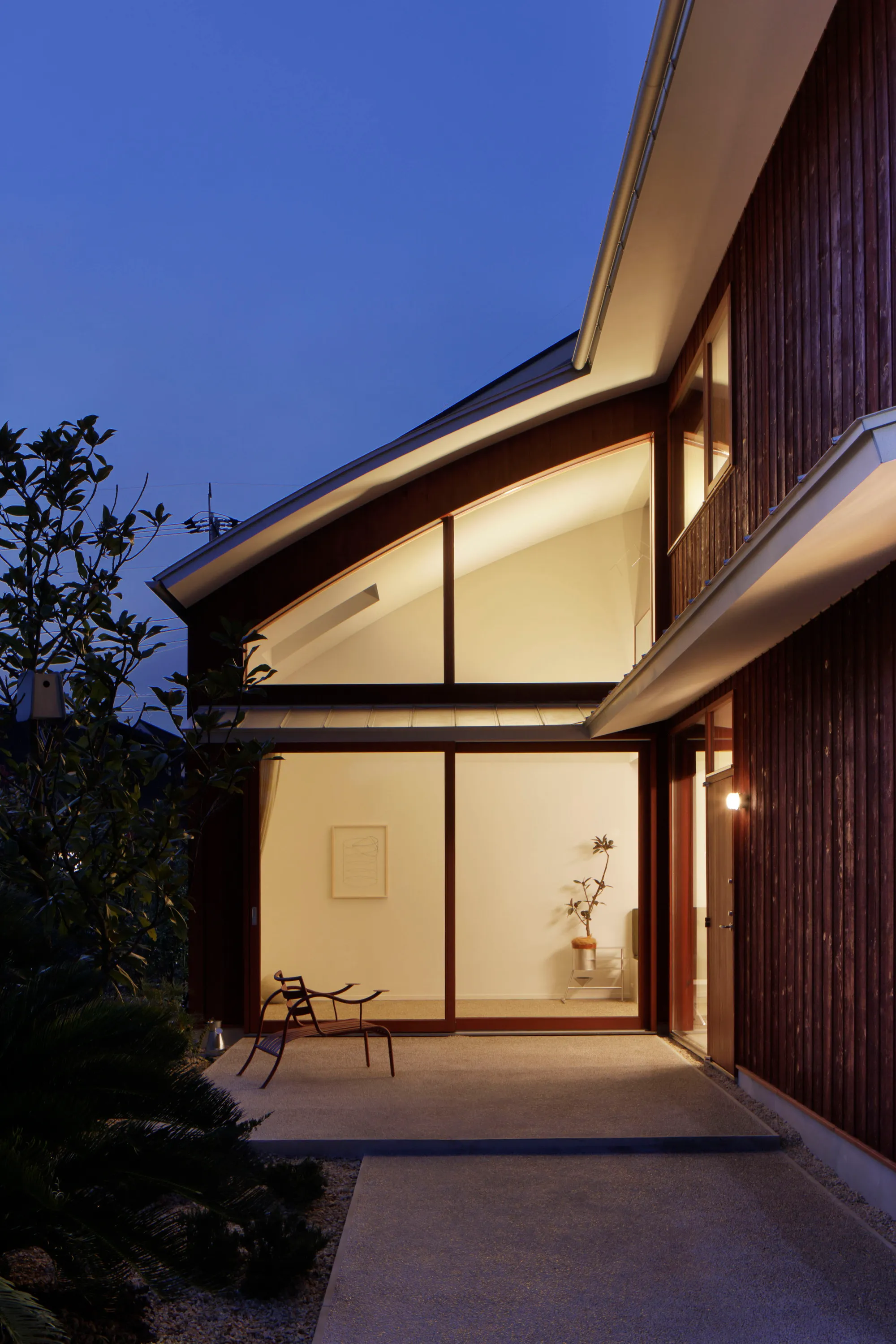
At dusk the house inverts its daytime logic. The Bengara-stained cedar recedes into shadow while the two-story glazed facade glows from within, projecting the interior life outward. The planted front garden, lit by spillover, becomes a foreground for a lantern-like composition. It is a house that performs twice: once in daylight as a bold chromatic object, and once at night as a warm, transparent box. Both readings reinforce the architects' intention that the building be seen, be present, and be part of the neighborhood rather than withdrawn from it.
Plans and Drawings
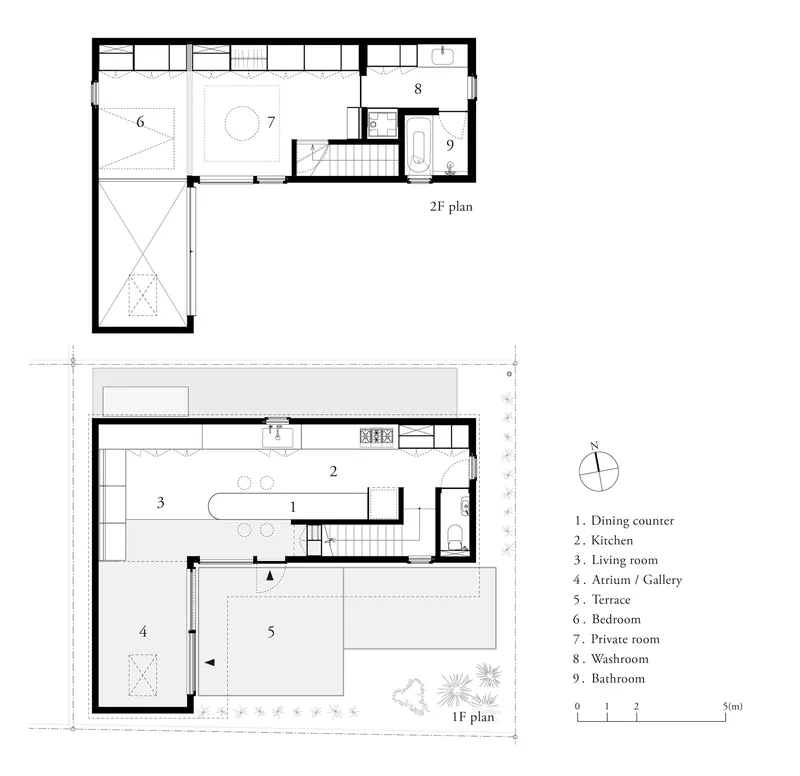
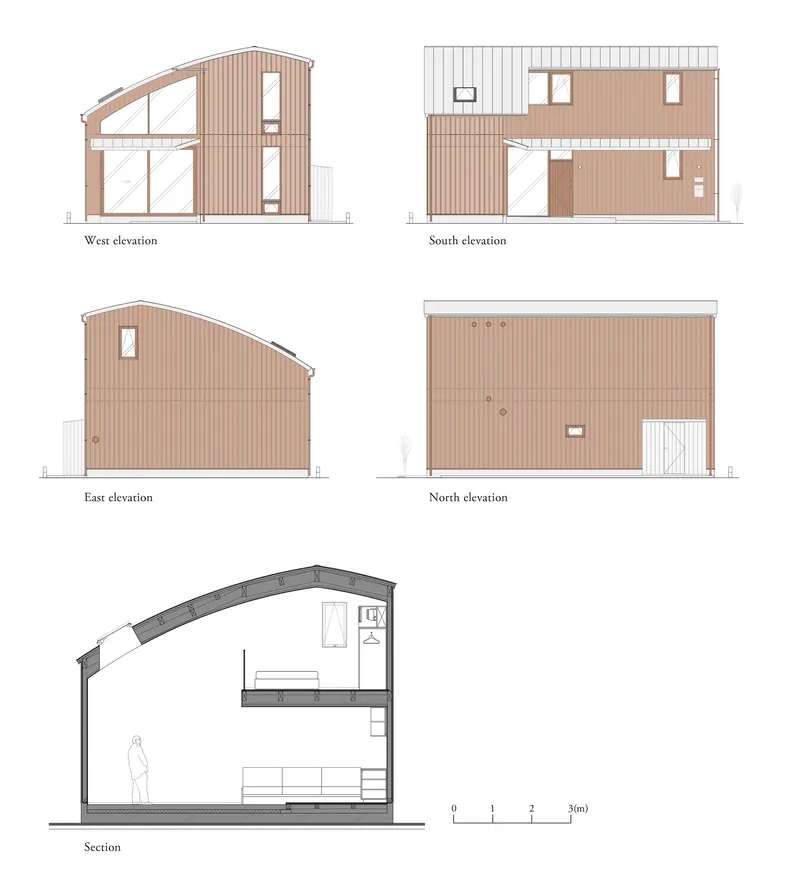
The floor plans reveal an L-shaped layout organized around a central staircase, with the courtyard nestled into the bend. Ground-floor public spaces wrap the atrium, while the upper level tucks private rooms along the shorter wing. Section drawings confirm the barrel-vaulted roof form and show how the double-height entry hall locks the two floors together spatially. The building area of just over 46 square meters per floor makes every dimension count, and the drawings expose how carefully CASE-REAL calibrated ceiling heights, counter levels, and window positions to support the dual public-private program.
Why This Project Matters
House in Jindaiji is a compact proof that small residential projects can carry cultural weight. By deploying Bengara, a centuries-old pigment, not as a heritage gesture but as a deliberate chromatic strategy, CASE-REAL demonstrates that traditional materials still have contemporary arguments to make. The house does not look backward. It uses a familiar technology to solve a present-day problem: how to give a tiny building identity in a neighborhood dominated by vegetation.
More importantly, the project challenges the assumption that a private home must be entirely private. The convertible ground floor, the furniture zoned around the shoe-removal line, and the gallery-scaled atrium all suggest that domesticity and community can coexist in 82 square meters, if the architecture is calibrated with enough precision. In a city where residential density keeps climbing and plot sizes keep shrinking, that idea is worth more than another neutral box behind a hedge.
House in Jindaiji, designed by CASE-REAL, Chofu City, Tokyo, Japan. 82 m². Completed 2022. Photography by Daisuke Shima.
About the Studio
Share Your Own Work on uni.xyz
If projects like this are the kind of work you want to make, uni.xyz is a place to publish your own, find collaborators, and enter design competitions.




Popular Articles
Popular articles from the community


The Earth Pod: 3D Printed Homes for Resilient Refugee Communities
The Earth Pod reimagines refugee housing through 3D printed homes made from clay, combining resilience, self-sufficiency, and rapid shelter.

The Musturak Paradise: Senior Living Architecture for a Connected Future in Temara, Morocco
The Musturak Paradise reimagines senior living architecture in Temara via private homes, social spaces, culture, community, and shared care.

Co-life: Sustainable Architecture for Age-Friendly Community Living
Co-life reimagines sustainable architecture for seniors through courtyards, rammed earth, shared gardens, and spaces designed for belonging.

EW PARK: Sustainable Architecture Reimagines the Future of Urban Parking
EW PARK reimagines city parking as a modular wooden tower combining automation, solar energy, electric mobility, and adaptable urban design.

Similar Reads
You might also enjoy these articles

Bao Huynh Watercolor Atelier: A Serene Art Retreat in Hội An
Bao Huynh Watercolor Atelier in Hội An blends multifunctional art spaces, sustainable design, local materials, and family-friendly living in a serene environment.

Atelier Macri Concept Store Interior Design by CASE-REAL
Atelier Macri store features a "ko" counter, walnut wood details, cork displays, blending retail, gallery, and seamless customer experiences.

Manuel Vargas Izquierdo Stadium and High-Performance Sports Center: Architectural Excellence in Jalpa de Méndez
The Manuel Vargas Izquierdo Stadium blends sustainable design, inclusive sports facilities, and cultural-inspired architecture, revitalizing Jalpa de Méndez’s public spaces.

KAKR Buluh Awar Hall: Revitalizing Community and Ecology Through Bamboo Architecture
Community built bamboo hall revitalizes Buluh Awar village, empowering youth, restoring ecology, celebrating vernacular craftsmanship through sustainable architecture and culture.


Comments (0)
Please login or sign up to add comments
No comments yet. Be the first to comment!