
CCTN Design Converts a Century-Old Beijing Steel Mill into a 223,000 m² Lakeside Mall
Liugong Hui reimagines Shougang's industrial heritage between two lakes as a post-Olympic commercial campus in west Beijing.


Shougang was once synonymous with heavy industry in Beijing. Founded in 1919 as a steel mill, the complex churned out metal for nearly a century before its furnaces went cold in 2005, shut down to clean the capital's air ahead of the 2008 Olympics. What remained was a sprawling industrial campus on the western edge of the city, wedged between Qunming Lake and Xiu Lake, loaded with brick warehouses, steel headframes, and cooling towers that no one was quite ready to demolish. CCTN Design, working with Beijing Shougang International Engineering Technology, was tasked with turning 223,753 square meters of this legacy into Liugong Hui, a commercial campus that opened in 2022 alongside the Winter Olympics. The name itself, drawn from The Book of Rites, translates roughly as a convergence of crafts, an apt frame for a project that tries to gather retail, dining, culture, and sport under roofs that once sheltered blast furnace operations.
What makes Liugong Hui worth studying is not just the scale of the conversion but the granularity of its approach. Rather than gutting the site and dropping a glass box on top, the architects parsed the campus into 11 standalone flagship buildings plus a central shopping center, each adapted from existing industrial structures with distinct material identities. Brick chimneys stand next to timber truss pavilions; glazed multi-story atriums sit beside low slung halls with polished concrete floors. The result reads less like a singular mega-mall and more like a small district that happened to share an industrial DNA.
An Industrial Campus Reframed


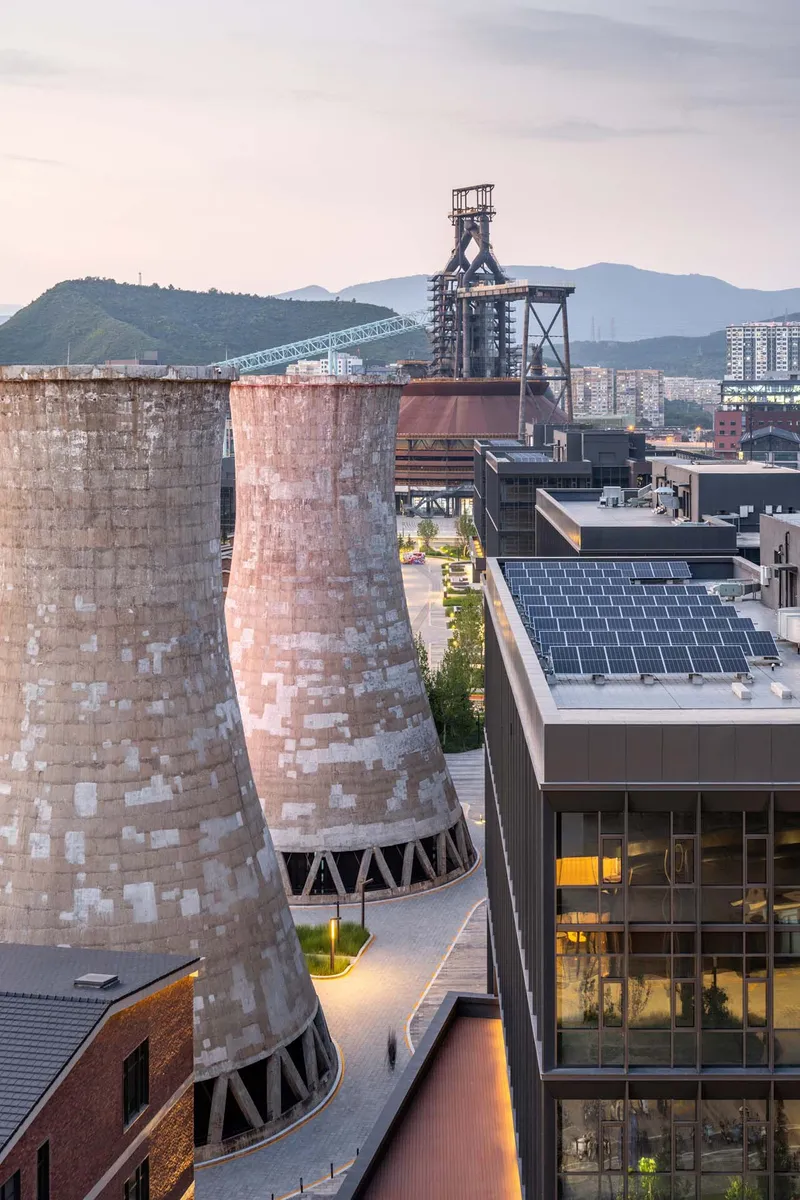
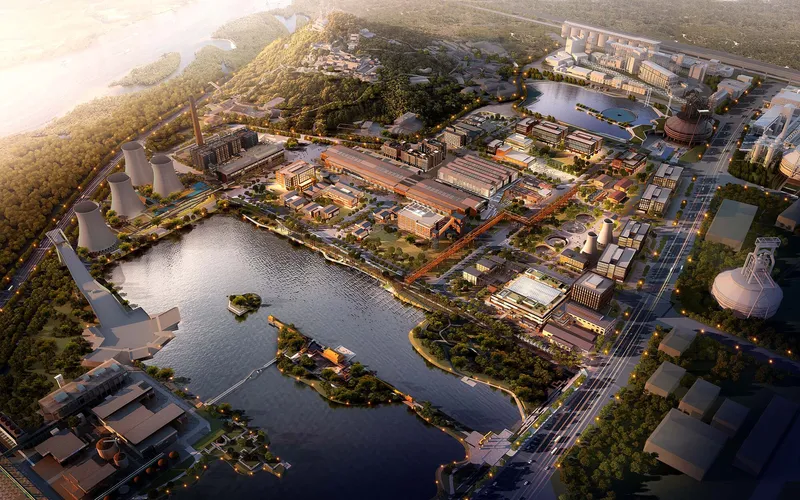
From the air, Liugong Hui reveals its logic most clearly. The red brick buildings line tree-flanked boulevards that radiate outward toward the cooling towers and steel headframes still punctuating the skyline. The architects chose not to erase these monuments. Preserved chimneys rise beside rooftop solar panels, a deliberate collision of eras that gives the campus its peculiar tension. Distant mountains frame the composition, a reminder that west Beijing is not the flat expanse of the central city.
The green corridors do more than soften the industrial edges. They establish a pedestrian-scaled circulation system, linking the standalone buildings in a sequence that encourages wandering rather than the forced march through a conventional mall. Cyclists share the routes, and planted beds mediate between the hard edges of brick and glass.
Brick, Glass, and the Layered Facade


At street level, the facades tell different stories depending on which building you face. Some retain their original brick skin, with tiered balconies and new glazing inserted behind the existing masonry. Others are wrapped in gridded glass volumes that float above red-paved paths, their interiors visible in layers that dissolve the boundary between commerce and streetscape. The ceremonial lion sculptures and painted mascots scattered across entrance plazas inject an irreverence that keeps the atmosphere from tipping into sterile heritage reverence.
The decision to treat each building as a distinct material proposition pays off. Visitors moving through the campus encounter a rhythm of textures: aluminum sheet cladding on one volume, ultra-white glass on another, exposed brick on a third. It prevents the numbing uniformity that plagues most developments at this scale.
Timber Trusses and the Memory of Structure
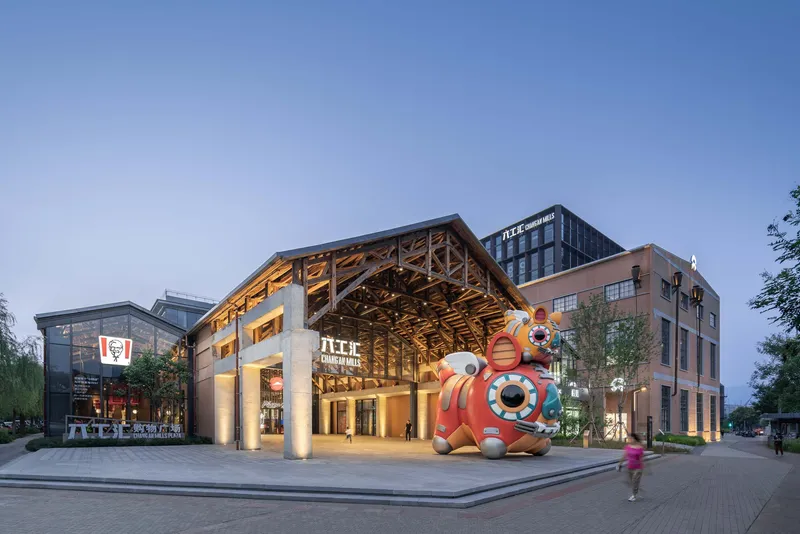


Several of the campus entries are sheltered by exposed timber truss canopies, a motif that recurs throughout Liugong Hui. Before-and-after images of the restoration process reveal the care taken: original trusses were stripped, reinforced, and relit, transforming structural necessity into architectural ornament. Concrete columns support the spans, and the warm color of the timber against dusk skies gives these thresholds a civic weight that a standard mall entrance never achieves.
The truss language extends inside as well, connecting exterior pavilions to the interior atrium spaces and establishing a material continuity that makes the transition from outdoors to indoors feel seamless rather than abrupt.
The Central Atrium as Vertical Village


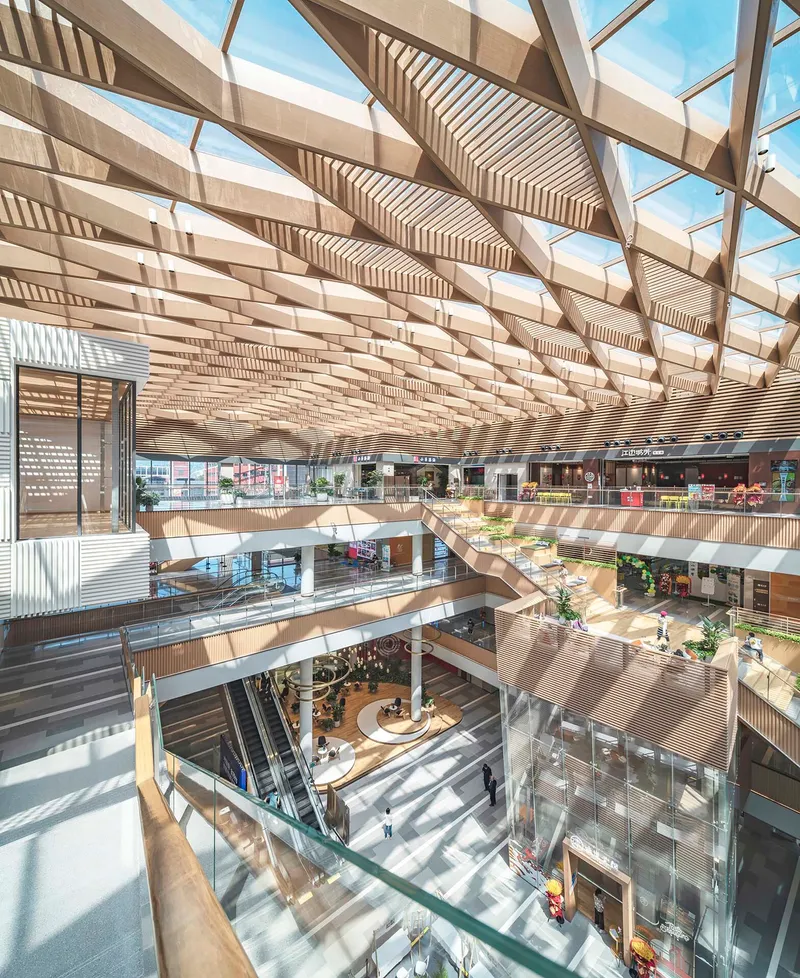
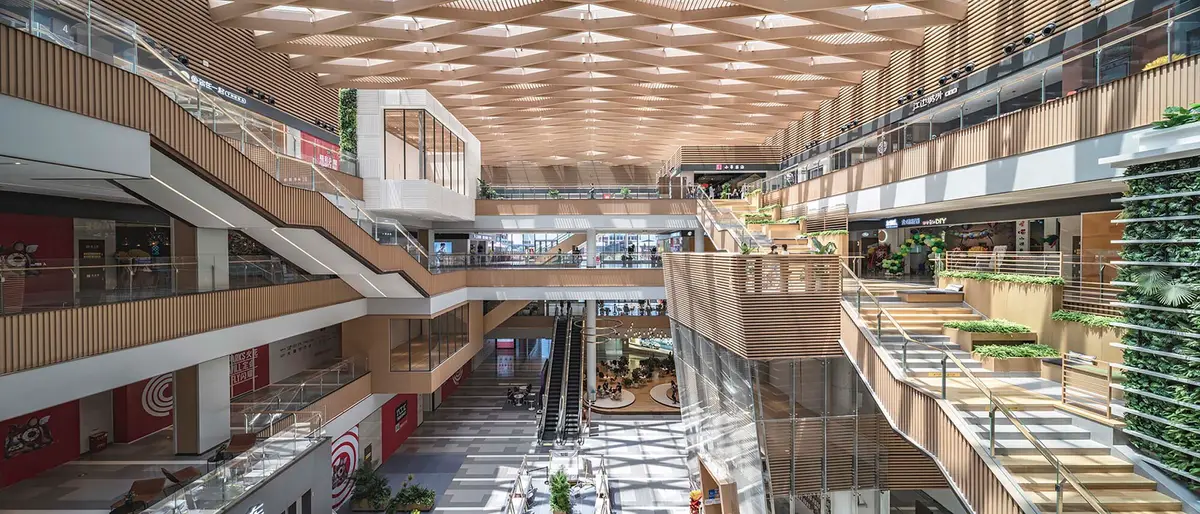
The main shopping center's multi-story atrium is the spatial heart of the project. A timber lattice skylight crowns the void, casting diagonal shadows across terrazzo floors several stories below. Interconnected walkways bridge the gap between levels, and potted plants line the balcony edges, giving the space a green, inhabited quality that resists the sterile white-box tendency of Chinese commercial interiors.
Looking down through the layered timber-screened balconies, the atrium reads almost like a sectional village, each level a terrace with its own character. Escalators and open staircases encourage visual connection between floors, so the space never feels compartmentalized. It is the kind of move that makes a 223,000 square meter building legible to someone standing in it.
Interior Spaces Between Heritage and Retail
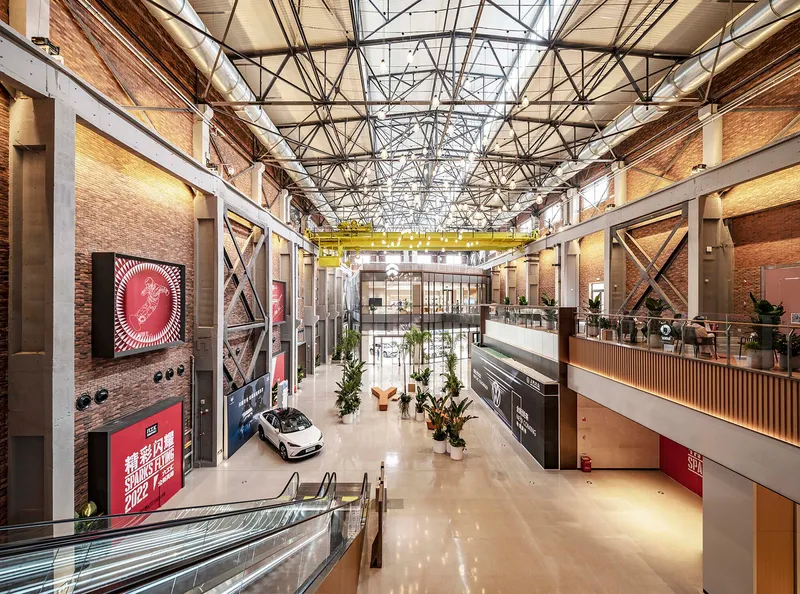
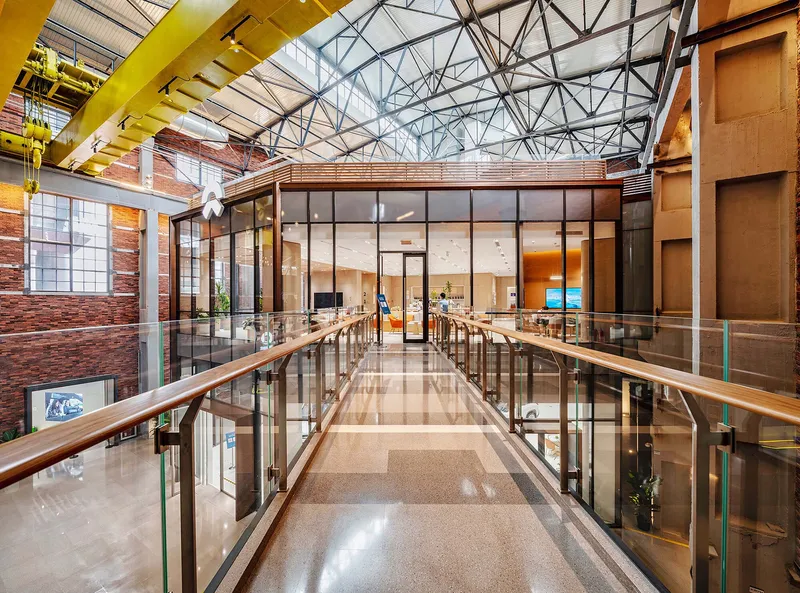
Inside individual buildings, the approach shifts. One hall retains its exposed steel trusses and brick walls wholesale, inserting mezzanine levels and a polished floor to create a gallery-like showroom where a display car sits like an artifact in a museum. Elsewhere, a glass-enclosed pedestrian bridge spans between brick and timber-clad volumes, its exposed steel structure honest about its role as connective tissue rather than spectacle.
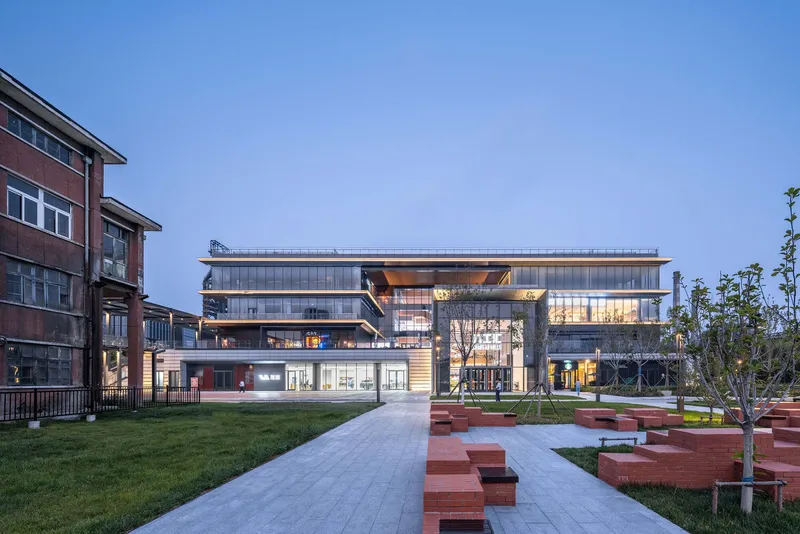
The twilight view of the glazed multi-level building facing its courtyard captures the project's ambition most concisely: illuminated interiors glow behind full-height glass while red brick seating elements anchor the foreground. Old and new materials coexist without the apologetic pastiche that often undermines adaptive reuse at commercial scale.
Construction and Structural Reinforcement


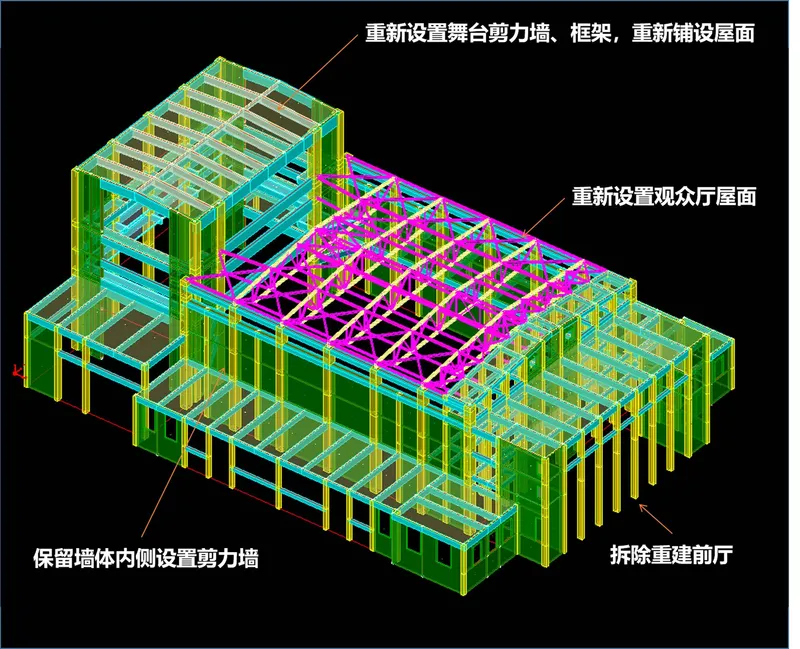
The construction photographs and structural diagrams expose the engineering backbone of the conversion. Foundation work and interior reinforcement of the brick warehouses reveal the extent of intervention needed to bring century-old industrial buildings up to contemporary commercial codes. Steel reinforcement frameworks for cylindrical volumes and color-coded framing diagrams with shear walls and roof truss systems show the project was not a cosmetic reskin but a deep structural overhaul.
These documents are worth lingering over because they illustrate the hidden cost and complexity of adaptive reuse. Every preserved brick chimney or retained timber truss required a corresponding structural strategy that is invisible in the finished photographs but fundamental to the project's integrity.
Plans and Drawings
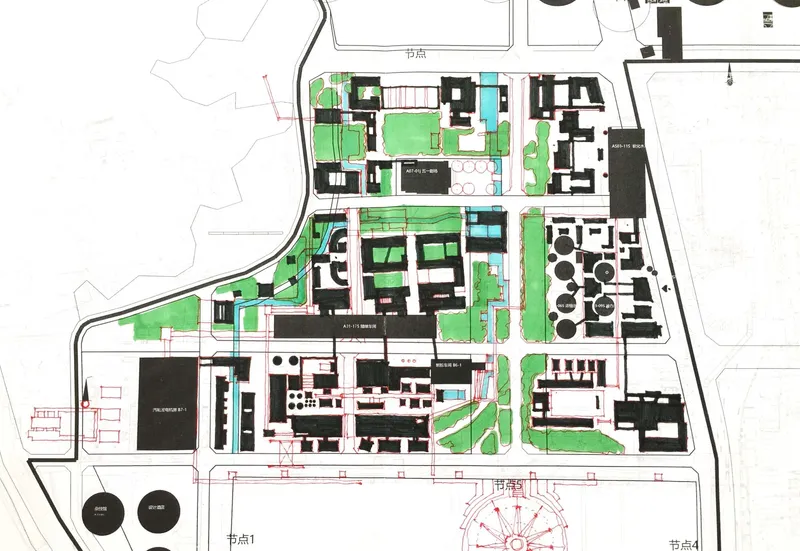
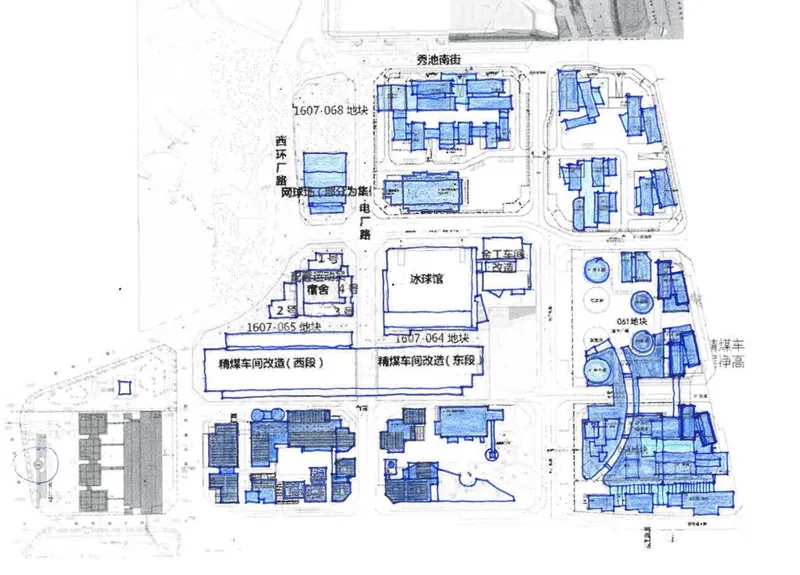
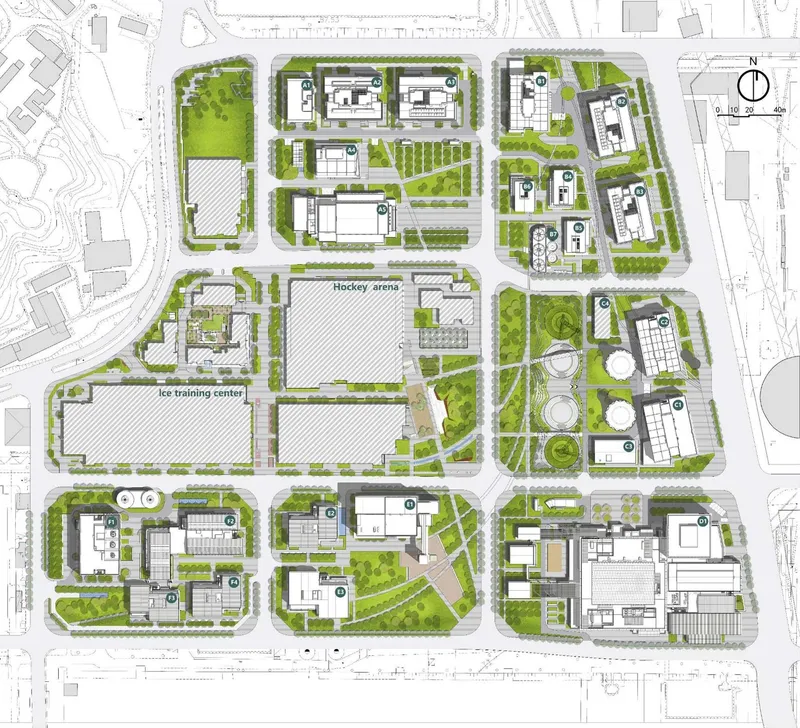


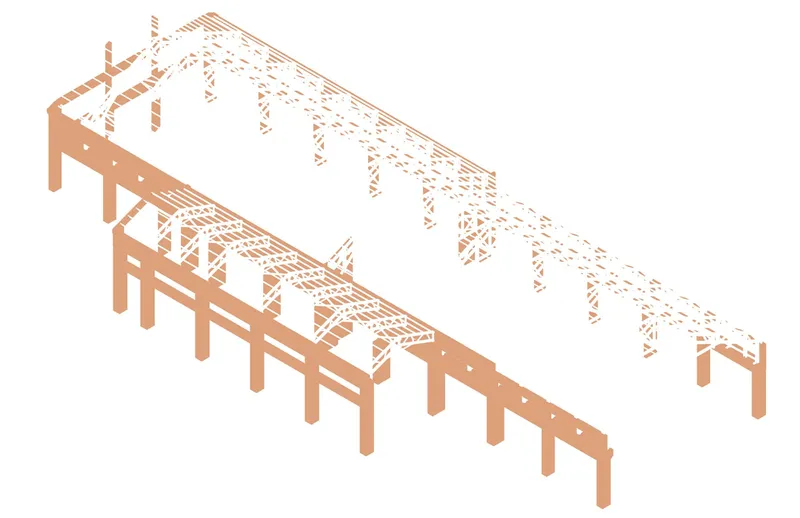
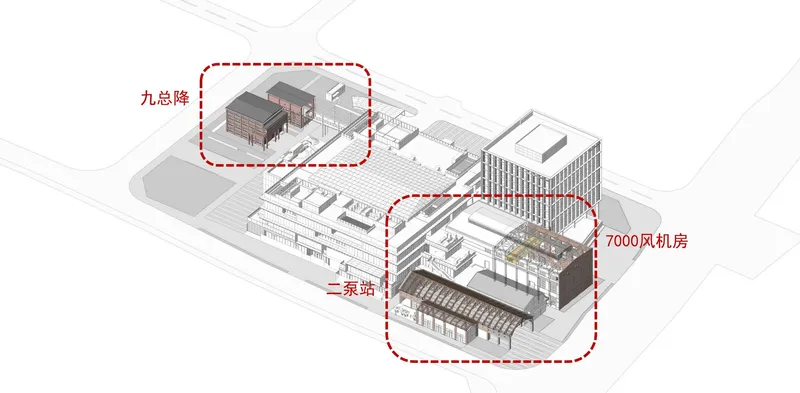
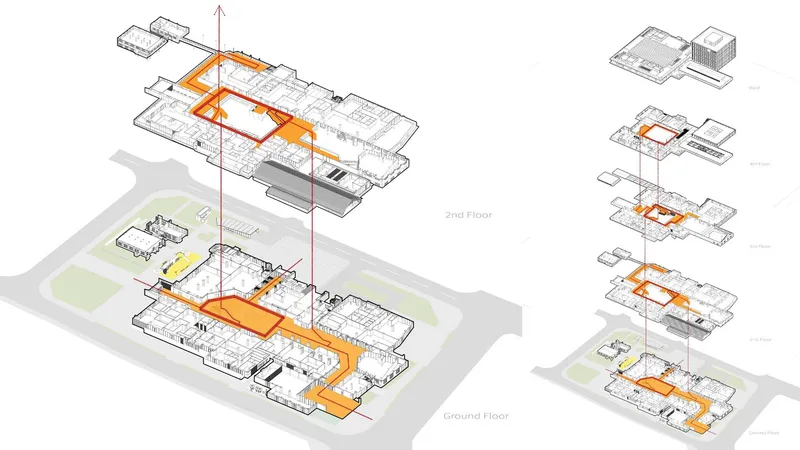


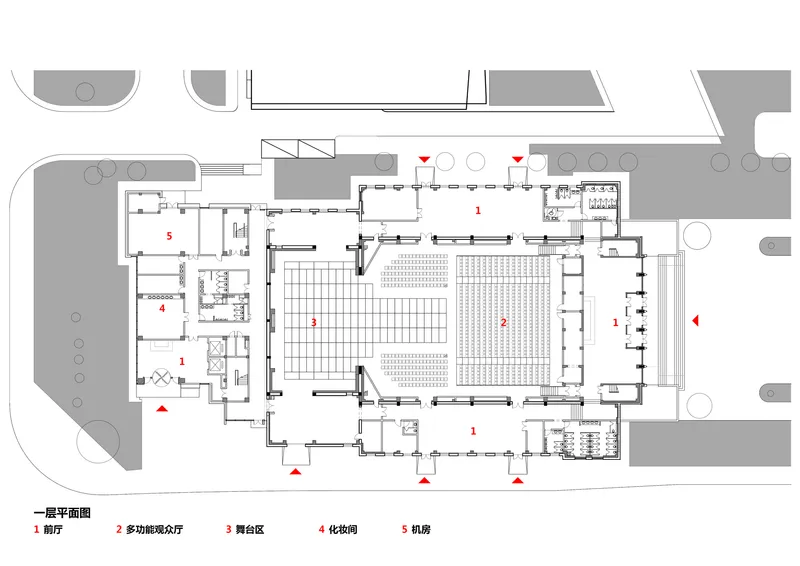
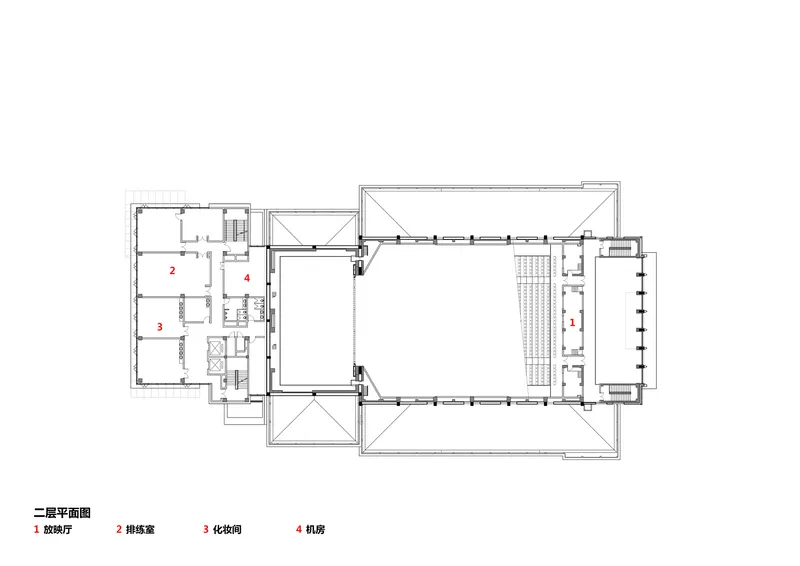



The drawing set is extensive and illuminating. Site plans reveal the dispersed campus logic, with building footprints scattered across multiple blocks linked by green corridors and circulation paths. Axonometric diagrams highlight preserved structures in red against new insertions, making the archaeological approach legible at a glance. Exploded axonometrics separate individual volumes with labeled programs, and floor plans from ground through third level trace the progression from large open halls at grade to more intimate dining and seating arrangements above. Sections cut through the campus confirm what the photographs suggest: the multi-story atriums and adjacent single-story trussed halls produce a varied roofline that reflects the original industrial variety rather than imposing a uniform datum.
The aerial renderings of the waterfront campus at dusk, with industrial towers silhouetted against a warm sky, capture the intended atmosphere of the completed district. These drawings, taken together, document a conversion methodology that treats each building as a distinct problem rather than applying a single template across the site.
Why This Project Matters
Liugong Hui matters because it tests whether adaptive reuse can operate at a scale typically reserved for tabula rasa development. At nearly a quarter-million square meters, the project is enormous, yet it managed to retain the spatial grain of the original industrial campus rather than replacing it with the hermetic interior corridors of a conventional mall. The standalone building strategy, each structure adapted with its own material palette and structural logic, creates a district rather than a destination. That distinction matters for the long-term life of the place: districts evolve, malls stagnate.
The project also offers a compelling model for post-Olympic urban renewal. Shougang's transformation from steel mill to Winter Olympics venue to commercial campus represents three distinct chapters, and Liugong Hui's contribution is to prove that the third chapter does not require erasing the first two. Brick chimneys, steel headframes, and timber trusses coexist with glazed retail boxes and landscaped plazas in a composition that feels neither nostalgic nor amnesiac. For cities grappling with decommissioned industrial sites, and there are many, the lesson is that scale and specificity can coexist if the architects are willing to do the work building by building.
Liugong Hui Mall by CCTN Design and Beijing Shougang International Engineering Technology. Located in Shijingshan District, Beijing, China. 223,753 m². Completed 2022. Photography by CreatAR Images, Xiaoguang Li, Zhang Jin PhotoGraphy Studio, Judi Huang, and Liugong Hui.
About the Studio
Share Your Own Work on uni.xyz
If projects like this are the kind of work you want to make, uni.xyz is a place to publish your own, find collaborators, and enter design competitions.


Popular Articles
Popular articles from the community


David Ortega Stacks a Two-Story Mexico City Penthouse Around a Steel Stair and a Pergola-Shaded Roof Terrace
In Colonia Roma, a 300 m² penthouse uses oak joinery, a planted steel stair and a slatted roof pergola to make a new-build apartment feel like a house.

Cube Design Draws an Ecological Corridor Between Two Shenzhen Hills with the Nankai Building
Beside Shenzhen's container docks, the Nankai Building pairs stacked balconies with a climbing green screen to connect two hillsides across its height.

Jaramillo Van Sluys Arquitectura and Urbanismo Turn a Demolished Registry Lot in Quito into an Orchard Plaza
In Quito's Centro Histórico, a 2,800 m² plaza exposes the San Agustín convent wall and redraws its lost Augustinian orchard in volcanic stone.

longwave studio Reorganizes a 112 m² Tainan Apartment Around the Daily Routines of a Family and Two Cats
In Tainan, Taiwan, birch plywood, rust-red furniture and a freestanding plaster wall link arrival, storage, work and family life in one apartment.

Similar Reads
You might also enjoy these articles


LAVA Architecten Gives Vocational Education a Sawtooth-Roofed Face on a Mechelen School Campus
In Mechelen, Belgium, a 2,053 m² STEM school on a 6×6 m grid turns workshops and classrooms into rooms that can be rearranged as teaching changes.

KEMA Studio Turns a Derelict Marvila Attic into a 60 m² Lighthouse Apartment Above Lisbon
In Lisbon's Marvila district, a rebuilt roof, four skylights and two plywood volumes turn an unlivable attic into a bright home facing the Tagus.

Pixel Gardens: One Repeated Module Stacked Into a Terraced Social Housing Tower for Famagusta
Salem Bader's shortlisted housing tower builds a vertical neighbourhood from one repeated module, offsetting units to carve terraces, light and air.

Bao Huynh Watercolor Atelier: A Serene Art Retreat in Hội An
Bao Huynh Watercolor Atelier in Hội An blends multifunctional art spaces, sustainable design, local materials, and family-friendly living in a serene environment.


Comments (0)
Please login or sign up to add comments
No comments yet. Be the first to comment!