
Celebrating Sake and Ceramics
Sake dates back several years in Japan’s history, discovered through man’s exploration of fermented rice. It has become a traditional drink for Japan, served in special ceramic vessels. As the world becomes more fast-paced and sake becomes mass-produced, the importance of these containers becomes forgotten and even the choice to drink sake submits to other alcoholic beverages. Through our design of a sake house, we hope to reignite the future generation’s respect and interest in the history of sake and ceramic pottery.
During the beginning of our process, the team wanted to focus on the contrast between day and night programs. Drinking and dining in the sake house is typically an evening event, so we wanted to incorporate some sort of activity to allow users to make use of the space while the sun is up and still stick around for when the sake house opens at night. Customers would have the option of going upstairs to the ceramic studio to learn to make sake bottles and cups with their own hands and when they finished, they could celebrate their hard work by returning downstairs for some good drinks and food. The process of firing the clay and finishing the cups takes roughly half a day, so the business can create an incentive for customers and give them a free drink if they come back that night or another night and use their own creations.
The issue with sake houses is that they can feel old and out of trend for the new generation to want to drink there. By incorporating a pottery studio into the house, it transforms the place into a city attraction; perfect for dates, friendly gatherings, or a tourist experience. Ceramics has also become a popular craft, especially due to the young generation’s desire to find new skills after feeling trapped at home because of the recent pandemic. Learning about sake and how to make ceramic sake bottles gives people a way to relax and get away from the fast-paced lifestyle of Osaka, Japan.
In this sake house, the culture and history of sake being stored in the classic ceramic bottles are respected and celebrated throughout the space, having many display shelves to show creations made by customers. Wood is the primary material used for the building to maintain the traditional style of Japanese architecture. The form and geometry of the space are simple and sleek so as to not distract from the pottery on display.
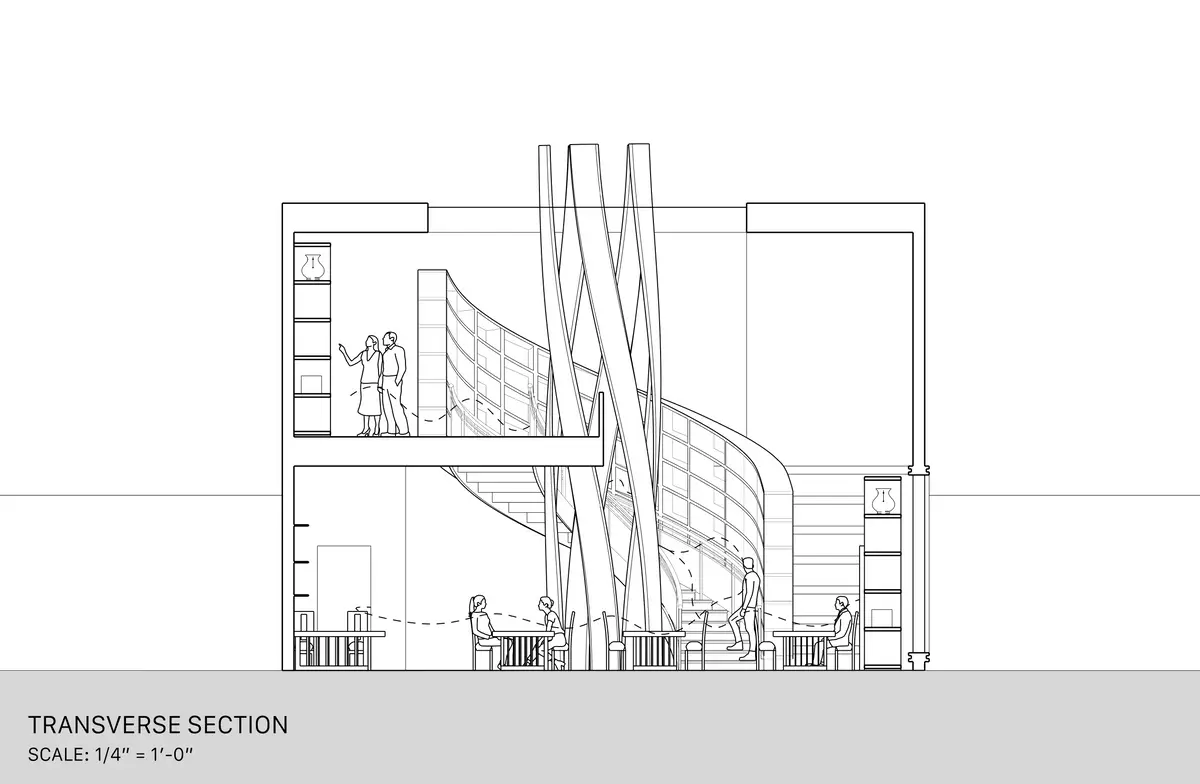
The main visual attraction of the sake house is the spiral sculpture connecting the sake space to the studio space. It climbs through both floors and shoots out through the skylight, creating a light tunnel. The spiral alludes to the sake bottle-making process, with the form being the “spinning fire” that ceramics must go through before entering the dining area. The spiral is a crucial part of keeping the sake house trendy, as it allows for a great photo opportunity for young people to post on social media. Social media is a powerful tool of the current age that can advertise the sake house to people all over the world. Customers should be encouraged to post pictures of themselves in front of the spiral or of the ceramics they made to show their friends and family, publicizing the sake house even more.
The programs are layered so that the dining and drinking-focused spaces are kept downstairs while the ceramic-focused spaces are put upstairs to make use of the skylight. Since sake drinking is commonly a nighttime event, the space does not make use of natural lighting as the studio space does. Keeping the pottery-making area upstairs allows full use of the skylight and windows to work without having to use artificial lighting for the customers to see what they are working on. The house is positioned so that the building's apertures are mostly north facing, providing soft, indirect light during the day. Direct light would cause the space to get too warm during the summer, which is especially important in the studio space since the kilns and furnaces to fire the clay are already contributing a lot of heat gain to the space.
This sake house design hopes to provide a comfortable environment for its customers while they are having fun making ceramics during the day and drinking sake during the night. Sake houses are an important part of Japanese culture, so transforming the house to be more inviting and relevant for young people is essential in keeping the tradition alive for generations to come.

Popular Articles
Popular articles from the community

Temporary Home for Dogs: A Reversed Zoo Rethinks Animal Shelter Architecture
In Bucharest, a sinuous corridor and freed landscape flip the logic of containment, designing a shelter that works to make itself unnecessary.

Singing Woman: An Opera House That Performs Before the Curtain Rises
Ovidiu Cristian Pavel's conceptual opera house translates Estonia's choral identity into a sculpted waterfront landmark facing the Baltic Sea.

Cloaked Colonization: A Mobile Underwater Habitat That Moves Like a Fish
Micah Abaya's shortlisted EHC Pacific entry reimagines ocean settlement as a dispersed network of self-sustaining architectural organisms.
Extended Shell: Retrofitting Kolkata's Balconies as Living Urban Thresholds
A modular retrofit system recovers the social and environmental intelligence of Kolkata's historic verandas for contemporary Park Street residents.

Similar Reads
You might also enjoy these articles

Shakur's House: Exposed Brick as an Interior Organiser in a 168 m² Mashhad Residence
Brick moves indoors in this Mashhad residence, where masonry walls, glass partitions and teal planes sequence a compact home without closing it off.

Day and Night Park: A Time-Based Urban Newsstand in Beijing
A temporary urban newsstand in Beijing blending travel, light, and reading through poetic colors, compact form, and community-focused design.

Modernist Patio Renovation in El Masnou, Barcelona by Oliver Segura Arquitectura + Cebrià Arquitectura
Modernist patio renovation blending tradition and innovation with a movable pool, leveled floors, and Catalan materials in El Masnou.

Alto Residencial Coop: Cooperative Housing Development in Santiago de Compostela by Carbajo Barrios Arquitectos
A linear cooperative housing complex blending white volumes and perforated metal façades, enhancing community living, natural light, privacy, and urban integration.


Comments (0)
Please login or sign up to add comments
No comments yet. Be the first to comment!