

Home On A Leaf
The senior center project in Kielnarowa combines residential, recreational, educational, and cultural functions, promoting an active and sustainable lifestyle. The complex consists of several building

The aim of this engineering thesis was to develop a design for a senior center in the small village of Kielnarowa near Rzeszów. Due to the phenomenon of aging populations, the demand for round-the-clock senior facilities is increasing. Existing facilities of this type are often adapted only to the basic physiological needs of elderly people. There is also a tendency to isolate such centers from society, which in the long term may lead younger generations to lose a sense of understanding of this social group. The designed center is an attempt to address these issues.
Old age is not the end, it is also an interesting journey
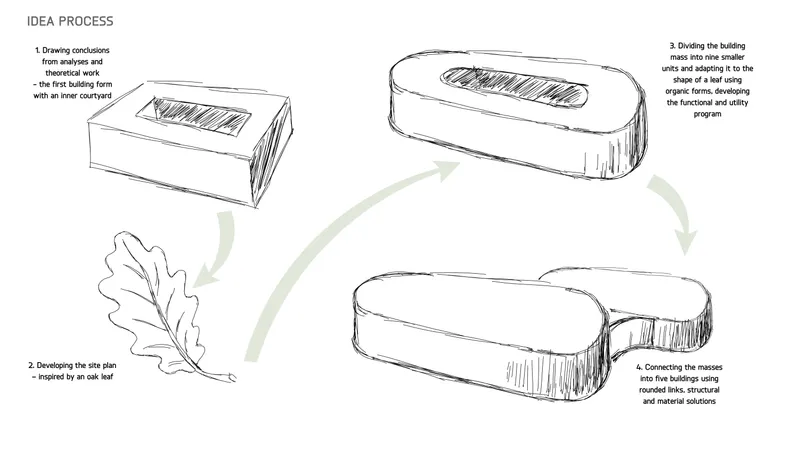
The main idea was to create a place that responds not only to the basic needs of seniors but also provides opportunities for an active lifestyle and self-realization, while introducing elements of integration between older adults and the local community. The concept is intergenerational – combining residential, recreational, educational, medical, and cultural functions, becoming a hub of local community life. The architectural form refers to nature – the urban layout is inspired by the shape of an oak leaf, a metaphor for the autumn of life and wisdom, while the organic forms of the five buildings echo the soft lines found in nature.
Location
The proposed senior center in Kielnarowa is planned on land previously used for agriculture, surrounded by single-family houses and neighboring a university campus. Open views of the gentle hills of the Dynów Foothills contribute to creating a welcoming space conducive to a calm and active life.
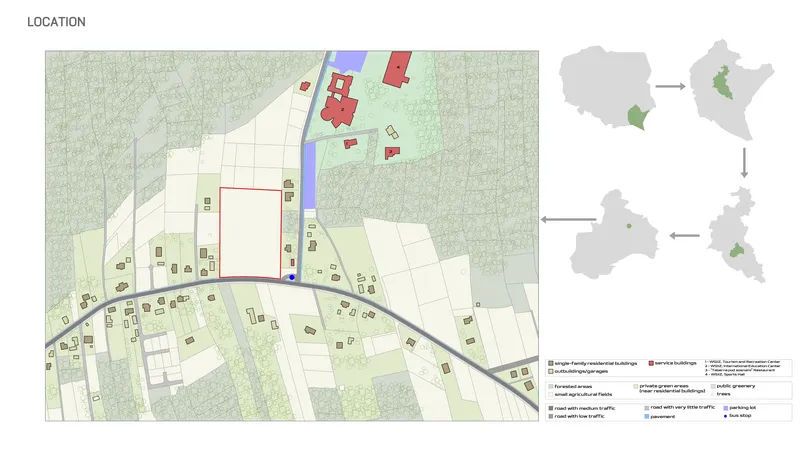
Urban layout and building plan
The space between the buildings functions as an active therapeutic garden. Sensory, retention, flower, and vegetable gardens have been designed, whose diversity supports both residents’ well-being and local biodiversity. Biologically active areas cover over 30% of the site, and newly introduced plantings – including an orchard – create a microclimate and spaces for daily activity. Brine graduation towers and a retention pond have also been introduced, serving both health and ecological purposes by retaining rainwater.
Each of the center’s buildings implements a shared functional base (residential rooms, kitchenettes, rehabilitation rooms, dining areas, technical rooms), while also featuring additional functions that support integration and personal development. Thus, artistic and craft spaces, a library and computer rooms, an ecumenical chapel, a health center, and an auditorium with conference facilities have been created. This makes the facility a place for meetings and experience exchange between generations.
Idea process and sustainable space
The design process was based on an analysis of local conditions and the needs of seniors. The concept of a single massive building was abandoned in favor of several smaller buildings, which better fit the context of single-family housing and help maintain an intimate atmosphere. The terrain was used to create a varied space, and all circulation solutions – including parking, fire access roads, and pedestrian paths – were subordinated to the principle of accessibility.
Low vegetation was placed on the roofs. Permeable path surfaces reduce the urban heat island effect, and rain gardens and the retention pond support the local water cycle. The introduction of biologically active areas in a radial layout increases infiltration area and improves air quality. The center promotes a sustainable lifestyle – vegetable gardens can be cultivated by residents, strengthening the sense of community and enabling the use of local resources. The facades include natural elements such as wood, complemented by light beige mineral plaster.
Summary
The overall concept aims to create a harmonious space that combines functionality with ecological responsibility and social sensitivity. The project is designed not only to provide seniors with comfort and safety but, most importantly, to give them the opportunity for an active, meaningful life in close connection with nature and in open dialogue with other generations.

Popular Articles
Popular articles from the community


Singing Woman: An Opera House That Performs Before the Curtain Rises
Ovidiu Cristian Pavel's conceptual opera house translates Estonia's choral identity into a sculpted waterfront landmark facing the Baltic Sea.

Tsunami Convergenics: Turning Catastrophic Ocean Forces into Underwater Housing Infrastructure
A speculative underwater settlement off the coast of Onagawa, Japan, treats tsunamis and typhoons as energy sources rather than threats.

The Amber Palace Opera: A Geological Fiction Surfaces on Tallinn's Baltic Waterfront
Pierre Brillard reimagines a Baltic legend as a public landscape, opera house, and waterfront promenade rooted in Tallinn's coastal identity.

Extended Shell: Retrofitting Kolkata's Balconies as Living Urban Thresholds
A modular retrofit system recovers the social and environmental intelligence of Kolkata's historic verandas for contemporary Park Street residents.

Similar Reads
You might also enjoy these articles

Shakur's House: Exposed Brick as an Interior Organiser in a 168 m² Mashhad Residence
Brick moves indoors in this Mashhad residence, where masonry walls, glass partitions and teal planes sequence a compact home without closing it off.

Day and Night Park: A Time-Based Urban Newsstand in Beijing
A temporary urban newsstand in Beijing blending travel, light, and reading through poetic colors, compact form, and community-focused design.

Modernist Patio Renovation in El Masnou, Barcelona by Oliver Segura Arquitectura + Cebrià Arquitectura
Modernist patio renovation blending tradition and innovation with a movable pool, leveled floors, and Catalan materials in El Masnou.

Alto Residencial Coop: Cooperative Housing Development in Santiago de Compostela by Carbajo Barrios Arquitectos
A linear cooperative housing complex blending white volumes and perforated metal façades, enhancing community living, natural light, privacy, and urban integration.


Comments (0)
Please login or sign up to add comments
No comments yet. Be the first to comment!