

HARLEM USTOPIA
Reclaiming through Synthetic Regrow

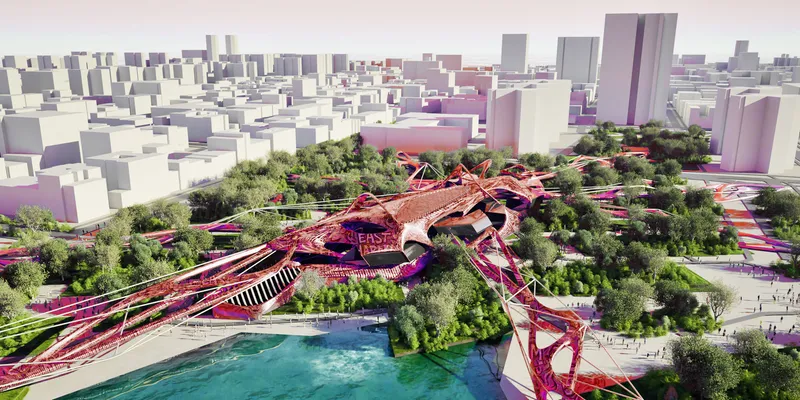
In a future shaped by systemic collapse and targeted displacement, Harlem Ustopia proposes an alternative narrative — one where community survival is not just a reaction to destruction, but an act of collective evolution. Set in East Harlem, the project imagines a future where technology, memory, and resilience are used to regrow what was lost.
A Targeted Community
In the early 21st century, East Harlem remained a vibrant, diverse neighborhood — a center of cultural strength and grassroots activism. When resistance movements against authoritarian policies gained momentum, East Harlem became a clear target. Under the cover of redevelopment laws, the government forcibly displaced thousands by demolishing large sections of project housing. What was left behind was a landscape of emptiness: a deliberate void where community ties had once been strongest.
Rather than surrender to displacement, the remaining residents adapted, using accessible emerging technologies to begin reconstructing their community from the ground up — but on their own terms.
The Beginning of Regrowth
Harlem Ustopia starts at the epicenter of destruction — the demolished housing block along the Harlem River. Instead of traditional rebuilding, a new system emerges: a synthetic spatial network that spreads outward like a living organism, reconnecting fragmented pieces of the neighborhood.
Using autonomous robotics, modular systems, and reconfigurable materials, residents initiated a new type of construction that prioritized flexibility, adaptability, and collective ownership.
Spatial Strategy
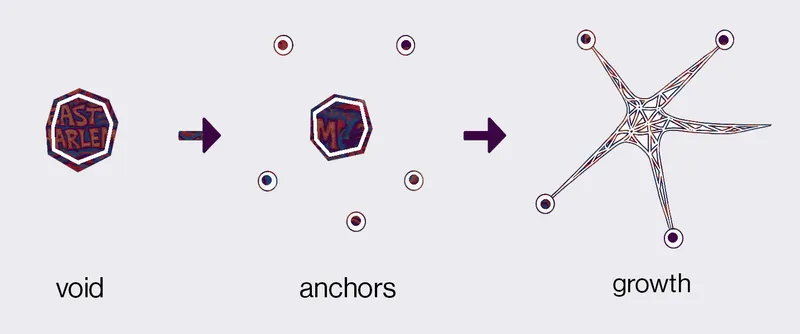
The project strategy is based on three moves:
- Void: The demolished landscape acts as a seed site, where spatial energy and memory converge.
- Points: Community anchors — memory sites, green spaces, and public corridors — are reconnected through a network of pathways.
- Growth: A flexible structure grows outward, layering new public spaces, gathering points, and housing modules across the site.
This new urban fabric bridges old and new, memory and future, body and machine.
Mapping the System
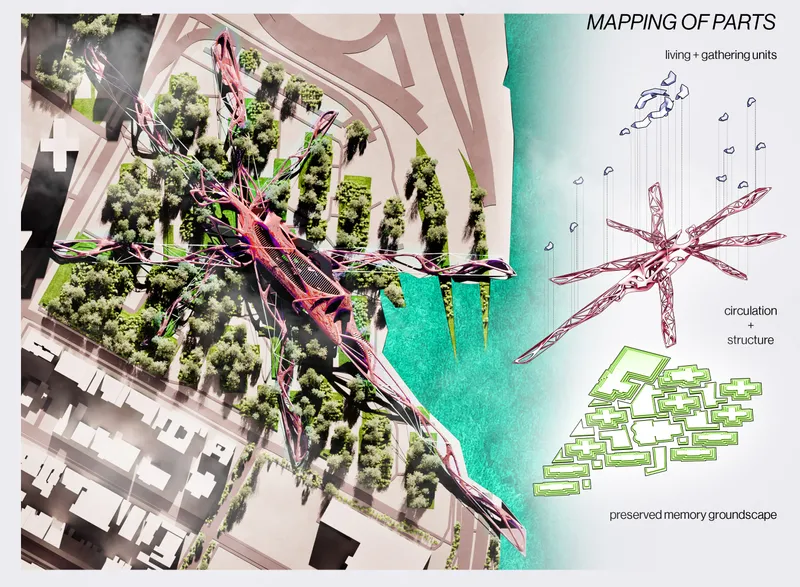
Harlem Ustopia is organized through three interconnected layers:
- Modules: Lightweight, reconfigurable units serve as gathering spaces, workshops, markets, and living quarters.
- Network: A structural canopy that connects the modules, weaving movement paths across the site and creating shaded, semi-enclosed public spaces below.
- Past Landscape: Elements of the old neighborhood — street grids, topography, riverfront access — are preserved and reactivated as part of the greenscape accessible to the public..
Through this mapping, the architecture becomes an extension of community memory, not a replacement of it.
Design Concept
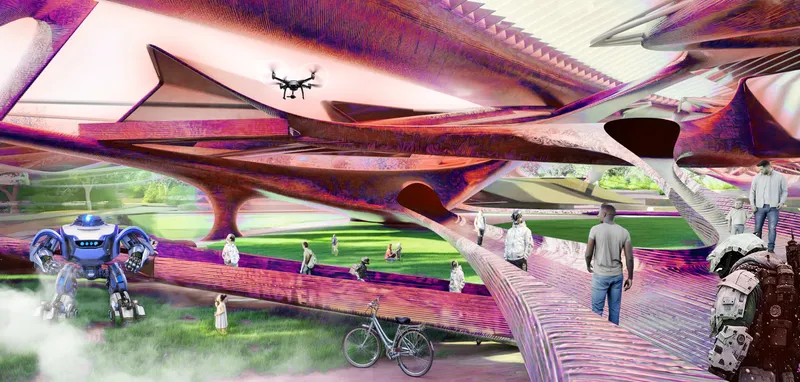
The architecture grows by reacting to both the physical and emotional landscape. Public parks and gathering spaces emerge at the ground level, stitched together by an overhead structure that provides shelter, circulation, and access to elevated modules.
Movement through the project is layered: starting at civic spaces, rising through recreation zones, and culminating in private modular living spaces. This vertical arrangement allows for a continuous experience of public engagement, social gathering, and private retreat, depending on the needs of the community.
The modularity ensures the system can keep adapting — expanding or contracting over time as the community evolves.
Technology and Adaptation
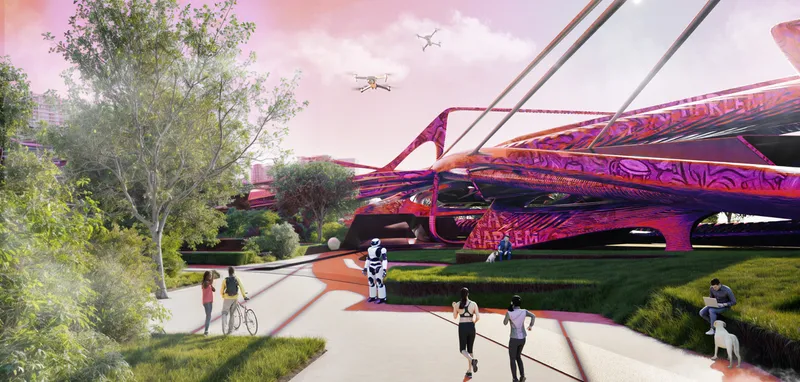
In this imagined future, technology becomes a tool for survival rather than control. Autonomous drones and ground-based robotic builders are visible throughout the environment, maintaining, adjusting, and expanding the network as needed.
Instead of a single master plan, the growth is dynamic, reacting to changes in community needs, environmental pressures, and available resources. Synthetic materials used for the network structures are fabricated from local recycled matter, embedding sustainability into the construction itself.
Here, technology is decentralized — no longer the exclusive domain of corporations or governments, but a system maintained by the people, for the people.
Atmosphere and Experience
The new neighborhood feels alive. Filtered light passes through the porous network, creating dynamic plays of shadow over parks and pathways. Cyclists and pedestrians move freely along fluid routes, while gathering spaces open up beneath sweeping structural arms. The landscape is rich with native plantings, riverfront parks, and small patches of urban farming.
Children play in open fields, seniors rest under shaded groves, and autonomous maintenance drones move overhead, ensuring the synthetic ecosystem remains in balance.
Instead of the rigid zoning of the old city, Harlem Ustopia is built for constant movement, connection, and adaptation.
Accessibility and Public Life
Every space is universally accessible. Ground paths are level and continuous, ramps are integrated into the network structure, and gathering spaces are open to all. There is no front door or gate — the network itself is the invitation.
Public life is prioritized at every level: markets, performances, small festivals, community events. Even the private modules are configured to maintain proximity to shared spaces, preventing isolation and encouraging everyday encounters.
The Result
Harlem Ustopia is not just an architectural project — it is a political and cultural act. In a future where communities are targeted and erased, the project imagines not a return to the past, but a leap forward into a new form of collective life. Through synthetic regrowth, technological autonomy, and spatial resilience, the community of East Harlem reclaims its right not just to exist, but to thrive.

Popular Articles
Popular articles from the community


Opera on the Sea: Driftwood Logic Shapes a Timber Opera House on Estonia's Coast
Trevor Orgill's opera house translates the entangled drift of floating timber into a civic building where wood, water, and music converge.


FCC Arquitectura Expands a Portuguese Granite House with a Board-Marked Concrete Wing
In Portugal, JV House pairs a cleaned-up whitewashed and granite dwelling with a timber-shuttered concrete extension, courtyards and a garden pool.

Singing Woman: An Opera House That Performs Before the Curtain Rises
Ovidiu Cristian Pavel's conceptual opera house translates Estonia's choral identity into a sculpted waterfront landmark facing the Baltic Sea.

The Amber Palace Opera: A Geological Fiction Surfaces on Tallinn's Baltic Waterfront
Pierre Brillard reimagines a Baltic legend as a public landscape, opera house, and waterfront promenade rooted in Tallinn's coastal identity.

Similar Reads
You might also enjoy these articles

Vereda Arquitetos Renovates a 40-Square-Meter Apartment Inside Niemeyer's Copan Building
A compact unit in São Paulo's most iconic residential tower gets a material overhaul that pairs exposed concrete with bold blue Formica.

Shakur's House: Exposed Brick as an Interior Organiser in a 168 m² Mashhad Residence
Brick moves indoors in this Mashhad residence, where masonry walls, glass partitions and teal planes sequence a compact home without closing it off.

Day and Night Park: A Time-Based Urban Newsstand in Beijing
A temporary urban newsstand in Beijing blending travel, light, and reading through poetic colors, compact form, and community-focused design.

Modernist Patio Renovation in El Masnou, Barcelona by Oliver Segura Arquitectura + Cebrià Arquitectura
Modernist patio renovation blending tradition and innovation with a movable pool, leveled floors, and Catalan materials in El Masnou.


Comments (0)
Please login or sign up to add comments
No comments yet. Be the first to comment!