

MOTION
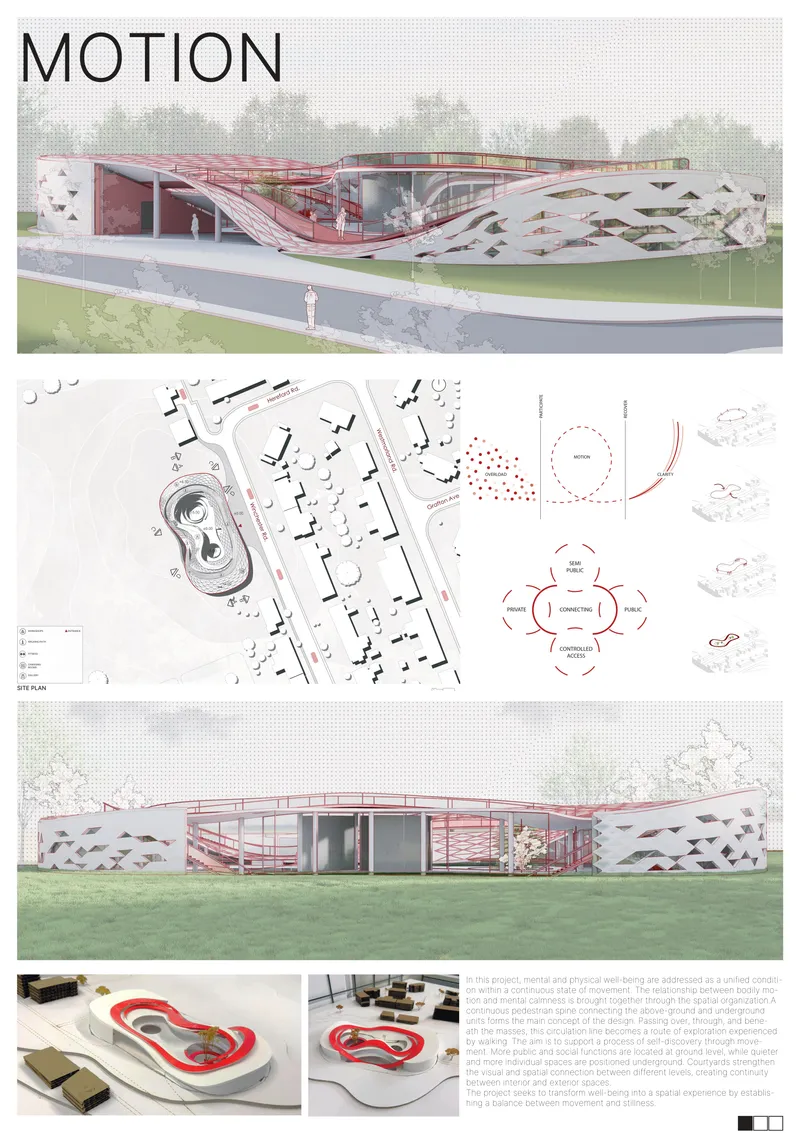
This project explores well being through movement. A continuous loop guides users through shifting spatial conditions, connecting public and introspective spaces. By integrating the urban ground and elevating parts of the path, movement becomes a tool for mental clarity and spatial experience.
In this project, mental and physical well being are approached as a unified condition shaped through continuous movement. The design is grounded in a simple yet powerful observation, when individuals feel mentally overwhelmed, they instinctively turn to walking. Whether in streets or parks, walking allows thoughts to settle, offering a natural process of self regulation. Building upon this idea, the project reinterprets movement not merely as a physical action, but as a therapeutic tool. This approach is encapsulated in the project’s name, “MOTION” meaning continuous motion and transformation.
Rather than treating circulation as a secondary or supportive element, the design is structured around a continuous pedestrian spine that generates space, experience, and program. This uninterrupted loop becomes the primary architectural system, guiding users through a sequence of spatial conditions that evolve gradually. It is not simply a path to move along, but a spatial framework that encourages reflection, awareness, and mental transition. Through movement, users engage in a process of self discovery, where physical motion and mental clarity become intertwined.
To strengthen its relationship with the urban context, the project integrates the existing sidewalk into the building. By pulling the pavement inside, the boundary between city and architecture is softened, allowing users to enter the structure seamlessly as part of their everyday movement. This gesture invites spontaneity and inclusivity, ensuring that the building is not perceived as an isolated object, but as an extension of the urban fabric. In contrast, another segment of the path is elevated above ground level, creating a visual connection with the surroundings and establishing a new perspective over the context. This dual strategy absorbing the ground and rising above it creates a dynamic dialogue between the building and its environment.
The program is organized around a balance between public and more specialized functions. A portion of the building operates as a public, accessible space that encourages social interaction, while another part functions as a more controlled sports center, supporting physical activity and movement. This duality reinforces the idea that well-being is both individual and collective, requiring spaces for interaction as well as moments of personal focus.
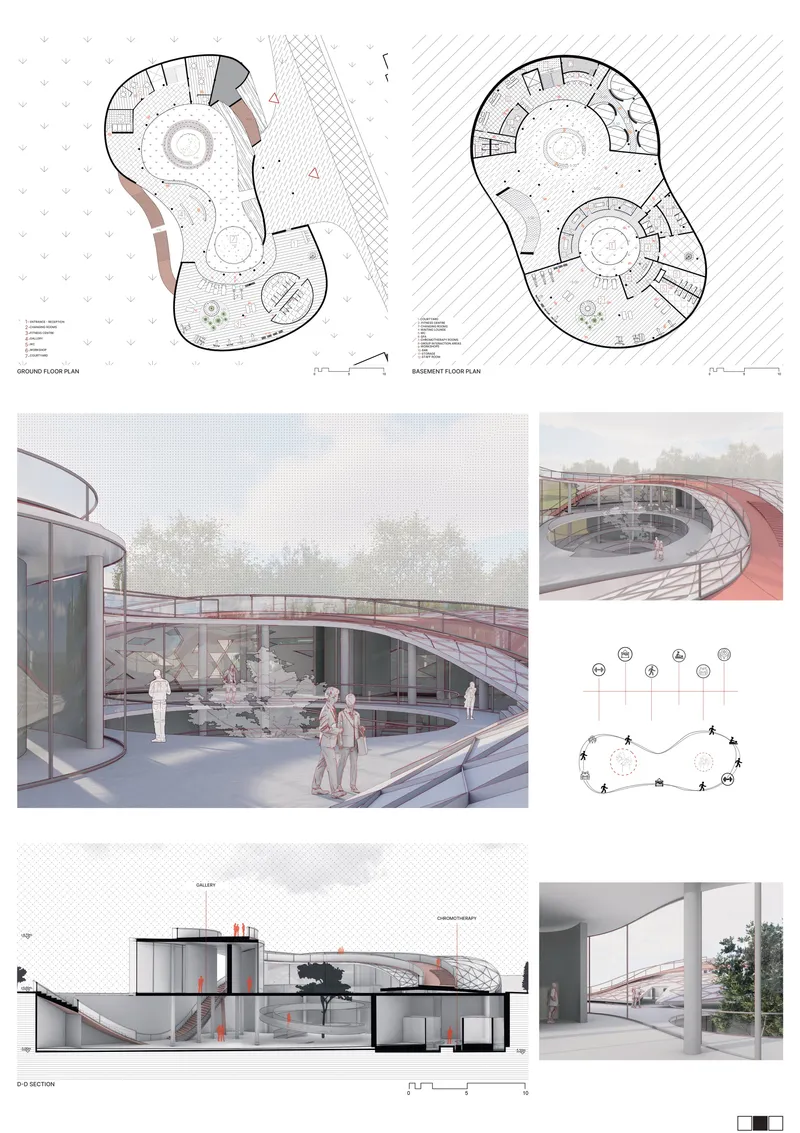
A significant part of the project is located underground, where quieter and more introspective spaces are positioned. To avoid isolation and enhance spatial continuity, two courtyards are introduced, bringing natural light, air, and visual connection into the lower level. These courtyards act as anchors that tie the underground spaces to the surface, preventing disconnection and creating a continuous spatial experience. Vertical circulation is deliberately multiplied and distributed across the building, allowing users to access different levels from various points and strengthening the relationship between ground and underground spaces.
Workshops play an important role in engaging the local community, inviting residents to participate in daily activities and fostering a sense of belonging. These spaces are complemented by exhibition areas, where the outcomes of the workshops can be displayed, creating a cycle of production and presentation. In this way, the building becomes not only a place of movement, but also a platform for creativity and social interaction.
The continuous path is designed with a very gentle slope, ensuring accessibility for a wide range of users, including pedestrians, cyclists, skaters, elderly individuals, and people with disabilities. This inclusivity reinforces the idea that movement and therefore well being should be available to everyone, without restriction. The path becomes a shared ground where different users coexist and experience the space at their own pace.
In addition to physical activity, the project explores alternative approaches to mental well being through sensory experience. Chromotherapy rooms are introduced as experimental spaces where color is used as a medium for emotional and psychological influence. By incorporating such unconventional methods, the project expands the definition of therapy beyond traditional frameworks, offering users new ways to engage with their mental state.
Supporting functions such as storage, technical rooms, and service areas are integrated into the system without disrupting the overall spatial continuity. These elements ensure the functionality of the building while remaining secondary to the primary concept of movement.
Ultimately, the project reframes well-being not as a static condition, but as an ongoing process that emerges through movement, spatial experience, and sensory interaction. By establishing a continuous loop that connects different levels, programs, and user groups, the design transforms walking into an architectural and therapeutic act. The balance between motion and stillness, public and private, ground and underground, defines the core of the project, allowing users to engage with space as an active participant in their own mental and physical transformation.


Popular Articles
Popular articles from the community

Tsunami Convergenics: Turning Catastrophic Ocean Forces into Underwater Housing Infrastructure
A speculative underwater settlement off the coast of Onagawa, Japan, treats tsunamis and typhoons as energy sources rather than threats.

Singing Woman: An Opera House That Performs Before the Curtain Rises
Ovidiu Cristian Pavel's conceptual opera house translates Estonia's choral identity into a sculpted waterfront landmark facing the Baltic Sea.
Faces of the Soviet Avant-Garde: Turning Moscow's Street Names into an Open-Air Museum
A network of sculptural installations across a Moscow residential district transforms forgotten architect names into spatial encounters with cultural memor

Opera by the Sea Estonia: Three Shells Dissolving Architecture into Tallinn's Coastline
A winning opera house proposal replaces monumental form with interconnected shells that blur the boundary between building, park and Baltic Sea.

Similar Reads
You might also enjoy these articles

Shakur's House: Exposed Brick as an Interior Organiser in a 168 m² Mashhad Residence
Brick moves indoors in this Mashhad residence, where masonry walls, glass partitions and teal planes sequence a compact home without closing it off.

Day and Night Park: A Time-Based Urban Newsstand in Beijing
A temporary urban newsstand in Beijing blending travel, light, and reading through poetic colors, compact form, and community-focused design.

Modernist Patio Renovation in El Masnou, Barcelona by Oliver Segura Arquitectura + Cebrià Arquitectura
Modernist patio renovation blending tradition and innovation with a movable pool, leveled floors, and Catalan materials in El Masnou.

Alto Residencial Coop: Cooperative Housing Development in Santiago de Compostela by Carbajo Barrios Arquitectos
A linear cooperative housing complex blending white volumes and perforated metal façades, enhancing community living, natural light, privacy, and urban integration.

Explore Kinetic Architecture Competitions
Discover active competitions in this discipline


Challenge to reimagine the Iron Throne

Photograph architecture without architects

Illustrate the lost glory of Angkor Wat - Render Challenge

Design challenge to reuse E-waste
Comments (0)
Please login or sign up to add comments
No comments yet. Be the first to comment!