

SYSTEM Architects and EKNC Build a Concrete Retreat Around Memory and Water in Bangladesh
On the banks of the Shitalakha River near Dhaka, CHAABI House turns longing into architecture through water, timber, and raw concrete.


About thirty minutes from the relentless density of Dhaka, the land along the Shitalakha River flattens out into something quieter. It is here, in Rupganj, Narayanganj, that SYSTEM Architects and EKNC, led by architect Enamul Karim Nirjhar, have completed CHAABI House: a 1,035 square meter concrete residence for the Alam family that treats water, light, and personal memory as genuine building materials. The name "CHAABI" translates from Bengali as "wanting something," and the house is organized around that restless desire, channeling it into a sequence of spaces that never quite let you settle into routine.
What makes CHAABI House worth serious attention is not its material palette, which is deliberately restrained, but the spatial logic it uses to collapse the boundary between interior comfort and landscape. A reflecting pool threads through the ground floor, open to the sky, turning the living room into a kind of inhabited veranda. Board-formed concrete walls frame views of the river and surrounding greenery without competing with them. The house is simultaneously heavy and porous, monolithic and open. That tension is the project's real subject.
Water as Organizing Principle
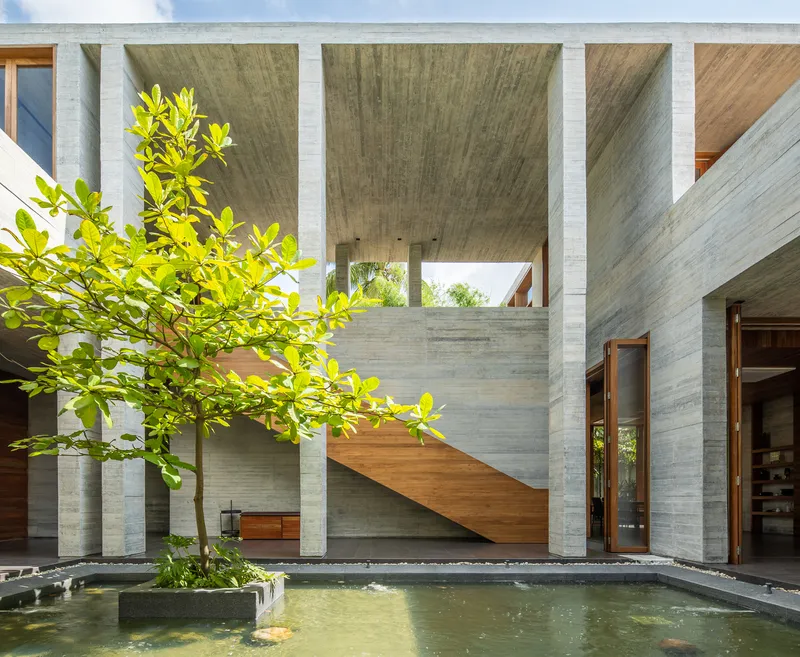
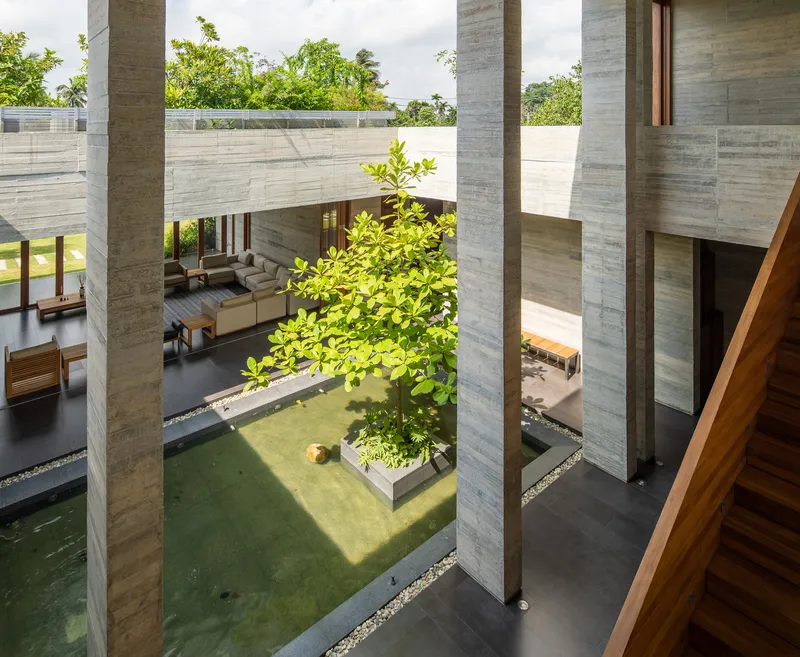
The reflecting pool at the heart of the plan does more than look good in photographs. It acts as a spatial hinge, separating the public zones of the ground floor from the more private wings while maintaining visual continuity between them. A planted tree rises from a concrete planter in the water, anchoring the composition and giving the courtyard a sense of age that raw concrete alone cannot provide. From the upper level, you read the entire ground floor arrangement as a series of rooms organized around this single body of water, each one open to it in a slightly different way.
A narrow walkway runs alongside the pool, forcing a deliberate pace before it opens onto a larger outdoor area. The house also sits near a natural pond, so water appears at multiple scales: the intimate reflecting pool, the swimming pool for the family, and the broader riparian landscape of the Shitalakha beyond. Water is not decorative here. It sets the tempo of the entire plan.
Concrete and Timber in Conversation
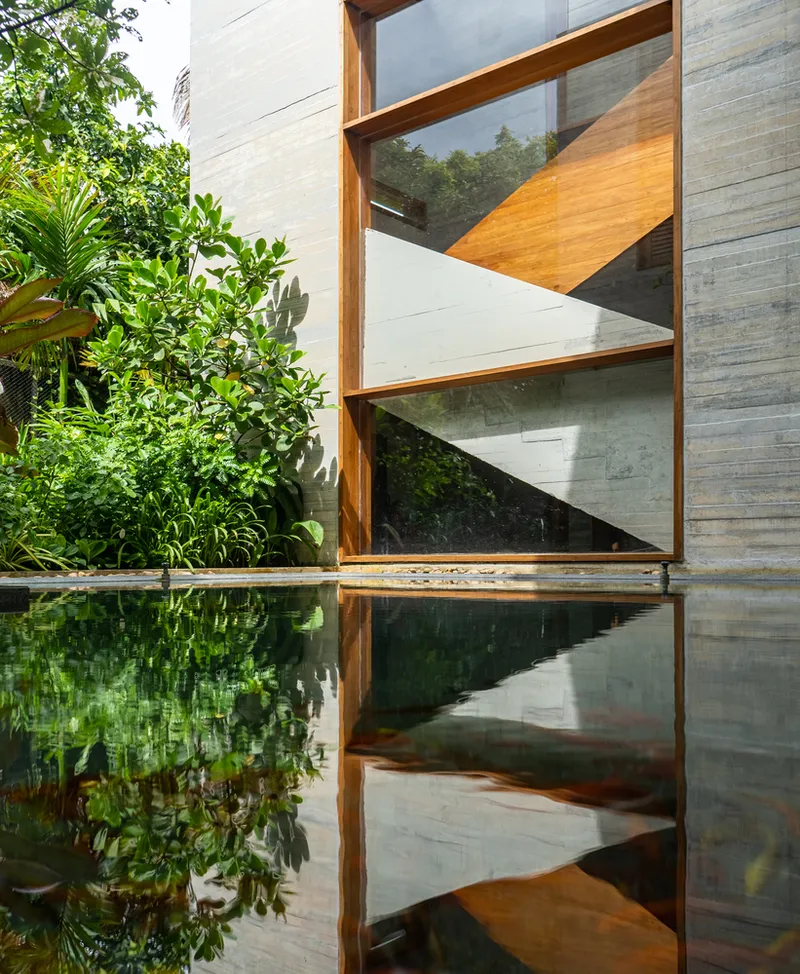
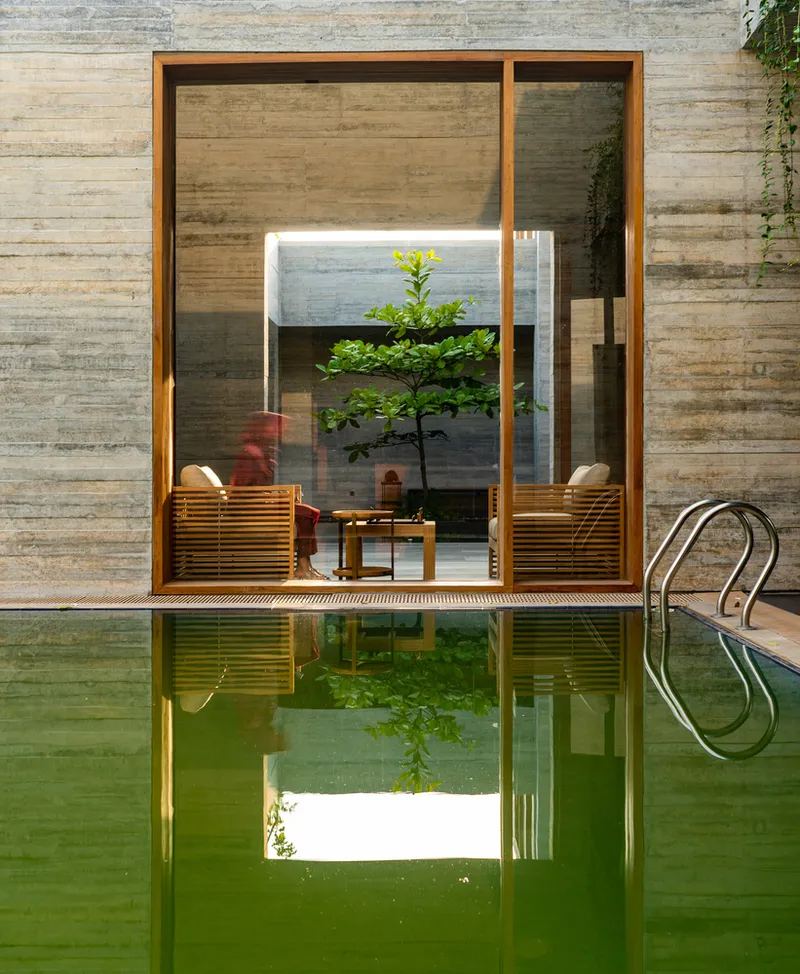
The material strategy is deliberately binary. Board-formed concrete provides the structural envelope: walls, ceilings, and the heavy volumes visible from the garden. Mahogany timber fills the openings, appearing as window frames, louvers, folding doors, and the stair cladding around the courtyard. The grain of the wood picks up and softens the texture left by the formwork, so the two materials read as complementary rather than contrasting. Grill-free glass panes sit behind the timber frames, allowing uninterrupted sightlines and filtered daylight without the visual clutter of security bars that are ubiquitous in the region.
Where the timber meets water, the effect intensifies. Reflections double the warm tone of the mahogany against the cool green of the pool surface, producing moments that shift with the time of day and the weather. It is a simple trick, but it works because the architects commit to it fully, keeping the material count low enough that every meeting of surface and light registers clearly.
Living Room as Threshold
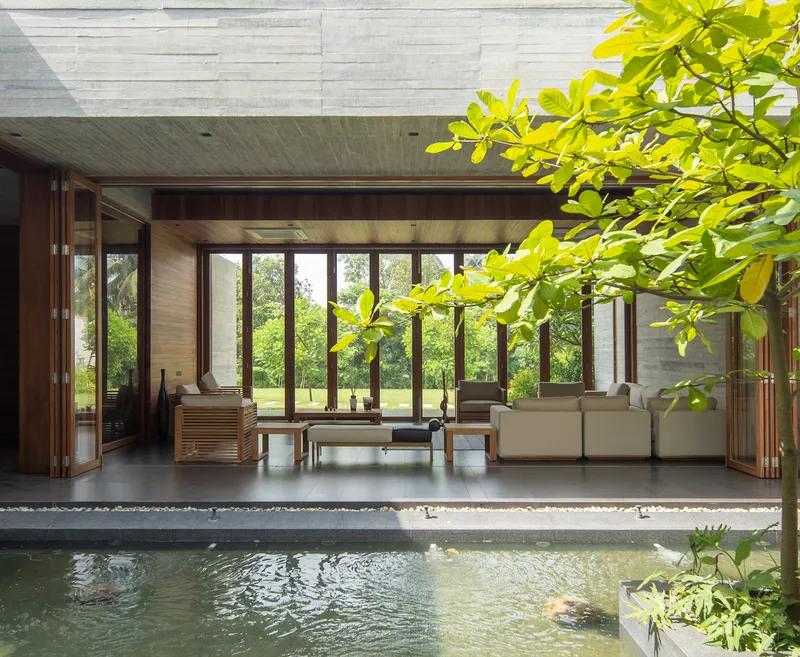
The ground floor living room is the most convincing space in the house. Folding timber doors open its entire long edge to the reflecting pool, erasing the wall and turning the room into a covered extension of the courtyard. Overhanging tree branches enter the frame from above, and the pool surface throws rippled light across the concrete ceiling. It is simultaneously a formal room and an outdoor space, depending on whether the doors are open or closed.
South-facing openings bring in what the architects describe as the "calmness of the south wind," a reference to the prevailing breeze direction in this part of Bangladesh. The transitional layering of space, from fully interior to semi-covered to open sky, creates a passive cooling strategy that reduces dependence on mechanical systems during milder months. It is climate-responsive design expressed through plan organization rather than gadgetry.
Elevated Volumes and the Garden
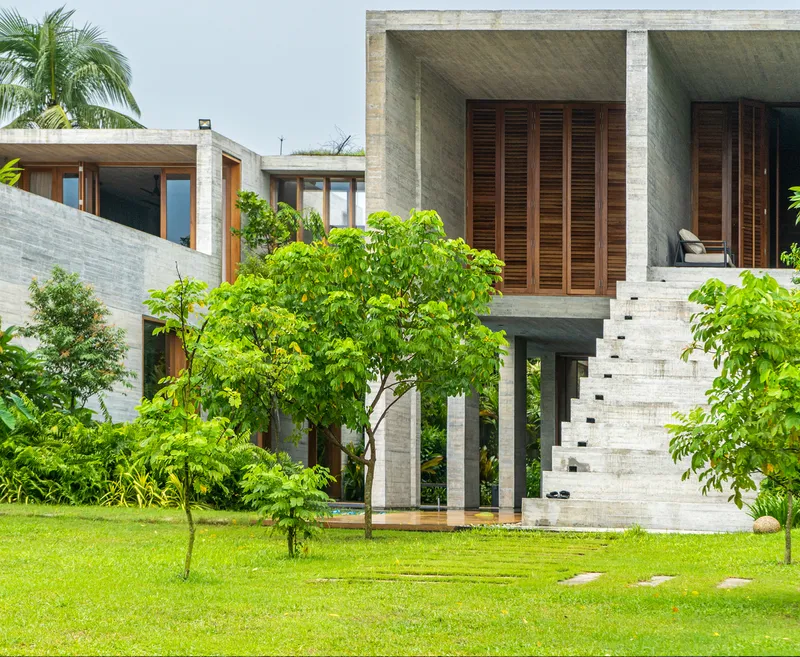
Seen from the garden, CHAABI House reveals a more muscular character. Concrete volumes cantilever and stack, punctuated by horizontal timber louvers that shade the upper floor bedrooms. An external staircase climbs along one flank, connecting the master bedroom directly to an open field on the contoured land behind the house. Young trees dot the lawn, promising a canopy that will eventually soften the facade's geometry. The landscaping is clearly designed for the long term, not for opening-day photography.
The siting carries a set of deliberate symbolic decisions. The daughter's room is elevated on a hill-like portion of the terrain, a gesture the architects describe as a statement about elevating women. The son's room is placed toward the back of the plan for privacy. Whether or not a visitor reads these intentions without being told, the spatial hierarchy is evident: different family members occupy distinct zones, each with its own relationship to light, landscape, and access.
Memory Traps and Emotional Architecture
One of the more unusual programmatic elements is the concept of "memory traps": ambient-lit recesses embedded in the ground floor where the family stores memorabilia of parents and grandparents. These are not display vitrines in the conventional sense. They are small, intimate zones with indirect light, designed to be encountered rather than exhibited. The idea is that a house built for retreat should also be a house that holds time, a place where personal history accumulates alongside everyday life.
The upper floor includes an "Address-Desk," an elevated wooden stage fitted with three microphones, intended as a space for speeches and family gatherings. It is an idiosyncratic feature, the kind of thing that only appears when an architect genuinely listens to a client's life rather than projecting a generic domestic program. Whether you find it charming or peculiar, it gives the house a specificity that most residential projects lack.
Why This Project Matters
CHAABI House matters because it demonstrates what happens when a residential project in South Asia is designed from the inside out, starting with a family's emotional and cultural needs rather than with an imported formal language. The concrete and timber palette is not novel, but the way it is deployed to create a dialogue between enclosure and openness, between the weight of structure and the lightness of water reflections, is accomplished and site-specific. SYSTEM Architects and EKNC have avoided the trap of producing a generic luxury villa with a tropical veneer.
The project also offers a useful case study in passive environmental design for the humid climate of the Bengal delta. Rather than relying on sealed envelopes and air conditioning, the plan uses south-facing openings, water features for evaporative cooling, and layered thresholds that modulate airflow. These are old strategies, but they require real commitment in the plan, and that commitment is visible here. CHAABI House earns its name: it makes you want something, specifically, more houses that take their context this seriously.
CHAABI House by SYSTEM Architects and EKNC. Rupganj, Narayanganj, Bangladesh. 1,035 m². Completed 2023. Photographed by Maruf Raihan.
About the Studio
Share Your Own Work on uni.xyz
If projects like this are the kind of work you want to make, uni.xyz is a place to publish your own, find collaborators, and enter design competitions.


Popular Articles
Popular articles from the community


Singing Woman: Contemporary Architecture Inspired by Estonia’s Voice and the Sea
Singing Woman turns Estonia’s song culture into flowing opera house architecture, blending public life, landscape, sea, and national memory.
Temporary Home for Dogs: A Reversed Zoo Rethinks Animal Shelter Architecture
In Bucharest, a sinuous corridor and freed landscape flip the logic of containment, designing a shelter that works to make itself unnecessary.

Opera by the Sea Estonia: Three Shells Dissolving Architecture into Tallinn's Coastline
A winning opera house proposal replaces monumental form with interconnected shells that blur the boundary between building, park and Baltic Sea.

Opera on the Sea: Driftwood Logic Shapes a Timber Opera House on Estonia's Coast
Trevor Orgill's opera house translates the entangled drift of floating timber into a civic building where wood, water, and music converge.

Similar Reads
You might also enjoy these articles


Hodi-Mandai Geram
Project Function: Preservation and revitalization of the Intangible heritage and socio-spatial identity of the Hodi by Housing, Cultural Memory Center, Sacred Grove, landscape, local tourism economy


Olio Towers: A Mid-Rise for Performers That Fuses Housing, Rehearsal, and Stage
Located blocks from Houston's Theater District, this modular tower stacks living units around a central performance atrium.

Oasis: Modular Green Housing Carved into Dhaka's Urban Fabric
A shortlisted Plugin Housing entry reclaims unauthorized settlements in Dhaka with stepped concrete volumes, green roofs, and ventilation-driven design.

Black Hole: A Floating Megastructure for the Post-Physical Era
Emiliano Mazzarotto envisions a spherical, self-scaling arena where e-sports, digital hotels, and holographic stadiums replace traditional public space.

Explore Arabic Architecture Competitions
Discover active competitions in this discipline

Challenge to reimagine the Iron Throne

Photograph architecture without architects

Illustrate the lost glory of Angkor Wat - Render Challenge

Design challenge to reuse E-waste
Comments (0)
Please login or sign up to add comments
No comments yet. Be the first to comment!